

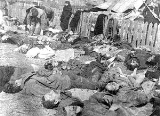
Massacres of Poles in Volhynia

Encyclopedia
The Massacres of Poles in Volhynia and Eastern Galicia were part of an ethnic cleansing
operation carried out by the Ukrainian Insurgent Army (UPA) West in the Nazi
occupied regions of the Eastern Galicia (Nazi created Distrikt Galizien in General Government
), and UPA North in Volhynia
(in Nazi created Reichskommissariat Ukraine
), beginning in March 1943 and lasting until the end of 1944. The peak of the massacres took place in July and August 1943 when a senior UPA commander, Dmytro Klyachkivsky, ordered the liquidation of the entire male Polish
population between 16 and 60 years of age. Despite this, most of the victims were women and children. The actions of the UPA resulted in 40,000-60,000 Polish civilian casualties in Volhynia, from 25,000 to 30,000-40,000 in Eastern Galicia Ukrainian casualties at the hands of Poles are estimated at 2,000-3,000 in Volhynia, 1,000-2,000 in Eastern Galicia.
The killings were directly linked with the policies of the Bandera
faction of the Organization of Ukrainian Nationalists
, whose goal, specified at the Second Conference of the OUN-B, was to purge all non-Ukrainians from the future Ukrainian state, and the perpetrators did not limit their activities to murdering of Polish civilians, as they wanted to erase all traces of hundreds of years of Polish presence in the area. An OUN order from early 1944 stated: "Liquidate all Polish traces. Destroy all walls in the Catholic Church and other Polish prayer houses. Destroy orchards and trees in the courtyards so that there will be no trace that someone lived there... Pay attention to the fact that when something remains that is Polish, then the Poles will have pretensions to our land".
of the 17th century persisted in the national memories of both groups. While not always harmonious, the Poles and Ukrainians interacted with each other on every civic, economic, and political level throughout hundreds of years. With the rise of nationalism
in the 19th century, the ethnicity of citizens became an issue, and the conflicts erupted anew after the First World War. Both Poles and Ukrainians claimed the territories of Volhynia
and Eastern Galicia. The political conflicts escalated in the Second Polish Republic
during the interwar period
, particularly in the 1930s as a result of a cycle of terrorist actions by the Organization of Ukrainian Nationalists
, formed in Poland, and the ensuing state repressions. Collective punishment
meted out to thousands of mostly innocent peasants resulted in exacerbation of animosity between the Polish state and the Ukrainian population. At the onset of World War II
, and soon after the Soviet annexation of that area
in 1939–1941 (see: Polish September Campaign), new doors of opportunity for Ukrainian nationalists began to open. Killings of Poles in Volhynia and Galicia started soon after the Soviet annexation
of the territory, and reached its pinnacle during the German occupation. The mass murder
of Poles did not end when the Red Army
pushed the Wehrmacht
out of the current territory of Western Ukraine. The massacres lasted well into 1945.
, Poles and Ukrainians struggled for the control over the city of Lemberg (today Lviv), populated mostly by Poles, but surrounded by a Ukrainian majority. Until 1772 the area belonged to the Polish–Lithuanian Commonwealth, but later, with the Partitions of Poland
, was annexed to Austria
. The conflict, known as the Polish–Ukrainian War, spilled over to Volhynia with the Ukrainian leader Symon Petlura
attempting to expand Ukrainian claims westward. The war was conducted by professional forces on both sides, resulting in a relatively minimal number of civilian deaths. On July 17, 1919, a ceasefire was signed. On November 21, 1919, the Paris Peace Conference granted Eastern Galicia to Poland. The lost war left a generation of frustrated western Ukrainian veterans convinced that Poland was Ukraine's principal enemy.
Even though Polish statehood had just been re-established by the Treaty of Versailles
after a century of partitions
, the frontiers between Poland and Soviet Russia had not been defined by the Treaty. As a result the Polish-Soviet war
of 1920 broke out with the Soviets claiming both Ukraine and Belarus
, which they viewed as a part of the Russian Empire
, currently under civil war
. The Soviets forced Ukrainian forces to retreat to Podolia
, and the Ukrainian leader Symon Petlura decided to ally with Poland's Józef Piłsudski. On April 21, 1920, Piłsudski and Petlura signed a military alliance
accepting the Polish-Ukrainian border on the river Zbruch
. Following this agreement, the government of the West Ukrainian National Republic went into exile in Vienna, viewing it as betrayal. At the end of the Polish-Ukrainian war with the Soviets, the Peace of Riga
was signed with Vladimir Lenin
in 1921. Volhynia and Eastern Galicia were eventually joined to the Second Polish Republic
, whilst the rest of contemporary Ukraine, known as the Ukrainian Soviet Socialist Republic became part of the USSR. Meanwhile, the exiled Ukrainian government was disbanded on March 14, 1923, by the Council of Ambassadors at the League of Nations. After a long series of negotiations, on March 14, 1923, the League of Nations decided that eastern Galicia would be incorporated into Poland, thus "taking into consideration that Poland has recognized that in regard to the eastern part of Galicia ethnographic conditions fully deserve its autonomous status." Their promise was not fulfilled by the Polish government. In the following years, the historical discourse between Polish and Ukrainian researchers has often been based on historical stereotypes stemming from ethnic conflicts during the First World War and the interwar period, making it difficult to draw an objective account of bilateral Polish-Ukrainian relations during World War II.
, that a pure national state and language were desired goals; glorification of violence and armed struggle of nation versus nation; and totalitarianism, in which the nation must be ruled by one person and one political party. While the moderate Melnyk faction of the OUN admired aspects of Mussolini's fascism, the more extreme Bandera faction of the OUN admired aspects of Nazism.
At the time of the OUN's founding, the most popular political party among Ukrainians was the Ukrainian National Democratic Alliance
which, while opposed to Polish rule, called for peaceful and democratic means to achieve independence from Poland. The OUN, on the other hand, was originally a fringe movement within western Ukraine, condemned for its violence by figures from mainstream Ukrainian society such as head of the Ukrainian Greek Catholic Church
Metropolitan Andriy Sheptytsky, who wrote of the OUN's leadership that "whoever demoralizes our youth is a criminal and an enemy of our people." Several factors contributed to the OUN-B's increase in popularity and, ultimately, monopoly of power within Ukrainian society, conditions necessary for the massacres to occur.
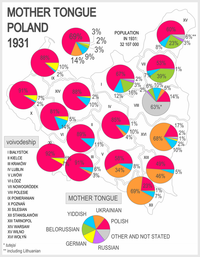 Until the Soviet invasion of 1939
, Volhynia belonged to the Second Polish Republic
. According to Yale historian Timothy Snyder
, between 1928 and 1938, Volhynia was "the site of one of eastern Europe's most ambitious policies of toleration". Through supporting Ukrainian culture, religious autonomy, and Ukrainization of the Orthodox church, Piłsudski and his allies wanted to achieve Ukrainian loyalty to the Polish state and to minimize Soviet influences in the borderline region. This approach was gradually abandoned after Piłsudski's death.
In the 1930s the Organization of Ukrainian Nationalists
, formed in Vienna
, Austria
, conducted a terrorist campaign in Poland, which included the assassination of prominent Polish politicians such as Interior Minister Bronisław Pieracki, and Polish and Ukrainian moderates such as Tadeusz Hołówko.
Beginning in 1937, the Polish government in Volhynia initiated an active campaign to use religion as a tool for Polonization
and to forcibly convert the Orthodox population to Roman Catholicism. Over 190 Orthodox churches were destroyed and 150 converted to Roman Catholic ones. Remaining Orthodox churches were forced to use the Polish language in their sermons. In August 1939, the last remaining Orthodox church in the Volhynian capital of Lutsk
was converted to a Roman Catholic one by decree of the Polish government.
By 1938, thousands of Polish colonists
and war veterans were encouraged to settle in Volhynia and Galicia. This number is estimated at 17,700 in Volhynia alone by Polish historians. Ukrainian sources estimated the total number of Polish inhabitants in both Galicia and Volhynia at 300,000 including the 1930s settlers. The short presence of the settlers, as all were forcibly expelled by the Soviets to Siberia, ignited further anti-Polish sentiment among the locals.
Harsh policies implemented by the Second Polish Republic, while often provoked by the OUN-B violence, contributed to a further deterioration of relations between the two ethnic groups. Between 1934 and 1938, a series of violent and sometimes deadly attacks against Ukrainians were conducted in other parts of Poland.
Also in Wołyń Voivodeship some of the new policies were implemented, resulting in suppressing the Ukrainian language
, culture and religion, and the antagonism escalated. Although around 68% of the voivodeship's population spoke Ukrainian as their first language (see table), practically all government and administrative positions, including the police, were assigned to Poles.
Jeffrey Burds of Northeastern University believes that the build up towards the ethnic cleansing of Poles that erupted during the Second World War in Galicia and Volhynia had its roots in this period.
The Ukrainian population was outraged by the Polish government policies. A Polish report about the popular mood in Volhynia recorded a comment of a young Ukrainian from October 1938 as "we will decorate our pillars with you and our trees with your wives." By the beginning of World War II, the membership of the OUN had risen to 20,000 active members and there were many times that number of supporters.
and in accordance with the secret protocol the Molotov-Ribbentrop Pact
, Poland was invaded from the west by Nazi Germany
and from the east
by the Soviet Union
. Volhynia was split by the Soviets into two oblast
s, Rovno
and Volyn
of the Ukrainian SSR
. Upon the annexation, the Soviet Secret Police
started to eliminate the predominantly Polish middle and upper classes, including social activists and military leaders. Between 1939–1941, 200,000 Poles were deported to Siberia by the Soviet authorities. Estimates of the number of Polish citizens transferred to the Eastern European part of the USSR, the Urals, and Siberia range from 1.2 to 1.7 million. Tens of thousands of Poles fled from the Soviet-occupied zone to areas controlled by the Germans. The deportations and murders deprived the Poles of their community leaders.
During the Soviet occupation, Polish members of the local administration were replaced by Ukrainians and Jews, and the Soviet NKVD subverted the Ukrainian independence movement. All local Ukrainian political parties were abolished. Between 20,000 and 30,000 Ukrainian activists fled to German-occupied territory; most of those who did not escape were arrested. For example, Dr. Dmytro Levitsky, the head of the moderate, left-leaning democratic party Ukrainian National Democratic Alliance
, and chief of the Ukrainian delegation in the pre-war Polish parliament
, as well as many of his colleagues, were arrested, deported to Moscow, and never heard from again. The elimination by the Soviets of the individuals, organizations, and parties that represented moderate or liberal political tendencies within Ukrainian society left the extremist Organization of Ukrainian Nationalists
, which operated in the underground, as the only political party with a significant organizational presence among western Ukrainians.
by German, Slovak, and Hungarian forces on June 22, 1941. Soviet forces in Volhynia were better armed and prepared than in more northerly areas and were able to resist, but only for a couple of days. On June 30 the Soviets withdrew eastwards and Volhynia was overrun by the Nazis, with support from Ukrainian nationalists carrying out acts of sabotage. The Ukrainian pro-Nazi militia staged pogrom
s and assisted the Nazis in executions of Poles and Jews. In 1941, two brothers of Ukrainian leader Stepan Bandera
were murdered while imprisoned in Auschwitz by Volksdeutsche
kapos
. In the Chełm region, 394 Ukrainian community leaders were killed by the Poles on the grounds of collaboration with the German authorities.
During the first year of German occupation, the Organization of Ukrainian Nationalists
pursued a policy of infiltrating the German police units with its members. In this role they obtained training in the use of weapons, and as a result would also assist the German SS in murdering approximately 200,000 Volhynian Jews. While the Ukrainian police's share in the actual killings of Jews was small (they primarily played a supporting role), the Ukrainian police learned from the Germans the techniques necessary to kill large numbers of people: detailed advanced planning and careful site selection; assurances to the local population prior to the massacres in order for them to let down their guard; sudden encirclement; and then mass killing. This training obtained in 1942 explains the UPA's efficiency in the killing of Poles in 1943.
According to OUN reports, from April to May 1942, Polish underground paramilitary groups were already being formed. The formation of such groups was corroborated by German sources. At the same time, other Poles attempted to enter German service and in those roles, OUN report claimed, they tried to sew distrust towards Ukrainians by the Germans in order to provoke the German repression of ethnic Ukrainians. However, as evidenced both by Polish and Ukrainian underground reports, the only major concern was that of strong Soviet partisan groups
operating in the area. The groups, consisting mostly of Soviet POW
s, initially specialized in raiding local settlements, which disturbed both the OUN and the AK
, who expected it to result in an increase in German terror. Indeed these concerns soon materialized, as Germans started the "pacifications" of entire villages in Volhynia in retaliation for real or alleged support for the Soviet partisans. Polish historiography
attributed most of these actions to Ukrainian nationalists, while in reality they were conducted by Ukrainian auxiliary police
units under the direct supervision of Germans. One of the best-known examples was the pacification of Obórki village in Lutsk
county on November 13–14, 1942. While most of the actions were carried out by the Ukrainian occupational police, the murder of 53 Polish villagers was perpetrated personally by the Germans, who supervised the operation.
For many months in 1942, the OUN-B was not able to control the situation in Volhynia, where in addition to Soviet partisans, many independent Ukrainian self-defense groups started to form in response to the growth of German terror. The first OUN-B military groups were created in Volhynia in autumn 1942 with the goal of subduing the other independent groups. By February 1943 the OUN had initiated a policy of murdering civilian Poles as a way of resolving the Polish question in Ukraine. In spring 1943 the OUN-B partisans started to call themselves the Ukrainian Insurgent Army (UPA), using the former name of the Ukrainian People's Revolutionary Army
, another Ukrainian group operating in the area in 1942. In March 1943 approximately 5,000 Ukrainian policemen defected with their weapons and joined the UPA. Well-trained and well-armed, this group contributed to the UPA achieving dominance over other Ukrainian groups active in Volhynia. Soon, the newly created OUN-B forces managed to either destroy or absorb other Ukrainian groups in Volhynia, including four OUN-M units and the Ukrainian People's Revolutionary Army
. It undertook steps to liquidate "foreign elements", with posters and leaflets urging Ukrainians to murder Poles. Its dominance secured, the UPA began large-scale UPA operations against the Polish population.
The Nazis replaced Ukrainian policemen who deserted from German service with Polish policemen. Polish motives for joining were local and personal: to defend themselves or avenge UPA atrocities. German policy called for the murder of the family of every Ukrainian police officer who deserted and the destruction of the village of any Ukrainian police officer deserting with his weapons. These retaliations were carried out using newly recruited Polish policemen. Though Volhynian Polish participation in the German Police followed UPA attacks on Polish settlements, it provided the Ukrainian Nationalists with useful sources of propaganda and was used as a justification for the cleansing action. OUN-B leader summarized the situation in August 1943 by saying that the German administration "uses Polaks in its destructive actions. In response we destroy them unmercifully." Despite the desertions in March and April 1943, the auxiliary Police remained heavily Ukrainian, and Ukrainians serving the Nazis continued pacifications
of Polish and other villages.
 On February 9, 1943, a group pretending to be Soviet partisans murdered 173 Poles in the Parośle
settlement in Sarny
county. According to Polish historiography, the perpetrators were a unit of UPA, commanded by Hryhory Perehyniak. The assault on Polish settlements began between late March and early April 1943, killing approximately 7,000 unarmed men, women, and children in its first days. On the night of April 22–23, Ukrainian groups, commanded by Ivan Lytwynchuk (aka Dubovy), attacked the settlement of Janowa Dolina
, killing 600 people and burning down the entire village. Those few who survived were mostly people that found refuge with friendly Ukrainian families. In one of the massacres, in the village of Lipniki, almost the entire family of Miroslaw Hermaszewski
(Poland's only astronaut) was murdered. The nationalists murdered the grandparents of composer Krzesimir Debski
, whose parents met each other during the Ukrainian attack on Kisielin (see Kisielin massacre
). Debski's parents survived, taking refuge with a friendly Ukrainian family. In another massacre, according to an UPA report, "in the village of Kuty, in the Szumski region, an entire Polish colony (86 farms) was liquidated for cooperation with the Gestapo and German authorities." According to Polish sources, Kuty self-defense
unit managed to repel the UPA assault, though 67 Poles were murdered. The rest of the inhabitants decided to abandon the village and were escorted by the Germans who arrived at Kuty, alerted by the glow of fire and the sound of gunfire. Nevertheless, claims about collaboration prior to the attack seem unreliable.
The decisive Soviet victory at Kursk
acted as a stimulus for escalation of massacres in June and August 1943, when ethnic cleansing reached its peak. In June 1943, Dmytro Klyachkivsky head-commander of UPA-North made a general decision to exterminate Poles in Volhynia. His secret directive stated:
"We should make a large action of the liquidation of the Polish element. As the German armies withdraw, we should take advantage of this convenient moment for liquidating the entire male population in the age from 16 up to 60 years. We cannot lose this fight, and it is necessary at all costs to weaken Polish forces. Villages and settlements lying next to the massive forests, should disappear from the face of the earth".
In mid-1943, after a wave of killings of Polish civilians, the Poles tried to initiate negotiations with the UPA. Two delegates of the Polish government in Exile, Zygmunt Rumel
and Krzysztof Markiewicz, together with a group of representatives from the Polish Home Army, attempted to negotiate with UPA leaders, but they were captured, tortured and murdered on July 10, 1943, in the village of Kustycze.
The following day, July 11, 1943, is regarded as the bloodiest day of the massacres, with many reports of UPA units marching from village to village, killing Polish civilians. On that day, UPA units surrounded and attacked Polish villages and settlements located in three counties – Kowel, Horochow, and Włodzimierz Wołyński. Events began at 3:00 am, with the Poles having no chance to escape. After the massacres, the Polish villages were burned to the ground. According to those few who survived, the action had been carefully prepared; a few days before the massacres there had been several meetings in Ukrainian villages, during which UPA members told the villagers that the slaughter of all Poles was necessary. Within a few days an unspecified number of Polish villages were completely destroyed and their populations murdered. In the Polish village of Gurow, out of 480 inhabitants, only 70 survived; in the settlement of Orzeszyn, the UPA killed 306 out of 340 Poles; in the village of Sadowa out of 600 Polish inhabitants only 20 survived; in Zagaje out of 350 Poles only a few survived. In August 1943, the Polish village of Gaj (near Kovel
) was burned and some 600 people massacred, in the village of Wola Ostrowiecka 529 people were killed, including 220 children under 14, and 438 people were killed, including 246 children, in Ostrowki. In September 1992 exhumations were carried out in these villages, confirming the number of dead.
The atrocities were carried out indiscriminately and without restraint. The victims, regardless of their age or gender, were routinely tortured to death. Norman Davies
in No Simple Victory gives a short, but shocking description of the massacres. He writes:
Timothy Snyder
describes the murders: "Ukrainian partisans burned homes, shot or forced back inside those who tried to flee, and used sickles and pitchforks to kill those they captured outside. In some cases, beheaded, crucified, dismembered, or disembowelled bodies were displayed, in order to encourage remaining Poles to flee". A similar account has been presented by Niall Ferguson, who wrote: "Whole villages were wiped out, men beaten to death, women raped and mutilated, babies bayoneted." Ukrainian historian Yuryi Kirichuk described the conflict as similar to medieval rebellions.
Authors of a monograph, Zycie religijne w Polsce pod okupacja 1939-1945, state that Roman Catholic priests were among those cruelly killed. Father Ludwik Wrodarczyk from the village of Okopy was crucified by the Ukrainians, father Stanisław Dobrzański from the village of Ostrówki beheaded (967 local Poles were killed with him) and father Karol Baran from the village of Korytnica was cut in half by a saw.
Chancellor of Roman Catholic Diocese of Lutsk
Fr. Jan Szych reported to Holy See
in the letter of August 23, 1945: "In 1943, Ukrainians organized a terrible slaughter. Armed, they attacked Poles and murdered them with full cruelty: they cut down with axes, burned alive, gouged eyes and tore tongues, some were wrapped in barbed wire and thrown into pits. Several times Ukrainians besieged a church during Mass, killing believers and priests and blowing the church up. According to the testimonies, the number of victims is 30,000 and even 50,000. There were murdered 17 priests in that time, some were tortured before death. Fr. Karol Baran was reportedly sawed in two. Ukrainian priests in their temple blessed the knives for murdering Poles."
Altogether, on July 11, 1943, the Ukrainians attacked 167 towns and villages. This wave of massacres lasted 5 days, until July 16. The UPA continued the ethnic cleansing, particularly in rural areas, until most Poles had been deported, killed or expelled. These actions were conducted by many units, and were well-coordinated and thoroughly planned. Even though it may be an exaggeration to say that the massacres enjoyed general support of the Ukrainians, it has been suggested that without wide support from local Ukrainians they would have been impossible. Those Ukrainian peasants who took part in the massacres created their own units, called Samoboronni Kushtchovi Viddily (Kushtchov Self-Defence Units). People who did not speak Polish but were considered Poles by the perpetrators were also murdered.
Ukrainians in ethnically mixed settlements were offered material incentives to join in the slaughter of their neighbours, or warned by UPA's security service (Sluzhba Bezbeky
) to flee by night, while all remaining inhabitants were murdered at dawn. Many of Ukrainians risked, and in some cases, lost their lives trying to shelter or warn Poles - such activities were treated by the UPA as collaboration with the enemy and severely punished. In 2007, the Polish Institute of National Remembrance
(IPN) published a document Kresowa Ksiega Sprawiedliwych 1939 - 1945. O Ukraincach ratujacych Polakow poddanych eksterminacji przez OUN i UPA ("Eastern Borderland's Book of the Righteous. About Ukrainians saving Poles from extermination of OUN and UIA"). The author of the book, IPN's historian Romuald Niedzielko, documented 1341 cases in which Ukrainian civilians helped their Polish neighbors. For this, 384 Ukrainians were executed by the UIA.
In case of Polish-Ukrainian families, one common UPA instruction was to kill one's Polish spouse and children born of that marriage. People who refused to carry such order were often murdered together with their entire family.
According to the Volhynian delegation to the Polish government, by October 1943 the number of Polish casualties exceeded 15,000 people. Timothy Snyder estimates that in spring and summer 1943 the UPA actions resulted in deaths of 40,000 Polish civilians.
Władysław Filar
from the Polish Institute of National Remembrance
, who witnessed the massacres, cites numerous statements made by Ukrainian officers when reporting their actions to the leaders of UPA-OUN. For example, in late September 1943, the commandant of the Lysoho group wrote to the OUN headquarters: "On September 29, 1943, I carried out the action in the villages of Wola Ostrowiecka (see Massacre of Wola Ostrowiecka
), and Ostrivky (see Massacre of Ostrowki
). I have liquidated all Poles, starting from the youngest ones. Afterwards, all buildings were burned and all goods were confiscated". On that day in Wola Ostrowiecka 529 Poles were murdered (including 220 children under 14), and in Ostrówki, the Ukrainians killed 438 persons (including 246 children).
In August 1943 the UPA placed notices in every Polish village stating "in 48 hours leave beyond the Bug River
or the San
river - otherwise Death." Ukrainian nationalists limited their actions to villages and settlements, and did not attack towns or cities. Prosecutor Piotr Zając from the IPN
branch in Lublin stated that in 1943 the massacres were organized westwards, starting in March in Kostopol and Sarny
counties. In April they moved to the area of Krzemieniec, Rivne
, Dubno
and Lutsk
. By June 1943, the attacks had spread to the counties of Kowel, Włodzimierz Wołyński, and Horochów, and in August to Luboml
county.
According to Polish historian Piotr Łossowski, the method used in most of the attacks was the same. At first, local Poles were assured that nothing would happen to them. Then, at dawn, a village was surrounded by armed members of the UPA, behind whom were peasants with axes, hammers, knives, and saws. All the Poles encountered were murdered; sometimes they were herded into one spot, to make it easier. After a massacre, all goods were looted, including clothes, grain, and furniture. The final part of an attack was setting fire to the village. In many cases, victims were tortured and their bodies mutilated, with all vestiges of Polish existence eradicated. Even abandoned Polish settlements were burned to the ground.
The massacres prompted Poles, starting in April 1943, to organize self-defence organizations, 100 of which were formed in Volhynia in 1943. Sometimes these self-defence organization obtained arms from the Germans; other times the Germans confiscated their weapons and arrested the leaders. Many of these organizations could not withstand the pressure of the UPA and were destroyed. Only the largest self-defence organizations who were able to obtain help from the AK or from Soviet partisans were able to survive.
Polish self-defence organizations took part in revenge massacres of Ukrainian civilians starting in the summer of 1943, when Ukrainian villagers who had nothing to do with the massacres suffered at the hands of Polish partisan forces. Evidence includes a letter dated August 26, 1943 to local Polish self-defence where AK commander Kazimierz Bąbiński criticized the burning of neighboring Ukrainian villages, killing any Ukrainian that crosses their path, and robbing Ukrainians of their material possessions. The total number of Ukrainian civilians murdered in Volyn in retaliatory acts by Poles is estimated at 2,000-3,000.
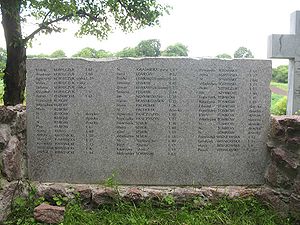

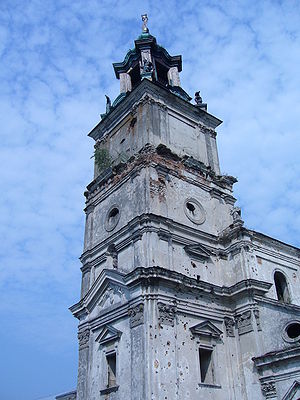 In late 1943 and early 1944, after most Poles of Volhynia had either been murdered or had fled the area, the conflict spread to the neighboring province of Galicia, where the majority of the population was still Ukrainian, but where the Polish presence was strong. Unlike in the case of Volhynia, where Polish villages were usually destroyed and their inhabitants murdered without warning, in east Galicia Poles were sometimes given the choice of fleeing or being killed (an order by an UPA commander in Galicia stated, "Once more I remind you: first call upon Poles to abandon their land and only later liquidate them, not the other way around"). This change in tactic, combined with better Polish self-defence and a demographic balance more favorable to Poles, resulted in a significantly lower death toll among Poles in Galicia than in Volhynia. The methods used by Ukrainian nationalists in this area were the same, and consisted of killing all of the Polish residents of the villages, then pillaging the villages and burning them to the ground. On February 28, 1944, in the village of Korosciatyn 135 Poles were murdered; the victims were later counted by a local Roman Catholic priest, Rev. Mieczysław Kamiński. Jan Zaleski (father of Fr. Tadeusz Isakowicz-Zaleski
) who witnessed the massacre, wrote in his diary: "The slaughter lasted almost all night. We heard terrible cries, the roar of cattle burning alive, shooting. It seemed that Antichrist
himself began his activity!"
Father Kamiński claimed that in Koropiec, where no Poles were actually murdered, a local Greek Catholic priest, in reference to mixed Polish-Ukrainian families, proclaimed from the pulpit: "Mother, you're suckling an enemy - strangle it." Among the scores of Polish villages whose inhabitants were murdered and all buildings burned, there are such places as Berezowica near Zbaraz, Ihrowica near Ternopil
, Plotych near Ternopil
, Podkamien near Brody
, Hanachiv and Hanachivka near Przemyslany.
Roman Shukhevych
, the UPA commander, stated in his order from 25 February 1944: "In view of the success of the Soviet forces it is necessary to speed up the liquidation of the Poles, they must be totally wiped out, their villages burned... only the Polish population must be destroyed."
One of the most infamous massacres took place on February 28, 1944, in the Polish village of Huta Pieniacka
, with over 1,000 inhabitants. The village served as a shelter for refugees including Polish Jews, as well as a recuperation base for Polish and Communist partisans. One AK unit was active there. In the winter of 1944 a Soviet partisan unit numbering 1,000 was stationed in the village for two weeks. Huta Pieniacka's villagers, although poor, organized a well-fortified and armed self-defense unit that fought off a Ukrainian and German reconnaissance
attack on February 23, 1944. Two soldiers of the 14th Waffen Grenadier Division of the SS Galicia (1st Ukrainian) Division of the Waffen-SS were killed and one wounded by the villagers. On February 28, elements of the Ukrainian Division from Brody returned with 500-600 men assisted by a group of civilian nationalists. The killing spree lasted all day. Kazimierz Wojciechowski, the commander of the Polish self-defense unit, was drenched with gasoline and burned alive at the main square. The village was utterly destroyed and all of its occupants killed. The civilians, mostly women and children, were rounded up at a church, divided and locked in barns which were set on fire. Estimates of casualties in the Huta Pieniacka massacre
vary, and include 500 (Ukrainian archives), over 1,000 (Tadeusz Piotrowski
), and 1,200 (Sol Littman). Some historians deny the role of the Ukrainian 14th SS Galician Division in the killings, and attribute them entirely to German units, while others disagree. According to IPN investigation, the crime was committed by the 4th battalion of the Ukrainian 14th SS Division. A military journal of the Ukrainian 14th SS Galician Division condemned the killing of Poles. In a March 2, 1944 article directed to the Ukrainian youth, written by military leaders, Soviet partisans were blamed for the murders of Poles and Ukrainians, and the authors stated that "If God forbid, among those who committed such inhuman acts, a Ukrainian hand was found, it will be forever excluded from the Ukrainian national community." According to Yale historian Timothy Snyder
, the Ukrainian 14th SS Galician Division's role in the ethnic cleansing of Poles from western Ukraine was marginal.
The village of Pidkamen near Brody was a shelter for Poles, who hid in the monastery of the Dominicans there. Some 2,000 persons, majority of them women and children, were living there when the monastery was attacked in mid-March 1944 by UPA units, which according to Polish Home Army accounts were cooperating with the Ukrainian SS. Over 250 Poles were killed. In the nearby village of Palikrovy, 300 Poles were killed, 20 in Maliniska and 16 in Chernytsia. Armed Ukrainian groups destroyed the monastery, stealing all valuables. What remained is the painting of Mary of Pidkamen, which now is kept in Saint Wojciech church in Wrocław. According to Kirichuk, the first attacks on the Poles took place there in August 1943 and they were probably the work of UPA units from Volhynia. In return, Poles killed important Ukrainians, including the Ukrainian doctor Lastowiecky from Lviv and a popular football player from Przemysl
, Wowczyszyn.
By the end of the summer, mass acts of terror aimed at Poles were taking place in Eastern Galicia with the purpose of forcing Poles to settle on the western bank of the San river
, under the slogan "Poles behind the San". The number of victims is unknown. Snyder estimates that 25,000 Poles were killed in Galicia alone, Motyka writes about 30,000-40,000 victims.
The slaughter did not stop after the Red Army
entered the areas, with massacres taking place in 1945 in such places as Czerwonogrod
(Ukrainian: Irkiv), where 60 Poles were murdered on February 2, 1945, the day before their departure to the Recovered Territories
.
By Autumn 1944 anti-Polish actions stopped and terror was used only against those who co-operated with the NKVD, but in late 1944 and in the beginning of 1945 UPA performed last massive anti-Polish action in Ternopil region. In the night of February 5–6, 1945, Ukrainian groups attacked the Polish village of Barysz, near Buchach
. 126 Poles were massacred, including women and children. A few days later on February 12–13, a local group of OUN under Petro Khamchuk attacked the Polish settlement of Puźniki, killing around 100 people and burning houses. Those who survived moved mostly to Prudnik
.
In Polish retaliatory actions conducted in early 1944, the Ukrainian villages of Prykhorile, Mentke, Sakhryn, Shykhoviche, and Terebin were destroyed. Seventy percent of the estimated 1,500 victims were Ukrainian women and children.
Approximately 366 Ukrainian and a few Polish inhabitants of Pawłokoma were killed by a former Polish Home Army unit aided by Polish self-defence groups from nearby villages. The massacre is believed to be an act of retaliation for earlier alleged murders by Ukrainian Insurgent Army of 9 (or 11) Poles in Pawłokoma and unspecified number of Poles killed by UPA in neighbouring villages.
According to Yuriy Kirichuk the Germans were actively prodding both sides of the conflict against each other. Erich Koch
once said: "We have to do everything possible so that a Pole meeting a Ukrainian, would be willing to kill him and conversely, a Ukrainian would be willing to kill a Pole". Kirichuk quotes a German commissioner from Sarny
whose response to Polish complaints was: "You want Sikorski, the Ukrainians want Bandera
. Fight each other".
On August 25, 1943, the German authorities ordered all Poles to leave the villages and settlements and move to larger towns.
Soviet partisan units
present in the area were aware of the massacres. On May 25, 1943, the commander of the Soviet partisan forces of the Rivne
area stressed in his report to the headquarters that Ukrainian nationalists did not shoot the Poles but cut them dead with knives and axes, with no consideration for age or gender.
The Soviet and Nazi invasions of pre-war eastern Poland, the UPA massacres, and postwar Soviet expulsions of Poles all contributed to the virtual elimination of a Polish presence in the region. Those who remained left Volhynia mostly for the neighbouring province of Lublin
. After the war, the survivors moved further west to the territories of Lower Silesia
. Polish orphans from Volhynia were kept in several orphanages, with the largest of them around Kraków. Several former Polish villages in Volhynia and Eastern Galicia do not exist any more and those that remain are in ruins.
There is a general consensus among Western and Polish historians that Polish civilian casualties from the UPA in Volhynia range from 35,000 to 60,000. According to Dr. Ivan Katchanovski of Harvard University, "the lower bound of these estimates [35,000] is more reliable than higher estimates which are based on an assumption that the Polish population in the region was several times less likely to perish as a result of Nazi genocidal policies compared to other regions of Poland and compared to the Ukrainian population of Volhynia." Władysław Siemaszko and his daughter Ewa
have documented 33,454 Polish victims, 18,208 of which are known by surname. (in July 2010 Ewa Siemaszko increased the accounts to 38,600 documented victims, 22,113 of which are known by surmane). At the first ever joint Polish-Ukrainian conference in Podkowa Leśna
organized on June 7–9, 1994 by Karta Centre, with almost 50 Polish and Ukrainian participants, an estimate of 50,000 Polish deaths in Volhynia was agreed upon, which they considered to be moderate. According to the sociologist Piotrowski, the UPA actions resulted in an estimated number of 68,700 deaths in Wołyń Voivodeship. Per Anders Rudling states that UPA killed 40,000-70,000 Poles in this area.
The number of Polish civilians killed in Galicia is believed to be between 20,000-25,000, 25,000 and 30,000-40,000.
Niall Ferguson
estimated the total number of Polish victims in Volhynia and Eastern Galicia to be between 60,000 and 80,000, G. Rossolinski-Liebe: 70,000-100,000, John P. Himka: 100,000. According to Grzegorz Motyka, from 1943 to 1947 in all territories that were covered by the conflict, approximately 80,000-100,000 Poles were killed.
Some extreme estimates place the number of Polish victims as high as 300,000.
, compounding casualties.
P. A. Rudling estimates the number of Ukrainians killed in Volhynia to be as high as 20,000. G. Rossolinski-Liebe puts the number of Ukrainians (both OUN-UPA members and civilians) killed by Poles during and after the World War at 10,000-20,000.
(OUN), of which the Ukrainian Insurgent Army would have become the armed wing, promoted removal, by force if necessary, of non-Ukrainians from the social and economic spheres of a future Ukrainian state.
The Organization of Ukrainian Nationalists adopted in 1929 the Ten Commandments of the Ukrainian Nationalists, which all members of the Organization were expected to adhere to. This Decalogue stated "Do not hesitate to carry out the most dangerous deeds" and "Treat the enemies of your nation with hatred and ruthlessness".
It is suggested that the decision to ethnically cleanse the area East of Bug River
was taken by the Ukrainian Insurgent Army early in 1943. In March 1943, OUN(B) (specifically Mykola Lebed
) imposed a collective death sentence of all Poles living in the former eastern part of the Second Polish Republic and a few months later local units of the UPA were instructed to complete the operation with haste. The decision to cleanse the territory of its Polish population determined the course of events in the future. According to Timothy Snyder
, the ethnic cleansing of the Poles was exclusively the work of the extreme Bandera faction of the Organization of Ukrainian Nationalists
, rather than the Melnyk faction of that organization or other Ukrainian political or religious organizations. Polish investigators claim that the OUN-B central leadership decided in February 1943 to drive all Poles out of Volhynia, to obtain an "ethnically pure territory" in the postwar period. Among those who were behind the decision, Polish investigators see Dmytro Klyachkivsky, Vasyl Ivakhov, Ivan Lytvynchuk, and Petro Oliynyk.
According to prosecutor Piotr Zając, Polish Institute of National Remembrance in 2003 considered three different versions of the events in its investigation:
IPN concluded that the second version was the most likely one.
expressed regret over the resettlement program, known as Operation Vistula, stating that "The infamous Operation Vistula is a symbol of the abominable deeds perpetrated by the communist authorities against Polish citizens of Ukrainian origin." He states that the argument that "Operation Vistula was the revenge for the slaughter of Poles by the Ukrainian Insurgent Army" in 1943-1944, was "fallacious and ethically inadmissible," as it invoked "the principle of collective guilt." The Ukrainian government has not yet issued an apology. On July 11, 2003, presidents Aleksander Kwaśniewski and Leonid Kuchma
attended a ceremony held in the Volhynian village of Pavlivka (previously known as Poryck
), where they unveiled a monument to the reconciliation. The Polish President said that it is unjust to blame the entire Ukrainian nation for these acts of terror, saying "The Ukrainian nation cannot be blamed for the massacre perpetrated on the Polish population. There are no nations that are guilty... It is always specific people who bear the responsibility for crimes".
investigates the crimes committed by Ukrainian nationalists against the Poles in Volhynia, Galicia and in the prewar Lublin Voivodeship
. The Commission has collected over 10,000 pages of documents and protocols. The massacres are officially classified as act of genocide
. According to the prosecutor Piotr Zając "there is no doubt that the crimes committed against the people of Polish nationality have the character of genocide".
On 15 July 2009 the Sejm of the Republic of Poland unanimously adopted a resolution regarding "the tragic fate of Poles in Eastern Borderlands". The text of the resolution states that July 2009 marks the 66th anniversary "of the beginning of anti-Polish actions by the Organization of Ukrainian Nationalists and the Ukrainian Insurgent Army on Polish Eastern territories - mass murders characterised by ethnic cleansing with marks of genocide." However, according to Katchanovski, the actions which occurred in Volhynia cannot be classified as genocide "because there is no evidence of an intent to eliminate entire or a significant party of the Polish population, and the anti-Polish action was mostly limited to a relatively small region."
, Balance of the crime] Pictures from massacres. Association Commemorating Victims of the Crime of Ukrainian nationalists / Volhynia and Eastern Galicia 1943–1944. Documents of State Committee on Archives of Ukraine Tragedy of Volhynia 1943–1944. Documents of State Committee on Archives of Ukraine
Ethnic cleansing
Ethnic cleansing is a purposeful policy designed by one ethnic or religious group to remove by violent and terror-inspiring means the civilian population of another ethnic orreligious group from certain geographic areas....
operation carried out by the Ukrainian Insurgent Army (UPA) West in the Nazi
Nazi Germany
Nazi Germany , also known as the Third Reich , but officially called German Reich from 1933 to 1943 and Greater German Reich from 26 June 1943 onward, is the name commonly used to refer to the state of Germany from 1933 to 1945, when it was a totalitarian dictatorship ruled by...
occupied regions of the Eastern Galicia (Nazi created Distrikt Galizien in General Government
General Government
The General Government was an area of Second Republic of Poland under Nazi German rule during World War II; designated as a separate region of the Third Reich between 1939–1945...
), and UPA North in Volhynia
Volhynia
Volhynia, Volynia, or Volyn is a historic region in western Ukraine located between the rivers Prypiat and Southern Bug River, to the north of Galicia and Podolia; the region is named for the former city of Volyn or Velyn, said to have been located on the Southern Bug River, whose name may come...
(in Nazi created Reichskommissariat Ukraine
Reichskommissariat Ukraine
Reichskommissariat Ukraine , literally "Reich Commissariat of Ukraine", was the civilian occupation regime of much of German-occupied Ukraine during World War II. Between September 1941 and March 1944, the Reichskommissariat was administered by Reichskommissar Erich Koch as a colony...
), beginning in March 1943 and lasting until the end of 1944. The peak of the massacres took place in July and August 1943 when a senior UPA commander, Dmytro Klyachkivsky, ordered the liquidation of the entire male Polish
Poland
Poland , officially the Republic of Poland , is a country in Central Europe bordered by Germany to the west; the Czech Republic and Slovakia to the south; Ukraine, Belarus and Lithuania to the east; and the Baltic Sea and Kaliningrad Oblast, a Russian exclave, to the north...
population between 16 and 60 years of age. Despite this, most of the victims were women and children. The actions of the UPA resulted in 40,000-60,000 Polish civilian casualties in Volhynia, from 25,000 to 30,000-40,000 in Eastern Galicia Ukrainian casualties at the hands of Poles are estimated at 2,000-3,000 in Volhynia, 1,000-2,000 in Eastern Galicia.
The killings were directly linked with the policies of the Bandera
Stepan Bandera
Stepan Andriyovych Bandera was a Ukrainian politician and one of the leaders of Ukrainian national movement in Western Ukraine , who headed the Organization of Ukrainian Nationalists...
faction of the Organization of Ukrainian Nationalists
Organization of Ukrainian Nationalists
The Organization of Ukrainian Nationalists is a Ukrainian political organization which as a movement originally was created in 1929 in Western Ukraine . The OUN accepted violence as an acceptable tool in the fight against foreign and domestic enemies particularly Poland and Russia...
, whose goal, specified at the Second Conference of the OUN-B, was to purge all non-Ukrainians from the future Ukrainian state, and the perpetrators did not limit their activities to murdering of Polish civilians, as they wanted to erase all traces of hundreds of years of Polish presence in the area. An OUN order from early 1944 stated: "Liquidate all Polish traces. Destroy all walls in the Catholic Church and other Polish prayer houses. Destroy orchards and trees in the courtyards so that there will be no trace that someone lived there... Pay attention to the fact that when something remains that is Polish, then the Poles will have pretensions to our land".
Background
Polish-Ukrainian tensions date back several hundred years, with territorial, religious, and social dimensions, and the Khmelnytsky UprisingKhmelnytsky Uprising
The Khmelnytsky Uprising, was a Cossack rebellion in the Ukraine between the years 1648–1657 which turned into a Ukrainian war of liberation from Poland...
of the 17th century persisted in the national memories of both groups. While not always harmonious, the Poles and Ukrainians interacted with each other on every civic, economic, and political level throughout hundreds of years. With the rise of nationalism
Nationalism
Nationalism is a political ideology that involves a strong identification of a group of individuals with a political entity defined in national terms, i.e. a nation. In the 'modernist' image of the nation, it is nationalism that creates national identity. There are various definitions for what...
in the 19th century, the ethnicity of citizens became an issue, and the conflicts erupted anew after the First World War. Both Poles and Ukrainians claimed the territories of Volhynia
Volhynia
Volhynia, Volynia, or Volyn is a historic region in western Ukraine located between the rivers Prypiat and Southern Bug River, to the north of Galicia and Podolia; the region is named for the former city of Volyn or Velyn, said to have been located on the Southern Bug River, whose name may come...
and Eastern Galicia. The political conflicts escalated in the Second Polish Republic
Second Polish Republic
The Second Polish Republic, Second Commonwealth of Poland or interwar Poland refers to Poland between the two world wars; a period in Polish history in which Poland was restored as an independent state. Officially known as the Republic of Poland or the Commonwealth of Poland , the Polish state was...
during the interwar period
Interwar period
Interwar period can refer to any period between two wars. The Interbellum is understood to be the period between the end of the Great War or First World War and the beginning of the Second World War in Europe....
, particularly in the 1930s as a result of a cycle of terrorist actions by the Organization of Ukrainian Nationalists
Organization of Ukrainian Nationalists
The Organization of Ukrainian Nationalists is a Ukrainian political organization which as a movement originally was created in 1929 in Western Ukraine . The OUN accepted violence as an acceptable tool in the fight against foreign and domestic enemies particularly Poland and Russia...
, formed in Poland, and the ensuing state repressions. Collective punishment
Collective punishment
Collective punishment is the punishment of a group of people as a result of the behavior of one or more other individuals or groups. The punished group may often have no direct association with the other individuals or groups, or direct control over their actions...
meted out to thousands of mostly innocent peasants resulted in exacerbation of animosity between the Polish state and the Ukrainian population. At the onset of World War II
World War II
World War II, or the Second World War , was a global conflict lasting from 1939 to 1945, involving most of the world's nations—including all of the great powers—eventually forming two opposing military alliances: the Allies and the Axis...
, and soon after the Soviet annexation of that area
Soviet annexation of Western Ukraine, 1939–1940
On the basis of a secret clause of the Molotov–Ribbentrop Pact between Nazi Germany and the Soviet Union , the Soviet Union invaded Poland on September 17, 1939, capturing the eastern regions of Poland , with Galicia and Volhynia, facing little Polish opposition and occupying the principal city of...
in 1939–1941 (see: Polish September Campaign), new doors of opportunity for Ukrainian nationalists began to open. Killings of Poles in Volhynia and Galicia started soon after the Soviet annexation
Annexation
Annexation is the de jure incorporation of some territory into another geo-political entity . Usually, it is implied that the territory and population being annexed is the smaller, more peripheral, and weaker of the two merging entities, barring physical size...
of the territory, and reached its pinnacle during the German occupation. The mass murder
Mass murder
Mass murder is the act of murdering a large number of people , typically at the same time or over a relatively short period of time. According to the FBI, mass murder is defined as four or more murders occurring during a particular event with no cooling-off period between the murders...
of Poles did not end when the Red Army
Red Army
The Workers' and Peasants' Red Army started out as the Soviet Union's revolutionary communist combat groups during the Russian Civil War of 1918-1922. It grew into the national army of the Soviet Union. By the 1930s the Red Army was among the largest armies in history.The "Red Army" name refers to...
pushed the Wehrmacht
Wehrmacht
The Wehrmacht – from , to defend and , the might/power) were the unified armed forces of Nazi Germany from 1935 to 1945. It consisted of the Heer , the Kriegsmarine and the Luftwaffe .-Origin and use of the term:...
out of the current territory of Western Ukraine. The massacres lasted well into 1945.
Polish-Ukrainian relations after World War I
As the Austro-Hungarian government collapsed following World War IWorld War I
World War I , which was predominantly called the World War or the Great War from its occurrence until 1939, and the First World War or World War I thereafter, was a major war centred in Europe that began on 28 July 1914 and lasted until 11 November 1918...
, Poles and Ukrainians struggled for the control over the city of Lemberg (today Lviv), populated mostly by Poles, but surrounded by a Ukrainian majority. Until 1772 the area belonged to the Polish–Lithuanian Commonwealth, but later, with the Partitions of Poland
Partitions of Poland
The Partitions of Poland or Partitions of the Polish–Lithuanian Commonwealth took place in the second half of the 18th century and ended the existence of the Polish–Lithuanian Commonwealth, resulting in the elimination of sovereign Poland for 123 years...
, was annexed to Austria
Habsburg Monarchy
The Habsburg Monarchy covered the territories ruled by the junior Austrian branch of the House of Habsburg , and then by the successor House of Habsburg-Lorraine , between 1526 and 1867/1918. The Imperial capital was Vienna, except from 1583 to 1611, when it was moved to Prague...
. The conflict, known as the Polish–Ukrainian War, spilled over to Volhynia with the Ukrainian leader Symon Petlura
Symon Petlura
Symon Vasylyovych Petliura was a publicist, writer, journalist, Ukrainian politician, statesman, and national leader who led Ukraine's struggle for independence following the Russian Revolution of 1917....
attempting to expand Ukrainian claims westward. The war was conducted by professional forces on both sides, resulting in a relatively minimal number of civilian deaths. On July 17, 1919, a ceasefire was signed. On November 21, 1919, the Paris Peace Conference granted Eastern Galicia to Poland. The lost war left a generation of frustrated western Ukrainian veterans convinced that Poland was Ukraine's principal enemy.
Even though Polish statehood had just been re-established by the Treaty of Versailles
Treaty of Versailles
The Treaty of Versailles was one of the peace treaties at the end of World War I. It ended the state of war between Germany and the Allied Powers. It was signed on 28 June 1919, exactly five years after the assassination of Archduke Franz Ferdinand. The other Central Powers on the German side of...
after a century of partitions
Partitions of Poland
The Partitions of Poland or Partitions of the Polish–Lithuanian Commonwealth took place in the second half of the 18th century and ended the existence of the Polish–Lithuanian Commonwealth, resulting in the elimination of sovereign Poland for 123 years...
, the frontiers between Poland and Soviet Russia had not been defined by the Treaty. As a result the Polish-Soviet war
Polish-Soviet War
The Polish–Soviet War was an armed conflict between Soviet Russia and Soviet Ukraine and the Second Polish Republic and the Ukrainian People's Republic—four states in post–World War I Europe...
of 1920 broke out with the Soviets claiming both Ukraine and Belarus
Belarus
Belarus , officially the Republic of Belarus, is a landlocked country in Eastern Europe, bordered clockwise by Russia to the northeast, Ukraine to the south, Poland to the west, and Lithuania and Latvia to the northwest. Its capital is Minsk; other major cities include Brest, Grodno , Gomel ,...
, which they viewed as a part of the Russian Empire
Russian Empire
The Russian Empire was a state that existed from 1721 until the Russian Revolution of 1917. It was the successor to the Tsardom of Russia and the predecessor of the Soviet Union...
, currently under civil war
Russian Civil War
The Russian Civil War was a multi-party war that occurred within the former Russian Empire after the Russian provisional government collapsed to the Soviets, under the domination of the Bolshevik party. Soviet forces first assumed power in Petrograd The Russian Civil War (1917–1923) was a...
. The Soviets forced Ukrainian forces to retreat to Podolia
Podolia
The region of Podolia is an historical region in the west-central and south-west portions of present-day Ukraine, corresponding to Khmelnytskyi Oblast and Vinnytsia Oblast. Northern Transnistria, in Moldova, is also a part of Podolia...
, and the Ukrainian leader Symon Petlura decided to ally with Poland's Józef Piłsudski. On April 21, 1920, Piłsudski and Petlura signed a military alliance
Treaty of Warsaw (1920)
The Treaty of Warsaw of April 1920 was an alliance between the Second Polish Republic, represented by Józef Piłsudski, and the Ukrainian People's Republic, represented by Symon Petlura, against Bolshevik Russia...
accepting the Polish-Ukrainian border on the river Zbruch
Zbruch River
Zbruch River is a river in Western Ukraine, a left tributary of the Dniester.It flows within the Podolia Upland starting from the Avratinian Upland. Zbruch is the namesake of the Zbruch idol, a sculpture of a Slavic deity in the form of a column with a head with four faces, discovered in 1848 by...
. Following this agreement, the government of the West Ukrainian National Republic went into exile in Vienna, viewing it as betrayal. At the end of the Polish-Ukrainian war with the Soviets, the Peace of Riga
Peace of Riga
The Peace of Riga, also known as the Treaty of Riga; was signed in Riga on 18 March 1921, between Poland, Soviet Russia and Soviet Ukraine. The treaty ended the Polish-Soviet War....
was signed with Vladimir Lenin
Vladimir Lenin
Vladimir Ilyich Lenin was a Russian Marxist revolutionary and communist politician who led the October Revolution of 1917. As leader of the Bolsheviks, he headed the Soviet state during its initial years , as it fought to establish control of Russia in the Russian Civil War and worked to create a...
in 1921. Volhynia and Eastern Galicia were eventually joined to the Second Polish Republic
Second Polish Republic
The Second Polish Republic, Second Commonwealth of Poland or interwar Poland refers to Poland between the two world wars; a period in Polish history in which Poland was restored as an independent state. Officially known as the Republic of Poland or the Commonwealth of Poland , the Polish state was...
, whilst the rest of contemporary Ukraine, known as the Ukrainian Soviet Socialist Republic became part of the USSR. Meanwhile, the exiled Ukrainian government was disbanded on March 14, 1923, by the Council of Ambassadors at the League of Nations. After a long series of negotiations, on March 14, 1923, the League of Nations decided that eastern Galicia would be incorporated into Poland, thus "taking into consideration that Poland has recognized that in regard to the eastern part of Galicia ethnographic conditions fully deserve its autonomous status." Their promise was not fulfilled by the Polish government. In the following years, the historical discourse between Polish and Ukrainian researchers has often been based on historical stereotypes stemming from ethnic conflicts during the First World War and the interwar period, making it difficult to draw an objective account of bilateral Polish-Ukrainian relations during World War II.
OUN-B
Decisions leading to the massacre of Poles in Volhynia and their implementation were primarily attributable to the extremist Bandera faction of the Organization of Ukrainian Nationalists (OUN-B) and not by other Ukrainian political or military groups. The OUN-B's ideology involved the following ideas: Integral nationalismIntegral Nationalism
Integral nationalism is one of five types of nationalism defined by Carlton Hayes in his 1928 book The Historical Evolution of Modern Nationalism....
, that a pure national state and language were desired goals; glorification of violence and armed struggle of nation versus nation; and totalitarianism, in which the nation must be ruled by one person and one political party. While the moderate Melnyk faction of the OUN admired aspects of Mussolini's fascism, the more extreme Bandera faction of the OUN admired aspects of Nazism.
At the time of the OUN's founding, the most popular political party among Ukrainians was the Ukrainian National Democratic Alliance
Ukrainian National Democratic Alliance
The Ukrainian National Democratic Alliance, was the largest Ukrainian political party in the Second Polish Republic, active in territory that is currently Western Ukraine. It dominated the mainstream political life of the Ukrainian minority in Poland, which with almost 14% of Poland's population...
which, while opposed to Polish rule, called for peaceful and democratic means to achieve independence from Poland. The OUN, on the other hand, was originally a fringe movement within western Ukraine, condemned for its violence by figures from mainstream Ukrainian society such as head of the Ukrainian Greek Catholic Church
Ukrainian Greek Catholic Church
The Ukrainian Greek Catholic Church , Ukrainska Hreko-Katolytska Tserkva), is the largest Eastern Rite Catholic sui juris particular church in full communion with the Holy See, and is directly subject to the Pope...
Metropolitan Andriy Sheptytsky, who wrote of the OUN's leadership that "whoever demoralizes our youth is a criminal and an enemy of our people." Several factors contributed to the OUN-B's increase in popularity and, ultimately, monopoly of power within Ukrainian society, conditions necessary for the massacres to occur.
Events during the times of the Second Polish Republic
Soviet invasion of Poland
Soviet invasion of Poland can refer to:* the second phase of the Polish-Soviet War of 1920 when Soviet armies marched on Warsaw, Poland* Soviet invasion of Poland of 1939 when Soviet Union allied with Nazi Germany attacked Second Polish Republic...
, Volhynia belonged to the Second Polish Republic
Second Polish Republic
The Second Polish Republic, Second Commonwealth of Poland or interwar Poland refers to Poland between the two world wars; a period in Polish history in which Poland was restored as an independent state. Officially known as the Republic of Poland or the Commonwealth of Poland , the Polish state was...
. According to Yale historian Timothy Snyder
Timothy Snyder
Timothy D. Snyder is an American professor of history at Yale University, specializing in the history of Central and Eastern Europe, as well as the Holocaust...
, between 1928 and 1938, Volhynia was "the site of one of eastern Europe's most ambitious policies of toleration". Through supporting Ukrainian culture, religious autonomy, and Ukrainization of the Orthodox church, Piłsudski and his allies wanted to achieve Ukrainian loyalty to the Polish state and to minimize Soviet influences in the borderline region. This approach was gradually abandoned after Piłsudski's death.
In the 1930s the Organization of Ukrainian Nationalists
Organization of Ukrainian Nationalists
The Organization of Ukrainian Nationalists is a Ukrainian political organization which as a movement originally was created in 1929 in Western Ukraine . The OUN accepted violence as an acceptable tool in the fight against foreign and domestic enemies particularly Poland and Russia...
, formed in Vienna
Vienna
Vienna is the capital and largest city of the Republic of Austria and one of the nine states of Austria. Vienna is Austria's primary city, with a population of about 1.723 million , and is by far the largest city in Austria, as well as its cultural, economic, and political centre...
, Austria
Austria
Austria , officially the Republic of Austria , is a landlocked country of roughly 8.4 million people in Central Europe. It is bordered by the Czech Republic and Germany to the north, Slovakia and Hungary to the east, Slovenia and Italy to the south, and Switzerland and Liechtenstein to the...
, conducted a terrorist campaign in Poland, which included the assassination of prominent Polish politicians such as Interior Minister Bronisław Pieracki, and Polish and Ukrainian moderates such as Tadeusz Hołówko.
Beginning in 1937, the Polish government in Volhynia initiated an active campaign to use religion as a tool for Polonization
Polonization
Polonization was the acquisition or imposition of elements of Polish culture, in particular, Polish language, as experienced in some historic periods by non-Polish populations of territories controlled or substantially influenced by Poland...
and to forcibly convert the Orthodox population to Roman Catholicism. Over 190 Orthodox churches were destroyed and 150 converted to Roman Catholic ones. Remaining Orthodox churches were forced to use the Polish language in their sermons. In August 1939, the last remaining Orthodox church in the Volhynian capital of Lutsk
Lutsk
Lutsk is a city located by the Styr River in northwestern Ukraine. It is the administrative center of the Volyn Oblast and the administrative center of the surrounding Lutskyi Raion within the oblast...
was converted to a Roman Catholic one by decree of the Polish government.
By 1938, thousands of Polish colonists
Osadnik
Osadniks was the Polish loanword used in Soviet Union for veterans of the Polish Army that were given land in the Kresy territory ceded to Poland by Polish-Soviet Riga Peace Treaty of 1921 .-Colonization process:Shortly before the battle of Warsaw on August 7, 1920, the Premier of Poland,...
and war veterans were encouraged to settle in Volhynia and Galicia. This number is estimated at 17,700 in Volhynia alone by Polish historians. Ukrainian sources estimated the total number of Polish inhabitants in both Galicia and Volhynia at 300,000 including the 1930s settlers. The short presence of the settlers, as all were forcibly expelled by the Soviets to Siberia, ignited further anti-Polish sentiment among the locals.
Harsh policies implemented by the Second Polish Republic, while often provoked by the OUN-B violence, contributed to a further deterioration of relations between the two ethnic groups. Between 1934 and 1938, a series of violent and sometimes deadly attacks against Ukrainians were conducted in other parts of Poland.
Also in Wołyń Voivodeship some of the new policies were implemented, resulting in suppressing the Ukrainian language
Ukrainian language
Ukrainian is a language of the East Slavic subgroup of the Slavic languages. It is the official state language of Ukraine. Written Ukrainian uses a variant of the Cyrillic alphabet....
, culture and religion, and the antagonism escalated. Although around 68% of the voivodeship's population spoke Ukrainian as their first language (see table), practically all government and administrative positions, including the police, were assigned to Poles.
Jeffrey Burds of Northeastern University believes that the build up towards the ethnic cleansing of Poles that erupted during the Second World War in Galicia and Volhynia had its roots in this period.
The Ukrainian population was outraged by the Polish government policies. A Polish report about the popular mood in Volhynia recorded a comment of a young Ukrainian from October 1938 as "we will decorate our pillars with you and our trees with your wives." By the beginning of World War II, the membership of the OUN had risen to 20,000 active members and there were many times that number of supporters.
Policies conducted by the Soviet Union (1939–1941)
In September 1939, at the outbreak of World War IIInvasion of Poland (1939)
The Invasion of Poland, also known as the September Campaign or 1939 Defensive War in Poland and the Poland Campaign in Germany, was an invasion of Poland by Germany, the Soviet Union, and a small Slovak contingent that marked the start of World War II in Europe...
and in accordance with the secret protocol the Molotov-Ribbentrop Pact
Molotov-Ribbentrop Pact
The Molotov–Ribbentrop Pact, named after the Soviet foreign minister Vyacheslav Molotov and the German foreign minister Joachim von Ribbentrop, was an agreement officially titled the Treaty of Non-Aggression between Germany and the Soviet Union and signed in Moscow in the late hours of 23 August 1939...
, Poland was invaded from the west by Nazi Germany
Nazi Germany
Nazi Germany , also known as the Third Reich , but officially called German Reich from 1933 to 1943 and Greater German Reich from 26 June 1943 onward, is the name commonly used to refer to the state of Germany from 1933 to 1945, when it was a totalitarian dictatorship ruled by...
and from the east
Kresy
The Polish term Kresy refers to a land considered by Poles as historical eastern provinces of their country. Today, it makes western Ukraine, western Belarus, as well as eastern Lithuania, with such major cities, as Lviv, Vilnius, and Hrodna. This territory belonged to the Polish-Lithuanian...
by the Soviet Union
Soviet invasion of Poland
Soviet invasion of Poland can refer to:* the second phase of the Polish-Soviet War of 1920 when Soviet armies marched on Warsaw, Poland* Soviet invasion of Poland of 1939 when Soviet Union allied with Nazi Germany attacked Second Polish Republic...
. Volhynia was split by the Soviets into two oblast
Oblast
Oblast is a type of administrative division in Slavic countries, including some countries of the former Soviet Union. The word "oblast" is a loanword in English, but it is nevertheless often translated as "area", "zone", "province", or "region"...
s, Rovno
Rivne Oblast
Rivne Oblast is an oblast of Ukraine. Its administrative center is Rivne. The area of the region is 20,100 km²; its population is 1.2 million...
and Volyn
Volyn Oblast
Volyn Oblast is an oblast in north-western Ukraine. Its administrative center is Lutsk. Kovel is the westernmost town and the last station in Ukraine of the rail line running from Kiev to Warsaw.-History:...
of the Ukrainian SSR
Ukrainian SSR
The Ukrainian Soviet Socialist Republic or in short, the Ukrainian SSR was a sovereign Soviet Socialist state and one of the fifteen constituent republics of the Soviet Union lasting from its inception in 1922 to the breakup in 1991...
. Upon the annexation, the Soviet Secret Police
NKVD
The People's Commissariat for Internal Affairs was the public and secret police organization of the Soviet Union that directly executed the rule of power of the Soviets, including political repression, during the era of Joseph Stalin....
started to eliminate the predominantly Polish middle and upper classes, including social activists and military leaders. Between 1939–1941, 200,000 Poles were deported to Siberia by the Soviet authorities. Estimates of the number of Polish citizens transferred to the Eastern European part of the USSR, the Urals, and Siberia range from 1.2 to 1.7 million. Tens of thousands of Poles fled from the Soviet-occupied zone to areas controlled by the Germans. The deportations and murders deprived the Poles of their community leaders.
During the Soviet occupation, Polish members of the local administration were replaced by Ukrainians and Jews, and the Soviet NKVD subverted the Ukrainian independence movement. All local Ukrainian political parties were abolished. Between 20,000 and 30,000 Ukrainian activists fled to German-occupied territory; most of those who did not escape were arrested. For example, Dr. Dmytro Levitsky, the head of the moderate, left-leaning democratic party Ukrainian National Democratic Alliance
Ukrainian National Democratic Alliance
The Ukrainian National Democratic Alliance, was the largest Ukrainian political party in the Second Polish Republic, active in territory that is currently Western Ukraine. It dominated the mainstream political life of the Ukrainian minority in Poland, which with almost 14% of Poland's population...
, and chief of the Ukrainian delegation in the pre-war Polish parliament
Sejm
The Sejm is the lower house of the Polish parliament. The Sejm is made up of 460 deputies, or Poseł in Polish . It is elected by universal ballot and is presided over by a speaker called the Marshal of the Sejm ....
, as well as many of his colleagues, were arrested, deported to Moscow, and never heard from again. The elimination by the Soviets of the individuals, organizations, and parties that represented moderate or liberal political tendencies within Ukrainian society left the extremist Organization of Ukrainian Nationalists
Organization of Ukrainian Nationalists
The Organization of Ukrainian Nationalists is a Ukrainian political organization which as a movement originally was created in 1929 in Western Ukraine . The OUN accepted violence as an acceptable tool in the fight against foreign and domestic enemies particularly Poland and Russia...
, which operated in the underground, as the only political party with a significant organizational presence among western Ukrainians.
Policies conducted by Nazi Germany (1941–1943)
The areas of eastern Poland occupied by the Soviet Union were attackedOperation Barbarossa
Operation Barbarossa was the code name for Germany's invasion of the Soviet Union during World War II that began on 22 June 1941. Over 4.5 million troops of the Axis powers invaded the USSR along a front., the largest invasion in the history of warfare...
by German, Slovak, and Hungarian forces on June 22, 1941. Soviet forces in Volhynia were better armed and prepared than in more northerly areas and were able to resist, but only for a couple of days. On June 30 the Soviets withdrew eastwards and Volhynia was overrun by the Nazis, with support from Ukrainian nationalists carrying out acts of sabotage. The Ukrainian pro-Nazi militia staged pogrom
Pogrom
A pogrom is a form of violent riot, a mob attack directed against a minority group, and characterized by killings and destruction of their homes and properties, businesses, and religious centres...
s and assisted the Nazis in executions of Poles and Jews. In 1941, two brothers of Ukrainian leader Stepan Bandera
Stepan Bandera
Stepan Andriyovych Bandera was a Ukrainian politician and one of the leaders of Ukrainian national movement in Western Ukraine , who headed the Organization of Ukrainian Nationalists...
were murdered while imprisoned in Auschwitz by Volksdeutsche
Volksdeutsche
Volksdeutsche - "German in terms of people/folk" -, defined ethnically, is a historical term from the 20th century. The words volk and volkische conveyed in Nazi thinking the meanings of "folk" and "race" while adding the sense of superior civilization and blood...
kapos
Kapo (concentration camp)
A kapo was a prisoner who worked inside German Nazi concentration camps during World War II in any of certain lower administrative positions. The official Nazi word was Funktionshäftling, or "prisoner functionary", but the Nazis commonly referred to them as kapos.- Etymology :The origin of "kapo"...
. In the Chełm region, 394 Ukrainian community leaders were killed by the Poles on the grounds of collaboration with the German authorities.
During the first year of German occupation, the Organization of Ukrainian Nationalists
Organization of Ukrainian Nationalists
The Organization of Ukrainian Nationalists is a Ukrainian political organization which as a movement originally was created in 1929 in Western Ukraine . The OUN accepted violence as an acceptable tool in the fight against foreign and domestic enemies particularly Poland and Russia...
pursued a policy of infiltrating the German police units with its members. In this role they obtained training in the use of weapons, and as a result would also assist the German SS in murdering approximately 200,000 Volhynian Jews. While the Ukrainian police's share in the actual killings of Jews was small (they primarily played a supporting role), the Ukrainian police learned from the Germans the techniques necessary to kill large numbers of people: detailed advanced planning and careful site selection; assurances to the local population prior to the massacres in order for them to let down their guard; sudden encirclement; and then mass killing. This training obtained in 1942 explains the UPA's efficiency in the killing of Poles in 1943.
Prelude
After Hitler's attack on the Soviet Union, both the Polish Government in Exile and the Ukrainian Nationalists of the OUN-B considered the possibility that in the event of the mutual military exhaustion of Germany and the Soviet Union, the region would become a scene of conflict between Poles and Ukrainians. The Polish Government in Exile, which wanted the region returned to Poland, planned for a swift armed takeover of the territory as part of its overall plan for a future anti-Nazi uprising. This view was strengthened by OUN collaboration with the Nazis, so that by 1943 no understanding between the Polish government's Home Army and OUN was possible. On the other hand, the OUN-B came to believe that it had to move fast while the Germans still controlled the area in order to preempt future Polish efforts at re-establishing Poland's pre-war borders. The result was that the local OUN-B commanders in Volhynia and Galicia (if not the OUN-B leadership itself) decided that an ethnic cleansing of Poles from the area, through terror and murder, was necessary. Throughout 1942 both Poles and Ukrainians considered Volhynia to be a relatively peaceful area, and there was no significant rise in ethnic tensions between the two peoples.According to OUN reports, from April to May 1942, Polish underground paramilitary groups were already being formed. The formation of such groups was corroborated by German sources. At the same time, other Poles attempted to enter German service and in those roles, OUN report claimed, they tried to sew distrust towards Ukrainians by the Germans in order to provoke the German repression of ethnic Ukrainians. However, as evidenced both by Polish and Ukrainian underground reports, the only major concern was that of strong Soviet partisan groups
Soviet partisans
The Soviet partisans were members of a resistance movement which fought a guerrilla war against the Axis occupation of the Soviet Union during World War II....
operating in the area. The groups, consisting mostly of Soviet POW
Nazi crimes against Soviet POWs
The Nazi crimes against Soviet Prisoners of War relate to the deliberately genocidal policies taken towards the captured soldiers of the Soviet Union by Nazi Germany...
s, initially specialized in raiding local settlements, which disturbed both the OUN and the AK
Armia Krajowa
The Armia Krajowa , or Home Army, was the dominant Polish resistance movement in World War II German-occupied Poland. It was formed in February 1942 from the Związek Walki Zbrojnej . Over the next two years, it absorbed most other Polish underground forces...
, who expected it to result in an increase in German terror. Indeed these concerns soon materialized, as Germans started the "pacifications" of entire villages in Volhynia in retaliation for real or alleged support for the Soviet partisans. Polish historiography
Historiography of the Massacre of Poles in Volhynia
This article presents the historiography of the Volyn tragedy as presented by historians in Poland in Ukraine after World War II. The Massacres of Poles in Volhynia were part of the ethnic cleansing operation in the Polish province of Eastern Galicia and Volhynia that took place beginning in March...
attributed most of these actions to Ukrainian nationalists, while in reality they were conducted by Ukrainian auxiliary police
Schutzmannschaft
Schutzmannschaft or Hilfspolizei were the collaborationist auxiliary police battalions of native policemen in occupied countries in East, which were created to fight the resistance during World War II mostly in the Eastern European countries occupied by Nazi Germany. Hilfspolizei refers also to...
units under the direct supervision of Germans. One of the best-known examples was the pacification of Obórki village in Lutsk
Lutsk
Lutsk is a city located by the Styr River in northwestern Ukraine. It is the administrative center of the Volyn Oblast and the administrative center of the surrounding Lutskyi Raion within the oblast...
county on November 13–14, 1942. While most of the actions were carried out by the Ukrainian occupational police, the murder of 53 Polish villagers was perpetrated personally by the Germans, who supervised the operation.
For many months in 1942, the OUN-B was not able to control the situation in Volhynia, where in addition to Soviet partisans, many independent Ukrainian self-defense groups started to form in response to the growth of German terror. The first OUN-B military groups were created in Volhynia in autumn 1942 with the goal of subduing the other independent groups. By February 1943 the OUN had initiated a policy of murdering civilian Poles as a way of resolving the Polish question in Ukraine. In spring 1943 the OUN-B partisans started to call themselves the Ukrainian Insurgent Army (UPA), using the former name of the Ukrainian People's Revolutionary Army
Ukrainian People's Revolutionary Army
Ukrainian People's Revolutionary Army was a paramilitary formation of Ukrainian nationalists, nominally proclaimed in Olevsk region in December 1941 by Taras Bulba-Borovets by renaming an existing military unit known from July 1941 as the UPA-Polissian Sich...
, another Ukrainian group operating in the area in 1942. In March 1943 approximately 5,000 Ukrainian policemen defected with their weapons and joined the UPA. Well-trained and well-armed, this group contributed to the UPA achieving dominance over other Ukrainian groups active in Volhynia. Soon, the newly created OUN-B forces managed to either destroy or absorb other Ukrainian groups in Volhynia, including four OUN-M units and the Ukrainian People's Revolutionary Army
Ukrainian People's Revolutionary Army
Ukrainian People's Revolutionary Army was a paramilitary formation of Ukrainian nationalists, nominally proclaimed in Olevsk region in December 1941 by Taras Bulba-Borovets by renaming an existing military unit known from July 1941 as the UPA-Polissian Sich...
. It undertook steps to liquidate "foreign elements", with posters and leaflets urging Ukrainians to murder Poles. Its dominance secured, the UPA began large-scale UPA operations against the Polish population.
The Nazis replaced Ukrainian policemen who deserted from German service with Polish policemen. Polish motives for joining were local and personal: to defend themselves or avenge UPA atrocities. German policy called for the murder of the family of every Ukrainian police officer who deserted and the destruction of the village of any Ukrainian police officer deserting with his weapons. These retaliations were carried out using newly recruited Polish policemen. Though Volhynian Polish participation in the German Police followed UPA attacks on Polish settlements, it provided the Ukrainian Nationalists with useful sources of propaganda and was used as a justification for the cleansing action. OUN-B leader summarized the situation in August 1943 by saying that the German administration "uses Polaks in its destructive actions. In response we destroy them unmercifully." Despite the desertions in March and April 1943, the auxiliary Police remained heavily Ukrainian, and Ukrainians serving the Nazis continued pacifications
Pacification operations in German-occupied Poland
The pacification operations in German-occupied Poland was the use of military force and punitive measures conducted during World War II by Nazi Germany with the goal of suppressing any Polish resistance....
of Polish and other villages.
Volhynia
Parośla I massacre
The Parośla I massacre was committed during World War II by the Ukrainian Insurgent Army under the command of Hryhorij Perehijniak "Dowbeszka-Korobka" on 9 February 1943 against the ethnic Polish residents of the village of Parośla in the Nazi-controlled Reichskommissariat Ukraine...
settlement in Sarny
Sarny
Sarny translated as Deer, is a small city in the Rivne Oblast of western Ukraine. It is the administrative center of the Sarny Raion , and is a major railway node on the Sluch River.The current estimated population is 27,700....
county. According to Polish historiography, the perpetrators were a unit of UPA, commanded by Hryhory Perehyniak. The assault on Polish settlements began between late March and early April 1943, killing approximately 7,000 unarmed men, women, and children in its first days. On the night of April 22–23, Ukrainian groups, commanded by Ivan Lytwynchuk (aka Dubovy), attacked the settlement of Janowa Dolina
Janowa Dolina
Bazaltove was a model settlement for workers of the Polish State Basalt Quarry, located in the Volhynian Voivodeship, in the Kostopol County of the Second Polish Republic. The name comes from Polish king Jan Kazimierz Waza, who reportedly hunted in the Volhynian forests, and after hunting — rested...
, killing 600 people and burning down the entire village. Those few who survived were mostly people that found refuge with friendly Ukrainian families. In one of the massacres, in the village of Lipniki, almost the entire family of Miroslaw Hermaszewski
Miroslaw Hermaszewski
Mirosław Hermaszewski , is a retired Polish Air Force officer. He became the first Pole in space when he flew aboard the Soyuz 30 spacecraft in 1978.-Early life:...
(Poland's only astronaut) was murdered. The nationalists murdered the grandparents of composer Krzesimir Debski
Krzesimir Debski
Krzesimir Dębski is a Polish composer, conductor and jazz violinist. His music career as an musician has been that of a performer as well as composer of classical music, opera, television and feature films.-Professional career:...
, whose parents met each other during the Ukrainian attack on Kisielin (see Kisielin massacre
Kisielin massacre
Kisielin massacre was a massacre of Polish worshipers which took place in the Volhynian village of Kisielin , now Kysylyn, located in the Volyn Oblast, Ukraine...
). Debski's parents survived, taking refuge with a friendly Ukrainian family. In another massacre, according to an UPA report, "in the village of Kuty, in the Szumski region, an entire Polish colony (86 farms) was liquidated for cooperation with the Gestapo and German authorities." According to Polish sources, Kuty self-defense
Kuty (Kąty) defence
Kuty defence – was a skirmish between Polish self-defense units and Ukrainian Insurgent Army unit under commander Ivan Klymshyn and Andriy Melnyk's supporters in the village of Kuty located in Volhynia, Krzemieniec county, Shumsk commune 3 or 4 May 1943...
unit managed to repel the UPA assault, though 67 Poles were murdered. The rest of the inhabitants decided to abandon the village and were escorted by the Germans who arrived at Kuty, alerted by the glow of fire and the sound of gunfire. Nevertheless, claims about collaboration prior to the attack seem unreliable.
The decisive Soviet victory at Kursk
Battle of Kursk
The Battle of Kursk took place when German and Soviet forces confronted each other on the Eastern Front during World War II in the vicinity of the city of Kursk, in the Soviet Union in July and August 1943. It remains both the largest series of armored clashes, including the Battle of Prokhorovka,...
acted as a stimulus for escalation of massacres in June and August 1943, when ethnic cleansing reached its peak. In June 1943, Dmytro Klyachkivsky head-commander of UPA-North made a general decision to exterminate Poles in Volhynia. His secret directive stated:
"We should make a large action of the liquidation of the Polish element. As the German armies withdraw, we should take advantage of this convenient moment for liquidating the entire male population in the age from 16 up to 60 years. We cannot lose this fight, and it is necessary at all costs to weaken Polish forces. Villages and settlements lying next to the massive forests, should disappear from the face of the earth".
In mid-1943, after a wave of killings of Polish civilians, the Poles tried to initiate negotiations with the UPA. Two delegates of the Polish government in Exile, Zygmunt Rumel
Zygmunt Rumel
Zygmunt Jan Rumel was a Polish poet and chef of the Wolhynia Region of the Bataliony Chłopskie. Rumel's poetic talent was acknowledged by a renowned Polish poet Leopold Staff, and author Jarosław Iwaszkiewicz...
and Krzysztof Markiewicz, together with a group of representatives from the Polish Home Army, attempted to negotiate with UPA leaders, but they were captured, tortured and murdered on July 10, 1943, in the village of Kustycze.
The following day, July 11, 1943, is regarded as the bloodiest day of the massacres, with many reports of UPA units marching from village to village, killing Polish civilians. On that day, UPA units surrounded and attacked Polish villages and settlements located in three counties – Kowel, Horochow, and Włodzimierz Wołyński. Events began at 3:00 am, with the Poles having no chance to escape. After the massacres, the Polish villages were burned to the ground. According to those few who survived, the action had been carefully prepared; a few days before the massacres there had been several meetings in Ukrainian villages, during which UPA members told the villagers that the slaughter of all Poles was necessary. Within a few days an unspecified number of Polish villages were completely destroyed and their populations murdered. In the Polish village of Gurow, out of 480 inhabitants, only 70 survived; in the settlement of Orzeszyn, the UPA killed 306 out of 340 Poles; in the village of Sadowa out of 600 Polish inhabitants only 20 survived; in Zagaje out of 350 Poles only a few survived. In August 1943, the Polish village of Gaj (near Kovel
Kovel
Kovel is a city located in the Volyn Oblast , in northwestern Ukraine. Serving as the administrative center of the Kovelskyi Raion , the city itself is also designated as a separate raion within the oblast. The current estimated population is around 65,777.Kovel gives its name to one of the...
) was burned and some 600 people massacred, in the village of Wola Ostrowiecka 529 people were killed, including 220 children under 14, and 438 people were killed, including 246 children, in Ostrowki. In September 1992 exhumations were carried out in these villages, confirming the number of dead.
The atrocities were carried out indiscriminately and without restraint. The victims, regardless of their age or gender, were routinely tortured to death. Norman Davies
Norman Davies
Professor Ivor Norman Richard Davies FBA, FRHistS is a leading English historian of Welsh descent, noted for his publications on the history of Europe, Poland, and the United Kingdom.- Academic career :...
in No Simple Victory gives a short, but shocking description of the massacres. He writes:
Timothy Snyder
Timothy Snyder
Timothy D. Snyder is an American professor of history at Yale University, specializing in the history of Central and Eastern Europe, as well as the Holocaust...
describes the murders: "Ukrainian partisans burned homes, shot or forced back inside those who tried to flee, and used sickles and pitchforks to kill those they captured outside. In some cases, beheaded, crucified, dismembered, or disembowelled bodies were displayed, in order to encourage remaining Poles to flee". A similar account has been presented by Niall Ferguson, who wrote: "Whole villages were wiped out, men beaten to death, women raped and mutilated, babies bayoneted." Ukrainian historian Yuryi Kirichuk described the conflict as similar to medieval rebellions.
Authors of a monograph, Zycie religijne w Polsce pod okupacja 1939-1945, state that Roman Catholic priests were among those cruelly killed. Father Ludwik Wrodarczyk from the village of Okopy was crucified by the Ukrainians, father Stanisław Dobrzański from the village of Ostrówki beheaded (967 local Poles were killed with him) and father Karol Baran from the village of Korytnica was cut in half by a saw.
Chancellor of Roman Catholic Diocese of Lutsk
Roman Catholic Diocese of Lutsk
The Roman Catholic diocese of Lutsk was first erected in the 13th century as the diocese of Luceoria o Łuck. After the victory of Napoleon, the diocese was united with the diocese of Zytomir and Zytomirsk, into the diocese of Lutzk, Zhitomir and Kamenetz...
Fr. Jan Szych reported to Holy See
Holy See
The Holy See is the episcopal jurisdiction of the Catholic Church in Rome, in which its Bishop is commonly known as the Pope. It is the preeminent episcopal see of the Catholic Church, forming the central government of the Church. As such, diplomatically, and in other spheres the Holy See acts and...
in the letter of August 23, 1945: "In 1943, Ukrainians organized a terrible slaughter. Armed, they attacked Poles and murdered them with full cruelty: they cut down with axes, burned alive, gouged eyes and tore tongues, some were wrapped in barbed wire and thrown into pits. Several times Ukrainians besieged a church during Mass, killing believers and priests and blowing the church up. According to the testimonies, the number of victims is 30,000 and even 50,000. There were murdered 17 priests in that time, some were tortured before death. Fr. Karol Baran was reportedly sawed in two. Ukrainian priests in their temple blessed the knives for murdering Poles."
Altogether, on July 11, 1943, the Ukrainians attacked 167 towns and villages. This wave of massacres lasted 5 days, until July 16. The UPA continued the ethnic cleansing, particularly in rural areas, until most Poles had been deported, killed or expelled. These actions were conducted by many units, and were well-coordinated and thoroughly planned. Even though it may be an exaggeration to say that the massacres enjoyed general support of the Ukrainians, it has been suggested that without wide support from local Ukrainians they would have been impossible. Those Ukrainian peasants who took part in the massacres created their own units, called Samoboronni Kushtchovi Viddily (Kushtchov Self-Defence Units). People who did not speak Polish but were considered Poles by the perpetrators were also murdered.
Ukrainians in ethnically mixed settlements were offered material incentives to join in the slaughter of their neighbours, or warned by UPA's security service (Sluzhba Bezbeky
Sluzhba Bezbeky
Sluzhba Bezpeky was the Ukrainian partisan underground intelligence service, and a division of the Organization of Ukrainian Nationalists responsible for clandestine operations and anti-espionage during World War II...
) to flee by night, while all remaining inhabitants were murdered at dawn. Many of Ukrainians risked, and in some cases, lost their lives trying to shelter or warn Poles - such activities were treated by the UPA as collaboration with the enemy and severely punished. In 2007, the Polish Institute of National Remembrance
Institute of National Remembrance
Institute of National Remembrance — Commission for the Prosecution of Crimes against the Polish Nation is a Polish government-affiliated research institute with lustration prerogatives and prosecution powers founded by specific legislation. It specialises in the legal and historical sciences and...
(IPN) published a document Kresowa Ksiega Sprawiedliwych 1939 - 1945. O Ukraincach ratujacych Polakow poddanych eksterminacji przez OUN i UPA ("Eastern Borderland's Book of the Righteous. About Ukrainians saving Poles from extermination of OUN and UIA"). The author of the book, IPN's historian Romuald Niedzielko, documented 1341 cases in which Ukrainian civilians helped their Polish neighbors. For this, 384 Ukrainians were executed by the UIA.
In case of Polish-Ukrainian families, one common UPA instruction was to kill one's Polish spouse and children born of that marriage. People who refused to carry such order were often murdered together with their entire family.
According to the Volhynian delegation to the Polish government, by October 1943 the number of Polish casualties exceeded 15,000 people. Timothy Snyder estimates that in spring and summer 1943 the UPA actions resulted in deaths of 40,000 Polish civilians.
Władysław Filar
Władysław Filar
Władysław Filar - soldier of 27th Home Army Infantry Division, Polish historian, professor.Born in Iwanicze Nowe in Volhynia, Ukraine, then under Polish administration...
from the Polish Institute of National Remembrance
Institute of National Remembrance
Institute of National Remembrance — Commission for the Prosecution of Crimes against the Polish Nation is a Polish government-affiliated research institute with lustration prerogatives and prosecution powers founded by specific legislation. It specialises in the legal and historical sciences and...
, who witnessed the massacres, cites numerous statements made by Ukrainian officers when reporting their actions to the leaders of UPA-OUN. For example, in late September 1943, the commandant of the Lysoho group wrote to the OUN headquarters: "On September 29, 1943, I carried out the action in the villages of Wola Ostrowiecka (see Massacre of Wola Ostrowiecka
Massacre of Wola Ostrowiecka
Massacre of Wola Ostrowiecka was a mass murder of Polish inhabitants of a Volhynian village of Wola Ostrowiecka, located in the prewar gmina Huszcza, Luboml county, in the Volhynian Voivodeship of the Second Polish Republic....
), and Ostrivky (see Massacre of Ostrowki
Massacre of Ostrówki
Massacre of Ostrówki was a mass murder of Polish inhabitants of a Volhynian village of Ostrówki, located in the interbellum in the gmina of Huszcza, Luboml county, Volhynian Voivodeship of the Second Polish Republic, now known as Ostrowky, located in the Manevychi Raion of the Volyn oblast,...
). I have liquidated all Poles, starting from the youngest ones. Afterwards, all buildings were burned and all goods were confiscated". On that day in Wola Ostrowiecka 529 Poles were murdered (including 220 children under 14), and in Ostrówki, the Ukrainians killed 438 persons (including 246 children).
In August 1943 the UPA placed notices in every Polish village stating "in 48 hours leave beyond the Bug River
Bug River
The Bug River is a left tributary of the Narew river flows from central Ukraine to the west, passing along the Ukraine-Polish and Polish-Belarusian border and into Poland, where it empties into the Narew river near Serock. The part between the lake and the Vistula River is sometimes referred to as...
or the San
San River
The San is a river in southeastern Poland and western Ukraine, a tributary of the Vistula River, with a length of 433 km and a basin area of 16,861 km2...
river - otherwise Death." Ukrainian nationalists limited their actions to villages and settlements, and did not attack towns or cities. Prosecutor Piotr Zając from the IPN
Institute of National Remembrance
Institute of National Remembrance — Commission for the Prosecution of Crimes against the Polish Nation is a Polish government-affiliated research institute with lustration prerogatives and prosecution powers founded by specific legislation. It specialises in the legal and historical sciences and...
branch in Lublin stated that in 1943 the massacres were organized westwards, starting in March in Kostopol and Sarny
Sarny
Sarny translated as Deer, is a small city in the Rivne Oblast of western Ukraine. It is the administrative center of the Sarny Raion , and is a major railway node on the Sluch River.The current estimated population is 27,700....
counties. In April they moved to the area of Krzemieniec, Rivne
Rivne
Rivne or Rovno is a historic city in western Ukraine. It is the administrative center of the Rivne Oblast , as well as the administrative center of the surrounding Rivne Raion within the oblast...
, Dubno
Dubno
Dubno is a city located on the Ikva River in the Rivne Oblast of western Ukraine. Serving as the administrative center of Dubno Raion , the city itself is also designated as a separate raion within the oblast...
and Lutsk
Lutsk
Lutsk is a city located by the Styr River in northwestern Ukraine. It is the administrative center of the Volyn Oblast and the administrative center of the surrounding Lutskyi Raion within the oblast...
. By June 1943, the attacks had spread to the counties of Kowel, Włodzimierz Wołyński, and Horochów, and in August to Luboml
Luboml
Luboml may refer to:* Liuboml, a city in Ukraine* Luboml: My Heart Remembers, a documentary...
county.
According to Polish historian Piotr Łossowski, the method used in most of the attacks was the same. At first, local Poles were assured that nothing would happen to them. Then, at dawn, a village was surrounded by armed members of the UPA, behind whom were peasants with axes, hammers, knives, and saws. All the Poles encountered were murdered; sometimes they were herded into one spot, to make it easier. After a massacre, all goods were looted, including clothes, grain, and furniture. The final part of an attack was setting fire to the village. In many cases, victims were tortured and their bodies mutilated, with all vestiges of Polish existence eradicated. Even abandoned Polish settlements were burned to the ground.
The massacres prompted Poles, starting in April 1943, to organize self-defence organizations, 100 of which were formed in Volhynia in 1943. Sometimes these self-defence organization obtained arms from the Germans; other times the Germans confiscated their weapons and arrested the leaders. Many of these organizations could not withstand the pressure of the UPA and were destroyed. Only the largest self-defence organizations who were able to obtain help from the AK or from Soviet partisans were able to survive.
Polish self-defence organizations took part in revenge massacres of Ukrainian civilians starting in the summer of 1943, when Ukrainian villagers who had nothing to do with the massacres suffered at the hands of Polish partisan forces. Evidence includes a letter dated August 26, 1943 to local Polish self-defence where AK commander Kazimierz Bąbiński criticized the burning of neighboring Ukrainian villages, killing any Ukrainian that crosses their path, and robbing Ukrainians of their material possessions. The total number of Ukrainian civilians murdered in Volyn in retaliatory acts by Poles is estimated at 2,000-3,000.
Eastern Galicia
Tadeusz Isakowicz-Zaleski
Tadeusz Isakowicz-Zaleski is a Polish Roman Catholic and Armenian Catholic priest, author and activist...
) who witnessed the massacre, wrote in his diary: "The slaughter lasted almost all night. We heard terrible cries, the roar of cattle burning alive, shooting. It seemed that Antichrist
Antichrist
The term or title antichrist, in Christian theology, refers to a leader who fulfills Biblical prophecies concerning an adversary of Christ, while resembling him in a deceptive manner...
himself began his activity!"
Father Kamiński claimed that in Koropiec, where no Poles were actually murdered, a local Greek Catholic priest, in reference to mixed Polish-Ukrainian families, proclaimed from the pulpit: "Mother, you're suckling an enemy - strangle it." Among the scores of Polish villages whose inhabitants were murdered and all buildings burned, there are such places as Berezowica near Zbaraz, Ihrowica near Ternopil
Ternopil
Ternopil , is a city in western Ukraine, located on the banks of the Seret River. Ternopil is one of the major cities of Western Ukraine and the historical region of Galicia...
, Plotych near Ternopil
Ternopil
Ternopil , is a city in western Ukraine, located on the banks of the Seret River. Ternopil is one of the major cities of Western Ukraine and the historical region of Galicia...
, Podkamien near Brody
Brody
Brody is a city in the Lviv Oblast of western Ukraine. It is the administrative center of the Brody Raion , and is located in the valley of the upper Styr River, approximately 90 kilometres northeast of the oblast capital, Lviv...
, Hanachiv and Hanachivka near Przemyslany.
Roman Shukhevych
Roman Shukhevych
Roman Taras Yosypovych Shukhevych was a Ukrainian politician and military leader, the general of the Ukrainian Insurgent Army.-Childhood:Roman Taras Yosypovych Shukhevych was born in the city of Krakovets, Jaworow powiat, in Kingdom of Galicia and Lodomeria which is located today between Lviv and...
, the UPA commander, stated in his order from 25 February 1944: "In view of the success of the Soviet forces it is necessary to speed up the liquidation of the Poles, they must be totally wiped out, their villages burned... only the Polish population must be destroyed."
One of the most infamous massacres took place on February 28, 1944, in the Polish village of Huta Pieniacka
Huta Pieniacka
Huta Pieniacka – was an ethnic Polish village of about 1,000 inhabitants, until 1939 located in Tarnopol Voivodeship, Poland...
, with over 1,000 inhabitants. The village served as a shelter for refugees including Polish Jews, as well as a recuperation base for Polish and Communist partisans. One AK unit was active there. In the winter of 1944 a Soviet partisan unit numbering 1,000 was stationed in the village for two weeks. Huta Pieniacka's villagers, although poor, organized a well-fortified and armed self-defense unit that fought off a Ukrainian and German reconnaissance
Reconnaissance
Reconnaissance is the military term for exploring beyond the area occupied by friendly forces to gain information about enemy forces or features of the environment....
attack on February 23, 1944. Two soldiers of the 14th Waffen Grenadier Division of the SS Galicia (1st Ukrainian) Division of the Waffen-SS were killed and one wounded by the villagers. On February 28, elements of the Ukrainian Division from Brody returned with 500-600 men assisted by a group of civilian nationalists. The killing spree lasted all day. Kazimierz Wojciechowski, the commander of the Polish self-defense unit, was drenched with gasoline and burned alive at the main square. The village was utterly destroyed and all of its occupants killed. The civilians, mostly women and children, were rounded up at a church, divided and locked in barns which were set on fire. Estimates of casualties in the Huta Pieniacka massacre
Huta Pieniacka massacre
The Huta Pieniacka massacre was a punitive military operation against the inhabitants of the ethnically Polish village Huta Pieniacka, located in western Ukraine, which took place on February 28, 1944. Estimates of the number of victims range from 500 to 1,200.Polish and Ukrainian historians...
vary, and include 500 (Ukrainian archives), over 1,000 (Tadeusz Piotrowski
Tadeusz Piotrowski
Tadeusz Piotrowski may refer to:* Tadeusz Piotrowski , mountaineer and writer, 1940-1986* Tadeusz Piotrowski , b. 1940, sociologist and author of books about Holocaust and the history of Poland...
), and 1,200 (Sol Littman). Some historians deny the role of the Ukrainian 14th SS Galician Division in the killings, and attribute them entirely to German units, while others disagree. According to IPN investigation, the crime was committed by the 4th battalion of the Ukrainian 14th SS Division. A military journal of the Ukrainian 14th SS Galician Division condemned the killing of Poles. In a March 2, 1944 article directed to the Ukrainian youth, written by military leaders, Soviet partisans were blamed for the murders of Poles and Ukrainians, and the authors stated that "If God forbid, among those who committed such inhuman acts, a Ukrainian hand was found, it will be forever excluded from the Ukrainian national community." According to Yale historian Timothy Snyder
Timothy Snyder
Timothy D. Snyder is an American professor of history at Yale University, specializing in the history of Central and Eastern Europe, as well as the Holocaust...
, the Ukrainian 14th SS Galician Division's role in the ethnic cleansing of Poles from western Ukraine was marginal.
The village of Pidkamen near Brody was a shelter for Poles, who hid in the monastery of the Dominicans there. Some 2,000 persons, majority of them women and children, were living there when the monastery was attacked in mid-March 1944 by UPA units, which according to Polish Home Army accounts were cooperating with the Ukrainian SS. Over 250 Poles were killed. In the nearby village of Palikrovy, 300 Poles were killed, 20 in Maliniska and 16 in Chernytsia. Armed Ukrainian groups destroyed the monastery, stealing all valuables. What remained is the painting of Mary of Pidkamen, which now is kept in Saint Wojciech church in Wrocław. According to Kirichuk, the first attacks on the Poles took place there in August 1943 and they were probably the work of UPA units from Volhynia. In return, Poles killed important Ukrainians, including the Ukrainian doctor Lastowiecky from Lviv and a popular football player from Przemysl
Przemysl
Przemyśl is a city in south-eastern Poland with 66,756 inhabitants, as of June 2009. In 1999, it became part of the Podkarpackie Voivodeship; it was previously the capital of Przemyśl Voivodeship....
, Wowczyszyn.
By the end of the summer, mass acts of terror aimed at Poles were taking place in Eastern Galicia with the purpose of forcing Poles to settle on the western bank of the San river
San River
The San is a river in southeastern Poland and western Ukraine, a tributary of the Vistula River, with a length of 433 km and a basin area of 16,861 km2...
, under the slogan "Poles behind the San". The number of victims is unknown. Snyder estimates that 25,000 Poles were killed in Galicia alone, Motyka writes about 30,000-40,000 victims.
The slaughter did not stop after the Red Army
Red Army
The Workers' and Peasants' Red Army started out as the Soviet Union's revolutionary communist combat groups during the Russian Civil War of 1918-1922. It grew into the national army of the Soviet Union. By the 1930s the Red Army was among the largest armies in history.The "Red Army" name refers to...
entered the areas, with massacres taking place in 1945 in such places as Czerwonogrod
Czerwonogród
Chervonohorod or Chervone or "Red Town" is a former town in Zalischyky Raion, Ternopil Oblast of Ukraine, that was part of the municipal district of Nyrkiv and the Dzhurin River, with its 16-meter-high waterfall, the highest in the country...
(Ukrainian: Irkiv), where 60 Poles were murdered on February 2, 1945, the day before their departure to the Recovered Territories
Recovered Territories
Recovered or Regained Territories was an official term used by the People's Republic of Poland to describe those parts of pre-war Germany that became part of Poland after World War II...
.
By Autumn 1944 anti-Polish actions stopped and terror was used only against those who co-operated with the NKVD, but in late 1944 and in the beginning of 1945 UPA performed last massive anti-Polish action in Ternopil region. In the night of February 5–6, 1945, Ukrainian groups attacked the Polish village of Barysz, near Buchach
Buchach
Buchach is a small city located on the Strypa River in the Ternopil Oblast of western Ukraine...
. 126 Poles were massacred, including women and children. A few days later on February 12–13, a local group of OUN under Petro Khamchuk attacked the Polish settlement of Puźniki, killing around 100 people and burning houses. Those who survived moved mostly to Prudnik
Prudnik
Prudnik is a town in Poland, located in the southern part of Opole Voivodeship. Its population numbers 26,400 inhabitants . It is the capital of Prudnik County.- Education :* * * II Liceum Ogólnokształcące w Prudniku...
.
In Polish retaliatory actions conducted in early 1944, the Ukrainian villages of Prykhorile, Mentke, Sakhryn, Shykhoviche, and Terebin were destroyed. Seventy percent of the estimated 1,500 victims were Ukrainian women and children.
Approximately 366 Ukrainian and a few Polish inhabitants of Pawłokoma were killed by a former Polish Home Army unit aided by Polish self-defence groups from nearby villages. The massacre is believed to be an act of retaliation for earlier alleged murders by Ukrainian Insurgent Army of 9 (or 11) Poles in Pawłokoma and unspecified number of Poles killed by UPA in neighbouring villages.
German involvement
While Germans actively encouraged the conflict, for most of the time they attempted to not get directly involved. However, there are reports of Germans supplying weapons to both Ukrainians and Poles. Special German units formed from collaborationist Ukrainian or Polish police were deployed in pacification actions in Volhynia, and some of their crimes were attributed to either the Polish Home Army or the Ukrainian UPA.According to Yuriy Kirichuk the Germans were actively prodding both sides of the conflict against each other. Erich Koch
Erich Koch
Erich Koch was a Gauleiter of the Nazi Party in East Prussia from 1928 until 1945. Between 1941 and 1945 he was the Chief of Civil Administration of Bezirk Bialystok. During this period, he was also the Reichskommissar in Reichskommissariat Ukraine from 1941 until 1943...
once said: "We have to do everything possible so that a Pole meeting a Ukrainian, would be willing to kill him and conversely, a Ukrainian would be willing to kill a Pole". Kirichuk quotes a German commissioner from Sarny
Sarny
Sarny translated as Deer, is a small city in the Rivne Oblast of western Ukraine. It is the administrative center of the Sarny Raion , and is a major railway node on the Sluch River.The current estimated population is 27,700....
whose response to Polish complaints was: "You want Sikorski, the Ukrainians want Bandera
Stepan Bandera
Stepan Andriyovych Bandera was a Ukrainian politician and one of the leaders of Ukrainian national movement in Western Ukraine , who headed the Organization of Ukrainian Nationalists...
. Fight each other".
On August 25, 1943, the German authorities ordered all Poles to leave the villages and settlements and move to larger towns.
Soviet partisan units
Soviet partisans
The Soviet partisans were members of a resistance movement which fought a guerrilla war against the Axis occupation of the Soviet Union during World War II....
present in the area were aware of the massacres. On May 25, 1943, the commander of the Soviet partisan forces of the Rivne
Rivne
Rivne or Rovno is a historic city in western Ukraine. It is the administrative center of the Rivne Oblast , as well as the administrative center of the surrounding Rivne Raion within the oblast...
area stressed in his report to the headquarters that Ukrainian nationalists did not shoot the Poles but cut them dead with knives and axes, with no consideration for age or gender.
Number of victims
Polish casualties
The death toll among civilians murdered during the Volhynia Massacre is still being researched. At least 10% of ethnic Poles in Volhynia were killed during this time by the UPA. Accordingly, "Polish casualties comprised about 1% of the prewar population of Poles on territories where the UPA was active and 0.2% of the entire ethnically Polish population in Ukraine and Poland." Łossowski emphasizes that documentation is far from conclusive, as in numerous cases there were no survivors who would later be able to testify.The Soviet and Nazi invasions of pre-war eastern Poland, the UPA massacres, and postwar Soviet expulsions of Poles all contributed to the virtual elimination of a Polish presence in the region. Those who remained left Volhynia mostly for the neighbouring province of Lublin
Lublin
Lublin is the ninth largest city in Poland. It is the capital of Lublin Voivodeship with a population of 350,392 . Lublin is also the largest Polish city east of the Vistula river...
. After the war, the survivors moved further west to the territories of Lower Silesia
Lower Silesia
Lower Silesia ; is the northwestern part of the historical and geographical region of Silesia; Upper Silesia is to the southeast.Throughout its history Lower Silesia has been under the control of the medieval Kingdom of Poland, the Kingdom of Bohemia and the Austrian Habsburg Monarchy from 1526...
. Polish orphans from Volhynia were kept in several orphanages, with the largest of them around Kraków. Several former Polish villages in Volhynia and Eastern Galicia do not exist any more and those that remain are in ruins.
There is a general consensus among Western and Polish historians that Polish civilian casualties from the UPA in Volhynia range from 35,000 to 60,000. According to Dr. Ivan Katchanovski of Harvard University, "the lower bound of these estimates [35,000] is more reliable than higher estimates which are based on an assumption that the Polish population in the region was several times less likely to perish as a result of Nazi genocidal policies compared to other regions of Poland and compared to the Ukrainian population of Volhynia." Władysław Siemaszko and his daughter Ewa
Ewa Siemaszko
Ewa Siemaszko – Polish engineer, publicist and writer, collector of oral accounts and historical data regarding the Massacres of Poles in Volhynia. Siemaszko graduated with a Master's degree in technological studies from the Warsaw University of Life Sciences...
have documented 33,454 Polish victims, 18,208 of which are known by surname. (in July 2010 Ewa Siemaszko increased the accounts to 38,600 documented victims, 22,113 of which are known by surmane). At the first ever joint Polish-Ukrainian conference in Podkowa Leśna
Podkowa Lesna
Podkowa Leśna is a town in Grodzisk Mazowiecki County of Poland and located on the Łowicko–Błońska Plain within the territory of the Młochowskie Forests. City status - from January 1, 1969. The city also has the status of gmina, meaning "commune"...
organized on June 7–9, 1994 by Karta Centre, with almost 50 Polish and Ukrainian participants, an estimate of 50,000 Polish deaths in Volhynia was agreed upon, which they considered to be moderate. According to the sociologist Piotrowski, the UPA actions resulted in an estimated number of 68,700 deaths in Wołyń Voivodeship. Per Anders Rudling states that UPA killed 40,000-70,000 Poles in this area.
The number of Polish civilians killed in Galicia is believed to be between 20,000-25,000, 25,000 and 30,000-40,000.
Niall Ferguson
Niall Ferguson
Niall Campbell Douglas Ferguson is a British historian. His specialty is financial and economic history, particularly hyperinflation and the bond markets, as well as the history of colonialism.....
estimated the total number of Polish victims in Volhynia and Eastern Galicia to be between 60,000 and 80,000, G. Rossolinski-Liebe: 70,000-100,000, John P. Himka: 100,000. According to Grzegorz Motyka, from 1943 to 1947 in all territories that were covered by the conflict, approximately 80,000-100,000 Poles were killed.
Some extreme estimates place the number of Polish victims as high as 300,000.
Ukrainian casualties
Timothy Snyder states that it is likely the UPA killed as many Ukrainians as it did Poles, as local Ukrainians who did not adhere to the OUN's form of nationalism were regarded as traitors. Within a month of the beginning of the massacres, Polish self-defense units responded in kind; all conflicts resulted in Poles taking revenge on Ukrainian civilians. According to Grzegorz Motyka, the number of Ukrainian victims is between 2,000-3,000 in Volhynia and between 10,000-20,000 in all territories covered by the conflict. There were also atrocities committed by Soviet Partisans and German policemen as part of the conflict of World War IIWorld War II
World War II, or the Second World War , was a global conflict lasting from 1939 to 1945, involving most of the world's nations—including all of the great powers—eventually forming two opposing military alliances: the Allies and the Axis...
, compounding casualties.
P. A. Rudling estimates the number of Ukrainians killed in Volhynia to be as high as 20,000. G. Rossolinski-Liebe puts the number of Ukrainians (both OUN-UPA members and civilians) killed by Poles during and after the World War at 10,000-20,000.
Responsibility
The Organization of Ukrainian NationalistsOrganization of Ukrainian Nationalists
The Organization of Ukrainian Nationalists is a Ukrainian political organization which as a movement originally was created in 1929 in Western Ukraine . The OUN accepted violence as an acceptable tool in the fight against foreign and domestic enemies particularly Poland and Russia...
(OUN), of which the Ukrainian Insurgent Army would have become the armed wing, promoted removal, by force if necessary, of non-Ukrainians from the social and economic spheres of a future Ukrainian state.
The Organization of Ukrainian Nationalists adopted in 1929 the Ten Commandments of the Ukrainian Nationalists, which all members of the Organization were expected to adhere to. This Decalogue stated "Do not hesitate to carry out the most dangerous deeds" and "Treat the enemies of your nation with hatred and ruthlessness".
It is suggested that the decision to ethnically cleanse the area East of Bug River
Bug River
The Bug River is a left tributary of the Narew river flows from central Ukraine to the west, passing along the Ukraine-Polish and Polish-Belarusian border and into Poland, where it empties into the Narew river near Serock. The part between the lake and the Vistula River is sometimes referred to as...
was taken by the Ukrainian Insurgent Army early in 1943. In March 1943, OUN(B) (specifically Mykola Lebed
Mykola Lebed
Mykola Lebed , also known as Maksym Ruban, Marko or Yevhen Skyrba, was a Ukrainian political activist, Ukrainian nationalist and guerrilla fighter. He was among those tried, convicted, and imprisoned for the murder, in 1936, of Polish Interior Minister Bronislaw Pieracki. The court sentenced him to...
) imposed a collective death sentence of all Poles living in the former eastern part of the Second Polish Republic and a few months later local units of the UPA were instructed to complete the operation with haste. The decision to cleanse the territory of its Polish population determined the course of events in the future. According to Timothy Snyder
Timothy Snyder
Timothy D. Snyder is an American professor of history at Yale University, specializing in the history of Central and Eastern Europe, as well as the Holocaust...
, the ethnic cleansing of the Poles was exclusively the work of the extreme Bandera faction of the Organization of Ukrainian Nationalists
Organization of Ukrainian Nationalists
The Organization of Ukrainian Nationalists is a Ukrainian political organization which as a movement originally was created in 1929 in Western Ukraine . The OUN accepted violence as an acceptable tool in the fight against foreign and domestic enemies particularly Poland and Russia...
, rather than the Melnyk faction of that organization or other Ukrainian political or religious organizations. Polish investigators claim that the OUN-B central leadership decided in February 1943 to drive all Poles out of Volhynia, to obtain an "ethnically pure territory" in the postwar period. Among those who were behind the decision, Polish investigators see Dmytro Klyachkivsky, Vasyl Ivakhov, Ivan Lytvynchuk, and Petro Oliynyk.
According to prosecutor Piotr Zając, Polish Institute of National Remembrance in 2003 considered three different versions of the events in its investigation:
- the Ukrainians at first planned to chase the Poles out but the events got out of hand in the course of time.
- the decision to exterminate the Poles was taken by the OUN-UPA headquarters.
- the decision to exterminate the Poles was taken by some of the leaders of OUN-UPA in the course of an internal conflict within the organisation.
IPN concluded that the second version was the most likely one.
Reconciliation
The question of official acknowledgment of the ethnic cleansing remains a matter of a discussion between Polish and Ukrainian historians and political leaders. Efforts are ongoing to bring about reconciliation between Poles and Ukrainians regarding these tragic events. The Polish side has made steps towards reconciliation. In 2002 president Aleksander KwaśniewskiAleksander Kwasniewski
Aleksander Kwaśniewski is a Polish politician who served as the President of Poland from 1995 to 2005. He was born in Białogard, and during communist rule he was active in the Socialist Union of Polish Students and was the Minister for Sport in the communist government in the 1980s...
expressed regret over the resettlement program, known as Operation Vistula, stating that "The infamous Operation Vistula is a symbol of the abominable deeds perpetrated by the communist authorities against Polish citizens of Ukrainian origin." He states that the argument that "Operation Vistula was the revenge for the slaughter of Poles by the Ukrainian Insurgent Army" in 1943-1944, was "fallacious and ethically inadmissible," as it invoked "the principle of collective guilt." The Ukrainian government has not yet issued an apology. On July 11, 2003, presidents Aleksander Kwaśniewski and Leonid Kuchma
Leonid Kuchma
Leonid Danylovych Kuchma was the second President of independent Ukraine from 19 July 1994, to 23 January 2005. Kuchma took office after winning the 1994 presidential election against his rival, incumbent Leonid Kravchuk...
attended a ceremony held in the Volhynian village of Pavlivka (previously known as Poryck
Poryck Massacre
Pavlivka is a town now located in northwestern Ukraine, in Volyn Oblast, near Volodymyr-Volynskyi, on the Luga river.-History:In the interbellum period it belonged to Poland, and was a town in Wołyń Voivodeship, inhabited by almost 2000 people, half of whom were Jewish and the remaining part...
), where they unveiled a monument to the reconciliation. The Polish President said that it is unjust to blame the entire Ukrainian nation for these acts of terror, saying "The Ukrainian nation cannot be blamed for the massacre perpetrated on the Polish population. There are no nations that are guilty... It is always specific people who bear the responsibility for crimes".
Question of genocide
Polish Commission for the Prosecution of Crimes against the Polish NationInstitute of National Remembrance
Institute of National Remembrance — Commission for the Prosecution of Crimes against the Polish Nation is a Polish government-affiliated research institute with lustration prerogatives and prosecution powers founded by specific legislation. It specialises in the legal and historical sciences and...
investigates the crimes committed by Ukrainian nationalists against the Poles in Volhynia, Galicia and in the prewar Lublin Voivodeship
Lublin Voivodeship
- Administrative division :Lublin Voivodeship is divided into 24 counties : 4 city counties and 20 land counties. These are further divided into 213 gminas....
. The Commission has collected over 10,000 pages of documents and protocols. The massacres are officially classified as act of genocide
Genocide
Genocide is defined as "the deliberate and systematic destruction, in whole or in part, of an ethnic, racial, religious, or national group", though what constitutes enough of a "part" to qualify as genocide has been subject to much debate by legal scholars...
. According to the prosecutor Piotr Zając "there is no doubt that the crimes committed against the people of Polish nationality have the character of genocide".
On 15 July 2009 the Sejm of the Republic of Poland unanimously adopted a resolution regarding "the tragic fate of Poles in Eastern Borderlands". The text of the resolution states that July 2009 marks the 66th anniversary "of the beginning of anti-Polish actions by the Organization of Ukrainian Nationalists and the Ukrainian Insurgent Army on Polish Eastern territories - mass murders characterised by ethnic cleansing with marks of genocide." However, according to Katchanovski, the actions which occurred in Volhynia cannot be classified as genocide "because there is no evidence of an intent to eliminate entire or a significant party of the Polish population, and the anti-Polish action was mostly limited to a relatively small region."
See also
- Historiography of the Massacre of Poles in VolhyniaHistoriography of the Massacre of Poles in VolhyniaThis article presents the historiography of the Volyn tragedy as presented by historians in Poland in Ukraine after World War II. The Massacres of Poles in Volhynia were part of the ethnic cleansing operation in the Polish province of Eastern Galicia and Volhynia that took place beginning in March...
- 27th Polish Home Army Infantry Division
- Janowa DolinaJanowa DolinaBazaltove was a model settlement for workers of the Polish State Basalt Quarry, located in the Volhynian Voivodeship, in the Kostopol County of the Second Polish Republic. The name comes from Polish king Jan Kazimierz Waza, who reportedly hunted in the Volhynian forests, and after hunting — rested...
- Operation Vistula
- Poryck MassacrePoryck MassacrePavlivka is a town now located in northwestern Ukraine, in Volyn Oblast, near Volodymyr-Volynskyi, on the Luga river.-History:In the interbellum period it belonged to Poland, and was a town in Wołyń Voivodeship, inhabited by almost 2000 people, half of whom were Jewish and the remaining part...
- Przebraże DefencePrzebraze DefenceThe Przebraże Defence was the World War II defence of Przebraże, a Polish settlement, located in Lutsk county, Volhynian Voivodeship, near the village of Troscianiec. Between 1919 and 1939, the settlement belonged to the Second Polish Republic; it exists no more.-Location:The Przebraże settlement...
- KoliyivschynaKoliyivschynaKoliyivshchyna 1768-1769 was a Ukrainian Cossack and peasant rebellion against Poland, which was responsible for the murder of noblemen , Jews, Uniates, and Catholic priests across the part of the country west of the Dnieper river...
- Massacre of OstrówkiMassacre of OstrówkiMassacre of Ostrówki was a mass murder of Polish inhabitants of a Volhynian village of Ostrówki, located in the interbellum in the gmina of Huszcza, Luboml county, Volhynian Voivodeship of the Second Polish Republic, now known as Ostrowky, located in the Manevychi Raion of the Volyn oblast,...
Further reading
- Timothy Snyder. (2003). The Causes of Ukrainian-Polish Ethnic Cleansing 1943, The Past and Present Society: Oxford University Press.
- Timothy Snyder. (2003). The Reconstruction of Nations, New Haven: Yale University Press. ISBN 0-300-09569-4
External links
http://ipn.gov.pl/download.php?s=1&id=25096The Polish Institute of National Membrance, Ewa SiemaszkoEwa Siemaszko
Ewa Siemaszko – Polish engineer, publicist and writer, collector of oral accounts and historical data regarding the Massacres of Poles in Volhynia. Siemaszko graduated with a Master's degree in technological studies from the Warsaw University of Life Sciences...
, Balance of the crime] Pictures from massacres. Association Commemorating Victims of the Crime of Ukrainian nationalists / Volhynia and Eastern Galicia 1943–1944. Documents of State Committee on Archives of Ukraine Tragedy of Volhynia 1943–1944. Documents of State Committee on Archives of Ukraine
- To resolve the Ukrainian Question Once and for all: the ethnic cleansing of Ukrainians in Poland 1943-1947, written by Yale historian Timothy Snyder
- Kost Bondarenko, "The Volyn Tragedy: Echoes Through Decades" in Zerkalo NedeliZerkalo NedeliZerkalo Nedeli , usually referred to in English as the Mirror Weekly, is one of Ukraine’s most influential analytical newspapers published weekly in Kiev, the nation's capital. It was founded in 1994, and as of 2006 its print circulation was 57,000. It offers political analysis, original...
(the Mirror Weekly), Feb. 15-21, 2003. Volyn Discussion (a list of articles) a Polish website of Światowy Związek Żołnierzy Armii Krajowej Genocide in Volhynia An abbreviated preface to the monographic book of Władysław Siemaszko and Ewa Siemaszko, November, 2000.