
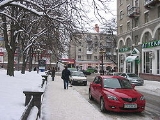
All Topics  
Ternopil

 
Ternopil

   Email Print
   Bookmark   Link


Ternopil


Ternopil (translit.
Romanization of Ukrainian

The romanization or Latinization of Ukrainian is the representation of the Ukrainian language using Latin alphabet. Ukrainian is natively written in its own Ukrainian alphabet, a variation of Cyrillic alphabet....
 Ternopil’, , , translit.
Romanization of Russian

Romanization of the Russian alphabet is the process of transliteration the Russian language from the Cyrillic alphabet into the Latin alphabet. Such transliteration is necessary for writing Russian names and other words in the alphabet of one's own language....
 Ternopol’), is a city
City

A city is an urban area with a high population density and a particular administrative, legal, or historical status.Large industrialized cities generally have advanced systems for sanitation, utilities, land usage, house, and transportation and more....
 in western Ukraine
Ukraine

Ukraine is a country in Eastern Europe. It is bordered by Russia to the east; Belarus to the north; Poland, Slovakia, and Hungary to the west; Romania and Moldova to the southwest; and the Black Sea and Sea of Azov to the south....
, located on the banks of the Seret River. Ternopil is one of three main cities of Eastern Galicia
Galicia (Central Europe)

Galicia is a historical region in East Central Europe, currently divided between Poland and Ukraine, named after Ukra?ni?n city of Halych.The nucleus of historic Galicia is formed of three regions of western Ukraine: Lvivska oblast, Ternopilska oblast and Ivano-Frankivsk Oblast....
. It is located approximately east of Lviv
Lviv

Lviv is a major city in western Ukraine.It is regarded as one of the main Ukrainian culture. In 2001, it had 725,000 inhabitants, of whom 88 per cent were Ukrainians, 9 per cent Russians and 1 per cent Poles....
, at around . It is served by Ternopil Airport
Ternopil Airport

Ternopil' Airport is an airport in Ukraine located 8 kilometre southeast of Ternopil. It services medium-sized airliners. The airport is relatively minor and has a simple taxiway/tarmac layout....
.

The current estimated population is 221,300 (as of 2004).

city is the administrative center of the Ternopil Oblast
Ternopil Oblast

Ternopil Oblast is an administrative divisions of Ukraine of Ukraine. Its Capital is Ternopil....
 (province
Oblast

Oblast is a type of administrative division in Slavic peoples countries and in some countries of the former Soviet Union. The word "oblast" is a loanword in English, but it is nevertheless often translated as "area", "zone", "province", or "region"....
), as well of the surrounding Ternopilsky Raion (district
Raion

A raion is a type of administrative unit of some post-Soviet states. The term, which is of French origin, describes both a type of a subnational entity and a division of a city, and is almost always translated as "district"....
) within the oblast.


Discussion
Ask a question about 'Ternopil'
Start a new discussion about 'Ternopil'
Answer questions from other users
Full Discussion Forum


Recent Posts


Encyclopedia


Ternopil (translit.
Romanization of Ukrainian

The romanization or Latinization of Ukrainian is the representation of the Ukrainian language using Latin alphabet. Ukrainian is natively written in its own Ukrainian alphabet, a variation of Cyrillic alphabet....
 Ternopil’, , , translit.
Romanization of Russian

Romanization of the Russian alphabet is the process of transliteration the Russian language from the Cyrillic alphabet into the Latin alphabet. Such transliteration is necessary for writing Russian names and other words in the alphabet of one's own language....
 Ternopol’), is a city
City

A city is an urban area with a high population density and a particular administrative, legal, or historical status.Large industrialized cities generally have advanced systems for sanitation, utilities, land usage, house, and transportation and more....
 in western Ukraine
Ukraine

Ukraine is a country in Eastern Europe. It is bordered by Russia to the east; Belarus to the north; Poland, Slovakia, and Hungary to the west; Romania and Moldova to the southwest; and the Black Sea and Sea of Azov to the south....
, located on the banks of the Seret River. Ternopil is one of three main cities of Eastern Galicia
Galicia (Central Europe)

Galicia is a historical region in East Central Europe, currently divided between Poland and Ukraine, named after Ukra?ni?n city of Halych.The nucleus of historic Galicia is formed of three regions of western Ukraine: Lvivska oblast, Ternopilska oblast and Ivano-Frankivsk Oblast....
. It is located approximately east of Lviv
Lviv

Lviv is a major city in western Ukraine.It is regarded as one of the main Ukrainian culture. In 2001, it had 725,000 inhabitants, of whom 88 per cent were Ukrainians, 9 per cent Russians and 1 per cent Poles....
, at around . It is served by Ternopil Airport
Ternopil Airport

Ternopil' Airport is an airport in Ukraine located 8 kilometre southeast of Ternopil. It services medium-sized airliners. The airport is relatively minor and has a simple taxiway/tarmac layout....
.

The current estimated population is 221,300 (as of 2004).

Administrative status

The city is the administrative center of the Ternopil Oblast
Ternopil Oblast

Ternopil Oblast is an administrative divisions of Ukraine of Ukraine. Its Capital is Ternopil....
 (province
Oblast

Oblast is a type of administrative division in Slavic peoples countries and in some countries of the former Soviet Union. The word "oblast" is a loanword in English, but it is nevertheless often translated as "area", "zone", "province", or "region"....
), as well of the surrounding Ternopilsky Raion (district
Raion

A raion is a type of administrative unit of some post-Soviet states. The term, which is of French origin, describes both a type of a subnational entity and a division of a city, and is almost always translated as "district"....
) within the oblast. However, Ternopil is a city of oblast subordinance, thus being subject directly to the oblast authorities rather to the raion administration housed in the city itself.

History

Ternopil Zamok
The city was founded in 1540 by Jan Amor Tarnowski as a Polish
Poland

Poland , officially the Republic of Poland , is a country in Central Europe. Poland is bordered by Germany to the west; the Czech Republic and Slovakia to the south; Ukraine, Belarus and Lithuania to the east; and the Baltic Sea and Kaliningrad Oblast, a Russian Enclave and exclave, to the north....
 military stronghold and a castle. In 1544 the Ternopil Castle
Ternopil Castle

The Tarnopol Castle originated as the residence of Jan Amor Tarnowski in 1540. Construction works on the marshy bank of the Seret River were authorized by King Sigismund the Old....
 was constructed and repelled its first Tatar
Tatars

Tatars , sometimes spelled Tartars, refers to a Turkic people ethnic group mainly inhabiting Russia, Uzbekistan, Kazakhstan, Ukraine, Kyrgyzstan, Bulgaria, Romania, Lithuania, and Poland....
 attacks. In 1548 Ternopil was granted city rights
Magdeburg rights

Magdeburg Rights or Magdeburg Law were a set of German town laws regulating the degree of internal autonomy within cities and villages granted with it by a local ruler....
 by king Sigismund I of Poland. In 1567 the city passed to the Ostrogski
Ostrogski

Ostrogski was one of the greatest Ruthenian princely families of the Grand Duchy of Lithuania.They were most likely of Rurikid stock and descended from Sviatopolk II of Kiev....
 family. In 1575 it was plundered by Tatars. In 1623 the city passed to the Zamoyski
Zamoyski

Zamoyski, plural: Zamoyscy is the surname of a an important Poland nobility family of Jelita coat of arms. The name is sometimes spelled Zamojski....
 family.

In the 17th century the town was almost wiped from the map in the Khmelnytsky Uprising
Khmelnytsky Uprising

File:Polish-Lithuanian Commonwealth in 1648.PNGThe term Khmelnytsky Uprising refers to a rebellion or war of liberation in the lands of present-day Ukraine which continued from 1648–1655....
 which drove out or killed most of its Jewish residents. Ternopil was almost completely destroyed by Turks
Turkic peoples

The Turkic peoples are Eurasian peoples residing in northern, central and western Eurasia, and who mostly speak languages belonging to the Turkic languages....
 and Tatars in 1675 and rebuilt by Aleksander Koniecpolski
Aleksander Koniecpolski (1620-1659)

Prince Aleksander Koniecpolski was a szlachta. He became the Great Chorazy of the Crown in 1641, the Voivode of Sandomierz Voivodeship in 1656, and the Starost of Perejaslaw, Korsun, Ploskirow and Dolina....
 but did not recover its previous glory until it passed to Marie Casimire, the wife of king Jan III Sobieski in 1690. The city was later sacked for the last time by Tatars in 1694, and twice by Russians
Russians

The Russian people are an East Slavs ethnic group, primarily living in Russia and neighboring countries.The English language term Russians is used to refer to the citizens of Russia, regardless of their ethnicity ; in Russian language, the demonym Russian is translated as Rossiyanin ....
 in the course of the Great Northern War
Great Northern War

The Great Northern War was a war in which the so-called Northern Alliance composed of Russia, Denmark-Norway, Polish?Lithuanian Commonwealth and Saxony engaged Sweden to challenge them for the supremacy in the Baltic Sea....
 in 1710 and the War of the Polish Succession
War of the Polish Succession

The War of the Polish Succession was sparked by a Polish civil war over the succession to Augustus II of Poland, King of Poland that widened as the two Pacte de Famille powers attempted to check the power of the Habsburg Monarchy in western Europe....
 in 1733. In 1747 Józef Potocki
Józef Potocki

J?zef Potocki was a Poland nobleman , magnate, Great Hetman of the Crown.J?zef was considered as the richest magnate at that time. He was Voivode of Kij?w Voivodship from 1702 to 1744, Regimentarz generalny of the Crown Army since 1733, Great Crown Hetman since 1735, voivod of Poznan Voivodship since 1743, castellan of Krak?w since 1748 an...
 invited the Dominicanes and founded the beautiful late baroque
Baroque

In the the arts, the Baroque was a Western cultural Epoch , starting roughly at the beginning of the 17th century in Rome, Italy. It was exemplified by drama and grandeur in Baroque sculpture, Baroque painting, literature, Baroque dance, and Baroque music....
 Dominican Church (today the Cathedral of the Immaculate Conception of The Blessed Virgin Mary of the Ternopil-Zboriv eparchy of the Ukrainian Greek Catholic Church
Ukrainian Greek Catholic Church

The Ukrainian Greek Catholic Church , also known as the Ukrainian Catholic Church, is one of the successor Church body to the Baptism of Kiev by Grand Prince Vladimir the Great of Kiev , in 988....
). The city was thrice looted during the confederation of Bar (1768–1772), by the confederates themeselves, by the kings army and by Russians. In 1770 it was further devastated by an outbreak of smallpox
Smallpox

Smallpox is an infectious disease unique to humans, caused by either of two virus variants, Variola major and Variola minor. The disease is also known by the Latin names Variola or Variola vera, which is a derivative of the Latin varius, meaning spotted, or varus, meaning "pimple"....
.
Tarnopolskie
In 1772 the city came under Austria
Austria

Austria , officially the Republic of Austria , is a landlocked country in Central Europe. It borders both Germany and the Czech Republic to the north, Slovakia and Hungary to the east, Slovenia and Italy to the south, and Switzerland and Liechtenstein to the west....
n rule after the First Partition of Poland
First Partition of Poland

The First Partition of Poland or First Partition of the Polish-Lithuanian Commonwealth took place in 1772 as the first of partitions of Poland that ended the existence of the Polish-Lithuanian Commonwealth by 1795....
. At the beginning of the 19th century the local population put great hopes into Napoleon Bonaparte, in 1809 the city came under Russian rule, which created to Ternopol krai there. In 1815 the city (then with 11,000 residents) returned to Austrian rule in accordance with the Congress of Vienna
Congress of Vienna

The Congress of Vienna was a conference of ambassadors of European states chaired by the Austrian statesman Klemens Wenzel von Metternich, and held in Vienna from September, 1814 to June, 1815....
. In 1820 Jesuits expelled from Polatsk
Polatsk

File:Polatsk Lenin street.JPGPolotsk is a historical city in Belarus, situated on the Western Dvina river. It is the center of Polotsk district in Vitsebsk Voblast....
 by Russians established a gymnasium
Gymnasium (school)

A gymnasium is a type of school providing secondary education in some parts of Europe, comparable to English Grammar schools in the United Kingdoms or sixth form colleges and U.S....
 in the town. In 1870 a rail line connected Tarnopol with Lviv
Lviv

Lviv is a major city in western Ukraine.It is regarded as one of the main Ukrainian culture. In 2001, it had 725,000 inhabitants, of whom 88 per cent were Ukrainians, 9 per cent Russians and 1 per cent Poles....
, accelerating the city's growth. At that time Ternopil had a population of about 25,000.

Ternopil Dominikanskyj Kostol


During World War I
World War I

World War I, or the First World War , was a global military conflict which involved the Great powers, organized into two opposing military alliances: the Allies of World War I and the Central Powers....
 the city passed from German
Germany

Germany , officially the Federal Republic of Germany , is a country in Central Europe. It is bordered to the north by the North Sea, Denmark, and the Baltic Sea; to the east by Poland and the Czech Republic; to the south by Austria and Switzerland; and to the west by France, Luxembourg, Belgium, and the Netherlands....
 and Austria
Austria

Austria , officially the Republic of Austria , is a landlocked country in Central Europe. It borders both Germany and the Czech Republic to the north, Slovakia and Hungary to the east, Slovenia and Italy to the south, and Switzerland and Liechtenstein to the west....
n forces to Russia
Russia

Russia , or the Russian Federation , is a list of countries spanning more than one continent country extending over much of northern Eurasia....
 several times. In 1917 it was burnt down by fleeing Russian forces. After the dissolution of the Austro-Hungarian Empire
Austria-Hungary

Austria-Hungary, also known as the Austro-Hungarian Empire, the Dual Monarchy or the Kaiserlich und k?niglich Monarchy was a state in Central Europe ruled by the House of Habsburg, constitutionally a personal union between the crowns of the Austrian Empire and the Kingdom of Hungary....
 the city was proclaimed part of the West Ukrainian People's Republic on 11 November 1918. During the Polish-Ukrainian War
Polish-Ukrainian War

The Polish-Ukrainian War of 1918 and 1919 was a conflict between the forces of the Second Polish Republic and West Ukrainian People's Republic for the control over Eastern Galicia after the dissolution of Austria-Hungary....
 it was the country's capital from 22 November to 30 December after Lviv
Lviv

Lviv is a major city in western Ukraine.It is regarded as one of the main Ukrainian culture. In 2001, it had 725,000 inhabitants, of whom 88 per cent were Ukrainians, 9 per cent Russians and 1 per cent Poles....
 was captured by Polish forces. After the act of union between Western-Ukrainian Republic and the Ukrainian People's Republic
Ukrainian People's Republic

The Ukrainian People's Republic was a republic in part of the territory of modern Ukraine Ukraine after the Russian Revolution, eventually headed by Symon Petliura....
 (UPR), Ternopil formally passed under the UPR's control. On 15 July 1919 the city was captured by Polish forces. In 1920 the exiled Ukrainian government of Symon Petlura
Symon Petlura

Symon Vasylyovych Petliura was a publicist, writer, journalist, Ukraine politician and statesman, a leader of Ukraine's fight for independence following the Russian Revolution of 1917....
 accepted the Polish control of Ternopil and of the entire area in exchange for the Polish assistance in restoration of Petlura's government in Kyiv. This effort
Kiev Offensive

The 1920 Kiev Offensive , sometimes considered to have started the Soviet-Polish War, was an attempt by the newly re-emerged Second Polish Republic, led by J?zef Pilsudski, to seize central and eastern Ukraine, torn in the warring among various factions, both domestic and foreign, from Soviet control....
 ultimately failed, and in July and August 1920 Ternopil was captured by the Red Army
Red Army

The Red Army was the armed force first organized by the Bolsheviks during the Russian Civil War in 1918 and, in 1922, became the army of the Soviet Union....
 in the course of the Polish-Soviet War
Polish-Soviet War

The Polish-Soviet War was an armed conflict of Russian SFSR and Ukrainian Soviet Socialist Republic against the Second Polish Republic and the short-lived Ukrainian People's Republic, four states in post-World War I Europe....
 and served as the capital of the Galician Soviet Socialist Republic
Galician Soviet Socialist Republic

The Galician Soviet Socialist Republic existed from July 8, 1920 to September 21, 1920 during the Polish-Soviet War within the area of the South-Western front of the Red Army....
. By the terms of the Riga treaty that ended the Polish-Soviet war, the Soviet Russia recognized the Polish control of the area.

From 1922 to September 1939, it was the capital of the Tarnopol Voivodeship
Tarnopol Voivodeship

Tarnopol Voivodeship was an administrative unit of interwar Poland . It ceased to exist in September 1939, following German and Soviet aggression on Poland ....
 that consisted of 17 powiat
Powiat

A powiat is the second-level unit of local government and administration in Poland, equivalent to a county, district or prefecture in other countries....
s. The policies of the Polish authorities, especially the assimilationist ethnic policies, affected all spheres of public life. Ukrainians, who according to the 1939 Statistical Yearbook of Poland, made less than half of voivodship's population, were restricted in their rights and were prosecuted for any attempts to oppose the Polonization
Polonization

Polonization is the acquisition or imposition of elements of Polish culture, especially Polish language, as experienced in some historic periods by non-Polish populations of territories controlled or substantially influenced by Poland....
. This created a strong backlash and strengthened the position of the militant Organization of Ukrainian Nationalists
Organization of Ukrainian Nationalists

Organization of Ukrainian Nationalists or OUN was a Ukraine political movement originally created in 1929 in the Second Polish Republic ....
 whose local Ternopil branch was led by Roman Paladiychuk and Taras Stetsko, the future leader of OUN,

In 1939 it was a city of 40,000; 50% of the population was Polish, 40% Jewish and 10% Ukrainian.

During the Polish Defensive War
Invasion of Poland (1939)

The Invasion of Poland in 1939 precipitated World War II. It was carried out by Nazi Germany, the Soviet Union, and a small Slovak invasion of Poland contingent....
 it was annexed by the Soviet Union
Soviet Union

The Union of Soviet Socialist Republics was a Constitution of the Soviet Union socialist state that existed in Eurasia from 1922 to 1991.The name is a translation of the , romanization of Russian Soyuz Sovetskikh Sotsialisticheskikh Respublik, abbreviated ????, SSSR....
 and attached to the Ukrainian Soviet Socialist Republic. The Soviets continued the campaign against the Organization of Ukrainian Nationalists aided by the information given to them by the former Polish authorities. The Soviets also carried the mass deportations of the Polish part of the population to Kazakhstan
Kazakhstan

Kazakhstan, also Kazakstan , officially the Republic of Kazakhstan, is a large Eurasian country in Central Asia and Eastern Europe. Ranked as the List of countries by area as well as the world's largest landlocked country, it has a territory of 2,727,300 km? ....
. In 1941 the city was occupied by the Germans who continued exterminating the population by murdering the Jews and sending others to forced labor in Germany. In april 1944 the city was retaken by the Red Army, the remaining Polish population has been previously expelled. During the soviet reoccupation in march and april 1944 the city was encircled and completely destroyed. In march 1944 the city has been declared a fortified place by Adolf Hitler, to defend until the last round was shot. The stiff german resistance caused extensive use of heavy artillery by the Red Army, resulting in the complete destruction of the city and killing of nearly all german defenders. (55 survivors out of 4,500) Unlike many other occasions, where the germans had practiced a scorched earth policy during their withdraw from the territory of soviet union, the devastation was caused directly by the hostilities. After the war Ternopil has been rebuilt in a typically soviet style. Only a few buildings have been reconstructed.

Since 1991 Ternopil is a part of independent Ukraine and along with other cities of Halychyna is an important center of Ukrainian national revival.

Jewish Ternopil

Polish Jews settled in Ternopil beginning at its founding and soon formed a majority of the population. During the 16th and 17th centuries there were 300 Jewish families in the city. The Great Synagogue of Ternopil was built in Gothic
Gothic architecture

Gothic architecture is a style of architecture which flourished during the high and late Middle Ages. It evolved from Romanesque architecture and was succeeded by Renaissance architecture....
 Survival style between 1622 and 1628. Among the towns destroyed by Bohdan Khmelnytsky
Bohdan Khmelnytsky

Bohdan Zynoviy Mykhailovych Khmelnytsky was a hetman of the Zaporizhzhia Cossack Hetmanate of Ukraine. He led the Khmelnytsky Uprising against the Polish-Lithuanian Commonwealth magnates with the goal of creating an independent Ukrainian state....
 during his march of devastation from Zolochiv
Zolochiv

Zolochiv is a Urban-type settlement located in the Lviv Oblast of western Ukraine. It is the Capital city of the Zolochivsky Raion .Zolochiv was incorporated as a town on 15 September 1523 by the Poland king Sigismund I the Old....
 through Galicia was Tarnopol, the large Jewish population of which carried on an extensive trade. Shortly afterward, however, when the Cossacks had been subdued by John III of Poland
John III Sobieski

John III Sobieski was one of the most notable monarchs of the Polish-Lithuanian Commonwealth, from 1674 until his death King of Poland and Grand Duke of Lithuania....
, the town began to prosper anew, and its Jewish population exceeded all previous figures. It may be noted that Hasidism
Hasidic Judaism

Hasidic Judaism is a type of Orthodox Judaism or Haredi Judaism Orthodox Judaism religious movement. Some refer to Hasidic Judaism as Hasidism, and the adjective chasidic / hasidic applies....
 at this time dominated the community, which opposed any introduction of Western culture
Western culture

File:Clash of Civilizations map.pngWestern culture are terms which are used to refer to cultures of European origin. This terminology originated as a way of describing what was different about the Graeco-Roman culture and its descendants, in contrast to the older neighboring civilizations of the Middle East, which in many ways continued...
. During the troublous times in the latter part of the eighteenth century the city was stormed (1770) by the adherents of the Confederacy of Bar
Bar Confederation

The Bar Confederation was an association of Poland nobles formed at the fortress of Bar, Ukraine in Podolia in 1768 to defend the internal and external independence of the Polish-Lithuanian Commonwealth against aggression by the Russian Empire and against King Stanislaw August Poniatowski and Polish reformers who were attempting to limit...
, who massacred many of its inhabitants, especially the Jews.

After the second partition of Poland, Ternopil came under Austria
Austria

Austria , officially the Republic of Austria , is a landlocked country in Central Europe. It borders both Germany and the Czech Republic to the north, Slovakia and Hungary to the east, Slovenia and Italy to the south, and Switzerland and Liechtenstein to the west....
n domination and Joseph Perl
Joseph Perl

Joseph Perl was an Ashkenazi Jewish educator and writer, a scion of the Haskalah or Jewish Enlightenment. He wrote in Hebrew, Yiddish, and German language....
 was able to continue his efforts to improve the condition of the Jews there, which he had begun under Russian rule. In 1813 he established a Jewish school which had for its chief object the instruction of Jewish youth in German
German language

German is a West Germanic languages, thus related to and classified alongside English language and Dutch language. It is one of the world's world language and the most widely spoken mother tongue in the European Union....
 as well as in Hebrew
Hebrew language

Hebrew is a Semitic languages of the Afro-Asiatic languages. Modern Hebrew is spoken by more than seven million people in Israel and Classical Hebrew is used for prayer or study in Jews communities around the world....
 and various other branches. Controversy between the traditional Hasidim and the modernising Maskilim which this school caused resulted four years later in a victory for the latter, whereupon the institution received official recognition and was placed under communal control. Since 1863 the school policy was gradually modified by Polish influences, and very little attention was given to instruction in German. The Tempel für Geregelten Gottesdienst, opened by Perl
Perl

In computer programming, Perl is a high-level programming language, List of programming languages by category, Interpreter , dynamic programming language....
 in 1819, also caused dissensions within the community, and its rabbi, S. J. Rapoport, was forced to withdraw. This dispute also was eventually settled in favor of the Maskilim. As of 1905, the Jewish community numbered 14,000 in a total population of 30,415. The Jews were engaged principally in an active import and export trade with Russia through the border city of Podwoloczyska.

Notable People


  • Kazimierz Ajdukiewicz
    Kazimierz Ajdukiewicz

    Kazimierz Ajdukiewicz was a Poland philosopher and logician.He originated many novel ideas in semiotics, including the "categorial grammar" used by many formal linguists....
  • Józef Arkusz
    Józef Arkusz

    J?zef Arkusz was a Poland film director and Film producer of over 70 educational films.J?zef Arkusz was born on March 18, 1921 in Peratyn, Poland ....
  • Hermann Balck
    Hermann Balck

    Hermann Balck was a general in Nazi Germany's Wehrmacht during World War II....
  • Eugeniusz Baziak
    Eugeniusz Baziak

    Eugeniusz Baziak was Archbishop of Roman Catholic Archdiocese of Lviv of the Latins and Apostolic Administrator of Krak?w. Baziak was rector of the Clerical Seminarium in Lw?w....
  • Yosef Babad
    Yosef Babad

    Yosef Ben Moshe Babad was a Rabbi, posek and Talmudist, best known for his work, the Minchat Chinuch, a commentary on the Sefer Hachinuch. He studied under Chaim Halberstam, the Sanz er Rov, and enjoyed close relationships with the various Hasidic rebbe of Galicia ....
  • Aleksander Brückner
    Aleksander Brückner

    Aleksander Br?ckner was a Poland scholar of Slavic languages and literatures , philologist, lexicographer and historian of literature. He is among the most notable scholars of the late 19th century and early 20th century, as well as the first to prepare complete monographs on the history of the Polish language and culture....
  • Lubomyr Husar
  • Tomasz Cholodecki
    Tomasz Cholodecki

    Tomasz Cholodecki was a political activist and Poland rebel and soldier, who took part in almost every major event that supported Poland's independence in the 19th century....
  • Alter Kacyzne
    Alter Kacyzne

    Alter Kacyzne was a Jewish writer and photographer....
  • Stanislaw Koniecpolski
    Stanislaw Koniecpolski

    Stanislaw Koniecpolski was a Polish nobleman , magnate, official , voivode of Sandomierz from 1625, and Field and later Grand Crown hetman of the Polish-Lithuanian Commonwealth....
  • Nachman Krochmal
    Nachman Krochmal

    Nachman Kohen Krochmal was a Jewish Austrian philosopher, theology, and historian....
  • Wladyslaw Langner
    Wladyslaw Langner

    Wladyslaw Langner was a Poland general, best known as commander of the Battle of Lw?w in 1939....
  • Mike Mazurki
    Mike Mazurki

    Mike Mazurki was an American actor and professional wrestling who appeared in over 100 movies. His towering 6' 5" presence and intimidating face usually got him roles playing tough guys, thugs, strong men, and gangsters....
  • Friedrich von Mellenthin
    Friedrich von Mellenthin

    Friedrich Wilhelm von Mellenthin was a Generalmajor in the Wehrmacht during World War II. A participant in most of the major campaigns of the war, he became well-known afterwards for his memoirs Panzer Battles , first published in 1956 and regularly reprinted since then....
  • Kazimierz Michalowski
    Kazimierz Michalowski

    Kazimierz Michalowski was a Poland archaeologist and Egyptologist, and the founder of Nubiology.Michalowski studied classical archeology and art history at the University of Lw?w; he studied at the Universities and Archaeological Institutes of Berlin, Heidelberg, M?nster, Paris, Rome, Athens and Cairo....
  • Soma Morgenstern
    Soma Morgenstern

    Soma Morgenstern was a Jewish-Austrian writer and journalist....
  • Józef Olszyna-Wilczynski
    Józef Olszyna-Wilczynski

    J?zef Konstanty Olszyna-Wilczynski was a Poland general and one of the high-ranking commanders of the Polish Army. A veteran of World War I, Polish-Ukrainian War and the Polish-Bolshevik War, he was murdered by the Soviets during the Invasion of Poland of 1939....
  • Kazimierz Orlik-Lukoski
    Kazimierz Orlik-Lukoski

    Kazimierz Orlik-Lukoski was a Poland military commander and one of the Generals of the Polish Army murdered by the Soviet Union in the Katyn massacre of 1940....
  • Rudolf Pöch
    Rudolf Pöch

    Rudolf P?ch , was an Austrians Physician, anthropologist, and ethnologist.P?ch is also known as a pioneer in photography, cinematography, and audio engineering....
  • Ivan Pulyui
    Ivan Pulyui

    Ivan Pulyui was a Ukraine-born physicist, inventor and Patriotism who has been championed as an early developer of the use of X-rays for medical imaging....
  • Samuel Judah Löb Rapoport
    Samuel Judah Löb Rapoport

    Solomon Judah L?b Rapoport , was a Galicia n rabbi and Jewish scholar. He was born in Lemberg, Kingdom of Galicia and Lodomeria, Austria.After various experiences in business, Rapoport became successively rabbi of Tarnopol and of Prague ....
  • Fritz von Scholz
    Fritz von Scholz

    Fritz von Scholz Edler von Rerancze, known as Fritz von Scholz was an Austrian Austro-Hungarian Army and later Germany Waffen SS officer who served in both the World War I and World War II....
  • Rudi Stephan
    Rudi Stephan

    Rudi Stephan , was a Germany composer of great promise who shortly before World War I was considered one of the leading talents among his generation....
  • Julian Stryjkowski
    Julian Stryjkowski

    Julian Stryjkowski was a Poland journalist and writer, notable for his social prose of leftists character.He was born April 27, 1905 in Stryj , to a family of Hasidic Judaism....
  • Jan Tarnowski
    Jan Tarnowski

    Jan Amor Tarnowski was a Polish-Lithuanian commonwealth szlachta. He was Grand Crown Hetman from 1527 and was the founder of the city of Tarnopol, where he built the Ternopil Castle and the Ternopil Lake....


  • Twin Towns

    Ternopil is twinned
    Town twinning

    Town twinning, also known as sister cities, is a concept whereby towns or city in geographically and politically distinct areas are paired, with the goal of fostering human contact and cultural links between their inhabitants....
     with:
    Radom
    Radom

    Radom is a city in central Poland with 227,309 inhabitants. It is located on the Mleczna River in the Masovian Voivodeship , having previously been the capital of Radom Voivodeship , 100 km south of Poland's capital, Warsaw....
     in Poland
    Poland

    Poland , officially the Republic of Poland , is a country in Central Europe. Poland is bordered by Germany to the west; the Czech Republic and Slovakia to the south; Ukraine, Belarus and Lithuania to the east; and the Baltic Sea and Kaliningrad Oblast, a Russian Enclave and exclave, to the north....
     
    • Tarnów
      Tarnów

      Tarn?w is a city in southeastern Poland with 116,109 inhabitants The city has been situated in the Lesser Poland Voivodeship since 1999, but from 1975 to 1998 it was the capital of the Tarn?w Voivodeship....
       in Poland
      Poland

      Poland , officially the Republic of Poland , is a country in Central Europe. Poland is bordered by Germany to the west; the Czech Republic and Slovakia to the south; Ukraine, Belarus and Lithuania to the east; and the Baltic Sea and Kaliningrad Oblast, a Russian Enclave and exclave, to the north....
  • Elblag
    Elblag

    Elblag is a city in northern Poland with 127,892 inhabitants . It is the capital of Elblag County and has been assigned to the Warmian-Masurian Voivodeship since 1999....
     in Poland
    Poland

    Poland , officially the Republic of Poland , is a country in Central Europe. Poland is bordered by Germany to the west; the Czech Republic and Slovakia to the south; Ukraine, Belarus and Lithuania to the east; and the Baltic Sea and Kaliningrad Oblast, a Russian Enclave and exclave, to the north....
     (since 1992)
  • Yonkers, New York
    Yonkers, New York

    Yonkers is the fourth largest city in the U.S. State of New York , and the largest city in Westchester County, with a population of 196,086 . More recent estimates put the population at 197,234 in 2002, 197,126 in 2004 and 196,425 in 2005....
     in United States
    United States

    The United States of America is a Federal government constitutional republic comprising U.S. state and a federal district. The country is situated mostly in central North America, where its Contiguous United States and Washington, D.C., the Capital districts and territories, lie between the Pacific Ocean and Atlantic Oceans, Borders of the U...
     
    (since 1991)


  • See also

    • Buczacz


    Bibliography of Jewish Encyclopedia

    By : Joseph Jacobs
    Joseph Jacobs

    Joseph Jacobs was a literary and Jewish historian. He was a writer for the Jewish Encyclopaedia and a notable folklorist, creating several noteworthy collections of fairy tales....
     & Schulim Ochser
    • Allg. Zeit. des Jud. 1839, iii. 606;
    • A. Bresler, Joseph Perl
      Joseph Perl

      Joseph Perl was an Ashkenazi Jewish educator and writer, a scion of the Haskalah or Jewish Enlightenment. He wrote in Hebrew, Yiddish, and German language....
      ,
      Warsaw, 1879, passim;
    • Orgelbrandt, in Encyklopedja Powszechna, xiv. 409;
    • J. H. Gurland, Le-?arot ha-Gezerot, p. 22, Odessa
      Odessa

      Odessa or Odesa is the Capital of the Odessa Oblast located in southern Ukraine. The city is a major port located on the shore of the Black Sea and the fourth largest city in Ukraine with a population of 1,029,000 ....
      , 1892;
    • Meyers Konversations-Lexikon
      Meyers Konversations-Lexikon

      Meyers Konversations-Lexikon was a major Germany encyclopedia that existed in various editions from 1839 until 1984, when it merged with the Brockhaus encyclopedia....


    External links