

Gallia Belgica

Encyclopedia
Roman province
In Ancient Rome, a province was the basic, and, until the Tetrarchy , largest territorial and administrative unit of the empire's territorial possessions outside of Italy...
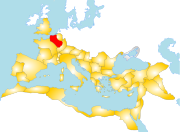
located in what is now the southern part of the Netherlands
Netherlands
The Netherlands is a constituent country of the Kingdom of the Netherlands, located mainly in North-West Europe and with several islands in the Caribbean. Mainland Netherlands borders the North Sea to the north and west, Belgium to the south, and Germany to the east, and shares maritime borders...
, Belgium
Belgium
Belgium , officially the Kingdom of Belgium, is a federal state in Western Europe. It is a founding member of the European Union and hosts the EU's headquarters, and those of several other major international organisations such as NATO.Belgium is also a member of, or affiliated to, many...
, Luxembourg
Luxembourg
Luxembourg , officially the Grand Duchy of Luxembourg , is a landlocked country in western Europe, bordered by Belgium, France, and Germany. It has two principal regions: the Oesling in the North as part of the Ardennes massif, and the Gutland in the south...
, northeastern France
France
The French Republic , The French Republic , The French Republic , (commonly known as France , is a unitary semi-presidential republic in Western Europe with several overseas territories and islands located on other continents and in the Indian, Pacific, and Atlantic oceans. Metropolitan France...
, and western Germany
Germany
Germany , officially the Federal Republic of Germany , is a federal parliamentary republic in Europe. The country consists of 16 states while the capital and largest city is Berlin. Germany covers an area of 357,021 km2 and has a largely temperate seasonal climate...
. The indigenous population of Gallia Belgica, the Belgae
Belgae
The Belgae were a group of tribes living in northern Gaul, on the west bank of the Rhine, in the 3rd century BC, and later also in Britain, and possibly even Ireland...
, consisted of a mixture of Celt
Celt
The Celts were a diverse group of tribal societies in Iron Age and Roman-era Europe who spoke Celtic languages.The earliest archaeological culture commonly accepted as Celtic, or rather Proto-Celtic, was the central European Hallstatt culture , named for the rich grave finds in Hallstatt, Austria....
ic and Germanic tribes. According to Julius Caesar
Julius Caesar
Gaius Julius Caesar was a Roman general and statesman and a distinguished writer of Latin prose. He played a critical role in the gradual transformation of the Roman Republic into the Roman Empire....
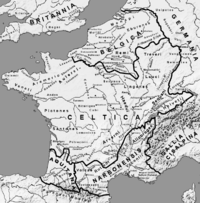
, the border between Gallia and Belgica was formed by the Marne
Marne River
The Marne is a river in France, a right tributary of the Seine in the area east and southeast of Paris. It is long. The river gave its name to the départements of Haute-Marne, Marne, Seine-et-Marne, and Val-de-Marne....
and the Seine
Seine
The Seine is a -long river and an important commercial waterway within the Paris Basin in the north of France. It rises at Saint-Seine near Dijon in northeastern France in the Langres plateau, flowing through Paris and into the English Channel at Le Havre . It is navigable by ocean-going vessels...
and that with Germania by the Rhine. The area is the historical heart of the Low Countries
Low Countries
The Low Countries are the historical lands around the low-lying delta of the Rhine, Scheldt, and Meuse rivers, including the modern countries of Belgium, the Netherlands, Luxembourg and parts of northern France and western Germany....
, a region corresponding roughly to all of modern Belgium
Belgium
Belgium , officially the Kingdom of Belgium, is a federal state in Western Europe. It is a founding member of the European Union and hosts the EU's headquarters, and those of several other major international organisations such as NATO.Belgium is also a member of, or affiliated to, many...
; the Netherlands
Netherlands
The Netherlands is a constituent country of the Kingdom of the Netherlands, located mainly in North-West Europe and with several islands in the Caribbean. Mainland Netherlands borders the North Sea to the north and west, Belgium to the south, and Germany to the east, and shares maritime borders...
south of the Rhine; the French regions of Nord
Nord
Nord may refer to:Places:* Nord, California, an unincorporated community in Butte County, California* Nord , a department in northern France* Nord Department , a department in northern Haiti...
, Picardy
Picardy
This article is about the historical French province. For other uses, see Picardy .Picardy is a historical province of France, in the north of France...
, Upper Normandy, and Champagne-Ardennes; and the northern part of the German Rhineland
Rhineland
Historically, the Rhinelands refers to a loosely-defined region embracing the land on either bank of the River Rhine in central Europe....
(not including the Moselle
Moselle
Moselle is a department in the east of France named after the river Moselle.- History :Moselle is one of the original 83 departments created during the French Revolution on March 4, 1790...
).
Roman conquest
In 57 BC, Julius Caesar led the conquest of the tribes in the region which Romans would later call Gallia Belgica. Modern accounts hold that there were eighteen peoples in the region. Save the southern Remi, all the tribes allied against the Romans, fearful of isolation if the rest of the region was conquered and angry at the Roman decision to garrison legions in their territory the preceding winter. Contemporary estimates of the allies' combined strength numbered the troops at 288,000, led by the SuessioneSuessiones
The Suessiones were a Belgic tribe of Western Belgium in the 1st century BC, inhabiting the region between the Oise and the Marne, based around the present-day city of Soissons...
king, Galba
Galba (Suessiones)
Galba was a king of the Suessiones, a Celtic polity of Belgic Gaul, during the Gallic Wars. When Julius Caesar entered the part of Gaul that was still independent of Roman rule in 58 BC, a number of Belgic polities formed a defensive alliance and universally acclaimed Galba commander-in-chief...
. Due to the Belgic coalition's size and reputation for uncommon bravery, Caesar avoided meeting the combined forces of the tribes in battle. Instead, he used cavalry to skirmish with smaller contingents of tribesmen. Only when Caesar managed to isolate one of the tribes did he risk conventional battle. The tribes fell in a piecemeal fashion and Caesar claimed to offer lenient terms to defeated, including Roman protection from the threat of surrounding tribes. Most tribes agreed to the conditions. A series of uprisings followed the 57 BC conquest. The largest revolt was led by the Bellovaci
Bellovaci
The Bellovaci were among the most powerful and numerous of the Belgic tribes of north-eastern Gaul conquered by Julius Caesar in 57 BC. The name survives today in the French city of Beauvais, called by the Romans Caesaromagus.- Geography :...
in 52 BC, after the defeat of Vercingetorix
Vercingetorix
Vercingetorix was the chieftain of the Arverni tribe, who united the Gauls in an ultimately unsuccessful revolt against Roman forces during the last phase of Julius Caesar's Gallic Wars....
. During this rebellion, it was the Belgae who avoided direct conflict. They harassed the Roman legions, led personally by Caesar, with cavalry detachments and archers. The rebellion was put down after a Bellovaci ambush of the Romans failed. The revolting party was slaughtered.
Julius Caesar's commentary
Julius CaesarJulius Caesar
Gaius Julius Caesar was a Roman general and statesman and a distinguished writer of Latin prose. He played a critical role in the gradual transformation of the Roman Republic into the Roman Empire....
wrote in his Commentarii de Bello Gallico
Commentarii de Bello Gallico
Commentarii de Bello Gallico is Julius Caesar's firsthand account of the Gallic Wars, written as a third-person narrative. In it Caesar describes the battles and intrigues that took place in the nine years he spent fighting local armies in Gaul that opposed Roman domination.The "Gaul" that Caesar...
:
Formation of Gallia Belgica
The province of Gallia Belgica was originally part of Gallia Comata, however this governmental structure proved ineffective. Following a census of the region in 27 BC, AugustusAugustus
Augustus ;23 September 63 BC – 19 August AD 14) is considered the first emperor of the Roman Empire, which he ruled alone from 27 BC until his death in 14 AD.The dates of his rule are contemporary dates; Augustus lived under two calendars, the Roman Republican until 45 BC, and the Julian...
ordered a restructuring of the provinces in Gaul. Therefore in 22 BC, Marcus Agrippa split Gallia Comata into three regions (Gallia Aquitania
Gallia Aquitania
Gallia Aquitania was a province of the Roman Empire, bordered by the provinces of Gallia Lugdunensis, Gallia Narbonensis, and Hispania Tarraconensis...
, Gallia Lugdunensis
Gallia Lugdunensis
Gallia Lugdunensis was a province of the Roman Empire in what is now the modern country of France, part of the Celtic territory of Gaul. It is named after its capital Lugdunum , possibly Roman Europe's major city west of Italy, and a major imperial mint...
and Gallia Belgica.) Agrippa made the divisions on what he perceived to be distinctions in language, race and community - Gallia Belgica was meant to be a mix of Celtic and Germanic peoples. The capital of this territory was Reims
Reims
Reims , a city in the Champagne-Ardenne region of France, lies east-northeast of Paris. Founded by the Gauls, it became a major city during the period of the Roman Empire....
, according to the geographer Strabo, though later the capital moved to modern day Trier
Trier
Trier, historically called in English Treves is a city in Germany on the banks of the Moselle. It is the oldest city in Germany, founded in or before 16 BC....
. The date of this move is uncertain.
Modern historians view the term 'Gaul' and its subdivisions as a "product of faulty ethnography" and see the split of Gallia Comata into three provinces as an attempt to construct a more efficient government, as opposed to a cultural division. Successive Roman emperors struck a balance between Romanizing
Romanization (cultural)
Romanization or latinization indicate different historical processes, such as acculturation, integration and assimilation of newly incorporated and peripheral populations by the Roman Republic and the later Roman Empire...
the people of Gallia Belgica and allowing pre-existing culture to survive. The Romans allowed local governments to survive, typically in the form of Cantons, however their number in Gallia Belgica was curbed. Roman government was run by Concilia in Reims
Reims
Reims , a city in the Champagne-Ardenne region of France, lies east-northeast of Paris. Founded by the Gauls, it became a major city during the period of the Roman Empire....
or Trier
Trier
Trier, historically called in English Treves is a city in Germany on the banks of the Moselle. It is the oldest city in Germany, founded in or before 16 BC....
. Additionally, local notables from Gallia Belgica were required to participate in a festival in Lugdunum
Lugdunum
Colonia Copia Claudia Augusta Lugdunum was an important Roman city in Gaul. The city was founded in 43 BC by Lucius Munatius Plancus. It served as the capital of the Roman province Gallia Lugdunensis. To 300 years after its foundation Lugdunum was the most important city to the west part of Roman...
(modern Lyon
Lyon
Lyon , is a city in east-central France in the Rhône-Alpes region, situated between Paris and Marseille. Lyon is located at from Paris, from Marseille, from Geneva, from Turin, and from Barcelona. The residents of the city are called Lyonnais....
) which typically celebrated or worshiped the emperor’s genius. The gradual adoption of Romanized names by local elites and the Romanization of laws under local authority demonstrate the effectiveness of this concilium Galliarum. With that said, the concept and community of Gallia Belgica did not predate the Roman province, but developed from it.
Under the Emperors
During the 1st century AD (estimated date 90 AD), the provinces of Gaul were restructured. Emperor DomitianDomitian
Domitian was Roman Emperor from 81 to 96. Domitian was the third and last emperor of the Flavian dynasty.Domitian's youth and early career were largely spent in the shadow of his brother Titus, who gained military renown during the First Jewish-Roman War...
reorganized the provinces in order to separate the militarized zones of the Rhine from the civilian populations of the region. The northeastern part of Gallia Belgica was split off and renamed Germania Inferior
Germania Inferior
Germania Inferior was a Roman province located on the left bank of the Rhine, in today's Luxembourg, southern Netherlands, parts of Belgium, and North Rhine-Westphalia left of the Rhine....
, later to be reorganized and re-named as Germania Secunda
Germania Secunda
In the early fourth-century Notitia Dignitatum, Germania Secunda , situated along the Lower Rhine and administered by a Consularis, was the name under the Dominate of Germania Inferior, a military border territory which had been established under the Flavian reorganization of the Roman Empire, out...
. This included the eastern part of modern Belgium
Belgium
Belgium , officially the Kingdom of Belgium, is a federal state in Western Europe. It is a founding member of the European Union and hosts the EU's headquarters, and those of several other major international organisations such as NATO.Belgium is also a member of, or affiliated to, many...
, the southernmost part of the modern Netherlands
Netherlands
The Netherlands is a constituent country of the Kingdom of the Netherlands, located mainly in North-West Europe and with several islands in the Caribbean. Mainland Netherlands borders the North Sea to the north and west, Belgium to the south, and Germany to the east, and shares maritime borders...
, and a part of modern Germany. The eastern part was split off to become Germania Superior
Germania Superior
Germania Superior , so called for the reason that it lay upstream of Germania Inferior, was a province of the Roman Empire. It comprised an area of western Switzerland, the French Jura and Alsace regions, and southwestern Germany...
(parts of western Germany and eastern France) and the southern border of Gallia Belgica was extended to the south. The newer Gallia Belgica included the cities of Camaracum (Cambrai
Cambrai
Cambrai is a commune in the Nord department in northern France. It is a sub-prefecture of the department.Cambrai is the seat of an archdiocese whose jurisdiction was immense during the Middle Ages. The territory of the Bishopric of Cambrai, roughly coinciding with the shire of Brabant, included...
), Nemetacum (Arras
Arras
Arras is the capital of the Pas-de-Calais department in northern France. The historic centre of the Artois region, its local speech is characterized as a Picard dialect...
), Samarobriua (Amiens
Amiens
Amiens is a city and commune in northern France, north of Paris and south-west of Lille. It is the capital of the Somme department in Picardy...
), Durocorter (Reims
Reims
Reims , a city in the Champagne-Ardenne region of France, lies east-northeast of Paris. Founded by the Gauls, it became a major city during the period of the Roman Empire....
), Diuidorum (Metz
Metz
Metz is a city in the northeast of France located at the confluence of the Moselle and the Seille rivers.Metz is the capital of the Lorraine region and prefecture of the Moselle department. Located near the tripoint along the junction of France, Germany, and Luxembourg, Metz forms a central place...
) and Augusta Treverorum (Trier
Trier
Trier, historically called in English Treves is a city in Germany on the banks of the Moselle. It is the oldest city in Germany, founded in or before 16 BC....
).
Emperor Diocletian
Diocletian
Diocletian |latinized]] upon his accession to Diocletian . c. 22 December 244 – 3 December 311), was a Roman Emperor from 284 to 305....
restructured the provinces around 300, and split Belgica into two provinces: Belgica Prima and Belgica Secunda. Belgica Prima had Treveri (Trier) as its main city, and consisted of the eastern part. The border between Belgica Prima and Belgica Secunda was approximately along the River Meuse
Meuse River
The Maas or Meuse is a major European river, rising in France and flowing through Belgium and the Netherlands before draining into the North Sea...
.
Fall of Gallia Belgica
In 406 AD, the VandalsVandals
The Vandals were an East Germanic tribe that entered the late Roman Empire during the 5th century. The Vandals under king Genseric entered Africa in 429 and by 439 established a kingdom which included the Roman Africa province, besides the islands of Sicily, Corsica, Sardinia and the Balearics....
, Burgundians
Burgundians
The Burgundians were an East Germanic tribe which may have emigrated from mainland Scandinavia to the island of Bornholm, whose old form in Old Norse still was Burgundarholmr , and from there to mainland Europe...
and other tribes crossed the Rhine and defeated the Gaulish forces. The Franks
Franks
The Franks were a confederation of Germanic tribes first attested in the third century AD as living north and east of the Lower Rhine River. From the third to fifth centuries some Franks raided Roman territory while other Franks joined the Roman troops in Gaul. Only the Salian Franks formed a...
had already infiltrated Germania Inferior and controlled it since at least 350 AD. They emerged victorious and Belgica Secunda became in the 5th century the center of Clovis
Clovis I
Clovis Leuthwig was the first King of the Franks to unite all the Frankish tribes under one ruler, changing the leadership from a group of royal chieftains, to rule by kings, ensuring that the kingship was held by his heirs. He was also the first Catholic King to rule over Gaul . He was the son...
' Merovingian kingdom and during the 8th century the heart of the Carolingian Empire
Carolingian Empire
Carolingian Empire is a historiographical term which has been used to refer to the realm of the Franks under the Carolingian dynasty in the Early Middle Ages. This dynasty is seen as the founders of France and Germany, and its beginning date is based on the crowning of Charlemagne, or Charles the...
. After the death of Charlemagne
Charlemagne
Charlemagne was King of the Franks from 768 and Emperor of the Romans from 800 to his death in 814. He expanded the Frankish kingdom into an empire that incorporated much of Western and Central Europe. During his reign, he conquered Italy and was crowned by Pope Leo III on 25 December 800...
's son, Louis the Pious
Louis the Pious
Louis the Pious , also called the Fair, and the Debonaire, was the King of Aquitaine from 781. He was also King of the Franks and co-Emperor with his father, Charlemagne, from 813...
, the region was divided by the Treaty of Verdun
Treaty of Verdun
The Treaty of Verdun was a treaty between the three surviving sons of Louis the Pious, the son and successor of Charlemagne, which divided the Carolingian Empire into three kingdoms...
in 843. The three sons of Louis the Pious divided his territories into three kingdoms: East Francia, West Francia which became the kernel of modern France
France
The French Republic , The French Republic , The French Republic , (commonly known as France , is a unitary semi-presidential republic in Western Europe with several overseas territories and islands located on other continents and in the Indian, Pacific, and Atlantic oceans. Metropolitan France...
, and Middle Francia
Middle Francia
Middle Francia was an ephemeral Frankish kingdom created by the Treaty of Verdun in 843, which divided the Carolingian Empire among the sons of Louis the Pious...
which was succeeded by Lotharingia
Lotharingia
Lotharingia was a region in northwest Europe, comprising the Low Countries, the western Rhineland, the lands today on the border between France and Germany, and what is now western Switzerland. It was born of the tripartite division in 855, of the kingdom of Middle Francia, itself formed of the...
. Though often presented as the dissolution of the Frankish empire, it was in fact the continued adherence to Salic patrimony
Salic patrimony
Salic patrimony or inheritance or land property refers to clan-based possession of real estate property, particularly in Germanic context...
. Lotharingia was divided in 870 by the Treaty of Meerssen
Treaty of Meerssen
The Treaty of Meerssen or Mersen was a partition treaty of the Carolingian Empire concluded on 8 August 870 by the two surviving sons of Emperor Louis the Pious, King Charles the Bald of West Francia and Louis the German of East Francia, at Meerssen north of Maastricht, in the present-day...
under West and East Francia.
Belgica as the name of the Low Countries
Belgium
Belgium , officially the Kingdom of Belgium, is a federal state in Western Europe. It is a founding member of the European Union and hosts the EU's headquarters, and those of several other major international organisations such as NATO.Belgium is also a member of, or affiliated to, many...
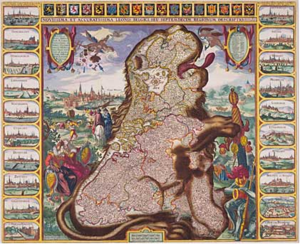
, before the division of the Low Countries into a southern and a northern half in the 16th century, the name referred to the entire Low Countries
Low Countries
The Low Countries are the historical lands around the low-lying delta of the Rhine, Scheldt, and Meuse rivers, including the modern countries of Belgium, the Netherlands, Luxembourg and parts of northern France and western Germany....
. The Seventeen Provinces
Seventeen Provinces
The Seventeen Provinces were a personal union of states in the Low Countries in the 15th century and 16th century, roughly covering the current Netherlands, Belgium, Luxembourg, a good part of the North of France , and a small part of Western Germany.The Seventeen Provinces were originally held by...
of the Low Countries
Low Countries
The Low Countries are the historical lands around the low-lying delta of the Rhine, Scheldt, and Meuse rivers, including the modern countries of Belgium, the Netherlands, Luxembourg and parts of northern France and western Germany....
were then divided into the independent Belgica Foederata or the federal Dutch Republic
Dutch Republic
The Dutch Republic — officially known as the Republic of the Seven United Netherlands , the Republic of the United Netherlands, or the Republic of the Seven United Provinces — was a republic in Europe existing from 1581 to 1795, preceding the Batavian Republic and ultimately...
and the Belgica Regia or the royal Southern Netherlands under the Habsbourgian crown. For example, several contemporary maps of the Dutch Republic
Dutch Republic
The Dutch Republic — officially known as the Republic of the Seven United Netherlands , the Republic of the United Netherlands, or the Republic of the Seven United Provinces — was a republic in Europe existing from 1581 to 1795, preceding the Batavian Republic and ultimately...
, which consisted of the Northern Netherlands, and therefore has almost no overlap with the country of Belgium, show the Latin title Belgium Foederatum.
In a Belgian Latin-French dictionary (edited in Brussels in 1826 by P. J. De Mat) the word "Belga" is translated as "Flamand" (Flemish).