

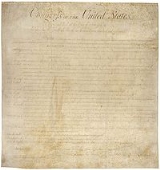
List of amendments to the United States Constitution

Encyclopedia
This is the complete list of all the ratified and unratified amendments to the United States Constitution
which received the approval of the United States Congress
. Twenty-seven amendments have been ratified since the original signing of the Constitution, the first ten of which are known collectively as the Bill of Rights
. The procedure for amending the United States Constitution
is governed by Article V of the original text
. There have been many other proposals for amendments to the United States Constitution introduced in Congress, but not submitted to the states.
Before an amendment can take effect, it must be proposed to the states by a two-thirds vote of both houses of Congress or by a convention called by two-thirds of the states, and ratified by three-fourths of the states or by three-fourths of conventions thereof, the method of ratification being determined by Congress at the time of proposal. To date, no convention for proposing amendments has been called by the states, and only once - in 1933 for the ratification of the twenty-first amendment
- has the convention method of ratification been employed.
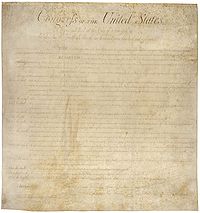 Six amendments have been passed by Congress and proposed but then did not get ratified by the appropriate number of states' legislatures. Four of these amendments are still technically pending before state lawmakers, one has expired by its own terms, and one has expired by the terms of the resolution proposing it (though that expiration is disputed).
United States Constitution
The Constitution of the United States is the supreme law of the United States of America. It is the framework for the organization of the United States government and for the relationship of the federal government with the states, citizens, and all people within the United States.The first three...
which received the approval of the United States Congress
United States Congress
The United States Congress is the bicameral legislature of the federal government of the United States, consisting of the Senate and the House of Representatives. The Congress meets in the United States Capitol in Washington, D.C....
. Twenty-seven amendments have been ratified since the original signing of the Constitution, the first ten of which are known collectively as the Bill of Rights
United States Bill of Rights
The Bill of Rights is the collective name for the first ten amendments to the United States Constitution. These limitations serve to protect the natural rights of liberty and property. They guarantee a number of personal freedoms, limit the government's power in judicial and other proceedings, and...
. The procedure for amending the United States Constitution
United States Constitution
The Constitution of the United States is the supreme law of the United States of America. It is the framework for the organization of the United States government and for the relationship of the federal government with the states, citizens, and all people within the United States.The first three...
is governed by Article V of the original text
Article Five of the United States Constitution
Article Five of the United States Constitution describes the process whereby the Constitution may be altered. Altering the Constitution consists of proposing an amendment and subsequent ratification....
. There have been many other proposals for amendments to the United States Constitution introduced in Congress, but not submitted to the states.
Before an amendment can take effect, it must be proposed to the states by a two-thirds vote of both houses of Congress or by a convention called by two-thirds of the states, and ratified by three-fourths of the states or by three-fourths of conventions thereof, the method of ratification being determined by Congress at the time of proposal. To date, no convention for proposing amendments has been called by the states, and only once - in 1933 for the ratification of the twenty-first amendment
Twenty-first Amendment to the United States Constitution
The Twenty-first Amendment to the United States Constitution repealed the Eighteenth Amendment to the United States Constitution, which had mandated nationwide Prohibition...
- has the convention method of ratification been employed.
Ratified amendments
| # | Amendments | Proposal date | Enactment date | Full text |
|---|---|---|---|---|
| 1st First Amendment to the United States Constitution The First Amendment to the United States Constitution is part of the Bill of Rights. The amendment prohibits the making of any law respecting an establishment of religion, impeding the free exercise of religion, abridging the freedom of speech, infringing on the freedom of the press, interfering... |
Protects the freedom of religion Freedom of religion Freedom of religion is a principle that supports the freedom of an individual or community, in public or private, to manifest religion or belief in teaching, practice, worship, and observance; the concept is generally recognized also to include the freedom to change religion or not to follow any... , speech Freedom of speech Freedom of speech is the freedom to speak freely without censorship. The term freedom of expression is sometimes used synonymously, but includes any act of seeking, receiving and imparting information or ideas, regardless of the medium used... , and the press Freedom of the press Freedom of the press or freedom of the media is the freedom of communication and expression through vehicles including various electronic media and published materials... , as well as the right to assemble Freedom of assembly Freedom of assembly, sometimes used interchangeably with the freedom of association, is the individual right to come together and collectively express, promote, pursue and defend common interests... and petition the government Right to petition in the United States In the United States the right to petition is guaranteed by the First Amendment to the federal constitution, which specifically prohibits Congress from abridging "the right of the people...to petition the Government for a redress of grievances."... |
September 25, 1789 | December 15, 1791 | Full text |
| 2nd Second Amendment to the United States Constitution The Second Amendment to the United States Constitution is the part of the United States Bill of Rights that protects the right of the people to keep and bear arms. It was adopted on December 15, 1791, along with the rest of the Bill of Rights.In 2008 and 2010, the Supreme Court issued two Second... |
Protects the right to bear arms | September 25, 1789 | December 15, 1791 | Full text |
| 3rd Third Amendment to the United States Constitution The Third Amendment to the United States Constitution is a part of the United States Bill of Rights. It was introduced on September 5, 1789, and then three quarters of the states ratified this as well as 9 other amendments on December 15, 1791. It prohibits, in peacetime, the quartering of... |
Prohibits the forced quartering of soldiers out of war time | September 25, 1789 | December 15, 1791 | Full text |
| 4th Fourth Amendment to the United States Constitution The Fourth Amendment to the United States Constitution is the part of the Bill of Rights which guards against unreasonable searches and seizures, along with requiring any warrant to be judicially sanctioned and supported by probable cause... |
Prohibits unreasonable searches and seizures Search and seizure Search and seizure is a legal procedure used in many civil law and common law legal systems whereby police or other authorities and their agents, who suspect that a crime has been committed, do a search of a person's property and confiscate any relevant evidence to the crime.Some countries have... and sets out requirements for search warrant Search warrant A search warrant is a court order issued by a Magistrate, judge or Supreme Court Official that authorizes law enforcement officers to conduct a search of a person or location for evidence of a crime and to confiscate evidence if it is found.... s based on probable cause Probable cause In United States criminal law, probable cause is the standard by which an officer or agent of the law has the grounds to make an arrest, to conduct a personal or property search, or to obtain a warrant for arrest, etc. when criminal charges are being considered. It is also used to refer to the... |
September 25, 1789 | December 15, 1791 | Full text |
| 5th Fifth Amendment to the United States Constitution The Fifth Amendment to the United States Constitution, which is part of the Bill of Rights, protects against abuse of government authority in a legal procedure. Its guarantees stem from English common law which traces back to the Magna Carta in 1215... |
Sets out rules for indictment Indictment An indictment , in the common-law legal system, is a formal accusation that a person has committed a crime. In jurisdictions that maintain the concept of felonies, the serious criminal offence is a felony; jurisdictions that lack the concept of felonies often use that of an indictable offence—an... by grand jury Grand jury A grand jury is a type of jury that determines whether a criminal indictment will issue. Currently, only the United States retains grand juries, although some other common law jurisdictions formerly employed them, and most other jurisdictions employ some other type of preliminary hearing... and eminent domain, protects the right to due process Due process Due process is the legal code that the state must venerate all of the legal rights that are owed to a person under the principle. Due process balances the power of the state law of the land and thus protects individual persons from it... , and prohibits self-incrimination Self-incrimination Self-incrimination is the act of accusing oneself of a crime for which a person can then be prosecuted. Self-incrimination can occur either directly or indirectly: directly, by means of interrogation where information of a self-incriminatory nature is disclosed; indirectly, when information of a... and double jeopardy Double jeopardy Double jeopardy is a procedural defense that forbids a defendant from being tried again on the same, or similar charges following a legitimate acquittal or conviction... |
September 25, 1789 | December 15, 1791 | Full text |
| 6th Sixth Amendment to the United States Constitution The Sixth Amendment to the United States Constitution is the part of the United States Bill of Rights which sets forth rights related to criminal prosecutions... |
Protects the right to a fair Fair Trial Fair Trial was a British Thoroughbred racehorse and Champion sire. He was bred and raced by John Arthur Dewar who also bred and raced Tudor Minstrel.... and speedy Speedy trial Speedy trial refers to one of the rights guaranteed by the United States Constitution to defendants in criminal proceedings. The right to a speedy trial, guaranteed by the Sixth Amendment, is intended to ensure that defendants are not subjected to unreasonably lengthy incarceration prior to a fair... public Public trial Public trial or open trial is a trial open to public, as opposed to the secret trial. The term should not be confused with show trial.-United States:... trial by jury Jury trial A jury trial is a legal proceeding in which a jury either makes a decision or makes findings of fact which are then applied by a judge... , including the rights to be notified of the accusation Criminal accusation A criminal accusation is the process of declaring one's belief in another's liability for that other's criminal action. A criminal accusation may be informally made through a declaration made to the public at large or by the filing of a formal accusation in a court of law by a person legally... s, to confront the accuser Confrontation Clause The Confrontation Clause of the Sixth Amendment to the United States Constitution provides that "in all criminal prosecutions, the accused shall enjoy the right…to be confronted with the witnesses against him." Generally, the right is to have a face-to-face confrontation with witnesses who are... , to obtain witnesses Subpoena A subpoena is a writ by a government agency, most often a court, that has authority to compel testimony by a witness or production of evidence under a penalty for failure. There are two common types of subpoena:... and to retain counsel Counsel A counsel or a counselor gives advice, more particularly in legal matters.-U.K. and Ireland:The legal system in England uses the term counsel as an approximate synonym for a barrister-at-law, and may apply it to mean either a single person who pleads a cause, or collectively, the body of barristers... |
September 25, 1789 | December 15, 1791 | Full text |
| 7th Seventh Amendment to the United States Constitution The Seventh Amendment to the United States Constitution, which was ratified as part of the Bill of Rights, codifies the right to a jury trial in certain civil cases. However, in some civil cases, the Supreme Court has not incorporated the right to a jury trial to the states in the fashion which... |
Provides for the right to trial by jury Jury trial A jury trial is a legal proceeding in which a jury either makes a decision or makes findings of fact which are then applied by a judge... in certain civil cases Lawsuit A lawsuit or "suit in law" is a civil action brought in a court of law in which a plaintiff, a party who claims to have incurred loss as a result of a defendant's actions, demands a legal or equitable remedy. The defendant is required to respond to the plaintiff's complaint... , according to common law Common law Common law is law developed by judges through decisions of courts and similar tribunals rather than through legislative statutes or executive branch action... |
September 25, 1789 | December 15, 1791 | Full text |
| 8th Eighth Amendment to the United States Constitution The Eighth Amendment to the United States Constitution is the part of the United States Bill of Rights which prohibits the federal government from imposing excessive bail, excessive fines or cruel and unusual punishments. The U.S. Supreme Court has ruled that this amendment's Cruel and Unusual... |
Prohibits excessive fines and excessive bail Bail Traditionally, bail is some form of property deposited or pledged to a court to persuade it to release a suspect from jail, on the understanding that the suspect will return for trial or forfeit the bail... , as well as cruel and unusual punishment Cruel and unusual punishment Cruel and unusual punishment is a phrase describing criminal punishment which is considered unacceptable due to the suffering or humiliation it inflicts on the condemned person... |
September 25, 1789 | December 15, 1791 | Full text |
| 9th Ninth Amendment to the United States Constitution The Ninth Amendment to the United States Constitution, which is part of the Bill of Rights, addresses rights of the people that are not specifically enumerated in the Constitution.-Text:-Adoption:When the U.S... |
Asserts the existence of unenumerated rights Unenumerated rights Unenumerated rights are sometimes defined as legal rights inferred from other legal rights that are officiated in a retrievable form codified by law institutions, such as in written constitutions, but are not themselves expressly coded or "enumerated" among the explicit writ of the law. ... retained by the people |
September 25, 1789 | December 15, 1791 | Full text |
| 10th Tenth Amendment to the United States Constitution The Tenth Amendment to the United States Constitution, which is part of the Bill of Rights, was ratified on December 15, 1791... |
Limits the powers of the federal government Federal government of the United States The federal government of the United States is the national government of the constitutional republic of fifty states that is the United States of America. The federal government comprises three distinct branches of government: a legislative, an executive and a judiciary. These branches and... to those delegated to it by the Constitution |
September 25, 1789 | December 15, 1791 | Full text |
| 11th Eleventh Amendment to the United States Constitution The Eleventh Amendment to the United States Constitution, which was passed by the Congress on March 4, 1794, and was ratified on February 7, 1795, deals with each state's sovereign immunity. This amendment was adopted in order to overrule the U.S. Supreme Court's decision in Chisholm v... |
Immunity of states from suits from out-of-state citizens and foreigners not living within the state borders. Lays the foundation for sovereign immunity Sovereign immunity Sovereign immunity, or crown immunity, is a legal doctrine by which the sovereign or state cannot commit a legal wrong and is immune from civil suit or criminal prosecution.... |
March 4, 1794 | February 7, 1795 | Full text |
| 12th Twelfth Amendment to the United States Constitution The Twelfth Amendment to the United States Constitution provides the procedure for electing the President and Vice President. It replaced Article II, Section 1, Clause 3, which provided the original procedure by which the Electoral College functioned. Problems with the original procedure arose in... |
Revises presidential election United States Electoral College The Electoral College consists of the electors appointed by each state who formally elect the President and Vice President of the United States. Since 1964, there have been 538 electors in each presidential election... procedures |
December 9, 1803 | June 15, 1804 | Full text |
| 13th Thirteenth Amendment to the United States Constitution The Thirteenth Amendment to the United States Constitution officially abolished and continues to prohibit slavery and involuntary servitude, except as punishment for a crime. It was passed by the Senate on April 8, 1864, passed by the House on January 31, 1865, and adopted on December 6, 1865. On... |
Abolishes slavery and involuntary servitude Involuntary servitude Involuntary servitude is a United States legal and constitutional term for a person laboring against that person's will to benefit another, under some form of coercion other than the worker's financial needs... , except as punishment for a crime |
January 31, 1865 | December 6, 1865 | Full text |
| 14th Fourteenth Amendment to the United States Constitution The Fourteenth Amendment to the United States Constitution was adopted on July 9, 1868, as one of the Reconstruction Amendments.Its Citizenship Clause provides a broad definition of citizenship that overruled the Dred Scott v... |
Defines citizenship Citizenship Citizenship is the state of being a citizen of a particular social, political, national, or human resource community. Citizenship status, under social contract theory, carries with it both rights and responsibilities... , contains the Privileges or Immunities Clause Privileges or Immunities Clause The Privileges or Immunities Clause is Amendment XIV, Section 1, Clause 2 of the United States Constitution. It states:Along with the rest of the Fourteenth Amendment, this clause became part of the Constitution on July 9, 1868.... , the Due Process Clause, the Equal Protection Clause Equal Protection Clause The Equal Protection Clause, part of the Fourteenth Amendment to the United States Constitution, provides that "no state shall ... deny to any person within its jurisdiction the equal protection of the laws"... , and deals with post-Civil War American Civil War The American Civil War was a civil war fought in the United States of America. In response to the election of Abraham Lincoln as President of the United States, 11 southern slave states declared their secession from the United States and formed the Confederate States of America ; the other 25... issues |
June 13, 1866 | July 9, 1868 | Full text |
| 15th Fifteenth Amendment to the United States Constitution The Fifteenth Amendment to the United States Constitution prohibits each government in the United States from denying a citizen the right to vote based on that citizen's "race, color, or previous condition of servitude"... |
Prohibits the denial of suffrage Suffrage Suffrage, political franchise, or simply the franchise, distinct from mere voting rights, is the civil right to vote gained through the democratic process... based on race, color, or previous condition of servitude |
February 26, 1869 | February 3, 1870 | Full text |
| 16th Sixteenth Amendment to the United States Constitution The Sixteenth Amendment to the United States Constitution allows the Congress to levy an income tax without apportioning it among the states or basing it on Census results... |
Allows the federal government to collect income tax Income tax An income tax is a tax levied on the income of individuals or businesses . Various income tax systems exist, with varying degrees of tax incidence. Income taxation can be progressive, proportional, or regressive. When the tax is levied on the income of companies, it is often called a corporate... |
July 12, 1909 | February 3, 1913 | Full text |
| 17th Seventeenth Amendment to the United States Constitution The Seventeenth Amendment to the United States Constitution established direct election of United States Senators by popular vote. The amendment supersedes Article I, § 3, Clauses 1 and 2 of the Constitution, under which senators were elected by state legislatures... |
Establishes the direct election of United States Senators United States Senate The United States Senate is the upper house of the bicameral legislature of the United States, and together with the United States House of Representatives comprises the United States Congress. The composition and powers of the Senate are established in Article One of the U.S. Constitution. Each... by popular vote |
May 13, 1912 | April 8, 1913 | Full text |
| 18th Eighteenth Amendment to the United States Constitution The Eighteenth Amendment of the United States Constitution established Prohibition in the United States. The separate Volstead Act set down methods of enforcing the Eighteenth Amendment, and defined which "intoxicating liquors" were prohibited, and which were excluded from prohibition... |
Establishes Prohibition of alcohol Prohibition in the United States Prohibition in the United States was a national ban on the sale, manufacture, and transportation of alcohol, in place from 1920 to 1933. The ban was mandated by the Eighteenth Amendment to the Constitution, and the Volstead Act set down the rules for enforcing the ban, as well as defining which... (Repealed by Twenty-first Amendment Twenty-first Amendment to the United States Constitution The Twenty-first Amendment to the United States Constitution repealed the Eighteenth Amendment to the United States Constitution, which had mandated nationwide Prohibition... ) |
December 18, 1917 | January 16, 1919 | Full text |
| 19th Nineteenth Amendment to the United States Constitution The Nineteenth Amendment to the United States Constitution prohibits any United States citizen to be denied the right to vote based on sex. It was ratified on August 18, 1920.... |
Establishes women's suffrage | June 4, 1919 | August 18, 1920 | Full text |
| 20th Twentieth Amendment to the United States Constitution The Twentieth Amendment to the United States Constitution establishes the beginning and ending of the terms of the elected federal offices. It also deals with scenarios in which there is no President-elect... |
Fixes the dates of term commencements for Congress (January 3) and the President (January 20); known as the "lame duck Lame duck (politics) A lame duck is an elected official who is approaching the end of his or her tenure, and especially an official whose successor has already been elected.-Description:The status can be due to*having lost a re-election bid... amendment" |
March 2, 1932 | January 23, 1933 | Full text |
| 21st Twenty-first Amendment to the United States Constitution The Twenty-first Amendment to the United States Constitution repealed the Eighteenth Amendment to the United States Constitution, which had mandated nationwide Prohibition... |
Repeals the Eighteenth Amendment Eighteenth Amendment to the United States Constitution The Eighteenth Amendment of the United States Constitution established Prohibition in the United States. The separate Volstead Act set down methods of enforcing the Eighteenth Amendment, and defined which "intoxicating liquors" were prohibited, and which were excluded from prohibition... |
February 20, 1933 | December 5, 1933 | Full text |
| 22nd Twenty-second Amendment to the United States Constitution The Twenty-second Amendment of the United States Constitution sets a term limit for the President of the United States. The Congress passed the amendment on March 21, 1947... |
Limits the president to two terms, or a maximum of 10 years (i.e., if a Vice President serves not more than one half of a President's term, he or she can be elected to a further two terms) | March 24, 1947 | February 27, 1951 | Full text |
| 23rd Twenty-third Amendment to the United States Constitution The Twenty-third Amendment to the United States Constitution permits citizens in the District of Columbia to vote for Electors for President and Vice President. The amendment was proposed by Congress on June 17, 1960, and ratified by the states on March 29, 1961... |
Provides for representation of Washington, D.C. Washington, D.C. Washington, D.C., formally the District of Columbia and commonly referred to as Washington, "the District", or simply D.C., is the capital of the United States. On July 16, 1790, the United States Congress approved the creation of a permanent national capital as permitted by the U.S. Constitution.... in the Electoral College |
June 16, 1960 | March 29, 1961 | Full text |
| 24th Twenty-fourth Amendment to the United States Constitution The Twenty-fourth Amendment prohibits both Congress and the states from conditioning the right to vote in federal elections on payment of a poll tax or other types of tax... |
Prohibits the revocation of voting rights due to the non-payment of poll tax Poll tax A poll tax is a tax of a portioned, fixed amount per individual in accordance with the census . When a corvée is commuted for cash payment, in effect it becomes a poll tax... es |
September 14, 1962 | January 23, 1964 | Full text |
| 25th Twenty-fifth Amendment to the United States Constitution The Twenty-fifth Amendment to the United States Constitution deals with succession to the Presidency and establishes procedures both for filling a vacancy in the office of the Vice President, as well as responding to Presidential disabilities... |
Codifies the Tyler Precedent; defines the process of presidential succession | July 6, 1965 | February 10, 1967 | Full text |
| 26th Twenty-sixth Amendment to the United States Constitution The Twenty-sixth Amendment to the United States Constitution limited the minimum voting age to no more than 18. It was adopted in response to student activism against the Vietnam War and to partially overrule the Supreme Court's decision in Oregon v. Mitchell... |
Establishes the official voting age to be 18 years old | March 23, 1971 | July 1, 1971 | Full text |
| 27th Twenty-seventh Amendment to the United States Constitution The Twenty-seventh Amendment prohibits any law that increases or decreases the salary of members of the Congress from taking effect until the start of the next set of terms of office for Representatives... |
Prevents laws affecting Congressional salary from taking effect until the beginning of the next session of Congress | September 25, 1789 | May 5 or 7, 1992 | Full text |
Proposed amendments
| Amendment | Date Proposed | Status | Subject |
|---|---|---|---|
| Congressional Apportionment Amendment | September 25, 1789 | Still pending before state lawmakers | Apportionment Apportionment (politics) Apportionment is the process of allocating political power among a set of principles . In most representative governments, political power has most recently been apportioned among constituencies based on population, but there is a long history of different approaches.The United States Constitution,... of U.S. Representatives |
| Titles of Nobility Amendment Titles of Nobility amendment The Titles of Nobility Amendment was proposed as an amendment to the United States Constitution in 1810. Upon approval of a resolution offered by U.S. Senator Philip Reed of Maryland, during the 2nd Session of the 11th Congress, TONA was submitted to the state legislatures for ratification... |
May 1, 1810 | Still pending before state lawmakers | Prohibition of titles of nobility |
| Corwin Amendment Corwin amendment The Corwin Amendment is a proposed amendment to the United States Constitution passed by the 36th Congress, 2nd Session, on March 2, 1861, in the form of House Resolution No. 80... |
March 2, 1861 | Still pending before state lawmakers | Preservation of slavery Slavery Slavery is a system under which people are treated as property to be bought and sold, and are forced to work. Slaves can be held against their will from the time of their capture, purchase or birth, and deprived of the right to leave, to refuse to work, or to demand compensation... |
| Child Labor Amendment Child Labor Amendment The Child Labor Amendment is a proposed and still-pending amendment to the United States Constitution offered by Republican Ohio Congressman Israel Moore Foster on April 26, 1924, during the 68th Congress, in the form of House Joint Resolution No. 184.... |
June 2, 1924 | Still pending before state lawmakers | Congressional power to regulate child labor Child labor Child labour refers to the employment of children at regular and sustained labour. This practice is considered exploitative by many international organizations and is illegal in many countries... |
| Equal Rights Amendment Equal Rights Amendment The Equal Rights Amendment was a proposed amendment to the United States Constitution. The ERA was originally written by Alice Paul and, in 1923, it was introduced in the Congress for the first time... |
March 22, 1972 | Expired 1979 or 1982 (some scholars disagree -- see main article), though possibly still able to be ratified as deadline has previously been extended and deadline was not placed in the Amendment's text. | Prohibition of inequality of men and women |
| District of Columbia Voting Rights Amendment District of Columbia Voting Rights Amendment The District of Columbia Voting Rights Amendment was a proposed amendment to the United States Constitution that would have given the District of Columbia full representation in the United States Congress, full representation in the Electoral College system, and full participation in the process by... |
August 22, 1978 | Expired 1985; cannot be revived as the deadline was in the amendment's text. | D.C. voting rights District of Columbia voting rights Voting rights of citizens in the District of Columbia differ from those of United States citizens in each of the fifty states. District of Columbia residents do not have voting representation in the United States Senate, but D.C. is entitled to three electoral votes for President. In the U.S... |
See also
- Convention to propose amendments to the United States Constitution
- State ratifying conventions
External links
- The Constitution of the United States of America: Analysis and Interpretation is available at:
- GPO Access - Official version of the document at the U.S. Government Printing Office.
- FindLaw – FindLawFindLawFindLaw is a business of Thomson Reuters that provides online legal information and online marketing services for law firms. FindLaw was created by Stacy Stern, Martin Roscheisen and Tim Stanley in 1995, and was acquired by Thomson West in 2001....
's version of the official document; incorporates 1996 and 1998 supplements into text, but does not include prefatory material included in official version. - Constitutional Amendments contains original document scan, transcribed text, PDF, Word, online stream and MP3 version for Amendments 1-27.
- U.S. Constitution Online