
All Topics  
United States Bill of Rights


   Email Print
   Bookmark   Link


United States Bill of Rights


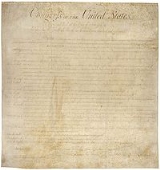
In the United States, the Bill of Rights is the name by which the first ten amendments to the United States Constitution
United States Constitution

The Constitution of the United States of America is the supreme law of the United States. It is the foundation and source of the legal authority underlying the existence of the United States of America; the Federal Government of the United States; and all the State & local governments and Territorial Administrative bodies contained therein....
 are known. They were introduced by James Madison
James Madison

James Madison was an American politician and political philosopher who served as the List of Presidents of the United States President of the United States , and one of the Founding Fathers of the United States....
 to the First United States Congress in 1789 as a series of constitutional amendment
Constitutional amendment

An amendment is a change to the Constitution of a nation or a state. In jurisdictions with "rigid" or "entrenched" constitutions, amendments require a special procedure different from that used for enacting ordinary laws....
s, and came into effect on December 15, 1791, when they had been ratified by three-fourths of the States
United States Constitution

The Constitution of the United States of America is the supreme law of the United States. It is the foundation and source of the legal authority underlying the existence of the United States of America; the Federal Government of the United States; and all the State & local governments and Territorial Administrative bodies contained therein....
. Thomas Jefferson was the main proponent of the Bill of Rights.

The Bill of Rights prohibits Congress
United States Congress

The United States Congress is the Bicameralism legislature of the Federal government of the United States of the United States of America, consisting of two houses, the United States Senate and the United States House of Representatives....
 from making any law respecting an establishment of religion
Established Church

An established church is a Church body officially sanctioned and supported by the government of a country, e.g. the Church of England and the Church of Scotland in the United Kingdom....
, forbids infringement of the right to keep and bear arms, by Congress or citizens in a federal territory and prohibits the federal government from depriving any person of life, liberty
Liberty

Liberty, the freedom to act or believe without being stopped by unnecessary force, is generally considered in modern time to be a concept of political philosophy and identifies the condition in which an individual has the right to act according to his or her own free will....
, or property
Property

Property is any physical or virtual entity that is ownership by an individual or jointly by a group of individuals. An owner of property has the right to consumption, sell, Renting, mortgage, transfer and exchange his or her property....
, without due process
Due process

Due process is the principle that the government must respect all of the legal rights that are owed to a person according to the law of the land, instead of respecting merely some or most of those legal rights....
 of law.


Discussion
Ask a question about 'United States Bill of Rights'
Start a new discussion about 'United States Bill of Rights'
Answer questions from other users
Full Discussion Forum


Recent Posts


Quotations


Like the government, corporations must be bound with the chains of the Constitution, and especially of the Bill of Rights.

The very first item in our Bill of Rights is freedom of the press, freedom of speech.

We have the Bill of Rights. What we need is a Bill of Responsibilities.

A Bill of Rights is what the people are entitled to against every government on earth, general or particular, and what no just government should refuse, or rest on inferences.

The Bill of Rights is a born rebel. It reeks with sedition. In every clause it shakes its fist in the face of constituted authority... it is the one guaranty of human freedom to the American people.

The Declaration of rights is like all other human blessings alloyed with some inconveniences, and not accomplishing fully its object. But the good in this instance vastly overweighs the evil.


Encyclopedia


In the United States, the Bill of Rights is the name by which the first ten amendments to the United States Constitution
United States Constitution

The Constitution of the United States of America is the supreme law of the United States. It is the foundation and source of the legal authority underlying the existence of the United States of America; the Federal Government of the United States; and all the State & local governments and Territorial Administrative bodies contained therein....
 are known. They were introduced by James Madison
James Madison

James Madison was an American politician and political philosopher who served as the List of Presidents of the United States President of the United States , and one of the Founding Fathers of the United States....
 to the First United States Congress in 1789 as a series of constitutional amendment
Constitutional amendment

An amendment is a change to the Constitution of a nation or a state. In jurisdictions with "rigid" or "entrenched" constitutions, amendments require a special procedure different from that used for enacting ordinary laws....
s, and came into effect on December 15, 1791, when they had been ratified by three-fourths of the States
United States Constitution

The Constitution of the United States of America is the supreme law of the United States. It is the foundation and source of the legal authority underlying the existence of the United States of America; the Federal Government of the United States; and all the State & local governments and Territorial Administrative bodies contained therein....
. Thomas Jefferson was the main proponent of the Bill of Rights.

The Bill of Rights prohibits Congress
United States Congress

The United States Congress is the Bicameralism legislature of the Federal government of the United States of the United States of America, consisting of two houses, the United States Senate and the United States House of Representatives....
 from making any law respecting an establishment of religion
Established Church

An established church is a Church body officially sanctioned and supported by the government of a country, e.g. the Church of England and the Church of Scotland in the United Kingdom....
, forbids infringement of the right to keep and bear arms, by Congress or citizens in a federal territory and prohibits the federal government from depriving any person of life, liberty
Liberty

Liberty, the freedom to act or believe without being stopped by unnecessary force, is generally considered in modern time to be a concept of political philosophy and identifies the condition in which an individual has the right to act according to his or her own free will....
, or property
Property

Property is any physical or virtual entity that is ownership by an individual or jointly by a group of individuals. An owner of property has the right to consumption, sell, Renting, mortgage, transfer and exchange his or her property....
, without due process
Due process

Due process is the principle that the government must respect all of the legal rights that are owed to a person according to the law of the land, instead of respecting merely some or most of those legal rights....
 of law. In federal criminal cases, it requires indictment
Indictment

In the common law legal system, an indictment is a formal accusation that a person has committed a criminal offense. In those jurisdictions which retain the concept of a felony, the serious criminal offense would be a felony; those jurisdictions which have abolished the concept of a felony often substitute the concept of an indictable offenc...
 by grand jury
Grand jury

In the common law, a grand jury is a type of jury that determines whether there is enough evidence for a Criminal procedure. Grand juries carry out this duty by examining evidence presented to them by a prosecutor and issuing indictments, or by investigating alleged crimes and issuing Wiktionary:presentments....
 for any capital
Capital punishment

Capital punishment, the death penalty or execution, is the killing of a person by procedural law for Punishment#Retribution and Punishment#Incapacitation....
 or "infamous crime", guarantees a speedy public trial
Trial (law)

In law, a trial is an event in which parties come together to a dispute present information in a formal setting, usually a court, before a judge, jury, or other designated finder of fact, in order to achieve a resolution to their dispute....
 with an impartial jury
Jury trial

A jury trial is a legal proceeding in which a jury either makes a decision or makes findings of fact which are then applied by a judge. It is be distinguished from a bench trial, in which a judge or panel of judges make all decisions....
 composed of members of the state or judicial district in which the crime occurred, and prohibits double jeopardy
Double jeopardy

Double jeopardy is a procedural defense that forbids a defendant from being trial twice for the same crime on the same set of facts. At common law a defendant may plead autrefois acquit or autrefois convict , meaning the defendant has been acquitted or convicted of the same offense....
. In addition, the Bill of Rights states that "the enumeration in the Constitution, of certain rights, shall not be construed to deny or disparage others retained by the people," and reserves all powers not granted to the federal government to the citizenry
United States nationality law

Article_I_of_the_US_Constitution#Enumerated_powers of the United States Constitution expressly gives the United States Congress the power to establish a uniform rule of naturalization....
 or States
U.S. state

A U.S. state is any one of the 50 state of the United States that share sovereignty with the federal government of the United States . Because of this shared sovereignty, an United States is a citizen both of the federal entity and of his or her state of Domicile ....
. Most of these restrictions were later applied to the states
Incorporation (Bill of Rights)

Incorporation is the United States legal doctrine by which portions of the United States Bill of Rights are applied to the U.S. state through the Due process#Interpretation of Due Process Clause in U.S....
 by a series of decisions applying the due process clause of the Fourteenth Amendment
Fourteenth Amendment to the United States Constitution

The Fourteenth Amendment to the United States Constitution is one of the post-American Civil War Reconstruction Amendments that was first intended to secure the rights of former Slavery in the United States....
, which was ratified in 1868, after the American Civil War
American Civil War

The American Civil War , also known as the War Between the States and several Naming the American Civil War, was a civil war in the United States....
.

Madison proposed the Bill of Rights while ideological conflict between Federalists
Federalism (United States)

'Federalism in the United States' is the evolving relationship between U.S. state governments and the federal government of the United States....
 and anti-Federalists
Anti-Federalism

Anti-Federalism refers to a movement that opposed the creation of a stronger U.S. federal government and which later opposed the ratification of the United States Constitution of 1787....
, dating from the 1787 Philadelphia Convention
Philadelphia Convention

The Philadelphia Convention took place from May 25 to September 17, 1787, in Philadelphia, Pennsylvania, to address problems in governing the United States of America, which had been operating under the Articles of Confederation following independence from Kingdom of Great Britain....
, threatened the overall ratification of the new national Constitution. It largely responded to the Constitution's influential opponents, including prominent Founding Fathers
Founding Fathers of the United States

The Founding Fathers of the United States were the political leaders who signed the United States Declaration of Independence or otherwise participated in the American Revolution as leaders of the Patriot s, or who participated in drafting the United States Constitution eleven years later....
, who argued that the Constitution should not be ratified because it failed to protect the basic principles of human liberty
Liberty

Liberty, the freedom to act or believe without being stopped by unnecessary force, is generally considered in modern time to be a concept of political philosophy and identifies the condition in which an individual has the right to act according to his or her own free will....
. The Bill was influenced by George Mason
George Mason

George Mason IV was an United States Patriot , statesman, and delegate from Virginia to the U.S. Constitutional Convention. Along with James Madison, he is called the "Father of the Bill of Rights." For these reasons he is considered one of the "Founding Fathers of the United States" of the United States....
's 1776 Virginia Declaration of Rights
Virginia Declaration of Rights

The Virginia Declaration of Rights is a document drafted in 1776 to proclaim the inherent natural rights of men, including the right to rebel against "inadequate" government....
, the 1689 English Bill of Rights, works of the Age of Enlightenment
Age of Enlightenment

The Age of Enlightenment or The Enlightenment is a term used to describe a time in Western philosophy and cultural life centered upon the eighteenth century, in which rationalism was advocated as the primary source and legitimacy for authority....
 pertaining to natural rights
Natural rights

Some philosophy and political science make a distinction between natural and legal rights. Natural rights are rights which are not contingent upon the laws, customs, or beliefs of a particular society or polity....
, and earlier English
Kingdom of England

The Kingdom of England was, from 927 to 1707, a state in North-West Europe. The Kingdom of England spanned the southern two-thirds of the island of Great Britain and a number of smaller outlying islands?what is today the legal unit of England and Wales....
 political documents such as Magna Carta
Magna Carta

Magna Carta , also called Magna Carta Libertatum , is an Kingdom of England legal charter, originally issued in the year 1215. It was written in Latin....
 (1215).

Two additional articles were proposed to the States; only the final ten articles were ratified quickly and correspond to the First through Tenth Amendments to the Constitution. The first Article
Article The First

Article the First is the first List of amendments to the United States Constitution#Unratified proposed amendments to the United States Constitution though it has not yet been ratified....
, dealing with the number and apportionment of U.S. Representatives
United States House of Representatives

The United States House of Representatives, commonly referred to as "the House", is one of the bicameralism of the United States Congress; the other is the United States Senate....
, never became part of the Constitution. The second Article, limiting the ability of Congress to increase the salaries of its members, was ratified two centuries later as the 27th Amendment
Twenty-seventh Amendment to the United States Constitution

The Twenty-seventh Amendment is the most recent Article Five of the United States Constitution to the United States Constitution, having been ratified in 1992, more than 202 years after its initial submission in 1789....
. Though they are incorporated into the document known as the "Bill of Rights", neither article establishes a right
Right

Rights are legal or moral entitlements or permissions. Rights are of vital importance in theories of justice and deontology.Many contemporary notions of rights are Universality and egalitarianism, with equal rights granted to all people....
 as that term is used today. For that reason, and also because the term had been applied to the first ten amendments long before the 27th Amendment was ratified, the term "Bill of Rights" in modern U.S. usage means only the ten amendments ratified in 1791.

The Bill of Rights plays a central role in American law
Law of the United States

The law of the United States was originally largely derived from the common law system of English law, which was in force at the time of the American Revolutionary War....
 and government, and remains a fundamental symbol of the freedoms and culture
Culture of the United States

The development of the culture of the United States of America ? Music of the United States, Cinema of the United States, Dance of the United States, Architecture of the United States, Literature of the United States, Poetry of the United States, Cuisine of the United States and the Visual arts of the United States ? has been marked by a tens...
 of the nation. One of the original fourteen copies of the Bill of Rights is on public display at the National Archives
National Archives and Records Administration

The United States National Archives and Records Administration is an Independent agencies of the United States government charged with preserving and documenting government and historical records and with increasing public access to those documents....
 in Washington, D.C.
Washington, D.C.

Washington, D.C. , formally the District of Columbia and commonly referred to as Washington, the District, or simply D.C., is the Capital of the United States, founded on July 16, 1790....


Text of the Bill of Rights


Preamble

The Preamble to the Bill of Rights:

Congress of the United States begun and held at the City of New-York, on Wednesday the fourth of March, one thousand seven hundred and eighty nine.


THE Conventions of a number of the States, having at the time of their adopting the Constitution, expressed a desire, in order to prevent misconstruction or abuse of its powers, that further declaratory and restrictive clauses should be added: And as extending the ground of public confidence in the Government, will best ensure the beneficent ends of its institution.


RESOLVED by the Senate and House of Representatives of the United States of America, in Congress assembled, two thirds of both Houses concurring, that the following Articles be proposed to the Legislatures of the several States, as amendments to the Constitution of the United States, all, or any of which Articles, when ratified by three fourths of the said Legislatures, to be valid to all intents and purposes, as part of the said Constitution; viz.


ARTICLES in addition to, and Amendment of the Constitution of the United States of America, proposed by Congress, and ratified by the Legislatures of the several States, pursuant to the fifth Article of the original Constitution.


Amendments

  • First Amendment
    First Amendment to the United States Constitution

    The First Amendment to the United States Constitution is the part of the United States Bill of Rights that expressly prohibits the United States Congress from making laws "Establishment Clause of the First Amendment" or that prohibit the Free Exercise Clause of the First Amendment, laws that infringe the Freedom of speech in the United State...
     Establishment Clause
    Establishment Clause of the First Amendment

    The Establishment Clause of the First Amendment refers to the first of several pronouncements in the First Amendment to the United States Constitution, stating that "United States Congress shall make no law respecting an establishment of religion"....
    , Free Exercise Clause
    Free Exercise Clause of the First Amendment

    The Free Exercise Clause is the accompanying clause with the Establishment Clause of the First Amendment to the United States Constitution. The Establishment Clause and the Free Exercise Clause together read:...
    ; freedom of speech
    Freedom of speech

    Freedom of speech is the freedom to speak freely without censorship or limitation. The synonymous term freedom of expression is sometimes used to denote not only freedom of verbal speech but any act of seeking, receiving and imparting information or ideas, regardless of the medium used....
    , of the press
    Freedom of the press

    Freedom of the press consists ofconstitutional or Statute protections pertaining to the Mass media and published materials.With respect to governmental information, any government distinguishes which materials are public or protected from disclosure to the public based on classified information as sensitive, classified or secret and being...
    , and of assembly
    Freedom of assembly

    Freedom of assembly, sometimes used interchangeably with the freedom of association, is the individual right to come together with other individuals and collectively express, promote, pursue and defend common interests....
    ; right to petition
    Right to petition in the United States

    The right to petition in the United States is guaranteed by the First Amendment to the United States Constitution to the United States Constitution, and specifically prohibits United States Congress from abridging "the right of the people...to petition the Government for a redress of grievances." Although often overlooked in favor of other m...


Congress shall make no law respecting an establishment of religion, or prohibiting the free exercise thereof; or abridging the freedom of speech, or of the press; or the right of the people peaceably to assemble, and to petition the Government for a redress of grievances.


  • Second Amendment
    Second Amendment to the United States Constitution

    The Second Amendment to the United States Constitution is the part of the United States Bill of Rights that protects a right to keep and bear arms....
     Right to keep and bear arms.
A well regulated Militia, being necessary to the security of a free State, the right of the people to keep and bear Arms, shall not be infringed.


  • Third Amendment
    Third Amendment to the United States Constitution

    The Third Amendment to the United States Constitution is a part of the United States Bill of Rights. It was introduced by James Madison on September 5, 1789, and then three-fourths of the states ratified this as well as 9 others on December 15, 1791....
     Protection from quartering
    Quartering Act

    Quartering Act is the name of at least two Act of Parliament of the Parliament of Great Britain. The Quartering Acts were used by the British forces in the American colonies to ensure that British troops had adequate housing and provisions....
     of troops.
No Soldier shall, in time of peace be quartered in any house, without the consent of the Owner, nor in time of war, but in a manner to be prescribed by law.


  • Fourth Amendment
    Fourth Amendment to the United States Constitution

    The Fourth Amendment to the United States Constitution is the part of the United States Bill of Rights which guards against unreasonable search and seizure....
     Protection from unreasonable search and seizure
    Search and seizure

    Search and seizure is a legal procedure used in many Civil law and common law legal systems whereby police or other authorities and their agents, who suspect that a crime has been committed, do a search of a person's property and confiscate any relevant evidence to the crime....
    .
The right of the people to be secure in their persons, houses, papers, and effects, against unreasonable searches and seizures, shall not be violated, and no Warrants
Warrant (law)

Most often, the term warrant refers to a specific type of authorization; a writ issued by a competent officer, usually a judge or magistrate, which wikt:commands an otherwise illegal act that would violate individual rights and affords the person executing the writ protection from damages if the act is performed....
 shall issue, but upon probable cause, supported by Oath or affirmation, and particularly describing the place to be searched, and the persons or things to be seized.


  • Fifth Amendment
    Fifth Amendment to the United States Constitution

    The Fifth Amendment of the United States Constitution, which is part of the United States Bill of Rights, protects against abuse of government authority in a legal procedure....
     due process
    Due process

    Due process is the principle that the government must respect all of the legal rights that are owed to a person according to the law of the land, instead of respecting merely some or most of those legal rights....
    , double jeopardy
    Double jeopardy

    Double jeopardy is a procedural defense that forbids a defendant from being trial twice for the same crime on the same set of facts. At common law a defendant may plead autrefois acquit or autrefois convict , meaning the defendant has been acquitted or convicted of the same offense....
    , self-incrimination
    Self-incrimination

    Self-incrimination is the act of accusing oneself of a crime for which a person can then be prosecuted. Self-incrimination can occur either directly or indirectly: directly, by means of interrogation where information of a self-incriminatory nature is disclosed; indirectly, when information of a self-incriminatory nature is disclosed voluntar...
    , eminent domain
    Eminent domain

    Eminent domain , compulsory purchase , resumption/compulsory acquisition or expropriation in common law legal systems is the inherent power of the state to seize a citizen's Property, expropriation property, or seize a citizen's rights in property with due monetary compensation, but without the owner's consent....
    .
No person shall be held to answer for any capital, or otherwise infamous crime, unless on a presentment or indictment of a Grand Jury, except in cases arising in the land or naval forces, or in the Militia, when in actual service in time of War or public danger; nor shall any person be subject for the same offence to be twice put in jeopardy of life or limb; nor shall be compelled in any criminal case to be a witness against himself, nor be deprived of life, liberty, or property, without due process of law; nor shall private property be taken for public use, without just compensation.


  • Sixth Amendment
    Sixth Amendment to the United States Constitution

    The Sixth Amendment to the United States Constitution is the part of the United States Bill of Rights which sets forth rights related to criminal prosecutions in federal courts....
     Trial by jury
    Trial by Jury

    Trial by Jury is a comic opera in one act, with music by Arthur Sullivan and libretto by W. S. Gilbert. It was first produced on 25 March 1875, at London's Royalty Theatre, where it initially ran for 131 performances and was considered a hit, receiving critical praise and outrunning its popular companion piece, Jacques Offenbach's...
     and rights of the accused
    Rights of the accused

    The Rights of the Accused is a class of rights that apply to a person in the time period between when they are formally accused of a crime and when they are either convicted or acquitted....
    ; Confrontation Clause
    Confrontation Clause

    The Confrontation Clause of the Sixth Amendment to the United States Constitution provides that "in all criminal prosecutions, the accused shall enjoy the right...to be confronted with the witnesses against him."...
    , speedy trial
    Speedy trial

    Speedy trial refers to one of the rights guaranteed by the United States Constitution to defendants in criminal law proceedings. The right to a speedy trial, guaranteed by the sixth Amendment to the United States Constitution, is intended to ensure that defendants are not subjected to unreasonably lengthy incarceration prior to a fair trial....
    , public trial
    Public trial

    Public trial or open trial is a trial open to public, as opposed to the secret trial. The term should not be confused with show trial....
    , right to counsel
    Right to counsel

    Right to counsel is currently generally regarded as a constituent of the right to a fair trial, allowing for the defendant to be assisted by counsel , and if he cannot afford his own lawyer, requiring that the government should appoint one for him, or pay his legal expenses....
In all criminal prosecutions, the accused shall enjoy the right to a speedy and public trial, by an impartial jury of the State and district where in the crime shall have been committed, which district shall have been previously ascertained by law, and to be informed of the nature and cause of the accusation; to be confronted with the witnesses against him; to have compulsory process for obtaining witnesses in his favor, and to have the Assistance of Counsel for his defense.


  • Seventh Amendment
    Seventh Amendment to the United States Constitution

    The Seventh Amendment of the United States Constitution, which is part of the United States Bill of Rights, codifies the right to a jury trial in certain civil trials....
     Civil
    Civil law (common law)

    Civil law, as opposed to criminal law, refers to that branch of law dealing with disputes between individuals and/or organizations, in which damages may be awarded to the victim....
     trial by jury.
In suits at common law, where the value in controversy shall exceed twenty dollars, the right of trial by jury shall be preserved, and no fact tried by a jury, shall be otherwise re-examined in any court of the United States, than according to the rules of the common law.


  • Eighth Amendment
    Eighth Amendment to the United States Constitution

    The Eighth Amendment to the United States Constitution is the part of the United States Bill of Rights which prohibits the Federal government of the United States from imposing excessive bail, excessive fines or cruel and unusual punishments....
     Prohibition of excessive bail
    Excessive bail

    The Excessive bail provision of the Eighth Amendment to the United States Constitution is based on an old England common law right of Englishmen and the British Bill of Rights....
     and cruel and unusual punishment
    Cruel and unusual punishment

    Cruel and unusual punishment is a statement implying that governments shall not inflict such treatment for crimes, regardless of their degree of severity....
    .
Excessive bail shall not be required, nor excessive fines imposed, nor cruel and unusual punishments inflicted.


  • Ninth Amendment
    Ninth Amendment to the United States Constitution

    Amendment IX to the United States Constitution, which is part of the United States Bill of Rights, addresses rights of the people that are Unenumerated rights in the Constitution....
     Protection of rights not specifically enumerated in the Bill of Rights.
The enumeration in the Constitution, of certain rights, shall not be construed to deny or disparage others retained by the people.


  • Tenth Amendment
    Tenth Amendment to the United States Constitution

    The Tenth Amendment of the United States Constitution, which is part of the United States Bill of Rights, was ratified on December 15, 1791. The Tenth Amendment restates the Constitution's principle of Federalism by providing that powers not granted to the National government nor prohibited to the states are reserved to the states and to the...
     Powers of states and people.
The powers not delegated to the United States by the Constitution, nor prohibited by it to the states, are reserved to the states respectively, or to the people.


Proposed amendments not passed with Bill of Rights


  • Article I Apportionment
    Article The First

    Article the First is the first List of amendments to the United States Constitution#Unratified proposed amendments to the United States Constitution though it has not yet been ratified....
    .
After the first enumeration required by the first article of the Constitution, there shall be one representative for every thirty thousand, until the number shall amount to one hundred, after which the proportion shall be so regulated by Congress, that there shall be not less than one hundred representatives, nor less than one representative for every forty thousand persons, until the number of representatives shall amount to two hundred; after which the proportion shall be so regulated by Congress, that there shall be not less than two hundred representatives, nor more than one representative for every fifty thousand persons.


  • Article II (ratified in 1992 as Twenty-seventh Amendment
    Twenty-seventh Amendment to the United States Constitution

    The Twenty-seventh Amendment is the most recent Article Five of the United States Constitution to the United States Constitution, having been ratified in 1992, more than 202 years after its initial submission in 1789....
    ) Congressional pay raises.
No law varying the compensation for the services of the Senators and Representatives, shall take effect, until an election of Representatives shall have intervened.


Background

The Philadelphia Convention
Philadelphia Convention

The Philadelphia Convention took place from May 25 to September 17, 1787, in Philadelphia, Pennsylvania, to address problems in governing the United States of America, which had been operating under the Articles of Confederation following independence from Kingdom of Great Britain....
 set out to correct weaknesses inherent in the Articles of Confederation
Articles of Confederation

The Articles of Confederation and Perpetual Union was the constitution of the revolutionary wartime alliance of the thirteen United States. The Articles' ratification was completed in 1781, and legally federated several sovereign and independent states, allied under the Articles of Association into a new federation styled the "United States...
 that had been apparent even before the American Revolutionary War
American Revolutionary War

The American Revolutionary War , also known as the American War of Independence, began as a war between the Kingdom of Great Britain and Thirteen Colonies on the North America, and ended in a global war between several European great powers....
 had been successfully concluded. The newly constituted Federal government included a strong executive branch, a stronger legislative branch and an independent judiciary
Judiciary

In law, the judiciary is the system of courts which administer justice in the name of the Sovereignty or state, a mechanism for the dispute resolution....
.

Arguments against the Bill of Rights

See also: Federalist Papers
Federalist Papers

The Federalist Papers are a series of List of Federalist Papers advocating the History of the United States Constitution#Ratification of the United States United States Constitution....
.
Alexander Hamilton
The idea of adding a bill of rights to the Constitution was originally controversial. Alexander Hamilton
Alexander Hamilton

Alexander Hamilton was the first Secretary of the Treasury, a Founding Fathers of the United States, economist, and political philosopher. He led calls for the Philadelphia Convention, was one of America's first Constitutional lawyers, and cowrote the Federalist Papers, a primary source for Constitutional interpretation....
, in Federalist No. 84
Federalist No. 84

Federalist No. 84 , an essay entitled "Certain General and Miscellaneous Objections to the Constitution Considered and Answered," is one of the Federalist Papers by Alexander Hamilton, published under the pseudonym Publius on May 28 1788....
, argued against a "Bill of Rights," asserting that ratification of the Constitution did not mean the American people were surrendering their rights, and therefore that protections were unnecessary: "Here, in strictness, the people surrender nothing, and as they retain every thing, they have no need of particular reservations." Critics pointed out that earlier political documents had protected specific rights, but Hamilton argued that the Constitution was inherently different:

Bills of rights are in their origin, stipulations between kings and their subjects, abridgments of prerogative
Prerogative

In law, a prerogative is an exclusive right given from a government or state and invested in an individual or group, the content of which is separate from the body of rights enjoyed under the general law of the normative state....
 in favor of privilege, reservations of rights not surrendered to the prince. Such was "Magna Charta
Magna Carta

Magna Carta , also called Magna Carta Libertatum , is an Kingdom of England legal charter, originally issued in the year 1215. It was written in Latin....
", obtained by the Barons, swords in hand, from King John
John of England

John reigned as List of English monarchs from 6 April 1199, until his death. He succeeded to the throne as the younger brother of King Richard I of England, who died without issue....
.


Finally, Hamilton expressed the fear that protecting specific rights might imply that any unmentioned rights would not be protected:
I go further, and affirm that bills of rights, in the sense and in the extent in which they are contended for, are not only unnecessary in the proposed constitution, but would even be dangerous. They would contain various exceptions to powers which are not granted; and on this very account, would afford a colorable pretext to claim more than were granted. For why declare that things shall not be done which there is no power to do?


Essentially, Hamilton and other Federalists believed in the British system of common law
Common law

Common law refers to law and the corresponding Legal systems of the world developed through legal opinion of courts and similar tribunals , rather than through statute law or Executive ....
 which did not define or quantify natural rights
Natural rights

Some philosophy and political science make a distinction between natural and legal rights. Natural rights are rights which are not contingent upon the laws, customs, or beliefs of a particular society or polity....
. They believed that adding a Bill of Rights to the Constitution would limit their rights to those listed in the Constitution. This is the primary reason the Ninth Amendment
Ninth Amendment to the United States Constitution

Amendment IX to the United States Constitution, which is part of the United States Bill of Rights, addresses rights of the people that are Unenumerated rights in the Constitution....
 was included.

The Anti-Federalists

Patrick Henry
See also: Anti-Federalism
Anti-Federalism

Anti-Federalism refers to a movement that opposed the creation of a stronger U.S. federal government and which later opposed the ratification of the United States Constitution of 1787....
, Anti-Federalist Papers
Anti-Federalist Papers

The Anti-Federalist Papers are a collection of articles, written in opposition to the ratification of the 1787 United States United States Constitution....
.


Following the Philadelphia Convention, some famous revolutionary
American Revolution

The American Revolution refers to the political upheaval during the last half of the 18th century in which the Thirteen Colonies of North America overthrew the governance of the British Empire and then rejected the British monarchy to become the sovereign United States of America....
 figures and statesmen, such as Patrick Henry
Patrick Henry

Patrick Henry was a prominent figure in the American Revolution, known and remembered for his "Give me Liberty, or give me Death!" speech. Along with Samuel Adams and Thomas Paine, he is remembered as one of the most influential advocates of the American Revolution and Republicanism in the United States, especially in his denunciations of c...
, publicly argued against the Constitution. Many were concerned that the strong national government proposed by the Federalists was a threat to individual rights
Individual rights

Individual rights refer to the rights of individuals, in contrast with group rights. An individual right is the sanction of independent action....
 and that the President
President of the United States

The President of the United States is the head of state and head of government of the United States and is the highest political official in the United States by influence and recognition....
 would become a king, and objected to the federal court system in the proposed Constitution.

Thomas Jefferson
Thomas Jefferson

Thomas Jefferson was the List of Presidents of the United States President of the United States , the principal author of the United States Declaration of Independence , and one of the most influential Founding Fathers of the United States for his promotion of the ideals of republicanism in the United States....
, at the time serving as Ambassador to France
Early Modern France

Early Modern France is the early modern period of French history from the end of the 15th century to the end of the 18th century . During this period France evolved from a feudalism regime to an increasingly centralized state organized around a powerful absolute monarchy that relied on the doctrine of the Divine Right of Kings and the explic...
, wrote to Madison advocating a Bill of Rights: "Half a loaf is better than no bread. If we cannot secure all our rights, let us secure what we can." George Mason
George Mason

George Mason IV was an United States Patriot , statesman, and delegate from Virginia to the U.S. Constitutional Convention. Along with James Madison, he is called the "Father of the Bill of Rights." For these reasons he is considered one of the "Founding Fathers of the United States" of the United States....
 refused to sign the proposed Constitution, in part to protest its lack of a Bill of Rights.

In a paper later collected into the Anti-Federalist papers
Anti-Federalist Papers

The Anti-Federalist Papers are a collection of articles, written in opposition to the ratification of the 1787 United States United States Constitution....
, the pseudonym
Pseudonym

A pseudonym, , is a fictitious alternative to a person's legal name. In some cases, pseudonyms are adopted because it is part of a cultural or organizational tradition, as in the case of Religious names used by members of some religious orders and "cadre names" used by Communist party leaders such as Leon Trotsky and Joseph Stalin....
ous "Brutus
Brutus

Brutus is a Ancient Rome Roman naming convention used by several politicians of the Junius family, especially in the Roman Republic. The plural of Brutus is Bruti, and the Vocative case form is Brute, as immortalized in the quotation "Et tu, Brute?"....
" (probably Robert Yates
Robert Yates (politician)

Robert Yates was a United States politician well known for his Anti-Federalism stances. Most scholars believe that he was the author of a series of sixteen articles written against the ratification of the United States Constitution under the pseudonym Brutus after Marcus Junius Brutus, who helped assassinate Julius Caesar in order to preser...
) wrote,
We find they have, in the ninth section of the first article
Article One of the United States Constitution

Article One of the United States Constitution describes the powers of the legislature of the Federal government of the United States, known as United States Congress, which includes the United States House of Representatives and the United States Senate....
 declared, that the writ of habeas corpus
Habeas corpus

For the Living Things CD, see Habeas Corpus Habeas corpus is a legal action, or writ, through which a person can seek justice from the unlawful detention of him or herself, or of another person....
 shall not be suspended, unless in cases of rebellion — that no bill of attainder
Bill of attainder

A bill of attainder is an act of legislature declaring a person or group of persons guilty of some crime and punishing them without benefit of a trial....
, or ex post facto
Ex Post Facto

Ex Post Facto may refer to:* Ex Post Facto , the eighth episode of Star Trek: Voyager* An ex post facto law, a law that retroactively changes the legal consequences of acts committed prior to the enactment of the law...
 law, shall be passed — that no title of nobility
Nobility

Nobility is a government-privileged title which may be either hereditary or for a lifetime. Titles of nobility exist today in many countries although it is usually associated with present or former monarchies....
 shall be granted by the United States, etc. If every thing which is not given is reserved, what propriety is there in these exceptions? Does this Constitution any where grant the power of suspending the habeas corpus, to make ex post facto laws, pass bills of attainder, or grant titles of nobility? It certainly does not in express terms. The only answer that can be given is, that these are implied in the general powers granted. With equal truth it may be said, that all the powers which the bills of rights guard against the abuse of, are contained or implied in the general ones granted by this Constitution.


Brutus continued with an implication directed against the Framers
Founding Fathers of the United States

The Founding Fathers of the United States were the political leaders who signed the United States Declaration of Independence or otherwise participated in the American Revolution as leaders of the Patriot s, or who participated in drafting the United States Constitution eleven years later....
:
Ought not a government, vested with such extensive and indefinite authority, to have been restricted by a declaration of rights? It certainly ought. So clear a point is this, that I cannot help suspecting that persons who attempt to persuade people that such reservations were less necessary under this Constitution than under those of the States, are wilfully endeavoring to deceive, and to lead you into an absolute state of vassalage.


Ratification and the Massachusetts Compromise

Individualism
Individualism

Individualism is the Morality stance, political philosophy, or social outlook that stresses independence and self-reliance. Individualists promote the exercise of one's goals and desires, while opposing most external interference upon one's choices, whether by society, or any other group or institution....
 was the strongest element of opposition; the necessity, or at least the desirability, of a bill of rights was almost universally felt, and the Anti-Federalists were able to play on these feelings in the ratification convention in Massachusetts
Massachusetts

The Commonwealth of Massachusetts is a U.S. state located in the New England region of the Northeastern United States United States. It borders Rhode Island and Connecticut to the south, New York to the west, and Vermont and New Hampshire to the north....
. By this stage, five of the states had ratified the Constitution with relative ease; however, the Massachusetts convention was bitter and contentious:

In Massachusetts, the Constitution ran into serious, organized opposition. Only after two leading Anti-federalists, Adams
Samuel Adams

Samuel Adams was a statesman, Political philosophy, and one of the Founding Fathers of the United States. As a politician in Province of Massachusetts Bay, Adams was a leader of the movement that became the American Revolution, and was one of the architects of the principles of Republicanism in the United States that shaped the political cul...
 and Hancock
John Hancock

John Hancock was a merchant, statesman, and prominent Patriot of the American Revolution. He served as President of the Continental Congress of the Second Continental Congress and was the first Governor of Massachusetts of the Massachusetts....
, negotiated a far-reaching compromise did the convention vote for ratification on February 6, 1788 (187–168). Anti-federalists had demanded that the Constitution be amended before they would consider it or that amendments be a condition of ratification; Federalists had retorted that it had to be accepted or rejected as it was. Under the Massachusetts compromise, the delegates recommended amendments to be considered by the new Congress, should the Constitution go into effect. The Massachusetts compromise determined the fate of the Constitution, as it permitted delegates with doubts to vote for it in the hope that it would be amended.


Four of the next five states to ratify, including New Hampshire
New Hampshire

New Hampshire is a U.S. state in the New England region of the Northeastern United States United States of America. The state was named after the southern English Counties of England of Hampshire....
, Virginia
Virginia

The Commonwealth of Virginia is an United States U.S. state on the East Coast of the United States of the Southern United States. The state is known as the "Old Dominion" and sometimes as "Mother of Presidents", because it is the birthplace of Lists of United States Presidents by place of birth#By state....
, and New York
New York

The State of New York is a U.S. state in the Mid-Atlantic States and Northeastern United States regions of the United States and is the nation's List of U.S....
, included similar language in their ratification instruments. They all sent recommendations for amendments with their ratification documents to the new Congress. Since many of these recommendations pertained to safeguarding personal rights, this pressured Congress to add a Bill of Rights after Constitutional ratification. Additionally, North Carolina
North Carolina

North Carolina is a U.S. state located on the Atlantic Seaboard in the southeastern United States. The state borders South Carolina and Georgia to the south, Tennessee to the west and Virginia to the north....
 refused to ratify the Constitution until progress was made on the issue of the Bill of Rights. Thus, while the Anti-Federalists were unsuccessful in their quest to prevent the adoption of the Constitution, their efforts were not totally in vain.

Jamesmadison
After the Constitution was ratified in 1789, the 1st United States Congress
1st United States Congress

The 1st United States Congress, consisting of the United States Senate and the United States House of Representatives, met from March 4, 1789 to March 3, 1791, during the first two years of George Washington's President of the United States, first at Federal Hall at 26 Wall Street in New York City and later at Congress Hall in Philadelphia...
 met in Federal Hall
Federal Hall

Federal Hall, located at 26 Wall Street in New York City, was the first capitol of the United States of America and the site of George Washington's first inauguration in 1789....
 in New York City
New York City

The City of New York is the List of United States cities by population in the United States, while the New York metropolitan area ranks among the List of urban areas by population....
. Most of the delegates agreed that a "bill of rights" was needed and most of them agreed on the rights they believed should be enumerated.

Madison, at the head of the Virginia delegation of the 1st Congress, had originally opposed a Bill of Rights but hoped to pre-empt a second Constitutional Convention
Constitutional convention (political meeting)

A constitutional convention is a gathering for the purpose of writing a new constitution or revising an existing constitution. A general constitutional convention is called to create the first constitution of a political unit or to entirely replace an existing constitution....
 that might have undone the difficult compromises of 1787: a second convention would open the entire Constitution to reconsideration and could undermine the work he and so many others had done in establishing the structure of the United States Government. Writing to Jefferson, he stated, "The friends of the Constitution...wish the revisal to be carried no farther than to supply additional guards for liberty...and are fixed in opposition to the risk of another Convention....It is equally certain that there are others who urge a second Convention with the insidious hope of throwing all things into Confusion, and of subverting the fabric just established, if not the Union itself."

Madison based much of the Bill of Rights on George Mason
George Mason

George Mason IV was an United States Patriot , statesman, and delegate from Virginia to the U.S. Constitutional Convention. Along with James Madison, he is called the "Father of the Bill of Rights." For these reasons he is considered one of the "Founding Fathers of the United States" of the United States....
's Virginia Declaration of Rights
Virginia Declaration of Rights

The Virginia Declaration of Rights is a document drafted in 1776 to proclaim the inherent natural rights of men, including the right to rebel against "inadequate" government....
 (1776), which itself had been written with Madison's input. He carefully considered the state amendment recommendations as well. He looked for recommendations shared by many states to avoid controversy and reduce opposition to the ratification of the future amendments. Additionally, Madison's work on the Bill of Rights reflected centuries of English law and philosophy, further modified by the principles of the American Revolution
American Revolution

The American Revolution refers to the political upheaval during the last half of the 18th century in which the Thirteen Colonies of North America overthrew the governance of the British Empire and then rejected the British monarchy to become the sovereign United States of America....
.

Antecedents


Locke
Madison
To some degree, the Bill of Rights (and the American Revolution) incorporated the ideas of John Locke, who argued in his 1689 work Two Treatises of Government
Two Treatises of Government

The Two Treatises of Government is a work of political philosophy published anonymously in 1689 by John Locke. The First Treatise attacks patriarchalism in the form of sentence-by-sentence refutation of Robert Filmer's Patriarcha and the Second Treatise outlines a theory of political or Civil_society#Pre-modern_history based...
 that civil society
Civil society

Civil society is composed of the totality of voluntary civic and social organizations and institutions that form the basis of a functioning society as opposed to the force-backed structures of a state and commercial institutions of the market....
 was created for the protection of property (Latin
Latin

Latin is an Italic language, historically spoken in Latium and Ancient Rome. Through the Military history of the Roman Empire, Latin spread throughout the Mediterranean and a large part of Europe....
 proprius, or that which is one's own, meaning "life, liberty, and estate"). Locke also advanced the notion that each individual is free and equal in the state of nature
State of nature

State of nature is a term in political philosophy used in social contract theories to describe the hypothetical condition of humanity before the state's foundation and its monopoly on the legitimate use of physical force....
. Locke expounded on the idea of natural rights that are inherent to all individuals, a concept Madison mentioned in his speech presenting the Bill of Rights to the 1st Congress. Locke's argument for protecting economic rights against government may have been most salient to the framers of the Amendments; quartering and cruel punishments were not the current abuses of 1791.

Virginia Declaration of Rights
The Virginia Declaration of Rights, well-known to Madison, had already been a strong influence on the American Revolution ("all power is vested in, and consequently derived from, the people …"; also "a majority of the community hath an indubitable, unalienable, and indefeasible right to reform, alter or abolish [the government]"). It had shaped the drafting of the United States Declaration of Independence
United States Declaration of Independence

The United States Declaration of Independence is a statement adopted by the Second Continental Congress on July 4, 1776, which announced that the Thirteen Colonies then at war with Kingdom of Great Britain were now independent states, and thus no longer a part of the British Empire....
 a decade before the drafting of the Constitution, proclaiming that "all men are by nature equally free and independent, and have certain inherent rights of which … [they cannot divest;] namely, the enjoyment of life and liberty, with the means of acquiring and possessing property, and pursuing and obtaining happiness and safety." On a practical level, its recommendations of a government with a separation of powers
Separation of powers

Separation of powers, a term ascribed to France Age of Enlightenment political philosopher Charles de Secondat, baron de Montesquieu, is a model for the governance of democracy states, having its origins in an ancient idea of mixed government....
 (Articles 5–6) and "frequent, certain, and regular" elections
Elections in the United States

The United States has a federalism, with elected officials at federal , state and local level. On a national level, the head of state, the President of the United States, is elected indirectly by the people, through electors of an United States Electoral College....
 of executives and legislators were incorporated into the United States Constitution — but the bulk of this work addresses the rights of the people and restrictions on the powers of government, and is recognizable in the modern Bill of Rights:

The government should not have the power of suspending or executing laws, "without consent of the representatives of the people,". A legal defendant has the right to be "confronted with the accusers and witnesses, to call for evidence in his favor, and to a speedy trial by an impartial jury of his vicinage," and may not be "compelled to give evidence against himself." Individuals should be protected against "cruel and unusual punishment
Cruel and unusual punishment

Cruel and unusual punishment is a statement implying that governments shall not inflict such treatment for crimes, regardless of their degree of severity....
s", baseless search and seizure
Search and seizure

Search and seizure is a legal procedure used in many Civil law and common law legal systems whereby police or other authorities and their agents, who suspect that a crime has been committed, do a search of a person's property and confiscate any relevant evidence to the crime....
, and be guaranteed a trial by jury
Jury trial

A jury trial is a legal proceeding in which a jury either makes a decision or makes findings of fact which are then applied by a judge. It is be distinguished from a bench trial, in which a judge or panel of judges make all decisions....
. The government should not abridge freedom of the press
Freedom of the press

Freedom of the press consists ofconstitutional or Statute protections pertaining to the Mass media and published materials.With respect to governmental information, any government distinguishes which materials are public or protected from disclosure to the public based on classified information as sensitive, classified or secret and being...
, or freedom of religion
Freedom of religion

Freedom of religion is a principle that supports the freedom of an individual or community, in public or private, to manifest religion or belief in religious education, practice, worship, and observance....
 ("all men are equally entitled to the free exercise of religion"). The government should be enjoined against maintaining a standing army
Standing army

A standing army is an army composed of full-time career soldiers who 'stand over', in other words, who do not disband during times of peace. They differ from army reserves who are activated only during such times as war or natural disasters....
 rather than a "well regulated militia
Militia

The term militia is commonly used today to refer to a military force composed of ordinary citizens to provide defense, emergency law enforcement, or paramilitary service, in times of emergency without being paid a regular salary or committed to a fixed term of service....
".

English Bill of Rights
The English Bill of Rights (1689), one of the fundamental documents of English constitutional law, differed substantially in form and intent from the American Bill of Rights, because it was intended to address the rights of citizens as represented by Parliament against the Crown
The Crown

Throughout the Commonwealth realms, the Crown is an abstract metonymy concept which represents the legal authority for the existence of any government....
. However, some of its basic tenets are adopted and extended to the general public by the U.S. Bill of Rights, including

  • the right of petition
  • an independent judiciary (the Sovereign was forbidden to establish his own courts or to act as a judge himself),
  • freedom from taxation by royal (executive) prerogative, without agreement by Parliament (legislators),
  • freedom from a peace-time standing army,
  • freedom [for Protestant
    Protestantism

    Protestantism is a movement within Christianity that originated in the sixteenth-century Protestant Reformation. It is considered to be one of the three principal traditions of Christianity, together with Roman Catholicism and Eastern Orthodoxy....
    s] to bear arms for their defence, as allowed by law,
  • freedom to elect members of Parliament without interference from the Sovereign,
  • freedom of speech in Parliament,
  • freedom from cruel and unusual punishments and excessive bail
    Bail

    Traditionally, bail is some form of property deposited or pledged to a court in order to persuade it to release a suspect from County jail, on the understanding that the suspect will return for trial or forfeit the bail ....
    , and
  • freedom from fines and forfeitures without trial.


Madison's preemptive proposal

On June 8, 1789, Madison submitted his proposal to Congress. In his speech to Congress on that day, Madison said:

For while we feel all these inducements to go into a revisal of the constitution, we must feel for the constitution itself, and make that revisal a moderate one. I should be unwilling to see a door opened for a re-consideration of the whole structure of the government, for a re-consideration of the principles and the substance of the powers given; because I doubt, if such a door was opened, if we should be very likely to stop at that point which would be safe to the government itself: But I do wish to see a door opened to consider, so far as to incorporate those provisions for the security of rights, against which I believe no serious objection has been made by any class of our constituents.


Prior to listing his proposals for a number of constitutional amendments, Madison acknowledged a major reason for some of the discontent with the Constitution as written:

I believe that the great mass of the people who opposed [the Constitution], disliked it because it did not contain effectual provision against encroachments on particular rights, and those safeguards which they have been long accustomed to have interposed between them and the magistrate who exercised the sovereign power: nor ought we to consider them safe, while a great number of our fellow citizens think these securities necessary.


Ratification process

On November 20, 1789, New Jersey
New Jersey

New Jersey is a state in the Mid-Atlantic States and Northeastern United States regions of the United States. It is bordered on the north by New York, on the east by the Hudson River and the Atlantic Ocean, on the southwest by Delaware, and on the west by Pennsylvania....
 became the first state to ratify these amendments. On December 15, 1791, 10 of these proposals became the First through Tenth Amendments — and United States law — when they were ratified by the Virginia legislature.

Articles III to XII were ratified by 11/14 states (> 75%). Article I, rejected by Delaware
Delaware

Delaware is a U.S. state located on the East Coast of the United States in the Mid-Atlantic States region of the United States. The state takes its name from Thomas West, 3rd Baron De La Warr, a British nobleman and Virginia's first colonial governor, after whom Cape Henlopen was originally named....
, was ratified only by 10/14 States (< 75%), and despite later ratification by Kentucky
Kentucky

The Commonwealth of Kentucky is a U.S. state located in the East Central United States of America. Kentucky is normally included in the group of Southern United States , but it is uncommonly included, geographically and culturally, in the Midwestern United States....
 (11/15 states < 75%), the article has never since received the approval of enough states for it to become part of the Constitution. Article II was ratified by 6/14, later 7/15 states, but did not receive the 3/4 majority of States needed for ratification until 1992 when it became the 27th Amendment
Twenty-seventh Amendment to the United States Constitution

The Twenty-seventh Amendment is the most recent Article Five of the United States Constitution to the United States Constitution, having been ratified in 1992, more than 202 years after its initial submission in 1789....
.

Ratification dates

  • New Jersey
    New Jersey

    New Jersey is a state in the Mid-Atlantic States and Northeastern United States regions of the United States. It is bordered on the north by New York, on the east by the Hudson River and the Atlantic Ocean, on the southwest by Delaware, and on the west by Pennsylvania....
    , November 20, 1789; rejected article II
  • Maryland
    Maryland

    Maryland is a U.S. state located in the Mid Atlantic States of the United States, bordering Virginia, West Virginia and the Washington, D.C. to the south and west, Pennsylvania to the north, and Delaware to the east....
    , December 19, 1789; approved all
  • North Carolina
    North Carolina

    North Carolina is a U.S. state located on the Atlantic Seaboard in the southeastern United States. The state borders South Carolina and Georgia to the south, Tennessee to the west and Virginia to the north....
    , December 22, 1789; approved all
  • South Carolina
    South Carolina

    South Carolina is a U.S. state in the Southern United States of the United States. It borders Georgia to the south and North Carolina to the north....
    , January 19, 1790; approved all
  • New Hampshire
    New Hampshire

    New Hampshire is a U.S. state in the New England region of the Northeastern United States United States of America. The state was named after the southern English Counties of England of Hampshire....
    , January 25, 1790; rejected article II
  • Delaware
    Delaware

    Delaware is a U.S. state located on the East Coast of the United States in the Mid-Atlantic States region of the United States. The state takes its name from Thomas West, 3rd Baron De La Warr, a British nobleman and Virginia's first colonial governor, after whom Cape Henlopen was originally named....
    , January 28, 1790; rejected article I
  • New York
    New York

    The State of New York is a U.S. state in the Mid-Atlantic States and Northeastern United States regions of the United States and is the nation's List of U.S....
    , February 27, 1790; rejected article II
  • Pennsylvania
    Pennsylvania

    The Commonwealth of Pennsylvania , often colloquially referred to as PA by natives and Northeasterners, is a U.S. state located in the Northeastern United States and Mid-Atlantic States regions of the United States....
    , March 10, 1790; rejected article II
  • Rhode Island
    Rhode Island

    Rhode Island and Providence Plantations, more commonly referred to as Rhode Island , is a U.S. state in the New England region of the United States....
    , June 7, 1790; rejected article II
  • Vermont
    Vermont

    Vermont is a U.S. state in the New England region of the Northeastern United States United States. The state ranks 43rd by land area, , and 45th by total area....
    , November 3, 1791; approved all
  • Virginia
    Virginia

    The Commonwealth of Virginia is an United States U.S. state on the East Coast of the United States of the Southern United States. The state is known as the "Old Dominion" and sometimes as "Mother of Presidents", because it is the birthplace of Lists of United States Presidents by place of birth#By state....
    , December 15, 1791; approved all


Later consideration

Lawmakers in Kentucky, which became the 15th state to join the Union
List of U.S. states by date of statehood

This is a list of U.S. states by date of statehood, or is it that is, the date when each U.S. state joined the United States. Although the Thirteen Colonies can be considered to have been members of the United States from the date of the United States Declaration of Independence – Thursday, July 4, 1776 – they are p...
 in June 1792, ratified the entire set of twelve proposals during that commonwealth
Commonwealth (United States)

Four of the constituent U.S. state of the United States officially designate themselves Commonwealths: Kentucky, Massachusetts, Pennsylvania, and Virginia....
's initial month of statehood, perhaps unaware — given the nature of long-distance communications in the 1700s — that Virginia's approval six months earlier had already made ten of the package of twelve part of the Constitution.

Although ratification made the Bill of Rights effective in 1791, three of the original thirteen states — Connecticut
Connecticut

Connecticut is a U.S. state located in the New England region of the northeastern United States. The state borders New York to the west and south , Massachusetts to the north, and Rhode Island to the east....
, Georgia
Georgia (U.S. state)

Georgia is a U.S. state in the United States and was one of the original Thirteen Colonies that revolted against United Kingdom rule in the American Revolution....
, and Massachusetts
Massachusetts

The Commonwealth of Massachusetts is a U.S. state located in the New England region of the Northeastern United States United States. It borders Rhode Island and Connecticut to the south, New York to the west, and Vermont and New Hampshire to the north....
 — did not "ratify" the first ten amendments until 1939, when they were urged to do so in a celebration of the 150th anniversary of their passage by Congress.

Copies of the Bill of Rights

Fourteen copies of the Bill of Rights were made, one for the federal government and one for each of the original thirteen states:
  • Connecticut
  • Delaware
  • Georgia
  • Maryland
  • Massachusetts
  • New Hampshire
  • New Jersey
  • New York
  • North Carolina
  • Pennsylvania
  • Rhode Island
  • South Carolina
  • Virginia


The copies for Georgia, Maryland, New York, and Pennsylvania are missing. The New York copy is thought to have been destroyed in a fire while the Pennsylvania copy reportedly disappeared in the later 18th century. Two unidentified copies of the missing four (thought to be the Georgia and Maryland copies) survive; one is in the Library of Congress
Library of Congress

The Library of Congress is the de facto national library of the United States and the research arm of the United States Congress. Located in three buildings in Washington, D.C., it is the largest library in the world by shelf space and holds the largest number of books....
 and the other is in the New York Public Library
New York Public Library

The New York Public Library is one of the leading Public library of the world and is one of the United States's most significant research libraries....
.

North Carolina's copy was stolen by a union soldier in April 1865 and returned to North Carolina in 2005, 140 years later.

Incorporation extends to States

Originally, the Bill of Rights restrictions applied only to the federal government and not to the several state governments. Parts of the amendments initially proposed by Madison that would have limited state governments ("No state shall violate the equal rights of conscience, or the freedom of the press, or the trial by jury in criminal cases.") were not approved by Congress, and therefore the Bill of Rights did not apply to the powers of state governments.

States had established state churches
State religion

A state religion is a religion body or creed officially endorsed by the state. Practically, a state without a state religion is called a secular state....
 up until the 1820s, and Southern states
Southern United States

The Southern United States—commonly referred to as the American South, Dixie, or simply the South—constitutes a large distinctive region in the southeastern and south-central United States....
, beginning in the 1830s, could ban abolitionist
Abolitionism

File:BLAKE10.JPGAbolitionism was a movement to end the slave trade and emancipate slaves in western Europe and the Americas. The slave system aroused little protest until the 18th century, when rationalist thinkers of the Age of Enlightenment criticized it for violating the rights of man, and Quaker and other evangelical religious groups con...
 literature. In the 1833 case Barron v. Baltimore
Barron v. Baltimore

Barron v. Mayor of Baltimore, Case citation established a precedent on whether the United States Bill of Rights could be applied to state governments....
, the Supreme Court
Supreme Court of the United States

The Supreme Court of the United States is the highest judicial body in the United States, and leads the federal United States federal courts. It consists of the Chief Justice of the United States and eight Associate Justice of the Supreme Court of the United States, who are nominated by the President of the United States and confirmed with th...
 specifically ruled that the Bill of Rights provided "security against the apprehended encroachments of the general government—not against those of local governments." In the Gitlow v. New York, 268 U.S. 652, (1925) case, the Supreme Court ruled that the Fourteenth Amendment
Fourteenth Amendment to the United States Constitution

The Fourteenth Amendment to the United States Constitution is one of the post-American Civil War Reconstruction Amendments that was first intended to secure the rights of former Slavery in the United States....
, which had been adopted in 1868, could make certain applications of the Bill of Rights applicable to the states. However, the Gitlow case stated (p. 666): "For present purposes we may and do presume that freedom of speech and of the press - which are protected by the First Amendment from abridgment by Congress - are among the fundamental personal rights and 'liberties' protected by the due process clause of the Fourteenth Amendment from impairment by the States." However at p. 668, the Court held: "It does not protect publications prompting the overthrow of government by force", which Gitlow and associates advocated in their publications. The Supreme Court has cited Gitlow v. New York as precedent for a series of decisions that made most, but not all, of the provisions of the Bill of Rights restrictions applicable to the states under the doctrine of selective incorporation.

Display and honoring of the Bill of Rights

In 1941, President Franklin D. Roosevelt
Franklin D. Roosevelt

Franklin Delano Roosevelt , often referred to by his initials FDR, was the List of Presidents of the United States President of the United States....
 declared December 15 to be Bill of Rights Day, commemorating the 150th anniversary of the ratification of the Bill of Rights.

The Bill of Rights is on display at the National Archives and Records Administration
National Archives and Records Administration

The United States National Archives and Records Administration is an Independent agencies of the United States government charged with preserving and documenting government and historical records and with increasing public access to those documents....
, in the Rotunda for the Charters of Freedom.

The Rotunda itself was constructed in the 1950s and dedicated in 1952 by President Harry S Truman, who said, "Only as these documents are reflected in the thoughts and acts of Americans, can they remain symbols of power that can move the world. That power is our faith in human liberty …."

After fifty years, signs of deterioration in the casing were noted, while the documents themselves appeared to be well-preserved: "But if the ink of 1787 was holding its own, the encasements of 1951 were not … minute crystals and microdroplets of liquid were found on surfaces of the two glass sheets over each document.... The CMS scans confirmed evidence of progressive glass deterioration, which was a major impetus in deciding to re-encase the Charters of Freedom."

Accordingly, the casing was updated and the Rotunda rededicated on September 17, 2003. In his dedicatory remarks, two hundred and sixteen years after the close of the Constitutional Convention, President George W. Bush
George W. Bush

George Walker Bush served as the List of Presidents of the United States President of the United States from 2001 to 2009. He was the 46th List of Governors of Texas from 1995 to 2000 before being United States presidential inauguration as President on January 20, 2001....
 stated, "The true [American] revolution was not to defy one earthly power, but to declare principles that stand above every earthly power—the equality of each person before God, and the responsibility of government to secure the rights of all."

In 1991, the Bill of Rights toured the country in honor of its bicentennial, visiting the capitals of all fifty states.

See also

  • Bill of Rights
    Bill of rights

    A Bill of Rights is a list or summary of rights that are considered important and essential by a nation. The purpose of these bills is to protect those rights against infringement by the government....
  • Bill of Rights Defense Committee
    Bill of Rights Defense Committee

    The national Bill of Rights Defense Committee is a nonpartisan, nonprofit organization which encourages local communities to take an active role in the ongoing national debate about threats to civil liberties guaranteed by the Bill of Rights, such as the USA PATRIOT Act, NSA warrantless surveillance controversy, and the Military Commissions...
  • G. I. Bill of Rights
  • Institute of Bill of Rights Law
    Institute of Bill of Rights Law

    The Institute of Bill of Rights Law , founded in 1982, is one of the most renowned centers for the study of constitutional law in the world. It is located at the College of William & Mary's Marshall-Wythe School of Law in Williamsburg, Virginia, United States....
  • Taxpayer Bill of Rights
    Taxpayer Bill of Rights

    The Taxpayer Bill of Rights is a concept advocated by certain conservatism and libertarianism groups, primarily in the United States, as a way of limiting the growth of government by requiring increases in overall tax revenue be tied to inflation and population increases....
  • U.S. Patients' Bill of Rights
    U.S. Patients' Bill of Rights

    A Patient's Bill of Rights is a statement of the rights to which patients are entitled as recipients of medical care. Typically, a statement articulates the positive rights which doctors and hospitals ought to provide patients, thereby providing information, offering fair treatment, and granting them autonomy over medical decisions....
  • United States Declaration of Independence
    United States Declaration of Independence

    The United States Declaration of Independence is a statement adopted by the Second Continental Congress on July 4, 1776, which announced that the Thirteen Colonies then at war with Kingdom of Great Britain were now independent states, and thus no longer a part of the British Empire....
  • United States Constitution
    United States Constitution

    The Constitution of the United States of America is the supreme law of the United States. It is the foundation and source of the legal authority underlying the existence of the United States of America; the Federal Government of the United States; and all the State & local governments and Territorial Administrative bodies contained therein....
  • Virginia Statute for Religious Freedom
    Virginia Statute for Religious Freedom

    The Virginia Statute for Religious Freedom was written in 1779 by Thomas Jefferson. In 1786, the Virginia General Assembly enacted the statute into the state's law....


Bibliography


External links


U.S Government sites

  • National Archives:
  • Library of Congress:
  • Footnote.com (partners with the National Archives):


Related documents

  • , on opposition to the Bill of Rights
  • House and Senate procedure and dates concerning the :) drafting of the Bill of Rights:


History and analysis