


District of Columbia voting rights

Encyclopedia
United States
The United States of America is a federal constitutional republic comprising fifty states and a federal district...
citizens in each of the fifty states. District of Columbia
Washington, D.C.
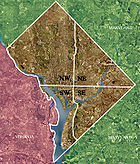
Washington, D.C., formally the District of Columbia and commonly referred to as Washington, "the District", or simply D.C., is the capital of the United States. On July 16, 1790, the United States Congress approved the creation of a permanent national capital as permitted by the U.S. Constitution....
residents do not have voting representation in the United States Senate
United States Senate
The United States Senate is the upper house of the bicameral legislature of the United States, and together with the United States House of Representatives comprises the United States Congress. The composition and powers of the Senate are established in Article One of the U.S. Constitution. Each...
, but D.C. is entitled to three electoral votes for President
President of the United States
The President of the United States of America is the head of state and head of government of the United States. The president leads the executive branch of the federal government and is the commander-in-chief of the United States Armed Forces....
. In the U.S. House of Representatives, the District is entitled to a delegate
Delegate (United States Congress)
A delegate to Congress is a non-voting member of the United States House of Representatives who is elected from a U.S. territory and from Washington, D.C. to a two-year term. While unable to vote in the full House, a non-voting delegate may vote in a House committee of which the delegate is a member...
, who is not allowed to vote on the floor of the House, but can vote on procedural matters and in House committees
United States Congressional committee
A congressional committee is a legislative sub-organization in the United States Congress that handles a specific duty . Committee membership enables members to develop specialized knowledge of the matters under their jurisdiction...
.
The United States Constitution
United States Constitution
The Constitution of the United States is the supreme law of the United States of America. It is the framework for the organization of the United States government and for the relationship of the federal government with the states, citizens, and all people within the United States.The first three...
grants congressional voting representation to the states, which the District is not. The District is a federal territory ultimately under the complete authority of Congress
District of Columbia home rule
District of Columbia home rule is a term to describe the various means by which residents of the District of Columbia are able to govern their local affairs...
. The lack of voting representation in Congress for residents of the U.S. capital has been an issue since the foundation of the federal district. Numerous proposals have been introduced to change this situation including legislation and constitutional amendments to grant D.C. residents voting representation, returning the District to the state of Maryland
Maryland
Maryland is a U.S. state located in the Mid Atlantic region of the United States, bordering Virginia, West Virginia, and the District of Columbia to its south and west; Pennsylvania to its north; and Delaware to its east...
, and making the District of Columbia into a new state. All proposals have been met with political or constitutional challenges; therefore, there has been no change in the District's representation in the Congress.
History
The "District Clause" in Article I, Section 8, Clause 17 of the U.S. Constitution states:In 1790, the land on which the District is formed was ceded by Maryland
Maryland
Maryland is a U.S. state located in the Mid Atlantic region of the United States, bordering Virginia, West Virginia, and the District of Columbia to its south and west; Pennsylvania to its north; and Delaware to its east...
following the passage of the Residence Act
Residence Act
The Residence Act of 1790, officially titled An Act for establishing the temporary and permanent seat of the Government of the United States, is the United States federal law that settled the question of locating the capital of the United States, selecting a site along the Potomac River...
. Virginia
Virginia
The Commonwealth of Virginia , is a U.S. state on the Atlantic Coast of the Southern United States. Virginia is nicknamed the "Old Dominion" and sometimes the "Mother of Presidents" after the eight U.S. presidents born there...
also ceded land that helped form the District, but that land was returned to Virginia in 1847. The Congress
United States Congress
The United States Congress is the bicameral legislature of the federal government of the United States, consisting of the Senate and the House of Representatives. The Congress meets in the United States Capitol in Washington, D.C....
did not officially move to the new federal capital until 1800. Shortly thereafter, the Congress passed the District of Columbia Organic Act of 1801
District of Columbia Organic Act of 1801
The District of Columbia Organic Act of 1801 is an Organic Act enacted by the United States Congress, which incorporated the District of Columbia and divided the territory into two counties: Washington County to the north and east of the Potomac River and Alexandria County...
and incorporated the new federal District under its sole authority as permitted by the District Clause. Since the District of Columbia was no longer part of any state, the District's residents lost voting representation.
Residents of Washington, D.C. were also originally barred from voting for the President of the United States
President of the United States
The President of the United States of America is the head of state and head of government of the United States. The president leads the executive branch of the federal government and is the commander-in-chief of the United States Armed Forces....
. This changed after the passage of the Twenty-third Amendment
Twenty-third Amendment to the United States Constitution
The Twenty-third Amendment to the United States Constitution permits citizens in the District of Columbia to vote for Electors for President and Vice President. The amendment was proposed by Congress on June 17, 1960, and ratified by the states on March 29, 1961...
in 1961, which grants the District three votes in the Electoral College. This right has been exercised by D.C. citizens since the presidential election of 1964
United States presidential election, 1964
The United States presidential election of 1964 was held on November 3, 1964. Incumbent President Lyndon B. Johnson had come to office less than a year earlier following the assassination of his predecessor, John F. Kennedy. Johnson, who had successfully associated himself with Kennedy's...
.
The District of Columbia Home Rule Act
District of Columbia Home Rule Act
The District of Columbia Home Rule Act is a United States federal law passed on December 24, 1973 which devolved certain congressional powers of the District of Columbia to local government, furthering District of Columbia home rule...
of 1973 devolved certain congressional powers over the District to a local government administered by an elected mayor, currently Vincent C. Gray
Vincent C. Gray
Vincent C. Gray is an American politician who is currently serving as the seventh Mayor of the District of Columbia. Prior to his inauguration as mayor in January 2011, Gray served as Chairman of the Council of the District of Columbia, and as Councilmember for Ward 7...
, and the thirteen-member Council of the District of Columbia
Council of the District of Columbia
The Council of the District of Columbia is the legislative branch of the local government of the District of Columbia. As permitted in the United States Constitution, the District is not part of any U.S. state and is instead overseen directly by the federal government...
. However, the Congress retains the right to review and overturn any of the District's laws. Each of the city's eight wards elects a single member of the council, and five members, including the chairman, are elected at large.
In 1980, District voters approved the call of a constitutional convention
Constitutional convention (political meeting)
A constitutional convention is now a gathering for the purpose of writing a new constitution or revising an existing constitution. A general constitutional convention is called to create the first constitution of a political unit or to entirely replace an existing constitution...
to draft a proposed state constitution
State constitution (United States)
In the United States, each state has its own constitution.Usually, they are longer than the 7,500-word federal Constitution and are more detailed regarding the day-to-day relationships between government and the people. The shortest is the Constitution of Vermont, adopted in 1793 and currently...
, just as U.S. territories had done prior to their admission as states. The proposed constitution was ratified by District voters in 1982 for a new state to be called "New Columbia"
District of Columbia statehood movement
The District of Columbia statehood movement is a political movement that advocates making the District of Columbia a U.S. state. Statehood would give the citizens of Washington, D.C. full representation in the United States Congress and full control over their own local affairs.Full statehood for D.C...
. However, the necessary authorization from the Congress has never been granted.
Pursuant to that proposed state constitution, the District still selects members of a shadow congressional delegation
Shadow congressperson
The offices of shadow U.S. Representative and shadow U.S. Senator are elective offices created by the District of Columbia as part of their efforts to gain full admittance to the Union as a State. The office originated with the election of the first Shadow Senators in 1796, and the position of...
, consisting of two shadow Senators and a shadow Representative, to lobby
Lobbying
Lobbying is the act of attempting to influence decisions made by officials in the government, most often legislators or members of regulatory agencies. Lobbying is done by various people or groups, from private-sector individuals or corporations, fellow legislators or government officials, or...
the Congress to grant statehood. These positions are not officially recognized by the Congress. Additionally, until May 2008, the Congress prohibited the District from spending any funds on lobbying for voting representation or statehood.
On December 29, 2003, The Inter-American Commission on Human Rights
Inter-American Commission on Human Rights
The Inter-American Commission on Human Rights is an autonomous organ of the Organization of American States .Along with the...
of the Organization of American States
Organization of American States
The Organization of American States is a regional international organization, headquartered in Washington, D.C., United States...
concluded that the United States is violating the District of Columbia's rights under Articles II and XX of the American Declaration of the Rights and Duties of Man
American Declaration of the Rights and Duties of Man
The American Declaration of the Rights and Duties of Man was the world's first international human rights instrument of a general nature, predating the Universal Declaration of Human Rights by less than a year....
by denying District of Columbia citizens
Citizenship in the United States
Citizenship in the United States is a status given to individuals that entails specific rights, duties, privileges, and benefits between the United States and the individual...
an effective opportunity to participate in the Congress. The commission reiterated the following recommendation to the United States: "Provide the Petitioners with an effective remedy, which includes adopting the legislative or other measures necessary to guarantee to the Petitioners the effective right to participate, directly or through freely chosen representatives and in general conditions of equality, in their national legislature".
A 2005 poll paid for by the advocacy group D.C. Vote, but conducted by the non-partisan polling firm KRC Research, found that 82% of 1,007 adults believed that D.C. should have full congressional voting representation. In 2007, a poll of 788 adults by The Washington Post
The Washington Post
The Washington Post is Washington, D.C.'s largest newspaper and its oldest still-existing paper, founded in 1877. Located in the capital of the United States, The Post has a particular emphasis on national politics. D.C., Maryland, and Virginia editions are printed for daily circulation...
found that 61% of those adults supported granting the District "a full voting" Representative.
Arguments for and against
There are arguments for and against giving the District of Columbia voting representation in the Congress.Consent of the governed
Basically, advocates of voting representation for the District of Columbia argue that as citizens living in the United States, the approximately 600,000 inhabitants of Washington, D.C. should have the same right to determine how they are governed as citizens of a stateU.S. state
A U.S. state is any one of the 50 federated states of the United States of America that share sovereignty with the federal government. Because of this shared sovereignty, an American is a citizen both of the federal entity and of his or her state of domicile. Four states use the official title of...
. At least as early as 1776, George Mason
George Mason
George Mason IV was an American Patriot, statesman and a delegate from Virginia to the U.S. Constitutional Convention...
wrote in the Virginia Declaration of Rights
Virginia Declaration of Rights
The Virginia Declaration of Rights is a document drafted in 1776 to proclaim the inherent rights of men, including the right to rebel against "inadequate" government...
:
Justice Hugo Black
Hugo Black
Hugo Lafayette Black was an American politician and jurist. A member of the Democratic Party, Black represented Alabama in the United States Senate from 1927 to 1937, and served as an Associate Justice of the Supreme Court of the United States from 1937 to 1971. Black was nominated to the Supreme...
described the right to vote as fundamental in Wesberry v. Sanders
Wesberry v. Sanders
Wesberry v. Sanders, 376 U.S. 1 was a U.S. Supreme Court case involving U.S. Congressional districts in the state of Georgia. The Court issued its ruling on February 17, 1964. This decision requires each state to draw its U.S...
, . He wrote, "No right is more precious in a free country than that of having a voice in the election of those who make the laws under which, as good citizens, we must live. Other rights, even the most basic, are illusory if the right to vote is undermined."
The Uniformed and Overseas Citizens Absentee Voting Act
Uniformed and Overseas Citizens Absentee Voting Act
The Uniformed and Overseas Citizens Absentee Voting Act is a United States federal law dealing with elections and voting rights for United States citizens residing overseas. The act requires that all U.S. states, the District of Columbia, Puerto Rico, Guam, American Samoa, and the U.S. Virgin...
allows U.S. citizens abroad, who once were residents of a U.S. state, to vote absentee for the Congress from that state while living anywhere else in the world. If a U.S. citizen were to move to the District, that person would lose the ability to vote for a member of the Congress. This is in contrast to citizens who have permanently left the United States, but are still permitted to vote for the Congress in their "home" state.
Constitutional provisions
The primary objection to legislative proposals to grant the District voting rights is that some provisions of the Constitution suggest that such an action would be unconstitutionalConstitutionality
Constitutionality is the condition of acting in accordance with an applicable constitution. Acts that are not in accordance with the rules laid down in the constitution are deemed to be ultra vires.-See also:*ultra vires*Company law*Constitutional law...
. How the House of Representatives is to be composed is described in Article I, Section 2: Section 2 of the Fourteenth Amendment reaffirms Article I, Section 2 in that regard when it says: In addition, the Seventeenth Amendment
Seventeenth Amendment to the United States Constitution
The Seventeenth Amendment to the United States Constitution established direct election of United States Senators by popular vote. The amendment supersedes Article I, § 3, Clauses 1 and 2 of the Constitution, under which senators were elected by state legislatures...
correspondingly describes the election of "two Senators from each State". Those who believe D.C. voting rights legislation would be unconstitutional point out that the District of Columbia is not a U.S. state
U.S. state
A U.S. state is any one of the 50 federated states of the United States of America that share sovereignty with the federal government. Because of this shared sovereignty, an American is a citizen both of the federal entity and of his or her state of domicile. Four states use the official title of...
. Advocates of voting rights legislation claim that Article I, Section 8, Clause 17 (the District Clause), which grants Congress "exclusive" legislative authority over the District, also allows the Congress to pass legislation that would grant D.C. voting representation in the Congress.
The District is entitled to three electors in the Electoral College, pursuant to the Twenty-third Amendment
Twenty-third Amendment to the United States Constitution
The Twenty-third Amendment to the United States Constitution permits citizens in the District of Columbia to vote for Electors for President and Vice President. The amendment was proposed by Congress on June 17, 1960, and ratified by the states on March 29, 1961...
which says the District is to have:
The constitutional argument about whether Congress can provide the District of Columbia with a voting member in the House of Representatives, but not in the Senate, is heavily debated by each side. In Hepburn v. Ellzey (1805), the Supreme Court held that the right of residents of the District to sue residents of other states is not explicitly stated in Article III, Section 2. In National Mutual Insurance Co. v. Tidewater Transfer Co., Inc, , the Supreme Court held that Congress could grant residents of the District of Columbia a right to sue residents of other states. However, opponents of the constitutionality of the legislation to grant D.C. voting rights point out that seven of the nine Justices in Tidewater rejected the view that the District is a “state” for other constitutional purposes. Opponents have also pointed out that if the power of Congress to "exercise exclusive legislation" over the District is used to supersede other sections of the Constitution, then the powers granted to Congress could potentially be unlimited.
On January 24, 2007, the Congressional Research Service
Congressional Research Service
The Congressional Research Service , known as "Congress's think tank", is the public policy research arm of the United States Congress. As a legislative branch agency within the Library of Congress, CRS works exclusively and directly for Members of Congress, their Committees and staff on a...
(CRS) issued a report on this subject. According to the CRS, "it would appear likely that the Congress does not have authority to grant voting representation in the House of Representatives to the District."
Tax arguments
Unlike residents of U.S. territories such as Puerto RicoPuerto Rico
Puerto Rico , officially the Commonwealth of Puerto Rico , is an unincorporated territory of the United States, located in the northeastern Caribbean, east of the Dominican Republic and west of both the United States Virgin Islands and the British Virgin Islands.Puerto Rico comprises an...
or Guam
Guam
Guam is an organized, unincorporated territory of the United States located in the western Pacific Ocean. It is one of five U.S. territories with an established civilian government. Guam is listed as one of 16 Non-Self-Governing Territories by the Special Committee on Decolonization of the United...
, which also have non-voting delegates, citizens of the District of Columbia are subject to all U.S. federal taxes. In the financial year 2007, D.C. residents and businesses paid $20.4 billion in federal taxes; more than the taxes collected from 19 states and the highest federal taxes per capita
Federal tax revenue by state
This is a table of the total federal tax revenue by state collected by the U.S. Internal Revenue Service in 2007.Gross collections indicates the total federal tax revenue collected by the IRS from each U.S. state, the District of Columbia, and Puerto Rico. The figure includes all individual and...
. This situation has given rise to the use of the phrase "Taxation Without Representation
No taxation without representation
"No taxation without representation" is a slogan originating during the 1750s and 1760s that summarized a primary grievance of the British colonists in the Thirteen Colonies, which was one of the major causes of the American Revolution...
" by those in favor of granting D.C. voting representation in the Congress. The slogan currently appears on the city's vehicle license plates
Vehicle registration plates of Washington, D.C.
The U.S. federal district of Washington, D.C. first required its residents to register their motor vehicles and display license plates in 1907.-Passenger baseplates 1985 to present:-Non-passenger types:-Optional types:-External links:**...
. The issue of taxation without representation in the District of Columbia is not new. For example, in Loughborough v. Blake , the Supreme Court said:
Opponents of D.C. voting rights point out that Congress appropriates money directly to the D.C. government to help offset some of the city's costs. However, proponents of a tax-centric view against D.C. representation do not apply the same logic to the 32 states that received more money from the federal government in 2005 than they paid in taxes. Additionally, the federal government is exempt
Tax exemption
Various tax systems grant a tax exemption to certain organizations, persons, income, property or other items taxable under the system. Tax exemption may also refer to a personal allowance or specific monetary exemption which may be claimed by an individual to reduce taxable income under some...
from paying city property taxes and the Congress prohibits the District from imposing a commuter tax
Commuter tax
A commuter tax is a tax levied upon persons who work in a jurisdiction, but who do not live in that jurisdiction...
on non-residents who work in the city. Limiting these revenue sources strains the local government's finances. Like the 50 states, D.C. receives federal grants for assistance programs such as Medicare
Medicare (United States)
Medicare is a social insurance program administered by the United States government, providing health insurance coverage to people who are aged 65 and over; to those who are under 65 and are permanently physically disabled or who have a congenital physical disability; or to those who meet other...
, accounting for approximately 26% of the city's total revenue. Congress also appropriates money to the District's government to help offset some of the city's security costs; these funds totaled $38 million in 2007, approximately 0.5% of the District's budget. In addition to those funds, the U.S. government provides other services. For example, the federal government operates the District's court system
Superior Court of the District of Columbia
The Superior Court of the District of Columbia is the local trial court for the District of Columbia. It hears cases involving criminal and civil law. The court also handles specialized cases in the following areas: family court, landlord and tenant, probate, tax, and traffic offenses...
, which had a budget of $272 million in 2008. Additionally, all federal law enforcement agencies, such as the U.S. Park Police
United States Park Police
The United States Park Police is one of the oldest uniformed federal law enforcement agencies in the United States. It functions as a full service law enforcement agency with responsibilities and jurisdiction in those National Park Service areas primarily located in the Washington, D.C., San...
, have jurisdiction in the city and help provide security. In total, the federal government provided about 33% of the District's general revenue. On average, federal funds formed about 30% of the states' general revenues in 2007.
Political considerations
Opponents of D.C. voting rights have also contended that the city is too small to warrant representation in the Senate. However, sponsors of voting rights legislation point out that WyomingWyoming
Wyoming is a state in the mountain region of the Western United States. The western two thirds of the state is covered mostly with the mountain ranges and rangelands in the foothills of the Eastern Rocky Mountains, while the eastern third of the state is high elevation prairie known as the High...
has a smaller population than the District of Columbia, yet has the same number of Senators as California
California
California is a state located on the West Coast of the United States. It is by far the most populous U.S. state, and the third-largest by land area...
, the most populous state.
In modern times, all elections held in the district have been overwhelmingly won by the Democratic Party
Democratic Party (United States)
The Democratic Party is one of two major contemporary political parties in the United States, along with the Republican Party. The party's socially liberal and progressive platform is largely considered center-left in the U.S. political spectrum. The party has the lengthiest record of continuous...
. The Democrats have therefore been accused of supporting increased D.C. representation in Congress for purely self-serving reasons.
Proposed reforms
Advocates for D.C. voting rights have proposed several, competing reforms to increase the District's representation in the Congress. These proposals generally involve either treating D.C. more like a state or allowing the state of Maryland to take back the land it ceded to form the District.Legislation
Several bills have been introduced in Congress to grant the District of Columbia voting representation in one or both houses of Congress. As detailed above, the primary issue with all legislative proposals is whether the Congress has the constitutional authority to grant the District voting representation. Members of Congress in support of the bills claim that constitutional concerns should not prohibit the legislation's passage, but rather should be left to the courts. A secondary criticism of a legislative remedy is that any law granting representation to the District could be undone in the future. Additionally, recent legislative proposals deal with granting representation in the House of Representatives only, which would still leave the issue of Senate representation for District residents unresolved. Thus far, no bill granting the District voting representation has successfully passed both houses of Congress. A summary of legislation proposed over the last few years is provided below.Proposals during administration of George W. Bush
The Justice Department during the administration of President George W. BushGeorge W. Bush
George Walker Bush is an American politician who served as the 43rd President of the United States, from 2001 to 2009. Before that, he was the 46th Governor of Texas, having served from 1995 to 2000....
took the position that “explicit provisions of the Constitution do not permit Congress to grant congressional representation to the District through legislation.” Various such proposals were considered by the Congress during Bush's tenure:
- The No Taxation Without Representation Act of 2003 ( and ) would have treated D.C. as if it were a state for the purposes of voting representation in the Congress, including the addition of two new senators; however, the bill never made it out of committee.
- The District of Columbia Fair and Equal House Voting Rights Act of 2006 would have granted the District of Columbia voting representation in the House of Representatives only. This bill never made it out of committee.
- The District of Columbia Fair and Equal House Voting Rights Act of 2007 was the first to propose granting the District of Columbia voting representation in the House of Representatives while also temporarily adding an extra seat to Republican-leaning Utah to increase the membership of the House by two. The addition of an extra seat for Utah was meant to entice conservative lawmakers into voting for the bill by balancing the addition of a likely-Democratic representative from the District. The bill still did not make it out of committee.
- The District of Columbia House Voting Rights Act of 2007 was essentially the same bill as H.R. 328 introduced previously in the same Congress. This bill would still have added two additional seats to the House of Representatives, one for the District of Columbia and a second for Utah. The bill passed two committee hearings before finally being incorporated into a second bill of the same name. The new bill passed the full House of Representatives in a vote of 214 to 177. The bill was then referred to the Senate where it passed in committee. However, the bill could only get 57 of the 60 votes needed to break a Republican filibusterFilibusterA filibuster is a type of parliamentary procedure. Specifically, it is the right of an individual to extend debate, allowing a lone member to delay or entirely prevent a vote on a given proposal...
and consequently failed on the floor of the Senate. Following the defeated 2007 bill, voting rights advocates were hopeful that Democratic PartyDemocratic Party (United States)The Democratic Party is one of two major contemporary political parties in the United States, along with the Republican Party. The party's socially liberal and progressive platform is largely considered center-left in the U.S. political spectrum. The party has the lengthiest record of continuous...
gains in both the House of Representatives and the Senate during the November 2008 elections would help pass the bill during the 111th Congress111th United States CongressThe One Hundred Eleventh United States Congress was the meeting of the legislative branch of the United States federal government from January 3, 2009 until January 3, 2011. It began during the last two weeks of the George W. Bush administration, with the remainder spanning the first two years of...
. Barack ObamaBarack ObamaBarack Hussein Obama II is the 44th and current President of the United States. He is the first African American to hold the office. Obama previously served as a United States Senator from Illinois, from January 2005 until he resigned following his victory in the 2008 presidential election.Born in...
, a Senate co-sponsor of the 2007 bill, said during his presidential campaign that he would sign such a bill if it were passed by the Congress while he was President.
Proposal during administration of Barack Obama
On January 6, 2009, Senators Joe LiebermanJoe Lieberman
Joseph Isadore "Joe" Lieberman is the senior United States Senator from Connecticut. A former member of the Democratic Party, he was the party's nominee for Vice President in the 2000 election. Currently an independent, he remains closely affiliated with the party.Born in Stamford, Connecticut,...
of Connecticut and Senator Orrin Hatch
Orrin Hatch
Orrin Grant Hatch is the senior United States Senator for Utah and is a member of the Republican Party. Hatch served as the chairman or ranking member of the Senate Judiciary Committee from 1993 to 2005...
of Utah, and D.C. Delegate
Delegate (United States Congress)
A delegate to Congress is a non-voting member of the United States House of Representatives who is elected from a U.S. territory and from Washington, D.C. to a two-year term. While unable to vote in the full House, a non-voting delegate may vote in a House committee of which the delegate is a member...
Eleanor Holmes Norton
Eleanor Holmes Norton
Eleanor Holmes Norton is a Delegate to Congress representing the District of Columbia. In her position she is able to serve on and vote with committees, as well as speak from the House floor...
in the House introduced the District of Columbia House Voting Rights Act of 2009 ( and ). On February 26, 2009, the Senate passed S. 160 by a vote of 61-37. However, before passing the bill, the Senate adopted an amendment by Senator John Ensign
John Ensign
John Eric Ensign is a former United States Senator from Nevada, serving from January 2001 until he resigned amid an investigation of an ethics violation in May 2011...
to remove the authority of the District of Columbia to prohibit or unduly burden the ability of its residents to possess guns in their homes, on their property, or at their places of business. The Ensign amendment would also repeal District legislation requiring gun registration, repeal the District's ban on semiautomatic weapons, and repeal the District's criminal penalties for possession of an unregistered handgun. Following the Senate's passage of the bill, as amended, House Majority Leader Steny Hoyer
Steny Hoyer
Steny Hamilton Hoyer is the U.S. Representative for , serving since 1981. The district includes a large swath of rural and suburban territory southeast of Washington, D.C.. He is a member of the Democratic Party....
said on March 4 that a House vote on the bill had been postponed by him for at least a week, but it quickly became clear there were not enough votes to bring the bill to the floor without any amendments for the time being. Despite Hoyer's efforts to have the amendment's supporters withdraw it and propose it as separate legislation, and Norton's efforts to achieve consensus within the District's political community, where there is strong opposition to Ensign's amendment, Hoyer had to announce on June 9 that the bill was on hold indefinitely. In April 2010, the bill rather abruptly returned to the agenda, but the week a vote was expected, Hoyer declared the bill was unlikely to pass during the 111th Congress. District politicians have reiterated their opposition to the House passing the bill with Ensign's amendment.
The Justice Department
United States Department of Justice
The United States Department of Justice , is the United States federal executive department responsible for the enforcement of the law and administration of justice, equivalent to the justice or interior ministries of other countries.The Department is led by the Attorney General, who is nominated...
has split over the constitutionality of legislation to give the District of Columbia voting representation in the House of Representatives. The Office of Legal Counsel
Office of Legal Counsel
The Office of Legal Counsel is an office in the United States Department of Justice that assists the Attorney General in his function as legal adviser to the President and all executive branch agencies.-History:...
reported to Attorney General Eric Holder
Eric Holder
Eric Himpton Holder, Jr. is the 82nd and current Attorney General of the United States and the first African American to hold the position, serving under President Barack Obama....
that the proposed legislation would be unconstitutional, but Holder overrode that determination and instead obtained an opinion from officials of the United States Solicitor General's office that the legislation could be defended if it were challenged after its enactment.
Retrocession
The process of reuniting the District of Columbia with the state of Maryland is referred to as retrocession. The District was originally formed out of parts of both Maryland and Virginia which they had cededCession
The act of Cession, or to cede, is the assignment of property to another entity. In international law it commonly refers to land transferred by treaty...
to the Congress. However, Virginia's portion was returned to that state in 1846; all the land in present-day D.C. was once part of Maryland. If both the Congress and the Maryland state legislature agreed, jurisdiction over the District of Columbia could be returned to Maryland, possibly excluding a small tract of land immediately surrounding the United States Capitol
United States Capitol
The United States Capitol is the meeting place of the United States Congress, the legislature of the federal government of the United States. Located in Washington, D.C., it sits atop Capitol Hill at the eastern end of the National Mall...
, the White House
White House
The White House is the official residence and principal workplace of the president of the United States. Located at 1600 Pennsylvania Avenue NW in Washington, D.C., the house was designed by Irish-born James Hoban, and built between 1792 and 1800 of white-painted Aquia sandstone in the Neoclassical...
and the Supreme Court building. If the District were returned to Maryland, citizens in D.C. would gain voting representation in the Congress as residents of Maryland. The main problem with any of these proposals is that the state of Maryland does not currently want to take the District back. Further, although the U.S. Constitution does not specify a minimum size for the District, retrocession may require a constitutional amendment, as the District's role as the seat of government is mandated by the Constitution's District Clause. Retrocession could also alter the idea of a separate national capital as envisioned by the Founding Fathers
Founding Fathers of the United States
The Founding Fathers of the United States of America were political leaders and statesmen who participated in the American Revolution by signing the United States Declaration of Independence, taking part in the American Revolutionary War, establishing the United States Constitution, or by some...
.
A proposal related to retrocession was the "District of Columbia Voting Rights Restoration Act of 2004" (H.R. 3709), which would have treated the residents of the District as residents of Maryland for the purposes of congressional representation. Maryland's congressional delegation would then be apportioned accordingly to include the population of the District. Those in favor of such a plan argue that the Congress already has the necessary authority to pass such legislation without the constitutional concerns of other proposed remedies. From the foundation of the District in 1790 until the passage of the Organic Act of 1801
District of Columbia Organic Act of 1801
The District of Columbia Organic Act of 1801 is an Organic Act enacted by the United States Congress, which incorporated the District of Columbia and divided the territory into two counties: Washington County to the north and east of the Potomac River and Alexandria County...
, citizens living in D.C. continued to vote for members of Congress in Maryland or Virginia; legal scholars therefore propose that the Congress has the power to restore those voting rights while maintaining the integrity of the federal district. However, the proposed legislation never made it out of committee.
Amendment process
Given the potential constitutional problems with legislation granting the District voting representation in the Congress, scholars have proposed that amending the U.S. ConstitutionArticle Five of the United States Constitution
Article Five of the United States Constitution describes the process whereby the Constitution may be altered. Altering the Constitution consists of proposing an amendment and subsequent ratification....
would be the appropriate manner to grant D.C. full representation.
District of Columbia Voting Rights Amendment
In 1978, the Congress proposed the District of Columbia Voting Rights AmendmentDistrict of Columbia Voting Rights Amendment
The District of Columbia Voting Rights Amendment was a proposed amendment to the United States Constitution that would have given the District of Columbia full representation in the United States Congress, full representation in the Electoral College system, and full participation in the process by...
. This amendment would have required that the District of Columbia be "treated as though it were a State" regarding congressional representation, presidential elections (to a greater extent than under the Twenty-third Amendment) and the constitutional amendment process. It would not have made the District of Columbia a state and had to be ratified within seven years in order to be adopted. The amendment was ratified by only 16 states, short of the requisite three-fourths (38) of the states, and so it expired in 1985.
Current proposal
Senator Lisa MurkowskiLisa Murkowski
Lisa Ann Murkowski is the senior U.S. Senator from the State of Alaska and a member of the Republican Party. She was appointed to the Senate in 2002 by her father, Governor Frank Murkowski. After losing a Republican primary in 2010, she became the second person ever to win a U.S...
believes the District of Columbia House Voting Rights Act of 2009 would be unconstitutional if adopted and so has proposed a constitutional amendment (S.J.Res. 11) that would provide one representative
United States House of Representatives
The United States House of Representatives is one of the two Houses of the United States Congress, the bicameral legislature which also includes the Senate.The composition and powers of the House are established in Article One of the Constitution...
to the District of Columbia. Unlike the District of Columbia Voting Rights Amendment, S.J.Res. 11 would not provide the District any Senators or a role in the constitutional amendment process. S.J.Res. 11 was referred to the Senate Judiciary Committee
United States Senate Committee on the Judiciary
The United States Senate Committee on the Judiciary is a standing committee of the United States Senate, of the United States Congress. The Judiciary Committee, with 18 members, is charged with conducting hearings prior to the Senate votes on confirmation of federal judges nominated by the...
.