

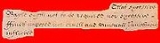
Eighth Amendment to the United States Constitution

Encyclopedia
United States Constitution
The Constitution of the United States is the supreme law of the United States of America. It is the framework for the organization of the United States government and for the relationship of the federal government with the states, citizens, and all people within the United States.The first three...
is the part of the United States Bill of Rights
United States Bill of Rights
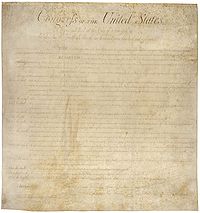
The Bill of Rights is the collective name for the first ten amendments to the United States Constitution. These limitations serve to protect the natural rights of liberty and property. They guarantee a number of personal freedoms, limit the government's power in judicial and other proceedings, and...
which prohibits the federal government
Federal government of the United States
The federal government of the United States is the national government of the constitutional republic of fifty states that is the United States of America. The federal government comprises three distinct branches of government: a legislative, an executive and a judiciary. These branches and...
from imposing excessive bail
Excessive bail
The Excessive Bail Clause of the Eighth Amendment to the United States Constitution prohibits excessive bail set in pre-trial detention.The Clause was drafted in response to the perceived excessiveness of bail in England. Excessive bail was also prohibited by the English Bill of Rights...
, excessive fines or cruel and unusual punishment
Cruel and unusual punishment
Cruel and unusual punishment is a phrase describing criminal punishment which is considered unacceptable due to the suffering or humiliation it inflicts on the condemned person...
s. The U.S. Supreme Court
Supreme Court of the United States
The Supreme Court of the United States is the highest court in the United States. It has ultimate appellate jurisdiction over all state and federal courts, and original jurisdiction over a small range of cases...
has ruled that this amendment's Cruel and Unusual Punishment Clause applies to the states. The phrases employed originated in the English Bill of Rights of 1689
Bill of Rights 1689
The Bill of Rights or the Bill of Rights 1688 is an Act of the Parliament of England.The Bill of Rights was passed by Parliament on 16 December 1689. It was a re-statement in statutory form of the Declaration of Right presented by the Convention Parliament to William and Mary in March 1689 ,...
.
Text
Background
The Eighth Amendment was adopted, as part of the Bill of RightsUnited States Bill of Rights
The Bill of Rights is the collective name for the first ten amendments to the United States Constitution. These limitations serve to protect the natural rights of liberty and property. They guarantee a number of personal freedoms, limit the government's power in judicial and other proceedings, and...
, in 1791. It is almost identical to a provision in the English Bill of Rights of 1689, in which Parliament
Parliament of England
The Parliament of England was the legislature of the Kingdom of England. In 1066, William of Normandy introduced a feudal system, by which he sought the advice of a council of tenants-in-chief and ecclesiastics before making laws...
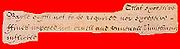
declared, "as their ancestors in like cases have usually done...that excessive bail ought not to be required, nor excessive fines imposed, nor cruel and unusual punishments inflicted.”
The provision was largely inspired by the case in England of Titus Oates
Titus Oates
Titus Oates was an English perjurer who fabricated the "Popish Plot", a supposed Catholic conspiracy to kill King Charles II.-Early life:...
who, after the ascension of King James II
James II of England
James II & VII was King of England and King of Ireland as James II and King of Scotland as James VII, from 6 February 1685. He was the last Catholic monarch to reign over the Kingdoms of England, Scotland, and Ireland...
in 1685, was tried for multiple acts of perjury
Perjury
Perjury, also known as forswearing, is the willful act of swearing a false oath or affirmation to tell the truth, whether spoken or in writing, concerning matters material to a judicial proceeding. That is, the witness falsely promises to tell the truth about matters which affect the outcome of the...
which had caused many executions of people whom Oates had wrongly accused. Oates was sentenced to imprisonment including an annual ordeal of being taken out for two days pillory
Pillory
The pillory was a device made of a wooden or metal framework erected on a post, with holes for securing the head and hands, formerly used for punishment by public humiliation and often further physical abuse, sometimes lethal...
plus one day of whipping while tied to a moving cart. The Oates case eventually became a topic of the U.S. Supreme Court’s Eighth Amendment jurisprudence
Jurisprudence
Jurisprudence is the theory and philosophy of law. Scholars of jurisprudence, or legal theorists , hope to obtain a deeper understanding of the nature of law, of legal reasoning, legal systems and of legal institutions...
. The punishment of Oates involved ordinary penalties collectively imposed in an excessive and unprecedented manner. The reason Oates did not receive the death penalty (unlike those whom he had falsely accused) may be because such a punishment would have deterred even honest witnesses from testifying in later cases.
England’s declaration against "cruel and unusual punishments" was approved by Parliament in February 1689, and was read to King William III
William III of England
William III & II was a sovereign Prince of Orange of the House of Orange-Nassau by birth. From 1672 he governed as Stadtholder William III of Orange over Holland, Zeeland, Utrecht, Guelders, and Overijssel of the Dutch Republic. From 1689 he reigned as William III over England and Ireland...
and his wife Queen Mary II
Mary II of England
Mary II was joint Sovereign of England, Scotland, and Ireland with her husband and first cousin, William III and II, from 1689 until her death. William and Mary, both Protestants, became king and queen regnant, respectively, following the Glorious Revolution, which resulted in the deposition of...
on the following day. Members of Parliament then explained in August 1689 that “the Commons had a particular regard…when that Declaration was first made” to punishments like the one that had been inflicted by the King's Bench against Titus Oates. Parliament then enacted the English Bill of Rights into law in December 1689.
In England, the "cruel and unusual punishments" clause was a limitation on the discretion of judges, and required judges to adhere to precedent. According to the great treatise of the 1760s by William Blackstone
William Blackstone
Sir William Blackstone KC SL was an English jurist, judge and Tory politician of the eighteenth century. He is most noted for writing the Commentaries on the Laws of England. Born into a middle class family in London, Blackstone was educated at Charterhouse School before matriculating at Pembroke...
entitled Commentaries on the Laws of England
Commentaries on the Laws of England
The Commentaries on the Laws of England are an influential 18th-century treatise on the common law of England by Sir William Blackstone, originally published by the Clarendon Press at Oxford, 1765–1769...
:
Virginia adopted this provision of the English Bill of Rights in the Virginia Declaration of Rights
Virginia Declaration of Rights
The Virginia Declaration of Rights is a document drafted in 1776 to proclaim the inherent rights of men, including the right to rebel against "inadequate" government...
of 1776, and the Virginia convention that ratified the U.S. Constitution
Virginia Ratifying Convention
The Virginia Ratifying Convention was a convention of 168 delegates from Virginia who met in 1788 to ratify or reject the United States Constitution, which had been drafted at the Philadelphia Convention the previous year.The Convention met and deliberated from June 2 through June 27 in Richmond...
recommended in 1788 that this language also be included in the Constitution.
Virginians such as George Mason
George Mason
George Mason IV was an American Patriot, statesman and a delegate from Virginia to the U.S. Constitutional Convention...
and Patrick Henry
Patrick Henry
Patrick Henry was an orator and politician who led the movement for independence in Virginia in the 1770s. A Founding Father, he served as the first and sixth post-colonial Governor of Virginia from 1776 to 1779 and subsequently, from 1784 to 1786...
wanted to ensure that this restriction would also be applied as a limitation on Congress. Mason warned that, otherwise, Congress may “inflict unusual and severe punishments.” Henry emphasized that Congress could otherwise depart from precedent: "What has distinguished our ancestors?--That they would not admit of tortures, or cruel and barbarous punishment. But Congress may introduce the practice of the civil law, in preference to that of the common law. They may introduce the practice of France, Spain, and Germany...." Ultimately, Henry and Mason prevailed, and the Eighth Amendment was adopted. James Madison
James Madison
James Madison, Jr. was an American statesman and political theorist. He was the fourth President of the United States and is hailed as the “Father of the Constitution” for being the primary author of the United States Constitution and at first an opponent of, and then a key author of the United...
changed "ought" to "shall", when he proposed the amendment to Congress in 1789.
Cruel and unusual punishments
According to the Supreme CourtSupreme Court of the United States
The Supreme Court of the United States is the highest court in the United States. It has ultimate appellate jurisdiction over all state and federal courts, and original jurisdiction over a small range of cases...
, the Eighth Amendment forbids some punishments entirely, and forbids some other punishments that are excessive when compared to the crime, or compared to the competence
Competence (law)
In American law, competence concerns the mental capacity of an individual to participate in legal proceedings. Defendants that do not possess sufficient "competence" are usually excluded from criminal prosecution, while witnesses found not to possess requisite competence cannot testify...
of the perpetrator.
In Louisiana ex rel. Francis v. Resweber
Francis v. Resweber
State of Louisiana Ex Rel. Francis v. Resweber, , is a case in which the U.S. Supreme Court was asked whether imposing capital punishment a second time, after it failed in an attempt to execute Willie Francis in 1946, constituted a violation of the United States Constitution...
, , the Supreme Court assumed arguendo
Arguendo
Arguendo is a Latin legal term meaning for the sake of argument. The phrase "assuming, arguendo, that ..." is used in courtroom settings and academic legal settings to designate provisional and unendorsed assumptions that will be made at the beginning of an argument in order to explore their...
that the Cruel and Unusual Punishments Clause applied to the states through the Due Process Clause of the Fourteenth Amendment. In Robinson v. California
Robinson v. California
Robinson v. California, 370 U.S. 660 , was a case in which the Supreme Court of the United States held that the use of civil imprisonment as punishment solely for the misdemeanor crime of addiction to a controlled substance was a violation of the Eighth Amendment's protection against cruel and...
, , the Court ruled that it did apply to the states through the Fourteenth Amendment. Robinson was the first case in which the Supreme Court applied the Eighth Amendment against the state governments through the Fourteenth Amendment. Before Robinson, the Eighth Amendment had only been applied against the federal government.
Justice Potter Stewart
Potter Stewart
Potter Stewart was an Associate Justice of the United States Supreme Court. During his tenure, he made, among other areas, major contributions to criminal justice reform, civil rights, access to the courts, and Fourth Amendment jurisprudence.-Education:Stewart was born in Jackson, Michigan,...
's opinion for the Robinson Court held that "infliction of cruel and unusual punishment [is] in violation of the Eighth and Fourteenth Amendments." The framers of the Fourteenth Amendment, such as John Bingham
John Bingham
John Armor Bingham was a Republican congressman from Ohio, America, judge advocate in the trial of the Abraham Lincoln assassination and a prosecutor in the impeachment trials of Andrew Johnson...
, had discussed this subject:
In Furman v. Georgia
Furman v. Georgia
Furman v. Georgia, was a United States Supreme Court decision that ruled on the requirement for a degree of consistency in the application of the death penalty. The case led to a de facto moratorium on capital punishment throughout the United States, which came to an end when Gregg v. Georgia was...
, , Justice Brennan wrote, "There are, then, four principles by which we may determine whether a particular punishment is 'cruel and unusual'."
- The "essential predicate" is "that a punishment must not by its severity be degrading to human dignity," especially tortureTortureTorture is the act of inflicting severe pain as a means of punishment, revenge, forcing information or a confession, or simply as an act of cruelty. Throughout history, torture has often been used as a method of political re-education, interrogation, punishment, and coercion...
. - "A severe punishment that is obviously inflicted in wholly arbitrary fashion."
- "A severe punishment that is clearly and totally rejected throughout society."
- "A severe punishment that is patently unnecessary."
Continuing, he wrote that he expected that no state would pass a law obviously violating any one of these principles, so court decisions regarding the Eighth Amendment would involve a "cumulative" analysis of the implication of each of the four principles.
Punishments forbidden regardless of the crime
In Wilkerson v. UtahWilkerson v. Utah
Wilkerson v. Utah, 99 U.S. 130 , is a United States Supreme Court case in which the Court affirmed the judgment of the Supreme Court of the Territory of Utah in stating that execution by firing squad, as prescribed by the Utah territorial statute, was not cruel and unusual punishment under the...
, , the Supreme Court commented that drawing and quartering
Hanged, drawn and quartered
To be hanged, drawn and quartered was from 1351 a penalty in England for men convicted of high treason, although the ritual was first recorded during the reigns of King Henry III and his successor, Edward I...
, public dissecting, burning alive
Execution by burning
Death by burning is death brought about by combustion. As a form of capital punishment, burning has a long history as a method in crimes such as treason, heresy, and witchcraft....
, or disemboweling would constitute cruel and unusual punishment regardless of the crime. The Supreme Court declared executing the mentally handicapped
Developmental disability
Developmental disability is a term used in the United States and Canada to describe lifelong disabilities attributable to mental or physical impairments, manifested prior to age 18. It is not synonymous with "developmental delay" which is often a consequence of a temporary illness or trauma during...
in Atkins v. Virginia
Atkins v. Virginia
Atkins v. Virginia, , is a case in which the Supreme Court of the United States ruled 6-3 that executing the mentally retarded violates the Eighth Amendment's ban on cruel and unusual punishments.-The case:...
, , and executing people who were under age 18 at the time the crime was committed in Roper v. Simmons
Roper v. Simmons
Roper v. Simmons, was a decision in which the Supreme Court of the United States held that it is unconstitutional to impose capital punishment for crimes committed while under the age of 18. The 5-4 decision overruled the Court's prior ruling upholding such sentences on offenders above or at the...
, , to be violations of the Eighth Amendment, regardless of the crime.
Punishments forbidden for certain crimes
The case of Weems v. United StatesWeems v. United States
Weems v. United States, 217 U.S. 349 , was a decision of the United States Supreme Court. It is primarily notable as it pertains to the prohibition of cruel and unusual punishment. It is cited concerning the Constitutional meaning of "privacy" and the scope of what is to receive legal protection...
, , marked the first time that the Supreme Court exercised judicial review
Judicial review
Judicial review is the doctrine under which legislative and executive actions are subject to review by the judiciary. Specific courts with judicial review power must annul the acts of the state when it finds them incompatible with a higher authority...
to overturn a criminal sentence as cruel and unusual. The Court overturned a punishment called cadena temporal
Cadena temporal
Cadena temporal and cadena perpetua are punishments notably present in the Philippine legal system. Cadena temporal included imprisonment for at least 12 years and one day, in chains, at hard and painful labor; the loss of many basic civil rights; and subjection to lifetime surveillance...
, which mandated "hard and painful labor," shackling for the duration of incarceration, and permanent civil disabilities. This case is often viewed as establishing a principle of proportionality under the Eighth Amendment. However, others have written that "it is hard to view Weems as announcing a constitutional requirement of proportionality."
In Trop v. Dulles
Trop v. Dulles
Trop v. Dulles, 356 U.S. 86 , was a federal case in the United States in which the Supreme Court ruled, 5-4, that it was unconstitutional for the government to revoke the citizenship of a U.S...
, , the Supreme Court held that punishing a natural-born citizen for a crime by taking away his citizenship is unconstitutional, being "more primitive than torture
Torture
Torture is the act of inflicting severe pain as a means of punishment, revenge, forcing information or a confession, or simply as an act of cruelty. Throughout history, torture has often been used as a method of political re-education, interrogation, punishment, and coercion...
" because it involved the "total destruction of the individual's status in organized society."
In Robinson v. California
Robinson v. California
Robinson v. California, 370 U.S. 660 , was a case in which the Supreme Court of the United States held that the use of civil imprisonment as punishment solely for the misdemeanor crime of addiction to a controlled substance was a violation of the Eighth Amendment's protection against cruel and...
, , the Court decided that a California law authorizing a 90-day jail sentence for "be[ing] addicted
Substance use disorder
Substance use disorders include substance abuse and substance dependence. In DSM-IV, the conditions are formally diagnosed as one or the other, but it has been proposed that DSM-5 combine the two into a single condition called "Substance-use disorder"....
to the use of narcotic
Narcotic
The term narcotic originally referred medically to any psychoactive compound with any sleep-inducing properties. In the United States of America it has since become associated with opioids, commonly morphine and heroin and their derivatives, such as hydrocodone. The term is, today, imprecisely...
s" violated the Eighth Amendment, as narcotics addiction "is apparently an illness," and California was attempting to punish people based on the state of this illness, rather than for any specific act. The Court wrote: "To be sure, imprisonment for ninety days is not, in the abstract, a punishment which is either cruel or unusual. But the question cannot be considered in the abstract. Even one day in prison would be a cruel and unusual punishment for the 'crime' of having a common cold." However, in Powell v. Texas
Powell v. Texas
Powell v. Texas, 392 U.S. 514 , was a United States Supreme Court case which ruled that a Texas statute criminalizing public intoxication did not violate the Eighth Amendment protection against cruel and unusual punishment. It was a 5-4 decision, and the majority opinion was by Justice Thurgood...
, , the Court upheld a statute barring public intoxication
Public intoxication
Public intoxication, also known as "drunk and disorderly", is a summary offense in many countries rated to public cases or displays of drunkenness...
by distinguishing Robinson on the basis that Powell dealt with a person who was drunk in public, not merely for being addicted to alcohol.
Traditionally, the length of a prison sentence was not subject to scrutiny under the Eighth Amendment, regardless of the crime for which the sentence was imposed. It was not until the case of Solem v. Helm
Solem v. Helm
Solem v. Helm, , was a United States Supreme Court case concerned with the scope of the Eighth Amendment protection from cruel and unusual punishment. Mr. Helm, who had written a check from a fictitious account and had reached his seventh nonviolent felony conviction since 1964, received a...
, , that the Supreme Court held that incarceration, standing alone, could constitute cruel and unusual punishment if it were "disproportionate" in duration to the offense. The Court outlined three factors that were to be considered in determining if the sentence is excessive: "(i) the gravity of the offense and the harshness of the penalty; (ii) the sentences imposed on other criminals in the same jurisdiction; and (iii) the sentences imposed for commission of the same crime in other jurisdictions." The Court held that in the circumstances of the case before it and the factors to be considered, a sentence of life imprisonment
Life imprisonment
Life imprisonment is a sentence of imprisonment for a serious crime under which the convicted person is to remain in jail for the rest of his or her life...
without parole
Parole
Parole may have different meanings depending on the field and judiciary system. All of the meanings originated from the French parole . Following its use in late-resurrected Anglo-French chivalric practice, the term became associated with the release of prisoners based on prisoners giving their...
for cashing a $100 check on a closed account was cruel and unusual.
However, in Harmelin v. Michigan
Harmelin v. Michigan
Harmelin v. Michigan, 501 U.S. 957 , was a case decided by the Supreme Court of the United States under the Eighth Amendment to the United States Constitution...
, , a fractured Court retreated from the Solem test and held that for non-capital sentences, the Eighth Amendment only constrains the length of prison terms by a "gross disproportionality principle." Under this principle, the Court sustained a mandatory sentence of life without parole imposed for possession of 672 grams or more of cocaine. In Harmelin, Justice Scalia
Antonin Scalia
Antonin Gregory Scalia is an American jurist who serves as an Associate Justice of the Supreme Court of the United States. As the longest-serving justice on the Court, Scalia is the Senior Associate Justice...
, joined by Chief Justice Rehnquist
William Rehnquist
William Hubbs Rehnquist was an American lawyer, jurist, and political figure who served as an Associate Justice on the Supreme Court of the United States and later as the 16th Chief Justice of the United States...
, said "the Eighth Amendment contains no proportionality guarantee," and that "what was 'cruel and unusual' under the Eighth Amendment was to be determined without reference to the particular offense." Scalia wrote "If 'cruel and unusual punishments' included disproportionate punishments, the separate prohibition of disproportionate fines (which are certainly punishments) would have been entirely superfluous."
In Graham v. Florida
Graham v. Florida
Graham v. Florida was a decision by the Supreme Court of the United States, in 2010, in which it was held that juvenile offenders cannot be sentenced to life imprisonment without parole for non-homicide offenses. The court decided whether Roper v...
(2010), the Supreme Court declared that a life sentence without any chance of parole, for a crime other than murder, is cruel and unusual punishment for a minor
Minor (law)
In law, a minor is a person under a certain age — the age of majority — which legally demarcates childhood from adulthood; the age depends upon jurisdiction and application, but is typically 18...
.
Death penalty for rape
In Coker v. GeorgiaCoker v. Georgia
Coker v. Georgia, , held that the Eighth Amendment to the United States Constitution forbade the death penalty for the crime of rape of a woman.-Facts:...
, , the Court declared that the death penalty was unconstitutionally excessive for rape
Rape
Rape is a type of sexual assault usually involving sexual intercourse, which is initiated by one or more persons against another person without that person's consent. The act may be carried out by physical force, coercion, abuse of authority or with a person who is incapable of valid consent. The...
of a woman
Woman
A woman , pl: women is a female human. The term woman is usually reserved for an adult, with the term girl being the usual term for a female child or adolescent...
and, by implication, for any crime where a death does not occur. The majority in Coker stated that "rape by definition does not include the death of or even the serious injury to another person." The dissent countered that the majority "takes too little account of the profound suffering the crime imposes upon the victims and their loved ones." The dissent also characterized the majority as "myopic" for only considering legal history of "the past five years."
In Kennedy v. Louisiana
Kennedy v. Louisiana
Kennedy v. Louisiana, 554 U.S. 407 was a landmark decision by the Supreme Court of the United States that held that the Eighth Amendment's Cruel and Unusual Punishment Clause did not permit a state to punish the crime of rape of a child with the death penalty; more broadly, the power of the state...
, 554 U.S. 407 (2008), the Court extended the reasoning of Coker by ruling that the death penalty was excessive for child rape "where the victim’s life was not taken." The Supreme Court failed to note a federal law, which applies to military court-martial proceedings, providing for the death penalty in cases of child rape. On October 1, 2008, the Court declined to reconsider its opinion in this case, but did amend the majority and dissenting opinions in order to acknowledge that federal law. Justice Scalia (joined by Chief Justice Roberts) wrote in dissent that "the proposed Eighth Amendment would have been laughed to scorn if it had read 'no criminal penalty shall be imposed which the Supreme Court deems unacceptable.'"
Special procedures for death penalty cases
The first significant general challenge to capital punishmentCapital punishment
Capital punishment, the death penalty, or execution is the sentence of death upon a person by the state as a punishment for an offence. Crimes that can result in a death penalty are known as capital crimes or capital offences. The term capital originates from the Latin capitalis, literally...
that reached the Supreme Court was the case of Furman v. Georgia
Furman v. Georgia
Furman v. Georgia, was a United States Supreme Court decision that ruled on the requirement for a degree of consistency in the application of the death penalty. The case led to a de facto moratorium on capital punishment throughout the United States, which came to an end when Gregg v. Georgia was...
, . In a 5-4 decision, the Supreme Court overturned the death sentences of Furman for murder, as well as two other defendants for rape. Of the five justices voting to overturn the death penalty, two found capital punishment to be unconstitutionally cruel and unusual, while three found that the statutes at issue were implemented in a random and capricious fashion, discriminating against blacks and the poor. Furman v. Georgia did not hold — even though it is sometimes claimed that it did — that capital punishment is per se unconstitutional.
States with capital punishment rewrote their laws to address the Supreme Court's decision, and the Court then revisited the issue in a murder case: Gregg v. Georgia
Gregg v. Georgia
Gregg v. Georgia, Proffitt v. Florida, Jurek v. Texas, Woodson v. North Carolina, and Roberts v. Louisiana, 428 U.S. 153 , reaffirmed the United States Supreme Court's acceptance of the use of the death penalty in the United States, upholding, in particular, the death sentence imposed on Troy Leon...
, . In Gregg, the Court found, in a 7-2 ruling, that Georgia's new death penalty laws passed Eighth Amendment scrutiny: the statutes provided a bifurcated trial in which guilt and sentence were determined separately; and, the statutes provided for "specific jury findings" followed by state supreme court review comparing each death sentence "with the sentences imposed on similarly situated defendants to ensure that the sentence of death in a particular case is not disproportionate." Because of the Gregg decision, executions resumed in 1977.
Some states have passed laws imposing mandatory death penalties in certain cases. The Supreme Court found these laws to be unconstitutional under the Eighth Amendment, in the murder case of Woodson v. North Carolina, , because these laws remove discretion from the trial judge to make an individualized determination in each case. Other statutes specifying factors for courts to use in making their decisions have been upheld. Some have not: in Godfrey v. Georgia
Godfrey v. Georgia
Godfrey v. Georgia 446 U.S. 420 is a United States Supreme Court case in which the Court held that a death sentence could not be granted for a murder when the only aggravating factor was that the murder was found to be "outrageously or wantonly vile."...
, , the Supreme Court overturned a sentence based upon a finding that a murder was "outrageously or wantonly vile, horrible, and inhuman," as it deemed that any murder may be reasonably characterized in this manner. Similarly, in Maynard v. Cartwright
Maynard v. Cartwright
Maynard v. Cartwright 486 U. S. 356 is a United States Supreme Court case in which the Court found that the "especially heinous, atrocious or cruel" standard for the application of the death penalty as defined by the Eighth Amendment was too vague....
, , the Court found that an "especially heinous, atrocious or cruel" standard in a homicide case was too vague. However, the meaning of this language depends on how lower courts interpret it. In Walton v. Arizona
Walton v. Arizona
Walton v. Arizona, 497 U.S. 639 , upheld two important aspects of the capital sentencing scheme in the U.S. state of Arizona — judicial sentencing and the aggravating factor "especially heinous, cruel, or depraved" — as not unconstitutionally vague. The Supreme Court has overruled the first of...
, , the Court found that the phrase "especially heinous, cruel, or depraved" was not vague in a murder case, because the state supreme court had expounded on its meaning.
The Court has generally held that death penalty cases require extra procedural protections. As the Court said in Herrera v. Collins
Herrera v. Collins
Herrera v. Collins, , is a case in which the Supreme Court of the United States ruled that a claim that the Eighth Amendment's ban on cruel and unusual punishment prohibits the execution of one who is actually innocent is not ground for federal habeas relief.-Background:On September 29, 1981,...
, , which involved the murder of a police officer, "the Eighth Amendment requires increased reliability of the process..."
Punishments specifically allowed
In Wilkerson v. UtahWilkerson v. Utah
Wilkerson v. Utah, 99 U.S. 130 , is a United States Supreme Court case in which the Court affirmed the judgment of the Supreme Court of the Territory of Utah in stating that execution by firing squad, as prescribed by the Utah territorial statute, was not cruel and unusual punishment under the...
, , the Court stated that death by firing squad was not cruel and unusual punishment under the Eighth Amendment.
In Rummel v. Estelle
Rummel v. Estelle
Rummel v. Estelle 445 U.S. 263 is a United States Supreme Court case in which the Court upheld a life sentence with the possibility of parole for William James Rummel for a felony fraud crime amounting to $120.75...
, , the Court upheld a life sentence with the possibility of parole imposed per Texas's three strikes law
Three strikes law
Three strikes laws)"are statutes enacted by state governments in the United States which require the state courts to hand down a mandatory and extended period of incarceration to persons who have been convicted of a serious criminal offense on three or more separate occasions. These statutes became...
for fraud crimes totaling $230. A few months after pleading guilty Rummel was released.
In Harmelin v. Michigan
Harmelin v. Michigan
Harmelin v. Michigan, 501 U.S. 957 , was a case decided by the Supreme Court of the United States under the Eighth Amendment to the United States Constitution...
, , the Court upheld a life sentence without the possibility of parole for possession of 672 grams of cocaine.
In Lockyer v. Andrade
Lockyer v. Andrade
Lockyer v. Andrade, , decided the same day as Ewing v. California, held that there would be no relief by means of a petition for a writ of habeas corpus from a sentence imposed under California's three strikes law as a violation of the Eighth Amendment's prohibition of cruel and unusual...
, , the Court upheld a 50 years to life sentence with the possibility of parole imposed under California's three strikes law
Three strikes law
Three strikes laws)"are statutes enacted by state governments in the United States which require the state courts to hand down a mandatory and extended period of incarceration to persons who have been convicted of a serious criminal offense on three or more separate occasions. These statutes became...
when the defendant was convicted of shoplifting videotapes worth a total of about $150.
Evolving standards of decency
In Trop v. DullesTrop v. Dulles
Trop v. Dulles, 356 U.S. 86 , was a federal case in the United States in which the Supreme Court ruled, 5-4, that it was unconstitutional for the government to revoke the citizenship of a U.S...
, , Chief Justice Earl Warren
Earl Warren
Earl Warren was the 14th Chief Justice of the United States.He is known for the sweeping decisions of the Warren Court, which ended school segregation and transformed many areas of American law, especially regarding the rights of the accused, ending public-school-sponsored prayer, and requiring...
said: "The [Eighth] Amendment must draw its meaning from the evolving standards of decency that mark the progress of a maturing society." Subsequently, the Court has looked to societal developments, as well as looking to its own independent judgment, in determining what are those "evolving standards of decency". The Court has then applied those standards not only to say what punishments are inherently cruel, but also to say what punishments that are not inherently cruel are nevertheless cruelly disproportionate to the offense in question.
An example of the "evolving standards" idea can be seen in Jackson v. Bishop
Jackson v. Bishop
Jackson v. Bishop was a case decided in 1968 on the Eighth Circuit Court of Appeals of the United States by then-judge Harry Blackmun. It abolished corporal punishment in the Arkansas prison system.-Issue:...
(8th Cir., 1968), an Eighth Circuit
United States Court of Appeals for the Eighth Circuit
The United States Court of Appeals for the Eighth Circuit is a federal court with appellate jurisdiction over the district courts in the following districts:* Eastern District of Arkansas* Western District of Arkansas...
decision outlawing corporal punishment in the Arkansas
Arkansas
Arkansas is a state located in the southern region of the United States. Its name is an Algonquian name of the Quapaw Indians. Arkansas shares borders with six states , and its eastern border is largely defined by the Mississippi River...
prison system.
The "evolving standards" test is not without its scholarly critics. For example, Professor John Stinneford asserts that the "evolving standards" test misinterprets the Eighth Amendment:
On the other hand, Dennis Baker
Dennis Baker
Dennis James Baker was an Australian cricketer who played for the Western Warriors and the Tasmanian Tigers. His career was from 1972 until 1982....
has asserted that the evolving standards of decency test accords with the moral purpose of the Eighth Amendment and the Framer’s intent that the right be used to prevent citizens being subjected to all forms of unjust and disproportionate punishments. As Professor John Bessler
John Bessler
John Bessler is a visiting professor of law at the University of Baltimore School of Law and the spouse of U.S. Senator Amy Klobuchar.Bessler attended Mankato Loyola High School and received his B.A. from the University of Minnesota, J.D. from Indiana University School of Law, M.F.A. from Hamline...
points out, "An Essay on On Crimes and Punishments," written by Cesare Beccaria in the 1760s, advocated proportionate punishments. Many of the Founding Fathers, including Thomas Jefferson and James Madison, read Beccaria's treatise and were influenced by it.
Excessive fines
In United States v. BajakajianUnited States v. Bajakajian
United States v. Bajakajian, , is a case decided by the Supreme Court of the United States regarding the Excessive Fines clause of the Eighth Amendment...
, , the Supreme Court ruled that it was unconstitutional to take $357,144 from a person who failed to report his taking of more than $10,000 in U.S. currency
United States dollar
The United States dollar , also referred to as the American dollar, is the official currency of the United States of America. It is divided into 100 smaller units called cents or pennies....
out of the United States. In what was the first case in which the Supreme Court ruled a fine to violate the Excessive Fines Clause, the Court ruled that it was "grossly disproportional" to take all of the money which Mr. Bajakajian attempted to take out of the United States without reporting trying to do so. In describing what constituted "gross disproportionality," the Court could not find any guidance from the history of the Excessive Fines Clause and so relied on Cruel and Unusual Punishment Clause case law:
Excessive bail
In EnglandEngland
England is a country that is part of the United Kingdom. It shares land borders with Scotland to the north and Wales to the west; the Irish Sea is to the north west, the Celtic Sea to the south west, with the North Sea to the east and the English Channel to the south separating it from continental...
, sheriff
Sheriff
A sheriff is in principle a legal official with responsibility for a county. In practice, the specific combination of legal, political, and ceremonial duties of a sheriff varies greatly from country to country....
s originally determined whether to grant bail to criminal suspects. Since they tended to abuse their power, Parliament passed a statute in 1275 whereby bailable and non-bailable offenses were defined. The King's judges often subverted the provisions of the law. It was held that an individual may be held without bail upon the Sovereign's command. Eventually, the Petition of Right
Petition of right
In English law, a petition of right was a remedy available to subjects to recover property from the Crown.Before the Crown Proceedings Act 1947, the British Crown could not be sued in contract...
of 1628 argued that the King did not have such authority. Later, technicalities in the law were exploited to keep the accused imprisoned without bail even where the offenses were bailable; such loopholes were for the most part closed by the Habeas Corpus Act 1679
Habeas Corpus Act 1679
The Habeas Corpus Act 1679 is an Act of the Parliament of England passed during the reign of King Charles II by what became known as the Habeas Corpus Parliament to define and strengthen the ancient prerogative writ of habeas corpus, whereby persons unlawfully detained cannot be ordered to be...
. Thereafter, judges were compelled to set bail, but they often required impracticable amounts. Finally, the English Bill of Rights (1689) held that "excessive bail ought not to be required." Nevertheless, the Bill did not determine the distinction between bailable and non-bailable offenses. Thus, the Eighth Amendment has been interpreted to mean that bail may be denied if the charges are sufficiently serious. The Supreme Court has also permitted "preventive" detention without bail. In United States v. Salerno
United States v. Salerno
United States v. Salerno, 481 U.S. 739 , was a United States Supreme Court decision. It determined that the "Bail Reform Act of 1984", which permitted the federal courts to detain an arrestee prior to trial if the government could prove that the individual was potentially dangerous to other people...
, , the Supreme Court held that the only limitation imposed by the bail clause is that "the government's proposed conditions of release or detention not be 'excessive' in light of the perceived evil."
See also
- Capital punishment in the United StatesCapital punishment in the United StatesCapital punishment in the United States, in practice, applies only for aggravated murder and more rarely for felony murder. Capital punishment was a penalty at common law, for many felonies, and was enforced in all of the American colonies prior to the Declaration of Independence...
- Cruel and unusual punishmentCruel and unusual punishmentCruel and unusual punishment is a phrase describing criminal punishment which is considered unacceptable due to the suffering or humiliation it inflicts on the condemned person...
- Crime against humanityCrime against humanityCrimes against humanity, as defined by the Rome Statute of the International Criminal Court Explanatory Memorandum, "are particularly odious offenses in that they constitute a serious attack on human dignity or grave humiliation or a degradation of one or more human beings...
- Human rightsHuman rightsHuman rights are "commonly understood as inalienable fundamental rights to which a person is inherently entitled simply because she or he is a human being." Human rights are thus conceived as universal and egalitarian . These rights may exist as natural rights or as legal rights, in both national...