

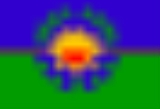
La Plata

Encyclopedia
La Plata is the capital city of the Province
of Buenos Aires
, Argentina
, and of La Plata
partido
. According to the , the city proper has a population of 574,369 and its metropolitan area
has 694,253 inhabitants.
La Plata was planned and developed to serve as the provincial capital after the city of Buenos Aires
was federalized in 1880, and it was officially founded by Governor Dardo Rocha
on 19 November 1882. Its construction is fully documented in photographs by Tomás Bradley Sutton. La Plata was renamed Eva Perón City
(Ciudad Eva Perón) between 1952 and 1955.
The city is home to two football (soccer)
teams that play in the first division
: Estudiantes de La Plata
and Gimnasia y Esgrima La Plata.
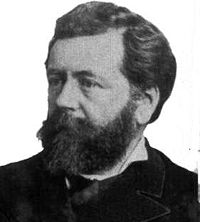
 Rocha decided to erect a new city to host the provincial government institutions and the planned university
. Urban planner Pedro Benoit
designed a city layout based on a rationalist
conception of urban centers
. The city has the shape of a square with a central park and two main diagonal avenues, north-south and east-west. (In addition, there are numerous other shorter diagonals.) This design is copied in a self-similar manner in small blocks of six by six blocks in length. Every six blocks, one finds a small park or square. Other than the diagonals, all streets are on a rectangular grid, and are numbered consecutively. Thus, La Plata is nicknamed "la ciudad de las diagonales" ("city of diagonals"). It is also called "la ciudad de los tilos" ("city of tilia
(linden trees)") because of the large number of linden trees lining many streets and squares.
The city design and its buildings are said to possess a strong Freemason symbolism. This is said to be a consequence of both Rocha and Benoit being Freemasons.
The designs for the government buildings were chosen in an international architectural competition. Thus, the Governor Palace was designed by Italians
, City Hall by Germans
, etc. Electric street lighting was installed in 1884, and was the first of its kind in Latin America.
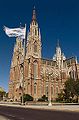
The cathedral of La Plata
, in neo-Gothic style, is the largest church in Argentina.
The Curutchet House
is one of the two buildings by Le Corbusier
in the Americas. The Teatro Argentino de La Plata
is the second most-important opera house
in Argentina after the Teatro Colón in Buenos Aires
.
The University of La Plata was founded in 1897 and nationalized in 1905. It is well-known for its observatory
and natural history museum
. Ernesto Sabato
graduated in physics at this university; he went on to teach at the Sorbonne
and the MIT
before becoming a famed novelist. Doctor René Favaloro
was another famous alumnus. During its early years, it attracted a number of renowned intellectuals from the Spanish-speaking world, such as Dominican
Pedro Henríquez Ureña
.
's administration (1922–1928), Enrique Mosconi
, the president of the oil state company Yacimientos Petrolíferos Fiscales
, created the distillery of La Plata, which was the tenth largest in the world.
 On 10 December 1945, in the Parish of St. Francis of Assisi in this city, Juan Domingo Perón and Eva Duarte married.
The city was renamed in 1952 as Eva Perón
, though the original name was restored in 1955. La Plata's residents are served by numerous daily newspapers, the most prominent of which is El Día
.
It was filmed in the 1997 film "Seven Years in Tibet", which featured a performance by Brad Pitt, David Thewlis, BD Wong, Mako, Danny Denzongpa, Victor Wong, Ingeborga Dapkunaite and Jamyang Jamtsho Wangchuk, among others. Location was used as a local train terminal, having a design similar to the train in Austria. The film belongs to the drama and was shot mostly in the U.S. and in the province of Mendoza, Argentina.
In October 1998, UNESCO approved the city's bid to gain recognition as a Heritage of Humanity. The distinction is still pending due to various objections to the criterion of maintaining architectural and landscape over recent decades, which in the opinion of other specialists has produced severe damage to the original design and contextual aesthetics.
On 28 October 2007 Pablo Bruera was elected Mayor with 26% of the vote, replacing Julio Alak, who had been in charge since 1991.
During 2009, following a series of agreements between the city municipality, the governor of the province and the nation's presidency, progress was made in the final transfer of the land of the Paseo del Bosque to Estudiantes and Gimnasia clubs. 24 June, the Deliberative Council adopted the Convention and the ordinance for which Gimnasia and Estudiantes clubs receive in character "grant from" the lands where they currently stand their grounds in El Bosque (The Forest).
On February 25, 2009 debuted the parking system via text messages (sms). With this fact, La Plata became the first city in Argentina to use technology applications class to control the parking lot.
In April 2009, reopened its doors as Pasaje Rodrigo shopping. The mall was opened in 1929 by Basilio Rodrigo (Spanish immigrant) and had being closed to the public for 10 years.
In 2011, the Estadio Ciudad de La Plata will be the site of the Copa America Cup, which after 24 years will be played in Argentina, with head in seven provinces.
and Berisso
, northwest with the Berazategui
and Florencio Varela
, southwest and south, with San Vicente
and Coronel Brandsen
and southeast with Magdalena
, occupying an area of 893 km.
The metropolitan area of La Plata includes besides the founding of the town, the towns of Tolosa, Ringuelet, Manuel B. Gonnet, City Bell, Villa Elisa, Melchor Romero, Abasto, Gorina, José Hernández, Ángel Etcheverry, Arturo Seguí Los Hornos, Lisandro Olmos, Villa Elvira and, Altos de San Lorenzo, all of them with community centers that operate as local delegations.
Average temperature: 16.7°C
Average clear days: 126 Rain: 1023 Mn
Average humidity: 78%
The executive branch in La Plata, is exercised by the municipal mayor, elected by popular vote every four years with the possibility of unlimited reelection. The government building is known as the Palacio Municipal, located between the streets 51, 53, 11 and 12, in the city center, is separated from the cathedral across the plaza Moreno. The current mayor is Paul Bruera.
The city government is divided into different areas. These are: Private Secretary, Secretary General, Ministry of Economy, Ministry of Public Management, Social Development Secretariat, Ministry of Culture, Ministry of Modernization and Economic Development, Ministry of Justice Faltas, Secretary of Health and Social Medicine, Chief of Staff , Regional Market La Plata, Management Consortium Puerto La Plata, Executive Unit Revenue Agency, Environment Agency Implementation Unit, Human Rights Department, Ministry of Government, Policy Planning Council, Regional Production and Employment, and the city council.
La Plata, also for being capital, is home to three provincial powers. That is, the provincial executive (by Daniel Scioli) along with their ministries, the judiciary and the provincial Legislature, have their seat in La Plata.
In the city there are branches of major banks operating in the country, including Banco Nación, Banco Provincia, Banco Ciudad de Buenos Aires, Banco Hipotecario, HSBC, Citigroup, Banco Itaú, Francés, Macro, Standard Bank, etc.
Furthermore, the La Plata partido's population since 1960 was developed as follows:
Notice how in 1991-2001 slowed their growth, as happened to many cities in Argentina, but still maintains a constantly growing.
Meanwhile in La Plata was reconstituted with 694 253 in 2001, which places so far as the 6th agglomeration of Argentina. Following their growth rate in 2009 to estimate the agglomerate is: 736 954 inhabitants.
The population is predominantly descended from Spanish and Italian, but also highlights German, Arabic, Bolivians, Jews, Paraguayans, Peruvians and Poles.
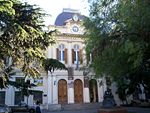 La Plata hosts one of the most renowned universities in Argentina, the National University of La Plata (Spanish: Universidad Nacional de La Plata, UNLP).
It has over 75,000 regular students, 8,000 teaching staff, 16 faculties and 106 available degrees.
UNLP students and professors include:
Four high school institutes are under UNLP control, three of them are located in La Plata:
La Plata is also home of other three universities:
Students come to these four universities from every part of Argentina and other countries, giving the city a rich young multicultural lifestyle.
There is also an international school for translators, Traductorado
.
, urban planning paradigm of the late nineteenth century. It is also an example of "hygiene", which was becoming important in that time.
The trace of the city, designed by architect
Pedro Benoit
, characterized by a strict grid, and its many avenues and diagonals. The convergence of the two major diagonals, 73 and 74, which cross the city from east to west and from north to south, respectively, takes place in Plaza Moreno. This square, in whose center is the foundation stone, the heart of the city, is the main square of the city and it is between the City Hall
and the cathedral
located at 14 N ° 1943 between 51 and 53, High Gothic, with its towers 112 m high, could be completed only in 1999. Highlights of the city are the Museum of Natural Sciences, the building of the Interior, the Provincial Legislature, the new theater and the hippodrome. Many of these buildings were built at the time of the founding of the city, following an international call for proposals. They are often called "buildings erected" and most of them are on the shaft foundation, which blocks are located between 51st and 53rd streets.
Another work is the parent company of Banco de la Provincia de Buenos Aires, located between the streets 6, 7, 46 and 47. This building was designed by architects Juan A. Buschiazzo and Luis Viglione. It opened on 19 April 1886, being amended in 1913 and in the 1970s.
It is a very green city, with its largest so-called "Paseo del Bosque" (or simply 'the forest'), with its lake, amphitheater Martin Fierro, the Zoo and Botanical Garden Victorian astronomical observatory, and Natural History Museum, part of the UNLP, with its famous collections. Other attractions are the nearby Parque Pereyra Iraola great and so-called Republic of children in which it is said, he would have inspired Walt Disney to build Disneyland then, there are videos that prove that Disney, prior to building the park, visited the Republic Children's during his visit to Argentina.
Architecturally the neo-Gothic cathedral called La Colorada, the former central railway station, in 1977 the city lost due to a fire, one of its most valuable monuments: the Teatro Argentino de La Plata
, predominantly neoclassic style. Instead they built a new brutalist style theater. The city also has the Estadio Ciudad de La Plata
influenced by modern architecture High-tech architecture, through a national competition which was amended in a subsequent project to expand capacity and cover. Is anticipated that by mid-2010s concrete deck semitransaparente Kevlar and plastic resins (which is still in Customs).
in Paris
in 1889, an event in which the new city are the two gold medals awarded in the categories "City of the Future" and "Better performance built."
, who was also responsible for the design of the city. It lies on the intersection of Avenue 31, 72 and diagonal 74 in the southern tip. It has outstanding architectural features, both on his porch as in many of their family vaults, including neoclassical
, Neo-Gothic
, Art Nouveau
(in its variant of Catalan Art Nouveau
), Art Deco
and Egyptian revival. The main entrance is an impressive neo-classical portico with Doric columns.
Its annex the Jewish Cemetery, part of the Asociación Mutual Israelita Argentina in La Plata, located on Avenue 72.
Among the many clubs that play football in the city, two of them stand out above the rest and these are the clubs Estudiantes de La Plata and Gimnasia y Esgrima La Plata
, they both play in the First Division of Argentine football. From these two teams came out great players like Martín Palermo
, Francisco Varallo
, Juan Sebastián Verón
and his father
, Gustavo
and Guillermo Barros Schelotto
, Leandro Cufré
, among others.
The city also has the Liga Amateur Platense de fútbol that encompasses dozens of clubs in the region, such as: Club Atlético Estrella de Berisso, La Plata Fútbol Club
, Asociación Nueva Alianza, Club Everton, among others.
Basketball
has a place in the Torneo Nacional de Ascenso (National Tournament Ascent), through Gimnasia y Esgrima La Plata
. In addition, through the Asociación Platense de Basquetbol, the city has leagues and tournaments for all levels and categories (First, Second Ascent, U21, Junior (U19), Cadet (U17) ,Kids (U15) Pre-Kids (U13), which involved Clubs: Gimnasia y Esgrima La Plata
, Estudiantes,Centro Fomento de Los Hornos Club Atenas, Unión Vecinal, Centro de Fomento Meridiano V, Club Cultural y Deportivo Juventud, among others.
Auto racing
also has its importance in the city from the hands of the Turismo Carretera
. For this competition is a racetrack called Autódromo Roberto José Mouras
in honor of the historic Chevrolet
driver died in Lobos
in 1992. Other information relating to motorsport in the city has to do with the last Argentine Formula 1
pilot, who was the "platense" Gastón Mazzacane
that after 21 races in Formula 1 came to compete in the Champ Car
and Top Race V6
.
Rugby
, meanwhile, is a comprehensive discipline of fans in the city. The most representative clubs are: La Plata Rugby Club
, Club San Luis
, Los Tilos, Universitario and Albatros.
Of note is the traditional seat of turf in the city. La Plata has a race track, the third in order of competition and offer careers in the country.
Volleyball teams include Gimnasia y Esgrima
and Universitario.
Hockey also claims two teams, Universitario and Santa Bárbara.
.

There were big personalities in the cultural sphere from the city: Paula Almerares (opera singer, soprano); Dante Anzolini (conductor); Efraín U. Bischoff (historian), José Walter Gavito (sculptor), Osvaldo Golijov (classical composer), Robert Noble (journalist and socialist politician, founder and first editor of the newspaper Clarín), Emilio Pettoruti (painter), Ernesto Tenenbaum (Reporter), María Dhialma Tiberti (writer), Iñaki Urlezaga (classical dancer), Álvaro Yunque (writer), Jorge and Federico D'Elia (actors); Adabel Guerrero (dancer, actress), Alejo García Pintos (film and television actor), Benjamín Rojas (actor), Freddy Villarreal (comedian, actor), Héctor Bidonde (actor), Juan Palomino (actor), Oscar Alberto "Lito" Cruz (actor), Maxi Ghione (actor), Pablo Andrés Martínez (actor), Carlos Mancinelli (musician), among others.
It is worth mentioning other important personalities, not being natives of La Plata, influenced the city's cultural life as Raúl Amaral (writer, poet and journalist. It was part of Ediciones del Bosque), Joaquin V. Gonzalez (historian, educator, writer and politician) and Rafael Hernández (politician and journalist), both founders of the UNLP, Pedro Bonifacio Palacios "Almafuerte" (Poet); Josefina Passadori (writer) Ernesto Sabato (writer and artist), Carlos "Indio" Solari (musician and band member platense Redonditos Patricio Rey and Ricotta), among others.
The city has a great attraction to music, whereas all festival concerts are organized. In addition, this is formed big band music and folklore of Argentina such as Los Redondos, Virus
, Guasones, Opus Cuatro, among others.
Every 18 April is International Day For Monuments and Sites
. That day, buses with tour guides leave from the Centro Cultural Pasaje Dardo Rocha to the various historical monuments of La Plata, Berisso and Ensenada, being the activity free.
In addition, every year on 19 November, the anniversary of the city is held with recitals and a fireworks show at the Plaza Moreno.
In La Plata, as well as in all of Argentina, the first day of spring is celebrated along with National Student's Day on 21 September. On this date, the municipality organizes concerts both in the Paseo del Bosque and Plaza Moreno.
and the Palacio Municipal
.
The city of La Plata has many monuments and historical sites. Among them are: the Banco Provincia de Buenos Aires headquarters, the Curutchet House
, Casa de Gobierno Provincial, Casa Mariani - Teruggi, Centro Cultural Islas Malvinas, Centro Cultural Meridiano V, Centro Cultural Pasaje Dardo Rocha, Iglesia San Benjamín, la Legislatura Provincial, Museo de Ciencias Naturales, the Quinta Oreste Santospago, the Rectorado de la UNLP, Museo Ferroviario of Tolosa, the Teatro Municipal Coliseo Podestá, the Anfiteatro Martín Fierro, the Estadio Ciudad de La Plata
, entre otros.
Moreover, staying at the city of La Plata the visitors can tour the monuments of the neighboring cities of Berisso and Ensenada (formerly part of La Plata), finding among these to the Street New York, the Swift Refrigerator, Ukrainian Catholic Parish "Our Lady of the Assumption, Old Station Cultural Centre, Fort Barragán and Historical Museum, the Ensenada Rotary Bridge, among others.
Porto Alegre
(Brazil
) 1982 Bologna
(Italy
) 1988-11-23 Beersheva (Israel
) 1989-04-18 Zaragoza
(Spain
) 1990-10-12 Asunción
(Paraguay
) 1993-02-20 Concepción
(Chile
) 1993 Louisville
, (U.S.) 1994 Maldonado
(Uruguay
) 1994
Santa Cruz de la Sierra
(Bolivia
) 1994 Sucre
(Bolivia
) 1994 Anghiari
(Italy
) 1998-11-18 Boulogne-sur-Mer
(France
) 2000-06-07 Liverpool
(England
) 2005 Santa Ana de Coro
(Venezuela
) 2007 Jiujiang
(China
) 2008 Toluca
(México
) 2010
Provinces of Argentina
Argentina is subdivided into twenty-three provinces and one autonomous city...
of Buenos Aires
Buenos Aires Province
The Province of Buenos Aires is the largest and most populous province of Argentina. It takes the name from the city of Buenos Aires, which used to be the provincial capital until it was federalized in 1880...
, Argentina
Argentina
Argentina , officially the Argentine Republic , is the second largest country in South America by land area, after Brazil. It is constituted as a federation of 23 provinces and an autonomous city, Buenos Aires...
, and of La Plata
La Plata Partido
La Plata is a partido in Buenos Aires Province, Argentina, located some 60 kilometers south-east of the city of Buenos Aires.It has an area of , and a population of 574,369 . Its capital is La Plata, which also serves as the capital of the province...
partido
Partido
A partido is an administrative subdivision of the . They are formally considered to be a single municipality, and usually contain one or more population centers...
. According to the , the city proper has a population of 574,369 and its metropolitan area
Metropolitan area
The term metropolitan area refers to a region consisting of a densely populated urban core and its less-populated surrounding territories, sharing industry, infrastructure, and housing. A metropolitan area usually encompasses multiple jurisdictions and municipalities: neighborhoods, townships,...
has 694,253 inhabitants.
La Plata was planned and developed to serve as the provincial capital after the city of Buenos Aires
Buenos Aires
Buenos Aires is the capital and largest city of Argentina, and the second-largest metropolitan area in South America, after São Paulo. It is located on the western shore of the estuary of the Río de la Plata, on the southeastern coast of the South American continent...
was federalized in 1880, and it was officially founded by Governor Dardo Rocha
Dardo Rocha
Dardo Rocha was an Argentine naval officer, lawyer and politician best known as the founder of the city of La Plata and of the University of La Plata.-Life and times:...
on 19 November 1882. Its construction is fully documented in photographs by Tomás Bradley Sutton. La Plata was renamed Eva Perón City
Eva Perón
María Eva Duarte de Perón was the second wife of President Juan Perón and served as the First Lady of Argentina from 1946 until her death in 1952. She is often referred to as simply Eva Perón, or by the affectionate Spanish language diminutive Evita.She was born in the village of Los Toldos in...
(Ciudad Eva Perón) between 1952 and 1955.
The city is home to two football (soccer)
Football (soccer)
Association football, more commonly known as football or soccer, is a sport played between two teams of eleven players with a spherical ball...
teams that play in the first division
Primera División Argentina
The Primera División is a professional football league in Argentina. It is the country's premier football division and is at the top of the Argentine football league system. Contested by twenty clubs, it operates on a system of promotion and relegation with the Primera B Nacional. The season runs...
: Estudiantes de La Plata
Estudiantes de La Plata
Club Estudiantes de La Plata , simply referred to as Estudiantes, is an Argentine professional sports club based in La Plata. The club's football team currently competes in the Primera División, where it has spent most of its history....
and Gimnasia y Esgrima La Plata.
History and description
University
A university is an institution of higher education and research, which grants academic degrees in a variety of subjects. A university is an organisation that provides both undergraduate education and postgraduate education...
. Urban planner Pedro Benoit
Pedro Benoit
Pedro Benoit was an Argentine architect, engineer and urbanist best known for designing the layout of the city of La Plata.-Life and times:...
designed a city layout based on a rationalist
Rationalism
In epistemology and in its modern sense, rationalism is "any view appealing to reason as a source of knowledge or justification" . In more technical terms, it is a method or a theory "in which the criterion of the truth is not sensory but intellectual and deductive"...
conception of urban centers
Urban planning
Urban planning incorporates areas such as economics, design, ecology, sociology, geography, law, political science, and statistics to guide and ensure the orderly development of settlements and communities....
. The city has the shape of a square with a central park and two main diagonal avenues, north-south and east-west. (In addition, there are numerous other shorter diagonals.) This design is copied in a self-similar manner in small blocks of six by six blocks in length. Every six blocks, one finds a small park or square. Other than the diagonals, all streets are on a rectangular grid, and are numbered consecutively. Thus, La Plata is nicknamed "la ciudad de las diagonales" ("city of diagonals"). It is also called "la ciudad de los tilos" ("city of tilia
Tilia
Tilia is a genus of about 30 species of trees native throughout most of the temperate Northern Hemisphere. The greatest species diversity is found in Asia, and the genus also occurs in Europe and eastern North America, but not western North America...
(linden trees)") because of the large number of linden trees lining many streets and squares.
The city design and its buildings are said to possess a strong Freemason symbolism. This is said to be a consequence of both Rocha and Benoit being Freemasons.
The designs for the government buildings were chosen in an international architectural competition. Thus, the Governor Palace was designed by Italians
Italy
Italy , officially the Italian Republic languages]] under the European Charter for Regional or Minority Languages. In each of these, Italy's official name is as follows:;;;;;;;;), is a unitary parliamentary republic in South-Central Europe. To the north it borders France, Switzerland, Austria and...
, City Hall by Germans
Germany
Germany , officially the Federal Republic of Germany , is a federal parliamentary republic in Europe. The country consists of 16 states while the capital and largest city is Berlin. Germany covers an area of 357,021 km2 and has a largely temperate seasonal climate...
, etc. Electric street lighting was installed in 1884, and was the first of its kind in Latin America.
The cathedral of La Plata
Cathedral of La Plata
The Cathedral of La Plata, dedicated to the Immaculate Conception, is the largest Roman Catholic sanctuary in the city of La Plata in Argentina, and one of the largest in Latin America...
, in neo-Gothic style, is the largest church in Argentina.
The Curutchet House
Curutchet House
The Curutchet House, La Plata, Argentina, is a building by Le Corbusier. It was commissioned by Dr. Pedro Domingo Curutchet, a surgeon, in 1948 and included a small medical office on the first floor. The house consists of four main levels with a courtyard between the house and the clinic. The...
is one of the two buildings by Le Corbusier
Le Corbusier
Charles-Édouard Jeanneret, better known as Le Corbusier , was a Swiss-born French architect, designer, urbanist, writer and painter, famous for being one of the pioneers of what now is called modern architecture. He was born in Switzerland and became a French citizen in 1930...
in the Americas. The Teatro Argentino de La Plata
Teatro Argentino de La Plata
The Teatro Argentino de La Plata is the second most important lyric opera house in Argentina, after the Teatro Colón in Buenos Aires. The Teatro Argentino is located in a central block of the city of La Plata, the capital of Buenos Aires Province...
is the second most-important opera house
Opera house
An opera house is a theatre building used for opera performances that consists of a stage, an orchestra pit, audience seating, and backstage facilities for costumes and set building...
in Argentina after the Teatro Colón in Buenos Aires
Buenos Aires
Buenos Aires is the capital and largest city of Argentina, and the second-largest metropolitan area in South America, after São Paulo. It is located on the western shore of the estuary of the Río de la Plata, on the southeastern coast of the South American continent...
.
The University of La Plata was founded in 1897 and nationalized in 1905. It is well-known for its observatory
La Plata Astronomical Observatory
The La Plata Astronomical Observatory is an observatory located in the city of La Plata, capital of the province of Buenos Aires, Argentina. Its IAU code is 839....
and natural history museum
La Plata Museum
The La Plata Museum is a natural history museum in La Plata, Argentina.The building, 135 meters long, today houses 3 million fossils and relics , an amphitheatre, opened in 1992, and a 58,000-volume library, serving over 400 university researchers...
. Ernesto Sabato
Ernesto Sabato
Ernesto Sabato , was an Argentine writer, painter and physicist. According to the BBC he "won some of the most prestigious prizes in Hispanic literature" and "became very influential in the literary world throughout Latin America"...
graduated in physics at this university; he went on to teach at the Sorbonne
University of Paris
The University of Paris was a university located in Paris, France and one of the earliest to be established in Europe. It was founded in the mid 12th century, and officially recognized as a university probably between 1160 and 1250...
and the MIT
Massachusetts Institute of Technology
The Massachusetts Institute of Technology is a private research university located in Cambridge, Massachusetts. MIT has five schools and one college, containing a total of 32 academic departments, with a strong emphasis on scientific and technological education and research.Founded in 1861 in...
before becoming a famed novelist. Doctor René Favaloro
René Favaloro
Dr. René Gerónimo Favaloro was an Argentine cardiac surgeon who created the technique for coronary bypass surgery....
was another famous alumnus. During its early years, it attracted a number of renowned intellectuals from the Spanish-speaking world, such as Dominican
Dominican Republic
The Dominican Republic is a nation on the island of La Hispaniola, part of the Greater Antilles archipelago in the Caribbean region. The western third of the island is occupied by the nation of Haiti, making Hispaniola one of two Caribbean islands that are shared by two countries...
Pedro Henríquez Ureña
Pedro Henríquez Ureña
Pedro Henríquez Ureña was a Dominican intellectual, essayist, philosopher, humanist, philologist and literary critic.-Early works:Pedro Henríquez Ureña was born in Santo Domingo, the third of four siblings...
.
La Plata in the twentieth century
Under AlvearMarcelo Torcuato de Alvear
Máximo Marcelo Torcuato de Alvear Pacheco , better known as Marcelo T. de Alvear was an Argentine politician and President of Argentina from October 12, 1922 to October 12, 1928.-Biography:...
's administration (1922–1928), Enrique Mosconi
Enrique Mosconi
Enrique Carlos Alberto Mosconi was an Argentine military engineer, who is best known as the pioneer and organizer of petroleum surveyance and exploitation in Argentina....
, the president of the oil state company Yacimientos Petrolíferos Fiscales
Yacimientos Petrolíferos Fiscales
Yacimientos Petrolíferos Fiscales is an Argentine oil company.Founded in 1922 under President Hipólito Yrigoyen's administration, it was privatized in 1993 by Carlos Menem, and bought by the Spanish firm Repsol; the resulting merger in 1999 produced Repsol YPF...
, created the distillery of La Plata, which was the tenth largest in the world.
The city was renamed in 1952 as Eva Perón
Eva Perón
María Eva Duarte de Perón was the second wife of President Juan Perón and served as the First Lady of Argentina from 1946 until her death in 1952. She is often referred to as simply Eva Perón, or by the affectionate Spanish language diminutive Evita.She was born in the village of Los Toldos in...
, though the original name was restored in 1955. La Plata's residents are served by numerous daily newspapers, the most prominent of which is El Día
El Día (La Plata)
El Día is an Argentine daily newspaper published in the city of La Plata.-History:A year following the establishment of the city of La Plata as the capital of the Province of Buenos Aires, four local intellectuals, Manuel Lainez, Arturo Ugalde, Martín Biedma and Julio Botet formed a partnership...
.
It was filmed in the 1997 film "Seven Years in Tibet", which featured a performance by Brad Pitt, David Thewlis, BD Wong, Mako, Danny Denzongpa, Victor Wong, Ingeborga Dapkunaite and Jamyang Jamtsho Wangchuk, among others. Location was used as a local train terminal, having a design similar to the train in Austria. The film belongs to the drama and was shot mostly in the U.S. and in the province of Mendoza, Argentina.
In October 1998, UNESCO approved the city's bid to gain recognition as a Heritage of Humanity. The distinction is still pending due to various objections to the criterion of maintaining architectural and landscape over recent decades, which in the opinion of other specialists has produced severe damage to the original design and contextual aesthetics.
Present
On June 7, 2003 opened the Estadio Ciudad de La Plata, one of the most modern in Latin America, even without having completed all the planned works.On 28 October 2007 Pablo Bruera was elected Mayor with 26% of the vote, replacing Julio Alak, who had been in charge since 1991.
During 2009, following a series of agreements between the city municipality, the governor of the province and the nation's presidency, progress was made in the final transfer of the land of the Paseo del Bosque to Estudiantes and Gimnasia clubs. 24 June, the Deliberative Council adopted the Convention and the ordinance for which Gimnasia and Estudiantes clubs receive in character "grant from" the lands where they currently stand their grounds in El Bosque (The Forest).
On February 25, 2009 debuted the parking system via text messages (sms). With this fact, La Plata became the first city in Argentina to use technology applications class to control the parking lot.
In April 2009, reopened its doors as Pasaje Rodrigo shopping. The mall was opened in 1929 by Basilio Rodrigo (Spanish immigrant) and had being closed to the public for 10 years.
In 2011, the Estadio Ciudad de La Plata will be the site of the Copa America Cup, which after 24 years will be played in Argentina, with head in seven provinces.
Location
Located in the northeastern province of Buenos Aires, limiting to the northeast with EnsenadaEnsenada Partido
Ensenada Partido is a district of Buenos Aires Province, Argentina, belonging to the Greater La Plata area, just south of the Gran Buenos Aires urban conglomerate....
and Berisso
Berisso Partido
Berisso Partido is a small eastern partido of Buenos Aires Province in Argentina.The provincial subdivision has a population of 80,092 inhabitants in an area of 135 km² , and its capital city is Berisso, which is located around 57 km from Buenos Aires.The district forms part of...
, northwest with the Berazategui
Berazategui Partido
Berazategui is a partido in Buenos Aires Province, Argentina. With a surface of 188 km² and a population of 320,224 , it is located at the southeast of the Greater Buenos Aires urban conglomerate, and its capital is Berazategui city.It was part of the Quilmes Partido until 1960.The...
and Florencio Varela
Florencio Varela Partido
Florencio Varela is a partido located in the south of Gran Buenos Aires urban area in Buenos Aires Province, Argentina.The partido has an area of and a population of 423,992...
, southwest and south, with San Vicente
San Vicente Partido
San Vicente Partido is a partido located in the centre-east of Buenos Aires Province in Argentina.The provincial subdivision has a population of about 45,000 inhabitants in an area of 666 km², and its capital city is San Vicente, which is located around 52 km from Buenos...
and Coronel Brandsen
Brandsen Partido
Brandsen is a north-eastern partido of the Buenos Aires Province, Argentina. As of 2001 the city and district had a population of 22,500 people. It covers an area of 1.126 km². The capital is also known as Brandsen.-History:...
and southeast with Magdalena
Magdalena Partido
Magdalena Partido is a partido located in the north eastern part of Buenos Aires Province in Argentina.The provincial subdivision has a population of about 16,000 inhabitants in an area of , and its capital city is Magdalena, which is located from Buenos Aires.-Settlements:*Magdalena*General...
, occupying an area of 893 km.
The metropolitan area of La Plata includes besides the founding of the town, the towns of Tolosa, Ringuelet, Manuel B. Gonnet, City Bell, Villa Elisa, Melchor Romero, Abasto, Gorina, José Hernández, Ángel Etcheverry, Arturo Seguí Los Hornos, Lisandro Olmos, Villa Elvira and, Altos de San Lorenzo, all of them with community centers that operate as local delegations.
Climate
Usually warm and humid in the summer. Mild winters.Average temperature: 16.7°C
Average clear days: 126 Rain: 1023 Mn
Average humidity: 78%
Snow
Snowfall in the city are rare. The last significant snowfall fell on 9 July 2007. The second last snowfall was on 22 June 1918.Earthquakes
The region responds to the "failure of Punta del Este" and its ultimate expression occurred on 5 June 1888 (122 years), at 3.20 UTC-3 with a magnitude of 5.5 on the Richter scale. (Earthquake of Rio de la Plata, 1888.)Government
Given the federal system of government in Argentina there are 3 orders or ranks: the National, Provincial and Municipal. Thus it is referring to the three branches in each of these tiers.The executive branch in La Plata, is exercised by the municipal mayor, elected by popular vote every four years with the possibility of unlimited reelection. The government building is known as the Palacio Municipal, located between the streets 51, 53, 11 and 12, in the city center, is separated from the cathedral across the plaza Moreno. The current mayor is Paul Bruera.
The city government is divided into different areas. These are: Private Secretary, Secretary General, Ministry of Economy, Ministry of Public Management, Social Development Secretariat, Ministry of Culture, Ministry of Modernization and Economic Development, Ministry of Justice Faltas, Secretary of Health and Social Medicine, Chief of Staff , Regional Market La Plata, Management Consortium Puerto La Plata, Executive Unit Revenue Agency, Environment Agency Implementation Unit, Human Rights Department, Ministry of Government, Policy Planning Council, Regional Production and Employment, and the city council.
La Plata, also for being capital, is home to three provincial powers. That is, the provincial executive (by Daniel Scioli) along with their ministries, the judiciary and the provincial Legislature, have their seat in La Plata.
Economy
According to the National Economic Survey 2004-2005, a total of 23,844 local listings, 90% are dedicated to the production of goods and services, 4% belonged to the Civil Service, 2% for semi sideshows or removable; 1% for worship, political parties and unions, and the remaining 2% was in the process of classification.Finance
La Plata has a Stock Market (Bolsa de Comercio) founded in 1960, member of the Argentine stock market system.In the city there are branches of major banks operating in the country, including Banco Nación, Banco Provincia, Banco Ciudad de Buenos Aires, Banco Hipotecario, HSBC, Citigroup, Banco Itaú, Francés, Macro, Standard Bank, etc.
Population
The urban foundation, according to the National Census of Population and Housing 2001, has a population of 186,524 inhabitants.Furthermore, the La Plata partido's population since 1960 was developed as follows:
- Census 1960: 337,060 inhabitants.
- Census 1970: 391,247 inhabitants.
- Census 1980: 459,054 inhabitants.
- Census 1991: 521,759 inhabitants.
- Census 2001: 563,943 inhabitants.
Notice how in 1991-2001 slowed their growth, as happened to many cities in Argentina, but still maintains a constantly growing.
Meanwhile in La Plata was reconstituted with 694 253 in 2001, which places so far as the 6th agglomeration of Argentina. Following their growth rate in 2009 to estimate the agglomerate is: 736 954 inhabitants.
The population is predominantly descended from Spanish and Italian, but also highlights German, Arabic, Bolivians, Jews, Paraguayans, Peruvians and Poles.
Spanish community
As for the Spanish community, stands out in their contributions, for example with renowned Spanish Hospital. The United Spanish has also acknowledged the community by installing a consulate in the city of La Plata.Italian community
It highlights the Italian Federation of the consular district of La Plata which brings together many institutions involved in the community. This community also has a school. Italy also set up a Consulate in La Plata. The city also boasts the renowned Italian Hospital.Arab community
The Arab community also has several institutions, including the Syriac Orthodox Welfare Assoc, Assoc Islamic Argentino de La Plata and the Lebanese Society of La Plata. Lebanese Club La Plata.Jewish community
The Jewish community of La Plata has numerous institutions, including La Plata AMIA (Asociación Mutual Israelita Argentina), which has under its orbit Hebrew School Chaim Nachman Bialik and the Jewish cemetery of the city, the Beit Chabad La Plata, part of Chabad Lubavitch Argentina, and has a library and a Synagogue, the Central Sephardic Jewish Cultural Association and Max Nordau.Education
| Statistics | |||
|---|---|---|---|
| Educational Institutions | |||
| Educational Level | Total | State | Private |
| Nivel Inicial | 184 | 82 | 102 |
| Nivel Primario | 171 | 96 | 75 |
| Nivel Medio | 102 | 48 | 54 |
| Nivel Terciario o Superior no Universitario | 42 | 9 | 33 |
| Students enrolled | |||
| Educational Level | Total | State | Private |
| Nivel Inicial | 29.111 | 14.791 | 14.320 |
| Nivel Primario | 93.575 | 58.825 | 34.750 |
| Nivel Medio | 29.884 | 21.243 | 8.641 |
| Nivel Terciario o Superior no Universitario | 12.162 | 4.597 | 7.565 |
It has over 75,000 regular students, 8,000 teaching staff, 16 faculties and 106 available degrees.
UNLP students and professors include:
- Raúl AlfonsínRaúl AlfonsínRaúl Ricardo Alfonsín was an Argentine lawyer, politician and statesman, who served as the President of Argentina from December 10, 1983, to July 8, 1989. Alfonsín was the first democratically-elected president of Argentina following the military government known as the National Reorganization...
(Law degree in 1950) President of Argentina (1983–1989) - Néstor KirchnerNéstor KirchnerNéstor Carlos Kirchner was an Argentine politician who served as the 54th President of Argentina from 25 May 2003 until 10 December 2007. Previously, he was Governor of Santa Cruz Province since 10 December 1991. He briefly served as Secretary General of the Union of South American Nations ...
(Law degree) President of Argentina (2003–2007) - Cristina Fernández de KirchnerCristina Fernández de KirchnerCristina Elisabet Fernández de Kirchner , commonly known as Cristina Fernández or Cristina Kirchner is the 55th and current President of Argentina and the widow of former President Néstor Kirchner. She is Argentina's first elected female president, and the second female president ever to serve...
(Law degree) President of Argentina (current; term 2007-2011) - René FavaloroRené FavaloroDr. René Gerónimo Favaloro was an Argentine cardiac surgeon who created the technique for coronary bypass surgery....
(Medicine degree in 1949, creator of the technique for coronary bypass surgery) - Carlos Saavedra LamasCarlos Saavedra LamasCarlos Saavedra Lamas was an Argentine academic and politician, and in 1936, the first Latin American Nobel Peace Prize recipient.-Biography:...
(law teacher, and rector, Nobel Peace PrizeNobel Peace PrizeThe Nobel Peace Prize is one of the five Nobel Prizes bequeathed by the Swedish industrialist and inventor Alfred Nobel.-Background:According to Nobel's will, the Peace Prize shall be awarded to the person who...
recipient) - Ernesto SábatoErnesto SabatoErnesto Sabato , was an Argentine writer, painter and physicist. According to the BBC he "won some of the most prestigious prizes in Hispanic literature" and "became very influential in the literary world throughout Latin America"...
(Physics PhD in 1937) - Mario BungeMario BungeMario Augusto Bunge is an Argentine philosopher and physicist mainly active in Canada.-Biography:Bunge began his studies at the National University of La Plata, graduating with a Ph.D. in physico-mathematical sciences in 1952. He was professor of theoretical physics and philosophy,...
(Physics-Mathematics PhD in 1952) - Florentino AmeghinoFlorentino AmeghinoFlorentino Ameghino was an Argentine naturalist, paleontologist, anthropologist and zoologist.Born in Luján, son of Italian immigrants, Ameghino was a self-taught naturalist, and focused his study on the lands of the southern Pampas...
(professor of geology) - Juan José ArévaloJuan José ArévaloJuan José Arévalo Bermejo was the first of the reformist presidents of Guatemala. Preceded by military junta interregnum after a definitive pro-democracy revolt in 1944...
(Philosophy PhD in 1934, 24th President of GuatemalaPresident of GuatemalaThe title of President of Guatemala has been the usual title of the leader of Guatemala since 1839, when that title was assumed by Mariano Rivera Paz...
) - Emilio PettorutiEmilio PettorutiEmilio Pettoruti was an Argentine painter, who caused a scandal with his avant-garde cubist exhibition in 1924 in Buenos Aires. At the beginning of the twentieth century, Buenos Aires was a city full of artistic development...
- Pedro Henríquez UreñaPedro Henríquez UreñaPedro Henríquez Ureña was a Dominican intellectual, essayist, philosopher, humanist, philologist and literary critic.-Early works:Pedro Henríquez Ureña was born in Santo Domingo, the third of four siblings...
Four high school institutes are under UNLP control, three of them are located in La Plata:
- Rafael Hernández National High School (Spanish: Colegio Nacional Rafael Hernández)
- Víctor Mercante Lyceum (Spanish: Liceo Víctor Mercante)
- Fine Arts High School (Spanish: Bachillerato de Bellas Artes)
La Plata is also home of other three universities:
- Universidad Católica de La Plata
- Universidad Notarial Argentina
- Facultad Regional de la Universidad Tecnológica Nacional.
Students come to these four universities from every part of Argentina and other countries, giving the city a rich young multicultural lifestyle.
There is also an international school for translators, Traductorado
Traductorado
Traductorado, or, as it is formally known, Instituto Superior del Traductorado, is a translation school in La Plata, Buenos Aires, Argentina.It was founded on 16 April 1995 in the city of La Plata, Buenos Aires, Argentina...
.
Architecture and composure of the city
La Plata is a planned cityNew town
A new town is a specific type of a planned community, or planned city, that was carefully planned from its inception and is typically constructed in a previously undeveloped area. This contrasts with settlements that evolve in a more ad hoc fashion. Land use conflicts are uncommon in new...
, urban planning paradigm of the late nineteenth century. It is also an example of "hygiene", which was becoming important in that time.
The trace of the city, designed by architect
Architect
An architect is a person trained in the planning, design and oversight of the construction of buildings. To practice architecture means to offer or render services in connection with the design and construction of a building, or group of buildings and the space within the site surrounding the...
Pedro Benoit
Pedro Benoit
Pedro Benoit was an Argentine architect, engineer and urbanist best known for designing the layout of the city of La Plata.-Life and times:...
, characterized by a strict grid, and its many avenues and diagonals. The convergence of the two major diagonals, 73 and 74, which cross the city from east to west and from north to south, respectively, takes place in Plaza Moreno. This square, in whose center is the foundation stone, the heart of the city, is the main square of the city and it is between the City Hall
La Plata City Hall
La Plata City Hall is the executive seat of government of the city of La Plata, the capital of Buenos Aires Province, Argentina.-Overview:Governor Dardo Rocha's proposal for the establishment of a new capital for the paramount Province of Buenos Aires, useful to the mollification of the province's...
and the cathedral
Cathedral of La Plata
The Cathedral of La Plata, dedicated to the Immaculate Conception, is the largest Roman Catholic sanctuary in the city of La Plata in Argentina, and one of the largest in Latin America...
located at 14 N ° 1943 between 51 and 53, High Gothic, with its towers 112 m high, could be completed only in 1999. Highlights of the city are the Museum of Natural Sciences, the building of the Interior, the Provincial Legislature, the new theater and the hippodrome. Many of these buildings were built at the time of the founding of the city, following an international call for proposals. They are often called "buildings erected" and most of them are on the shaft foundation, which blocks are located between 51st and 53rd streets.
Another work is the parent company of Banco de la Provincia de Buenos Aires, located between the streets 6, 7, 46 and 47. This building was designed by architects Juan A. Buschiazzo and Luis Viglione. It opened on 19 April 1886, being amended in 1913 and in the 1970s.
It is a very green city, with its largest so-called "Paseo del Bosque" (or simply 'the forest'), with its lake, amphitheater Martin Fierro, the Zoo and Botanical Garden Victorian astronomical observatory, and Natural History Museum, part of the UNLP, with its famous collections. Other attractions are the nearby Parque Pereyra Iraola great and so-called Republic of children in which it is said, he would have inspired Walt Disney to build Disneyland then, there are videos that prove that Disney, prior to building the park, visited the Republic Children's during his visit to Argentina.
Architecturally the neo-Gothic cathedral called La Colorada, the former central railway station, in 1977 the city lost due to a fire, one of its most valuable monuments: the Teatro Argentino de La Plata
Teatro Argentino de La Plata
The Teatro Argentino de La Plata is the second most important lyric opera house in Argentina, after the Teatro Colón in Buenos Aires. The Teatro Argentino is located in a central block of the city of La Plata, the capital of Buenos Aires Province...
, predominantly neoclassic style. Instead they built a new brutalist style theater. The city also has the Estadio Ciudad de La Plata
Estadio Ciudad de La Plata
The Estadio Ciudad de La Plata is a multi-purpose stadium located in the city of La Plata, Argentina. It is also known popularly as the Estadio Único and is owned by the Province of Buenos Aires, administered jointly by the provincial government, the Municipality of La Plata, and the football clubs...
influenced by modern architecture High-tech architecture, through a national competition which was amended in a subsequent project to expand capacity and cover. Is anticipated that by mid-2010s concrete deck semitransaparente Kevlar and plastic resins (which is still in Customs).
Awards received by the city
The city was awarded at the Exposition UniverselleExposition Universelle (1889)
The Exposition Universelle of 1889 was a World's Fair held in Paris, France from 6 May to 31 October 1889.It was held during the year of the 100th anniversary of the storming of the Bastille, an event traditionally considered as the symbol for the beginning of the French Revolution...
in Paris
Paris
Paris is the capital and largest city in France, situated on the river Seine, in northern France, at the heart of the Île-de-France region...
in 1889, an event in which the new city are the two gold medals awarded in the categories "City of the Future" and "Better performance built."
La Plata Cemetery
The municipal cemetery of La Plata was enabled in 1886 to work as a necropolis of the new capital of the province of Buenos Aires. It was designed by Pedro BenoitPedro Benoit
Pedro Benoit was an Argentine architect, engineer and urbanist best known for designing the layout of the city of La Plata.-Life and times:...
, who was also responsible for the design of the city. It lies on the intersection of Avenue 31, 72 and diagonal 74 in the southern tip. It has outstanding architectural features, both on his porch as in many of their family vaults, including neoclassical
Neoclassical architecture
Neoclassical architecture was an architectural style produced by the neoclassical movement that began in the mid-18th century, manifested both in its details as a reaction against the Rococo style of naturalistic ornament, and in its architectural formulas as an outgrowth of some classicizing...
, Neo-Gothic
Gothic Revival architecture
The Gothic Revival is an architectural movement that began in the 1740s in England...
, Art Nouveau
Modern architecture
Modern architecture is generally characterized by simplification of form and creation of ornament from the structure and theme of the building. It is a term applied to an overarching movement, with its exact definition and scope varying widely...
(in its variant of Catalan Art Nouveau
Modernisme
Modernisme was a cultural movement associated with the search for Catalan national identity. It is often understood as an equivalent to a number of fin-de-siècle art movements, such as Art Nouveau, Jugendstil, Secessionism, and Liberty style, and was active from roughly 1888 to 1911 Modernisme ...
), Art Deco
Art Deco
Art deco , or deco, is an eclectic artistic and design style that began in Paris in the 1920s and flourished internationally throughout the 1930s, into the World War II era. The style influenced all areas of design, including architecture and interior design, industrial design, fashion and...
and Egyptian revival. The main entrance is an impressive neo-classical portico with Doric columns.
Its annex the Jewish Cemetery, part of the Asociación Mutual Israelita Argentina in La Plata, located on Avenue 72.
Sports
The most popular sport in the city, as in the whole country, is football.Among the many clubs that play football in the city, two of them stand out above the rest and these are the clubs Estudiantes de La Plata and Gimnasia y Esgrima La Plata
Club de Gimnasia y Esgrima La Plata
Club de Gimnasia y Esgrima La Plata Gimnasia y Esgrima was promoted to the first division after becoming champions of the División Intermedia of Argentine football in 1915. Later, in 1929, the club would become champions of the Primera División...
, they both play in the First Division of Argentine football. From these two teams came out great players like Martín Palermo
Martín Palermo
Martín Palermo is a retired Argentine footballer who formerly played for Boca Juniors of Argentina, and the Argentina national team...
, Francisco Varallo
Francisco Varallo
Francisco Antonio "Pancho" Varallo was an Argentine football forward. He played for the Argentine national team from 1930 to 1937. He was a member of Argentina's squad at the inaugural FIFA World Cup in 1930...
, Juan Sebastián Verón
Juan Sebastián Verón
Juan Sebastián Verón is an Argentinian professional football player who is the current captain and midfielder for Estudiantes de La Plata in the Argentine Primera División....
and his father
Juan Ramón Verón
Juan Ramón Verón is an Argentine football coach and former professional player.-Estudiantes:Nicknamed La Bruja , Juan Ramón Verón was a midfielder and striker renowned for his technical ability. He played for Estudiantes de La Plata, who were a dominant force in Argentine football during the late...
, Gustavo
Gustavo Barros Schelotto
Gustavo Barros Schelotto is a former Argentine footballer who played as a midfielder. He is the twin brother of Guillermo Barros Schelotto.-Playing career:...
and Guillermo Barros Schelotto
Guillermo Barros Schelotto
Guillermo Barros Schelotto is a former Argentine football forward.Barros Schelotto, nicknamed "Guille" or "Melli" , played 16 years of his professional career in the Argentine Primera División...
, Leandro Cufré
Leandro Cufré
Leandro Damián Cufré is an Argentinian footballer, currently plays as a defender for GNK Dinamo Zagreb.-Career:...
, among others.
The city also has the Liga Amateur Platense de fútbol that encompasses dozens of clubs in the region, such as: Club Atlético Estrella de Berisso, La Plata Fútbol Club
La Plata FC
La Plata FC are a football club from La Plata in Buenos Aires Province in Argentina. They currently play in Torneo Argentino B, which is the regionalised fourth tier of the Argentine Football Association league system....
, Asociación Nueva Alianza, Club Everton, among others.
Basketball
Basketball
Basketball is a team sport in which two teams of five players try to score points by throwing or "shooting" a ball through the top of a basketball hoop while following a set of rules...
has a place in the Torneo Nacional de Ascenso (National Tournament Ascent), through Gimnasia y Esgrima La Plata
Club de Gimnasia y Esgrima La Plata
Club de Gimnasia y Esgrima La Plata Gimnasia y Esgrima was promoted to the first division after becoming champions of the División Intermedia of Argentine football in 1915. Later, in 1929, the club would become champions of the Primera División...
. In addition, through the Asociación Platense de Basquetbol, the city has leagues and tournaments for all levels and categories (First, Second Ascent, U21, Junior (U19), Cadet (U17) ,Kids (U15) Pre-Kids (U13), which involved Clubs: Gimnasia y Esgrima La Plata
Club de Gimnasia y Esgrima La Plata
Club de Gimnasia y Esgrima La Plata Gimnasia y Esgrima was promoted to the first division after becoming champions of the División Intermedia of Argentine football in 1915. Later, in 1929, the club would become champions of the Primera División...
, Estudiantes,Centro Fomento de Los Hornos Club Atenas, Unión Vecinal, Centro de Fomento Meridiano V, Club Cultural y Deportivo Juventud, among others.
Auto racing
Auto racing
Auto racing is a motorsport involving the racing of cars for competition. It is one of the world's most watched televised sports.-The beginning of racing:...
also has its importance in the city from the hands of the Turismo Carretera
Turismo Carretera
Turismo Carretera is a popular touring car racing series in Argentina, and the oldest car racing series still active in the world....
. For this competition is a racetrack called Autódromo Roberto José Mouras
Autódromo Roberto José Mouras
Autódromo Roberto José Mouras is a motorsports circuit located near La Plata, Argentina. It has hosted events in the Turismo Carretera series....
in honor of the historic Chevrolet
Chevrolet
Chevrolet , also known as Chevy , is a brand of vehicle produced by General Motors Company . Founded by Louis Chevrolet and ousted GM founder William C. Durant on November 3, 1911, General Motors acquired Chevrolet in 1918...
driver died in Lobos
Lobos
Lobos is the head city of the Lobos Partido in the Buenos Aires Province, Argentina, founded on June 2, 1802 by José Salgado.-Background:Located 100 km from Buenos Aires, Lobos is currently a fertile agricultural area known mainly because of the dairy activity and dairy-related products.Lobos...
in 1992. Other information relating to motorsport in the city has to do with the last Argentine Formula 1
Formula One
Formula One, also known as Formula 1 or F1 and referred to officially as the FIA Formula One World Championship, is the highest class of single seater auto racing sanctioned by the Fédération Internationale de l'Automobile . The "formula" designation in the name refers to a set of rules with which...
pilot, who was the "platense" Gastón Mazzacane
Gastón Mazzacane
Gastón Hugo Mazzacane is a racing driver from Argentina. He participated in 21 Formula One Grands Prix, debuting on March 12, 2000. He scored no championship points....
that after 21 races in Formula 1 came to compete in the Champ Car
Champ Car
Champ Car was the name for a class and specification of open wheel cars used in American Championship Car Racing for many decades, primarily for use in the Indianapolis 500 auto race...
and Top Race V6
Top Race V6
-The cars:The Top Race V6 category sees the vehicles presented in silhouette form, with identical, strictly controlled mechanical specifications. Body styles currently running in the series are the Ford Mondeo, Chevrolet Vectra , Peugeot 407, Mercedes C-Class and Volkswagen Passat, all in sedan form...
.
Rugby
Rugby football
Rugby football is a style of football named after Rugby School in the United Kingdom. It is seen most prominently in two current sports, rugby league and rugby union.-History:...
, meanwhile, is a comprehensive discipline of fans in the city. The most representative clubs are: La Plata Rugby Club
La Plata Rugby Club
La Plata Rugby Club is a rugby union club from the city of La Plata in the province of Buenos Aires, Argentina.-History:In 1924, members of the rowing section of multi-sports Club Gimnasia y Esgrima La Plata decided to try a new sport, so they could stay fit during the winter period...
, Club San Luis
Club San Luis
San Luis Fútbol Club, known more commonly as San Luis or San Luis Potosí, is a Mexican professional football club from the city of San Luis Potosí, Mexico...
, Los Tilos, Universitario and Albatros.
Of note is the traditional seat of turf in the city. La Plata has a race track, the third in order of competition and offer careers in the country.
Volleyball teams include Gimnasia y Esgrima
Club de Gimnasia y Esgrima La Plata
Club de Gimnasia y Esgrima La Plata Gimnasia y Esgrima was promoted to the first division after becoming champions of the División Intermedia of Argentine football in 1915. Later, in 1929, the club would become champions of the Primera División...
and Universitario.
Hockey also claims two teams, Universitario and Santa Bárbara.
Culture
The culture has a major role in the city of La Plata. This is reflected in the large amount of cultural centers, theaters, museums, cinemas and libraries that are in the city, as well as the Universidad Nacional de La Plata and the observatoryLa Plata Astronomical Observatory
The La Plata Astronomical Observatory is an observatory located in the city of La Plata, capital of the province of Buenos Aires, Argentina. Its IAU code is 839....
.
- Cultural centers: Centro Cultural Pasaje Dardo Rocha, Centro Cultural Islas Malvinas, Centro Cultural Estación Provincial, Centro Cultural Viejo Almacén El Obrero, Centro de Cultura & Comunicación, Centro Cultural El Núcleo, Centro Actividades Artísticas CRISOLES, Centro Cultural Los Hornos, Centro Cultural y Social El Galpón de Tolosa.
- Theaters: Teatro Argentino de La PlataTeatro Argentino de La PlataThe Teatro Argentino de La Plata is the second most important lyric opera house in Argentina, after the Teatro Colón in Buenos Aires. The Teatro Argentino is located in a central block of the city of La Plata, the capital of Buenos Aires Province...
, Teatro Municipal Coliseo Podestá, Anfiteatro Martín Fierro, Teatro La Nonna, Teatro La Hermandad del Princesa, Sala 420, Taller de Teatro de la UNLP, Complejo El Teatro, Teatro La Lechuza. - Museums: Museo de Ciencias NaturalesLa Plata MuseumThe La Plata Museum is a natural history museum in La Plata, Argentina.The building, 135 meters long, today houses 3 million fossils and relics , an amphitheatre, opened in 1992, and a 58,000-volume library, serving over 400 university researchers...
, Museo de Arte Contemporáneo Latinoamericano, Museo Provincial de Bellas Artes, Museo Municipal de Bellas Artes, Museo de Arte Fra. Angélico, Museo de Instrumentos Musicales Colección Dr. Emilio Azzarini, Museo Histórico del Fuerte de la Ensenada de Barragán, Museo y Archivo Dardo Rocha, Museo Almafuerte, Museo del Teatro Argentino, Museo José Juan Podestá, Museo de la Catedral, Museo Indigenista Yana Kúntur, Museo Internacional de Muñecos, Museo del Automóvil Colección Rau, Museo del Tango Platense, Museo Policial Inspector Mayor Vesiroglos, Museo Histórico Contralmirante Chalier (Escuela Naval de Río Santiago), Museo Histórico Militar Tte. Julio A. Roca, Museo de Anatomía Veterinaria Dr. Víctor M. Arroyo, Museo de Artesanía Tradicional Juan Alfonso Carrizo, Museo de Astronomía y Geofísica, Museo de Botánica y Farmacognosia Dr. Carlos Spegazzini, Museo y Casa de Descanso Samay Huasi, Museo de Física, Museo de Historia de la Medicina Dr. Santiago Gorostiague, Museo Biblioteca de Química y Farmacia Prof. Dr. Carlos Sagastume, Museo de Odontología, Museo de Ciencias Agrarias y Forestales Prof. Julio Ocampo. - Libraries: Biblioteca Central General José de San Martín, Biblioteca Municipal Francisco López Merino, Biblioteca de la Universidad Nacional de La Plata, Biblioteca de la Legislatura de la Provincia.
- Cinemas: Cinema San Martín, Cinema 8, Cinema City, Cinema Paradiso, Cinema Rocha, Cine Select, Espacio INCAAINCAAThe National Institute of Cinema and Audiovisual Arts is an Argentine government film production company in Buenos Aires. It promotes the Argentine film industry by funding qualified Argentine film production companies.-Ratings:...
km. 60.
There were big personalities in the cultural sphere from the city: Paula Almerares (opera singer, soprano); Dante Anzolini (conductor); Efraín U. Bischoff (historian), José Walter Gavito (sculptor), Osvaldo Golijov (classical composer), Robert Noble (journalist and socialist politician, founder and first editor of the newspaper Clarín), Emilio Pettoruti (painter), Ernesto Tenenbaum (Reporter), María Dhialma Tiberti (writer), Iñaki Urlezaga (classical dancer), Álvaro Yunque (writer), Jorge and Federico D'Elia (actors); Adabel Guerrero (dancer, actress), Alejo García Pintos (film and television actor), Benjamín Rojas (actor), Freddy Villarreal (comedian, actor), Héctor Bidonde (actor), Juan Palomino (actor), Oscar Alberto "Lito" Cruz (actor), Maxi Ghione (actor), Pablo Andrés Martínez (actor), Carlos Mancinelli (musician), among others.
It is worth mentioning other important personalities, not being natives of La Plata, influenced the city's cultural life as Raúl Amaral (writer, poet and journalist. It was part of Ediciones del Bosque), Joaquin V. Gonzalez (historian, educator, writer and politician) and Rafael Hernández (politician and journalist), both founders of the UNLP, Pedro Bonifacio Palacios "Almafuerte" (Poet); Josefina Passadori (writer) Ernesto Sabato (writer and artist), Carlos "Indio" Solari (musician and band member platense Redonditos Patricio Rey and Ricotta), among others.
The city has a great attraction to music, whereas all festival concerts are organized. In addition, this is formed big band music and folklore of Argentina such as Los Redondos, Virus
Virus (Argentine band)
Virus is an Argentine New wave music band, led by Federico Moura until his death on December 21, 1988 from AIDS-related complications. His brother Marcelo then became lead singer, until the band gave its final performance on September 29, 1990, in a support slot to David Bowie. Virus reunited in...
, Guasones, Opus Cuatro, among others.
Festivals, celebrations and events scheduled
The city of La Plata has the particularity of being the only place (with Berisso and Ensenada) in the country where the burning of Momos (Dolls similar to those cremated at the Fallas festival in Valencia, Spain) is held every New Year's Eve. Hundreds of dolls are burnt to celebrate the end of the year and the beginning of a new year. Competitions for the best doll is awarded by the La Plata municipality and media.Every 18 April is International Day For Monuments and Sites
International Day For Monuments and Sites
The International Day for Monuments and Sites was held on 18 April each year around the world with different types of activities, including visits to monuments and heritage sites, conferences, round tables and newspaper articles.- History :...
. That day, buses with tour guides leave from the Centro Cultural Pasaje Dardo Rocha to the various historical monuments of La Plata, Berisso and Ensenada, being the activity free.
In addition, every year on 19 November, the anniversary of the city is held with recitals and a fireworks show at the Plaza Moreno.
In La Plata, as well as in all of Argentina, the first day of spring is celebrated along with National Student's Day on 21 September. On this date, the municipality organizes concerts both in the Paseo del Bosque and Plaza Moreno.
Patron saint
The patron saint of the city and the party of La Plata is Saint Ponciano, the 18th pope of the Catholic Church, who died in Sardinia on 19 November 235. On 19 November is the feast of the Catholic parish of St. Pontian, pope and martyr.Tourism
The most important tourist sites are located in the heart of the city's founding, between Streets 51 and 53, being the center of the city's Plaza Moreno. The square separates two great works of the city: the Metropolitan Cathedral of La Plata "Immaculate Conception"Cathedral of La Plata
The Cathedral of La Plata, dedicated to the Immaculate Conception, is the largest Roman Catholic sanctuary in the city of La Plata in Argentina, and one of the largest in Latin America...
and the Palacio Municipal
La Plata City Hall
La Plata City Hall is the executive seat of government of the city of La Plata, the capital of Buenos Aires Province, Argentina.-Overview:Governor Dardo Rocha's proposal for the establishment of a new capital for the paramount Province of Buenos Aires, useful to the mollification of the province's...
.
The city of La Plata has many monuments and historical sites. Among them are: the Banco Provincia de Buenos Aires headquarters, the Curutchet House
Curutchet House
The Curutchet House, La Plata, Argentina, is a building by Le Corbusier. It was commissioned by Dr. Pedro Domingo Curutchet, a surgeon, in 1948 and included a small medical office on the first floor. The house consists of four main levels with a courtyard between the house and the clinic. The...
, Casa de Gobierno Provincial, Casa Mariani - Teruggi, Centro Cultural Islas Malvinas, Centro Cultural Meridiano V, Centro Cultural Pasaje Dardo Rocha, Iglesia San Benjamín, la Legislatura Provincial, Museo de Ciencias Naturales, the Quinta Oreste Santospago, the Rectorado de la UNLP, Museo Ferroviario of Tolosa, the Teatro Municipal Coliseo Podestá, the Anfiteatro Martín Fierro, the Estadio Ciudad de La Plata
Estadio Ciudad de La Plata
The Estadio Ciudad de La Plata is a multi-purpose stadium located in the city of La Plata, Argentina. It is also known popularly as the Estadio Único and is owned by the Province of Buenos Aires, administered jointly by the provincial government, the Municipality of La Plata, and the football clubs...
, entre otros.
Moreover, staying at the city of La Plata the visitors can tour the monuments of the neighboring cities of Berisso and Ensenada (formerly part of La Plata), finding among these to the Street New York, the Swift Refrigerator, Ukrainian Catholic Parish "Our Lady of the Assumption, Old Station Cultural Centre, Fort Barragán and Historical Museum, the Ensenada Rotary Bridge, among others.
Sister cities
La Plata has signed long-lasting cooperative ties in the nature of twinning, with the following cities on the dates specified:Porto Alegre
Porto Alegre
Porto Alegre is the tenth most populous municipality in Brazil, with 1,409,939 inhabitants, and the centre of Brazil's fourth largest metropolitan area . It is also the capital city of the southernmost Brazilian state of Rio Grande do Sul. The city is the southernmost capital city of a Brazilian...
(Brazil
Brazil
Brazil , officially the Federative Republic of Brazil , is the largest country in South America. It is the world's fifth largest country, both by geographical area and by population with over 192 million people...
) 1982 Bologna
Bologna
Bologna is the capital city of Emilia-Romagna, in the Po Valley of Northern Italy. The city lies between the Po River and the Apennine Mountains, more specifically, between the Reno River and the Savena River. Bologna is a lively and cosmopolitan Italian college city, with spectacular history,...
(Italy
Italy
Italy , officially the Italian Republic languages]] under the European Charter for Regional or Minority Languages. In each of these, Italy's official name is as follows:;;;;;;;;), is a unitary parliamentary republic in South-Central Europe. To the north it borders France, Switzerland, Austria and...
) 1988-11-23 Beersheva (Israel
Israel
The State of Israel is a parliamentary republic located in the Middle East, along the eastern shore of the Mediterranean Sea...
) 1989-04-18 Zaragoza
Zaragoza
Zaragoza , also called Saragossa in English, is the capital city of the Zaragoza Province and of the autonomous community of Aragon, Spain...
(Spain
Spain
Spain , officially the Kingdom of Spain languages]] under the European Charter for Regional or Minority Languages. In each of these, Spain's official name is as follows:;;;;;;), is a country and member state of the European Union located in southwestern Europe on the Iberian Peninsula...
) 1990-10-12 Asunción
Asunción
Asunción is the capital and largest city of Paraguay.The "Ciudad de Asunción" is an autonomous capital district not part of any department. The metropolitan area, called Gran Asunción, includes the cities of San Lorenzo, Fernando de la Mora, Lambaré, Luque, Mariano Roque Alonso, Ñemby, San...
(Paraguay
Paraguay
Paraguay , officially the Republic of Paraguay , is a landlocked country in South America. It is bordered by Argentina to the south and southwest, Brazil to the east and northeast, and Bolivia to the northwest. Paraguay lies on both banks of the Paraguay River, which runs through the center of the...
) 1993-02-20 Concepción
Concepción, Chile
Concepción is a city in Chile, capital of Concepción Province and of the Biobío Region or Region VIII. Greater Concepción is the second-largest conurbation in the country, with 889,725 inhabitants...
(Chile
Chile
Chile ,officially the Republic of Chile , is a country in South America occupying a long, narrow coastal strip between the Andes mountains to the east and the Pacific Ocean to the west. It borders Peru to the north, Bolivia to the northeast, Argentina to the east, and the Drake Passage in the far...
) 1993 Louisville
Louisville, Kentucky
Louisville is the largest city in the U.S. state of Kentucky, and the county seat of Jefferson County. Since 2003, the city's borders have been coterminous with those of the county because of a city-county merger. The city's population at the 2010 census was 741,096...
, (U.S.) 1994 Maldonado
Maldonado, Uruguay
Maldonado is the capital of Maldonado Department of Uruguay. It is located on Route 39 and shares borders with Punta del Este to the south, Pinares - Las Delicias to the south and to the east and suburb La Sonrisa to the north. Together they all for a unified metropolitan area. East of the city...
(Uruguay
Uruguay
Uruguay ,officially the Oriental Republic of Uruguay,sometimes the Eastern Republic of Uruguay; ) is a country in the southeastern part of South America. It is home to some 3.5 million people, of whom 1.8 million live in the capital Montevideo and its metropolitan area...
) 1994
Santa Cruz de la Sierra
Santa Cruz de la Sierra
Santa Cruz de la Sierra, commonly known as Santa Cruz, is the capital of the Santa Cruz department in eastern Bolivia and the largest city in the country...
(Bolivia
Bolivia
Bolivia officially known as Plurinational State of Bolivia , is a landlocked country in central South America. It is the poorest country in South America...
) 1994 Sucre
Sucre
Sucre, also known historically as Charcas, La Plata and Chuquisaca is the constitutional capital of Bolivia and the capital of the department of Chuquisaca. Located in the south-central part of the country, Sucre lies at an elevation of 2750m...
(Bolivia
Bolivia
Bolivia officially known as Plurinational State of Bolivia , is a landlocked country in central South America. It is the poorest country in South America...
) 1994 Anghiari
Anghiari
-History:Anghiari is famous for the Battle of Anghiari between Florence and Milan which took place there on June 29, 1440. The battle inspired a fresco in the Palazzo Vecchio by Leonardo da Vinci...
(Italy
Italy
Italy , officially the Italian Republic languages]] under the European Charter for Regional or Minority Languages. In each of these, Italy's official name is as follows:;;;;;;;;), is a unitary parliamentary republic in South-Central Europe. To the north it borders France, Switzerland, Austria and...
) 1998-11-18 Boulogne-sur-Mer
Boulogne-sur-Mer
-Road:* Metropolitan bus services are operated by the TCRB* Coach services to Calais and Dunkerque* A16 motorway-Rail:* The main railway station is Gare de Boulogne-Ville and located in the south of the city....
(France
France
The French Republic , The French Republic , The French Republic , (commonly known as France , is a unitary semi-presidential republic in Western Europe with several overseas territories and islands located on other continents and in the Indian, Pacific, and Atlantic oceans. Metropolitan France...
) 2000-06-07 Liverpool
Liverpool
Liverpool is a city and metropolitan borough of Merseyside, England, along the eastern side of the Mersey Estuary. It was founded as a borough in 1207 and was granted city status in 1880...
(England
England
England is a country that is part of the United Kingdom. It shares land borders with Scotland to the north and Wales to the west; the Irish Sea is to the north west, the Celtic Sea to the south west, with the North Sea to the east and the English Channel to the south separating it from continental...
) 2005 Santa Ana de Coro
Santa Ana de Coro
Coro is the capital of Falcón State and the oldest city in the west of Venezuela.-History:The city was founded on July 26, 1527 by Spanish colonists. The name "Coro" is believed to be an indigenous word meaning "wind".The city had a turbulent history in colonial times and suffered a number of...
(Venezuela
Venezuela
Venezuela , officially called the Bolivarian Republic of Venezuela , is a tropical country on the northern coast of South America. It borders Colombia to the west, Guyana to the east, and Brazil to the south...
) 2007 Jiujiang
Jiujiang
Jiujiang , formerly transliterated Kiukiang, is a prefecture-level city located on the southern shores of the Yangtze River in northwest Jiangxi Province, China. It is the second-largest prefecture-level city in Jiangxi province, the largest one being Nanchang...
(China
China
Chinese civilization may refer to:* China for more general discussion of the country.* Chinese culture* Greater China, the transnational community of ethnic Chinese.* History of China* Sinosphere, the area historically affected by Chinese culture...
) 2008 Toluca
Toluca
Toluca, formally known as Toluca de Lerdo, is the state capital of Mexico State as well as the seat of the Municipality of Toluca. It is the center of a rapidly growing urban area, now the fifth largest in Mexico. It is located west-southwest of Mexico City and only about 40 minutes by car to the...
(México
Mexico
The United Mexican States , commonly known as Mexico , is a federal constitutional republic in North America. It is bordered on the north by the United States; on the south and west by the Pacific Ocean; on the southeast by Guatemala, Belize, and the Caribbean Sea; and on the east by the Gulf of...
) 2010