

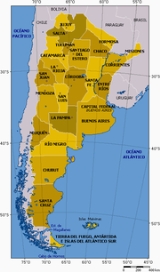
Provinces of Argentina

Encyclopedia
Argentina
is subdivided into twenty-three province
s and one autonomous city
(Ciudad autónoma de Buenos Aires, informally the Capital Federal). The city and the provinces have their own constitutions, but exist under a federal system.
Provinces are then divided into departments
, except for Buenos Aires Province
, which is divided into partidos.
Each province has also its own government, with a provincial constitution, a set of provincial laws and justice system, a supreme court, a governor, an autonomous police force (independent of the Federal Police), and a congress: in eight provinces the parliament is constituted by an upper chamber (senate) and a lower chamber (deputies), while in the remaining fifteen provinces and in the Autonomous City of Buenos Aires
the congress has just one chamber.
On occasion the national government intervenes
in a province under internal instability or after a corruption scandal, designating an intervenor to replace the local government until the situation is normalized: since the return of democracy to the country in 1983, four provinces were intervened, namely Catamarca
, Corrientes
(twice), Santiago del Estero
(twice) and Tucumán
.
During the 20th century, some provinces have had governments traditionally controlled by a single family (i.e. the Saadi family in Catamarca, or the Sapag family in Neuquén); in one case, it is still the situation as of 2009: the Province of San Luis was ruled almost without a break by the Rodríguez Saá family since December 1983.
The internal products of the provinces are merged into the national product when the national budget is decided. The share of the budget given to each province is decided based on each province's individual contribution to the national budget. Provinces are free to choose their own utilization of their assigned percentages of the national product.
to the port of Buenos Aires
.
Santiago del Estero
, in the year 1550, was the first city founded in the territory with such ends, but lost its importance when Tucumán and Salta
replaced it as mid-stops to the Atlantic coast
when these two cities secured from the aboriginal attacks, and economically strengthened.
The centre of the country was also soon explored and inhabited, being the most important of the first founded cities the city of Córdoba
, that became not only a political but also cultural centre with the creation of the first university, the Universidad Nacional de Córdoba in 1622.
Most capital cities of the centre-northern Argentina were founded before the year 1600, except for Santa Rosa
in La Pampa Province
, and Resistencia
in Chaco Province
.
To the south of the Colorado River
, the Patagonia
remained under control of the aboriginals. The river itself served as natural frontier.
It was not until the infamous Roca
's Conquest of the Desert
, started in 1879, when the southern part of Argentina was conquered in what meant the near annihilation of the aboriginal people living in these lands.
The current political division of the provinces of Patagonia was set in 1884 and has not been changed since then, except between 1944 and 1955 when a stripe covering the southern part of Chubut Province
and the northern part of Santa Cruz Province was named Comodoro Rivadavia Military Zone.
But the National Territories didn't have provincial status until the 20th century. They were named provinces in 1957. The exception is Tierra del Fuego Province
, which was named in 1990.
Due to the late conquest of the south of the country and the prevailing cold weather, most people live in the central or northern provinces. Recent immigration to the south, mainly from Buenos Aires Province
and Buenos Aires city, is lessening this difference.
Even though there are provinces that belong to more than one region, they are shown here within the most representative region. In the Tucumán province, the smallest of Argentina, coexist three regions: the Pampas to the south, Gran Chaco
to the northeast, and Argentine Northwest
.
Argentina
Argentina , officially the Argentine Republic , is the second largest country in South America by land area, after Brazil. It is constituted as a federation of 23 provinces and an autonomous city, Buenos Aires...
is subdivided into twenty-three province
Province
A province is a territorial unit, almost always an administrative division, within a country or state.-Etymology:The English word "province" is attested since about 1330 and derives from the 13th-century Old French "province," which itself comes from the Latin word "provincia," which referred to...
s and one autonomous city
Autonomous city
Autonomous city is a type of administrative division.-Argentina:The 1994 amendment of the Argentine Constitution granted Buenos Aires city, formerly a federal district of Argentina, the status of autonomous, and changed its formal name to Autonomous City of Buenos Aires .Another large city that is...
(Ciudad autónoma de Buenos Aires, informally the Capital Federal). The city and the provinces have their own constitutions, but exist under a federal system.
Provinces are then divided into departments
Departments of Argentina
Departments form the second level of administrative division in the provinces of Argentina. There are no departments in the city of Buenos Aires, which has so far been divided into neighbourhoods as its administrative divisions, but is to be divided now into communes by a recently passed local act...
, except for Buenos Aires Province
Buenos Aires Province
The Province of Buenos Aires is the largest and most populous province of Argentina. It takes the name from the city of Buenos Aires, which used to be the provincial capital until it was federalized in 1880...
, which is divided into partidos.
Provinces of Argentina and Autonomous City of Buenos Aires
Demographics
| Flag | Province/District | Capital | Official Language | Population (2010) | Rank | Area (km²) | Rank | Density (/km²) | Rank |
|---|---|---|---|---|---|---|---|---|---|
 |
Buenos Aires Buenos Aires Buenos Aires is the capital and largest city of Argentina, and the second-largest metropolitan area in South America, after São Paulo. It is located on the western shore of the estuary of the Río de la Plata, on the southeastern coast of the South American continent... |
-- | 4 | 24 | 1 | ||||
 |
Buenos Aires Province Buenos Aires Province The Province of Buenos Aires is the largest and most populous province of Argentina. It takes the name from the city of Buenos Aires, which used to be the provincial capital until it was federalized in 1880... |
La Plata La Plata La Plata is the capital city of the Province of Buenos Aires, Argentina, and of La Plata partido. According to the , the city proper has a population of 574,369 and its metropolitan area has 694,253 inhabitants.... |
1 | 1 | 3 | ||||
 |
Catamarca Province Catamarca Province Catamarca is a province of Argentina, located in the northwest of the country. The province has a population of 334,568 as per the , and covers an area of 102,602 km². Its literacy rate is 95.5%. Neighbouring provinces are : Salta, Tucumán, Santiago del Estero, Córdoba, and La Rioja... |
S.F.V. de Catamarca San Fernando del Valle de Catamarca San Fernando del Valle de Catamarca is a city in northwestern Argentina and capital of Catamarca Province, on the Río Valle River, at the feet of the Cerro Ambato.... |
20 | 11 | 20 | ||||
 |
Chaco Province Chaco Province Chaco is an Argentine province located in the north of the country, near the border with Paraguay. Its capital is Resistencia on the Paraná River opposite the city of Corrientes... |
Resistencia Resistencia, Chaco Resistencia is the capital and largest city in the province of Chaco, in northeastern Argentina. At the 2001 census, the population of the Resistencia city proper was 274,490 inhabitants. It is the anchor of a slightly larger metropolitan area, Greater Resistencia, which comprises three more... |
10 | 12 | 11 | ||||
 |
Chubut Province Chubut Province Chubut a province in the southern part of Argentina situated between the 42nd parallel south and the 46th parallel south , the Andes range separating Argentina from Chile, and the Atlantic ocean... |
Rawson Rawson, Chubut Rawson is the capital of the Argentine province of Chubut, in Patagonia. It has about 26,000 inhabitants, and it is the head town of the Rawson Department, which has 122,000 inhabitants... |
18 | 3 | 22 | ||||
 |
Córdoba Province | Córdoba Córdoba, Argentina Córdoba is a city located near the geographical center of Argentina, in the foothills of the Sierras Chicas on the Suquía River, about northwest of Buenos Aires. It is the capital of Córdoba Province. Córdoba is the second-largest city in Argentina after the federal capital Buenos Aires, with... |
2 | 5 | 6 | ||||
 |
Corrientes Province Corrientes Province Corrientes is a province in northeast Argentina, in the Mesopotamia region. It is surrounded by : Paraguay, the province of Misiones, Brazil, Uruguay, and the provinces of Entre Rios, Santa Fe and Chaco.-History:... |
Corrientes Corrientes Corrientes is the capital city of the province of Corrientes, Argentina, located on the eastern shore of the Paraná River, about from Buenos Aires and from Posadas, on National Route 12... |
Spanish, Guaraní Guaraní language Guaraní, specifically the primary variety known as Paraguayan Guaraní , is an indigenous language of South America that belongs to the Tupí–Guaraní subfamily of the Tupian languages. It is one of the official languages of Paraguay , where it is spoken by the majority of the population, and half of... |
11 | 16 | 10 | |||
 |
Entre Ríos Province Entre Ríos Province Entre Ríos is a northeastern province of Argentina, located in the Mesopotamia region. It borders the provinces of Buenos Aires , Corrientes and Santa Fe , and Uruguay in the east.... |
Paraná | 7 | 17 | 7 | ||||
 |
Formosa Province Formosa Province Formosa Province is in northeastern Argentina, part of the Gran Chaco Region. Its northeast end touches Asunción, Paraguay, and borders the provinces of Chaco and Salta to its south and west, respectively... |
Formosa Formosa, Argentina Formosa is the capital city of the Argentine province of Formosa, on the banks of the Paraguay River, about from Buenos Aires, on National Route 11. It has a population of about 210,000 as per the .... |
17 | 19 | 14 | ||||
 |
Jujuy Province Jujuy Province Jujuy is a province of Argentina, located in the extreme northwest of the country, at the borders with Chile and Bolivia. The only neighboring Argentine province is Salta to the east and south.-History:... |
San Salvador de Jujuy San Salvador de Jujuy San Salvador de Jujuy , commonly known as Jujuy and locally often referred to as San Salvador, is the capital city of Jujuy Province in northwest Argentina. It lies near the southern end of the Humahuaca Canyon where wooded hills meet the lowlands.... |
14 | 20 | 8 | ||||
 |
La Pampa Province La Pampa Province La Pampa is a sparsely populated province of Argentina, located in the Pampas in the center of the country. Neighboring provinces are from the north clockwise San Luis, Córdoba, Buenos Aires, Río Negro, Neuquén and Mendoza.-History:... |
Santa Rosa Santa Rosa, Argentina Santa Rosa is a city in the Argentine Pampas, and the capital of La Pampa Province, Argentina. It lies on the east of the province, on the shore of the Don Tomás Lagoon, at the intersection of National Routes 5 and 35. The city and its surroundings hold 102,610 inhabitants , around a third of the... |
22 | 8 | 23 | ||||
| La Rioja Province La Rioja Province (Argentina) La Rioja is a one of the provinces of Argentina and is located in the west of the country. Neighboring provinces are from the north clockwise Catamarca, Córdoba, San Luis and San Juan.-History:... |
La Rioja La Rioja, Argentina La Rioja is the capital city of the Argentine province of La Rioja, located on the east of the province. The city has a population of almost 150,000 as per the .... |
21 | 14 | 19 | |||||
 |
Mendoza Province Mendoza Province The Province of Mendoza is a province of Argentina, located in the western central part of the country in the Cuyo region. It borders to the north with San Juan, the south with La Pampa and Neuquén, the east with San Luis, and to the west with the republic of Chile; the international limit is... |
Mendoza Mendoza, Argentina Mendoza is the capital city of Mendoza Province, in Argentina. It is located in the northern-central part of the province, in a region of foothills and high plains, on the eastern side of the Andes. As of the , Mendoza's population was 110,993... |
5 | 7 | 9 | ||||
 |
Misiones Province Misiones Province Misiones is one of the 23 provinces of Argentina, located in the northeastern corner of the country in the Mesopotamiсa region. It is surrounded by Paraguay to the northwest, Brazil to the north, east and south, and Corrientes Province of Argentina to the southwest.- History :The province was... |
Posadas Posadas, Misiones Posadas is the capital city of the Argentine province of Misiones, located at the south of the province, on the left-hand shore of the Paraná River, opposite Encarnación, Paraguay. The city has an area of 965 km² and a population of 323,739 .... |
9 | 21 | 4 | ||||
 |
Neuquén Province Neuquén Province Neuquén is a province of Argentina, located in the west of the country, at the northern end of Patagonia. It borders Mendoza Province to the north, Rio Negro Province to the southeast, and Chile to the west... |
Neuquén Neuquén Neuquén is the name of the following things:* Neuquén, Argentina* Neuquén Province* Neuquén River* Neuquén Group... |
16 | 13 | 17 | ||||
| Río Negro Province Río Negro Province Río Negro is a province of Argentina, located at the northern edge of Patagonia. Neighboring provinces are from the south clockwise Chubut, Neuquén, Mendoza, La Pampa and Buenos Aires. To the east lies the Atlantic Ocean.Its capital is Viedma... |
Viedma | 15 | 4 | 21 | |||||
 |
Salta Province Salta Province Salta is a province of Argentina, located in the northwest of the country. Neighboring provinces are from the east clockwise Formosa, Chaco, Santiago del Estero, Tucumán and Catamarca. It also surrounds Jujuy... |
Salta Salta Salta is a city in northwestern Argentina and the capital city of the Salta Province. Along with its metropolitan area, it has a population of 464,678 inhabitants as of the , making it Argentina's eighth largest city.-Overview:... |
8 | 6 | 12 | ||||
 |
San Juan Province San Juan Province (Argentina) San Juan is a province of Argentina, located in the western part of the country. Neighbouring provinces are, moving clockwise from the north, La Rioja, San Luis and Mendoza. It borders with Chile at the west.... |
San Juan San Juan, Argentina San Juan is the capital city of the Argentine province of San Juan in the Cuyo region, located in the Tulúm Valley, west of the San Juan River, at above mean sea level, with a population of around 112,000 as per the .... |
13 | 15 | 13 | ||||
 |
San Luis Province San Luis Province San Luis is a province of Argentina located near the geographical center of the country . Neighboring provinces are, from the north clockwise, La Rioja, Córdoba, La Pampa, Mendoza and San Juan.-History:... |
San Luis San Luis, Argentina -External links:* * *... |
19 | 18 | 18 | ||||
 |
Santa Cruz Province Santa Cruz Province (Argentina) Santa Cruz is a province of Argentina, located in the southern part of the country, in Patagonia. It borders Chubut province to the north, and Chile to the west and south. To the east is the Atlantic Ocean... |
Río Gallegos | 23 | 2 | 24 | ||||
 |
Santa Fe Province Santa Fe Province The Invincible Province of Santa Fe, in Spanish Provincia Invencible de Santa Fe , is a province of Argentina, located in the center-east of the country. Neighboring provinces are from the north clockwise Chaco , Corrientes, Entre Ríos, Buenos Aires, Córdoba, and Santiago del Estero... |
Santa Fe Santa Fe, Argentina Santa Fe is the capital city of province of Santa Fe, Argentina. It sits in northeastern Argentina, near the junction of the Paraná and Salado rivers. It lies opposite the city of Paraná, to which it is linked by the Hernandarias Subfluvial Tunnel. The city is also connected by canal with the... |
3 | 10 | 5 | ||||
 |
Santiago del Estero Province Santiago del Estero Province Santiago del Estero is a province of Argentina, located in the north of the country. Neighbouring provinces are from the north clockwise Salta, Chaco, Santa Fe, Córdoba, Catamarca and Tucumán.-History:... |
Santiago del Estero Santiago del Estero Santiago del Estero is the capital of Santiago del Estero Province in northern Argentina. It has a population of 244,733 inhabitants, making it the twelfth largest city in the country, with a surface area of 2,116 km². It lies on the Dulce River and on National Route 9, at a distance of... |
12 | 9 | 15 | ||||
 |
Tierra del Fuego Province Tierra del Fuego Province (Argentina) Tierra del Fuego is an Argentine province entirely separated from mainland Argentina by the Strait of Magellan. It includes:* The eastern part of the Isla Grande of Tierra del Fuego archipelago and the Staten Island.* Argentina's claims to the Falkland Islands and to... |
Ushuaia Ushuaia Ushuaia may refer to the following:*Ushuaia, a city in Argentina.**Ushuaia Department, an administrative division**Ushuaia River**Ushuaia International Airport**Colegio Nacional de Ushuaia, National School of Ushuaia.... |
24 | 23 | 16 | ||||
 |
Tucumán Province Tucumán Province Tucumán is the most densely populated, and the smallest by land area, of the provinces of Argentina. Located in the northwest of the country, the capital is San Miguel de Tucumán, often shortened to Tucumán. Neighboring provinces are, clockwise from the north: Salta, Santiago del Estero and... |
San Miguel de Tucumán | 6 | 22 | 2 |
Politics
See also List of Governors in ArgentinaEach province has also its own government, with a provincial constitution, a set of provincial laws and justice system, a supreme court, a governor, an autonomous police force (independent of the Federal Police), and a congress: in eight provinces the parliament is constituted by an upper chamber (senate) and a lower chamber (deputies), while in the remaining fifteen provinces and in the Autonomous City of Buenos Aires
Buenos Aires
Buenos Aires is the capital and largest city of Argentina, and the second-largest metropolitan area in South America, after São Paulo. It is located on the western shore of the estuary of the Río de la Plata, on the southeastern coast of the South American continent...
the congress has just one chamber.
On occasion the national government intervenes
Federal intervention
Federal intervention is an attribution of the federal government of Argentina, by which it takes control of a province in certain extreme cases. Intervention is declared by the President with the assent of the National Congress...
in a province under internal instability or after a corruption scandal, designating an intervenor to replace the local government until the situation is normalized: since the return of democracy to the country in 1983, four provinces were intervened, namely Catamarca
Catamarca Province
Catamarca is a province of Argentina, located in the northwest of the country. The province has a population of 334,568 as per the , and covers an area of 102,602 km². Its literacy rate is 95.5%. Neighbouring provinces are : Salta, Tucumán, Santiago del Estero, Córdoba, and La Rioja...
, Corrientes
Corrientes Province
Corrientes is a province in northeast Argentina, in the Mesopotamia region. It is surrounded by : Paraguay, the province of Misiones, Brazil, Uruguay, and the provinces of Entre Rios, Santa Fe and Chaco.-History:...
(twice), Santiago del Estero
Santiago del Estero Province
Santiago del Estero is a province of Argentina, located in the north of the country. Neighbouring provinces are from the north clockwise Salta, Chaco, Santa Fe, Córdoba, Catamarca and Tucumán.-History:...
(twice) and Tucumán
Tucumán Province
Tucumán is the most densely populated, and the smallest by land area, of the provinces of Argentina. Located in the northwest of the country, the capital is San Miguel de Tucumán, often shortened to Tucumán. Neighboring provinces are, clockwise from the north: Salta, Santiago del Estero and...
.
During the 20th century, some provinces have had governments traditionally controlled by a single family (i.e. the Saadi family in Catamarca, or the Sapag family in Neuquén); in one case, it is still the situation as of 2009: the Province of San Luis was ruled almost without a break by the Rodríguez Saá family since December 1983.
The internal products of the provinces are merged into the national product when the national budget is decided. The share of the budget given to each province is decided based on each province's individual contribution to the national budget. Provinces are free to choose their own utilization of their assigned percentages of the national product.
History
The north of Argentina was the first part of the present country to be explored by the Spanish colonisation, searching for the routes that would allow them to bring the gold and silver extracted in the Viceroyalty of PeruViceroyalty of Peru
Created in 1542, the Viceroyalty of Peru was a Spanish colonial administrative district that originally contained most of Spanish-ruled South America, governed from the capital of Lima...
to the port of Buenos Aires
Buenos Aires
Buenos Aires is the capital and largest city of Argentina, and the second-largest metropolitan area in South America, after São Paulo. It is located on the western shore of the estuary of the Río de la Plata, on the southeastern coast of the South American continent...
.
Santiago del Estero
Santiago del Estero
Santiago del Estero is the capital of Santiago del Estero Province in northern Argentina. It has a population of 244,733 inhabitants, making it the twelfth largest city in the country, with a surface area of 2,116 km². It lies on the Dulce River and on National Route 9, at a distance of...
, in the year 1550, was the first city founded in the territory with such ends, but lost its importance when Tucumán and Salta
Salta
Salta is a city in northwestern Argentina and the capital city of the Salta Province. Along with its metropolitan area, it has a population of 464,678 inhabitants as of the , making it Argentina's eighth largest city.-Overview:...
replaced it as mid-stops to the Atlantic coast
Atlantic Ocean
The Atlantic Ocean is the second-largest of the world's oceanic divisions. With a total area of about , it covers approximately 20% of the Earth's surface and about 26% of its water surface area...
when these two cities secured from the aboriginal attacks, and economically strengthened.
The centre of the country was also soon explored and inhabited, being the most important of the first founded cities the city of Córdoba
Córdoba, Argentina
Córdoba is a city located near the geographical center of Argentina, in the foothills of the Sierras Chicas on the Suquía River, about northwest of Buenos Aires. It is the capital of Córdoba Province. Córdoba is the second-largest city in Argentina after the federal capital Buenos Aires, with...
, that became not only a political but also cultural centre with the creation of the first university, the Universidad Nacional de Córdoba in 1622.
Most capital cities of the centre-northern Argentina were founded before the year 1600, except for Santa Rosa
Santa Rosa, Argentina
Santa Rosa is a city in the Argentine Pampas, and the capital of La Pampa Province, Argentina. It lies on the east of the province, on the shore of the Don Tomás Lagoon, at the intersection of National Routes 5 and 35. The city and its surroundings hold 102,610 inhabitants , around a third of the...
in La Pampa Province
La Pampa Province
La Pampa is a sparsely populated province of Argentina, located in the Pampas in the center of the country. Neighboring provinces are from the north clockwise San Luis, Córdoba, Buenos Aires, Río Negro, Neuquén and Mendoza.-History:...
, and Resistencia
Resistencia, Chaco
Resistencia is the capital and largest city in the province of Chaco, in northeastern Argentina. At the 2001 census, the population of the Resistencia city proper was 274,490 inhabitants. It is the anchor of a slightly larger metropolitan area, Greater Resistencia, which comprises three more...
in Chaco Province
Chaco Province
Chaco is an Argentine province located in the north of the country, near the border with Paraguay. Its capital is Resistencia on the Paraná River opposite the city of Corrientes...
.
To the south of the Colorado River
Colorado River (Argentina)
The Colorado River is a river in the south of Argentina.The Colorado river marks most of the political limit between the provinces of Neuquén and Mendoza, and between Rio Negro and La Pampa...
, the Patagonia
Patagonia
Patagonia is a region located in Argentina and Chile, integrating the southernmost section of the Andes mountains to the southwest towards the Pacific ocean and from the east of the cordillera to the valleys it follows south through Colorado River towards Carmen de Patagones in the Atlantic Ocean...
remained under control of the aboriginals. The river itself served as natural frontier.
It was not until the infamous Roca
Julio Argentino Roca
Alejo Julio Argentino Roca Paz was an army general who served as President of Argentina from 12 October 1880 to 12 October 1886 and again from 12 October 1898 to 12 October 1904.-Upbringing and early career:...
's Conquest of the Desert
Conquest of the Desert
The Conquest of the Desert was a military campaign directed mainly by General Julio Argentino Roca in the 1870s, which established Argentine dominance over Patagonia, which was inhabited by indigenous peoples...
, started in 1879, when the southern part of Argentina was conquered in what meant the near annihilation of the aboriginal people living in these lands.
The current political division of the provinces of Patagonia was set in 1884 and has not been changed since then, except between 1944 and 1955 when a stripe covering the southern part of Chubut Province
Chubut Province
Chubut a province in the southern part of Argentina situated between the 42nd parallel south and the 46th parallel south , the Andes range separating Argentina from Chile, and the Atlantic ocean...
and the northern part of Santa Cruz Province was named Comodoro Rivadavia Military Zone.
But the National Territories didn't have provincial status until the 20th century. They were named provinces in 1957. The exception is Tierra del Fuego Province
Tierra del Fuego Province (Argentina)
Tierra del Fuego is an Argentine province entirely separated from mainland Argentina by the Strait of Magellan. It includes:* The eastern part of the Isla Grande of Tierra del Fuego archipelago and the Staten Island.* Argentina's claims to the Falkland Islands and to...
, which was named in 1990.
Due to the late conquest of the south of the country and the prevailing cold weather, most people live in the central or northern provinces. Recent immigration to the south, mainly from Buenos Aires Province
Buenos Aires Province
The Province of Buenos Aires is the largest and most populous province of Argentina. It takes the name from the city of Buenos Aires, which used to be the provincial capital until it was federalized in 1880...
and Buenos Aires city, is lessening this difference.
Geographical Regions
The country is also divided into six or seven regions (seven when The Pampas is divided into the Pampas' plains and Pampas' sierras):| Region | Provinces included |
|---|---|
| Argentine Northwest Argentine Northwest The Argentine Northwest is a region of Argentina composed by the provinces of Catamarca, Jujuy, Salta, Santiago del Estero and Tucumán.-Geography:The region had 5 different biomes:* Sub-Andean humid Sierras of the east... |
Jujuy Jujuy Province Jujuy is a province of Argentina, located in the extreme northwest of the country, at the borders with Chile and Bolivia. The only neighboring Argentine province is Salta to the east and south.-History:... , Salta Salta Province Salta is a province of Argentina, located in the northwest of the country. Neighboring provinces are from the east clockwise Formosa, Chaco, Santiago del Estero, Tucumán and Catamarca. It also surrounds Jujuy... , Tucumán Tucumán Province Tucumán is the most densely populated, and the smallest by land area, of the provinces of Argentina. Located in the northwest of the country, the capital is San Miguel de Tucumán, often shortened to Tucumán. Neighboring provinces are, clockwise from the north: Salta, Santiago del Estero and... , Catamarca Catamarca Province Catamarca is a province of Argentina, located in the northwest of the country. The province has a population of 334,568 as per the , and covers an area of 102,602 km². Its literacy rate is 95.5%. Neighbouring provinces are : Salta, Tucumán, Santiago del Estero, Córdoba, and La Rioja... , La Rioja La Rioja Province (Argentina) La Rioja is a one of the provinces of Argentina and is located in the west of the country. Neighboring provinces are from the north clockwise Catamarca, Córdoba, San Luis and San Juan.-History:... |
| Gran Chaco Gran Chaco The Gran Chaco is a sparsely populated, hot and semi-arid lowland region of the Río de la Plata basin, divided among eastern Bolivia, Paraguay, northern Argentina and a portion of the Brazilian states of Mato Grosso and Mato Grosso do Sul, where it is connected with the Pantanal region... |
Formosa Formosa Province Formosa Province is in northeastern Argentina, part of the Gran Chaco Region. Its northeast end touches Asunción, Paraguay, and borders the provinces of Chaco and Salta to its south and west, respectively... , Chaco Chaco Province Chaco is an Argentine province located in the north of the country, near the border with Paraguay. Its capital is Resistencia on the Paraná River opposite the city of Corrientes... , Santiago del Estero Santiago del Estero Province Santiago del Estero is a province of Argentina, located in the north of the country. Neighbouring provinces are from the north clockwise Salta, Chaco, Santa Fe, Córdoba, Catamarca and Tucumán.-History:... |
| Mesopotamia Mesopotamia, Argentina La Mesopotamia, Región Mesopotámica is the humid and verdant area of north-east Argentina, comprising the provinces of Misiones, Entre Ríos and Corrientes. The region called Litoral consists of the Mesopotamia and the provinces of Chaco, Formosa and Santa Fe... |
Misiones Misiones Province Misiones is one of the 23 provinces of Argentina, located in the northeastern corner of the country in the Mesopotamiсa region. It is surrounded by Paraguay to the northwest, Brazil to the north, east and south, and Corrientes Province of Argentina to the southwest.- History :The province was... , Entre Ríos Entre Ríos Province Entre Ríos is a northeastern province of Argentina, located in the Mesopotamia region. It borders the provinces of Buenos Aires , Corrientes and Santa Fe , and Uruguay in the east.... , Corrientes Corrientes Province Corrientes is a province in northeast Argentina, in the Mesopotamia region. It is surrounded by : Paraguay, the province of Misiones, Brazil, Uruguay, and the provinces of Entre Rios, Santa Fe and Chaco.-History:... |
| Cuyo | San Juan San Juan Province (Argentina) San Juan is a province of Argentina, located in the western part of the country. Neighbouring provinces are, moving clockwise from the north, La Rioja, San Luis and Mendoza. It borders with Chile at the west.... , Mendoza Mendoza Province The Province of Mendoza is a province of Argentina, located in the western central part of the country in the Cuyo region. It borders to the north with San Juan, the south with La Pampa and Neuquén, the east with San Luis, and to the west with the republic of Chile; the international limit is... , San Luis San Luis Province San Luis is a province of Argentina located near the geographical center of the country . Neighboring provinces are, from the north clockwise, La Rioja, Córdoba, La Pampa, Mendoza and San Juan.-History:... |
| The Pampas Pampa The Pampas are the fertile South American lowlands, covering more than , that include the Argentine provinces of Buenos Aires, La Pampa, Santa Fe, Entre Ríos and Córdoba, most of Uruguay, and the southernmost Brazilian State, Rio Grande do Sul... |
Córdoba, Santa Fe Santa Fe Province The Invincible Province of Santa Fe, in Spanish Provincia Invencible de Santa Fe , is a province of Argentina, located in the center-east of the country. Neighboring provinces are from the north clockwise Chaco , Corrientes, Entre Ríos, Buenos Aires, Córdoba, and Santiago del Estero... , La Pampa La Pampa Province La Pampa is a sparsely populated province of Argentina, located in the Pampas in the center of the country. Neighboring provinces are from the north clockwise San Luis, Córdoba, Buenos Aires, Río Negro, Neuquén and Mendoza.-History:... , Buenos Aires Buenos Aires Province The Province of Buenos Aires is the largest and most populous province of Argentina. It takes the name from the city of Buenos Aires, which used to be the provincial capital until it was federalized in 1880... |
| Patagonia Patagonia Patagonia is a region located in Argentina and Chile, integrating the southernmost section of the Andes mountains to the southwest towards the Pacific ocean and from the east of the cordillera to the valleys it follows south through Colorado River towards Carmen de Patagones in the Atlantic Ocean... |
Rio Negro Río Negro Province Río Negro is a province of Argentina, located at the northern edge of Patagonia. Neighboring provinces are from the south clockwise Chubut, Neuquén, Mendoza, La Pampa and Buenos Aires. To the east lies the Atlantic Ocean.Its capital is Viedma... , Neuquén Neuquén Province Neuquén is a province of Argentina, located in the west of the country, at the northern end of Patagonia. It borders Mendoza Province to the north, Rio Negro Province to the southeast, and Chile to the west... , Chubut Chubut Province Chubut a province in the southern part of Argentina situated between the 42nd parallel south and the 46th parallel south , the Andes range separating Argentina from Chile, and the Atlantic ocean... , Santa Cruz Santa Cruz Province (Argentina) Santa Cruz is a province of Argentina, located in the southern part of the country, in Patagonia. It borders Chubut province to the north, and Chile to the west and south. To the east is the Atlantic Ocean... , Tierra del Fuego Tierra del Fuego Province (Argentina) Tierra del Fuego is an Argentine province entirely separated from mainland Argentina by the Strait of Magellan. It includes:* The eastern part of the Isla Grande of Tierra del Fuego archipelago and the Staten Island.* Argentina's claims to the Falkland Islands and to... |
Even though there are provinces that belong to more than one region, they are shown here within the most representative region. In the Tucumán province, the smallest of Argentina, coexist three regions: the Pampas to the south, Gran Chaco
Gran Chaco
The Gran Chaco is a sparsely populated, hot and semi-arid lowland region of the Río de la Plata basin, divided among eastern Bolivia, Paraguay, northern Argentina and a portion of the Brazilian states of Mato Grosso and Mato Grosso do Sul, where it is connected with the Pantanal region...
to the northeast, and Argentine Northwest
Argentine Northwest
The Argentine Northwest is a region of Argentina composed by the provinces of Catamarca, Jujuy, Salta, Santiago del Estero and Tucumán.-Geography:The region had 5 different biomes:* Sub-Andean humid Sierras of the east...
.
See also
- List of Governors in Argentina
- ISO 3166-2:ARISO 3166-2:ARISO 3166-2:AR is the entry for Argentina in ISO 3166-2, part of the ISO 3166 standard published by the International Organization for Standardization , which defines codes for the names of the principal subdivisions of all countries coded in ISO 3166-1.Currently for Argentina, ISO 3166-2 codes are...
, the ISO codes for the provinces of Argentina. - List of Argentine Provinces by Human Development Index
- List of Argentine provinces by GDP (nominal)
- List of Argentine provinces by GDP (nominal) per capita
- Comparison between Argentine provinces and countries by GDP (PPP) per capitaComparison between Argentine provinces and countries by GDP (PPP) per capitaThis is a comparison between Argentine provinces and countries by Gross Domestic Product per capita. All data is for the year 2008.These figures are based on the IADER list on List of Argentine provinces by GDP per capita for Argentine provinces, and the List of countries by GDP per capita for...