

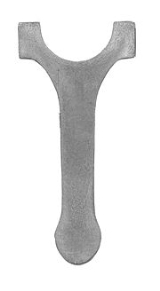
Forging

Encyclopedia
Forging is a manufacturing process involving the shaping of metal using localized compressive forces. Forging is often classified according to the temperature at which it is performed: '"cold," "warm," or "hot" forging. Forged parts can range in weight from less than a kilogram to 580 metric tons. Forged parts usually require further processing to achieve a finished part.
Traditionally, forging was performed by a smith using hammer and anvil, and though the use of water power in the production and working of iron dates to the 12th century, the hammer and anvil are not obsolete. The smithy or forge
has evolved over centuries to become a facility with engineered processes, production equipment, tooling, raw materials and products to meet the demands of modern industry.
In modern times, industrial forging is done either with presses
or with hammers powered by compressed air, electricity, hydraulics or steam. These hammers may have reciprocating weights in the thousands of pounds. Smaller power hammer
s, 500 lb (226.8 kg) or less reciprocating weight, and hydraulic presses are common in art smithies as well. Some steam hammers remain in use, but they became obsolete with the availability of the other, more convenient, power sources.
part. As the metal is shaped during the forging process, its internal grain deforms to follow the general shape of the part. As a result, the grain is continuous throughout the part, giving rise to a piece with improved strength characteristics.
Some metals may be forged cold, but iron
and steel
are almost always hot forged
. Hot forging prevents the work hardening
that would result from cold forging, which would increase the difficulty of performing secondary machining operations on the piece. Also, while work hardening may be desirable in some circumstances, other methods of hardening the piece, such as heat treating, are generally more economical and more controllable. Alloys that are amenable to precipitation hardening, such as most aluminium
alloys and titanium
, can be hot forged, followed by hardening.
Production forging involves significant capital expenditure for machinery, tooling, facilities and personnel. In the case of hot forging, a high temperature furnace (sometimes referred to as the forge) will be required to heat ingot
s or billets
. Owing to the massiveness of large forging hammers and presses and the parts they can produce, as well as the dangers inherent in working with hot metal, a special building is frequently required to house the operation. In the case of drop forging operations, provisions must be made to absorb the shock and vibration generated by the hammer. Most forging operations will require the use of metal-forming dies, which must be precisely machined and carefully heat treated to correctly shape the workpiece, as well as to withstand the tremendous forces involved.
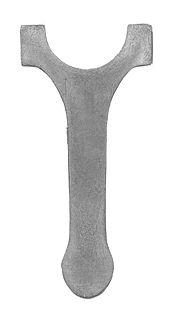 There are many different kinds of forging processes available, however they can be grouped into three main classes:
Common forging processes include: roll forging, swaging
, cogging, open-die forging, impression-die forging, press forging, automatic hot forging and upsetting.
effects are negated by the recrystallization process. Cold forging typically results in work hardening of the piece.
Open-die forging lends itself to short runs and is appropriate for art smithing and custom work. In some cases, open-die forging may be employed to rough-shape ingot
s to prepare them for subsequent operations. Open-die forging may also orient the grain to increase strength in the required direction.
is successive deformation of a bar along its length using an open-die drop forge. It is commonly used to work a piece of raw material to the proper thickness. Once the proper thickness is achieved the proper width is achieved via edging.
is the process of concentrating material using a concave shaped open die. The process is called edging, because it is usually carried out on the ends of the workpiece. is a similar process that thins out sections of the forging using a convex shaped die. These processes prepare the workpieces for further forging processes.
In commercial impression-die forging the workpiece is usually moved through a series of cavities in a die to get from an ingot
to the final form. The first impression is used to distribute the metal into the rough shape in accordance to the needs of later cavities; this impression is called an edging, fullering, or bending impression. The following cavities are called blocking cavities, in which the piece is working into a shape that more closely resembles the final product. These stages usually impart the workpiece with generous bends and large fillets
. The final shape is forged in a final or finisher impression cavity. If there is only a short run of parts to be done it may be more economical for the die to lack a final impression cavity and instead machine the final features.
Impression-die forging has been further improved in recent years through increased automation which includes induction heating, mechanical feeding, positioning and manipulation, and the direct heat treatment of parts after forging.
One variation of impression-die forging is called flashless forging, or true closed-die forging. In this type of forging the die cavities are completely closed, which keeps the workpiece from forming flash. The major advantage to this process is that less metal is lost to flash. Flash can account for 20 to 45% of the starting material. The disadvantages of this process include additional cost due to a more complex die design and the need for better lubrication and workpiece placement.
There are other variations of part formation that integrate impression-die forging. One method incorporates casting a forging preform from liquid metal. The casting is removed after it has solidified, but while still hot. It is then finished in a single cavity die. The flash is trimmed, then the part is quench hardened. Another variation follows the same process as outlined above, except the preform is produced by the spraying deposition of metal droplet into shaped collectors (similar to the Osprey process).
Closed-die forging has a high initial cost due to the creation of dies and required design work to make working die cavities. However, it has low recurring costs for each part, thus forgings become more economical with more volume. This is one of the major reasons closed-die forgings are often used in the automotive and tool industry. Another reason forgings are common in these industrial sectors is because forgings generally have about a 20 percent higher strength-to-weight ratio compared to cast or machined parts of the same material.
Forging dies are usually made of high-alloy or tool steel
. Dies must be impact resistant, wear resistant, maintain strength at high temperatures, and have the ability to withstand cycles of rapid heating and cooling. In order to produce a better, more economical die the following rules should be followed:
The dimensional tolerances of a steel part produced using the impression-die forging method are outlined in the table below. It should be noted that the dimensions across the paring plane are affected by the closure of the dies, and are therefore dependent die wear and the thickness of the final flash. Dimensions that are completely contained within a single die segment or half can be maintained at a significantly greater level of accuracy.
A lubricant is always used when forging to reduce friction and wear. It is also used to as a thermal barrier to restrict heat transfer from the workpiece to the die. Finally, the lubricant acts as a parting compound to prevent the part from sticking in one of the dies.
The main advantage of press forging, as compared to drop-hammer forging, is its ability to deform the complete workpiece. Drop-hammer forging usually only deforms the surfaces of the workpiece in contact with the hammer and anvil; the interior of the workpiece will stay relatively undeformed. Another advantage to the process includes the knowledge of the new part's strain rate. We specifically know what kind of strain can be put on the part, because the compression rate of the press forging operation is controlled. There are a few disadvantages to this process, most stemming from the workpiece being in contact with the dies for such an extended period of time. The operation is a time consuming process due to the amount of steps and how long each of them take. The workpiece will cool faster because the dies are in contact with workpiece; the dies facilitate drastically more heat transfer than the surrounding atmosphere. As the workpiece cools it becomes stronger and less ductile, which may induce cracking if deformation continues. Therefore heated dies are usually used to reduce heat loss, promote surface flow, and enable the production of finer details and closer tolerances. The workpiece may also need to be reheated. When done in high productivity, press forging is more economical than hammer forging. The operation also creates closer tolerances. In hammer forging a lot of the work is absorbed by the machinery, when in press forging, the greater percentage of work is used in the work piece. Another advantage is that the operation can be used to create any size part because there is no limit to the size of the press forging machine. New press forging techniques have been able to create a higher degree of mechanical and orientation integrity. By the constraint of oxidation to the outer most layers of the part material, reduced levels of microcracking take place in the finished part.
Press forging can be used to perform all types of forging, including open-die and impression-die forging. Impression-die press forging usually requires less draft than drop forging and has better dimensional accuracy. Also, press forgings can often be done in one closing of the dies, allowing for easy automation.
Upset forging is usually done in special high speed machines called crank presses, but upsetting can also be done in a vertical crank press or a hydraulic press. The machines are usually set up to work in the horizontal plane, to facilitate the quick exchange of workpieces from one station to the next. The initial workpiece is usually wire or rod, but some machines can accept bars up to 25 cm (9.8 in) in diameter and a capacity of over 1000 tons. The standard upsetting machine employs split dies that contain multiple cavities. The dies open enough to allow the workpiece to move from one cavity to the next; the dies then close and the heading tool, or ram, then moves longitudinally against the bar, upsetting it into the cavity. If all of the cavities are utilized on every cycle then a finished part will be produced with every cycle, which is why this process is ideal for mass production.
The following three rules must be followed when designing parts to be upset forged:
The process starts by heating up the bar to 1200 to 1300 °C (2,192 to 2,372 F) in less than 60 seconds using high power induction coils. It is then descaled with rollers, sheared into blanks, and transferred several successive forming stages, during which it is upset, preformed, final forged, and pierced (if necessary). This process can also be couple with high speed cold forming operations. Generally, the cold forming operation will do the finishing stage so that the advantages of cold-working can be obtained, while maintaining the high speed of automatic hot forging.
Examples of parts made by this process are: wheel hub unit bearings, transmission gears, tapered roller bearing races, stainless steel coupling flanges, and neck rings for LP gas cylinders. Manual transmission gears are an example of automatic hot forging used in conjunction with cold working.
Examples of products produced using this method include axle
s, tapered levers and leaf spring
s.
Example disciplines are: die-lubricant management (Use of uncontaminated and homogeneous mixtures, amount and placement of lubricant). Tight control of die temperatures and surface finish / friction.
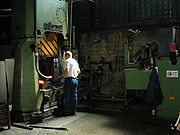
 The most common type of forging equipment is the hammer and anvil. Principles behind the hammer and anvil are still used today in drop-hammer equipment. The principle behind the machine is very simple—raise the hammer and then drop it or propel it into the workpiece, which rests on the anvil. The main variations between drop-hammers are in the way the hammer is powered; the most common being air and steam hammers. Drop-hammers usually operate in a vertical position. The main reason for this is excess energy (energy that isn't used to deform the workpiece) that isn't released as heat or sound needs to be transmitted to the foundation. Moreover, a large machine base is needed to absorb the impacts.
To overcome some of the shortcomings of the drop-hammer, the counterblow machine or impactor is used. In a counterblow machine both the hammer and anvil move and the workpiece is held between them. Here excess energy becomes recoil. This allows the machine to work horizontally and consist of a smaller base. Other advantages include less noise, heat and vibration. It also produces a distinctly different flow pattern. Both of these machines can be used for open die or closed die forging.
A forging press, often just called a press, is used for press forging. There are two main types: mechanical and hydraulic presses. Mechanical presses function by using cams, cranks and/or toggles to produce a preset (a predetermined force at a certain location in the stroke) and reproducible stroke. Due to the nature of this type of system, different forces are available at different stroke positions. Mechanical presses are faster than their hydraulic counterparts (up to 50 strokes per minute). Their capacities range from 3 to 160 MN (300 to 18,000 short tons-force). Hydraulic presses use fluid pressure and a piston to generate force. The advantages of a hydraulic press over a mechanical press are its flexibility and greater capacity. The disadvantages include a slower, larger, and costlier machine to operate.
The roll forging, upsetting, and automatic hot forging processes all use specialized machinery.
History
Forging is one of the oldest known metalworking processes.Traditionally, forging was performed by a smith using hammer and anvil, and though the use of water power in the production and working of iron dates to the 12th century, the hammer and anvil are not obsolete. The smithy or forge
Forge
A forge is a hearth used for forging. The term "forge" can also refer to the workplace of a smith or a blacksmith, although the term smithy is then more commonly used.The basic smithy contains a forge, also known as a hearth, for heating metals...
has evolved over centuries to become a facility with engineered processes, production equipment, tooling, raw materials and products to meet the demands of modern industry.
In modern times, industrial forging is done either with presses
Machine press
A machine press, commonly shortened to press, is a machine tool that changes the shape of a workpiece.-Servomechanism:A servomechanism press, also known as a servo press or a electro press, is a press driven by an AC servo motor. The torque produced is converted to a linear force via a ball screw....
or with hammers powered by compressed air, electricity, hydraulics or steam. These hammers may have reciprocating weights in the thousands of pounds. Smaller power hammer
Power hammer
Power hammers are mechanical forging hammers that use a non-muscular power source to raise the hammer preparatory to striking, and accelerate it onto the work being hammered...
s, 500 lb (226.8 kg) or less reciprocating weight, and hydraulic presses are common in art smithies as well. Some steam hammers remain in use, but they became obsolete with the availability of the other, more convenient, power sources.
Advantages and disadvantages
Forging can produce a piece that is stronger than an equivalent cast or machinedMachining
Conventional machining is a form of subtractive manufacturing, in which a collection of material-working processes utilizing power-driven machine tools, such as saws, lathes, milling machines, and drill presses, are used with a sharp cutting tool to physical remove material to achieve a desired...
part. As the metal is shaped during the forging process, its internal grain deforms to follow the general shape of the part. As a result, the grain is continuous throughout the part, giving rise to a piece with improved strength characteristics.
Some metals may be forged cold, but iron
Iron
Iron is a chemical element with the symbol Fe and atomic number 26. It is a metal in the first transition series. It is the most common element forming the planet Earth as a whole, forming much of Earth's outer and inner core. It is the fourth most common element in the Earth's crust...
and steel
Steel
Steel is an alloy that consists mostly of iron and has a carbon content between 0.2% and 2.1% by weight, depending on the grade. Carbon is the most common alloying material for iron, but various other alloying elements are used, such as manganese, chromium, vanadium, and tungsten...
are almost always hot forged
Hot working
Hot working refers to processes where metals are plastically deformed above their recrystallization temperature. Being above the recrystallization temperature allows the material to recrystallize during deformation. This is important because recrystallization keeps the materials from strain...
. Hot forging prevents the work hardening
Work hardening
Work hardening, also known as strain hardening or cold working, is the strengthening of a metal by plastic deformation. This strengthening occurs because of dislocation movements within the crystal structure of the material. Any material with a reasonably high melting point such as metals and...
that would result from cold forging, which would increase the difficulty of performing secondary machining operations on the piece. Also, while work hardening may be desirable in some circumstances, other methods of hardening the piece, such as heat treating, are generally more economical and more controllable. Alloys that are amenable to precipitation hardening, such as most aluminium
Aluminium
Aluminium or aluminum is a silvery white member of the boron group of chemical elements. It has the symbol Al, and its atomic number is 13. It is not soluble in water under normal circumstances....
alloys and titanium
Titanium
Titanium is a chemical element with the symbol Ti and atomic number 22. It has a low density and is a strong, lustrous, corrosion-resistant transition metal with a silver color....
, can be hot forged, followed by hardening.
Production forging involves significant capital expenditure for machinery, tooling, facilities and personnel. In the case of hot forging, a high temperature furnace (sometimes referred to as the forge) will be required to heat ingot
Ingot
An ingot is a material, usually metal, that is cast into a shape suitable for further processing. Non-metallic and semiconductor materials prepared in bulk form may also be referred to as ingots, particularly when cast by mold based methods.-Uses:...
s or billets
Billet (manufacturing)
Semi-finished casting products are intermediate castings produced in a foundry that need further processing before being a finished good. There are four types: ingots, billets, blooms, and slabs.-Ingot:...
. Owing to the massiveness of large forging hammers and presses and the parts they can produce, as well as the dangers inherent in working with hot metal, a special building is frequently required to house the operation. In the case of drop forging operations, provisions must be made to absorb the shock and vibration generated by the hammer. Most forging operations will require the use of metal-forming dies, which must be precisely machined and carefully heat treated to correctly shape the workpiece, as well as to withstand the tremendous forces involved.
Processes
- Drawn out: length increases, cross-section decreases
- Upset: length decreases, cross-section increases
- Squeezed in closed compression dies: produces multidirectional flow
Common forging processes include: roll forging, swaging
Swage
Swaging is a forging process in which the dimensions of an item are altered using a die or dies, into which the item is forced. Swaging is usually a cold working process; however, it is sometimes done as a hot working process....
, cogging, open-die forging, impression-die forging, press forging, automatic hot forging and upsetting.
Temperature
All of the following forging processes can be performed at various temperatures, however they are generally classified by whether the metal temperature is above or below the recrystallization temperature. If the temperature is above the material's recrystallization temperature it is deemed hot forging; if the temperature is below the material's recrystallization temperature but above ths of the recrystallization temperature (on an absolute scale) it is deemed warm forging; if below ths of the recrystallization temperature (usually room temperature) then it is deemed cold forging. The main advantage of hot forging is that as the metal is deformed work hardeningWork hardening
Work hardening, also known as strain hardening or cold working, is the strengthening of a metal by plastic deformation. This strengthening occurs because of dislocation movements within the crystal structure of the material. Any material with a reasonably high melting point such as metals and...
effects are negated by the recrystallization process. Cold forging typically results in work hardening of the piece.
Drop forging
Drop forging is a forging process where a hammer is raised up and then "dropped" onto the workpiece to deform it according to the shape of the die. There are two types of drop forging: open-die drop forging and closed-die drop forging. As the names imply, the difference is in the shape of the die, with the former not fully enclosing the workpiece, while the latter does.Open-die drop forging
Open-die forging is also known as smith forging. In open-die forging, a hammer strikes and deforms the workpiece, which is placed on a stationary anvil. Open-die forging gets its name from the fact that the dies (the surfaces that are in contact with the workpiece) do not enclose the workpiece, allowing it to flow except where contacted by the dies. Therefore the operator needs to orient and position the workpiece to get the desired shape. The dies are usually flat in shape, but some have a specially shaped surface for specialized operations. For example, a die may have a round, concave, or convex surface or be a tool to form holes or be a cut-off tool.Open-die forging lends itself to short runs and is appropriate for art smithing and custom work. In some cases, open-die forging may be employed to rough-shape ingot
Ingot
An ingot is a material, usually metal, that is cast into a shape suitable for further processing. Non-metallic and semiconductor materials prepared in bulk form may also be referred to as ingots, particularly when cast by mold based methods.-Uses:...
s to prepare them for subsequent operations. Open-die forging may also orient the grain to increase strength in the required direction.
is successive deformation of a bar along its length using an open-die drop forge. It is commonly used to work a piece of raw material to the proper thickness. Once the proper thickness is achieved the proper width is achieved via edging.
is the process of concentrating material using a concave shaped open die. The process is called edging, because it is usually carried out on the ends of the workpiece. is a similar process that thins out sections of the forging using a convex shaped die. These processes prepare the workpieces for further forging processes.
Impression-die drop forging
Impression-die forging is also called closed-die forging. In impression-die work metal is placed in a die resembling a mold, which is attached to the anvil. Usually the hammer die is shaped as well. The hammer is then dropped on the workpiece, causing the metal to flow and fill the die cavities. The hammer is generally in contact with the workpiece on the scale of milliseconds. Depending on the size and complexity of the part the hammer may be dropped multiple times in quick succession. Excess metal is squeezed out of the die cavities, forming what is referred to as flash. The flash cools more rapidly than the rest of the material; this cool metal is stronger than the metal in the die so it helps prevent more flash from forming. This also forces the metal to completely fill the die cavity. After forging the flash is removed.In commercial impression-die forging the workpiece is usually moved through a series of cavities in a die to get from an ingot
Ingot
An ingot is a material, usually metal, that is cast into a shape suitable for further processing. Non-metallic and semiconductor materials prepared in bulk form may also be referred to as ingots, particularly when cast by mold based methods.-Uses:...
to the final form. The first impression is used to distribute the metal into the rough shape in accordance to the needs of later cavities; this impression is called an edging, fullering, or bending impression. The following cavities are called blocking cavities, in which the piece is working into a shape that more closely resembles the final product. These stages usually impart the workpiece with generous bends and large fillets
Fillet (mechanics)
In mechanical engineering, a fillet is a concave easing of an interior corner of a part design. A rounding of an exterior corner is called a "round" or a "chamfer".-Applications:...
. The final shape is forged in a final or finisher impression cavity. If there is only a short run of parts to be done it may be more economical for the die to lack a final impression cavity and instead machine the final features.
Impression-die forging has been further improved in recent years through increased automation which includes induction heating, mechanical feeding, positioning and manipulation, and the direct heat treatment of parts after forging.
One variation of impression-die forging is called flashless forging, or true closed-die forging. In this type of forging the die cavities are completely closed, which keeps the workpiece from forming flash. The major advantage to this process is that less metal is lost to flash. Flash can account for 20 to 45% of the starting material. The disadvantages of this process include additional cost due to a more complex die design and the need for better lubrication and workpiece placement.
There are other variations of part formation that integrate impression-die forging. One method incorporates casting a forging preform from liquid metal. The casting is removed after it has solidified, but while still hot. It is then finished in a single cavity die. The flash is trimmed, then the part is quench hardened. Another variation follows the same process as outlined above, except the preform is produced by the spraying deposition of metal droplet into shaped collectors (similar to the Osprey process).
Closed-die forging has a high initial cost due to the creation of dies and required design work to make working die cavities. However, it has low recurring costs for each part, thus forgings become more economical with more volume. This is one of the major reasons closed-die forgings are often used in the automotive and tool industry. Another reason forgings are common in these industrial sectors is because forgings generally have about a 20 percent higher strength-to-weight ratio compared to cast or machined parts of the same material.
Design of impression-die forgings and tooling
Forging dies are usually made of high-alloy or tool steel
Tool steel
Tool steel refers to a variety of carbon and alloy steels that are particularly well-suited to be made into tools. Their suitability comes from their distinctive hardness, resistance to abrasion, their ability to hold a cutting edge, and/or their resistance to deformation at elevated temperatures...
. Dies must be impact resistant, wear resistant, maintain strength at high temperatures, and have the ability to withstand cycles of rapid heating and cooling. In order to produce a better, more economical die the following rules should be followed:
- The dies should part along a single, flat plane if at all possible. If not the parting plane should follow the contour of the part.
- The parting surface should be a plane through the center of the forging and not near an upper or lower edge.
- Adequate draft should be provided; a good guideline is at least 3° for aluminum and 5° to 7° for steel
- Generous fillets and radii should be used
- Ribs should be low and wide
- The various sections should be balanced to avoid extreme difference in metal flow
- Full advantage should be taken of fiber flow lines
- Dimensional tolerances should not be closer than necessary
The dimensional tolerances of a steel part produced using the impression-die forging method are outlined in the table below. It should be noted that the dimensions across the paring plane are affected by the closure of the dies, and are therefore dependent die wear and the thickness of the final flash. Dimensions that are completely contained within a single die segment or half can be maintained at a significantly greater level of accuracy.
| Mass [kg (lb)] | Minus tolerance [mm (in)] | Plus tolerance [mm (in)] |
|---|---|---|
| 0.45 (1) | 0.15 (0.006) | 0.48 (0.018) |
| 0.91 (2) | 0.20 (0.008) | 0.61 (0.024) |
| 2.27 (5) | 0.25 (0.010) | 0.76 (0.030) |
| 4.54 (10) | 0.28 (0.011) | 0.84 (0.033) |
| 9.07 (20) | 0.33 (0.013) | 0.99 (0.039) |
| 22.68 (50) | 0.48 (0.019) | 1.45 (0.057) |
| 45.36 (100) | 0.74 (0.029) | 2.21 (0.087) |
A lubricant is always used when forging to reduce friction and wear. It is also used to as a thermal barrier to restrict heat transfer from the workpiece to the die. Finally, the lubricant acts as a parting compound to prevent the part from sticking in one of the dies.
Press forging
Press forging works by slowly applying a continuous pressure or force, which differs from the near-instantaneous impact of drop-hammer forging. The amount of time the dies are in contact with the workpiece is measured in seconds (as compared to the milliseconds of drop-hammer forges). The press forging operation can be done either cold or hot.The main advantage of press forging, as compared to drop-hammer forging, is its ability to deform the complete workpiece. Drop-hammer forging usually only deforms the surfaces of the workpiece in contact with the hammer and anvil; the interior of the workpiece will stay relatively undeformed. Another advantage to the process includes the knowledge of the new part's strain rate. We specifically know what kind of strain can be put on the part, because the compression rate of the press forging operation is controlled. There are a few disadvantages to this process, most stemming from the workpiece being in contact with the dies for such an extended period of time. The operation is a time consuming process due to the amount of steps and how long each of them take. The workpiece will cool faster because the dies are in contact with workpiece; the dies facilitate drastically more heat transfer than the surrounding atmosphere. As the workpiece cools it becomes stronger and less ductile, which may induce cracking if deformation continues. Therefore heated dies are usually used to reduce heat loss, promote surface flow, and enable the production of finer details and closer tolerances. The workpiece may also need to be reheated. When done in high productivity, press forging is more economical than hammer forging. The operation also creates closer tolerances. In hammer forging a lot of the work is absorbed by the machinery, when in press forging, the greater percentage of work is used in the work piece. Another advantage is that the operation can be used to create any size part because there is no limit to the size of the press forging machine. New press forging techniques have been able to create a higher degree of mechanical and orientation integrity. By the constraint of oxidation to the outer most layers of the part material, reduced levels of microcracking take place in the finished part.
Press forging can be used to perform all types of forging, including open-die and impression-die forging. Impression-die press forging usually requires less draft than drop forging and has better dimensional accuracy. Also, press forgings can often be done in one closing of the dies, allowing for easy automation.
Upset forging
Upset forging increases the diameter of the workpiece by compressing its length. Based on number of pieces produced this is the most widely used forging process. A few examples of common parts produced using the upset forging process are engine valves, couplings, bolts, screws, and other fasteners.Upset forging is usually done in special high speed machines called crank presses, but upsetting can also be done in a vertical crank press or a hydraulic press. The machines are usually set up to work in the horizontal plane, to facilitate the quick exchange of workpieces from one station to the next. The initial workpiece is usually wire or rod, but some machines can accept bars up to 25 cm (9.8 in) in diameter and a capacity of over 1000 tons. The standard upsetting machine employs split dies that contain multiple cavities. The dies open enough to allow the workpiece to move from one cavity to the next; the dies then close and the heading tool, or ram, then moves longitudinally against the bar, upsetting it into the cavity. If all of the cavities are utilized on every cycle then a finished part will be produced with every cycle, which is why this process is ideal for mass production.
The following three rules must be followed when designing parts to be upset forged:
- The length of unsupported metal that can be upset in one blow without injurious buckling should be limited to three times the diameter of the bar.
- Lengths of stock greater than three times the diameter may be upset successfully provided that the diameter of the upset is not more than 1.5 times the diameter of the stock.
- In an upset requiring stock length greater than three times the diameter of the stock, and where the diameter of the cavity is not more than 1.5 times the diameter of the stock, the length of unsupported metal beyond the face of the die must not exceed the diameter of the bar.
Automatic hot forging
The automatic hot forging process involves feeding mill-length steel bars (typically 7 m (23 ft) long) into one end of the machine at room temperature and hot forged products emerge from the other end. This all occurs very quickly; small parts can be made at a rate of 180 parts per minute (ppm) and larger can be made at a rate of 90 ppm. The parts can be solid or hollow, round or symmetrical, up to 6 kg (13.2 lb), and up to 18 cm (7.1 in) in diameter. The main advantages to this process are its high output rate and ability to accept low cost materials. Little labor is required to operate the machinery. There is no flash produced so material savings are between 20 and 30% over conventional forging. The final product is a consistent 1050 °C (1,922 °F) so air cooling will result in a part that is still easily machinable (the advantage being the lack of annealing required after forging). Tolerances are usually ±0.3 mm (0.0118110236220472 in), surfaces are clean, and draft angles are 0.5 to 1°. Tool life is nearly double that of conventional forging because contact times are on the order of 6/100 of a second. The downside to the process is it only feasible on smaller symmetric parts and cost; the initial investment can be over $10 million, so large quantities are required to justify this process.The process starts by heating up the bar to 1200 to 1300 °C (2,192 to 2,372 F) in less than 60 seconds using high power induction coils. It is then descaled with rollers, sheared into blanks, and transferred several successive forming stages, during which it is upset, preformed, final forged, and pierced (if necessary). This process can also be couple with high speed cold forming operations. Generally, the cold forming operation will do the finishing stage so that the advantages of cold-working can be obtained, while maintaining the high speed of automatic hot forging.
Examples of parts made by this process are: wheel hub unit bearings, transmission gears, tapered roller bearing races, stainless steel coupling flanges, and neck rings for LP gas cylinders. Manual transmission gears are an example of automatic hot forging used in conjunction with cold working.
Roll forging
Roll forging is a process where round or flat bar stock is reduced in thickness and increased in length. Roll forging is performed using two cylindrical or semi-cylindrical rolls, each containing one or more shaped grooves. A heated bar is inserted into the rolls and when it hits a stop the rolls rotate and the bar is progressively shaped as it is rolled out of the machine. The work piece is then transferred to the next set of grooves or turned around and reinserted into the same grooves. This continues until the desired shape and size is achieved. The advantage of this process is there is no flash and it imparts a favorable grain structure into the workpiece.Examples of products produced using this method include axle
Axle
An axle is a central shaft for a rotating wheel or gear. On wheeled vehicles, the axle may be fixed to the wheels, rotating with them, or fixed to its surroundings, with the wheels rotating around the axle. In the former case, bearings or bushings are provided at the mounting points where the axle...
s, tapered levers and leaf spring
Leaf spring
Originally called laminated or carriage spring, a leaf spring is a simple form of spring, commonly used for the suspension in wheeled vehicles...
s.
Net-shape and near-net-shape forging
This process is also known as precision forging. This process was developed to minimize cost and waste associated with post forging operations. Therefore, the final product from a precision forging needs little to no final machining. Cost savings are gained from the use of less material, and thus less scrap, the overall decrease in energy used, and the reduction or elimination of machining. Precision forging also requires less of a draft, 1° to 0°. The downside of this process is its cost, therefore it is only implemented if significant cost reduction can be achieved.Cost implications
To achieve a low cost net shape forging for demanding applications that are subject to a high degree of scrutiny, i.e. non-destructive testing by way of a dye-penetrant inspection technique, it is crucial that basic forging process disciplines are implemented. If the basic disciplines are not met, there is a high probability that subsequent material removal operations will be necessary to remove material defects found at non-destructive testing inspection. Hence low cost parts will not be achievable.Example disciplines are: die-lubricant management (Use of uncontaminated and homogeneous mixtures, amount and placement of lubricant). Tight control of die temperatures and surface finish / friction.
Induction forging
Unlike the above processes, induction forging is based on the type of heating style used. Many of the above processes can be used in conjunction with this heating method.Equipment
To overcome some of the shortcomings of the drop-hammer, the counterblow machine or impactor is used. In a counterblow machine both the hammer and anvil move and the workpiece is held between them. Here excess energy becomes recoil. This allows the machine to work horizontally and consist of a smaller base. Other advantages include less noise, heat and vibration. It also produces a distinctly different flow pattern. Both of these machines can be used for open die or closed die forging.
A forging press, often just called a press, is used for press forging. There are two main types: mechanical and hydraulic presses. Mechanical presses function by using cams, cranks and/or toggles to produce a preset (a predetermined force at a certain location in the stroke) and reproducible stroke. Due to the nature of this type of system, different forces are available at different stroke positions. Mechanical presses are faster than their hydraulic counterparts (up to 50 strokes per minute). Their capacities range from 3 to 160 MN (300 to 18,000 short tons-force). Hydraulic presses use fluid pressure and a piston to generate force. The advantages of a hydraulic press over a mechanical press are its flexibility and greater capacity. The disadvantages include a slower, larger, and costlier machine to operate.
The roll forging, upsetting, and automatic hot forging processes all use specialized machinery.
| Force (tonne Tonne The tonne, known as the metric ton in the US , often put pleonastically as "metric tonne" to avoid confusion with ton, is a metric system unit of mass equal to 1000 kilograms. The tonne is not an International System of Units unit, but is accepted for use with the SI... s) |
Ingot Ingot An ingot is a material, usually metal, that is cast into a shape suitable for further processing. Non-metallic and semiconductor materials prepared in bulk form may also be referred to as ingots, particularly when cast by mold based methods.-Uses:... size (tonne Tonne The tonne, known as the metric ton in the US , often put pleonastically as "metric tonne" to avoid confusion with ton, is a metric system unit of mass equal to 1000 kilograms. The tonne is not an International System of Units unit, but is accepted for use with the SI... s) |
Company | Country |
|---|---|---|---|
| 30,000 | 8 | Wyman Gordon, Livingston, Scotland Scotland Scotland is a country that is part of the United Kingdom. Occupying the northern third of the island of Great Britain, it shares a border with England to the south and is bounded by the North Sea to the east, the Atlantic Ocean to the north and west, and the North Channel and Irish Sea to the... |
UK |
| 15,000 | 580 | China First Heavy Industries Group, Heilongjiang Heilongjiang For the river known in Mandarin as Heilong Jiang, see Amur River' is a province of the People's Republic of China located in the northeastern part of the country. "Heilongjiang" literally means Black Dragon River, which is the Chinese name for the Amur. The one-character abbreviation is 黑... |
China |
| 14,000 | 600 | Japan Steel Works Japan Steel Works is a steel manufacturer founded in Muroran, Hokkaidō, Japan in 1907.-History:Japan Steel Works was set up with investment from British firms Vickers and Armstrong Whitworth. During World War II, they manufactured what was then the world's largest gun barrel to be fitted on the battleship Yamato... |
Japan |
| 13,000 | Doosan Doosan Heavy Industries & Construction Doosan Heavy Industries & Construction Co., Ltd., a subsidiary of Doosan Group, is one of the largest Korean heavy industrial companies. It was established in 1962.... |
South Korea | |