

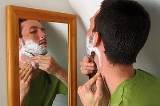
Shaving

Encyclopedia
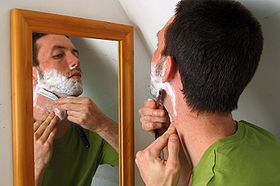
Hair
Hair is a filamentous biomaterial, that grows from follicles found in the dermis. Found exclusively in mammals, hair is one of the defining characteristics of the mammalian class....
, by using a razor
Razor
A razor is a bladed tool primarily used in the removal of unwanted body hair through the act of shaving. Kinds of razors include straight razors, disposable razors and electric razors....
or any other kind of bladed implement, to slice it down to the level of the skin. Shaving is most commonly practiced by men
Man
The term man is used for an adult human male . However, man is sometimes used to refer to humanity as a whole...
to remove their facial hair and by women
Woman
A woman , pl: women is a female human. The term woman is usually reserved for an adult, with the term girl being the usual term for a female child or adolescent...
to remove their leg and underarm hair. A man is called clean-shaven if he has had his beard
Beard
A beard is the collection of hair that grows on the chin, cheeks and neck of human beings. Usually, only pubescent or adult males are able to grow beards. However, women with hirsutism may develop a beard...
entirely removed.
Both men and women sometimes shave their undercheek hair, chest hair
Chest hair
The term chest hair is generally used to describe hair that grows on the chest of human males, in the region between the neck and the abdomen. Chest hair, which is a secondary sex characteristic, develops during and after puberty...
, abdominal hair
Abdominal hair
The term abdominal hair refers to the hair that grows on the abdomen of humans and non-human mammals, in the region between the pubic area and the thorax . The growth of abdominal hair follows the same pattern on nearly all mammals, vertically from the pubic area upwards and from the thorax...
, leg hair
Leg hair
Leg hair is hair that grows on the legs of humans, generally appearing at the onset of adulthood.Male legs are most often hairier than female ones. The amount of hair on an individuals legs can depend on their ethnic background...
, underarm hair
Underarm hair
Underarm hair is the composition of hair in the underarm area .- Development and function :...
, pubic hair
Pubic hair
Pubic hair is hair in the frontal genital area, the crotch, and sometimes at the top of the inside of the legs; these areas form the pubic region....
or any other bodily hair. Head shaving
Head shaving
Head shaving is the practice of shaving the hair from a person's head. At different times and places people have shaved their heads for very diverse reasons: practical, religious, cultural, or aesthetic—so a shaven head has widely varying connotations depending on the context.-Early...
is much more common among men. It is often associated with religious practice, the armed forces
Armed forces
The armed forces of a country are its government-sponsored defense, fighting forces, and organizations. They exist to further the foreign and domestic policies of their governing body, and to defend that body and the nation it represents from external aggressors. In some countries paramilitary...
and some competitive sports such as swimming
Swimming (sport)
Swimming is a sport governed by the Fédération Internationale de Natation .-History: Competitive swimming in Europe began around 1800 BCE, mostly in the form of the freestyle. In 1873 Steve Bowyer introduced the trudgen to Western swimming competitions, after copying the front crawl used by Native...
, running
Running
Running is a means of terrestrial locomotion allowing humans and other animals to move rapidly on foot. It is simply defined in athletics terms as a gait in which at regular points during the running cycle both feet are off the ground...
and extreme sports. Head shaving has also been used to humiliate, punish and show submission to an authority, and also as part of a fund-raising effort. The shaving of head hair is also sometimes done by cancer patients when their treatment may result in partial hair loss. It has become common for men with partial male pattern baldness
Baldness
Baldness implies partial or complete lack of hair and can be understood as part of the wider topic of "hair thinning". The degree and pattern of baldness can vary greatly, but its most common cause is male and female pattern baldness, also known as androgenic alopecia, alopecia androgenetica or...
.
History
Copper
Copper is a chemical element with the symbol Cu and atomic number 29. It is a ductile metal with very high thermal and electrical conductivity. Pure copper is soft and malleable; an exposed surface has a reddish-orange tarnish...
tools were developed, copper razors were invented. The idea of an aesthetic approach to personal hygiene may have begun at this time, though Egypt
Ancient Egypt
Ancient Egypt was an ancient civilization of Northeastern Africa, concentrated along the lower reaches of the Nile River in what is now the modern country of Egypt. Egyptian civilization coalesced around 3150 BC with the political unification of Upper and Lower Egypt under the first pharaoh...
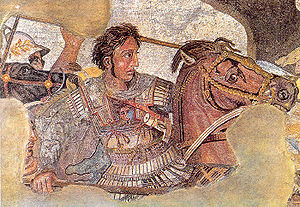
ian priests may have practiced something similar to this earlier. Alexander the Great strongly promoted shaving during his reign in the 4th century BCE to avoid "dangerous beard-grabbing in combat", and because he believed it looked tidier.
Women and shaving
Women removed body hair in some ancient cultures using depilatory methods. In the Middle East, sugaringSugaring (epilation)
Sugaring, sugar waxing or Persian waxing is a method of hair removal.It has been in use since 1900 BC.Sugaring can be less painful than waxing, because the substrate sticks to the hair without attaching to the skin, may be applied at room temperature or heated to a lukewarm temperature, preventing...
is a practise that has existed for centuries. Facial hair has traditionally been removed in some parts of India using the threading
Threading
Threading has more than one meaning:* Thread , a programming technique* Threading , a hair removal method* Threading , the process of making a thread...
method.
The removal of body hair was not common in Europe during, or after, the Middle Ages. The common attitude in Europe, and later North America, was that the removal of body hair was immodest and indicated an immoral focus on sexual esthetics. Mainstream perceptions towards women's body hair changed during the 1920s, when a freer attitude towards women's fashion became popular. Rising hemlines and naked arms in evening and cocktail dresses became the new standard. For some women, this did not pose a problem. Women who were more hirsute, however, faced a dilemma: whether to dress modestly and unfashionably, or whether to reveal body hair, which was still aesthetically unacceptable in public.
American manufacturers of men's shaving products rose to the challenge, and began launching products aimed directly at this market. The first print advertisement for a woman's razor, titled "Shaving made easy" appeared in the upscale Harper's Bazaar
Harper's Bazaar
Harper’s Bazaar is an American fashion magazine, first published in 1867. Harper’s Bazaar is published by Hearst and, as a magazine, considers itself to be the style resource for “women who are the first to buy the best, from casual to couture.”...
magazine in 1905 and stirred controversy. The "Milady Gilette" women's razor was introduced in 1915. The popularity of the practise of shaving legs and underarms grew gradually over the next two decades. By the 1933 Chicago World's Fair
Chicago World's Fair
Chicago World's Fair may refer to:*World's Columbian Exposition of 1893*Century of Progress Exposition of 1933...
, the practise was mainstream to the point that the Schermack-Thompson Company of Detroit had a hit with the round razor that it distributed as a souvenir. The first women's electric razor was introduced by Remington in 1940.
In the following decades, many competing manufacturers brought products to the market, and the associated advertising became ubiquitous in American and Canadian women's publications, and later in television commercials. The first disposable women's razor, Gilette's pink "Daisy razor", was launched in 1975 and became an iconic symbol of women's grooming. A survey conducted by Gilette in 1990 revealed 92 percent of women 13 or older in the United States shave their legs; of those women, 66 percent shave the entire leg and 33 percent shave from the knee down. 98 percent of the women surveyed shave their underarms, and only 50 percent of them shave their bikini line. A vast number of products related to women's shaving needs are available today, including exfoliating creams, shaving lotions, and many styles of disposable, reuseable, and electric razors.
In Mediterranean and South American countries, depilatories have been used for decades as the preferred method of hair removal. Shaving practises for women became popular in Europe somewhat later than in North America. Sophia Loren
Sophia Loren
Sophia Loren, OMRI is an Italian actress.In 1962, Loren won the Academy Award for Best Actress for her role in Two Women, along with 21 awards, becoming the first actress to win an Academy Award for a non-English-speaking performance...
famously did not shave, and posed for numerous glamourous photos during her career that make this clear.
Shaving methods
Shaving can be done with a straight razorStraight razor
A straight razor is a razor with a blade that can fold into its handle. They are also called open razors and cut-throat razors.Although straight razors were once the principal method of manual shaving, they have been largely overshadowed by the safety razor, incorporating a disposable blade...
or safety razor
Safety razor
A safety razor is a razor that protects the skin from all but the very edge of the blade. These razors reduce the possibility of serious injury, which makes them more forgiving than a straight razor.-Cartridges introduced:...
(called 'manual shaving' or 'wet shaving') or an electric razor (called 'dry shaving').
For men, the removal of a full beard often requires the use of scissors or an electric (or beard) trimmer to reduce the mass of hair, simplifying the process.
"Traditional" wet shaving
There are two types of manual razors: straight razor and safety razors. Safety razors are further subdivided into double-edged razors, single edge, injector razors, cartridge razors and disposable razors.In the twentieth century, Gillette razors were the most prevalent. Double-edge razors are currently readily available and are manufactured by Merkur in Germany, Kiwishaver in New Zealand, Parker in India, Feather in Japan, Hart Steel in the United States and Weishi in China. Double-edge razors are named so because the blade that they use has two sharp edges on opposite sides of the blade. Current multi-bladed cartridge manufacturers attempt to differentiate themselves by having more or fewer blades than their competitors, each arguing that their product gives a greater shave quality at a more affordable price.
Before wet shaving, a lathering or lubricating agent such as cream
Shaving cream
Shaving cream is a substance that is applied to the face or wherever else hair grows, to provide lubrication and avoid razor burn during shaving. Shaving cream is often bought in a spray can, but can also be purchased in tubs or tubes. Shaving cream in a can is commonly dispensed as a foam or a gel...
, soap
Shaving soap
Shaving soap typically refers to a hard soap that is whipped into a lather using a shaving brush. The lather it produces is used to coat the face during shaving, providing protection and lubrication for the razor...
, gel, foam or oil is normally applied. Lubricating and moisturizing the skin to be shaved helps to prevent a painful razor burn. Many razor cartridges include a lubricating strip, made of polyethylene glycol
Polyethylene glycol
Polyethylene glycol is a polyether compound with many applications from industrial manufacturing to medicine. It has also been known as polyethylene oxide or polyoxyethylene , depending on its molecular weight, and under the tradename Carbowax.-Available forms:PEG, PEO, or POE refers to an...
, to function instead of or in supplement to extrinsic agents. It also lifts and softens the hairs, causing them to swell. This enhances the cutting action and sometimes permits cutting the hairs slightly below the surface of the skin. Additionally, during shaving, the lather indicates areas that have not been addressed. When soap is used, it is generally applied with a shaving brush, which has long soft bristles. It is worked up into a usable lather by the brush, either against the face, in a shaving mug, bowl, scuttle, or palm of the hand.
Since cuts are more likely when using safety razors and straight razors, wet shaving is generally done in more than one pass with the blade. The goal is to reduce the amount of hair with each pass, instead of trying to eliminate all of it in a single pass. This also reduces the risks of cuts, soreness, and ingrown hair
Ingrown hair
Ingrown hair is a condition where the hair curls back or grows sideways into the skin. The ingrown hair condition is seen primarily among people having curly hair. It may or may not be accompanied by an infection of the hair follicle or "razor bumps" , which vary in size...
s.
Aftershave
Men may use an aftershave lotion after they have finished shaving. It may contain an antisepticAntiseptic
Antiseptics are antimicrobial substances that are applied to living tissue/skin to reduce the possibility of infection, sepsis, or putrefaction...
agent such as isopropyl alcohol
Isopropyl alcohol
Isopropyl alcohol is a common name for a chemical compound with the molecular formula C3H8O. It is a colorless, flammable chemical compound with a strong odor...
to prevent infection
Infection
An infection is the colonization of a host organism by parasite species. Infecting parasites seek to use the host's resources to reproduce, often resulting in disease...
from cuts, a perfume
Perfume
Perfume is a mixture of fragrant essential oils and/or aroma compounds, fixatives, and solvents used to give the human body, animals, objects, and living spaces "a pleasant scent"...
, and a moisturizer
Moisturizer
Moisturizers or emollients are complex mixtures of chemical agents specially designed to make the external layers of the skin softer and more pliable, by increasing its hydration by reducing evaporation. Naturally occurring skin lipids and sterols as well as artificial or natural oils,...
to soften the facial skin.
Electric shaving
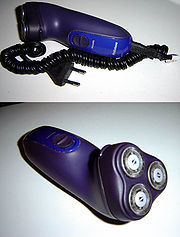
The main disadvantages of electric shaving are that it may not cut the whiskers as close as wet shaving does and it requires a source of electricity. The advantages are fewer cuts in the skin, quicker shaving and no need for a water supply. Some people also find they do not experience ingrown hairs (pseudofolliculitis barbae
Pseudofolliculitis barbae
Pseudofolliculitis barbae , also known as barber's itch, folliculitis barbae traumatica, razor bumps, scarring pseudofolliculitis of the beard, and shave bumps, is a medical term for persistent irritation caused by shaving....
, also called razor bumps), when using an electric shaver.
Many pre- and post-electric lotions are sold but electric shaving does not usually require the application of any lubrication to be effective and can be done dry.
There are special electric razors available for use by women, but these are essentially no different from those made for men.
Shaving products
The shaving products that are marketed nowadays can be broken into three categories, pre, during and after-shave. For the sake of the skin, it is recommended that shaving is always accompanied by the pre-shaving and after-shaving processes.Pre-shaving mainly consists of getting the skin and hairs ready for the blade
Blade
A blade is that portion of a tool, weapon, or machine with a cutting edge and/or a pointed tip that is designed to cut and/or puncture, stab, slash, chop, slice, thrust, or scrape animate or inanimate surfaces or materials...
. The shaving products that one can find for this particular action are oil
Oil
An oil is any substance that is liquid at ambient temperatures and does not mix with water but may mix with other oils and organic solvents. This general definition includes vegetable oils, volatile essential oils, petrochemical oils, and synthetic oils....
s, creams and shaving soaps. These products come in various formulations which are designed for a particular type of skin or beard. They may also be chosen according to the instrument which is going to be used for shaving. The market provides pre-shaving products intended for individuals who shave with hand razors or for those who prefer an electric razor. Although pre-shave oils may result in a smoother shave, these products are not so popular. Individuals that use a manual razor tend to skip this step because the soap or cream which is used for shaving, provides the same benefit as a pre-shave product.
There are mainly three types of manual razors that can be found on the market. One of the oldest types is the straight razor. These razors have two parts, the blade and the handle
Handle (grip)
A handle is a part of, or attachment to, an object that can be moved or used by hand. The design of each type of handle involves substantial ergonomic issues, even where these are dealt with intuitively or by following tradition...
. The blade has different sizes and it may be folded into the handle. They can be made of different materials, but the best quality ones are made from steel
Steel
Steel is an alloy that consists mostly of iron and has a carbon content between 0.2% and 2.1% by weight, depending on the grade. Carbon is the most common alloying material for iron, but various other alloying elements are used, such as manganese, chromium, vanadium, and tungsten...
. One of the most popular types of straight razors is those manufactured by Sheffield, Eng. The price of these razors depends on the quality of the material they are made of and ranges from as low as a little over $10 to more than $100. The brand
Brand
The American Marketing Association defines a brand as a "Name, term, design, symbol, or any other feature that identifies one seller's good or service as distinct from those of other sellers."...
may also influence the price of the razor.
By far the most common type of razor in the developed world is the disposable. These minimize the risk of injury for inexperienced or hurried shavers and they are commonly used by both men and women. The primary disadvantages that come with the use of disposable razors are the lower quality shave, and the skin irritation or in-grown hairs that may result afterward. These razors are commonly found with between one and five blades, and opinions differ regarding which setup provides the best shave.
Double-edge safety razors are not as popular as disposable razors, but they are still an option for those who feel comfortable using them. Although their name suggests that these razors are very safe, they are not entirely without risk because the blade edges of the razor are exposed and can cause cuts if the appropriate technique and sufficient caution are not used. They are, however, considered to be safer than straight razors because there is no actual risk of serious injury as there is with the latter.
Shaving with a hand razor requires either water
Water
Water is a chemical substance with the chemical formula H2O. A water molecule contains one oxygen and two hydrogen atoms connected by covalent bonds. Water is a liquid at ambient conditions, but it often co-exists on Earth with its solid state, ice, and gaseous state . Water also exists in a...
or the use of a foam, cream or soap. Generally, shaving creams and foams are used with disposable razors and soap is more commonly used with straight razors. These shaving products are intended to smooth the face by lubricating the skin which allows a gentler shave. It seems that individuals who use these products are less likely to cut their skin and the shaved area is smoother by comparison with people who use only water before shaving. Moreover, the shaving products also help in preventing and reducing skin irritation
Irritation
Irritation or exacerbation, in biology and physiology, is a state of inflammation or painful reaction to allergy or cell-lining damage. A stimulus or agent which induces the state of irritation is an irritant...
. When shaving with a straight razor, the soap is applied onto the face with the help of a mug
Mug
A mug is a sturdily built type of cup often used for drinking hot beverages, such as coffee, tea, or hot chocolate. Mugs, by definition, have handles and often hold a larger amount of fluid than other types of cup. Usually a mug holds approximately 12 fluid ounces of liquid; double a tea cup...
and a brush
Brush
A brush is a tool with bristles, wire or other filaments, used for cleaning, grooming hair, make up, painting, surface finishing and for many other purposes. It is one of the most basic and versatile tools known to mankind, and the average household may contain several dozen varieties...
. The use of soap with a brush is thought to result in a superior quality shave as the brush may unclog the hairs that are stuck together.
Shaving with an electric razor can be done with the skin dry, but many individuals apply a commercial pre-shaving lubricant to lessen irritation. Most electric razors come with features which help to raise the hairs, allowing them to be cut more efficiently. This prevents the skin from being irritated by excessive motion from the razor.
Aftershaves and colognes are the main products used after shaving, to smoothen the shaved area and for preventing skin irritation. They can also help to sterilize
Sterilization (microbiology)
Sterilization is a term referring to any process that eliminates or kills all forms of microbial life, including transmissible agents present on a surface, contained in a fluid, in medication, or in a compound such as biological culture media...
any cuts in the skin.
Effects of shaving
Shaving can have numerous side effects, including cuts, abrasions, and irritation. Many side effects can be minimized by using a fresh blade, applying plenty of lubrication, and avoiding pressing down with the razor. A shaving brush can also help. The cosmetic market in some consumer economies offers many products to reduce these effects; they commonly dry the affected area, and some also help to lift out the trapped hair(s). Some shavers choose to use only single-blade or wire-wrapped blades that shave farther away from the skin. Others have skin that cannot tolerate razor shaving at all; they use depilatory shaving powders to dissolve hair above the skin's surface, or grow a beard.Cuts
Cuts from shaving can bleed for about fifteen minutes (more if the person is haemophilic and/or clot-inhibited by medications such as aspirinAspirin
Aspirin , also known as acetylsalicylic acid , is a salicylate drug, often used as an analgesic to relieve minor aches and pains, as an antipyretic to reduce fever, and as an anti-inflammatory medication. It was discovered by Arthur Eichengrun, a chemist with the German company Bayer...
). Shaving cuts can be caused by blade movement perpendicular to the blade's cutting axis or by regular / orthogonal shaving over prominent bumps on the skin (which the blade incises). Common methods used to stop shaving-induced bleeding include: (1) pressing any simple alcohol onto the cut until the bleeding stops (e.g. with a cotton swab); (2) placing a small piece of tissue or toilet paper
Toilet paper
Toilet paper is a soft paper product used to maintain personal hygiene after human defecation or urination. However, it can also be used for other purposes such as blowing one's nose when one has a cold or absorbing common spills around the house, although paper towels are more used for the latter...
onto the cut; (3) applying styptic pencil
Styptic pencil
An antihemorrhagic agent is a substance that promotes hemostasis . It may also be known as a hemostatic agent....
s and styptic liquids; 4) placing a small amount of petroleum jelly
Petroleum jelly
Petroleum jelly, petrolatum, white petrolatum or soft paraffin, CAS number 8009-03-8, is a semi-solid mixture of hydrocarbons , originally promoted as a topical ointment for its healing properties...
on the cut after most of the bleeding has ended (which can stop the bleeding without forming a scab
Scab
Scab can refer to the following:* Scab, a hard coating on the skin formed during the wound healing reconstruction phase* Derogatory term for a strikebreaker, a person who works despite strike action or against the will of other employees...
), or 5) applying a small amount of aluminum chlorohydrate (commonly found in roll-on deodorants such as Ban). Shaving in or just after a cold shower can help prevent bleeding as well, because blood flow to the skin is reduced in these conditions due to vasoconstriction
Vasoconstriction
Vasoconstriction is the narrowing of the blood vessels resulting from contraction of the muscular wall of the vessels, particularly the large arteries, small arterioles and veins. The process is the opposite of vasodilation, the widening of blood vessels. The process is particularly important in...
caused by the cold water. Shaving blade disposal in the era of safety razors and double-edged blades was a concern for a man's spouse and children who could easily take a blade casually cast into the garbage, and in the process of compressing or compacting the garbage, cut themselves seriously. Some razor blade manufacturers include disposal containers or receptacles to avoid injuries.
Razor burn
Razor burn is an irritation of the skin caused by using a blunt blade or not using proper technique. It appears as a mild rashRash
A rash is a change of the skin which affects its color, appearance or texture. A rash may be localized in one part of the body, or affect all the skin. Rashes may cause the skin to change color, itch, become warm, bumpy, chapped, dry, cracked or blistered, swell and may be painful. The causes, and...
2–4 minutes after shaving (once hair starts to grow through sealed skin) and usually disappears after a few hours to a few days, depending on severity. In severe cases, razor burn can also be accompanied by razor bumps
Pseudofolliculitis barbae
Pseudofolliculitis barbae , also known as barber's itch, folliculitis barbae traumatica, razor bumps, scarring pseudofolliculitis of the beard, and shave bumps, is a medical term for persistent irritation caused by shaving....
, where the area around shaved hairs get raised red welts or infected pustules.
A rash at the time of shaving is usually a sign of lack of lubrication. Razor burn is a common problem, especially among those who shave coarse hairs on areas with sensitive skin
Sensitive skin type
Sensitive skin is a skin condition in which skin which is prone to itching and irritation experienced as a subjective sensation when using cosmetics and toiletries. When questioned, over 50% of women in the UK and US report that they have sensitive skin....
like the bikini line, pubic hair
Pubic hair
Pubic hair is hair in the frontal genital area, the crotch, and sometimes at the top of the inside of the legs; these areas form the pubic region....
, underarms, chest
Chest
The chest is a part of the anatomy of humans and various other animals. It is sometimes referred to as the thorax or the bosom.-Chest anatomy - Humans and other hominids:...
, and beard
Beard
A beard is the collection of hair that grows on the chin, cheeks and neck of human beings. Usually, only pubescent or adult males are able to grow beards. However, women with hirsutism may develop a beard...
. The condition can be caused by shaving too closely, shaving with a blunt blade, dry shaving, applying too much pressure when shaving, shaving too quickly or roughly, or shaving against the grain.
Ways to prevent razor burn include keeping the skin moist, using a shaving brush and lather, using a moisturizing shaving gel, shaving in the direction of the hair
Hair
Hair is a filamentous biomaterial, that grows from follicles found in the dermis. Found exclusively in mammals, hair is one of the defining characteristics of the mammalian class....
growth, resisting the urge to shave too closely, applying minimal pressure, avoiding scratching or irritation after shaving, avoiding irritating products on the shaved area (cologne
Eau de Cologne
Eau de Cologne or simply Cologne is a toiletry, a perfume in a style that originated from Cologne, Germany. It is nowadays a generic term for scented formulations in typical concentration of 2-5% essential oils. However as of today cologne is a blend of extracts, alcohol, and water...
s, perfume
Perfume
Perfume is a mixture of fragrant essential oils and/or aroma compounds, fixatives, and solvents used to give the human body, animals, objects, and living spaces "a pleasant scent"...
s, etc.) and using an aftershave
Aftershave
Aftershave describes a lotion, gel, balm, powder, or liquid used mainly by men after they have finished shaving. It may contain an antiseptic agent such as denatured alcohol or stearate citrate to prevent infection of cuts...
cream with aloe vera
Aloe vera
Aloe vera, pronounced , also known as the true aloe or medicinal aloe, is a species of succulent plant in the genus Aloe that is believed to have originated in the Sudan. Aloe vera grows in arid climates and is widely distributed in Africa, India, Nepal and other arid areas.The species is...
or other emollients. Also, it is good to prepare the skin for shaving by cleansing the area to be shaved with a wash containing salicylic acid
Salicylic acid
Salicylic acid is a monohydroxybenzoic acid, a type of phenolic acid and a beta hydroxy acid. This colorless crystalline organic acid is widely used in organic synthesis and functions as a plant hormone. It is derived from the metabolism of salicin...
, to facilitate the removal of oils and dead skin. Putting a warm, wet cloth on one's skin helps as well, by softening hairs. This can also be done by using pre-shave oil before the application of shaving cream. One other technique involves exfoliating the skin before and after shaving, using various exfoliating products, included but not limited to, mitts and luffa. This process removes dead skin cells, reducing the potential for ingrown hairs and allowing the razor to glide across the skin smoothly decreasing the risk of the razor snagging or grabbing causing razor burn.
Razor bumps
Pseudofolliculitis barbae is a medical term for persistent inflammation caused by shaving. It is also known by the initials PFB or colloquial terms such as "razor bumps."Myths
Shaving does not cause terminal hairTerminal hair
Terminal hairs are thick, long, and dark, as compared with vellus hair. During puberty, the increase in androgenic hormone levels causes vellus hair to be replaced with terminal hair in certain parts of the human body...
to grow back thicker or coarser or darker. This belief arose because hair that has never been cut has a tapered end, whereas, after cutting, there is no taper. Thus, it appears thicker, and feels coarser due to the sharper, unworn edges. The fact that shorter hairs are "harder" (less flexible) than longer hairs also contributes to this effect. Hair can also appear darker after it grows back because hair that has never been cut is often lighter due to sun exposure. In addition, as humans grow older hair tends to grow coarser and in more places on the face and body. For example, a teenager may start shaving their face or legs at around 16, but as they age hair will start to grow more abundantly and thicker, leading some to believe this was due to the shaving, but in reality is just part of the aging process.
Christianity, Jainism, Hinduism and Buddhism

Tonsure
Tonsure is the traditional practice of Christian churches of cutting or shaving the hair from the scalp of clerics, monastics, and, in the Eastern Orthodox Church, all baptized members...
is the practice of some Christian
Christian
A Christian is a person who adheres to Christianity, an Abrahamic, monotheistic religion based on the life and teachings of Jesus of Nazareth as recorded in the Canonical gospels and the letters of the New Testament...
churches and some Hindu
Hindu
Hindu refers to an identity associated with the philosophical, religious and cultural systems that are indigenous to the Indian subcontinent. As used in the Constitution of India, the word "Hindu" is also attributed to all persons professing any Indian religion...
, Jain and Buddhist (usually only monks or nuns) temples of shaving or plucking the hair from the scalp of priests and nuns as a symbol of their renunciation of worldly fashion and esteem. Amish
Amish
The Amish , sometimes referred to as Amish Mennonites, are a group of Christian church fellowships that form a subgroup of the Mennonite churches...
men shave their beard until they are married, after which they allow it to grow.
Among Hindus, a child's birth hair is shaved as practice in the religion. This is perceived, in their faith, to make it grow back thicker and healthier.
Islam
In some cultures (mostly in central Asia) at the birth of a baby, in 7 days time it is customary that a baby's hair of the head be shaved off. In Islam it is habit or usual practiceSunnah
The word literally means a clear, well trodden, busy and plain surfaced road. In the discussion of the sources of religion, Sunnah denotes the practice of Prophet Muhammad that he taught and practically instituted as a teacher of the sharī‘ah and the best exemplar...
for one to grow a full beard and shave off the mustache completely; if genetically possible. In addition to the above requirements, both Muslim men and women are highly encouraged to shave their pubic hair and armpit hair for both hygienic and aesthetic reasons. Some Muslims also interpret this as habit, while classical scholars have viewed the matter as religious duty
Fard
also is an Islamic term which denotes a religious duty. The word is also used in Persian, Turkish, and Urdu in the same meaning....
.
Judaism
Observant Jewish men are subject to restrictions on the shaving of their beards, as the book of LeviticusLeviticus
The Book of Leviticus is the third book of the Hebrew Bible, and the third of five books of the Torah ....
in the Bible appears to completely forbid the shaving of the corners of the head and prohibits the marring of the corners of the beard. The Hebrew word used in this verse refers specifically to shaving with a blade against the skin; rabbis at different times and places have interpreted this in many ways. Tools like scissors
Scissors
Scissors are hand-operated cutting instruments. They consist of a pair of metal blades pivoted so that the sharpened edges slide against each other when the handles opposite to the pivot are closed. Scissors are used for cutting various thin materials, such as paper, cardboard, metal foil, thin...
and electric razors, which cut the hair between two blades instead of between blade and skin, have often been considered more acceptable.
See also
- Androgenic hairAndrogenic hairAndrogenic hair, colloquially body hair, is the terminal hair that develops on the body during and after puberty. It is differentiated from the head hair and less visible vellus hair, which are much finer and lighter in color. The growth of androgenic hair is related to the level of androgens in...
- BarberBarberA barber is someone whose occupation is to cut any type of hair, and to shave or trim the beards of men. The place of work of a barber is generally called a barbershop....
- BeardBeardA beard is the collection of hair that grows on the chin, cheeks and neck of human beings. Usually, only pubescent or adult males are able to grow beards. However, women with hirsutism may develop a beard...
- Beard Liberation FrontBeard Liberation FrontThe Beard Liberation Front is a British interest group which campaigns in support of beards and opposes discrimination against those who wear them. It was founded in 1995 by socialist historian Keith Flett who continues to organise and represent the organisation...
- Burma-ShaveBurma-ShaveBurma-Shave was an American brand of brushless shaving cream, famous for its advertising gimmick of posting humorous rhyming poems on small, sequential, highway-billboard signs.-History:...
- GlabrousnessGlabrousnessGlabrousness is the technical term for an anatomically atypical lack of hair, down, or similar structures...
- Hair removalHair removalHair removal is the removal of body hair, and describes the methods used to achieve that result.Hair typically grows all over the human body during and after puberty. Men tend to have more body hair than women. Both men and women tend to have hair on the head, eyebrows, eyelashes, armpits, pubic...
- Head shavingHead shavingHead shaving is the practice of shaving the hair from a person's head. At different times and places people have shaved their heads for very diverse reasons: practical, religious, cultural, or aesthetic—so a shaven head has widely varying connotations depending on the context.-Early...
- Leg shavingLeg shavingLeg shaving is the practice of removing leg hair by shaving the hair off using a razor or electric shaver. In addition, some people remove leg hair using waxing, sugaring, depilatories, depilation devices, or lasers, but shaving remains the least expensive method.It is a very common practice among...
- Police v. City of Newark
- Pubic hairPubic hairPubic hair is hair in the frontal genital area, the crotch, and sometimes at the top of the inside of the legs; these areas form the pubic region....
- RazorRazorA razor is a bladed tool primarily used in the removal of unwanted body hair through the act of shaving. Kinds of razors include straight razors, disposable razors and electric razors....
s - Shaving creamShaving creamShaving cream is a substance that is applied to the face or wherever else hair grows, to provide lubrication and avoid razor burn during shaving. Shaving cream is often bought in a spray can, but can also be purchased in tubs or tubes. Shaving cream in a can is commonly dispensed as a foam or a gel...
- Shaving oilShaving oilShaving oil is normally a plant-based oil or blend of vegetable and essential oils used as a stand-alone shave lubricant or in conjunction with shave creme, soap or gel, to facilitate the shave of facial and other body hair. Often these products require activation with water before the razor is...
- Shaving soapShaving soapShaving soap typically refers to a hard soap that is whipped into a lather using a shaving brush. The lather it produces is used to coat the face during shaving, providing protection and lubrication for the razor...