

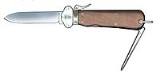
Gravity knife

Encyclopedia
Knife
A knife is a cutting tool with an exposed cutting edge or blade, hand-held or otherwise, with or without a handle. Knives were used at least two-and-a-half million years ago, as evidenced by the Oldowan tools...
with a blade contained in its handle, and which opens its blade by the force of inertia or gravity. As the gravity knife requires gravity or inertia to propel the blade out of the handle, it differs fundamentally from the switchblade
Switchblade
A switchblade is a type of knife with a folding or sliding blade contained in the handle which is opened automatically by a spring when a button, lever, or switch on the handle or bolster is activated A switchblade (also known as an automatic knife, pushbutton knife, switch, Sprenger, Springer,...
, which opens its spring-propelled blade automatically upon the push of a button, switch, or fulcrum lever.
The gravity knife uses a button, trigger, or fulcrum lever to release the blade from both the open and the closed positions, and may use a side-folding or telescoping (out-the-front, or OTF) blade. While most military gravity knives utilize a locking blade design, other types may not mechanically lock open but rely instead upon friction to wedge the rear section of the blade against the interior of the handle. Factory-made gravity knives have various types of buttons, triggers, and fulcrum levers, which usually are used to release the blade from both the open and the closed positions.
Fallschirmjäger-Messer
World War II
World War II, or the Second World War , was a global conflict lasting from 1939 to 1945, involving most of the world's nations—including all of the great powers—eventually forming two opposing military alliances: the Allies and the Axis...
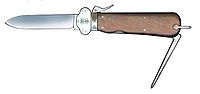
Luftwaffe Fallschirmjäger-Messer or German air force paratrooper
Fallschirmjäger
are German paratroopers. Together with the Gebirgsjäger they are perceived as the elite infantry units of the German Army....
knife, which utilizes a four-inch (100mm) telescoping (OTF), gravity-propelled locking blade. First produced in 1937, the FJM was issued to German flight crews and paratroops, primarily for the purpose of cutting a trapped parachutist from his rigging in case he landed with a tangled parachute. Though not intended for use as a fighting knife, the FJM's blade could be and was used as a close combat weapon when necessary.
The Luftwaffe Fallschirmjäger-Messer uses a sliding blade inside a metal gripframe, which was originally fitted with smooth wood scales, usually of beech or walnut. The blade itself is a relatively blunt spear-point, and the profile is flat ground, tapering to a utility edge. To open the blade using gravity, the user points the FJM downwards while flipping up the fulcrum-style operating lever, allowing gravity to draw out the blade to its fullest extent. Releasing the lever locks the blade into position. The FJM may also be opened by flipping the blade release lever while flicking the wrist holding the knfe, causing the blade to extend. The FJM was also equipped with a folding rigging spike
Marlinspike
Marlinspike is a tool used in ropework for tasks such as unlaying rope for splicing, untying knots, forming a toggle , or forming a makeshift handle....
or awl
Bradawl
A bradawl is a tool with a blade similar to that of a straight screwdriver and a handle made from wood or plastic. A bradawl is used to make an indentation in wood or other materials in order to ease the insertion of a nail or screw...
. Primarily intended for untangling rope knots, it can also be used as a prying tool. The FJM's spike does not lock when opened and was never intended to be used as a combat weapon, though individual German paratroopers may have employed it as such.
There are three principal types of wartime era Luftwaffe Fallschirmjäger-Messer. The Type I FKm has wood scales (handle), was made 1937-1941, and unlike successive models, has no takedown ability. The Type II FKm is the same knife, but with takedown feature, and was produced from 1941 to the end of World War II.
After the end of World War II, the newly-organized West German Bundeswehr placed new orders with German cutlery manufacturers for a postwar version of the FJM for issue to certain units of the West German Army, including its airborne forces. The postwar FJM produced in olive drab and was stamped BUND (for Bundeswehr). The BUND FJM was made by a variety of contractors for the West German Army, in three major types. The first is the Type III “trap door” gravity knife, made from 1955-1961. The second, the Type IV FKm, is very similar to the WWII-production Type II takedown knife, but features plastic polymer instead of wooden scales, and was made by WMF, OWF, or Eickhorn from 1961-1979. The third model is the Type V FKm, currently produced under the designation LL80 (1979-present). The LL80 is smaller, has fewer parts and is more cost-effective to produce than earlier Fallschirmjäger-Messer. A civilian version of this knife featuring a plastic polymer trapdoor handle, without marlinspike was also made.
Ibberson Gravity Knife
After British forces had captured numbers of the Luftwaffe Fallschirmjäger-Messer, the British government approached George Ibberson & Co. of SheffieldSheffield
Sheffield is a city and metropolitan borough of South Yorkshire, England. Its name derives from the River Sheaf, which runs through the city. Historically a part of the West Riding of Yorkshire, and with some of its southern suburbs annexed from Derbyshire, the city has grown from its largely...
, England, a knife and cutlery manufacturer, and asked him to produce a British version of the German Luftwaffe gravity knife for the Special Operations Executive
Special Operations Executive
The Special Operations Executive was a World War II organisation of the United Kingdom. It was officially formed by Prime Minister Winston Churchill and Minister of Economic Warfare Hugh Dalton on 22 July 1940, to conduct guerrilla warfare against the Axis powers and to instruct and aid local...
(SOE) and other clandestine warfare units. Under the initial wartime contract, George Ibberson & Co. initially made 500 gravity knives for issue to the SOE
Special Operations Executive
The Special Operations Executive was a World War II organisation of the United Kingdom. It was officially formed by Prime Minister Winston Churchill and Minister of Economic Warfare Hugh Dalton on 22 July 1940, to conduct guerrilla warfare against the Axis powers and to instruct and aid local...
and other special forces. Two other manufacturers, both of Sheffield, Yorkshire, produced between 1,200 and 1,500 knives during the war. These Sheffield gravity knives had smooth wood or textured plastic scales, but were otherwise idential in features and operation to the Luftwaffe Fallschirmjäger-Messer, with a locking gravity-deployed blade, takedown feature, and a folding rigging spike or awl. In the hands of British SOE agents, the Sheffield gravity knife was considered to be a secondary combat weapon. In addition to the knife blade, SOE close combat instructors found that the folding rigging spike was useful for silent elimination of sentries by opening the carotid artery on the neck.
'False gravity' and non-gravity knives
Some folding or telescoping knives that can open their blades by force of inertia or gravity were not intended or advertised by the manufacturer to do so. Knives that will lock their blades open, but do not have any closed position lock device are referred to as "False" Gravity blades.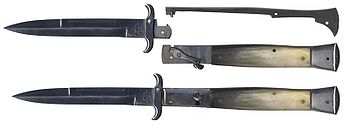
After the passage of the Switchblade Knife Act in the U.S. in 1958, it was discovered that some U.S. businesses were importing folding stiletto
Stiletto
A stiletto is a knife or dagger with a long slender blade and needle-like point, intended primarily as a stabbing weapon. The stiletto blade's narrow cross-section and acuminated tip reduces friction upon entry, allowing the blade to penetrate deeply...
knives without spring mechanisms which did not have a pronounced blade heel (internal surface) in the pivot area allowing the longer 11 and 13 inch-bladed models to easily flick open. Modern (post 1965) folding stilettos imported or distributed in the U.S. now have blade heels that are intentionally pointed and ratchet against the lockback mechanism, preventing inertia opening.
Other knives commonly mistaken for gravity knives include the automatic OTF knife, the switchblade
Switchblade
A switchblade is a type of knife with a folding or sliding blade contained in the handle which is opened automatically by a spring when a button, lever, or switch on the handle or bolster is activated A switchblade (also known as an automatic knife, pushbutton knife, switch, Sprenger, Springer,...
and the butterfly knife
Balisong (knife)
A Butterfly knife, also known as a fan knife or Balisong, is a folding pocket knife with two handles counter-rotating around the tang such that, when closed, the blade is concealed within grooves in the handles. It is sometimes called a Batangas knife, after the Tagalog province of Batangas in the...
(or balisong), the sliding knife
Sliding knife
An OTF Knife, also known as an out-the-front knife, sliding knife, or telescoping knife, is a pocketknife with a blade that opens and closes through a hole in one end of the handle...
, penny knife
Penny knife
The penny knife dates from the 18th century and was an extremely basic utility knife, originally with a fixed blade. It received the name penny knife for what it reportedly cost in England and America during the late 18th century...
, and occasionally even common folding hunting knives such as the Buck 110 Folding Hunter.
Other gravity knives

lockback mechanism to allow the blade to swing more easily.
Legality
In some countries, such as the United Kingdom, and in certain U.S. states, a gravity knife is defined under the law as a prohibited weapon, with attendant criminal penalties. Other laws may criminalize the ownership, sale, importation, or carrying of a gravity knife upon one's person, either concealed or unconcealed. In the United States, some state criminal codes prohibit either the ownership or the carrying of gravity knives, either by name or by including a functional description of their opening mechanisms. Other state criminal codes bar gravity knives by redefining them variously (though incorrectly) as switchblades or balisongBalisong (knife)
A Butterfly knife, also known as a fan knife or Balisong, is a folding pocket knife with two handles counter-rotating around the tang such that, when closed, the blade is concealed within grooves in the handles. It is sometimes called a Batangas knife, after the Tagalog province of Batangas in the...
s (butterfly knives). Local jurisdictions including cities and counties may also restrict the ownership or carrying of gravity knives.
Importantly, a few jurisdictions and courts have periodically attempted to classify ordinary lock-blade folding knives
Buck Knives
Buck Knives is an American knife manufacturer founded in San Diego, California and now located in Post Falls, Idaho. The company has a long history through five generations of the Buck family from 1902 to the present day...
with a blade that may be opened by centrifugal force (normally, using a flicking motion of the wrist) as a gravity knife, thus making the knife's owner subject to the same criminal penalties imposed for illegal possession of a gravity knife.