


Stiletto

Encyclopedia
A stiletto is a knife
or dagger
with a long slender blade and needle-like point, intended primarily as a stabbing
weapon. The stiletto blade's narrow cross-section and acuminated tip reduces friction upon entry, allowing the blade to penetrate deeply. Though considered by some to be a form of dagger, most stilettos are specialized thrusting weapons not designed for cutting
or slashing, even with edged examples. Over time, the term stiletto has been used as a general descriptive term for a variety of knife blades exhibiting a narrow blade with minimal cutting surfaces and a needle-like point, such as the U.S. V-42 Stiletto
, while in American English
usage, the name stiletto can also refer to a switchblade
knife with a stiletto- or bayonet-type blade design.
The Italian
word "stiletto" comes from the Latin
stilus
, the thin pointed Roman writing instrument used to engrave wax or clay tablets in ancient times. The stiletto began to gain fame during the late Middle Ages
, when it was the secondary weapon of knight
s. Originally designed as a purely offensive weapon, the stiletto was used to finish off a fallen or severely wounded heavily armored opponent. The needle-like blade could easily penetrate most mail
or find its way through gaps in a knight's plate armor, and was narrow enough to pass through the eye slits of the helmeted knight. A severely wounded opponent, who was not expected to survive, would be given a "mercy strike" (French coup de grâce
), hence the name miséricorde. Later the Gunner's Stiletto became a tool for clearing cannon-fuse touch holes; used in the manner of an automotive oil dipstick, they were often inscribed with marks indicating levels of powder charges for ranging distance.
, Opera Nova, countains sections on dagger and stiletto fighting. By the time of the Renaissance
the term stiletto had come to describe a range of slender thrusting knives closely resembling the French poignard
, many with conventional dagger-profile blades and sharpened edges, but always retaining the slim profile and needle-like point. To lighten the weapon, many stilettos were equipped with blades carrying fullers
over a portion of their length. Others were constructed with narrow grooves running the length of their blades, which when dipped in poison served as channels to funnel the poison into the body as the stiletto was thrust into the victim.
The stiletto remained a popular weapon of criminals or political assassins from the 16th through the end of the 19th century, particularly in France, Corsica, and Italy. While still used as a weapon of surprise and assassination, the use of stiletto in preference to the dagger in close combat confrontations
between adversaries became widespread throughout Italy, Sardinia, and Corsica. The continued popularity of the stiletto in the Kingdom of Sicily
resulted in the development of the scherma di stiletto Siciliano (Sicilian school of stiletto fighting). A person skilled in the use of a stiletto would thrust the knife deep into the victim, then twist the blade sharply in various directions before retracting it, causing the sharp point to inflict severe internal damage not readily apparent when examining the entrance wound.
The stiletto followed the first wave of Italian immigration to the city of New Orleans, Louisiana
during the mid-1800s, where the knife became a popular weapon of gamblers, gang members, and assorted assassins. The stiletto was involved in so many stabbings and murders in New Orleans that the city passed an ordinance in 1879 outlawing the sale or exhibition for sale of any stiletto within the city limits. Italian immigrants to America frequently purchased or made such knives for self-defense, and the stiletto was used by anarchists as well as by members of various Black Hand organizations to assassinate Italian-Americans and others who either opposed the Black Hand or ignored its demands for blackmail. The Black Hand even established schools for training its members in the use of the stiletto.
created a new need for stabbing weapons, resulting in the reappearance of the dagger and the stiletto. Many versions of these stabbing knives exist, some individually made by soldiers, while others were government-procured and authorized. On the Allied side, the French Lebel M1886 épée (needle sword) bayonet was frequently cut down and converted into a stiletto or thrusting knife (Poignard-Baïonnette Lebel). These weapons were used to eliminate sentries in trench raids as well as for personal defense. As a class, these daggers, knives, and stilettos were given the title trench knife
.
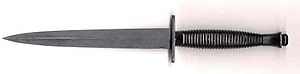 World War II
saw a resurgence of the stiletto in the form of combat knives for commando raiding forces and other troops who needed a weapon for silent killing. In late 1940, the famed British hand-to-hand combat instructors William E. Fairbairn
and Eric A. Sykes
designed the Fairbairn-Sykes Fighting Knife
, a double-edged dagger with a long narrow point designed to optimize the blade for thrusting, though it was also capable of slashing strokes if the cutting edges were sharpened.
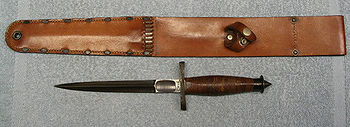 Other variations of the F-S knife soon emerged, including the U.S. Marine Raider Stiletto
, which was based upon the Fairbairn-Sykes knife, and the U.S. V-42 Stiletto, designed from the outset to emphasize thrusting over cutting.
. These Italian switchblades were commonly and popularly referred to as stilettos, since most incorporated a long, slender blade tapering to a needle-like point, together with a slim-profile handle and vestigial cross-guard. The majority of these Italian stiletto switchblade knives used a now-iconic bayonet-style blade with a single sabre-grind edge (often unsharpened) and a long opposing false edge. As with the medieval stiletto, the stiletto switchblade was designed primarily as an offensive weapon, optimized for thrusting rather than cutting. Most of these knives were designed with a locking device which locked the blade in the open position, and this lock, combined with the stiletto blade profile, enabled the knife to be used as an effective thrusting or stabbing weapon (unlike most U.S. switchblade designs of the day). Though most switchblade stilettos used a single-edge blade equipped with a long false edge, many variations exist. The stiletto switchblade is produced to this day in Italy and many other countries, and now includes many derivative folding knife designs that incorporate the same basic 'stiletto' or bayonet-style blade profile, including spring-assist, non-locking, and lock blade variants.
Knife
A knife is a cutting tool with an exposed cutting edge or blade, hand-held or otherwise, with or without a handle. Knives were used at least two-and-a-half million years ago, as evidenced by the Oldowan tools...
or dagger
Dagger
A dagger is a fighting knife with a sharp point designed or capable of being used as a thrusting or stabbing weapon. The design dates to human prehistory, and daggers have been used throughout human experience to the modern day in close combat confrontations...
with a long slender blade and needle-like point, intended primarily as a stabbing
Stabbing
A stabbing is penetration with a sharp or pointed object at close range. Stab connotes purposeful action, as by an assassin or murderer, but it is also possible to accidentally stab oneself or others.Stabbing differs from slashing or cutting in that the motion of the object used in a stabbing...
weapon. The stiletto blade's narrow cross-section and acuminated tip reduces friction upon entry, allowing the blade to penetrate deeply. Though considered by some to be a form of dagger, most stilettos are specialized thrusting weapons not designed for cutting
Cutting
Cutting is the separation of a physical object, or a portion of a physical object, into two portions, through the application of an acutely directed force. An implement commonly used for cutting is the knife or in medical cases the scalpel...
or slashing, even with edged examples. Over time, the term stiletto has been used as a general descriptive term for a variety of knife blades exhibiting a narrow blade with minimal cutting surfaces and a needle-like point, such as the U.S. V-42 Stiletto
V-42 Stiletto
The V-42 Stiletto was a stiletto and fighting knife issued during World War II to the First Special Service Force , a joint Canadian/American commando unit.-Design and Features:...
, while in American English
American English
American English is a set of dialects of the English language used mostly in the United States. Approximately two-thirds of the world's native speakers of English live in the United States....
usage, the name stiletto can also refer to a switchblade
Switchblade
A switchblade is a type of knife with a folding or sliding blade contained in the handle which is opened automatically by a spring when a button, lever, or switch on the handle or bolster is activated A switchblade (also known as an automatic knife, pushbutton knife, switch, Sprenger, Springer,...
knife with a stiletto- or bayonet-type blade design.
Origins
First developed in Italy, the stiletto dates from the late 1400s, and is thought to be a development of the rondel dagger or misericordia, a needle-pointed weapon with a narrow blade designed primarily for thrusting, though possessing cutting edges. Early stilettos normally used a one-piece cast-metal handle which was shaped and turned on a lathe. The stiletto blade was usually hammer-forged into a dense rod with a narrow, triangular cross section, without any sharpened edges. However, other examples of the period have emerged bearing round, square, or diamond cross sections.The Italian
Italian language
Italian is a Romance language spoken mainly in Europe: Italy, Switzerland, San Marino, Vatican City, by minorities in Malta, Monaco, Croatia, Slovenia, France, Libya, Eritrea, and Somalia, and by immigrant communities in the Americas and Australia...
word "stiletto" comes from the Latin
Latin
Latin is an Italic language originally spoken in Latium and Ancient Rome. It, along with most European languages, is a descendant of the ancient Proto-Indo-European language. Although it is considered a dead language, a number of scholars and members of the Christian clergy speak it fluently, and...
stilus
Stylus
A stylus is a writing utensil, or a small tool for some other form of marking or shaping, for example in pottery. The word is also used for a computer accessory . It usually refers to a narrow elongated staff, similar to a modern ballpoint pen. Many styli are heavily curved to be held more easily...
, the thin pointed Roman writing instrument used to engrave wax or clay tablets in ancient times. The stiletto began to gain fame during the late Middle Ages
Late Middle Ages
The Late Middle Ages was the period of European history generally comprising the 14th to the 16th century . The Late Middle Ages followed the High Middle Ages and preceded the onset of the early modern era ....
, when it was the secondary weapon of knight
Knight
A knight was a member of a class of lower nobility in the High Middle Ages.By the Late Middle Ages, the rank had become associated with the ideals of chivalry, a code of conduct for the perfect courtly Christian warrior....
s. Originally designed as a purely offensive weapon, the stiletto was used to finish off a fallen or severely wounded heavily armored opponent. The needle-like blade could easily penetrate most mail
Chainmail
Mail is a type of armour consisting of small metal rings linked together in a pattern to form a mesh.-History:Mail was a highly successful type of armour and was used by nearly every metalworking culture....
or find its way through gaps in a knight's plate armor, and was narrow enough to pass through the eye slits of the helmeted knight. A severely wounded opponent, who was not expected to survive, would be given a "mercy strike" (French coup de grâce
Coup de grâce
The expression coup de grâce means a death blow intended to end the suffering of a wounded creature. The phrase can refer to the killing of civilians or soldiers, friends or enemies, with or without the consent of the sufferer...
), hence the name miséricorde. Later the Gunner's Stiletto became a tool for clearing cannon-fuse touch holes; used in the manner of an automotive oil dipstick, they were often inscribed with marks indicating levels of powder charges for ranging distance.
Use as offensive weapon
The stiletto was later adopted throughout Italy as the favored offensive thrusting knife (arma manesca) of the medieval assassin, so much so that it was invariably prohibited as a treacherous weapon (arma insidiosa) by the authorities of the day. The stiletto was preferred by assassins as it was silent, easily concealed inside a sleeve or jacket, and featured a blade capable of easily penetrating the heavy leather and fabric clothing of the day, while inflicting mortal wounds that tended to bleed less than those made by other types of knives. In Italy, the stiletto began to be employed along with the dagger as a fighting weapon; a 1536 duelling treatise authored by Achille MarozzoAchille Marozzo
Achille Marozzo was an Italian fencing master teaching in the Dardi or Bolognese tradition.Marozzo was probably born in Bologna. His text Opera Nova dell'Arte delle Armi was published in 1536 in Modena, dedicated to Count Rangoni, then reprinted several times all the way into the next century...
, Opera Nova, countains sections on dagger and stiletto fighting. By the time of the Renaissance
Renaissance
The Renaissance was a cultural movement that spanned roughly the 14th to the 17th century, beginning in Italy in the Late Middle Ages and later spreading to the rest of Europe. The term is also used more loosely to refer to the historical era, but since the changes of the Renaissance were not...
the term stiletto had come to describe a range of slender thrusting knives closely resembling the French poignard
Poignard
Poignard, or poniard, , refers to a long, lightweight thrusting knife with a continuously tapering, acutely pointed blade and crossguard, historically worn by the upper class, noblemen, or the knighthood...
, many with conventional dagger-profile blades and sharpened edges, but always retaining the slim profile and needle-like point. To lighten the weapon, many stilettos were equipped with blades carrying fullers
Fuller (weapon)
A fuller is a rounded or beveled groove or slot in the flat side of a blade . A fuller is often used to lighten the blade, much in the way that an I-beam shape allows a given amount of strength to be achieved with less material...
over a portion of their length. Others were constructed with narrow grooves running the length of their blades, which when dipped in poison served as channels to funnel the poison into the body as the stiletto was thrust into the victim.
The stiletto remained a popular weapon of criminals or political assassins from the 16th through the end of the 19th century, particularly in France, Corsica, and Italy. While still used as a weapon of surprise and assassination, the use of stiletto in preference to the dagger in close combat confrontations
Knife fight
A knife fight is a violent physical confrontation between two or more combatants in which one or more participants is armed with a knife...
between adversaries became widespread throughout Italy, Sardinia, and Corsica. The continued popularity of the stiletto in the Kingdom of Sicily
Kingdom of Sicily
The Kingdom of Sicily was a state that existed in the south of Italy from its founding by Roger II in 1130 until 1816. It was a successor state of the County of Sicily, which had been founded in 1071 during the Norman conquest of southern Italy...
resulted in the development of the scherma di stiletto Siciliano (Sicilian school of stiletto fighting). A person skilled in the use of a stiletto would thrust the knife deep into the victim, then twist the blade sharply in various directions before retracting it, causing the sharp point to inflict severe internal damage not readily apparent when examining the entrance wound.
The stiletto followed the first wave of Italian immigration to the city of New Orleans, Louisiana
New Orleans, Louisiana
New Orleans is a major United States port and the largest city and metropolitan area in the state of Louisiana. The New Orleans metropolitan area has a population of 1,235,650 as of 2009, the 46th largest in the USA. The New Orleans – Metairie – Bogalusa combined statistical area has a population...
during the mid-1800s, where the knife became a popular weapon of gamblers, gang members, and assorted assassins. The stiletto was involved in so many stabbings and murders in New Orleans that the city passed an ordinance in 1879 outlawing the sale or exhibition for sale of any stiletto within the city limits. Italian immigrants to America frequently purchased or made such knives for self-defense, and the stiletto was used by anarchists as well as by members of various Black Hand organizations to assassinate Italian-Americans and others who either opposed the Black Hand or ignored its demands for blackmail. The Black Hand even established schools for training its members in the use of the stiletto.
First World War
The emergence of fierce hand-to-hand combat in the trenches of World War IWorld War I
World War I , which was predominantly called the World War or the Great War from its occurrence until 1939, and the First World War or World War I thereafter, was a major war centred in Europe that began on 28 July 1914 and lasted until 11 November 1918...
created a new need for stabbing weapons, resulting in the reappearance of the dagger and the stiletto. Many versions of these stabbing knives exist, some individually made by soldiers, while others were government-procured and authorized. On the Allied side, the French Lebel M1886 épée (needle sword) bayonet was frequently cut down and converted into a stiletto or thrusting knife (Poignard-Baïonnette Lebel). These weapons were used to eliminate sentries in trench raids as well as for personal defense. As a class, these daggers, knives, and stilettos were given the title trench knife
Trench knife
A Trench knife is a combat knife designed to kill or gravely incapacitate an enemy soldier at close quarters, as might be encountered in a trenchline or other confined area. It was developed in response to a need for a close combat weapon for soldiers conducting assaults and raids on enemy...
.
Second World War
World War II
World War II, or the Second World War , was a global conflict lasting from 1939 to 1945, involving most of the world's nations—including all of the great powers—eventually forming two opposing military alliances: the Allies and the Axis...
saw a resurgence of the stiletto in the form of combat knives for commando raiding forces and other troops who needed a weapon for silent killing. In late 1940, the famed British hand-to-hand combat instructors William E. Fairbairn
William E. Fairbairn
William Ewart Fairbairn was a British soldier, police officer and exponent of hand-to-hand combat method, the close combat, for the Shanghai Police between the world wars, and allied special forces in World War II. He developed his own fighting system known as Defendu, as well as other weapons...
and Eric A. Sykes
Eric A. Sykes
Eric Anthony Sykes , born Eric Anthony Schwabe in Barton on Irwell, Manchester, England. He is most famous for his work with William E. Fairbairn in the development of the eponymous Fairbairn-Sykes Fighting Knife and modern British Close Quarters Battle martial arts during World War II...
designed the Fairbairn-Sykes Fighting Knife
Fairbairn-Sykes fighting knife
The Fairbairn-Sykes Fighting Knife is a double-edged fighting knife resembling a dagger or poignard with a foil grip developed by William Ewart Fairbairn and Eric Anthony Sykes in Shanghai based on concepts which the two men initiated before World War II while serving on the Shanghai Municipal...
, a double-edged dagger with a long narrow point designed to optimize the blade for thrusting, though it was also capable of slashing strokes if the cutting edges were sharpened.
U.S. Marine Raider Stiletto
The U.S. Marine Raider Stiletto was a stiletto and combat knife issued to the Marine Raiders and 1st Canadian Parachute Battalion during World War II.-Background:At the start of World War II, the Mark I Trench Knife was the only knife issued to Marines...
, which was based upon the Fairbairn-Sykes knife, and the U.S. V-42 Stiletto, designed from the outset to emphasize thrusting over cutting.
The 1950s: folding knives and stiletto switchblades
During the 1950s, large numbers of folding switchblade or automatic opening knives with locking blades were imported from Italy to the United States. Most of these switchblades were side-opening designs, though some employed a telescoping bladeSliding knife
An OTF Knife, also known as an out-the-front knife, sliding knife, or telescoping knife, is a pocketknife with a blade that opens and closes through a hole in one end of the handle...
. These Italian switchblades were commonly and popularly referred to as stilettos, since most incorporated a long, slender blade tapering to a needle-like point, together with a slim-profile handle and vestigial cross-guard. The majority of these Italian stiletto switchblade knives used a now-iconic bayonet-style blade with a single sabre-grind edge (often unsharpened) and a long opposing false edge. As with the medieval stiletto, the stiletto switchblade was designed primarily as an offensive weapon, optimized for thrusting rather than cutting. Most of these knives were designed with a locking device which locked the blade in the open position, and this lock, combined with the stiletto blade profile, enabled the knife to be used as an effective thrusting or stabbing weapon (unlike most U.S. switchblade designs of the day). Though most switchblade stilettos used a single-edge blade equipped with a long false edge, many variations exist. The stiletto switchblade is produced to this day in Italy and many other countries, and now includes many derivative folding knife designs that incorporate the same basic 'stiletto' or bayonet-style blade profile, including spring-assist, non-locking, and lock blade variants.
In popular culture
- In the film GladiatorGladiator (2000 film)Gladiator is a 2000 historical epic film directed by Ridley Scott, starring Russell Crowe, Joaquin Phoenix, Connie Nielsen, Ralf Möller, Oliver Reed, Djimon Hounsou, Derek Jacobi, John Shrapnel and Richard Harris. Crowe portrays the loyal Roman General Maximus Decimus Meridius, who is betrayed...
, an anachronistic stiletto is used by CommodusCommodusCommodus , was Roman Emperor from 180 to 192. He also ruled as co-emperor with his father Marcus Aurelius from 177 until his father's death in 180. His name changed throughout his reign; see changes of name for earlier and later forms. His accession as emperor was the first time a son had succeeded...
to stab Maximus. - In Red DragonRed Dragon (film)Red Dragon is a 2002 thriller film based on Thomas Harris' novel of the same name and featuring psychiatrist and serial killer Dr. Hannibal Lecter. It is a prequel to The Silence of the Lambs....
, Dr. Hannibal LecterHannibal LecterHannibal Lecter M.D. is a fictional character in a series of horror novels by Thomas Harris and in the films adapted from them.Lecter was introduced in the 1981 thriller novel Red Dragon as a brilliant psychiatrist and cannibalistic serial killer...
stabs Will Graham in the stomach with a stiletto. - A stiletto-style switchblade is used in the famous knife fight scene in West Side StoryWest Side StoryWest Side Story is an American musical with a script by Arthur Laurents, music by Leonard Bernstein, lyrics by Stephen Sondheim, and choreographed by Jerome Robbins...
. - In both the 1957 and 1997 versions of the film 12 Angry Men12 Angry Men12 Angry Men is a 1957 American drama film adapted from a teleplay of the same name by Reginald Rose. Directed by Sidney Lumet, the film tells the story of a jury made up of 12 men as they deliberate the guilt or acquittal of a defendant on the basis of reasonable doubt...
, a stiletto-style switchblade knife is a key plot point and central piece of evidence in the murder trial of a delinquent teen. - In the game Assassin's Creed IIAssassin's Creed IIAssassin's Creed II is a historical third-person action-adventure video game developed by Ubisoft Montreal and published by Ubisoft for PlayStation 3, Xbox 360, Microsoft Windows and Mac OS X. It is the second video game installment of the Assassin's Creed series, and is a sequel to the 2007 video...
, a stiletto knife is available for purchase and use as a weapon.