


James Stirling (Australian governor)

Encyclopedia
Admiral
Sir James Stirling RN
(28 January 179122 April 1865) was a British naval officer and colonial administrator. His enthusiasm and persistence persuaded the British Government to establish the Swan River Colony
and he became the first Governor
and Commander-in-Chief of Western Australia
. In 1854, when Commander-in-Chief, East Indies and China Station
, Stirling on his own initiative signed Britain's first Anglo-Japanese Friendship Treaty
. Throughout his career Stirling showed considerable diplomatic skill and was selected for a number of sensitive missions. Paradoxically, this was not reflected in his personal dealings with officialdom and his hopes for preferment received many rebuffs.
Stirling entered the Royal Navy
at age 12 and as a midshipman
saw action in the Napoleonic Wars
. Rapid promotion followed and when he was 21 he received his first command, the 28-gun sloop , and, in the War of 1812
between the US and the UK, seized two prizes. The Brazen carried the news of the end of that war to Fort Bowyer
and took part in carrying to England the British troops that had captured the fort. On return to the West Indies, Stirling made two surveys of the Venezuelan coast and reported on the strengths, attitudes and dispositions of the Spanish government and various revolutionary factions, later playing a role in the British negotiations with these groups.
In his second command, , he carried supplies and coinage to Australia, but with a covert mission to assess other nations' interest in the region and explore opportunites for British settlements. He is chiefly remembered for his exploration of the Swan River, followed by his eventual success in lobbying the British Government to establish a settlement there. On 30 December 1828 he was made Lieutenant-Governor of the colony-to-be. He formally founded the city of Perth and the port of Fremantle
and oversaw the development of the surrounding area and on 4 March 1831 he was confirmed as Governor and Commander-in-Chief of the new territory, Western Australia, in which post he remained until in 1838 he resumed his naval career.
From 1840 to 1844, in command of the 80 gun , he patrolled the Mediterranean with instructions to 'show the flag' and keep an eye on the French. In 1847 he was given command of the 120 gun first rate ship of the line and his first commission was to conduct Her Majesty, the Dowager Queen Adelaide
on trips to Lisbon and Madeira and then back to Osborne House
on the Isle of Wight
. After that, the Howe was assigned to the eastern Mediterranean, where she reinforced the squadron led by Vice Admiral Parker
using gunboat diplomacy
to secure an uneasy peace in the region.
Stirling's fifth and final command was as Commander in Chief, China and the East Indies Station, and his flag, as Rear Admiral of the White, was hoisted on on 11 May 1854. Shortly afterwards news arrived that war had been declared on Russia. Stirling was anxious to prevent Russian ships from sheltering in Japanese ports and menacing allied shipping and, after lengthy negotiations through the Goverrnor of Nagasaki, concluded a Treaty of Friendship with the Japanese. The treaty was endorsed by the British Government, but Stirling was criticised in the popular press for not finding and engaging with the Russian fleet.
near Coatbridge
, North Lanarkshire
, Scotland
, and his father's second cousin, Anne Stirling.
The Stirling family was well-known and celebrated in the naval annals of the 18th century. His maternal grandfather was Admiral Sir Walter Stirling
and his uncle was Admiral Sir Charles Stirling
. With such a family background, it was natural for James to enter the Royal Navy
. His education at Westminster School
was interleaved with periods of training on board British warships, and on 14 January 1804, at the age of 12, he entered the navy as a First-Class Volunteer, embarking on the storeship HMS Camel for the West Indies
. Thus he began a distinguished career.
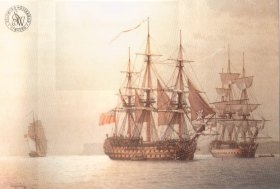 Stirling trained for midshipman
on board the Camel and also served for a period on HMS Hercule
under the flag of Admiral Sir John Duckworth
, Commander-in-Chief, Jamaica Squadron. He passed his midshipman tests on 20 January 1805 and shortly afterwards was posted to HMS Prince George, but on 27 June, at the request of his uncle, Rear-Admiral Charles Stirling
, he joined his uncle's flagship, the 98-gun HMS Glory
.
The following month, at age 14, he was to see his first naval action. The Glory was in the fleet, commanded by Vice-Admiral Robert Calder
, which in July that year engaged against the combined French and Spanish fleets off Cape Finisterre
during the Napoleonic Wars
. The Glory sustained a damaged foremast spar and sails "much torn". After the battle, the Squadron returned to England with two captured Spanish ships as prizes.
In July 1806 his uncle was given a new ship, HMS Sampson
, and orders to convoy General Samuel Auchmuty and his troops to the Río de la Plata
and take over command of the squadron there from Admiral Sir Home Popham
on the flagship HMS Diadem
. James accompanied his uncle and saw the fall of Montevideo
to General Auchmuty's forces and the capture of twenty-five warships and more than 10,000 tons of merchant shipping. In August 1807 the Stirlings crossed the South Atlantic for a stay of five months at the Cape of Good Hope
and at the end of February 1808 the Diadem returned to England via a short period in Rio de Janeiro
.
On arrival in England in April, Midshipman Stirling was posted to HMS Warspite
under Captain Henry Blackwood
. At this time he was preparing for his examinations to become a Lieutenant, and Blackwood arranged for him to have short stints as Acting Lieutenant on other vessels in the Channel Fleet. He started his examinations at Somerset House
on 1 August 1809 and on 12 August rejoined the Warspite as a full Lieutenant.
under Captain R.D.Drum and moved with Drum when the Captain was transferred to HMS Armide
in November. A year later, on 20 November 1811, he received a significant elevation to Flag Lieutenant on HMS Arethusa
, the flagship of his uncle, now Vice-Admiral and Commander-in-Chief of the Jamaica Station. On 3 March 1812, he was appointed Acting Commander of the sloop "Moselle" and three months later, at age 21, he was promoted to the rank of Commander. Soon after that he was given command of the 28-gun sloop HMS Brazen
, built in 1808, in which he was to serve for six years.
In the War of 1812
between the United States of America and Britain, the role assigned to the ships of the Jamaica Station was to attack the US coast and ports on the Gulf of Mexico
and to destroy their ships and stores. On 11 July 1812 the Brazen weighed anchor on Stirling's first mission, which was to be against New Orleans and the Mississippi delta. However, the Brazen was severely damaged by a hurricane and had to abandon the mission and enter the Spanish port of Pensacola
to carry out repairs. Despite this, Stirling was able to make a valuable survey of Mobile Bay
and the Spanish held Florida coastline and capture an American ship, which he took back to Jamaica as a prize on 20 November.
He had no immediate opportunity to revisit the Gulf of Mexico, as the Brazen was ordered to return to England for a maintenance survey. After docking in Sheerness for four months, the ship escorted a convoy carrying settlers and stores to Hudson Bay
. On his return to the Strait of Dover
at the end of December 1813, Stirling received confidential orders for an important mission, to carry the Duke of Brunswick to Holland. After that, during most of 1814, the Brazen patrolled the Irish Sea
and the Hebrides
in search of French or American ships until, at the end of the year, Stirling received orders to return to the West Indies, to the Windward Islands Station at Barbados
, where Admiral Duckworth was now Commander-in-Chief.
There were now two stations in the West Indies, at Barbados and Jamaica, and for a while the Brazen shuttled between the two, carrying communications between the two admirals. On one such trip Stirling was introduced to Simón Bolívar
, who was in Jamaica following a defeat on the South American mainland. Soon after that he was given a mission to carry the news of the Treaty of Ghent
, ending the War of 1812, to the British troops under the command of General John Lambert, near New Orleans, and to assist in their return to England. His reconnaissance of Mobile Bay and the coast of Florida three years earlier now stood him in good stead. The troops, who had captured Fort Bowyer
, were recovered and some of them, under the command of Lieutenant Harry Smith, were taken to England on the Brazen after surviving a severe gale in the Gulf of Florida. Smith was impressed with Stirling's seamanship and became a long-standing friend.
The Treaty of Paris
, signed by France, Great Britain, Austria, Prussia and Russia on 20 Nov 1815, ended the Napoleonic Wars and a large fleet was no longer needed. The Admiralty set about decommissioning ships and retiring officers. However, Stirling and the Brazen received a stay of execution, as they were needed again in the West Indies. Spain was losing its grip on the north of South America and rival factions were struggling for power. So close to the West Indies, Britain had an interest in the establishment of secure government on the mainland, but needed to be careful to avoid offending Spain, now an ally. The Brazen arrived at Barbados in June 1816 and on 20 July Stirling and the Barbados Harbourmaster were sent to survey the coast of Venezuela and gain intelligence regarding the attitudes of the population and the disposition of the various revolutionary factions.
After making his report Stirling went back to patrolling the Caribbean with orders to prevent piracy and the contraband trade. Late in September he seized the Hercules. This action turned out to be unwise. The Hercules, not to be confused with HMS Hercule on which Stirling had served in 1804, was nicknamed the Black Frigate and had at one time been the flagship of the Argentine Navy. When taken by Stirling, she was a privateer
with 22 guns carrying a valuable cargo plundered from Spanish American cities and ships. She was under the command of William Brown
, who had been an Admiral in the Argentine Navy and was in command of the revolutionary fleet fighting the Spaniards. Her capture compromised the cautious line taken by the British between the Spanish and the revolutionaries. The Governor of Barbados ordered her release, but, when she had left Barbados, Stirling recaptured her and took her to Antigua as a prize. After long drawn-out proceedings, the High Court of the Admiralty ruled in Brown's favour, but he lost the frigate and her cargo. Stirling continued to receive demands for payment of damages for many years.
At the end of 1816 Stirling was commissioned to make a further detailed inspection of the conditions in Venezuela. From Güiria in the Paria Peninsula
he sailed west to Caracas
and the port of La Guaira
and returned eastward by an inland route, in order to study the conditions in the interior of the country. In February 1817 he submitted a detailed report to the Commander-in-Chief, Admiral John Harvey
. In it he blamed Spanish neglect for the devastation and decay he found in the interior. He described the insurgent 'Patriots' as determined and disciplined, but the Loyalists were indisciplined and lazy. Following this, Stirling was given a number of covert missions in connection with Venezuela. The exact orders he received are not known, as the period from January to June 1817 has been removed from the Brazen's log in Admiralty files. In May, the Executive Committee of the Patriots prepared a draft Constitution for the Republic of Venezuela which was given to Stirling for transmission to the West Indies Stations and thence to England. However this draft was subsequently rejected by Bolívar. Another source reports that a secret agreement, between the British and the Republicans, was signed later on board the Brazen, in which the British would assist Bolívar in exchange for preferential trading rights when the Republic came into being.
In the second half of 1817 Stirling returned once again to patrolling the Caribbean with orders to seize any vessels suspected of piracy, orders which he carried out with alacrity because of the prize money. By June 1818 the Brazen was in need of repair and he returned with her to England, where the ship was taken out of commission and Stirling received the dread news that he was to be placed on half pay. However, Admiral Harvey had sent the Lords of the Admiralty a letter strongly commending 'the zeal and alacrity of this intelligent and excellent officer', which may have influenced their decision to promote him to Post Captain on 7 December 1818.
Between 1818 and 1822 his father, Andrew, was a tenant at Henley Park
in Surrey
,
and Stirling made use of his enforced leave to visit his parents and other members of his scattered family. He also made several visits to the Continent of Europe. On one such visit to France he met and befriended Captain James Mangles, RN, who was also on half pay. Mangles was returning from a tour of North Africa and Asia Minor and was among the first Europeans to have visited Petra
. His uncle had an estate at Woodbridge Park, about ten miles from the Stirlings at Henley Park and had extensive interests in the East Indies
, had been High Sheriff for Surrey in 1808 and was a director of the British East India Company
.
Captain Mangles invited Stirling to visit Woodbridge, where he met for the first time the, then, 13-year-old Ellen Mangles, his future wife. The two families got on well together and the parents were delighted two years later when, according to the etiquette of that era, Stirling formally asked the uncle's permission to propose marriage to his daughter. The permission was granted on the condition that Stirling should not make the proposal until Ellen completed her schooling.
The couple were married at Stoke Church, Guildford on 3 September 1823, on Ellen's 16th birthday,
and went on a nine month honeymoon and grand tour
. On their return, Ellen gave birth to their first child, Andrew, at Woodbridge on 24 October 1824.
During the next eighteen months Stirling put forward several ideas to the Admiralty, including a means of assessing compass declinations at sea and a proposal for improving stowage in warships. He was keen to keep his name in front of those in the Admiralty who could post him to active service. He had returned from the grand tour short of funds, his father had died in 1823, the family businesses were not prospering and he himself had to make payments to the court in connection with the Hercules case. The competition for preferment from other officers on half pay was intense, so he was fortunate that on 23 January 1826 he was recommissioned and given command of the newly built HMS Success
.
, but the Dutch appeared to have no interest in its development. For the British, a port on the west or north coast might be a useful stage for trade with their settlements in the Cape of Good Hope, India and Singapore. However, the French were known to be have an intense interest and French ships were exploring the Australian coasts. The British needed to assess further the potential of the region and find out the extent of the French interest without creating a diplomatic incident. For this task, Stirling, with his record of exploration, diplomacy and covert missions, was a natural choice. New South Wales
was running short of currency and the settlement on Melville Island was short of food and scurvy was rife. A supply mission to these would be excellent cover for intelligence gathering activities.
The Success sailed on 9 July 1826, carrying cases of coins and a distinguished passenger, Admiral Sir James Saumarez
, Knight Companion of the Bath
, a hero of the Napoleonic Wars. Ellen and one year old Andrew remained at home at Woodbridge. One of Stirling's officers was 3rd Lieutenant William Preston, who would marry Ellen's sister Hamilla seven years later. The Success arrived at the Cape of Good Hope on 2 September, discharged its passenger, took on provisions and set sail again, arriving at Sydney Heads
on 28 November.
Captain Jules d'Urville
arrived in Sydney Harbour on 2 December on the French corvette
L'Astrolabe
. The L'Astrolabe was on a voyage of exploration, which gave Stirling an opportunity to assess French interest in the region. Stirling and d'Urville dined together several times and Stirling discovered that the Astrolabe had a detailed chart of the Swan River
. Before leaving England, Stirling had studied the available charts of the west coast of Australia and had concluded that the Swan was a possible site for a harbour and settlement and had hoped to be the first European to explore and chart it. However, d'Urville indicated that the French did not consider that the Swan would be a suitable site for a harbour, because of the difficulty of access and lack of fresh water. This gave Stirling a free hand.
A ship arrived from Melville Island on the same day as the L'Astrolabe, bringing reassuring news that scurvy was under control and the settlement was progressing more satisfactorily. The Governor, Major General Ralph Darling
, advised Stirling to delay his visit to Melville until later in the year. Stirling then made a report to Darling, setting out detailed arguments for a mission to the Swan River. Darling gave his approval and, on 17 January 1827, the Success sailed from Sydney for the Swan, via Hobart
in Van Diemen's Land
, where several cases of coins were delivered. On board the Success were the Colonial Botanist Charles Frazer
, the surgeon Frederick Clause
and the landscape artist Frederick Garling.
and the ship's Master, Millroy, were left to take soundings and look for channels and possible landing places. Meanwhile, Stirling, Frazer and Lieutenant Preston made a preliminary reconnaissance up the river in the gig. They sailed about five miles upstream, reaching a wide section which Stirling named Melville Water. Other features were named after Stirling's brother Walter and Lieutenant Preston. During the next day more soundings were taken, and Isle Berthelot and Isle Bauche were renamed Carnac Island and Garden Island. Stirling gave the name Cockburn Sound to the "Magnificent Sound between that Island and the Main possessing great attractions for a Sailor in search of a Port".
At mid-day on 8 March the exploration party - Stirling, Frazer, Garling, Clause, Lieutenant Belches, Mr Midshipman Heathcote, the ship's clerk Augustus Gilbert, 7 seamen and 4 marines - left the Success in the cutter and the gig and sailed to Point Belches. There the boats grounded and, as the party was unable to find a channel, the boats were unloaded and dragged across the shallows until nightfall. While this was being done, Stirling, Frazer and Garling climbed the commanding hill on the west bank, which Stirling named Mount Eliza in honour of Eliza Darling, the Governor's wife. While there, Garling painted a watercolour landscape view showing the entrance to the river on the opposite side of Melville Water. Stirling later named this Canning River
after the British Prime Minister at that time.
The next day, dragging across the shallows started at daybreak and continued until nightfall. Frazer, exploring on land, found a freshwater brook and Stirling named the nearby point of land Point Frazer. Frazer also found a lagoon of fresh water and the party moved camp to beside it. On the following morning three armed natives demonstrated their anger at the 'invasion' (Stirling's word) of their territory with violent gestures, but eventually retired. During the day, the boats reached the Heirisson Islands and in the channel above them progress was much easier, but still slow, due to the winding of the river. On 11 March the boats passed through a long narrow stretch and encountered more natives, who threatened the boats with their spears from higher ground. When the boats reached more level terrain, gestures of goodwill defused the situation and the natives disappeared.
On 12 March the boats reached a place where a tributary, later named Helena River
, joined the Swan from the east. The party also found another fresh water stream, which they named Success, on the west side of the Swan. From this point on, the Swan narrowed and there were many obstructions. The next day, the cutter was holed and had to be repaired, after which the party reached a creek which Stirling named Ellen Brook, after his young wife. The Swan was not navigable any further and Stirling and Garling set off on foot for the hills to the east, arriving at about sunset. On their return to camp they lost their way in the dark, but Frazer sent out search parties to guide them back. On 14 March the party split into three groups. Frazer went east and Belches and Heathcote north. Stirling and Clause went west and discovered a freshwater lagoon, some deserted aborigine huts and a fertile region which so pleased Stirling that he named it Henley Park after his Surrey home.
The return journey was much quicker, being downstream and through previously charted areas. On arrival at Melville Water, Belches was sent to explore the Canning River. The rest of the party returned to the Success and spent the next four days surveying the surrounding islands and finding a safe channel into Cockburn Sound. On 21 March the Success weighed anchor and three days later arrived at Geographe Bay
, in order to carry out Governor Darling's instructions to explore and report on the region. The Success then sailed to King George Sound
, to pick up Major Edmund Lockyer
and unload provisions for the settlement there, after which the ship returned to New South Wales, anchoring off Sydney Heads on 16 April.
Stirling's report to Darling and Frazer's report on the quality of the land were enclosed with Darlings report of 21 April 1827 to the Colonial Office in the United Kingdom. Stirling's report consisted of a diary Narrative of Operations and a section Observations on the Territory, which included a report by Clause on the healthiness of the climate. Later events showed that all three reports were over enthusiastic, the party having explored only the strip of soil in the vicinity of the Swan. Frazer was heavily criticised for this later. However, in their defence, both Clause and Frazer were subject to Stirling's intense enthusiasm for the project and may have been unduly influenced by it. Stirling wrote a second report on the Swan River on 31 August. This was addressed to the Admiralty and was shorter, placing more emphasis on naval concerns and the strategic value of the area.
The Success arrived at Fort Dundas on Melville Island on 25 July and set sail again four days later for Madras, and then to Penang
, to report to Admiral Gage
, Commander of the Eastern Station. Stirling was keen to return home to see his family and to further his case for a settlement at the Swan River. However, Gage instructed him to base the Success in Trincomalee
Harbour, Ceylon (now Sri Lanka), where he arrived on 4 January 1828. There he succumbed rapidly to the tropical climate and on 21 February three Royal Navy surgeons certified that he was so ill he should return immediately to England.
The settlements at Fort Dundas and Fort Wellington rapidly got into difficulties with outbreaks of scurvy and fever, supply shortages and communication failures. The Melville Island outpost was abandoned in November 1828 and the Raffles Bay settlement was broken up in July 1829.
, the large hill on which Kings Park
is now situated, "as it is near the narrows of the Swan River, which would make defending the colony from gunships easy, with just a few cannons." His efforts were unsuccessful at first, but rumours of renewed French interest in the region led Sir George Murray on 5 November to request the Admiralty to send a ship-of-war "to proceed to the Western Coast of New Holland and take possession of the whole territory in His Majesty's name." This task was given to HMS Challenger under the command of Captain Charles Fremantle
and, a week later, a further order was issued to prepare to carry a detachment of troops to the Swan River.
On 31 December Murray wrote to Stirling confirming his title as Lieutenant-Governor of the new colony and on the same day his Under-Secretary, Robert Hay, confirmed the appointment of the members of the civil establishment including Colonial Secretary Peter Brown
, Surveyor-General John Septimus Roe
, Harbourmaster Mark John Currie
, naturalist James Drummond
, a surgeon, a storekeeper, a cooper, a blacksmith and a boatbuilder. After hectic preparations, on 6 February 1829 these pioneers, with their assistants, families, servants and livestock, departed Plymouth
in the Parmelia
under Captain J H Luscombe out of Spithead
in company with the Sulphur, carrying 100 men of the 63rd Regiment of Foot, under the command of Major Frederick Irwin
, and three years' of army stores, 10,000 bricks and £1,000 to meet all expenses of government.
On arrival on 31 May at Garden Island
, at what became known as the Swan River Colony
, they re-erected a wooden house that had first been assembled at Lieutenant Preston's home in Sutton Green that would become the Governor's home. These pioneers were responsible for laying the foundations of Perth
, Fremantle
and the market-town named Guildford
that is now a suburb of Perth.
Stirling administered the Swan River settlement from June 1829 until August 1832, when he left on an extended visit to England where he was knighted, and again from August 1834 until December 1838. However, he was commissioned as Governor of Western Australia
only from 4 March 1831, rectifying the absence of a legal instrument providing the authority detailed in Stirling's Instructions of 30 December 1828. Stirling had said
With the creation of the Western Australian Legislative Council
in 1830, Stirling automatically became an official member.
In October 1834 Stirling led a detachment of 25 armed troopers and settlers including Septimus Roe and Thomas Peel
that attacked an encampment of 60-80 Pindjarep Aboriginal people. The Pindjarep fled into the bush and were later encircled near a crossing on the Pinjarra River, Stirling referred to this as the Battle of Pinjarra
. Settlers accounts claim between 10-80 aboriginals died compared to aboriginal oral history which claim 150 people died.
Stirling remained entirely unsympathetic to the needs of Aboriginal people in Western Australia, and never recognised their prior ownership of the land despite the fact that the Buxton Committee of the British House of Commons informed him that this was a mistake for which the new colony would suffer. Stirling mentioned in dispatches that the Aborigines "must gradually disappear" and the "most anxious and judicious measures of the local government [could] prevent the ulterior extinction of the race".
As recognition of his service in establishing the colony Stirling was granted land near Beverley, Western Australia
. This land, along with neighbouring properties was re-acquired by the Western Australian Government, who later subdivided the land into farmlets for returning soldiers. The remaining land was later used to establish the Avondale Agricultural Research Station
, which includes Stirling's restored homestead.
and called it the "Harvey River Settlement". However, the only improvement made was a convict built cottage on the banks of the Harvey River
. The cottage featured a shingled roof and pit-sawn jarrah walls with hexagonal-shaped paving blocks fitted together to form firm flooring. A replica cottage known as Stirling's Cottage has been built on the site and includes one of the original paving blocks in its history room.
. The British Foreign Secretary, Lord Palmerston, considered it was necessary to show a strong British naval presence in the Mediterranean. Muhammad Ali Pasha had triggered the Oriental Crisis of 1840
by declaring himself Khedive
of Egypt
, which had been until then a province of the Ottoman Empire
. Also King Ferdinand II
of the Two Sicilies and Naples
, had been persuaded by a British naval blockade of Naples to restore to a British company the monopoly for Sicilian sulphur, an essential ingredient of gunpowder. The Indus reached Gibraltar in August 1841 and made herself felt along the Algerian coast on her way to the Mediterranean station at Malta. For a few months she was deployed around Sicily and the boot of Italy, but in November Stirling received new instructions to show a presence and monitor the situation at Lisbon
. Portugal had been in turmoil for several years and the British Admiralty had received intelligence that Lisbon was threatened by a 5,000 strong revolutionary army and the Portugese Government was preparing for conflict. Stirling was directed not to take part in any action, but to safeguard British subjects and the Portugese royal family. In the event, the conflict was resolved peacefully.
In June the Indus was ordered back to Malta and then to Smyrna
, where there had been an insurrection and British subjects and property in the region were thought to be at risk. This threat also failed to materialise and after three months at Piraeus
in Greece the Indus sailed to Naples to take part in the farewell celebrations sending the Princess Teresa Cristina on her way to marry the Emperor Pedro II of Brazil
. This was a major diplomatic event and Stirling entertained the British Ambassador and British Consul on board and was received by King Ferdinand. The harbour was filled with vessels of the Neapolitan, Brazilian and British navies as well as an American warship and Stirling sent a detailed report on the foreign warships to the Admiralty.
A brief spell at Gibraltar was followed by a visit to Cadiz to prevent a planned blockade of the harbour by rebel troops. Then, in September 1843, Vice-Admiral Sir Edward Owen
, Commander-in-Chief, Mediterranean Fleet, received an urgent request for assistance from Sir Edmund Lyons
, the British Consul in Athens. King Otto of Greece
had rejected a proposed new constitutional government for Greece and was facing an armed rebellion. Stirling was to join , under the command of Sir Charles Sullivan
, place himself at the disposal of Sir Edmund and arrange for the protection of British subjects. Stirling's charm and diplomatic skill, combined with the presence of three British warships in the harbour, calmed the situation and, despite the King's reluctance to adopt the new constitution, Sullivan and Stirling persuaded him that acceptance was the wisest course. In gratitude for their help in quelling the rebellion and negotiating with his ministers, the King bestowed on Sullivan and Stirling Greece's high honour, Knight Commander of the Order of the Redeemer. Following this, Stirling returned to England, where the Indus was paid off on 13 June 1844.
in May 1847 and joined the Channel Fleet under the command of the newly appointed Rear-Admiral Sir Charles Napier on . In September he received special orders. He was to conduct Her Majesty, the Dowager Queen Adelaide
, Queen Victoria's aunt, on trips to Lisbon and Madeira and then back to Osborne House
on the Isle of Wight
. Flying the Royal Standard at the main, the Howe entered the River Tagus
on 22 October. Sir Charles Napier immediately boarded to pay his respects, followed shortly afterwards by Ferdinand of Saxe-Coburg Gotha
, King of Portugal, and two princes. The next day, all the captains in the squadron donned full dress and white trousers and were formally presented to the Dowager Queen, after which Napier and Stirling escorted her to the royal Palace of Necessidades
, where they were received by Queen Maria II.
After five days of sightseeing, the party set sail for Madeira. Leaving the Tagus, the Howe was struck by a large wave and the Queen slipped and nearly fell overboard, but was saved by Stirling, who in so doing lost his ceremonial sword overboard. The grateful Queen later presented him with a magnificent replacement, a fine gold plated dress sword and scabbard which had been specially made for her. She also presented him with a silver snuff box with an inscription thanking him for his presence of mind on the occasion. After delivering the Queen in Madeira, the Howe returned to Lisbon and took part in various exercises and manoeuvres before leaving again to collect her for the return voyage. She arrived at Osborne House on 27 April and Stirling learned a year later that she had honoured him by appointing him as her naval aide-de-camp
.
He now had a few weeks with his family before receiving orders to report at Malta to Vice-Admiral Sir William Parker, Commander-in-Chief, Mediterranean Fleet, who had succeeded Sir Edward Owen. During the next few years, the presence of the British and French fleets encouraged an uneasy peace in the eastern Mediterranean. In 1849 the Howe was recalled. She reached England on 2 July and two weeks later the ship's company was paid off.
and in the following year served as Third Naval Lord
at the Admiralty
. From January 1854 to February 1856 Stirling was commander in chief of the East Indies and China Station
. Using gunboat diplomacy
he signed the first British treaty with Japan
(the Anglo-Japanese Friendship Treaty
) on 14 October 1854.
In November 1854, with Hong Kong Governor John Bowring
, he led a fleet up the Pearl River
to Canton
to support the Viceroy of Liangguang
(modern day Guangdong
and Guangxi
) Ye Mingchen
and his forces besieged by the Tiandihui
army. The fleet carried weapons and ammunition, food and Qing
reinforcements.
"In 1856 he was recalled because he had failed in the primary naval duty of finding and destroying the Russia
n squadron - partly, perhaps, because of his preoccupation with the self-imposed task of negotiating with Japan" Yet his agreements with Japan were ratified, and his conduct was officially commended.
in August 1857. He became an Admiral
in November 1862 and died in comfortable retirement at Guildford in Surrey on 22 April 1865 aged 74. There is a memorial tablet within St Marks Church, Wyke
. His wife survived him by nine years and was buried in the extension to the graveyard of Stoke Church where they had been married.
, was named in his honour by Stephan Endlicher in 1838. A variety of Pittosporum
is also named in his honour. In England, Stoke Church's social centre and hall is named The Stirling Centre.
In Western Australia the suburb of Stirling
is named after him as is a seat in the lower House of the federal Parliament
. The Royal Australian Navy's Indian Ocean Fleet is based at HMAS Stirling
near Rockingham
. Stirling Highway (which links Perth and Fremantle) was named so in his honour. There are also many pubs and buildings and businesses named after him throughout Perth and Fremantle.
|-
|-
Admiral
Admiral is the rank, or part of the name of the ranks, of the highest naval officers. It is usually considered a full admiral and above vice admiral and below admiral of the fleet . It is usually abbreviated to "Adm" or "ADM"...
Sir James Stirling RN
Royal Navy
The Royal Navy is the naval warfare service branch of the British Armed Forces. Founded in the 16th century, it is the oldest service branch and is known as the Senior Service...
(28 January 179122 April 1865) was a British naval officer and colonial administrator. His enthusiasm and persistence persuaded the British Government to establish the Swan River Colony
Swan River Colony
The Swan River Colony was a British settlement established in 1829 on the Swan River, in Western Australia. The name was a pars pro toto for Western Australia. In 1832, the colony was officially renamed Western Australia, when the colony's founding Lieutenant-Governor, Captain James Stirling,...
and he became the first Governor
Governor of Western Australia
The Governor of Western Australia is the representative in Western Australia of Australia's Monarch, Queen Elizabeth II. The Governor performs important constitutional, ceremonial and community functions, including:* presiding over the Executive Council;...
and Commander-in-Chief of Western Australia
Western Australia
Western Australia is a state of Australia, occupying the entire western third of the Australian continent. It is bounded by the Indian Ocean to the north and west, the Great Australian Bight and Indian Ocean to the south, the Northern Territory to the north-east and South Australia to the south-east...
. In 1854, when Commander-in-Chief, East Indies and China Station
East Indies and China Station
The East Indies and China Station was a formation of the British Royal Navy from 1831 to 1865.-History:The Station was formed in 1831; it ceased to exist when it was separated into the East Indies Station and the China Station in 1865. Its area covered the Indian Ocean and the coasts of China and...
, Stirling on his own initiative signed Britain's first Anglo-Japanese Friendship Treaty
Anglo-Japanese Friendship Treaty
The between Britain and Japan was signed October 14, 1854 in Nagasaki. The United Kingdom was represented by Admiral Sir James Stirling, with the governors of Nagasaki representing the Tokugawa shogunate ....
. Throughout his career Stirling showed considerable diplomatic skill and was selected for a number of sensitive missions. Paradoxically, this was not reflected in his personal dealings with officialdom and his hopes for preferment received many rebuffs.
Stirling entered the Royal Navy
Royal Navy
The Royal Navy is the naval warfare service branch of the British Armed Forces. Founded in the 16th century, it is the oldest service branch and is known as the Senior Service...
at age 12 and as a midshipman
Midshipman
A midshipman is an officer cadet, or a commissioned officer of the lowest rank, in the Royal Navy, United States Navy, and many Commonwealth navies. Commonwealth countries which use the rank include Australia, New Zealand, South Africa, India, Pakistan, Singapore, Sri Lanka and Kenya...
saw action in the Napoleonic Wars
Napoleonic Wars
The Napoleonic Wars were a series of wars declared against Napoleon's French Empire by opposing coalitions that ran from 1803 to 1815. As a continuation of the wars sparked by the French Revolution of 1789, they revolutionised European armies and played out on an unprecedented scale, mainly due to...
. Rapid promotion followed and when he was 21 he received his first command, the 28-gun sloop , and, in the War of 1812
War of 1812
The War of 1812 was a military conflict fought between the forces of the United States of America and those of the British Empire. The Americans declared war in 1812 for several reasons, including trade restrictions because of Britain's ongoing war with France, impressment of American merchant...
between the US and the UK, seized two prizes. The Brazen carried the news of the end of that war to Fort Bowyer
Fort Bowyer
Fort Bowyer was a short-lived earthen and stockade fortification erected by the United States Army on Mobile Point, near the mouth of Mobile Bay in Baldwin County, Alabama. Built during the War of 1812, the fort was the site of two attacks by the British. The first, unsuccessful, attack led to the...
and took part in carrying to England the British troops that had captured the fort. On return to the West Indies, Stirling made two surveys of the Venezuelan coast and reported on the strengths, attitudes and dispositions of the Spanish government and various revolutionary factions, later playing a role in the British negotiations with these groups.
In his second command, , he carried supplies and coinage to Australia, but with a covert mission to assess other nations' interest in the region and explore opportunites for British settlements. He is chiefly remembered for his exploration of the Swan River, followed by his eventual success in lobbying the British Government to establish a settlement there. On 30 December 1828 he was made Lieutenant-Governor of the colony-to-be. He formally founded the city of Perth and the port of Fremantle
Fremantle
Freemantle is a suburb of Southampton in England.Fremantle or Freemantle may also refer to:- Places :* Fremantle, the port city to the capital Perth, Western Australia...
and oversaw the development of the surrounding area and on 4 March 1831 he was confirmed as Governor and Commander-in-Chief of the new territory, Western Australia, in which post he remained until in 1838 he resumed his naval career.
From 1840 to 1844, in command of the 80 gun , he patrolled the Mediterranean with instructions to 'show the flag' and keep an eye on the French. In 1847 he was given command of the 120 gun first rate ship of the line and his first commission was to conduct Her Majesty, the Dowager Queen Adelaide
Adelaide of Saxe-Meiningen
Princess Adelaide of Saxe-Meiningen was the queen consort of the United Kingdom and of Hanover as spouse of William IV of the United Kingdom. Adelaide, the capital city of South Australia, is named after her.-Early life:Adelaide was born on 13 August 1792 at Meiningen, Thuringia, Germany...
on trips to Lisbon and Madeira and then back to Osborne House
Osborne House
Osborne House is a former royal residence in East Cowes, Isle of Wight, UK. The house was built between 1845 and 1851 for Queen Victoria and Prince Albert as a summer home and rural retreat....
on the Isle of Wight
Isle of Wight
The Isle of Wight is a county and the largest island of England, located in the English Channel, on average about 2–4 miles off the south coast of the county of Hampshire, separated from the mainland by a strait called the Solent...
. After that, the Howe was assigned to the eastern Mediterranean, where she reinforced the squadron led by Vice Admiral Parker
Hyde Parker (Sea Lord)
Vice-Admiral Hyde Parker CB was a senior British naval officer who started to serve during the Napoleonic Wars and who was appointed First Naval Lord of the Admiralty in 1852...
using gunboat diplomacy
Gunboat diplomacy
In international politics, gunboat diplomacy refers to the pursuit of foreign policy objectives with the aid of conspicuous displays of military power — implying or constituting a direct threat of warfare, should terms not be agreeable to the superior force....
to secure an uneasy peace in the region.
Stirling's fifth and final command was as Commander in Chief, China and the East Indies Station, and his flag, as Rear Admiral of the White, was hoisted on on 11 May 1854. Shortly afterwards news arrived that war had been declared on Russia. Stirling was anxious to prevent Russian ships from sheltering in Japanese ports and menacing allied shipping and, after lengthy negotiations through the Goverrnor of Nagasaki, concluded a Treaty of Friendship with the Japanese. The treaty was endorsed by the British Government, but Stirling was criticised in the popular press for not finding and engaging with the Russian fleet.
Family background
He was the fifth of eight sons, ninth of the sixteen children, of Andrew Stirling, Esq. of DrumpellierDrumpellier
Drumpellier is a country park situated within North Lanarkshire Council, to the west of Coatbridge. The park was formerly a private estate. The land was given over to the Burgh of Coatbridge for use as a public park in 1919, and was designated as a country park in 1984 by the then Monklands...
near Coatbridge
Coatbridge
Coatbridge is a town in North Lanarkshire, Scotland, about east of Glasgow city centre, set in the central Lowlands. The town, with neighbouring Airdrie, is part of the Greater Glasgow urban area. The first settlement of the area stretches back to the Stone Age era...
, North Lanarkshire
North Lanarkshire
North Lanarkshire is one of 32 council areas in Scotland. It borders onto the northeast of the City of Glasgow and contains much of Glasgow's suburbs and commuter towns and villages. It also borders Stirling, Falkirk, East Dunbartonshire, West Lothian and South Lanarkshire...
, Scotland
Scotland
Scotland is a country that is part of the United Kingdom. Occupying the northern third of the island of Great Britain, it shares a border with England to the south and is bounded by the North Sea to the east, the Atlantic Ocean to the north and west, and the North Channel and Irish Sea to the...
, and his father's second cousin, Anne Stirling.
The Stirling family was well-known and celebrated in the naval annals of the 18th century. His maternal grandfather was Admiral Sir Walter Stirling
Walter Stirling
Admiral Sir Walter Stirling was an admiral in the Royal Navy.Born in 1718, Walter Stirling entered the Royal Navy. He was made "The Regulating Captain of the Impress at the Tower". On 30 October 1753 he married Dorothy Willing, the daughter of Charles Willing, a Philadelphia merchant...
and his uncle was Admiral Sir Charles Stirling
Charles Stirling
Sir Charles Stirling was a vice-admiral in the Royal Navy.-Early life and career:Charles Stirling was born in London on 28 April 1760 and baptised at St. Albans on 15 May. The son of Admiral Sir Walter Stirling, he was born into a family with a long and proud naval tradition. Stirling joined the...
. With such a family background, it was natural for James to enter the Royal Navy
Royal Navy
The Royal Navy is the naval warfare service branch of the British Armed Forces. Founded in the 16th century, it is the oldest service branch and is known as the Senior Service...
. His education at Westminster School
Westminster School
The Royal College of St. Peter in Westminster, almost always known as Westminster School, is one of Britain's leading independent schools, with the highest Oxford and Cambridge acceptance rate of any secondary school or college in Britain...
was interleaved with periods of training on board British warships, and on 14 January 1804, at the age of 12, he entered the navy as a First-Class Volunteer, embarking on the storeship HMS Camel for the West Indies
Caribbean
The Caribbean is a crescent-shaped group of islands more than 2,000 miles long separating the Gulf of Mexico and the Caribbean Sea, to the west and south, from the Atlantic Ocean, to the east and north...
. Thus he began a distinguished career.
Period as a midshipman
Midshipman
A midshipman is an officer cadet, or a commissioned officer of the lowest rank, in the Royal Navy, United States Navy, and many Commonwealth navies. Commonwealth countries which use the rank include Australia, New Zealand, South Africa, India, Pakistan, Singapore, Sri Lanka and Kenya...
on board the Camel and also served for a period on HMS Hercule
French ship Hercule (1798)
The Hercule was a 74-gun ship of the line of the French Navy.During her maiden journey, on 21 April 1798, and just 24 hours out of port, she was captured by the British ship HMS Mars after a violent fight, off Île de Sein near Brest...
under the flag of Admiral Sir John Duckworth
John Thomas Duckworth
Admiral Sir John Thomas Duckworth, 1st Baronet, GCB was a British naval officer, serving during the American War of Independence, the French Revolutionary and Napoleonic Wars, as the Governor of Newfoundland during the War of 1812, and a member of the British House of Commons during his...
, Commander-in-Chief, Jamaica Squadron. He passed his midshipman tests on 20 January 1805 and shortly afterwards was posted to HMS Prince George, but on 27 June, at the request of his uncle, Rear-Admiral Charles Stirling
Charles Stirling
Sir Charles Stirling was a vice-admiral in the Royal Navy.-Early life and career:Charles Stirling was born in London on 28 April 1760 and baptised at St. Albans on 15 May. The son of Admiral Sir Walter Stirling, he was born into a family with a long and proud naval tradition. Stirling joined the...
, he joined his uncle's flagship, the 98-gun HMS Glory
HMS Glory (1788)
HMS Glory was a 98-gun second rate ship of the line of the Royal Navy, launched on 5 July 1788 at Plymouth.Glory served as the flagship of Rear-Admiral Sir Charles Stirling at the Battle of Cape Finisterre in 1805....
.
The following month, at age 14, he was to see his first naval action. The Glory was in the fleet, commanded by Vice-Admiral Robert Calder
Robert Calder
Admiral Sir Robert Calder, 1st Baronet, KCB was a British naval officer who served in the Seven Years' War, the American Revolutionary War, the French Revolutionary Wars and the Napoleonic Wars.-Early life:...
, which in July that year engaged against the combined French and Spanish fleets off Cape Finisterre
Battle of Cape Finisterre (1805)
In the Battle of Cape Finisterre off Galicia, Spain, the British fleet under Admiral Robert Calder fought an indecisive naval battle against the Combined Franco-Spanish fleet which was returning from the West Indies...
during the Napoleonic Wars
Napoleonic Wars
The Napoleonic Wars were a series of wars declared against Napoleon's French Empire by opposing coalitions that ran from 1803 to 1815. As a continuation of the wars sparked by the French Revolution of 1789, they revolutionised European armies and played out on an unprecedented scale, mainly due to...
. The Glory sustained a damaged foremast spar and sails "much torn". After the battle, the Squadron returned to England with two captured Spanish ships as prizes.
In July 1806 his uncle was given a new ship, HMS Sampson
HMS Sampson (1781)
HMS Sampson was a 64-gun third rate ship of the line of the Royal Navy, launched on 8 May 1781 at Woolwich.She was hulked in 1802, and broken up in 1832....
, and orders to convoy General Samuel Auchmuty and his troops to the Río de la Plata
Río de la Plata
The Río de la Plata —sometimes rendered River Plate in British English and the Commonwealth, and occasionally rendered [La] Plata River in other English-speaking countries—is the river and estuary formed by the confluence of the Uruguay River and the Paraná River on the border between Argentina and...
and take over command of the squadron there from Admiral Sir Home Popham
Home Riggs Popham
Admiral Sir Home Riggs Popham KCB was a British Royal Naval Commander who saw service during the French Revolutionary Wars and the Napoleonic Wars...
on the flagship HMS Diadem
HMS Diadem (1782)
HMS Diadem was a 64-gun third rate ship of the line of the Royal Navy, launched on 19 December 1782 at Chatham. She participated in the Battle of Cape St Vincent in 1797.In 1798 she was converted to serve as a troopship...
. James accompanied his uncle and saw the fall of Montevideo
Montevideo
Montevideo is the largest city, the capital, and the chief port of Uruguay. The settlement was established in 1726 by Bruno Mauricio de Zabala, as a strategic move amidst a Spanish-Portuguese dispute over the platine region, and as a counter to the Portuguese colony at Colonia del Sacramento...
to General Auchmuty's forces and the capture of twenty-five warships and more than 10,000 tons of merchant shipping. In August 1807 the Stirlings crossed the South Atlantic for a stay of five months at the Cape of Good Hope
Cape of Good Hope
The Cape of Good Hope is a rocky headland on the Atlantic coast of the Cape Peninsula, South Africa.There is a misconception that the Cape of Good Hope is the southern tip of Africa, because it was once believed to be the dividing point between the Atlantic and Indian Oceans. In fact, the...
and at the end of February 1808 the Diadem returned to England via a short period in Rio de Janeiro
Rio de Janeiro
Rio de Janeiro , commonly referred to simply as Rio, is the capital city of the State of Rio de Janeiro, the second largest city of Brazil, and the third largest metropolitan area and agglomeration in South America, boasting approximately 6.3 million people within the city proper, making it the 6th...
.
On arrival in England in April, Midshipman Stirling was posted to HMS Warspite
HMS Warspite (1807)
HMS Warspite was a 74-gun third-rate ship of the line of the Royal Navy, launched in 1807. She served in the Napoleonic Wars and was decommissioned in 1815. After conversion to a 76-gun ship in 1817 she circumnavigated the world, visiting Australia. She was cut down to a single decker 50-gun...
under Captain Henry Blackwood
Henry Blackwood
Vice-Admiral Sir Henry Blackwood, 1st Baronet, GCH, KCB , whose memorial is in the St. John's Church, Killyleagh, was a British sailor....
. At this time he was preparing for his examinations to become a Lieutenant, and Blackwood arranged for him to have short stints as Acting Lieutenant on other vessels in the Channel Fleet. He started his examinations at Somerset House
Somerset House
Somerset House is a large building situated on the south side of the Strand in central London, England, overlooking the River Thames, just east of Waterloo Bridge. The central block of the Neoclassical building, the outstanding project of the architect Sir William Chambers, dates from 1776–96. It...
on 1 August 1809 and on 12 August rejoined the Warspite as a full Lieutenant.
West Indies
On 1 April 1810 Stirling was transferred from the Warspite to HMS HiberniaHMS Hibernia (1804)
HMS Hibernia was a 110-gun first rate ship of the line of the Royal Navy. She was launched at Plymouth dockyard on 17 November 1804, and was the only ship built to her draught, designed by Sir John Henslow....
under Captain R.D.Drum and moved with Drum when the Captain was transferred to HMS Armide
French frigate Armide (1804)
Armide was a 40-gun frigate of the French Navy, lead ship of her class, and launched in 1804 at Rochefort. She served briefly in the French navy before the British captured her in 1806. She went on to serve in the British Navy until 1815 when she was broken up.-French service:She took part in...
in November. A year later, on 20 November 1811, he received a significant elevation to Flag Lieutenant on HMS Arethusa
HMS Arethusa (1781)
HMS Arethusa was a 38-gun Minerva-class fifth-rate frigate of the Royal Navy built at Bristol in 1781.She took part in the Action of 23 April 1794, capturing Pomone....
, the flagship of his uncle, now Vice-Admiral and Commander-in-Chief of the Jamaica Station. On 3 March 1812, he was appointed Acting Commander of the sloop "Moselle" and three months later, at age 21, he was promoted to the rank of Commander. Soon after that he was given command of the 28-gun sloop HMS Brazen
HMS Brazen (1808)
HMS Brazen was a Bittern-class 28-gun Royal Navy ship sloop, launched in 1808.Though she served during the Napoleonic Wars, she appears to have missed any combat whatsoever and to have taken few prizes in that conflict...
, built in 1808, in which he was to serve for six years.
In the War of 1812
War of 1812
The War of 1812 was a military conflict fought between the forces of the United States of America and those of the British Empire. The Americans declared war in 1812 for several reasons, including trade restrictions because of Britain's ongoing war with France, impressment of American merchant...
between the United States of America and Britain, the role assigned to the ships of the Jamaica Station was to attack the US coast and ports on the Gulf of Mexico
Gulf of Mexico
The Gulf of Mexico is a partially landlocked ocean basin largely surrounded by the North American continent and the island of Cuba. It is bounded on the northeast, north and northwest by the Gulf Coast of the United States, on the southwest and south by Mexico, and on the southeast by Cuba. In...
and to destroy their ships and stores. On 11 July 1812 the Brazen weighed anchor on Stirling's first mission, which was to be against New Orleans and the Mississippi delta. However, the Brazen was severely damaged by a hurricane and had to abandon the mission and enter the Spanish port of Pensacola
Pensacola
Pensacola is a city in the western part of the U.S. state of Florida.Pensacola may also refer to:* Pensacola people, a group of Native Americans* A number of places in the Florida:** Pensacola Bay** Pensacola Regional Airport...
to carry out repairs. Despite this, Stirling was able to make a valuable survey of Mobile Bay
Mobile Bay
Mobile Bay is an inlet of the Gulf of Mexico, lying within the state of Alabama in the United States. Its mouth is formed by the Fort Morgan Peninsula on the eastern side and Dauphin Island, a barrier island on the western side. The Mobile River and Tensaw River empty into the northern end of the...
and the Spanish held Florida coastline and capture an American ship, which he took back to Jamaica as a prize on 20 November.
He had no immediate opportunity to revisit the Gulf of Mexico, as the Brazen was ordered to return to England for a maintenance survey. After docking in Sheerness for four months, the ship escorted a convoy carrying settlers and stores to Hudson Bay
Hudson Bay
Hudson Bay , sometimes called Hudson's Bay, is a large body of saltwater in northeastern Canada. It drains a very large area, about , that includes parts of Ontario, Quebec, Saskatchewan, Alberta, most of Manitoba, southeastern Nunavut, as well as parts of North Dakota, South Dakota, Minnesota,...
. On his return to the Strait of Dover
Strait of Dover
The Strait of Dover or Dover Strait is the strait at the narrowest part of the English Channel. The shortest distance across the strait is from the South Foreland, 6 kilometres northeast of Dover in the county of Kent, England, to Cap Gris Nez, a cape near to Calais in the French of...
at the end of December 1813, Stirling received confidential orders for an important mission, to carry the Duke of Brunswick to Holland. After that, during most of 1814, the Brazen patrolled the Irish Sea
Irish Sea
The Irish Sea separates the islands of Ireland and Great Britain. It is connected to the Celtic Sea in the south by St George's Channel, and to the Atlantic Ocean in the north by the North Channel. Anglesey is the largest island within the Irish Sea, followed by the Isle of Man...
and the Hebrides
Hebrides
The Hebrides comprise a widespread and diverse archipelago off the west coast of Scotland. There are two main groups: the Inner and Outer Hebrides. These islands have a long history of occupation dating back to the Mesolithic and the culture of the residents has been affected by the successive...
in search of French or American ships until, at the end of the year, Stirling received orders to return to the West Indies, to the Windward Islands Station at Barbados
Barbados
Barbados is an island country in the Lesser Antilles. It is in length and as much as in width, amounting to . It is situated in the western area of the North Atlantic and 100 kilometres east of the Windward Islands and the Caribbean Sea; therein, it is about east of the islands of Saint...
, where Admiral Duckworth was now Commander-in-Chief.
There were now two stations in the West Indies, at Barbados and Jamaica, and for a while the Brazen shuttled between the two, carrying communications between the two admirals. On one such trip Stirling was introduced to Simón Bolívar
Simón Bolívar
Simón José Antonio de la Santísima Trinidad Bolívar y Palacios Ponte y Yeiter, commonly known as Simón Bolívar was a Venezuelan military and political leader...
, who was in Jamaica following a defeat on the South American mainland. Soon after that he was given a mission to carry the news of the Treaty of Ghent
Treaty of Ghent
The Treaty of Ghent , signed on 24 December 1814, in Ghent , was the peace treaty that ended the War of 1812 between the United States of America and the United Kingdom of Great Britain and Ireland...
, ending the War of 1812, to the British troops under the command of General John Lambert, near New Orleans, and to assist in their return to England. His reconnaissance of Mobile Bay and the coast of Florida three years earlier now stood him in good stead. The troops, who had captured Fort Bowyer
Fort Bowyer
Fort Bowyer was a short-lived earthen and stockade fortification erected by the United States Army on Mobile Point, near the mouth of Mobile Bay in Baldwin County, Alabama. Built during the War of 1812, the fort was the site of two attacks by the British. The first, unsuccessful, attack led to the...
, were recovered and some of them, under the command of Lieutenant Harry Smith, were taken to England on the Brazen after surviving a severe gale in the Gulf of Florida. Smith was impressed with Stirling's seamanship and became a long-standing friend.
The Treaty of Paris
Treaty of Paris (1815)
Treaty of Paris of 1815, was signed on 20 November 1815 following the defeat and second abdication of Napoleon Bonaparte. In February, Napoleon had escaped from his exile on Elba; he entered Paris on 20 March, beginning the Hundred Days of his restored rule. Four days after France's defeat in the...
, signed by France, Great Britain, Austria, Prussia and Russia on 20 Nov 1815, ended the Napoleonic Wars and a large fleet was no longer needed. The Admiralty set about decommissioning ships and retiring officers. However, Stirling and the Brazen received a stay of execution, as they were needed again in the West Indies. Spain was losing its grip on the north of South America and rival factions were struggling for power. So close to the West Indies, Britain had an interest in the establishment of secure government on the mainland, but needed to be careful to avoid offending Spain, now an ally. The Brazen arrived at Barbados in June 1816 and on 20 July Stirling and the Barbados Harbourmaster were sent to survey the coast of Venezuela and gain intelligence regarding the attitudes of the population and the disposition of the various revolutionary factions.
After making his report Stirling went back to patrolling the Caribbean with orders to prevent piracy and the contraband trade. Late in September he seized the Hercules. This action turned out to be unwise. The Hercules, not to be confused with HMS Hercule on which Stirling had served in 1804, was nicknamed the Black Frigate and had at one time been the flagship of the Argentine Navy. When taken by Stirling, she was a privateer
Privateer
A privateer is a private person or ship authorized by a government by letters of marque to attack foreign shipping during wartime. Privateering was a way of mobilizing armed ships and sailors without having to spend public money or commit naval officers...
with 22 guns carrying a valuable cargo plundered from Spanish American cities and ships. She was under the command of William Brown
William Brown (admiral)
Admiral William Brown was an Irish-born Argentine Admiral. Brown's victories in the Independence War, the Argentina-Brazil War, and the Anglo-French blockade of the Río de la Plata earned the respect and appreciation of the Argentine people, and today he is regarded as one of Argentina's national...
, who had been an Admiral in the Argentine Navy and was in command of the revolutionary fleet fighting the Spaniards. Her capture compromised the cautious line taken by the British between the Spanish and the revolutionaries. The Governor of Barbados ordered her release, but, when she had left Barbados, Stirling recaptured her and took her to Antigua as a prize. After long drawn-out proceedings, the High Court of the Admiralty ruled in Brown's favour, but he lost the frigate and her cargo. Stirling continued to receive demands for payment of damages for many years.
At the end of 1816 Stirling was commissioned to make a further detailed inspection of the conditions in Venezuela. From Güiria in the Paria Peninsula
Paria Peninsula
Paria Peninsula is a large peninsula in Sucre State, northern Venezuela. It separates the Gulf of Paria and Caribbean Sea. Península de Paria National Park is located on the peninsula...
he sailed west to Caracas
Caracas
Caracas , officially Santiago de León de Caracas, is the capital and largest city of Venezuela; natives or residents are known as Caraquenians in English . It is located in the northern part of the country, following the contours of the narrow Caracas Valley on the Venezuelan coastal mountain range...
and the port of La Guaira
La Guaira
La Guaira is the capital city of the Venezuelan state of Vargas and the country's chief port. It was founded in 1577 as an outlet for Caracas, to the southeast. The town and the port were badly damaged during the December 1999 floods and mudslides that affected much of the region...
and returned eastward by an inland route, in order to study the conditions in the interior of the country. In February 1817 he submitted a detailed report to the Commander-in-Chief, Admiral John Harvey
John Harvey (Royal Navy admiral)
Admiral Sir John Harvey, KCB was an officer of the British Royal Navy during the French Revolutionary and Napoleonic Wars who held numerous commands and served in several actions during his long and distinguished career...
. In it he blamed Spanish neglect for the devastation and decay he found in the interior. He described the insurgent 'Patriots' as determined and disciplined, but the Loyalists were indisciplined and lazy. Following this, Stirling was given a number of covert missions in connection with Venezuela. The exact orders he received are not known, as the period from January to June 1817 has been removed from the Brazen's log in Admiralty files. In May, the Executive Committee of the Patriots prepared a draft Constitution for the Republic of Venezuela which was given to Stirling for transmission to the West Indies Stations and thence to England. However this draft was subsequently rejected by Bolívar. Another source reports that a secret agreement, between the British and the Republicans, was signed later on board the Brazen, in which the British would assist Bolívar in exchange for preferential trading rights when the Republic came into being.
In the second half of 1817 Stirling returned once again to patrolling the Caribbean with orders to seize any vessels suspected of piracy, orders which he carried out with alacrity because of the prize money. By June 1818 the Brazen was in need of repair and he returned with her to England, where the ship was taken out of commission and Stirling received the dread news that he was to be placed on half pay. However, Admiral Harvey had sent the Lords of the Admiralty a letter strongly commending 'the zeal and alacrity of this intelligent and excellent officer', which may have influenced their decision to promote him to Post Captain on 7 December 1818.
Surrey
Although at the end of 1817 he was not to know it, Stirling was to be without a command for eight years.Between 1818 and 1822 his father, Andrew, was a tenant at Henley Park
Henley Park
Henley Park is a country house and landscape garden in Bix and Assendon civil parish in the Chiltern Hills of South Oxfordshire, England. The house is about north of Henley-on-Thames. The park adjoins the county boundary with Buckinghamshire....
in Surrey
Surrey
Surrey is a county in the South East of England and is one of the Home Counties. The county borders Greater London, Kent, East Sussex, West Sussex, Hampshire and Berkshire. The historic county town is Guildford. Surrey County Council sits at Kingston upon Thames, although this has been part of...
,
and Stirling made use of his enforced leave to visit his parents and other members of his scattered family. He also made several visits to the Continent of Europe. On one such visit to France he met and befriended Captain James Mangles, RN, who was also on half pay. Mangles was returning from a tour of North Africa and Asia Minor and was among the first Europeans to have visited Petra
Petra
Petra is a historical and archaeological city in the Jordanian governorate of Ma'an that is famous for its rock cut architecture and water conduits system. Established sometime around the 6th century BC as the capital city of the Nabataeans, it is a symbol of Jordan as well as its most visited...
. His uncle had an estate at Woodbridge Park, about ten miles from the Stirlings at Henley Park and had extensive interests in the East Indies
Indies
The Indies is a term that has been used to describe the lands of South and Southeast Asia, occupying all of the present India, Pakistan, Bangladesh, Myanmar, Nepal, Sri Lanka, the Maldives, and also Thailand, Cambodia, Laos, Vietnam, Brunei, Singapore, the Philippines, East Timor, Malaysia and...
, had been High Sheriff for Surrey in 1808 and was a director of the British East India Company
British East India Company
The East India Company was an early English joint-stock company that was formed initially for pursuing trade with the East Indies, but that ended up trading mainly with the Indian subcontinent and China...
.
Captain Mangles invited Stirling to visit Woodbridge, where he met for the first time the, then, 13-year-old Ellen Mangles, his future wife. The two families got on well together and the parents were delighted two years later when, according to the etiquette of that era, Stirling formally asked the uncle's permission to propose marriage to his daughter. The permission was granted on the condition that Stirling should not make the proposal until Ellen completed her schooling.
The couple were married at Stoke Church, Guildford on 3 September 1823, on Ellen's 16th birthday,
and went on a nine month honeymoon and grand tour
Grand Tour
The Grand Tour was the traditional trip of Europe undertaken by mainly upper-class European young men of means. The custom flourished from about 1660 until the advent of large-scale rail transit in the 1840s, and was associated with a standard itinerary. It served as an educational rite of passage...
. On their return, Ellen gave birth to their first child, Andrew, at Woodbridge on 24 October 1824.
During the next eighteen months Stirling put forward several ideas to the Admiralty, including a means of assessing compass declinations at sea and a proposal for improving stowage in warships. He was keen to keep his name in front of those in the Admiralty who could post him to active service. He had returned from the grand tour short of funds, his father had died in 1823, the family businesses were not prospering and he himself had to make payments to the court in connection with the Hercules case. The competition for preferment from other officers on half pay was intense, so he was fortunate that on 23 January 1826 he was recommissioned and given command of the newly built HMS Success
HMS Success (1825)
HMS Success was an Atholl-class 28-gun sixth-rate wooden sailing ship notable for exploring Western Australia and the Swan River in 1827 as well as being one of the first ships to arrive at the fledgling Swan River Colony two years later, at which time she ran aground off Carnac Island.- History...
.
Sydney
In 1826 the western side of Australia was still called New HollandNew Holland (Australia)
New Holland is a historic name for the island continent of Australia. The name was first applied to Australia in 1644 by the Dutch seafarer Abel Tasman as Nova Hollandia, naming it after the Dutch province of Holland, and remained in use for 180 years....
, but the Dutch appeared to have no interest in its development. For the British, a port on the west or north coast might be a useful stage for trade with their settlements in the Cape of Good Hope, India and Singapore. However, the French were known to be have an intense interest and French ships were exploring the Australian coasts. The British needed to assess further the potential of the region and find out the extent of the French interest without creating a diplomatic incident. For this task, Stirling, with his record of exploration, diplomacy and covert missions, was a natural choice. New South Wales
New South Wales
New South Wales is a state of :Australia, located in the east of the country. It is bordered by Queensland, Victoria and South Australia to the north, south and west respectively. To the east, the state is bordered by the Tasman Sea, which forms part of the Pacific Ocean. New South Wales...
was running short of currency and the settlement on Melville Island was short of food and scurvy was rife. A supply mission to these would be excellent cover for intelligence gathering activities.
The Success sailed on 9 July 1826, carrying cases of coins and a distinguished passenger, Admiral Sir James Saumarez
James Saumarez, 1st Baron de Saumarez
Admiral James Saumarez, 1st Baron de Saumarez , GCB was an admiral of the British Royal Navy, notable for his victory at the Battle of Algeciras.-Early life:...
, Knight Companion of the Bath
Order of the Bath
The Most Honourable Order of the Bath is a British order of chivalry founded by George I on 18 May 1725. The name derives from the elaborate mediæval ceremony for creating a knight, which involved bathing as one of its elements. The knights so created were known as Knights of the Bath...
, a hero of the Napoleonic Wars. Ellen and one year old Andrew remained at home at Woodbridge. One of Stirling's officers was 3rd Lieutenant William Preston, who would marry Ellen's sister Hamilla seven years later. The Success arrived at the Cape of Good Hope on 2 September, discharged its passenger, took on provisions and set sail again, arriving at Sydney Heads
Sydney Heads
Sydney Heads , is the entrance to Port Jackson in Sydney, New South Wales, Australia.North Head and Quarantine Head are to the north, South Head and Dunbar Head are to the south. Middle Head, Georges Head and Chowder Head are to the west and within the bay...
on 28 November.
Captain Jules d'Urville
Jules Dumont d'Urville
Jules Sébastien César Dumont d'Urville was a French explorer, naval officer and rear admiral, who explored the south and western Pacific, Australia, New Zealand and Antarctica.-Childhood:Dumont was born at Condé-sur-Noireau...
arrived in Sydney Harbour on 2 December on the French corvette
Corvette
A corvette is a small, maneuverable, lightly armed warship, originally smaller than a frigate and larger than a coastal patrol craft or fast attack craft , although many recent designs resemble frigates in size and role...
L'Astrolabe
French ship Astrolabe (1817)
The Astrolabe was a horse barge converted to an exploration ship of the French Navy. She is famous for her travels with Jules Dumont d'Urville.The name derives from an early navigational instrument, the astrolabe, a precursor to the sextant.-Legacy:...
. The L'Astrolabe was on a voyage of exploration, which gave Stirling an opportunity to assess French interest in the region. Stirling and d'Urville dined together several times and Stirling discovered that the Astrolabe had a detailed chart of the Swan River
Swan River (Western Australia)
The Swan River estuary flows through the city of Perth, in the south west of Western Australia. Its lower reaches are relatively wide and deep, with few constrictions, while the upper reaches are usually quite narrow and shallow....
. Before leaving England, Stirling had studied the available charts of the west coast of Australia and had concluded that the Swan was a possible site for a harbour and settlement and had hoped to be the first European to explore and chart it. However, d'Urville indicated that the French did not consider that the Swan would be a suitable site for a harbour, because of the difficulty of access and lack of fresh water. This gave Stirling a free hand.
A ship arrived from Melville Island on the same day as the L'Astrolabe, bringing reassuring news that scurvy was under control and the settlement was progressing more satisfactorily. The Governor, Major General Ralph Darling
Ralph Darling
General Sir Ralph Darling, GCH was a British colonial Governor and Governor of New South Wales from 1825 to 1831.-Early career:...
, advised Stirling to delay his visit to Melville until later in the year. Stirling then made a report to Darling, setting out detailed arguments for a mission to the Swan River. Darling gave his approval and, on 17 January 1827, the Success sailed from Sydney for the Swan, via Hobart
Hobart
Hobart is the state capital and most populous city of the Australian island state of Tasmania. Founded in 1804 as a penal colony,Hobart is Australia's second oldest capital city after Sydney. In 2009, the city had a greater area population of approximately 212,019. A resident of Hobart is known as...
in Van Diemen's Land
Van Diemen's Land
Van Diemen's Land was the original name used by most Europeans for the island of Tasmania, now part of Australia. The Dutch explorer Abel Tasman was the first European to land on the shores of Tasmania...
, where several cases of coins were delivered. On board the Success were the Colonial Botanist Charles Frazer
Charles Fraser (botanist)
Charles Fraser or Frazer was Colonial Botanist of New South Wales from 1821 to 1831. He collected and catalogued numerous Australian plant species, and participated in a number of exploring expeditions...
, the surgeon Frederick Clause
Frederick Clause
Dr. Frederick Rushbrook Clause was a naval surgeon who became an early explorer in Western Australia. He painted the only picture of the Swan River published prior to the establishment of the Swan River Colony....
and the landscape artist Frederick Garling.
Swan River exploration
The Success arrived off the west coast of Australia on 5 March 1827 and anchored near the north east corner of Rottnest Island. The following day, the ship moved cautiously towards the coast and anchored about a mile from the mouth of the Swan. Lieutenant CarnacJohn Rivett-Carnac
Admiral John Rivett-Carnac or John Rivett Carnac was an officer in the Royal Navy who became an early explorer in Western Australia. He later attained the rank of admiral....
and the ship's Master, Millroy, were left to take soundings and look for channels and possible landing places. Meanwhile, Stirling, Frazer and Lieutenant Preston made a preliminary reconnaissance up the river in the gig. They sailed about five miles upstream, reaching a wide section which Stirling named Melville Water. Other features were named after Stirling's brother Walter and Lieutenant Preston. During the next day more soundings were taken, and Isle Berthelot and Isle Bauche were renamed Carnac Island and Garden Island. Stirling gave the name Cockburn Sound to the "Magnificent Sound between that Island and the Main possessing great attractions for a Sailor in search of a Port".
At mid-day on 8 March the exploration party - Stirling, Frazer, Garling, Clause, Lieutenant Belches, Mr Midshipman Heathcote, the ship's clerk Augustus Gilbert, 7 seamen and 4 marines - left the Success in the cutter and the gig and sailed to Point Belches. There the boats grounded and, as the party was unable to find a channel, the boats were unloaded and dragged across the shallows until nightfall. While this was being done, Stirling, Frazer and Garling climbed the commanding hill on the west bank, which Stirling named Mount Eliza in honour of Eliza Darling, the Governor's wife. While there, Garling painted a watercolour landscape view showing the entrance to the river on the opposite side of Melville Water. Stirling later named this Canning River
Canning River (Western Australia)
The Canning River is a major tributary of the Swan River in south western Western Australia.-Source and route:With headwaters on the Darling Scarp, the Canning meanders through suburbs of Perth on the Swan Coastal Plain, including Cannington, Thornlie, Riverton, Shelley, Rossmoyne and Mount...
after the British Prime Minister at that time.
The next day, dragging across the shallows started at daybreak and continued until nightfall. Frazer, exploring on land, found a freshwater brook and Stirling named the nearby point of land Point Frazer. Frazer also found a lagoon of fresh water and the party moved camp to beside it. On the following morning three armed natives demonstrated their anger at the 'invasion' (Stirling's word) of their territory with violent gestures, but eventually retired. During the day, the boats reached the Heirisson Islands and in the channel above them progress was much easier, but still slow, due to the winding of the river. On 11 March the boats passed through a long narrow stretch and encountered more natives, who threatened the boats with their spears from higher ground. When the boats reached more level terrain, gestures of goodwill defused the situation and the natives disappeared.
On 12 March the boats reached a place where a tributary, later named Helena River
Helena River
The Helena River is a tributary of the Swan River in Western Australia. The river rises in country east of Mount Dale and moves to the north west to Mundaring Weir, where it is dammed...
, joined the Swan from the east. The party also found another fresh water stream, which they named Success, on the west side of the Swan. From this point on, the Swan narrowed and there were many obstructions. The next day, the cutter was holed and had to be repaired, after which the party reached a creek which Stirling named Ellen Brook, after his young wife. The Swan was not navigable any further and Stirling and Garling set off on foot for the hills to the east, arriving at about sunset. On their return to camp they lost their way in the dark, but Frazer sent out search parties to guide them back. On 14 March the party split into three groups. Frazer went east and Belches and Heathcote north. Stirling and Clause went west and discovered a freshwater lagoon, some deserted aborigine huts and a fertile region which so pleased Stirling that he named it Henley Park after his Surrey home.
The return journey was much quicker, being downstream and through previously charted areas. On arrival at Melville Water, Belches was sent to explore the Canning River. The rest of the party returned to the Success and spent the next four days surveying the surrounding islands and finding a safe channel into Cockburn Sound. On 21 March the Success weighed anchor and three days later arrived at Geographe Bay
Geographe Bay
Geographe Bay is located in the South West of Western Australia around 220 km southwest of Perth.The bay was named in May 1801 by French explorer Nicolas Baudin; Baudin named the bay after his ship, Géographe. The bay is a wide curve of coastline extending from Cape Naturaliste past the towns...
, in order to carry out Governor Darling's instructions to explore and report on the region. The Success then sailed to King George Sound
King George Sound
King George Sound is the name of a sound on the south coast of Western Australia. Located at , it is the site of the city of Albany.The sound covers an area of and varies in depth from to ....
, to pick up Major Edmund Lockyer
Edmund Lockyer
Edmund Lockyer, – 10 June 1860) was a British soldier and explorer of Australia.Born in Plymouth, Devon, Lockyer was son of Thomas Lockyer, a sailmaker, and his wife Ann, née Grose. Lockyer began his army career as an ensign in the 19th Regiment in June 1803, was promoted lieutenant in early 1805...
and unload provisions for the settlement there, after which the ship returned to New South Wales, anchoring off Sydney Heads on 16 April.
Stirling's report to Darling and Frazer's report on the quality of the land were enclosed with Darlings report of 21 April 1827 to the Colonial Office in the United Kingdom. Stirling's report consisted of a diary Narrative of Operations and a section Observations on the Territory, which included a report by Clause on the healthiness of the climate. Later events showed that all three reports were over enthusiastic, the party having explored only the strip of soil in the vicinity of the Swan. Frazer was heavily criticised for this later. However, in their defence, both Clause and Frazer were subject to Stirling's intense enthusiasm for the project and may have been unduly influenced by it. Stirling wrote a second report on the Swan River on 31 August. This was addressed to the Admiralty and was shorter, placing more emphasis on naval concerns and the strategic value of the area.
Melville Island and North Australia
Stirling's original mission included a task to carry supplies to Melville Island. However, Darling had received further instructions to investigate the formation of a new settlement on the coast to the east of Melville Island. Accordingly, the Success left Sydney on 19 May 1827 carrying an establishment force for a new settlement and accompanied by the brig Mary Elizabeth. The two ships separated. The Mary Elizabeth sailed to Melville Island and on 15 June the Success anchored in Palm Bay, on the western side of Croker Island. Stirling quickly established that the island was unsuitable for settlement and sent a boat across to the mainland to explore Raffles Bay. The report being favourable, Stirling looked no further and on 18 June he went ashore with his officers to take possession of Raffles Bay and the surrounding territory in His Majesty's name. The establishment force and supplies were landed and Stirling named the settlement Fort Wellington. A month later, believing all to be well, Stirling set sail for Melville island.The Success arrived at Fort Dundas on Melville Island on 25 July and set sail again four days later for Madras, and then to Penang
Penang
Penang is a state in Malaysia and the name of its constituent island, located on the northwest coast of Peninsular Malaysia by the Strait of Malacca. It is bordered by Kedah in the north and east, and Perak in the south. Penang is the second smallest Malaysian state in area after Perlis, and the...
, to report to Admiral Gage
William Hall Gage
Admiral of the Fleet Sir William Hall Gage GCB GCH was Second Sea Lord in the British Navy.-Naval career:Born the third son of General Thomas Gage, Gage joined the Royal Navy in 1789. In 1797 he was given command of the frigate HMS Terpsichore and sailed in the Mediterranean to conduct the Siege...
, Commander of the Eastern Station. Stirling was keen to return home to see his family and to further his case for a settlement at the Swan River. However, Gage instructed him to base the Success in Trincomalee
Trincomalee
Trincomalee is a port city in Eastern Province, Sri Lanka and lies on the east coast of the island, about 113 miles south of Jaffna. It has a population of approximately 100,000 . The city is built on a peninsula, which divides the inner and outer harbours. Overlooking the Kottiyar Bay,...
Harbour, Ceylon (now Sri Lanka), where he arrived on 4 January 1828. There he succumbed rapidly to the tropical climate and on 21 February three Royal Navy surgeons certified that he was so ill he should return immediately to England.
The settlements at Fort Dundas and Fort Wellington rapidly got into difficulties with outbreaks of scurvy and fever, supply shortages and communication failures. The Melville Island outpost was abandoned in November 1828 and the Raffles Bay settlement was broken up in July 1829.
Western Australia
On returning to London in 1828, Stirling lobbied the Foreign Office and the Admiralty for support for a settlement in the vicinity of the Swan River, describing it as ideal for a permanent establishment. He emphasised the defensive prospects of Mount ElizaMount Eliza, Western Australia
Mount Eliza is a hill which overlooks the city of Perth, Western Australia and forms part of Kings Park. It is known as Kaarta gar-up and Mooro Katta in the local Noongar dialect....
, the large hill on which Kings Park
Kings Park, Western Australia
Kings Park is a park located on the western edge of Perth, Western Australia central business district. The park is a mixture of grassed parkland, botanical gardens and natural bushland on Mount Eliza with two thirds of the grounds conserved as native bushland. With panoramic views of the Swan...
is now situated, "as it is near the narrows of the Swan River, which would make defending the colony from gunships easy, with just a few cannons." His efforts were unsuccessful at first, but rumours of renewed French interest in the region led Sir George Murray on 5 November to request the Admiralty to send a ship-of-war "to proceed to the Western Coast of New Holland and take possession of the whole territory in His Majesty's name." This task was given to HMS Challenger under the command of Captain Charles Fremantle
Charles Fremantle
Admiral Sir Charles Howe Fremantle GCB RN was a British Royal Navy officer. The city of Fremantle in Western Australia is named after him.-Early life:...
and, a week later, a further order was issued to prepare to carry a detachment of troops to the Swan River.
On 31 December Murray wrote to Stirling confirming his title as Lieutenant-Governor of the new colony and on the same day his Under-Secretary, Robert Hay, confirmed the appointment of the members of the civil establishment including Colonial Secretary Peter Brown
Peter Broun
Peter Nicholas Broun , known for most of his life as Peter Nicholas Brown, was the first Colonial Secretary of Western Australia, and a member of Western Australia's first Legislative Council.-Early life:...
, Surveyor-General John Septimus Roe
John Septimus Roe
John Septimus Roe was the first Surveyor-General of Western Australia. He was a renowned explorer, and a Member of Western Australia's Legislative and Executive Councils for nearly 40 years.-Early life:...
, Harbourmaster Mark John Currie
Mark John Currie
Captain Mark John Currie RN played a significant role in the exploration of Australia and the foundation of the Swan River Colony, later named 'Western Australia'....
, naturalist James Drummond
James Drummond (botanist)
James Drummond was a botanist and naturalist who was an early settler in Western Australia.-Early life:...
, a surgeon, a storekeeper, a cooper, a blacksmith and a boatbuilder. After hectic preparations, on 6 February 1829 these pioneers, with their assistants, families, servants and livestock, departed Plymouth
Plymouth
Plymouth is a city and unitary authority area on the coast of Devon, England, about south-west of London. It is built between the mouths of the rivers Plym to the east and Tamar to the west, where they join Plymouth Sound...
in the Parmelia
Parmelia (barque)
The Parmelia was a barque that was used to transport the first civilian officials and settlers of the Swan River Colony to Western Australia in 1829....
under Captain J H Luscombe out of Spithead
Spithead
Spithead is an area of the Solent and a roadstead off Gilkicker Point in Hampshire, England. It is protected from all winds, except those from the southeast...
in company with the Sulphur, carrying 100 men of the 63rd Regiment of Foot, under the command of Major Frederick Irwin
Frederick Irwin
Lieutenant-Colonel Frederick Chidley Irwin was acting Governor of Western Australia from 1847 to 1848.Born in 1788 in Enniskillen, Ireland, Frederick Chidley Irwin was the son of Reverend James Irwin. In 1808, he was commissioned into the 83rd Regiment of Foot...
, and three years' of army stores, 10,000 bricks and £1,000 to meet all expenses of government.
On arrival on 31 May at Garden Island
Garden Island
Garden Island may refer to:Australia:* Garden Island, New South Wales* Garden Island, Tasmania* Garden Island , near PerthCanada:* Garden Island , Ontario* Garden Island , Ontario...
, at what became known as the Swan River Colony
Swan River Colony
The Swan River Colony was a British settlement established in 1829 on the Swan River, in Western Australia. The name was a pars pro toto for Western Australia. In 1832, the colony was officially renamed Western Australia, when the colony's founding Lieutenant-Governor, Captain James Stirling,...
, they re-erected a wooden house that had first been assembled at Lieutenant Preston's home in Sutton Green that would become the Governor's home. These pioneers were responsible for laying the foundations of Perth
Perth, Western Australia
Perth is the capital and largest city of the Australian state of Western Australia and the fourth most populous city in Australia. The Perth metropolitan area has an estimated population of almost 1,700,000....
, Fremantle
Fremantle, Western Australia
Fremantle is a city in Western Australia, located at the mouth of the Swan River. Fremantle Harbour serves as the port of Perth, the state capital. Fremantle was the first area settled by the Swan River colonists in 1829...
and the market-town named Guildford
Guildford, Western Australia
Guildford is a suburb of Perth, Western Australia, located 13 km northeast of the city. Its Local Government Area is the City of Swan.-History:Guildford was established in 1829 on the Swan River, being sited near a permanent fresh water supply...
that is now a suburb of Perth.
Stirling administered the Swan River settlement from June 1829 until August 1832, when he left on an extended visit to England where he was knighted, and again from August 1834 until December 1838. However, he was commissioned as Governor of Western Australia
Governor of Western Australia
The Governor of Western Australia is the representative in Western Australia of Australia's Monarch, Queen Elizabeth II. The Governor performs important constitutional, ceremonial and community functions, including:* presiding over the Executive Council;...
only from 4 March 1831, rectifying the absence of a legal instrument providing the authority detailed in Stirling's Instructions of 30 December 1828. Stirling had said
I believe I am the first Governor who ever formed a settlement without Commission, Laws, Instructions and Salary.
With the creation of the Western Australian Legislative Council
Western Australian Legislative Council
The Legislative Council, or upper house, is one of the two chambers of parliament in the Australian state of Western Australia. Its central purpose is to act as a house of review for legislation passed through the lower house, the Legislative Assembly. It sits in Parliament House in the state...
in 1830, Stirling automatically became an official member.
In October 1834 Stirling led a detachment of 25 armed troopers and settlers including Septimus Roe and Thomas Peel
Thomas Peel
Mr. Peel, he moans, took him from England to Swan River, West Australia, means of subsistence and of production to the amount of £50,000. Mr. Peel had the foresight to bring with him, besides, 300 persons of the working-class, men, women, and children. Once arrived at his destination, "Mr. Peel was...
that attacked an encampment of 60-80 Pindjarep Aboriginal people. The Pindjarep fled into the bush and were later encircled near a crossing on the Pinjarra River, Stirling referred to this as the Battle of Pinjarra
Battle of Pinjarra
The Battle of Pinjarra or Pinjarra Massacre was a conflict that occurred in Pinjarra, Western Australia between a group of 60 to 80 Australian Aborigines and a detachment of 25 soldiers and policemen led by Governor James Stirling in 1834...
. Settlers accounts claim between 10-80 aboriginals died compared to aboriginal oral history which claim 150 people died.
Stirling remained entirely unsympathetic to the needs of Aboriginal people in Western Australia, and never recognised their prior ownership of the land despite the fact that the Buxton Committee of the British House of Commons informed him that this was a mistake for which the new colony would suffer. Stirling mentioned in dispatches that the Aborigines "must gradually disappear" and the "most anxious and judicious measures of the local government [could] prevent the ulterior extinction of the race".
As recognition of his service in establishing the colony Stirling was granted land near Beverley, Western Australia
Beverley, Western Australia
Beverley is a town located in the Wheatbelt region of Western Australia, south-east of the state capital, Perth, between York and Brookton on the Great Southern Highway...
. This land, along with neighbouring properties was re-acquired by the Western Australian Government, who later subdivided the land into farmlets for returning soldiers. The remaining land was later used to establish the Avondale Agricultural Research Station
Avondale Agricultural Research Station
Avondale Agriculture Research Station or Avondale Discovery Farm is one of thirteen research farms and stations operated by Western Australia's Department of Agriculture and Food...
, which includes Stirling's restored homestead.
Harvey
In 1829 Stirling selected 12800 acres (51.8 km²) of land in HarveyHarvey, Western Australia
Harvey is a town located in the South West of Western Australia along the South Western Highway, 140 km south of Perth, between Pinjarra and Bunbury...
and called it the "Harvey River Settlement". However, the only improvement made was a convict built cottage on the banks of the Harvey River
Harvey River
The Harvey River is a river in Western Australia and is the southernmost of the three major waterways which drain into the Peel-Harvey Estuary, with its delta in the southern extreme of the Harvey Estuary. It is about 90 km in length, rising near Mount Keats...
. The cottage featured a shingled roof and pit-sawn jarrah walls with hexagonal-shaped paving blocks fitted together to form firm flooring. A replica cottage known as Stirling's Cottage has been built on the site and includes one of the original paving blocks in its history room.
HMS Indus
In 1840 Stirling was given command of HMS Indus and instructions to join the Mediterranean FleetMediterranean Fleet
Several countries have or have had a Mediterranean Fleet in their navy. See:* Mediterranean Fleet * French Mediterranean Fleet* Mediterranean Squadron * United States Sixth Fleet...
. The British Foreign Secretary, Lord Palmerston, considered it was necessary to show a strong British naval presence in the Mediterranean. Muhammad Ali Pasha had triggered the Oriental Crisis of 1840
Oriental Crisis of 1840
The Oriental Crisis of 1840 was an armed conflict in the eastern Mediterranean between Egypt and the Ottoman Empire. It was triggered by Wāli Muhammad Ali Pasha's aims to establish a personal empire in the Ottoman province of Egypt.-Origins of the conflict:...
by declaring himself Khedive
Khedive
The term Khedive is a title largely equivalent to the English word viceroy. It was first used, without official recognition, by Muhammad Ali Pasha , the Wāli of Egypt and Sudan, and vassal of the Ottoman Empire...
of Egypt
Egypt
Egypt , officially the Arab Republic of Egypt, Arabic: , is a country mainly in North Africa, with the Sinai Peninsula forming a land bridge in Southwest Asia. Egypt is thus a transcontinental country, and a major power in Africa, the Mediterranean Basin, the Middle East and the Muslim world...
, which had been until then a province of the Ottoman Empire
Ottoman Empire
The Ottoman EmpireIt was usually referred to as the "Ottoman Empire", the "Turkish Empire", the "Ottoman Caliphate" or more commonly "Turkey" by its contemporaries...
. Also King Ferdinand II
Ferdinand II of the Two Sicilies
Ferdinand II was King of the Two Sicilies from 1830 until his death.-Family:Ferdinand was born in Palermo, the son of King Francis I of the Two Sicilies and his wife and first cousin Maria Isabella of Spain.His paternal grandparents were King Ferdinand I of the Two Sicilies and Queen Marie...
of the Two Sicilies and Naples
Naples
Naples is a city in Southern Italy, situated on the country's west coast by the Gulf of Naples. Lying between two notable volcanic regions, Mount Vesuvius and the Phlegraean Fields, it is the capital of the region of Campania and of the province of Naples...
, had been persuaded by a British naval blockade of Naples to restore to a British company the monopoly for Sicilian sulphur, an essential ingredient of gunpowder. The Indus reached Gibraltar in August 1841 and made herself felt along the Algerian coast on her way to the Mediterranean station at Malta. For a few months she was deployed around Sicily and the boot of Italy, but in November Stirling received new instructions to show a presence and monitor the situation at Lisbon
Lisbon
Lisbon is the capital city and largest city of Portugal with a population of 545,245 within its administrative limits on a land area of . The urban area of Lisbon extends beyond the administrative city limits with a population of 3 million on an area of , making it the 9th most populous urban...
. Portugal had been in turmoil for several years and the British Admiralty had received intelligence that Lisbon was threatened by a 5,000 strong revolutionary army and the Portugese Government was preparing for conflict. Stirling was directed not to take part in any action, but to safeguard British subjects and the Portugese royal family. In the event, the conflict was resolved peacefully.
In June the Indus was ordered back to Malta and then to Smyrna
Smyrna
Smyrna was an ancient city located at a central and strategic point on the Aegean coast of Anatolia. Thanks to its advantageous port conditions, its ease of defence and its good inland connections, Smyrna rose to prominence. The ancient city is located at two sites within modern İzmir, Turkey...
, where there had been an insurrection and British subjects and property in the region were thought to be at risk. This threat also failed to materialise and after three months at Piraeus
Piraeus
Piraeus is a city in the region of Attica, Greece. Piraeus is located within the Athens Urban Area, 12 km southwest from its city center , and lies along the east coast of the Saronic Gulf....
in Greece the Indus sailed to Naples to take part in the farewell celebrations sending the Princess Teresa Cristina on her way to marry the Emperor Pedro II of Brazil
Pedro II of Brazil
Dom Pedro II , nicknamed "the Magnanimous", was the second and last ruler of the Empire of Brazil, reigning for over 58 years. Born in Rio de Janeiro, he was the seventh child of Emperor Dom Pedro I of Brazil and Empress Dona Maria Leopoldina and thus a member of the Brazilian branch of...
. This was a major diplomatic event and Stirling entertained the British Ambassador and British Consul on board and was received by King Ferdinand. The harbour was filled with vessels of the Neapolitan, Brazilian and British navies as well as an American warship and Stirling sent a detailed report on the foreign warships to the Admiralty.
A brief spell at Gibraltar was followed by a visit to Cadiz to prevent a planned blockade of the harbour by rebel troops. Then, in September 1843, Vice-Admiral Sir Edward Owen
Edward Owen (Royal Navy officer)
Admiral Sir Edward William Campbell Rich Owen GCB GCH was a Royal Navy officer who went on to be Commander-in-Chief, Mediterranean Fleet. He was the son of Captain William Owen and elder brother of Vice-Admiral William Fitzwilliam Owen....
, Commander-in-Chief, Mediterranean Fleet, received an urgent request for assistance from Sir Edmund Lyons
Edmund Lyons, 1st Baron Lyons
Admiral Edmund Lyons, 1st Baron Lyons, GCB, KCH was a British naval commander and diplomat who led a distinguished career in the Royal Navy, culminating with the Crimean War and his appointment as Commander of the Black Sea Fleet...
, the British Consul in Athens. King Otto of Greece
Otto of Greece
Otto, Prince of Bavaria, then Othon, King of Greece was made the first modern King of Greece in 1832 under the Convention of London, whereby Greece became a new independent kingdom under the protection of the Great Powers .The second son of the philhellene King Ludwig I of Bavaria, Otto ascended...
had rejected a proposed new constitutional government for Greece and was facing an armed rebellion. Stirling was to join , under the command of Sir Charles Sullivan
Sullivan Baronets
There have been two Baronetcies created for persons with the surname Sullivan, both in the Baronetage of the United Kingdom. One creation is extant as of 2010....
, place himself at the disposal of Sir Edmund and arrange for the protection of British subjects. Stirling's charm and diplomatic skill, combined with the presence of three British warships in the harbour, calmed the situation and, despite the King's reluctance to adopt the new constitution, Sullivan and Stirling persuaded him that acceptance was the wisest course. In gratitude for their help in quelling the rebellion and negotiating with his ministers, the King bestowed on Sullivan and Stirling Greece's high honour, Knight Commander of the Order of the Redeemer. Following this, Stirling returned to England, where the Indus was paid off on 13 June 1844.
HMS Howe
Stirling received his fourth command, the 120-gun first rate ship of the lineShip of the line
A ship of the line was a type of naval warship constructed from the 17th through the mid-19th century to take part in the naval tactic known as the line of battle, in which two columns of opposing warships would manoeuvre to bring the greatest weight of broadside guns to bear...
in May 1847 and joined the Channel Fleet under the command of the newly appointed Rear-Admiral Sir Charles Napier on . In September he received special orders. He was to conduct Her Majesty, the Dowager Queen Adelaide
Adelaide of Saxe-Meiningen
Princess Adelaide of Saxe-Meiningen was the queen consort of the United Kingdom and of Hanover as spouse of William IV of the United Kingdom. Adelaide, the capital city of South Australia, is named after her.-Early life:Adelaide was born on 13 August 1792 at Meiningen, Thuringia, Germany...
, Queen Victoria's aunt, on trips to Lisbon and Madeira and then back to Osborne House
Osborne House
Osborne House is a former royal residence in East Cowes, Isle of Wight, UK. The house was built between 1845 and 1851 for Queen Victoria and Prince Albert as a summer home and rural retreat....
on the Isle of Wight
Isle of Wight
The Isle of Wight is a county and the largest island of England, located in the English Channel, on average about 2–4 miles off the south coast of the county of Hampshire, separated from the mainland by a strait called the Solent...
. Flying the Royal Standard at the main, the Howe entered the River Tagus
Tagus
The Tagus is the longest river on the Iberian Peninsula. It is long, in Spain, along the border between Portugal and Spain and in Portugal, where it empties into the Atlantic Ocean at Lisbon. It drains an area of . The Tagus is highly utilized for most of its course...
on 22 October. Sir Charles Napier immediately boarded to pay his respects, followed shortly afterwards by Ferdinand of Saxe-Coburg Gotha
Ferdinand II of Portugal
Ferdinand of Saxe-Coburg and Gotha , named Prince Ferdinand Augustus Francis Anthony of Saxe-Coburg-Gotha-Koháry, was King of Portugal as husband of Queen Maria II of Portugal from the birth of their son in 1837 to her death in 1853.In keeping with Portuguese law, only after the birth of his son in...
, King of Portugal, and two princes. The next day, all the captains in the squadron donned full dress and white trousers and were formally presented to the Dowager Queen, after which Napier and Stirling escorted her to the royal Palace of Necessidades
Palace of Necessidades
The Palace of Necessidades is a historical building in the Largo do Rilvas, a public square in Lisbon, Portugal...
, where they were received by Queen Maria II.
After five days of sightseeing, the party set sail for Madeira. Leaving the Tagus, the Howe was struck by a large wave and the Queen slipped and nearly fell overboard, but was saved by Stirling, who in so doing lost his ceremonial sword overboard. The grateful Queen later presented him with a magnificent replacement, a fine gold plated dress sword and scabbard which had been specially made for her. She also presented him with a silver snuff box with an inscription thanking him for his presence of mind on the occasion. After delivering the Queen in Madeira, the Howe returned to Lisbon and took part in various exercises and manoeuvres before leaving again to collect her for the return voyage. She arrived at Osborne House on 27 April and Stirling learned a year later that she had honoured him by appointing him as her naval aide-de-camp
Aide-de-camp
An aide-de-camp is a personal assistant, secretary, or adjutant to a person of high rank, usually a senior military officer or a head of state...
.
He now had a few weeks with his family before receiving orders to report at Malta to Vice-Admiral Sir William Parker, Commander-in-Chief, Mediterranean Fleet, who had succeeded Sir Edward Owen. During the next few years, the presence of the British and French fleets encouraged an uneasy peace in the eastern Mediterranean. In 1849 the Howe was recalled. She reached England on 2 July and two weeks later the ship's company was paid off.
Far East
In July 1851, Stirling was promoted to Rear AdmiralRear Admiral
Rear admiral is a naval commissioned officer rank above that of a commodore and captain, and below that of a vice admiral. It is generally regarded as the lowest of the "admiral" ranks, which are also sometimes referred to as "flag officers" or "flag ranks"...
and in the following year served as Third Naval Lord
Third Sea Lord
The Third Sea Lord and Controller of the Navy was formerly the Naval Lord and member of the Board of Admiralty responsible for procurement and matériel in the British Royal Navy...
at the Admiralty
Admiralty
The Admiralty was formerly the authority in the Kingdom of England, and later in the United Kingdom, responsible for the command of the Royal Navy...
. From January 1854 to February 1856 Stirling was commander in chief of the East Indies and China Station
East Indies and China Station
The East Indies and China Station was a formation of the British Royal Navy from 1831 to 1865.-History:The Station was formed in 1831; it ceased to exist when it was separated into the East Indies Station and the China Station in 1865. Its area covered the Indian Ocean and the coasts of China and...
. Using gunboat diplomacy
Gunboat diplomacy
In international politics, gunboat diplomacy refers to the pursuit of foreign policy objectives with the aid of conspicuous displays of military power — implying or constituting a direct threat of warfare, should terms not be agreeable to the superior force....
he signed the first British treaty with Japan
Japan
Japan is an island nation in East Asia. Located in the Pacific Ocean, it lies to the east of the Sea of Japan, China, North Korea, South Korea and Russia, stretching from the Sea of Okhotsk in the north to the East China Sea and Taiwan in the south...
(the Anglo-Japanese Friendship Treaty
Anglo-Japanese Friendship Treaty
The between Britain and Japan was signed October 14, 1854 in Nagasaki. The United Kingdom was represented by Admiral Sir James Stirling, with the governors of Nagasaki representing the Tokugawa shogunate ....
) on 14 October 1854.
In November 1854, with Hong Kong Governor John Bowring
John Bowring
Sir John Bowring, KCB was an English political economist, traveller, miscellaneous writer, polyglot, and the 4th Governor of Hong Kong.- Early life :...
, he led a fleet up the Pearl River
Pearl River (China)
The Pearl River or less commonly, the "Guangdong River" or "Canton River" etc., , is an extensive river system in southern China. The name Pearl River is usually used as a catchment term to refer to the watersheds of the Xi Jiang , the Bei Jiang , and the Dong Jiang...
to Canton
Guangzhou
Guangzhou , known historically as Canton or Kwangchow, is the capital and largest city of the Guangdong province in the People's Republic of China. Located in southern China on the Pearl River, about north-northwest of Hong Kong, Guangzhou is a key national transportation hub and trading port...
to support the Viceroy of Liangguang
Viceroy of Liangguang
The Viceroy of Liangguang , fully referred to as the Governor General of Liangguang and surrounding areas; Overseeing Military Affairs, Food Production; Manager of Waterways; Director of Civil Affairs , was one of eight viceroys in China proper during the Qing Dynasty of China...
(modern day Guangdong
Guangdong
Guangdong is a province on the South China Sea coast of the People's Republic of China. The province was previously often written with the alternative English name Kwangtung Province...
and Guangxi
Guangxi
Guangxi, formerly romanized Kwangsi, is a province of southern China along its border with Vietnam. In 1958, it became the Guangxi Zhuang Autonomous Region of the People's Republic of China, a region with special privileges created specifically for the Zhuang people.Guangxi's location, in...
) Ye Mingchen
Ye Mingchen
Ye Mingchen was a high-ranking Chinese official during the Qing Dynasty, known for his resistance to British influence in Guangzhou in the aftermath of the First Opium War.-Early career:...
and his forces besieged by the Tiandihui
Tiandihui
The Tiandihui is a fraternal organization that originated in China. The Hongmen grouping is today more or less synonymous with the whole Tiandihui concept, although the title "Hongmen" is also claimed by some criminal groups.As the Tiandihui spread through different counties and provinces, it...
army. The fleet carried weapons and ammunition, food and Qing
Qing Dynasty
The Qing Dynasty was the last dynasty of China, ruling from 1644 to 1912 with a brief, abortive restoration in 1917. It was preceded by the Ming Dynasty and followed by the Republic of China....
reinforcements.
"In 1856 he was recalled because he had failed in the primary naval duty of finding and destroying the Russia
Russia
Russia or , officially known as both Russia and the Russian Federation , is a country in northern Eurasia. It is a federal semi-presidential republic, comprising 83 federal subjects...
n squadron - partly, perhaps, because of his preoccupation with the self-imposed task of negotiating with Japan" Yet his agreements with Japan were ratified, and his conduct was officially commended.
Retirement
Stirling was promoted Vice AdmiralVice Admiral
Vice admiral is a senior naval rank of a three-star flag officer, which is equivalent to lieutenant general in the other uniformed services. A vice admiral is typically senior to a rear admiral and junior to an admiral...
in August 1857. He became an Admiral
Admiral
Admiral is the rank, or part of the name of the ranks, of the highest naval officers. It is usually considered a full admiral and above vice admiral and below admiral of the fleet . It is usually abbreviated to "Adm" or "ADM"...
in November 1862 and died in comfortable retirement at Guildford in Surrey on 22 April 1865 aged 74. There is a memorial tablet within St Marks Church, Wyke
Wyke, Surrey
Wyke is a hamlet in Surrey, England. Formerly within the parish of St Peter, Ash, it is now its own ecclesiastical parish , and lies within the civil parish of Normandy....
. His wife survived him by nine years and was buried in the extension to the graveyard of Stoke Church where they had been married.
Honours
The plant genus StirlingiaStirlingia
Stirlingia, commonly known as Blueboy, is a genus of 7 species in the family Proteaceae, all of which are endemic to Western Australia.-Description:...
, was named in his honour by Stephan Endlicher in 1838. A variety of Pittosporum
Pittosporum
Pittosporum is a genus of about 200 species of flowering plants in the family Pittosporaceae. The genus is probably Gondwanan in origin; its present range extends from Australasia, Oceania, eastern Asia and some parts of Africa. Citriobatus is usually included here, but might be a distinct genus...
is also named in his honour. In England, Stoke Church's social centre and hall is named The Stirling Centre.
In Western Australia the suburb of Stirling
Stirling, Western Australia
The City of Stirling is a Local Government Area in the northern suburbs of the Western Australian capital city of Perth, located about north of Perth's central business district...
is named after him as is a seat in the lower House of the federal Parliament
Division of Stirling
The Division of Stirling is an Australian Electoral Division in the inner northern and beachside suburbs of Perth, Western Australia. It includes the suburbs of Balcatta, Balga, Carine, Innaloo, Nollamara, North Beach, Scarborough, Stirling, Trigg and Yokine....
. The Royal Australian Navy's Indian Ocean Fleet is based at HMAS Stirling
HMAS Stirling
HMAS Stirling is the Royal Australian Navy's primary base on the west coast of Australia. It is located on Garden Island in the state of Western Australia, near the city of Perth...
near Rockingham
Rockingham, Western Australia
Rockingham is a suburb and primary centre in Western Australia south-west of the Perth city centre and south of Fremantle. It has a beachside location at Mangles Bay, the southern extremity of Cockburn Sound. To its north stretches the maritime and resource-industry installations of Kwinana and...
. Stirling Highway (which links Perth and Fremantle) was named so in his honour. There are also many pubs and buildings and businesses named after him throughout Perth and Fremantle.
See also
- History of Western AustraliaHistory of Western AustraliaThe human history of Western Australia commenced between 40,000 and 60,000 years ago with the arrival of Indigenous Australians on the north-west coast. The first inhabitants expanded the range of their settlement to the east and south of the continent. The first recorded European contact was in...
- Anglo-Japanese relationsAnglo-Japanese relationsThe history of the relationship between Britain and Japan began in 1600 with the arrival of William Adams on the shores of Kyūshū at Usuki in Ōita Prefecture...
Further reading
- Hasluck, Alexandra.James Stirling.Melbourne: Oxford University Press. 1963.
- Statham-Drew, Pamela. James Stirling : Admiral and Founding Governor of Western Australia : University of Western Australia Press, Crawley W.A., 2003. ISBN 1876268948
External links
- Celebrate W.A. site
- James Stirling by Christopher John Pettitt for Normandy Historians
|-
|-