

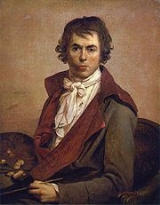
Jacques-Louis David

Encyclopedia
Jacques-Louis David (30 August 1748 – 29 December 1825) was an influential French
painter in the Neoclassical
style, considered to be the preeminent painter of the era. In the 1780s his cerebral brand of history painting
marked a change in taste away from Rococo
frivolity toward a classical austerity and severity, heightened feeling chiming with the moral climate of the final years of the Ancien Régime.
David later became an active supporter of the French Revolution
and friend of Maximilien Robespierre
(1758–1794), and was effectively a dictator of the arts under the French Republic
. Imprisoned after Robespierre's fall from power, he aligned himself with yet another political regime upon his release, that of Napoleon I
. It was at this time that he developed his Empire style, notable for its use of warm Venetian
colours. David had a huge number of pupils, making him the strongest influence in French art of the early 19th century, especially academic Salon
painting.
on 30 August 1748. When he was about nine his father was killed in a duel and his mother left him with his prosperous architect uncles. They saw to it that he received an excellent education at the Collège des Quatre-Nations
, but he was never a good student: he had a facial tumor that impeded his speech, and he was always preoccupied with drawing. He covered his notebooks with drawings, and he once said, "I was always hiding behind the instructor’s chair, drawing for the duration of the class". Soon, he desired to be a painter, but his uncles and mother wanted him to be an architect. He overcame the opposition, and went to learn from François Boucher
(1703–1770), the leading painter of the time, who was also a distant relative. Boucher was a Rococo
painter, but tastes were changing, and the fashion for Rococo was giving way to a more classical style. Boucher decided that instead of taking over David’s tutelage, he would send David to his friend Joseph-Marie Vien
(1716–1809), a painter who embraced the classical reaction to Rococo. There David attended the Royal Academy
, based in what is now the Louvre
.
David attempted to win the Prix de Rome
, an art scholarship to the French Academy in Rome
, five times. At each failure he became increasingly frustrated with the Academy for denying him the prize, and this dissatisfaction sowed the seeds of a long-standing grudge against the institution. Once, he lost according to legend because he had not consulted Vien, one of the judges. Another time, he lost because a few other students had been competing for years, and Vien felt David's education could wait for these other mediocre painters. In protest, he attempted to starve himself to death. Finally, in 1774, David won the Prix de Rome. Normally, he would have had to attend another school before attending the Academy in Rome, but Vien's influence kept him out of it. He went to Italy with Vien in 1775, as Vien had been appointed director of the French Academy at Rome
. While in Italy, David observed the Italian masterpieces and the ruins of ancient Rome. David filled twelve sketchbooks with material that he would derive from for the rest of his life. He met the influential early neoclassical painter Raphael Mengs (1728–1779), and through Mengs was introduced to the pathbreaking theories of art historian Johann Joachim Winckelmann
(1717–1768). While in Rome, he studied great masters, and came to favor above all others Raphael
. In 1779, David was able to see the ruins of Pompeii
, and was filled with wonder. After this, he sought to revolutionize the art world with the "eternal" concepts of classicism.
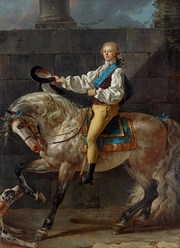 David's fellow students at the academy found him difficult to get along with, but they recognized his genius. David was allowed to stay at the French Academy in Rome for an extra year, but after 5 years in Rome, he returned to Paris. There, he found people ready to use their influence for him, and he was made a member of the Royal Academy. He sent the Academy two paintings, and both were included in the Salon
of 1781, a high honor. He was praised by his famous contemporary painters, but the administration of the Royal Academy was very hostile to this young upstart. After the Salon, the King granted David lodging in the Louvre, an ancient and much desired privilege of great artists. When the contractor of the King's buildings, M. Pécoul, was arranging with David, he asked the artist to marry his daughter, Marguerite Charlotte. This marriage brought him money and eventually four children. David had his own pupils, about 40 to 50, and was commissioned by the government to paint "Horace defended by his Father", but he soon decided, "Only in Rome can I paint Romans." His father-in-law provided the money he needed for the trip, and David headed for Rome with his wife and three of his students, one of whom, Jean-Germain Drouais (1763–1788), was the Prix de Rome winner of that year.
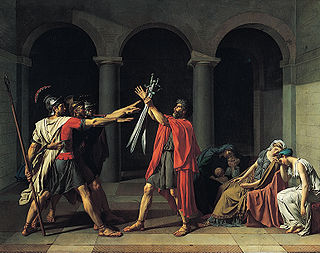
In Rome, David painted his famous Oath of the Horatii
, 1784. In this piece, the artist references Enlightenment
values while alluding to Rousseau’s social contract. The republican ideal of the general will becomes the focus of the painting with all three sons positioned in compliance with the father. The Oath between the characters can be read as an act of unification of men to the binding of the state. The issue of gender roles also becomes apparent in this piece, as the women in Horatii greatly contrast the group of brothers. David depicts the father with his back to the women, shutting them out of the oath making ritual; they also appear to be smaller in scale than the male figures. The masculine virility and discipline displayed by the men’s rigid and confident stances is also severely contrasted to the slouching, swooning female softness created in the other half of the composition. Here we see the clear division of male-female attributes which confined the sexes to specific roles, under Rousseau’s popular doctrines.
 These revolutionary ideals are also apparent in the Distribution of Eagles. While Oath of the Horatii and Oath of the Tennis Court stress the importance of masculine self-sacrifice for one's country and patriotism, the Distribution of Eagles would ask for self-sacrifice for one's Emperor (Napoleon) and the importance of battlefield glory.
In 1787, David did not become the Director of the French Academy in Rome, which was a position he wanted dearly. The Count in charge of the appointments said David was too young, but said he would support him in 6 to 12 years. This situation would be one of many that would cause him to lash out at the Academy in years to come.
 For the salon of 1787, David exhibited his famous Death of Socrates. "Condemned to death, Socrates, strong, calm and at peace, discusses the immortality of the soul. Surrounded by Crito, his grieving friends and students, he is teaching, philosophizing, and in fact, thanking the God of Health, Asclepius, for the hemlock
brew which will ensure a peaceful death... The wife of Socrates can be seen grieving alone outside the chamber, dismissed for her weakness. Plato is depicted as an old man seated at the end of the bed." Critics compared the Socrates with Michelangelo
’s Sistine Ceiling
and Raphael's Stanze, and one, after ten visits to the Salon, described it as "in every sense perfect". Denis Diderot
said it looked like he copied it from some ancient bas-relief. The painting was very much in tune with the political climate at the time. For this painting, David was not honored by a royal "works of encouragement".
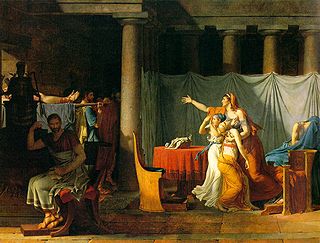 For his next painting, David created The Lictors Bring to Brutus the Bodies of His Sons
. The work had tremendous appeal for the time. Before the opening of the Salon, the French Revolution
had begun. The National Assembly
had been established, and the Bastille
had fallen. The royal court did not want propaganda agitating the people, so all paintings had to be checked before being hung. David’s portrait of Lavoisier
, who was a chemist and physicist as well as an active member of the Jacobin party, was banned by the authorities for such reasons. When the newspapers reported that the government had not allowed the showing of The Lictors Bring to Brutus the Bodies of His Sons, the people were outraged, and the royals were forced to give in. The painting was hung in the exhibition, protected by art students. The painting depicts Lucius Junius Brutus
, the Roman leader, grieving for his sons. Brutus's sons had attempted to overthrow the government and restore the monarchy, so the father ordered their death to maintain the republic. Thus, Brutus was the heroic defender of the republic, at the cost of his own family. On the right, the Mother holds her two daughters, and the grandmother is seen on the far right, in anguish. Brutus sits on the left, alone, brooding, seemingly dismissing the dead bodies of his sons. Knowing what he did was best for his country, but the tense posture of his feet and toes reveals his inner turmoil. The whole painting was a Republican symbol, and obviously had immense meaning during these times in France.
. While others were leaving the country for new and greater opportunities, David stayed to help destroy the old order; he was a regicide who voted in the National Convention for the Execution of Louis XVI
. It is uncertain why he did this, as there were many more opportunities for him under the King than the new order; some people suggest David's love for the classical made him embrace everything about that period, including a republican government.
Others believed that they found the key to the artist's revolutionary career in his personality. Undoubtedly, David's artistic sensibility, mercurial temperament, volatile emotions, ardent enthusiasm, and fierce independence might have been expected to help turn him against the established order but they did not fully explain his devotion to the republican regime. Nor did the vague statements of those who insisted upon his "powerful ambition... and unusual energy of will” actually account for his revolutionary connections. Those who knew him maintained that "generous ardor", high-minded idealism and well-meaning, though sometimes fanatical, enthusiasm rather than selfishness and jealousy, motivated his activities during this period.
Soon, David turned his critical sights on Royal Academy of Painting and Sculpture. This attack was probably caused primarily by the hypocrisy of the organization and their personal opposition against his work, as seen in previous episodes in David’s life. The Royal Academy was chock full of royalists, and David’s attempt to reform it did not go over well with the members. However, the deck was stacked against this symbol of the old regime, and the National Assembly ordered it to make changes to conform to the new constitution.
David then began work on something that would later hound him: propaganda for the new republic. David’s painting of Brutus was shown during the play Brutus, by the famous Frenchman, Voltaire
. The people responded in an uproar of approval.
In 1789, Jacques-Louis David attempted to leave his artistic mark on the historical beginnings of the French Revolution with his painting of The Oath of the Tennis Court
. David undertook this task not out of personal political conviction but rather because he was commissioned to do so. The painting was meant to commemorate the event of the same name but was never completed. A meeting of the Estates General was convened in May to address reforms of the monarchy. Dissent arose over whether the numerous members of the Third Estate would be counted by head or – following tradition – as one body. On June 17 the members of the Third Estate renamed themselves the National Assembly
. The new assembly decided that each individual would be counted by head and the members alone would levy taxes. Shortly thereafter, on June 20, the National Assembly attempted to meet but the chamber doors were locked and guarded by soldiers of the monarchy. Members of the new National Assembly convened at a nearby tennis court and vowed they would not be disbanded until they had created a constitution. In 1789 this event was seen as a symbol of the national unity against the ancien regime. David was enlisted by the Society of Friends of the Constitution, the body that would eventually form the Jacobins, to enshrine this symbolic event.
This instance is notable in more ways than one because it eventually led David to finally become involved in politics as he joined the Jacobins. The picture was meant to be massive in scale; the figures in the foreground were meant to be life-sized portraits of the counterparts, including Jean-Sylvain Bailly, the President of the Constituent Assembly. Seeking additional funding, David turned to the Society of Friends of the Constitution. The funding for the project was to come from over three thousand subscribers hoping to receive a print of the image. However, when the funding was insufficient, the state ended up financing the project.
David set out in 1790, to transform the contemporary event into a major historical picture, which would appear at the Salon of 1791 as a large pen and ink drawing. As in the Oath of the Horatii, David represents the unity of men in the service of a patriotic ideal. In what was essentially an act of intellect and reason, David creates an air of drama in this work. The very power of the people appears to be “blowing” through the scene with the stormy weather, in a sense alluding to the storm that would be the revolution.
Symbolism in this work of art closely represents the revolutionary events taking place at the time. The figure in the middle is raising his right arm making the oath that they will never disband until they have reached their goal of creating a “constitution of the realm fixed upon solid foundations.” The importance of this symbol is highlighted by the fact that the crowd’s arms are angled to his hand forming a triangular shape. Additionally, the open space in the top half contrasted to the commotion in the lower half serves to emphasize the magnitude of the Tennis Court Oath
.
In his attempt to depict political events of the Revolution in “real time,” David was venturing down a new and untrodden path in the art world. However, Thomas Crow
argues that this path “proved to be less a way forward than a cul-de-sac for history painting.” Essentially, the history of the demise of David’s The Tennis Court Oath illustrates the difficulty of creating works of art that portray current and controversial political occurrences. Political circumstances in France proved too volatile to allow the completion of the painting. The unity that was to be symbolized in The Tennis Court Oath no longer existed in radicalized 1792. The National Assembly had split between conservatives and radical Jacobins, both vying for political power. By 1792 there was no longer consensus that all the revolutionaries at the tennis court were “heroes.” A sizeable number of the heroes of 1789 had become the villains of 1792. In this unstable political climate David’s work remained unfinished. With only a few nude figures sketched onto the massive canvas, David abandoned The Oath of the Tennis Court. To have completed it would have been politically unsound. After this incident, when David attempted to make a political statement in his paintings, he returned to the less politically charged use of metaphor to convey his message.
When Voltaire died in 1778, the church denied him a church burial, and his body was interred near a monastery. A year later, Voltaire’s old friends began a campaign to have his body buried in the Panthéon
, as church property had been confiscated by the French Government. In 1791 David was appointed to head the organizing committee for the ceremony, a parade through the streets of Paris to the Panthéon. Despite rain, and opposition from conservatives based on the amount of money that was being spent, the procession went ahead. Up to 100,000 people watched the "Father of the Revolution" be carried to his resting place. This was the first of many large festivals organized by David for the republic. He went on to organize festivals for martyrs that died fighting royalists. These funerals echoed the religious festivals of the pagan Greeks and Romans and are seen by many as Saturnalian.
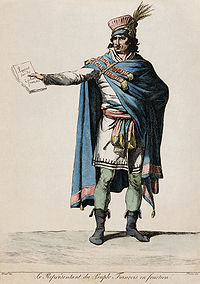 David incorporated many revolutionary symbols into these theatrical performances and orchestrated ceremonial rituals; in effect radicalizing the applied arts, themselves. The most popular symbol David was responsible for as propaganda minister, was drawn from classical Greek images; changing and transforming them with contemporary politics. In an elaborate festival held on the anniversary of the revolt that brought the monarchy to its knees, David’s Hercules figure was revealed in a procession following the lady Liberty (Marianne). Liberty, the symbol of Enlightenment ideals was here being overturned by the Hercules symbol; that of strength and passion for the protection of the Republic against disunity and factionalism. In his speech during the procession, David “explicitly emphasized the opposition between people and monarchy; Hercules was chosen, after all, to make this opposition more evident”. It was the ideals that David linked to his Hercules that single-handedly transformed the figure from a sign of the old regime into a powerful new symbol of revolution. “David turned him into the representation of a collective, popular power. He took one of the favorite signs of monarchy and reproduced, elevated, and monumentalized it into the sign of its opposite.” Hercules, the image, became to the revolutionaries, something to rally around.
In June 1791, the King made an ill-fated attempt to flee the country (flight to Varennes
), but was apprehended short of his goal on the Austrian Belgian border and was forced to return under guard to Paris. Louis XVI had made secret requests to Emperor Joseph II of Austria, Marie-Antoinette's brother, to restore him to his throne. This was granted and Austria threatened France if the royal couple were hurt. In reaction, the people arrested the King. This led to an Invasion after the trials and execution of Louis and Marie-Antoinette. The Bourbon monarchy was destroyed by the French people in 1792—it would be restored after Napoleon, then destroyed again with the Restoration of the House of Bonaparte. When the new National Convention held its first meeting, David was sitting with his friends Jean-Paul Marat
and Robespierre. In the Convention, David soon earned a nickname "ferocious terrorist". Soon, Robespierre’s agents discovered a secret vault of the king’s proving he was trying to overthrow the government, and demanded his execution. The National Convention held the trial of Louis XVI and David voted for the death of the King, which caused his wife, a royalist, to divorce him.
When Louis XVI was executed on 21 January 1793, another man had already died as well — Louis Michel le Peletier de Saint-Fargeau
. Le Peletier was killed on the preceding day by a royal bodyguard, in revenge for having voted the death of the King. David was called upon to organize a funeral, and he painted Le Peletier Assassinated. In it the assassin’s sword was seen hanging by a single strand of horsehair above Le Peletier's body, a concept inspired by the proverbial ancient tale of the sword of Damocles, which illustrated the insecurity of power and position. This underscored the courage displayed by Le Peletier and his companions in routing an oppressive king. The sword pierces a piece of paper on which is written ‘I vote the death of the tyrant’, and as a tribute at the bottom right of the picture David placed the inscription ‘David to Le Peletier. 20 January 1793’. The painting was later destroyed by Le Peletier's royalist daughter, and is known only by a drawing, an engraving, and contemporary accounts. Nevertheless, this work was important in David's career, because it was the first completed painting of the French Revolution, made in less than three months, and a work through which he initiated the regeneration process that would continue with The Death of Marat
, David's masterpiece.
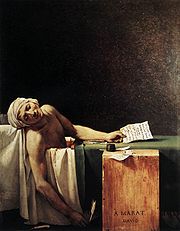 On 13 July 1793, David's friend Marat was assassinated by Charlotte Corday
with a knife she had hidden in her clothing. She gained entrance to Marat's house on the pretense of presenting him a list of people who should be executed as enemies of France. Marat thanked her and said that they would be guillotined next week upon which Corday immediately fatally stabbed him. She was guillotined shortly thereafter. Corday was of an opposing political party, whose name can be seen in the note Marat holds in David's subsequent painting, The Death of Marat
. Marat, a member of the National Assembly and a journalist, had a skin disease that caused him to itch horribly. The only relief he could get was in his bath over which he improvised a desk to write his list of suspect counter-revolutionaries who were to be quickly tried and, if convicted, guillotined. David once again organized a spectacular funeral, and Marat was buried in the Panthéon. Because Marat died in the bathtub
, writing, David wanted to have his body submerged in the bathtub during the funeral procession. This did not play out because the body had begun to putrefy. Instead, Marat’s body was periodically sprinkled with water as the people came to see his corpse, complete with gaping wound. The Death of Marat, perhaps David's most famous painting, has been called the Pietà
of the revolution. Upon presenting the painting to the convention, he said "Citizens, the people were again calling for their friend; their desolate voice was heard: David, take up your brushes.., avenge Marat... I heard the voice of the people. I obeyed." David had to work quickly, but the result was a simple and powerful image.
The Death of Marat, 1793, became the leading image of the Terror and immortalized both Marat, and David in the world of the revolution. This piece stands today as “a moving testimony to what can be achieved when an artist’s political convictions are directly manifested in his work". A political martyr was instantly created as David portrayed Marat with all the marks of the real murder, in a fashion which greatly resembles that of Christ or his disciples. The subject although realistically depicted remains lifeless in a rather supernatural composition. With the surrogate tombstone placed in front of him and the almost holy light cast upon the whole scene; alluding to an out of this world existence. “Atheists though they were, David and Marat, like so many other fervent social reformers of the modern world, seem to have created a new kind of religion.” At the very center of these beliefs, there stood the republic.
 After executing the King, war broke out between the new Republic and virtually every major power in Europe. David, as a member of the Committee of General Security
, contributed directly to the reign of Terror. The committee was severe. Marie Antoinette
went to the guillotine; an event recorded in a famous sketch by David. Portable guillotines killed failed generals, aristocrats, priests and perceived enemies. David organized his last festival: the festival of the Supreme Being. Robespierre had realized what a tremendous propaganda tool these festivals were, and he decided to create a new religion, mixing moral ideas with the republic, based on the ideas of Rousseau, with Robespierre as the new high priest. This process had already begun by confiscating church lands and requiring priests to take an oath to the state. The festivals, called fêtes, would be the method of indoctrination. On the appointed day, 20 Prairial by the revolutionary calendar
, Robespierre spoke, descended steps, and with a torch presented to him by David, incinerated a cardboard image symbolizing atheism, revealing an image of wisdom underneath. The festival hastened the "Incorruptible's" downfall.
Soon, the war began to go well; French troops marched across the southern half of the Netherlands
(which would later become Belgium
), and the emergency that had placed the Committee of Public Safety in control was no more. Then plotters seized Robespierre at the National Convention and he was later guillotined, in effect ending the reign of terror. As Robespierre was arrested, David yelled to his friend "if you drink hemlock, I shall drink it with you." After this, he supposedly fell ill, and did not attend the evening session because of "stomach pain", which saved him from being guillotined along with Robespierre. David was arrested and placed in prison. There he painted his own portrait, showing him much younger than he actually was, as well as that of his jailer.
. The Sabine Women Enforcing Peace by Running between the Combatants, also called The Intervention of the Sabine Women is said to have been painted to honor his wife, with the theme being love prevailing over conflict. The painting was also seen as a plea for the people to reunite after the bloodshed of the revolution.
David conceived a new style for this painting, one which he called the "Grecian style," as opposed to the "Roman style" of his earlier historical paintings. The new style was influenced heavily by the work of art historian Johann Joachim Winkelmann. In David's words, “the most prominent general characteristics of the Greek masterpieces are a noble simplicity and silent greatness in pose as well as in expression.”
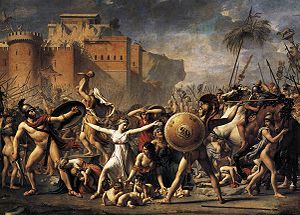 This work also brought him to the attention of Napoleon
. The story for the painting is as follows: "The Romans have abducted the daughters of their neighbors, the Sabines. To avenge this abduction, the Sabines attacked Rome, although not immediately—since Hersilia, the daughter of Tatius, the leader of the Sabines, had been married to Romulus
, the Roman leader, and then had two children by him in the interim. Here we see Hersilia between her father and husband as she adjures the warriors on both sides not to take wives away from their husbands or mothers away from their children. The other Sabine Women join in her exhortations." During this time, the martyrs of the revolution were taken from the Pantheon and buried in common ground, and revolutionary statues were destroyed. When he was finally released to the country, France had changed. His wife managed to get David released from prison, and he wrote letters to his former wife, and told her he never ceased loving her. He remarried her in 1796. Finally, wholly restored to his position, he retreated to his studio, took pupils and for the most part, retired from politics.
 In one of history's great coincidences, David's close association with the Committee of Public Safety during the Terror resulted in his signing of the death warrant for one Alexandre de Beauharnais, a minor noble. De Beauharnais's widow, Rose-Marie Josèphe de Tascher de Beauharnais
would later be known to the world as Joséphine Bonaparte, Empress of the French. It was her coronation by her husband, Napoleon I, that David depicted so memorably in the Coronation of Napoleon and Josephine, 2 December 1804.
David had been an admirer of Napoleon from their first meeting, struck by the then-General Bonaparte's classical features. Requesting a sitting from the busy and impatient general, David was able to sketch Napoleon in 1797. David recorded the conqueror of Italy's face, but the full composition of General Bonaparte holding the peace treaty with Austria remains unfinished. Napoleon had high esteem for David, and asked him to accompany him to Egypt
in 1798, but David refused, claiming he was too old for adventuring and sending instead his student, Antoine-Jean Gros
.
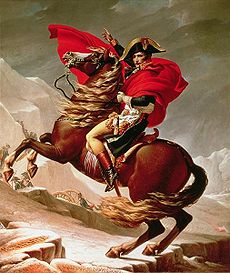
After Napoleon's successful coup d'état
in 1799, as First Consul he commissioned David to commemorate his daring crossing of the Alps. The crossing of the St. Bernard Pass had allowed the French to surprise the Austrian army and win victory at the Battle of Marengo on 14 June 1800. Although Napoleon had crossed the Alps on a mule, he requested that he be portrayed "calm upon a fiery steed". David complied with Napoleon Crossing the Saint-Bernard.
After the proclamation of the Empire in 1804, David became the official court painter
of the regime.
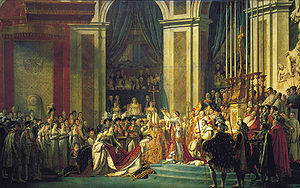 One of the works David was commissioned for was The Coronation of Napoleon in Notre Dame. David was permitted to watch the event. He had plans of Notre Dame
delivered and participants in the coronation came to his studio to pose individually, though never the Emperor (the only time David obtained a sitting from Napoleon had been in 1797). David did manage to get a private sitting with the Empress Josephine and Napoleon's sister, Caroline Murat
, through the intervention of erstwhile art patron, Marshal Joachim Murat
, the Emperor's brother-in-law. For his background, David had the choir of Notre Dame act as his fill-in characters. The Pope came to sit for the painting, and actually blessed David. Napoleon came to see the painter, stared at the canvas for an hour and said "David, I salute you". David had to redo several parts of the painting because of Napoleon's various whims, and for this painting, David received only 24,000 Francs.
 On the Bourbons
returning to power, David figured in the list of proscribed former revolutionaries and Bonapartists — for having voted execution for the deposed King Louis XVI; and for participating in the death of Louis XVII
. Mistreated and starved, the imprisoned Louis XVII was forced to confess to incest with his mother, Queen Marie-Antoinette, (untrue; separated early, son and mother were disallowed communication, nevertheless, the allegation helped earn her the guillotine). The new Bourbon King, Louis XVIII, however, granted amnesty to David and even offered him the position of court painter. David refused, preferring self-exile in Brussels. There, he trained and influenced Brussels artists like François-Joseph Navez
and Ignace Brice
, painted Cupid and Psyche and quietly lived the remainder of his life with his wife (whom he had remarried). In that time, he painted smaller-scale mythological scenes, and portraits of citizens of Brussels and Napoleonic émigrés, such as the Baron Gerard.
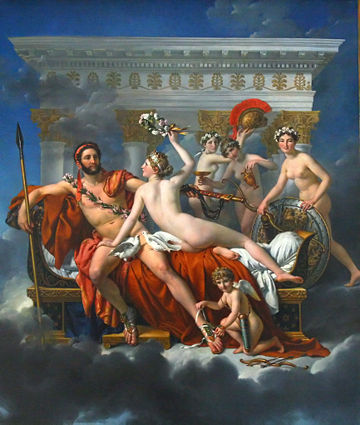
David created his last great work, Mars Being Disarmed by Venus and the Three Graces
, from 1822 to 1824. In December 1823, he wrote: "This is the last picture I want to paint, but I want to surpass myself in it. I will put the date of my seventy-five years on it and afterwards I will never again pick up my brush." The finished painting — evoking painted porcelain because of its limpid coloration — was exhibited first in Brussels, then in Paris, where his former students flocked to view it. The exhibition was profitable — 13,000 francs, after deducting operating costs, thus, more than 10,000 people visited and viewed the painting. In his later years, David remained in full command of his artistic faculties, even after a stroke in the spring of 1825 disfigured his face and slurred his speech. In June 1825, he resolved to embark on an improved version of his Anger of Achilles (also known as the Sacrifice of Iphigenie; the earlier version was completed in 1819 and is now in the collection of the Kimbell Art Museum, Fort Worth, Texas
. David remarked to his friends who visited his studio "this [painting] is what is killing me" such was his determination to complete the work, but by October it must have already been well advanced as his former pupil Gros wrote to congratulate him, having heard reports of the painting's merits. By the time David died, the painting had been completed and the commissioner Ambroise Firmin-Didot brought it back to Paris to include it in the exhibition "Pour les grecs" that he had organised and which opened in Paris in April 1826.
When David was leaving a theater, a carriage struck him, and he later died, on 29 December 1825. At his death, some portraits were auctioned in Paris, they sold for little; the famous Death of Marat was exhibited in a secluded room, to avoid outraging public sensibilities. Disallowed return to France for burial, for having been a regicide of King Louis XVI, the body of the painter Jacques-Louis David was buried at Brussels Cemetery, while his heart was buried at Père Lachaise, Paris.
incident. These left him with a noticeable asymmetry during facial expression and resulted in his difficulty in eating or speaking (he could not pronounce some consonants such as the letter 'r'). A sword scar wound on the left side of his face is present in his self-portrait and sculptures and corresponds to some of the buccal branches of the facial nerve. An injury to this nerve and its branches are likely to have resulted in the difficulties with his left facial movement.
Furthermore, as a result of this injury, he suffered from a growth on his face that biographers and art historians have defined as a “benign tumour” or “exostosis”. These however may have been a granuloma
, or even a post-traumatic neuroma
. As Simon Schama has pointed out, witty banter and public speaking ability were key aspects of the social culture of 18th century France. In light of these cultural keystones, David's tumor would have been a heavy obstacle in his social life. David was sometimes referred to as "David of the Tumor".
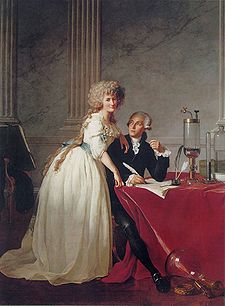
For example, in 1788, he painted a portrait of Antoine Lavoisier
and his wife.
 In the painting of Brutus (1789), the man and his wife are separated, both morally and physically. It was paintings like these, depicting the great strength of patriotic sacrifice, that made David a popular hero of the revolution.
In the Portrait of Antoine-Laurent Lavoisier and his wife
the man and his wife are tied together in an intimate pose. She leans on his shoulder while he pauses from his work to look up at her. David casts them in a soft light, not in the sharp contrast of Brutus or of the Horatii. Also of interest – Lavoisier was a tax collector, as well as a famous chemist. Though he spent some of his money trying to clean up swamps and eradicate malaria, he was nonetheless sent to the guillotine during the Reign of Terror as an enemy of the people. David, then a powerful member of the National Assembly, stood idly by and watched.
Other portraits include paintings of his sister-in-law and her husband, Madame and Monsieur Seriziat. The picture of Monsieur Seriziat depicts a man of wealth, sitting comfortably with his horse-riding equipment. The picture of the Madame shows her wearing an unadorned white dress, holding her young child's hand as they lean against a bed.
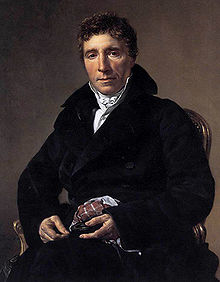
Towards the end of David's life, he painted a portrait of his old friend,Abbe Sieyès. Both had been involved in the revolution, both had survived the purging of political radicals that followed the reign of terror.
After Robespierre was sent to the guillotine, however, David was imprisoned and changed the attitude of his rhetoric. During his imprisonment he wrote many letters, pleading his innocence. In one, he apologized for his misconduct, writing, “I am prevented from returning to my atelier, which, alas, I should never have left. I believed that in accepting the most honorable position, but very difficult to fill, that of legislator, that a righteous heart would suffice, but I lacked the second quality, understanding.”
Later, while explaining his developing "Grecian style" for paintings such as The Intervention of the Sabine Women
, David further commented on a shift in attitude: “In all human activity the violent and transitory develops first; repose and profundity appear last. The recognition of these latter qualities requires time; only great masters have them, while their pupils have access only to violent passions.”
(Andrzej Wajda
, France, 1982) – Historical drama. Many scenes include David as a silent character watching and drawing. The film focuses on the period of the Terror.
France
The French Republic , The French Republic , The French Republic , (commonly known as France , is a unitary semi-presidential republic in Western Europe with several overseas territories and islands located on other continents and in the Indian, Pacific, and Atlantic oceans. Metropolitan France...
painter in the Neoclassical
Neoclassicism
Neoclassicism is the name given to Western movements in the decorative and visual arts, literature, theatre, music, and architecture that draw inspiration from the "classical" art and culture of Ancient Greece or Ancient Rome...
style, considered to be the preeminent painter of the era. In the 1780s his cerebral brand of history painting
History painting
History painting is a genre in painting defined by subject matter rather than an artistic style, depicting a moment in a narrative story, rather than a static subject such as a portrait...
marked a change in taste away from Rococo
Rococo
Rococo , also referred to as "Late Baroque", is an 18th-century style which developed as Baroque artists gave up their symmetry and became increasingly ornate, florid, and playful...
frivolity toward a classical austerity and severity, heightened feeling chiming with the moral climate of the final years of the Ancien Régime.
David later became an active supporter of the French Revolution
French Revolution
The French Revolution , sometimes distinguished as the 'Great French Revolution' , was a period of radical social and political upheaval in France and Europe. The absolute monarchy that had ruled France for centuries collapsed in three years...
and friend of Maximilien Robespierre
Maximilien Robespierre
Maximilien François Marie Isidore de Robespierre is one of the best-known and most influential figures of the French Revolution. He largely dominated the Committee of Public Safety and was instrumental in the period of the Revolution commonly known as the Reign of Terror, which ended with his...
(1758–1794), and was effectively a dictator of the arts under the French Republic
French First Republic
The French First Republic was founded on 22 September 1792, by the newly established National Convention. The First Republic lasted until the declaration of the First French Empire in 1804 under Napoleon I...
. Imprisoned after Robespierre's fall from power, he aligned himself with yet another political regime upon his release, that of Napoleon I
Napoleon I of France
Napoleon Bonaparte was a French military and political leader during the latter stages of the French Revolution.As Napoleon I, he was Emperor of the French from 1804 to 1815...
. It was at this time that he developed his Empire style, notable for its use of warm Venetian
Venetian school (art)
-Context:In the 15th century Venetian painting developed through influences from the Paduan School and Antonello da Messina, who introduced the oil painting technique of Early Netherlandish painting. It is typified by a warm colour scale and a picturesque use of colour...
colours. David had a huge number of pupils, making him the strongest influence in French art of the early 19th century, especially academic Salon
Paris Salon
The Salon , or rarely Paris Salon , beginning in 1725 was the official art exhibition of the Académie des Beaux-Arts in Paris, France. Between 1748–1890 it was the greatest annual or biannual art event in the Western world...
painting.
Early life
Jacques-Louis David was born into a prosperous family in ParisParis
Paris is the capital and largest city in France, situated on the river Seine, in northern France, at the heart of the Île-de-France region...
on 30 August 1748. When he was about nine his father was killed in a duel and his mother left him with his prosperous architect uncles. They saw to it that he received an excellent education at the Collège des Quatre-Nations
Collège des Quatre-Nations
The Collège des Quatre-Nations , also known as the Collège Mazarin after its founder, was one of the colleges of the historic University of Paris. It was founded through a bequest by the Cardinal Mazarin...
, but he was never a good student: he had a facial tumor that impeded his speech, and he was always preoccupied with drawing. He covered his notebooks with drawings, and he once said, "I was always hiding behind the instructor’s chair, drawing for the duration of the class". Soon, he desired to be a painter, but his uncles and mother wanted him to be an architect. He overcame the opposition, and went to learn from François Boucher
François Boucher
François Boucher was a French painter, a proponent of Rococo taste, known for his idyllic and voluptuous paintings on classical themes, decorative allegories representing the arts or pastoral occupations, intended as a sort of two-dimensional furniture...
(1703–1770), the leading painter of the time, who was also a distant relative. Boucher was a Rococo
Rococo
Rococo , also referred to as "Late Baroque", is an 18th-century style which developed as Baroque artists gave up their symmetry and became increasingly ornate, florid, and playful...
painter, but tastes were changing, and the fashion for Rococo was giving way to a more classical style. Boucher decided that instead of taking over David’s tutelage, he would send David to his friend Joseph-Marie Vien
Joseph-Marie Vien
Joseph-Marie Vien , French painter, was born at Montpellier. He was the last holder of the post of Premier peintre du Roi, serving from 1789 to 1791....
(1716–1809), a painter who embraced the classical reaction to Rococo. There David attended the Royal Academy
Académie de peinture et de sculpture
The Académie royale de peinture et de sculpture , Paris, was founded in 1648, modelled on Italian examples, such as the Accademia di San Luca in Rome. Paris already had the Académie de Saint-Luc, which was a city artist guild like any other Guild of Saint Luke...
, based in what is now the Louvre
Louvre
The Musée du Louvre – in English, the Louvre Museum or simply the Louvre – is one of the world's largest museums, the most visited art museum in the world and a historic monument. A central landmark of Paris, it is located on the Right Bank of the Seine in the 1st arrondissement...
.
David attempted to win the Prix de Rome
Prix de Rome
The Prix de Rome was a scholarship for arts students, principally of painting, sculpture, and architecture. It was created, initially for painters and sculptors, in 1663 in France during the reign of Louis XIV. It was an annual bursary for promising artists having proved their talents by...
, an art scholarship to the French Academy in Rome
Rome
Rome is the capital of Italy and the country's largest and most populated city and comune, with over 2.7 million residents in . The city is located in the central-western portion of the Italian Peninsula, on the Tiber River within the Lazio region of Italy.Rome's history spans two and a half...
, five times. At each failure he became increasingly frustrated with the Academy for denying him the prize, and this dissatisfaction sowed the seeds of a long-standing grudge against the institution. Once, he lost according to legend because he had not consulted Vien, one of the judges. Another time, he lost because a few other students had been competing for years, and Vien felt David's education could wait for these other mediocre painters. In protest, he attempted to starve himself to death. Finally, in 1774, David won the Prix de Rome. Normally, he would have had to attend another school before attending the Academy in Rome, but Vien's influence kept him out of it. He went to Italy with Vien in 1775, as Vien had been appointed director of the French Academy at Rome
French Academy in Rome
The French Academy in Rome is an Academy located in the Villa Medici, within the Villa Borghese, on the Pincio in Rome, Italy.-History:...
. While in Italy, David observed the Italian masterpieces and the ruins of ancient Rome. David filled twelve sketchbooks with material that he would derive from for the rest of his life. He met the influential early neoclassical painter Raphael Mengs (1728–1779), and through Mengs was introduced to the pathbreaking theories of art historian Johann Joachim Winckelmann
Johann Joachim Winckelmann
Johann Joachim Winckelmann was a German art historian and archaeologist. He was a pioneering Hellenist who first articulated the difference between Greek, Greco-Roman and Roman art...
(1717–1768). While in Rome, he studied great masters, and came to favor above all others Raphael
Raphael
Raffaello Sanzio da Urbino , better known simply as Raphael, was an Italian painter and architect of the High Renaissance. His work is admired for its clarity of form and ease of composition and for its visual achievement of the Neoplatonic ideal of human grandeur...
. In 1779, David was able to see the ruins of Pompeii
Pompeii
The city of Pompeii is a partially buried Roman town-city near modern Naples in the Italian region of Campania, in the territory of the comune of Pompei. Along with Herculaneum, Pompeii was destroyed and completely buried during a long catastrophic eruption of the volcano Mount Vesuvius spanning...
, and was filled with wonder. After this, he sought to revolutionize the art world with the "eternal" concepts of classicism.
Early work
Paris Salon
The Salon , or rarely Paris Salon , beginning in 1725 was the official art exhibition of the Académie des Beaux-Arts in Paris, France. Between 1748–1890 it was the greatest annual or biannual art event in the Western world...
of 1781, a high honor. He was praised by his famous contemporary painters, but the administration of the Royal Academy was very hostile to this young upstart. After the Salon, the King granted David lodging in the Louvre, an ancient and much desired privilege of great artists. When the contractor of the King's buildings, M. Pécoul, was arranging with David, he asked the artist to marry his daughter, Marguerite Charlotte. This marriage brought him money and eventually four children. David had his own pupils, about 40 to 50, and was commissioned by the government to paint "Horace defended by his Father", but he soon decided, "Only in Rome can I paint Romans." His father-in-law provided the money he needed for the trip, and David headed for Rome with his wife and three of his students, one of whom, Jean-Germain Drouais (1763–1788), was the Prix de Rome winner of that year.
In Rome, David painted his famous Oath of the Horatii
Oath of the Horatii
Oath of the Horatii , is a work by French artist Jacques-Louis David painted in 1784. It depicts a scene from a Roman legend about a dispute between two warring cities; Rome and Alba Longa, when three brothers from a Roman family, the Horatii, agree to end the war by fighting three brothers from an...
, 1784. In this piece, the artist references Enlightenment
Age of Enlightenment
The Age of Enlightenment was an elite cultural movement of intellectuals in 18th century Europe that sought to mobilize the power of reason in order to reform society and advance knowledge. It promoted intellectual interchange and opposed intolerance and abuses in church and state...
values while alluding to Rousseau’s social contract. The republican ideal of the general will becomes the focus of the painting with all three sons positioned in compliance with the father. The Oath between the characters can be read as an act of unification of men to the binding of the state. The issue of gender roles also becomes apparent in this piece, as the women in Horatii greatly contrast the group of brothers. David depicts the father with his back to the women, shutting them out of the oath making ritual; they also appear to be smaller in scale than the male figures. The masculine virility and discipline displayed by the men’s rigid and confident stances is also severely contrasted to the slouching, swooning female softness created in the other half of the composition. Here we see the clear division of male-female attributes which confined the sexes to specific roles, under Rousseau’s popular doctrines.
In 1787, David did not become the Director of the French Academy in Rome, which was a position he wanted dearly. The Count in charge of the appointments said David was too young, but said he would support him in 6 to 12 years. This situation would be one of many that would cause him to lash out at the Academy in years to come.
Conium
Conium is a genus of two species of highly poisonous perennial herbaceous flowering plants in the family Apiaceae, native to Europe and the Mediterranean region as Conium maculatum, and to southern Africa as Conium chaerophylloides....
brew which will ensure a peaceful death... The wife of Socrates can be seen grieving alone outside the chamber, dismissed for her weakness. Plato is depicted as an old man seated at the end of the bed." Critics compared the Socrates with Michelangelo
Michelangelo
Michelangelo di Lodovico Buonarroti Simoni , commonly known as Michelangelo, was an Italian Renaissance painter, sculptor, architect, poet, and engineer who exerted an unparalleled influence on the development of Western art...
’s Sistine Ceiling
Sistine Chapel
Sistine Chapel is the best-known chapel in the Apostolic Palace, the official residence of the Pope in Vatican City. It is famous for its architecture and its decoration that was frescoed throughout by Renaissance artists including Michelangelo, Sandro Botticelli, Pietro Perugino, Pinturicchio...
and Raphael's Stanze, and one, after ten visits to the Salon, described it as "in every sense perfect". Denis Diderot
Denis Diderot
Denis Diderot was a French philosopher, art critic, and writer. He was a prominent person during the Enlightenment and is best known for serving as co-founder and chief editor of and contributor to the Encyclopédie....
said it looked like he copied it from some ancient bas-relief. The painting was very much in tune with the political climate at the time. For this painting, David was not honored by a royal "works of encouragement".
The Lictors Bring to Brutus the Bodies of His Sons
The Lictors Bring to Brutus the Bodies of His Sons is a 1789 painting by the French painter Jacques-Louis David in the Neo-Classical manner.The work is housed in the Louvre in Paris....
. The work had tremendous appeal for the time. Before the opening of the Salon, the French Revolution
French Revolution
The French Revolution , sometimes distinguished as the 'Great French Revolution' , was a period of radical social and political upheaval in France and Europe. The absolute monarchy that had ruled France for centuries collapsed in three years...
had begun. The National Assembly
National Assembly (French Revolution)
During the French Revolution, the National Assembly , which existed from June 17 to July 9, 1789, was a transitional body between the Estates-General and the National Constituent Assembly.-Background:...
had been established, and the Bastille
Bastille
The Bastille was a fortress in Paris, known formally as the Bastille Saint-Antoine. It played an important role in the internal conflicts of France and for most of its history was used as a state prison by the kings of France. The Bastille was built in response to the English threat to the city of...
had fallen. The royal court did not want propaganda agitating the people, so all paintings had to be checked before being hung. David’s portrait of Lavoisier
Portrait of Antoine-Laurent Lavoisier and his wife
The Portrait of Antoine-Laurent Lavoisier and his wife is a double portrait of the French chemist Antoine Lavoisier and his wife and collaborator Marie-Anne Pierrette Paulze, commissioned from the French painter Jacques-Louis David in 1788 by Marie-Anne...
, who was a chemist and physicist as well as an active member of the Jacobin party, was banned by the authorities for such reasons. When the newspapers reported that the government had not allowed the showing of The Lictors Bring to Brutus the Bodies of His Sons, the people were outraged, and the royals were forced to give in. The painting was hung in the exhibition, protected by art students. The painting depicts Lucius Junius Brutus
Lucius Junius Brutus
Lucius Junius Brutus was the founder of the Roman Republic and traditionally one of the first consuls in 509 BC. He was claimed as an ancestor of the Roman gens Junia, including Marcus Junius Brutus, the most famous of Caesar's assassins.- Background :...
, the Roman leader, grieving for his sons. Brutus's sons had attempted to overthrow the government and restore the monarchy, so the father ordered their death to maintain the republic. Thus, Brutus was the heroic defender of the republic, at the cost of his own family. On the right, the Mother holds her two daughters, and the grandmother is seen on the far right, in anguish. Brutus sits on the left, alone, brooding, seemingly dismissing the dead bodies of his sons. Knowing what he did was best for his country, but the tense posture of his feet and toes reveals his inner turmoil. The whole painting was a Republican symbol, and obviously had immense meaning during these times in France.
The French Revolution
In the beginning, David was a supporter of the Revolution, a friend of Robespierre and a member of the Jacobin ClubJacobin Club
The Jacobin Club was the most famous and influential political club in the development of the French Revolution, so-named because of the Dominican convent where they met, located in the Rue St. Jacques , Paris. The club originated as the Club Benthorn, formed at Versailles from a group of Breton...
. While others were leaving the country for new and greater opportunities, David stayed to help destroy the old order; he was a regicide who voted in the National Convention for the Execution of Louis XVI
Louis XVI of France
Louis XVI was a Bourbon monarch who ruled as King of France and Navarre until 1791, and then as King of the French from 1791 to 1792, before being executed in 1793....
. It is uncertain why he did this, as there were many more opportunities for him under the King than the new order; some people suggest David's love for the classical made him embrace everything about that period, including a republican government.
Others believed that they found the key to the artist's revolutionary career in his personality. Undoubtedly, David's artistic sensibility, mercurial temperament, volatile emotions, ardent enthusiasm, and fierce independence might have been expected to help turn him against the established order but they did not fully explain his devotion to the republican regime. Nor did the vague statements of those who insisted upon his "powerful ambition... and unusual energy of will” actually account for his revolutionary connections. Those who knew him maintained that "generous ardor", high-minded idealism and well-meaning, though sometimes fanatical, enthusiasm rather than selfishness and jealousy, motivated his activities during this period.
Soon, David turned his critical sights on Royal Academy of Painting and Sculpture. This attack was probably caused primarily by the hypocrisy of the organization and their personal opposition against his work, as seen in previous episodes in David’s life. The Royal Academy was chock full of royalists, and David’s attempt to reform it did not go over well with the members. However, the deck was stacked against this symbol of the old regime, and the National Assembly ordered it to make changes to conform to the new constitution.
David then began work on something that would later hound him: propaganda for the new republic. David’s painting of Brutus was shown during the play Brutus, by the famous Frenchman, Voltaire
Voltaire
François-Marie Arouet , better known by the pen name Voltaire , was a French Enlightenment writer, historian and philosopher famous for his wit and for his advocacy of civil liberties, including freedom of religion, free trade and separation of church and state...
. The people responded in an uproar of approval.
In 1789, Jacques-Louis David attempted to leave his artistic mark on the historical beginnings of the French Revolution with his painting of The Oath of the Tennis Court
Tennis Court Oath
The Tennis Court Oath was a pivotal event during the first days of the French Revolution. The Oath was a pledge signed by 576 of the 577 members from the Third Estate who were locked out of a meeting of the Estates-General on 20 June 1789...
. David undertook this task not out of personal political conviction but rather because he was commissioned to do so. The painting was meant to commemorate the event of the same name but was never completed. A meeting of the Estates General was convened in May to address reforms of the monarchy. Dissent arose over whether the numerous members of the Third Estate would be counted by head or – following tradition – as one body. On June 17 the members of the Third Estate renamed themselves the National Assembly
National Assembly (French Revolution)
During the French Revolution, the National Assembly , which existed from June 17 to July 9, 1789, was a transitional body between the Estates-General and the National Constituent Assembly.-Background:...
. The new assembly decided that each individual would be counted by head and the members alone would levy taxes. Shortly thereafter, on June 20, the National Assembly attempted to meet but the chamber doors were locked and guarded by soldiers of the monarchy. Members of the new National Assembly convened at a nearby tennis court and vowed they would not be disbanded until they had created a constitution. In 1789 this event was seen as a symbol of the national unity against the ancien regime. David was enlisted by the Society of Friends of the Constitution, the body that would eventually form the Jacobins, to enshrine this symbolic event.
This instance is notable in more ways than one because it eventually led David to finally become involved in politics as he joined the Jacobins. The picture was meant to be massive in scale; the figures in the foreground were meant to be life-sized portraits of the counterparts, including Jean-Sylvain Bailly, the President of the Constituent Assembly. Seeking additional funding, David turned to the Society of Friends of the Constitution. The funding for the project was to come from over three thousand subscribers hoping to receive a print of the image. However, when the funding was insufficient, the state ended up financing the project.
David set out in 1790, to transform the contemporary event into a major historical picture, which would appear at the Salon of 1791 as a large pen and ink drawing. As in the Oath of the Horatii, David represents the unity of men in the service of a patriotic ideal. In what was essentially an act of intellect and reason, David creates an air of drama in this work. The very power of the people appears to be “blowing” through the scene with the stormy weather, in a sense alluding to the storm that would be the revolution.
Symbolism in this work of art closely represents the revolutionary events taking place at the time. The figure in the middle is raising his right arm making the oath that they will never disband until they have reached their goal of creating a “constitution of the realm fixed upon solid foundations.” The importance of this symbol is highlighted by the fact that the crowd’s arms are angled to his hand forming a triangular shape. Additionally, the open space in the top half contrasted to the commotion in the lower half serves to emphasize the magnitude of the Tennis Court Oath
Tennis Court Oath
The Tennis Court Oath was a pivotal event during the first days of the French Revolution. The Oath was a pledge signed by 576 of the 577 members from the Third Estate who were locked out of a meeting of the Estates-General on 20 June 1789...
.
In his attempt to depict political events of the Revolution in “real time,” David was venturing down a new and untrodden path in the art world. However, Thomas Crow
Thomas Crow
Thomas Crow may refer to:*Thomas E. Crow *Thomas S. Crow *Thomas Crow Hundley...
argues that this path “proved to be less a way forward than a cul-de-sac for history painting.” Essentially, the history of the demise of David’s The Tennis Court Oath illustrates the difficulty of creating works of art that portray current and controversial political occurrences. Political circumstances in France proved too volatile to allow the completion of the painting. The unity that was to be symbolized in The Tennis Court Oath no longer existed in radicalized 1792. The National Assembly had split between conservatives and radical Jacobins, both vying for political power. By 1792 there was no longer consensus that all the revolutionaries at the tennis court were “heroes.” A sizeable number of the heroes of 1789 had become the villains of 1792. In this unstable political climate David’s work remained unfinished. With only a few nude figures sketched onto the massive canvas, David abandoned The Oath of the Tennis Court. To have completed it would have been politically unsound. After this incident, when David attempted to make a political statement in his paintings, he returned to the less politically charged use of metaphor to convey his message.
When Voltaire died in 1778, the church denied him a church burial, and his body was interred near a monastery. A year later, Voltaire’s old friends began a campaign to have his body buried in the Panthéon
Panthéon, Paris
The Panthéon is a building in the Latin Quarter in Paris. It was originally built as a church dedicated to St. Genevieve and to house the reliquary châsse containing her relics but, after many changes, now functions as a secular mausoleum containing the remains of distinguished French citizens...
, as church property had been confiscated by the French Government. In 1791 David was appointed to head the organizing committee for the ceremony, a parade through the streets of Paris to the Panthéon. Despite rain, and opposition from conservatives based on the amount of money that was being spent, the procession went ahead. Up to 100,000 people watched the "Father of the Revolution" be carried to his resting place. This was the first of many large festivals organized by David for the republic. He went on to organize festivals for martyrs that died fighting royalists. These funerals echoed the religious festivals of the pagan Greeks and Romans and are seen by many as Saturnalian.
In June 1791, the King made an ill-fated attempt to flee the country (flight to Varennes
Flight to Varennes
The Flight to Varennes was a significant episode in the French Revolution during which King Louis XVI of France, his wife Marie Antoinette, and their immediate family attempted unsuccessfully to escape from Paris in order to initiate a counter-revolution...
), but was apprehended short of his goal on the Austrian Belgian border and was forced to return under guard to Paris. Louis XVI had made secret requests to Emperor Joseph II of Austria, Marie-Antoinette's brother, to restore him to his throne. This was granted and Austria threatened France if the royal couple were hurt. In reaction, the people arrested the King. This led to an Invasion after the trials and execution of Louis and Marie-Antoinette. The Bourbon monarchy was destroyed by the French people in 1792—it would be restored after Napoleon, then destroyed again with the Restoration of the House of Bonaparte. When the new National Convention held its first meeting, David was sitting with his friends Jean-Paul Marat
Jean-Paul Marat
Jean-Paul Marat , born in the Principality of Neuchâtel, was a physician, political theorist, and scientist best known for his career in France as a radical journalist and politician during the French Revolution...
and Robespierre. In the Convention, David soon earned a nickname "ferocious terrorist". Soon, Robespierre’s agents discovered a secret vault of the king’s proving he was trying to overthrow the government, and demanded his execution. The National Convention held the trial of Louis XVI and David voted for the death of the King, which caused his wife, a royalist, to divorce him.
When Louis XVI was executed on 21 January 1793, another man had already died as well — Louis Michel le Peletier de Saint-Fargeau
Louis Michel le Peletier de Saint-Fargeau
Louis-Michel le Peletier, marquis de Saint-Fargeau was a French politician.-Career:...
. Le Peletier was killed on the preceding day by a royal bodyguard, in revenge for having voted the death of the King. David was called upon to organize a funeral, and he painted Le Peletier Assassinated. In it the assassin’s sword was seen hanging by a single strand of horsehair above Le Peletier's body, a concept inspired by the proverbial ancient tale of the sword of Damocles, which illustrated the insecurity of power and position. This underscored the courage displayed by Le Peletier and his companions in routing an oppressive king. The sword pierces a piece of paper on which is written ‘I vote the death of the tyrant’, and as a tribute at the bottom right of the picture David placed the inscription ‘David to Le Peletier. 20 January 1793’. The painting was later destroyed by Le Peletier's royalist daughter, and is known only by a drawing, an engraving, and contemporary accounts. Nevertheless, this work was important in David's career, because it was the first completed painting of the French Revolution, made in less than three months, and a work through which he initiated the regeneration process that would continue with The Death of Marat
The Death of Marat
The Death of Marat is a 1793 painting in the Neoclassical style by Jacques-Louis David, and is one of the most famous images of the French Revolution. This work depicts the radical journalist Jean-Paul Marat lying dead in his bath on 13 July 1793 after his murder by Charlotte Corday...
, David's masterpiece.
Charlotte Corday
Marie-Anne Charlotte de Corday d'Armont , known to history as Charlotte Corday, was a figure of the French Revolution. In 1793, she was executed under the guillotine for the assassination of Jacobin leader Jean-Paul Marat, who was in part responsible, through his role as a politician and...
with a knife she had hidden in her clothing. She gained entrance to Marat's house on the pretense of presenting him a list of people who should be executed as enemies of France. Marat thanked her and said that they would be guillotined next week upon which Corday immediately fatally stabbed him. She was guillotined shortly thereafter. Corday was of an opposing political party, whose name can be seen in the note Marat holds in David's subsequent painting, The Death of Marat
The Death of Marat
The Death of Marat is a 1793 painting in the Neoclassical style by Jacques-Louis David, and is one of the most famous images of the French Revolution. This work depicts the radical journalist Jean-Paul Marat lying dead in his bath on 13 July 1793 after his murder by Charlotte Corday...
. Marat, a member of the National Assembly and a journalist, had a skin disease that caused him to itch horribly. The only relief he could get was in his bath over which he improvised a desk to write his list of suspect counter-revolutionaries who were to be quickly tried and, if convicted, guillotined. David once again organized a spectacular funeral, and Marat was buried in the Panthéon. Because Marat died in the bathtub
Bathtub
A bath , bathtub , or tub is a large container for holding water in which a person may bathe . Most modern bathtubs are made of acrylic or fiberglass, but alternatives are available in enamel over steel or cast iron, and occasionally waterproof finished wood...
, writing, David wanted to have his body submerged in the bathtub during the funeral procession. This did not play out because the body had begun to putrefy. Instead, Marat’s body was periodically sprinkled with water as the people came to see his corpse, complete with gaping wound. The Death of Marat, perhaps David's most famous painting, has been called the Pietà
Pietà
The Pietà is a subject in Christian art depicting the Virgin Mary cradling the dead body of Jesus, most often found in sculpture. As such, it is a particular form of the Lamentation of Christ, a scene from the Passion of Christ found in cycles of the Life of Christ...
of the revolution. Upon presenting the painting to the convention, he said "Citizens, the people were again calling for their friend; their desolate voice was heard: David, take up your brushes.., avenge Marat... I heard the voice of the people. I obeyed." David had to work quickly, but the result was a simple and powerful image.
The Death of Marat, 1793, became the leading image of the Terror and immortalized both Marat, and David in the world of the revolution. This piece stands today as “a moving testimony to what can be achieved when an artist’s political convictions are directly manifested in his work". A political martyr was instantly created as David portrayed Marat with all the marks of the real murder, in a fashion which greatly resembles that of Christ or his disciples. The subject although realistically depicted remains lifeless in a rather supernatural composition. With the surrogate tombstone placed in front of him and the almost holy light cast upon the whole scene; alluding to an out of this world existence. “Atheists though they were, David and Marat, like so many other fervent social reformers of the modern world, seem to have created a new kind of religion.” At the very center of these beliefs, there stood the republic.
Committee of General Security
The Committee of General Security was a French parliamentary committee which acted as police agency during the French Revolution that, along with the Committee of Public Safety, oversaw the Reign of Terror....
, contributed directly to the reign of Terror. The committee was severe. Marie Antoinette
Marie Antoinette
Marie Antoinette ; 2 November 1755 – 16 October 1793) was an Archduchess of Austria and the Queen of France and of Navarre. She was the fifteenth and penultimate child of Holy Roman Empress Maria Theresa and Holy Roman Emperor Francis I....
went to the guillotine; an event recorded in a famous sketch by David. Portable guillotines killed failed generals, aristocrats, priests and perceived enemies. David organized his last festival: the festival of the Supreme Being. Robespierre had realized what a tremendous propaganda tool these festivals were, and he decided to create a new religion, mixing moral ideas with the republic, based on the ideas of Rousseau, with Robespierre as the new high priest. This process had already begun by confiscating church lands and requiring priests to take an oath to the state. The festivals, called fêtes, would be the method of indoctrination. On the appointed day, 20 Prairial by the revolutionary calendar
French Republican Calendar
The French Republican Calendar or French Revolutionary Calendar was a calendar created and implemented during the French Revolution, and used by the French government for about 12 years from late 1793 to 1805, and for 18 days by the Paris Commune in 1871...
, Robespierre spoke, descended steps, and with a torch presented to him by David, incinerated a cardboard image symbolizing atheism, revealing an image of wisdom underneath. The festival hastened the "Incorruptible's" downfall.
Soon, the war began to go well; French troops marched across the southern half of the Netherlands
Netherlands
The Netherlands is a constituent country of the Kingdom of the Netherlands, located mainly in North-West Europe and with several islands in the Caribbean. Mainland Netherlands borders the North Sea to the north and west, Belgium to the south, and Germany to the east, and shares maritime borders...
(which would later become Belgium
Belgium
Belgium , officially the Kingdom of Belgium, is a federal state in Western Europe. It is a founding member of the European Union and hosts the EU's headquarters, and those of several other major international organisations such as NATO.Belgium is also a member of, or affiliated to, many...
), and the emergency that had placed the Committee of Public Safety in control was no more. Then plotters seized Robespierre at the National Convention and he was later guillotined, in effect ending the reign of terror. As Robespierre was arrested, David yelled to his friend "if you drink hemlock, I shall drink it with you." After this, he supposedly fell ill, and did not attend the evening session because of "stomach pain", which saved him from being guillotined along with Robespierre. David was arrested and placed in prison. There he painted his own portrait, showing him much younger than he actually was, as well as that of his jailer.
Post-revolution
After David’s wife visited him in jail, he conceived the idea of telling the story of the Sabine WomenSabine
The Sabines were an Italic tribe that lived in the central Appennines of ancient Italy, also inhabiting Latium north of the Anio before the founding of Rome...
. The Sabine Women Enforcing Peace by Running between the Combatants, also called The Intervention of the Sabine Women is said to have been painted to honor his wife, with the theme being love prevailing over conflict. The painting was also seen as a plea for the people to reunite after the bloodshed of the revolution.
David conceived a new style for this painting, one which he called the "Grecian style," as opposed to the "Roman style" of his earlier historical paintings. The new style was influenced heavily by the work of art historian Johann Joachim Winkelmann. In David's words, “the most prominent general characteristics of the Greek masterpieces are a noble simplicity and silent greatness in pose as well as in expression.”
Napoleon I of France
Napoleon Bonaparte was a French military and political leader during the latter stages of the French Revolution.As Napoleon I, he was Emperor of the French from 1804 to 1815...
. The story for the painting is as follows: "The Romans have abducted the daughters of their neighbors, the Sabines. To avenge this abduction, the Sabines attacked Rome, although not immediately—since Hersilia, the daughter of Tatius, the leader of the Sabines, had been married to Romulus
Romulus
- People:* Romulus and Remus, the mythical founders of Rome* Romulus Augustulus, the last Western Roman Emperor* Valerius Romulus , deified son of the Roman emperor Maxentius* Romulus , son of the Western Roman emperor Anthemius...
, the Roman leader, and then had two children by him in the interim. Here we see Hersilia between her father and husband as she adjures the warriors on both sides not to take wives away from their husbands or mothers away from their children. The other Sabine Women join in her exhortations." During this time, the martyrs of the revolution were taken from the Pantheon and buried in common ground, and revolutionary statues were destroyed. When he was finally released to the country, France had changed. His wife managed to get David released from prison, and he wrote letters to his former wife, and told her he never ceased loving her. He remarried her in 1796. Finally, wholly restored to his position, he retreated to his studio, took pupils and for the most part, retired from politics.
Napoleon
Joséphine de Beauharnais
Joséphine de Beauharnais was the first wife of Napoléon Bonaparte, and thus the first Empress of the French. Her first husband Alexandre de Beauharnais had been guillotined during the Reign of Terror, and she had been imprisoned in the Carmes prison until her release five days after Alexandre's...
would later be known to the world as Joséphine Bonaparte, Empress of the French. It was her coronation by her husband, Napoleon I, that David depicted so memorably in the Coronation of Napoleon and Josephine, 2 December 1804.
David had been an admirer of Napoleon from their first meeting, struck by the then-General Bonaparte's classical features. Requesting a sitting from the busy and impatient general, David was able to sketch Napoleon in 1797. David recorded the conqueror of Italy's face, but the full composition of General Bonaparte holding the peace treaty with Austria remains unfinished. Napoleon had high esteem for David, and asked him to accompany him to Egypt
Egypt
Egypt , officially the Arab Republic of Egypt, Arabic: , is a country mainly in North Africa, with the Sinai Peninsula forming a land bridge in Southwest Asia. Egypt is thus a transcontinental country, and a major power in Africa, the Mediterranean Basin, the Middle East and the Muslim world...
in 1798, but David refused, claiming he was too old for adventuring and sending instead his student, Antoine-Jean Gros
Antoine-Jean Gros
Baron Antoine-Jean Gros , also known as Jean-Antoine Gros, was both a French History and neoclassical painter.-Early life and training:...
.
After Napoleon's successful coup d'état
18 Brumaire
The coup of 18 Brumaire was the coup d'état by which General Napoleon Bonaparte overthrew the French Directory, replacing it with the French Consulate...
in 1799, as First Consul he commissioned David to commemorate his daring crossing of the Alps. The crossing of the St. Bernard Pass had allowed the French to surprise the Austrian army and win victory at the Battle of Marengo on 14 June 1800. Although Napoleon had crossed the Alps on a mule, he requested that he be portrayed "calm upon a fiery steed". David complied with Napoleon Crossing the Saint-Bernard.
Napoleon Crossing the Alps
Napoleon Crossing the Alps is the title given to the five versions of an oil on canvas equestrian portrait of Napoleon Bonaparte painted by the French artist Jacques-Louis David between 1801 and 1805...
After the proclamation of the Empire in 1804, David became the official court painter
Court painter
A court painter was an artist who painted for the members of a royal or noble family, sometimes on a fixed salary and on an exclusive basis where the artist was not supposed to undertake other work. Especially in the late Middle Ages, they were often given the office of valet de chambre...
of the regime.
Notre Dame de Paris
Notre Dame de Paris , also known as Notre Dame Cathedral, is a Gothic, Roman Catholic cathedral on the eastern half of the Île de la Cité in the fourth arrondissement of Paris, France. It is the cathedral of the Catholic Archdiocese of Paris: that is, it is the church that contains the cathedra of...
delivered and participants in the coronation came to his studio to pose individually, though never the Emperor (the only time David obtained a sitting from Napoleon had been in 1797). David did manage to get a private sitting with the Empress Josephine and Napoleon's sister, Caroline Murat
Caroline Bonaparte
Maria Annunziata Carolina Murat , better known as Caroline Bonaparte, was the seventh surviving child and third surviving daughter of Carlo Buonaparte and Letizia Ramolino and a younger sister of Napoleon I of France...
, through the intervention of erstwhile art patron, Marshal Joachim Murat
Joachim Murat
Joachim-Napoléon Murat , Marshal of France and Grand Admiral or Admiral of France, 1st Prince Murat, was Grand Duke of Berg from 1806 to 1808 and then King of Naples from 1808 to 1815...
, the Emperor's brother-in-law. For his background, David had the choir of Notre Dame act as his fill-in characters. The Pope came to sit for the painting, and actually blessed David. Napoleon came to see the painter, stared at the canvas for an hour and said "David, I salute you". David had to redo several parts of the painting because of Napoleon's various whims, and for this painting, David received only 24,000 Francs.
Exile and death
House of Bourbon
The House of Bourbon is a European royal house, a branch of the Capetian dynasty . Bourbon kings first ruled Navarre and France in the 16th century. By the 18th century, members of the Bourbon dynasty also held thrones in Spain, Naples, Sicily, and Parma...
returning to power, David figured in the list of proscribed former revolutionaries and Bonapartists — for having voted execution for the deposed King Louis XVI; and for participating in the death of Louis XVII
Louis XVII of France
Louis XVII , from birth to 1789 known as Louis-Charles, Duke of Normandy; then from 1789 to 1791 as Louis-Charles, Dauphin of France; and from 1791 to 1793 as Louis-Charles, Prince Royal of France, was the son of King Louis XVI of France and Queen Marie Antoinette...
. Mistreated and starved, the imprisoned Louis XVII was forced to confess to incest with his mother, Queen Marie-Antoinette, (untrue; separated early, son and mother were disallowed communication, nevertheless, the allegation helped earn her the guillotine). The new Bourbon King, Louis XVIII, however, granted amnesty to David and even offered him the position of court painter. David refused, preferring self-exile in Brussels. There, he trained and influenced Brussels artists like François-Joseph Navez
François-Joseph Navez
François-Joseph Navez was a Belgian neo-classical painter.A pupil of Jacques-Louis David, he spent five years in Italy between 1817 and 1822. Between 1835 and 1862 he was the director of the Académie Royale des Beaux-Arts in Brussels.He was a very successful portrait painter...
and Ignace Brice
Ignace Brice
Ignace Brice was a Belgian painter.-Family, marriage and issue:His father Antoine and his paternal grandfather Pierre-François were both also painters...
, painted Cupid and Psyche and quietly lived the remainder of his life with his wife (whom he had remarried). In that time, he painted smaller-scale mythological scenes, and portraits of citizens of Brussels and Napoleonic émigrés, such as the Baron Gerard.
David created his last great work, Mars Being Disarmed by Venus and the Three Graces
Mars being disarmed by Venus
Mars Being Disarmed by Venus is the last painting produced by the French artist Jacques-Louis David. He began it in 1822 during his exile in Brussels and completed it three years later, before dying in an accident in 1825. It is an impressive, ambitious, provocative and ironic work in which David...
, from 1822 to 1824. In December 1823, he wrote: "This is the last picture I want to paint, but I want to surpass myself in it. I will put the date of my seventy-five years on it and afterwards I will never again pick up my brush." The finished painting — evoking painted porcelain because of its limpid coloration — was exhibited first in Brussels, then in Paris, where his former students flocked to view it. The exhibition was profitable — 13,000 francs, after deducting operating costs, thus, more than 10,000 people visited and viewed the painting. In his later years, David remained in full command of his artistic faculties, even after a stroke in the spring of 1825 disfigured his face and slurred his speech. In June 1825, he resolved to embark on an improved version of his Anger of Achilles (also known as the Sacrifice of Iphigenie; the earlier version was completed in 1819 and is now in the collection of the Kimbell Art Museum, Fort Worth, Texas
Kimbell Art Museum
The Kimbell Art Museum in Fort Worth, Texas, hosts a small but excellent art collection as well as traveling art exhibitions, educational programs and an extensive research library. Its initial artwork came from the private collection of Kay and Velma Kimbell, who also provided funds for a new...
. David remarked to his friends who visited his studio "this [painting] is what is killing me" such was his determination to complete the work, but by October it must have already been well advanced as his former pupil Gros wrote to congratulate him, having heard reports of the painting's merits. By the time David died, the painting had been completed and the commissioner Ambroise Firmin-Didot brought it back to Paris to include it in the exhibition "Pour les grecs" that he had organised and which opened in Paris in April 1826.
When David was leaving a theater, a carriage struck him, and he later died, on 29 December 1825. At his death, some portraits were auctioned in Paris, they sold for little; the famous Death of Marat was exhibited in a secluded room, to avoid outraging public sensibilities. Disallowed return to France for burial, for having been a regicide of King Louis XVI, the body of the painter Jacques-Louis David was buried at Brussels Cemetery, while his heart was buried at Père Lachaise, Paris.
Medical analysis of his face
Jacques-Louis David’s facial abnormalities were traditionally reported to be a consequence of a deep facial sword wound after a fencingFencing
Fencing, which is also known as modern fencing to distinguish it from historical fencing, is a family of combat sports using bladed weapons.Fencing is one of four sports which have been featured at every one of the modern Olympic Games...
incident. These left him with a noticeable asymmetry during facial expression and resulted in his difficulty in eating or speaking (he could not pronounce some consonants such as the letter 'r'). A sword scar wound on the left side of his face is present in his self-portrait and sculptures and corresponds to some of the buccal branches of the facial nerve. An injury to this nerve and its branches are likely to have resulted in the difficulties with his left facial movement.
Furthermore, as a result of this injury, he suffered from a growth on his face that biographers and art historians have defined as a “benign tumour” or “exostosis”. These however may have been a granuloma
Granuloma
Granuloma is a medical term for a tiny collection of immune cells known as macrophages. Granulomas form when the immune system attempts to wall off substances that it perceives as foreign but is unable to eliminate. Such substances include infectious organisms such as bacteria and fungi as well as...
, or even a post-traumatic neuroma
Neuroma
A neuroma is a growth or tumor of nerve tissue. Just as the Latin word for swelling is now restricted to neoplasias, the equivalent Greek suffix -oma has shared in that fate. Thus, the typical modern usage of neuroma is for nerve tumors...
. As Simon Schama has pointed out, witty banter and public speaking ability were key aspects of the social culture of 18th century France. In light of these cultural keystones, David's tumor would have been a heavy obstacle in his social life. David was sometimes referred to as "David of the Tumor".
Portraiture
In addition to his history paintings, David completed a number of privately commissioned portraits. Warren Roberts, among others, has pointed out the contrast between David's "public style" of painting, as shown in his history paintings, and his "private style", as shown in his portraits.For example, in 1788, he painted a portrait of Antoine Lavoisier
Antoine Lavoisier
Antoine-Laurent de Lavoisier , the "father of modern chemistry", was a French nobleman prominent in the histories of chemistry and biology...
and his wife.
In the Portrait of Antoine-Laurent Lavoisier and his wife
Portrait of Antoine-Laurent Lavoisier and his wife
The Portrait of Antoine-Laurent Lavoisier and his wife is a double portrait of the French chemist Antoine Lavoisier and his wife and collaborator Marie-Anne Pierrette Paulze, commissioned from the French painter Jacques-Louis David in 1788 by Marie-Anne...
the man and his wife are tied together in an intimate pose. She leans on his shoulder while he pauses from his work to look up at her. David casts them in a soft light, not in the sharp contrast of Brutus or of the Horatii. Also of interest – Lavoisier was a tax collector, as well as a famous chemist. Though he spent some of his money trying to clean up swamps and eradicate malaria, he was nonetheless sent to the guillotine during the Reign of Terror as an enemy of the people. David, then a powerful member of the National Assembly, stood idly by and watched.
Other portraits include paintings of his sister-in-law and her husband, Madame and Monsieur Seriziat. The picture of Monsieur Seriziat depicts a man of wealth, sitting comfortably with his horse-riding equipment. The picture of the Madame shows her wearing an unadorned white dress, holding her young child's hand as they lean against a bed.
Towards the end of David's life, he painted a portrait of his old friend,Abbe Sieyès. Both had been involved in the revolution, both had survived the purging of political radicals that followed the reign of terror.
Shift in attitude
The shift in David's perspective played an important role in the paintings of David's later life, including this one of Sieyès. During the height of the reign of terror, David was an ardent supporter of radicals such as Robespierre and Marat, and twice offered up his life in their defense. He organized revolutionary festivals and painted portraits of martyrs of the revolution, such as Lepeletier, who was assassinated for voting for the death of the king. David was an impassioned speaker at times in the National Assembly. In speaking to the Assembly about the young boy named Bara, another martyr of the revolution, David said, “O Bara! O Viala! The blood that you have spread still smokes; it rises toward Heaven and cries for vengeance.”After Robespierre was sent to the guillotine, however, David was imprisoned and changed the attitude of his rhetoric. During his imprisonment he wrote many letters, pleading his innocence. In one, he apologized for his misconduct, writing, “I am prevented from returning to my atelier, which, alas, I should never have left. I believed that in accepting the most honorable position, but very difficult to fill, that of legislator, that a righteous heart would suffice, but I lacked the second quality, understanding.”
Later, while explaining his developing "Grecian style" for paintings such as The Intervention of the Sabine Women
The Intervention of the Sabine Women
The Intervention of the Sabine Women is a 1799 painting by the French painter Jacques-Louis David.The work was considered when Jacques-Louis David was imprisoned in the Luxembourg Palace in 1795; he hesitated between representing either this subject or that of Homer reciting his verses to the Greeks...
, David further commented on a shift in attitude: “In all human activity the violent and transitory develops first; repose and profundity appear last. The recognition of these latter qualities requires time; only great masters have them, while their pupils have access only to violent passions.”
Filmography
DantonDanton (1983 film)
Danton is a 1983 French language film depicting the last months of Georges Danton, one of the leaders of the French Revolution. It is an adaptation of the Polish play The Danton Case by Stanislawa Przybyszewska....
(Andrzej Wajda
Andrzej Wajda
Andrzej Wajda is a Polish film director. Recipient of an honorary Oscar, he is possibly the most prominent member of the unofficial "Polish Film School"...
, France, 1982) – Historical drama. Many scenes include David as a silent character watching and drawing. The film focuses on the period of the Terror.
External links
- A Closer Look at David's Consecration of Napoleon multimedia feature; Louvre museum official website
- The Intervention of the Sabines (Louvre museum)
- Web Gallery of Art
- www.jacqueslouisdavid.org 101 paintings by Jacques-Louis David
- Jacques-Louis David at Olga's Gallery
- Jacques-Louis David in the "History of Art"
- smARThistory: Death of Socrates
- Sterling and Francine Clark Art Institute 2005 exhibition, Jacques-Louis David: Empire to Exile
- The equestrian portrait of Stanislaw Kostka Potocki at the Wilanow Palace Museum