


Charlotte Corday

Encyclopedia
Marie-Anne Charlotte de Corday d'Armont (27 July 1768 – 17 July 1793), known to history as Charlotte Corday, was a figure of the French Revolution
. In 1793, she was executed under the guillotine
for the assassination of Jacobin
leader Jean-Paul Marat
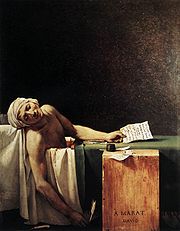
, who was in part responsible, through his role as a politician and journalist, for the more radical course the Revolution had taken. More specifically, he played a substantial role in the political purge of the Girondins, with whom Corday sympathized. His murder was memorialized in a celebrated painting by Jacques-Louis David
which shows Marat after Corday had stabbed him to death in his bathtub. In 1847, writer Alphonse de Lamartine
gave Corday the posthumous nickname l'ange de l'assassinat (the Angel of Assassination).
(Orne
), in Normandy, France, Charlotte Corday was a member of a minor aristocratic family. She was a fifth-generation matrilineal descendant of the dramatist Pierre Corneille
. Her parents were cousins.
While Charlotte was a young girl, her mother, Charlotte Marie Jacqueline Gaultier de Mesnival and her older sister died. Her father, Jacques François de Corday, seigneur d'Armont (1737–1798), unable to cope with his grief over their death, sent Charlotte and her younger sister to the Abbaye-aux-Dames
convent in Caen, where she had access to the abbey's library and first encountered the writings of Plutarch
, Rousseau and Voltaire
. After 1791, she lived in Caen with her cousin, Madame Le Coustellier de Bretteville-Gouville. The two developed a close relationship and Corday was the sole heir to her cousin's estate.
 Jean-Paul Marat
was a member of the radical Jacobin
faction which had a leading role during the Reign of Terror
. As a journalist, he exerted power and influence through his newspaper, L'Ami du peuple
("The Friend of the People").
Corday's decision to kill Marat was stimulated not only by her revulsion at the September Massacres
, for which she held Marat responsible, but for her fear of an all-out civil war. She believed that Marat was threatening the Republic, and that his death would end violence throughout the nation. She also believed that King Louis XVI
should not have been executed.
 On 9 July 1793, Corday left her cousin, carrying a copy of Plutarch
's Parallel Lives
, and went to Paris, where she took a room at the Hôtel de Providence. She bought a kitchen knife with a six-inch blade. She then wrote her Addresse aux Français amis des lois et de la paix ("Address to the French people, friends of Law and Peace") to explain her motives for assassinating Marat.
She went first to the National Assembly
to carry out her plan, but discovered that Marat no longer attended meetings. She went to Marat's home before noon on 13 July, claiming to have knowledge of a planned Girondist uprising in Caen
; she was turned away. On her return that evening, Marat admitted her. At the time, he conducted most of his affairs from a bathtub
because of a debilitating skin condition
. Marat wrote down the names of the Girondists that she gave to him, then she pulled out the knife and plunged it into his chest, piercing his lung
, aorta
and left ventricle
. He called out, Aidez-moi, ma chère amie! ("Help me, my dear friend!") and died.
This is the moment memorialised by Jacques-Louis David
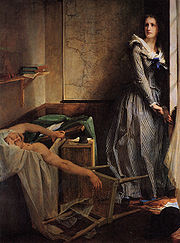
's painting (illustration, right). The iconic pose of Marat dead in his bath has been reviewed from a different angle in Baudry
's posthumous painting of 1860, both literally and interpretively: Corday, rather than Marat, has been made the hero of the action.
's words before the execution of King Louis XVI. On 17 July 1793, four days after Marat was killed, Corday was executed under the guillotine
and her corpse was disposed of in the Madeleine Cemetery
.
After her decapitation, a man named Legros lifted her head from the basket and slapped it on the cheek. Charles-Henri Sanson, the executioner, indignantly rejected published reports that Legros was one of his assistants. However, Sanson stated in his diary that Legros was in fact a carpenter who had been hired to make repairs to the guillotine. Witnesses report an expression of "unequivocal indignation" on her face when her cheek was slapped. This slap was considered unacceptable and Legros was imprisoned for three months because of his outburst.
Jacobin leaders had her body autopsied immediately after her death to see if she was a virgin
. They believed there was a man sharing her bed and the assassination plans. To their dismay, she was found to be virgo intacta (a virgin), a condition that focused more attention on women throughout France—laundresses, housewives, domestic servants—who were also rising up against authority after having been controlled by men for so long.
The assassination did not stop the Jacobins or the Terror: Marat became a martyr, and busts of him replaced crucifix
es and religious statues that had been banished under the new regime.
and lighten her hair. Although this story rapidly became popular in Paris at the time, there is no historical evidence to support that it actually happened. Part of the reason for the discrepancy in descriptions of Corday can be attributed to the stigma attached to powdered hair. At the time, only nobility and royalty ever powdered their hair, and in that time of violent anti-royalist revolt, such an association could be powerful in influencing popular opinion.
French Revolution
The French Revolution , sometimes distinguished as the 'Great French Revolution' , was a period of radical social and political upheaval in France and Europe. The absolute monarchy that had ruled France for centuries collapsed in three years...
. In 1793, she was executed under the guillotine
Guillotine
The guillotine is a device used for carrying out :executions by decapitation. It consists of a tall upright frame from which an angled blade is suspended. This blade is raised with a rope and then allowed to drop, severing the head from the body...
for the assassination of Jacobin
Jacobin Club
The Jacobin Club was the most famous and influential political club in the development of the French Revolution, so-named because of the Dominican convent where they met, located in the Rue St. Jacques , Paris. The club originated as the Club Benthorn, formed at Versailles from a group of Breton...
leader Jean-Paul Marat
Jean-Paul Marat
Jean-Paul Marat , born in the Principality of Neuchâtel, was a physician, political theorist, and scientist best known for his career in France as a radical journalist and politician during the French Revolution...
, who was in part responsible, through his role as a politician and journalist, for the more radical course the Revolution had taken. More specifically, he played a substantial role in the political purge of the Girondins, with whom Corday sympathized. His murder was memorialized in a celebrated painting by Jacques-Louis David
Jacques-Louis David
Jacques-Louis David was an influential French painter in the Neoclassical style, considered to be the preeminent painter of the era...
which shows Marat after Corday had stabbed him to death in his bathtub. In 1847, writer Alphonse de Lamartine
Alphonse de Lamartine
Alphonse Marie Louis de Prat de Lamartine was a French writer, poet and politician who was instrumental in the foundation of the Second Republic.-Career:...
gave Corday the posthumous nickname l'ange de l'assassinat (the Angel of Assassination).
Biography
Born in Saint-Saturnin-des-Ligneries, a hamlet in the commune of ÉcorchesÉcorches
Écorches is a commune in the Orne department in north-western France.-References:*...
(Orne
Orne
Orne is a department in the northwest of France, named after the river Orne.- History :Orne is one of the original 83 departments created during the French Revolution, on March 4, 1790. It was created from parts of the former provinces of Normandy and Perche.- Geography :Orne is in the region of...
), in Normandy, France, Charlotte Corday was a member of a minor aristocratic family. She was a fifth-generation matrilineal descendant of the dramatist Pierre Corneille
Pierre Corneille
Pierre Corneille was a French tragedian who was one of the three great seventeenth-century French dramatists, along with Molière and Racine...
. Her parents were cousins.
While Charlotte was a young girl, her mother, Charlotte Marie Jacqueline Gaultier de Mesnival and her older sister died. Her father, Jacques François de Corday, seigneur d'Armont (1737–1798), unable to cope with his grief over their death, sent Charlotte and her younger sister to the Abbaye-aux-Dames
Abbaye aux Dames
The Abbaye aux Dames is a former abbey in Caen, Normandy, northern France, now home to the Conseil Régional de Basse Normandie...
convent in Caen, where she had access to the abbey's library and first encountered the writings of Plutarch
Plutarch
Plutarch then named, on his becoming a Roman citizen, Lucius Mestrius Plutarchus , c. 46 – 120 AD, was a Greek historian, biographer, essayist, and Middle Platonist known primarily for his Parallel Lives and Moralia...
, Rousseau and Voltaire
Voltaire
François-Marie Arouet , better known by the pen name Voltaire , was a French Enlightenment writer, historian and philosopher famous for his wit and for his advocacy of civil liberties, including freedom of religion, free trade and separation of church and state...
. After 1791, she lived in Caen with her cousin, Madame Le Coustellier de Bretteville-Gouville. The two developed a close relationship and Corday was the sole heir to her cousin's estate.
Marat's assassination
Jean-Paul Marat
Jean-Paul Marat , born in the Principality of Neuchâtel, was a physician, political theorist, and scientist best known for his career in France as a radical journalist and politician during the French Revolution...
was a member of the radical Jacobin
Jacobin Club
The Jacobin Club was the most famous and influential political club in the development of the French Revolution, so-named because of the Dominican convent where they met, located in the Rue St. Jacques , Paris. The club originated as the Club Benthorn, formed at Versailles from a group of Breton...
faction which had a leading role during the Reign of Terror
Reign of Terror
The Reign of Terror , also known simply as The Terror , was a period of violence that occurred after the onset of the French Revolution, incited by conflict between rival political factions, the Girondins and the Jacobins, and marked by mass executions of "enemies of...
. As a journalist, he exerted power and influence through his newspaper, L'Ami du peuple
L'Ami du peuple
L'Ami du peuple was a newspaper written by Jean-Paul Marat during the French Revolution. “The most celebrated radical paper of the Revolution”, according to historian Jeremy D...
("The Friend of the People").
Corday's decision to kill Marat was stimulated not only by her revulsion at the September Massacres
September Massacres
The September Massacres were a wave of mob violence which overtook Paris in late summer 1792, during the French Revolution. By the time it had subsided, half the prison population of Paris had been executed: some 1,200 trapped prisoners, including many women and young boys...
, for which she held Marat responsible, but for her fear of an all-out civil war. She believed that Marat was threatening the Republic, and that his death would end violence throughout the nation. She also believed that King Louis XVI
Louis XVI of France
Louis XVI was a Bourbon monarch who ruled as King of France and Navarre until 1791, and then as King of the French from 1791 to 1792, before being executed in 1793....
should not have been executed.
Plutarch
Plutarch then named, on his becoming a Roman citizen, Lucius Mestrius Plutarchus , c. 46 – 120 AD, was a Greek historian, biographer, essayist, and Middle Platonist known primarily for his Parallel Lives and Moralia...
's Parallel Lives
Parallel Lives
Plutarch's Lives of the Noble Greeks and Romans, commonly called Parallel Lives or Plutarch's Lives, is a series of biographies of famous men, arranged in tandem to illuminate their common moral virtues or failings, written in the late 1st century...
, and went to Paris, where she took a room at the Hôtel de Providence. She bought a kitchen knife with a six-inch blade. She then wrote her Addresse aux Français amis des lois et de la paix ("Address to the French people, friends of Law and Peace") to explain her motives for assassinating Marat.
She went first to the National Assembly
National Assembly (French Revolution)
During the French Revolution, the National Assembly , which existed from June 17 to July 9, 1789, was a transitional body between the Estates-General and the National Constituent Assembly.-Background:...
to carry out her plan, but discovered that Marat no longer attended meetings. She went to Marat's home before noon on 13 July, claiming to have knowledge of a planned Girondist uprising in Caen
Caen
Caen is a commune in northwestern France. It is the prefecture of the Calvados department and the capital of the Basse-Normandie region. It is located inland from the English Channel....
; she was turned away. On her return that evening, Marat admitted her. At the time, he conducted most of his affairs from a bathtub
Bathtub
A bath , bathtub , or tub is a large container for holding water in which a person may bathe . Most modern bathtubs are made of acrylic or fiberglass, but alternatives are available in enamel over steel or cast iron, and occasionally waterproof finished wood...
because of a debilitating skin condition
Dermatitis herpetiformis
Dermatitis herpetiformis , or Duhring's disease,Freedberg, et al. . Fitzpatrick's Dermatology in General Medicine. . McGraw-Hill. ISBN 0-07-138076-0. is a chronic blistering skin condition, characterised by blisters filled with a watery fluid...
. Marat wrote down the names of the Girondists that she gave to him, then she pulled out the knife and plunged it into his chest, piercing his lung
Lung
The lung is the essential respiration organ in many air-breathing animals, including most tetrapods, a few fish and a few snails. In mammals and the more complex life forms, the two lungs are located near the backbone on either side of the heart...
, aorta
Aorta
The aorta is the largest artery in the body, originating from the left ventricle of the heart and extending down to the abdomen, where it branches off into two smaller arteries...
and left ventricle
Left ventricle
The left ventricle is one of four chambers in the human heart. It receives oxygenated blood from the left atrium via the mitral valve, and pumps it into the aorta via the aortic valve.-Shape:...
. He called out, Aidez-moi, ma chère amie! ("Help me, my dear friend!") and died.
This is the moment memorialised by Jacques-Louis David
Jacques-Louis David
Jacques-Louis David was an influential French painter in the Neoclassical style, considered to be the preeminent painter of the era...
's painting (illustration, right). The iconic pose of Marat dead in his bath has been reviewed from a different angle in Baudry
Paul-Jacques-Aimé Baudry
Paul-Jacques-Aimé Baudry was a French painter.-Biography:He studied under Michel Martin Drolling and carried off the Prix de Rome in 1850 by his picture of Zenobia found on the banks of the Araxes...
's posthumous painting of 1860, both literally and interpretively: Corday, rather than Marat, has been made the hero of the action.
Trial and execution
At her trial, Corday testified that she had carried out the assassination alone, saying "I killed one man to save 100,000." It was likely an allusion to Maximilien RobespierreMaximilien Robespierre
Maximilien François Marie Isidore de Robespierre is one of the best-known and most influential figures of the French Revolution. He largely dominated the Committee of Public Safety and was instrumental in the period of the Revolution commonly known as the Reign of Terror, which ended with his...
's words before the execution of King Louis XVI. On 17 July 1793, four days after Marat was killed, Corday was executed under the guillotine
Guillotine
The guillotine is a device used for carrying out :executions by decapitation. It consists of a tall upright frame from which an angled blade is suspended. This blade is raised with a rope and then allowed to drop, severing the head from the body...
and her corpse was disposed of in the Madeleine Cemetery
Madeleine Cemetery
Cimetière de la Madeleine is also the name of a cemetery in AmiensMadeleine Cemetery in French known as Cimetière de la Madeleine is a former cemetery in Paris, part of the land on which the Chapelle expiatoire now stands.-History and location:...
.
After her decapitation, a man named Legros lifted her head from the basket and slapped it on the cheek. Charles-Henri Sanson, the executioner, indignantly rejected published reports that Legros was one of his assistants. However, Sanson stated in his diary that Legros was in fact a carpenter who had been hired to make repairs to the guillotine. Witnesses report an expression of "unequivocal indignation" on her face when her cheek was slapped. This slap was considered unacceptable and Legros was imprisoned for three months because of his outburst.
Jacobin leaders had her body autopsied immediately after her death to see if she was a virgin
Virginity
Virginity refers to the state of a person who has never engaged in sexual intercourse. There are cultural and religious traditions which place special value and significance on this state, especially in the case of unmarried females, associated with notions of personal purity, honor and worth...
. They believed there was a man sharing her bed and the assassination plans. To their dismay, she was found to be virgo intacta (a virgin), a condition that focused more attention on women throughout France—laundresses, housewives, domestic servants—who were also rising up against authority after having been controlled by men for so long.
The assassination did not stop the Jacobins or the Terror: Marat became a martyr, and busts of him replaced crucifix
Crucifix
A crucifix is an independent image of Jesus on the cross with a representation of Jesus' body, referred to in English as the corpus , as distinct from a cross with no body....
es and religious statues that had been banished under the new regime.
Hair and controversy
Soon after her death, controversy arose surrounding the color of Corday's hair. Although her passport, filled out and signed by a Caen official, described her hair as chestnut brown, the painting "The Murder of Marat" by Jean-Jacques Hauer portrays Corday with powdered blonde hair. Following Corday's execution and the popularity of Hauer's painting, stories quickly spread about how Corday had hired a local coiffeur to straightenHair straightening
Hair straightening is a hair styling technique which involves the flattening and straightening of hair in order to give it a smooth, streamlined, and 'sleek' appearance. It may be accomplished by using hair irons and hot combs, chemical relaxers, Japanese hair straightening, or Brazilian hair...
and lighten her hair. Although this story rapidly became popular in Paris at the time, there is no historical evidence to support that it actually happened. Part of the reason for the discrepancy in descriptions of Corday can be attributed to the stigma attached to powdered hair. At the time, only nobility and royalty ever powdered their hair, and in that time of violent anti-royalist revolt, such an association could be powerful in influencing popular opinion.
Cultural references
- Percy Bysshe ShelleyPercy Bysshe ShelleyPercy Bysshe Shelley was one of the major English Romantic poets and is critically regarded as among the finest lyric poets in the English language. Shelley was famous for his association with John Keats and Lord Byron...
wrote about her in his Posthumous Fragments of Margaret Nicholson (1810). - Alphonse de LamartineAlphonse de LamartineAlphonse Marie Louis de Prat de Lamartine was a French writer, poet and politician who was instrumental in the foundation of the Second Republic.-Career:...
devoted to her a book of his Histoire des Girondins (1847), in which he gave her this now famous nickname: "l'ange de l'assassinat" (the angel of assassination). - Italian composer Lorenzo FerreroLorenzo FerreroLorenzo Ferrero is a contemporary Italian composer with a predilection for opera, a librettist, author, and book editor. He started composing at an early age and wrote over a hundred compositions thus far, including twelve operas, three ballets, and numerous orchestral, chamber music, solo...
(1951– ) composed an opera in three acts Charlotte Corday, which was premièred at Teatro dell'Opera di RomaTeatro dell'Opera di RomaThe Teatro dell'Opera di Roma is an opera house in Rome, Italy. Originally opened in November 1880 as the 2,212 seat Costanzi Theatre, it has undergone several changes of name as well modifications and improvements...
in February, 1989. - In Peter WeissPeter WeissPeter Ulrich Weiss was a German writer, painter, and artist of adopted Swedish nationality. He is particularly known for his plays Marat/Sade and The Investigation and his novel The Aesthetics of Resistance....
's Marat/SadeMarat/SadeThe Persecution and Assassination of Jean-Paul Marat as Performed by the Inmates of the Asylum of Charenton Under the Direction of the Marquis de Sade , almost invariably shortened to Marat/Sade, is a 1963 play by Peter Weiss...
, the assassination of Marat is presented as a play, written by the Marquis de SadeMarquis de SadeDonatien Alphonse François, Marquis de Sade was a French aristocrat, revolutionary politician, philosopher, and writer famous for his libertine sexuality and lifestyle...
, to be performed by inmates of the asylum at Charenton, for the public; the patient performing the role of Corday in the play-within-a-play (Glenda JacksonGlenda JacksonGlenda May Jackson, CBE is a British Labour Party politician and former actress. She has been a Member of Parliament since 1992, and currently represents Hampstead and Kilburn. She previously served as MP for Hampstead and Highgate...
in the stage production and subsequent film adaptationMarat/Sade (film)Marat/Sade is a 1967 adaptation of the Peter Weiss play, The Persecution and Assassination of Jean-Paul Marat as Performed by the Inmates of the Asylum of Charenton Under the Direction of the Marquis de Sade...
) is, somewhat ironically, a narcolepticNarcolepsyNarcolepsy is a chronic sleep disorder, or dyssomnia, characterized by excessive sleepiness and sleep attacks at inappropriate times, such as while at work. People with narcolepsy often experience disturbed nocturnal sleep and an abnormal daytime sleep pattern, which often is confused with insomnia...
. - American dramatist Sarah Pogson Smith (1774–1870) also memorialised Corday in her verse drama The Female Enthusiast: A Tragedy in Five Acts (1807).
- A minor character in P.G. Wodehouse's JeevesJeevesReginald Jeeves is a fictional character in the short stories and novels of P. G. Wodehouse, being the valet of Bertie Wooster . Created in 1915, Jeeves would continue to appear in Wodehouse's works until his final, completed, novel Aunts Aren't Gentlemen in 1974, making him Wodehouse's most famous...
series is named after Charlotte Corday. - British singer-songwriter Al StewartAl StewartAl Stewart is a Scottish singer-songwriter and folk-rock musician.Stewart came to stardom as part of the British folk revival in the 1960s and 1970s, and developed his own unique style of combining folk-rock songs with delicately woven tales of the great characters and events from history.He is...
included a song co-written by Tori AmosTori AmosTori Amos is an American pianist, singer-songwriter and composer. She was at the forefront of a number of female singer-songwriters in the early 1990s and was noteworthy early in her career as one of the few alternative rock performers to use a piano as her primary instrument...
about Corday on his album Famous Last Words (1993). - In Katherine Neville's novel The EightThe Eight (novel)The Eight, published December 27, 1988, is American author Katherine Neville's debut novel. Compared to the works of Umberto Eco when it first appeared, it is a postmodern thriller in which the heroine, accountant Catherine Velis, must enter into a cryptic world of danger and conspiracy in order to...
, Charlotte Corday changes place with the heroine Mireille, who kills Jean-Paul Marat for revenge. - French dramatist François PonsardFrançois PonsardFrançois Ponsard , was a French dramatist, poet and author and was a member of the Académie française.-Literary career:...
(1814–67) wrote a play, Charlotte Corday, which was premièred at the Théâtre-Français in March, 1850. - Charlotte appears briefly but significantly, in Caen, in A Far Better Rest, by Susanne Alleyn, a reimagining of A Tale of Two CitiesA Tale of Two CitiesA Tale of Two Cities is a novel by Charles Dickens, set in London and Paris before and during the French Revolution. With well over 200 million copies sold, it ranks among the most famous works in the history of fictional literature....
. - Drieu La Rochelle wrote a play in three acts called Charlotte Corday in 1939. In was performed in southern France during World War IIWorld War IIWorld War II, or the Second World War , was a global conflict lasting from 1939 to 1945, involving most of the world's nations—including all of the great powers—eventually forming two opposing military alliances: the Allies and the Axis...
. Corday is depicted as a fervent republican who hopes eliminating Marat will save the revolution and prevent it from degenerating into tyranny. - A novel by the English writer , tells Charlotte's story.
- The historical-fiction "My Bonny Light HorsemanMy Bonny Light HorsemanMy Bonny Light Horseman is the sixth novel in L. A. Meyer's series Bloody Jack. The series begins with Bloody Jack, Curse of the Blue Tattoo, Under the Jolly Roger, In the Belly of the Bloodhound , Mississippi Jack and is followed by Rapture of the Deep , and The Wake of the Lorelei Lee.-Plot...
", part of the Bloody Jack series by L.A. Meyer, references a Jean-Paul de Valdon, who claims to be the cousin of Charlotte Corday