

Oath of the Horatii

Encyclopedia
Oath of the Horatii
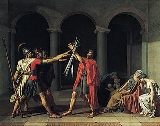
(French: Le Serment des Horaces), is a work by French artist Jacques-Louis David
painted in 1784. It depicts a scene from a Roman legend about a dispute between two warring cities; Rome
and Alba Longa
, when three brothers from a Roman family, the Horatii
, agree to end the war by fighting three brothers from an Alba Longa
family, the Curiatii. The three brothers, all of which appear willing to sacrifice their lives for the good of Rome
, are shown saluting their father who holds their swords out for them. The principal sources for the story behind David's Oath are the first book of Livy
(sections 24-6) which was elaborated by Dionysius
in book 3 of his Roman Antiquities. However, the moment depicted in David's painting is his own invention.
It grew to be considered a paradigm
of neoclassical
art. The painting increased David's fame, allowing him to rear his own students.
approached, paintings increasingly referred to the loyalty to the state rather than the family or the church. Although this picture was made nearly five years before the Revolution, the Oath of the Horatii became one of the images representing the time.
In 1789, David painted The Lictors Bring to Brutus the Bodies of His Sons
, a picture that was also a royal commission. Ironically, shortly after, the king would go up to the scaffold also accused of treason, as the sons of Brutus, and with the vote of the artist in the National Assembly, which supported the execution of Louis XVI.
family, who, according to Titus Livius' Ab Urbe Condita
(From the Founding of the City) had been chosen for a ritual duel against three members of the Curiatii, a family from Alba Longa
, in order to settle disputes between the Romans and the latter city. As revolution in France
loomed, paintings urging loyalty to the state rather than to clan or clergy abounded. Although it was painted nearly five years before the revolution in France, the Oath of the Horatii became one of the defining images of the time.
In the painting, the three brothers express their loyalty and solidarity with Rome before battle, wholly supported by their father. These are men willing to lay down their lives out of patriotic duty. With their resolute gaze and taut, outstretched limbs, they are citadels of patriotism. They are symbols of the highest virtues of Rome. Their clarity of purpose, mirrored by David's simple yet powerful use of tonal contrasts, lends the painting, and its message about the nobility of patriotic sacrifice, an electric intensity. This is all in contrast to the tender-hearted women who lie weeping and mourning, awaiting the results of the fighting.
The mother and sisters are shown clothed in silken garments seemingly melting into tender expressions of sorrow. Their despair is partly due to the fact that one sister was engaged to one of the Curiatii and another is a sister of the Curiatii, married to one of the Horatii. Upon defeat of the Curiatii, the remaining Horatius journeyed home to find his sister cursing Rome over the death of her fiancé. He killed her, horrified that Rome was being cursed. Originally David had intended to depict this episode, and a drawing survives showing the surviving Horatius raising his sword, with his sister lying dead. David later decided that this subject was too gruesome a way of sending the message of public duty overcoming private feeling, but his next major painting depicted a similar scene - Lucius Junius Brutus
brooding as the bodies of his sons, whose executions for treason he had ordered, are returned home.
The painting shows the three brothers on the left, the Horatii father in the center, and the sister/wives on the right. The Horatii brothers are depicted swearing upon (saluting) their swords as they take their oath. The men show no sense of emotion. Even the father, who holds up three swords, shows no emotion. On the right, three women are weeping -- one in the back and two up closer. The woman dressed in the white is a Horatius weeping for both her Curiatii fiancé and her brother; the one dressed in brown is a Curiatius who weeps for her Horatii husband and her brother. The background woman in black holds two children -- one of whom is the child of a Horatius male and his Curiatii wife. The younger daughter hides her face in her nanny’s dress as the son refuses to have his eyes shielded.
According to Thomas Le Claire:
art style, and employs various techniques that were typical for it:
David's painting also inspired artists in later generations such as William Sidney Mount
in his School Boys Quarreling.
Horatii
According to Livy, the Horatii were male triplets from Rome. During a war between Rome and Alba Longa during the reign of Tullus Hostilius , it was agreed that settlement of the war would depend on the outcome of a battle between the Horatii and the Curiatii...
(French: Le Serment des Horaces), is a work by French artist Jacques-Louis David
Jacques-Louis David
Jacques-Louis David was an influential French painter in the Neoclassical style, considered to be the preeminent painter of the era...
painted in 1784. It depicts a scene from a Roman legend about a dispute between two warring cities; Rome
Roman Kingdom
The Roman Kingdom was the period of the ancient Roman civilization characterized by a monarchical form of government of the city of Rome and its territories....
and Alba Longa
Alba Longa
Alba Longa – in Italian sources occasionally written Albalonga – was an ancient city of Latium in central Italy southeast of Rome in the Alban Hills. Founder and head of the Latin League, it was destroyed by Rome around the middle of the 7th century BC. In legend, Romulus and Remus, founders of...
, when three brothers from a Roman family, the Horatii
Horatii
According to Livy, the Horatii were male triplets from Rome. During a war between Rome and Alba Longa during the reign of Tullus Hostilius , it was agreed that settlement of the war would depend on the outcome of a battle between the Horatii and the Curiatii...
, agree to end the war by fighting three brothers from an Alba Longa
Alba Longa
Alba Longa – in Italian sources occasionally written Albalonga – was an ancient city of Latium in central Italy southeast of Rome in the Alban Hills. Founder and head of the Latin League, it was destroyed by Rome around the middle of the 7th century BC. In legend, Romulus and Remus, founders of...
family, the Curiatii. The three brothers, all of which appear willing to sacrifice their lives for the good of Rome
Roman Kingdom
The Roman Kingdom was the period of the ancient Roman civilization characterized by a monarchical form of government of the city of Rome and its territories....
, are shown saluting their father who holds their swords out for them. The principal sources for the story behind David's Oath are the first book of Livy
Livy
Titus Livius — known as Livy in English — was a Roman historian who wrote a monumental history of Rome and the Roman people. Ab Urbe Condita Libri, "Chapters from the Foundation of the City," covering the period from the earliest legends of Rome well before the traditional foundation in 753 BC...
(sections 24-6) which was elaborated by Dionysius
Dionysius
The Graeco-Roman name Dionysius, deriving from the name of the Thracian god Dionysus, was exceedingly common, and many ancient people, famous and otherwise, bore it. It remains a common name today in the form Dennis . The modern Greek form of the name is Dionysios or Dionysis. The Spanish form of...
in book 3 of his Roman Antiquities. However, the moment depicted in David's painting is his own invention.
It grew to be considered a paradigm
Paradigm
The word paradigm has been used in science to describe distinct concepts. It comes from Greek "παράδειγμα" , "pattern, example, sample" from the verb "παραδείκνυμι" , "exhibit, represent, expose" and that from "παρά" , "beside, beyond" + "δείκνυμι" , "to show, to point out".The original Greek...
of neoclassical
Neoclassicism
Neoclassicism is the name given to Western movements in the decorative and visual arts, literature, theatre, music, and architecture that draw inspiration from the "classical" art and culture of Ancient Greece or Ancient Rome...
art. The painting increased David's fame, allowing him to rear his own students.
Commissioning the work
In 1774, David won the Prix de Rome with his work Érasistrate découvrant la cause de la maladie d’Antiochius. This allowed him to stay five years(1775-1780) in Rome as a student from the French government. Upon his return to Paris he show his exhibition, in which Diderot worshipped his paintings; the success was so resounding that King Louis XVI of France allowed him to stay in the Louvre, a very ancient privilege desired by artists. There he met Pecoul, contractor for the actual buildings, and Pecoul's daughter, whom he married. The king made him work on the Oath of the Horatii, with the intention that it be an allegory about loyalty to the state and therefore to the king. As the French RevolutionFrench Revolution
The French Revolution , sometimes distinguished as the 'Great French Revolution' , was a period of radical social and political upheaval in France and Europe. The absolute monarchy that had ruled France for centuries collapsed in three years...
approached, paintings increasingly referred to the loyalty to the state rather than the family or the church. Although this picture was made nearly five years before the Revolution, the Oath of the Horatii became one of the images representing the time.
In 1789, David painted The Lictors Bring to Brutus the Bodies of His Sons
The Lictors Bring to Brutus the Bodies of His Sons
The Lictors Bring to Brutus the Bodies of His Sons is a 1789 painting by the French painter Jacques-Louis David in the Neo-Classical manner.The work is housed in the Louvre in Paris....
, a picture that was also a royal commission. Ironically, shortly after, the king would go up to the scaffold also accused of treason, as the sons of Brutus, and with the vote of the artist in the National Assembly, which supported the execution of Louis XVI.
Symbolic theme
The painting depicts the Roman HoratiusHoratius
Horatius is the nomen of the Roman gens Horatia. Some of its members were:* The Horatii, three members of the Horatia gens who fought to the death against the Curiatii during the reign of Tullus Hostilius.* Marcus Horatius M. f...
family, who, according to Titus Livius' Ab Urbe Condita
Ab Urbe condita (book)
Ab urbe condita libri — often shortened to Ab urbe condita — is a monumental history of ancient Rome written in Latin sometime between 27 and 25 BC by the historian Titus Livius. The work covers the time from the stories of Aeneas, the earliest legendary period from before the city's founding in c....
(From the Founding of the City) had been chosen for a ritual duel against three members of the Curiatii, a family from Alba Longa
Alba Longa
Alba Longa – in Italian sources occasionally written Albalonga – was an ancient city of Latium in central Italy southeast of Rome in the Alban Hills. Founder and head of the Latin League, it was destroyed by Rome around the middle of the 7th century BC. In legend, Romulus and Remus, founders of...
, in order to settle disputes between the Romans and the latter city. As revolution in France
French Revolution
The French Revolution , sometimes distinguished as the 'Great French Revolution' , was a period of radical social and political upheaval in France and Europe. The absolute monarchy that had ruled France for centuries collapsed in three years...
loomed, paintings urging loyalty to the state rather than to clan or clergy abounded. Although it was painted nearly five years before the revolution in France, the Oath of the Horatii became one of the defining images of the time.
In the painting, the three brothers express their loyalty and solidarity with Rome before battle, wholly supported by their father. These are men willing to lay down their lives out of patriotic duty. With their resolute gaze and taut, outstretched limbs, they are citadels of patriotism. They are symbols of the highest virtues of Rome. Their clarity of purpose, mirrored by David's simple yet powerful use of tonal contrasts, lends the painting, and its message about the nobility of patriotic sacrifice, an electric intensity. This is all in contrast to the tender-hearted women who lie weeping and mourning, awaiting the results of the fighting.
The mother and sisters are shown clothed in silken garments seemingly melting into tender expressions of sorrow. Their despair is partly due to the fact that one sister was engaged to one of the Curiatii and another is a sister of the Curiatii, married to one of the Horatii. Upon defeat of the Curiatii, the remaining Horatius journeyed home to find his sister cursing Rome over the death of her fiancé. He killed her, horrified that Rome was being cursed. Originally David had intended to depict this episode, and a drawing survives showing the surviving Horatius raising his sword, with his sister lying dead. David later decided that this subject was too gruesome a way of sending the message of public duty overcoming private feeling, but his next major painting depicted a similar scene - Lucius Junius Brutus
Lucius Junius Brutus
Lucius Junius Brutus was the founder of the Roman Republic and traditionally one of the first consuls in 509 BC. He was claimed as an ancestor of the Roman gens Junia, including Marcus Junius Brutus, the most famous of Caesar's assassins.- Background :...
brooding as the bodies of his sons, whose executions for treason he had ordered, are returned home.
The painting shows the three brothers on the left, the Horatii father in the center, and the sister/wives on the right. The Horatii brothers are depicted swearing upon (saluting) their swords as they take their oath. The men show no sense of emotion. Even the father, who holds up three swords, shows no emotion. On the right, three women are weeping -- one in the back and two up closer. The woman dressed in the white is a Horatius weeping for both her Curiatii fiancé and her brother; the one dressed in brown is a Curiatius who weeps for her Horatii husband and her brother. The background woman in black holds two children -- one of whom is the child of a Horatius male and his Curiatii wife. The younger daughter hides her face in her nanny’s dress as the son refuses to have his eyes shielded.
According to Thomas Le Claire:
Symbolic technique
This painting shows the neoclassicalNeoclassicism
Neoclassicism is the name given to Western movements in the decorative and visual arts, literature, theatre, music, and architecture that draw inspiration from the "classical" art and culture of Ancient Greece or Ancient Rome...
art style, and employs various techniques that were typical for it:
- The background is de-emphasized, while the figures in the foreground are emphasized to show their importance.
- The use of dull colors is to show the importance of the story behind the painting over the painting itself.
- The picture is clearly organized, depicting the symbolism of the number three and of the moment itself.
- The focus on clear, hard details and the lack of use of the more wispy brushstrokes preferred by RococoRococoRococo , also referred to as "Late Baroque", is an 18th-century style which developed as Baroque artists gave up their symmetry and became increasingly ornate, florid, and playful...
art. - The brushstrokes are invisible, to show that the painting is more important compared to the artist
- The men are all depicted with straight lines mirroring the columns in the background signifying their rigidity and strength while the women are all curved like the arches which are held up by the columns.
- The use of straight lines to depict strength is also demonstrated in the swords, two of which are curved while one is straight foreshadowing that only one brother would survive the encounter.
- The brother closest to the viewer (presumably destined to be the sole survivor) is dressed in colors matching that of the father while the garb of the other brothers is obscured but seems to mimic the colors being worn by the women.
- The frozen quality of the painting is also intended to emphasize rationality, unlike the Rococo style.
- The only emotion shown is from the women, who were allowed to feel, while it was for the men to do their duty with heroic determination.
- The fact that it also depicts a morally complex or disturbing story lends to its classification as a neoclassical work.
Reception
When the royalty, churchmen, and aristocrats went to view the painting, they eulogised it; the Pope himself expressed his desire to view The Oath of the Horatii. David wanted the painting exhibited in the Salon, but it was delivered late, and enemies of him at the Academy took advantage to exhibit it in a poor locale in the gallery. In the event, public dissatisfaction with the poor viewing conditions obliged the gallery to move the painting to a site proper for viewing the painting; moreover, David held The Oath of the Horatii on exhibit for some extra weeks, to permit reporters to write about all of the paintings exhibited, not just his.David's painting also inspired artists in later generations such as William Sidney Mount
William Sidney Mount
William Sidney Mount was an American genre painter and contemporary of the Hudson River School.-Biography:...
in his School Boys Quarreling.