

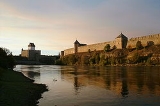
Narva River

Encyclopedia
The Narva is a river flowing into the Baltic Sea
, the largest river in Estonia. Draining Lake Peipsi, the river forms the border of Estonia and Russia and flows through the towns of Narva
/Ivangorod
and Narva-Jõesuu
into Narva Bay
. Though the river is only 77 km long, in terms of volume discharged it is the second largest river flowing into the Finnish Gulf
. The river gives its name to the Narva culture
and the city of Narva
.
(Estonia) and Skamya (Russia). There are a few more small villages on the upper section of the river, for example Permisküla and Kuningaküla on the Estonian side and Omuti on the Russian side, but up to the city of Narva
the shores of the river are mostly forested or marshy. The river is dammed entering Narva and Ivangorod, forming the Narva Reservoir
, which extends up to 38 km upstream. Narva flows into Narva Bay
near the Estonian town of Narva-Jõesuu
, third largest settlement on the river after Narva and Ivangorod.
The River Plyussa is the largest tributary, joining Narva at the Narva Reservoir.
, forming the Narva Waterfall, once among the most powerful in Europe. As before the falls the island of Kreenholm
divides the river into two branches, thus the falls consist of two sections: Kreenholm Falls to the west of the island (60 m in width, 6.5 m high with multiple terraces) and Joala Falls to the east (110 m in width, up to 6.5 m high). The Estonian-Russian border follows the eastern branch and goes through Joala Falls.
Since the damming of the river in 1955 the waterfalls are usually dry, but water is allowed to flow in the original channel for up to a few days every year. Access to the waterfalls is difficult as they are located in the border zone and the surrounding area on the Estonian side is closed industrial land belonging to Krenholm Manufacture.
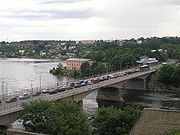 The Narva River is crossed only by a handful of bridges between Narva and Ivangorod. Besides the dam of the Narva Reservoir, these are, in downstream order:
, from 5th to 11th century. It was an offshoot of the trade route from the Varangians to the Greeks
.
Narva has for centuries been an important border river. Beginning in the 13th century it was the border of Medieval Livonia and the Novgorod Republic
. Though in earlier periods Narva was part of a larger buffer zone between the two territories, gradually the river emerged as the exact border. Castles built on the river banks (Narva Hermann Castle
, founded at the beginning of 14th century, Ivangorod fortress
, established in 1492 and Vasknarva Castle, first built in the 14th century) were one of the main reasons behind this. Treaties from the 15th century between the Livonian Order
and Novgorod Republic also recognize Narva River as the border. During the time of Swedish Estonia
, when Ingria
was also part of Sweden, the importance of the river as a border diminished. During the Russian Empire
, from the end of the Great Northern War
until the establishment of the Republic of Estonia in 1918, the Narva River was the border of Governorate of Estonia
and Saint Petersburg Governorate
, with the exception of the town of Narva
, which was part of the latter. By the Treaty of Tartu
, signed in 1920, the Estonian-Russian
border went slightly east of the river, up to 10 km. In 1944 the former Estonian territory east of the river was transferred to Russian SFSR and Narva was thus established as the eastern border of Estonian SSR, an internal border within USSR. In 1991 the same border became the de facto border of Estonia and Russia. Although no official border treaty has been ratified since then, today Narva River is the eastern border of the European Union
and Schengen Zone
.
Baltic Sea
The Baltic Sea is a brackish mediterranean sea located in Northern Europe, from 53°N to 66°N latitude and from 20°E to 26°E longitude. It is bounded by the Scandinavian Peninsula, the mainland of Europe, and the Danish islands. It drains into the Kattegat by way of the Øresund, the Great Belt and...
, the largest river in Estonia. Draining Lake Peipsi, the river forms the border of Estonia and Russia and flows through the towns of Narva
Narva
Narva is the third largest city in Estonia. It is located at the eastern extreme point of Estonia, by the Russian border, on the Narva River which drains Lake Peipus.-Early history:...
/Ivangorod
Ivangorod
Ivangorod is a town in Leningrad Oblast, Russia, situated on the right bank of the Narva River by the Russian-Estonian border, west of St. Petersburg. Population: The town is known for the Ivangorod fortress....
and Narva-Jõesuu
Narva-Jõesuu
Narva-Jõesuu is a town in Ida-Viru County, Estonia, located on the country's northern Baltic Sea coast near the Russian border. The name of the town in Estonian and Russian means "mouth of the Narva River"....
into Narva Bay
Narva Bay
The Narva Bay is a bay in the southern part of the Gulf of Finland divided between Estonia and Russia. The Kurgalsky Peninsula separates it from the Luga Bay to the east. The bay is about long and wide at its mouth. The eastern shore is low and sandy, while the south coast is rather steep...
. Though the river is only 77 km long, in terms of volume discharged it is the second largest river flowing into the Finnish Gulf
Gulf of Finland
The Gulf of Finland is the easternmost arm of the Baltic Sea. It extends between Finland and Estonia all the way to Saint Petersburg in Russia, where the river Neva drains into it. Other major cities around the gulf include Helsinki and Tallinn...
. The river gives its name to the Narva culture
Narva culture
Narva culture or eastern Baltic was a European Neolithic archaeological culture found in present-day Estonia, Latvia, Lithuania, Kaliningrad Oblast , and adjacent portions of Poland and Russia. A successor of the Mesolithic Kunda culture, Narva culture continued up to the start of the Bronze Age....
and the city of Narva
Narva
Narva is the third largest city in Estonia. It is located at the eastern extreme point of Estonia, by the Russian border, on the Narva River which drains Lake Peipus.-Early history:...
.
Etymology
The etymology of the toponym Narva is not clear, but according to the most common theory it comes from a Vepsian word narva meaning waterfall or stream..Geography
The Narva river has its source at the northeastern end of Lake Peipsi, near the villages of VasknarvaVasknarva
Vasknarva is a village in Alajõe Parish, Ida-Viru County in northeastern Estonia. It's located on the northern shore of Lake Peipus, in the headwaters of Narva River. Vasknarva has a population of 59 , most of them are Old Believers....
(Estonia) and Skamya (Russia). There are a few more small villages on the upper section of the river, for example Permisküla and Kuningaküla on the Estonian side and Omuti on the Russian side, but up to the city of Narva
Narva
Narva is the third largest city in Estonia. It is located at the eastern extreme point of Estonia, by the Russian border, on the Narva River which drains Lake Peipus.-Early history:...
the shores of the river are mostly forested or marshy. The river is dammed entering Narva and Ivangorod, forming the Narva Reservoir
Narva Reservoir
Narva Reservoir is a reservoir by Narva River, shared by Russia and Estonia.The reservoir was constructed during 1955-1956, during the Soviet times. It provides water to Narva Hydroelectric Station and cooling water to the Estonian Narva Power Plants...
, which extends up to 38 km upstream. Narva flows into Narva Bay
Narva Bay
The Narva Bay is a bay in the southern part of the Gulf of Finland divided between Estonia and Russia. The Kurgalsky Peninsula separates it from the Luga Bay to the east. The bay is about long and wide at its mouth. The eastern shore is low and sandy, while the south coast is rather steep...
near the Estonian town of Narva-Jõesuu
Narva-Jõesuu
Narva-Jõesuu is a town in Ida-Viru County, Estonia, located on the country's northern Baltic Sea coast near the Russian border. The name of the town in Estonian and Russian means "mouth of the Narva River"....
, third largest settlement on the river after Narva and Ivangorod.
The River Plyussa is the largest tributary, joining Narva at the Narva Reservoir.
Narva Waterfall
Between Narva and Ivangorod the river flows over the Baltic KlintBaltic Klint
The Baltic Klint is an erosional limestone escarpment on several islands of the Baltic Sea, in Estonia and in Leningrad Oblast of Russia...
, forming the Narva Waterfall, once among the most powerful in Europe. As before the falls the island of Kreenholm
Kreenholm
-See also:List of islands of Estonia...
divides the river into two branches, thus the falls consist of two sections: Kreenholm Falls to the west of the island (60 m in width, 6.5 m high with multiple terraces) and Joala Falls to the east (110 m in width, up to 6.5 m high). The Estonian-Russian border follows the eastern branch and goes through Joala Falls.
Since the damming of the river in 1955 the waterfalls are usually dry, but water is allowed to flow in the original channel for up to a few days every year. Access to the waterfalls is difficult as they are located in the border zone and the surrounding area on the Estonian side is closed industrial land belonging to Krenholm Manufacture.
Bridges
- a pedestrian bridge below the Kreenholm island
- TallinnTallinnTallinn is the capital and largest city of Estonia. It occupies an area of with a population of 414,940. It is situated on the northern coast of the country, on the banks of the Gulf of Finland, south of Helsinki, east of Stockholm and west of Saint Petersburg. Tallinn's Old Town is in the list...
-St. Petersburg railway bridge - Tallinn-St. Petersburg highway bridge on E20European route E20The European route E 20 is part of the United Nations International E-road network.It runs roughly west-east through Ireland, the United Kingdom, Denmark, Sweden, Estonia and finally Russia. The length is . The road is not continuous, at three points, a sea crossing is required. ...
just downstream from the Hermann CastleHermann CastleHermann Castle is a castle in Narva, eastern Estonia. It was founded in 1256 by the Danes and the first stone castle was built in the beginning of the 14th century...
and Ivangorod fortressIvangorod fortressIvangorod Fortress is a Russian medieval castle established by Ivan III in 1492 and since then grown into the town of Ivangorod....
. The bridge named Friendship Bridge was built in 1960 and is 162 m long.
History
Narva River was used as a trade route during the Viking AgeViking Age
Viking Age is the term for the period in European history, especially Northern European and Scandinavian history, spanning the late 8th to 11th centuries. Scandinavian Vikings explored Europe by its oceans and rivers through trade and warfare. The Vikings also reached Iceland, Greenland,...
, from 5th to 11th century. It was an offshoot of the trade route from the Varangians to the Greeks
Trade route from the Varangians to the Greeks
The trade route from the Varangians to the Greeks was a trade route that connected Scandinavia, Kievan Rus' and the Byzantine Empire. The route allowed traders along the route to establish a direct prosperous trade with Byzantium, and prompted some of them to settle in the territories of...
.
Narva has for centuries been an important border river. Beginning in the 13th century it was the border of Medieval Livonia and the Novgorod Republic
Novgorod Republic
The Novgorod Republic was a large medieval Russian state which stretched from the Baltic Sea to the Ural Mountains between the 12th and 15th centuries, centred on the city of Novgorod...
. Though in earlier periods Narva was part of a larger buffer zone between the two territories, gradually the river emerged as the exact border. Castles built on the river banks (Narva Hermann Castle
Hermann Castle
Hermann Castle is a castle in Narva, eastern Estonia. It was founded in 1256 by the Danes and the first stone castle was built in the beginning of the 14th century...
, founded at the beginning of 14th century, Ivangorod fortress
Ivangorod fortress
Ivangorod Fortress is a Russian medieval castle established by Ivan III in 1492 and since then grown into the town of Ivangorod....
, established in 1492 and Vasknarva Castle, first built in the 14th century) were one of the main reasons behind this. Treaties from the 15th century between the Livonian Order
Livonian Order
The Livonian Order was an autonomous Livonian branch of the Teutonic Order and a member of the Livonian Confederation from 1435–1561. After being defeated by Samogitians in the 1236 Battle of Schaulen , the remnants of the Livonian Brothers of the Sword were incorporated into the Teutonic Knights...
and Novgorod Republic also recognize Narva River as the border. During the time of Swedish Estonia
Swedish Estonia
The Duchy of Estonia , also known as Swedish Estonia, was a dominion of the Swedish Empire from 1561 until 1721, when it was ceded to Russia in the Treaty of Nystad, following its capitulation in the Great Northern War. The dominion arose when the northern parts of present-day Estonia were united...
, when Ingria
Ingria
Ingria is a historical region in the eastern Baltic, now part of Russia, comprising the southern bank of the river Neva, between the Gulf of Finland, the Narva River, Lake Peipus in the west, and Lake Ladoga and the western bank of the Volkhov river in the east...
was also part of Sweden, the importance of the river as a border diminished. During the Russian Empire
Russian Empire
The Russian Empire was a state that existed from 1721 until the Russian Revolution of 1917. It was the successor to the Tsardom of Russia and the predecessor of the Soviet Union...
, from the end of the Great Northern War
Great Northern War
The Great Northern War was a conflict in which a coalition led by the Tsardom of Russia successfully contested the supremacy of the Swedish Empire in northern Central Europe and Eastern Europe. The initial leaders of the anti-Swedish alliance were Peter I the Great of Russia, Frederick IV of...
until the establishment of the Republic of Estonia in 1918, the Narva River was the border of Governorate of Estonia
Governorate of Estonia
The Governorate of Estonia or Estland, also known as the Government of Estonia or Province of Estonia, was a governorate of the Russian Empire in what is now northern Estonia.-Historical overview:...
and Saint Petersburg Governorate
Saint Petersburg Governorate
Saint Petersburg Governorate , or Government of Saint Petersburg, was an administrative division of the Russian Empire, which existed in 1708–1927....
, with the exception of the town of Narva
Narva
Narva is the third largest city in Estonia. It is located at the eastern extreme point of Estonia, by the Russian border, on the Narva River which drains Lake Peipus.-Early history:...
, which was part of the latter. By the Treaty of Tartu
Treaty of Tartu (Russian–Estonian)
Tartu Peace Treaty or Treaty of Tartu was a peace treaty between Estonia and Russian SFSR signed on February 2, 1920 ending the Estonian War of Independence. The terms of the treaty stated that "Russia unreservedly recognises" the independence of Republic of Estonia de jure and renounced in...
, signed in 1920, the Estonian-Russian
Russian Soviet Federative Socialist Republic
The Russian Soviet Federative Socialist Republic , commonly referred to as Soviet Russia, Bolshevik Russia, or simply Russia, was the largest, most populous and economically developed republic in the former Soviet Union....
border went slightly east of the river, up to 10 km. In 1944 the former Estonian territory east of the river was transferred to Russian SFSR and Narva was thus established as the eastern border of Estonian SSR, an internal border within USSR. In 1991 the same border became the de facto border of Estonia and Russia. Although no official border treaty has been ratified since then, today Narva River is the eastern border of the European Union
European Union
The European Union is an economic and political union of 27 independent member states which are located primarily in Europe. The EU traces its origins from the European Coal and Steel Community and the European Economic Community , formed by six countries in 1958...
and Schengen Zone
Schengen Agreement
The Schengen Agreement is a treaty signed on 14 June 1985 near the town of Schengen in Luxembourg, between five of the ten member states of the European Economic Community. It was supplemented by the Convention implementing the Schengen Agreement 5 years later...
.