


Infanteria de Marina

Encyclopedia
The Spanish Navy Marines is a corps within the Spanish Navy
responsible for providing amphibious warfare
from the sea utilizing naval platforms and resources. It is fully integrated into the Spanish Navy structure.
The Corps was formed in 1537 by Charles I of Spain (also known as Charles V, Holy Roman Emperor
), making it the oldest extant marine corps in the world, drawing from the Compañías Viejas del Mar de Nápoles.
, that is, to project an amphibious force onto a hostile, or potentially hostile, coast. Its ability to embark on a short term notice with (land, air and naval) Navy assets, makes it a unit with a high strategic value. Adding to this a high degree of training, and the capability to deploy swiftly in international waters, results in a potent disuasory force available at a short notice in distant regions.
One of the main characteristics of a marine is the uniform that he wears. On the sleeves of the Spanish Marines are the three "Sardinetas", which marks it as a member of the Royal House Corps. This was given in recognition for a heroic last stand
in the Castillo del Morro
of Havana
, Cuba
against a British expedition
in 1762. The only other unit to wear the sardinetas and red trouser stripes is the Spanish Royal Guard
.
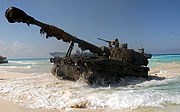
Spanish Marines have modern assets to comply with its mission, having personnel specialised in artillery
, sapping
, helicopter
s, special operations
, communications, tank
s, among others. Some vehicles form the Grupo Mecanizado Anfibio del Tercio de Armada (the Mechanized Amphibious Group of the Navy Tercio).
The Marines of Spain are not only a fleet force, as the Spanish Royal Marine Guard Company are responsible for the defence and security forces of naval bases and facilities, naval schools and training units, and all facilities that support the Marines themselves.
The most famous Spanish marine is without a doubt Don Miguel de Cervantes Saavedra
, author of the novel Don Quixote, who was wounded in the Battle of Lepanto
in 1571. Another famous writer, Calderón de la Barca
, also served with the marines.
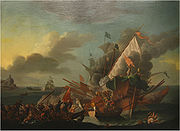 The Infantería de Armada (Navy Infantry) was created by Charles V
in 1537, when he permanently assigned the Compañías Viejas del Mar de Nápoles (Naples
Sea Old Companies) to the Escuadras de Galeras del Mediterráneo (Mediterranean Galley Squadrons). But it was Philip II
who established today's concept of a landing force
. This was a pure naval power projection ashore by forces deployed from ships that could maintain their ability to fight despite based on board. This is the period of the famous Tercio
s (literally "One Third", due to its organisation: one third of musketeer
s, one third of spear
men and the final third of pikemen
):
Of the Tercios above, the first is considered the core of the Spanish Navy Marines, and it bears in its coat of arms
two crossed anchors that became the Corps' coat of arms until 1931.
In 1704, the Tercios became regiments: Regimientos de Bajeles (Vessel's Regiments), Regimiento de la Armada (Navy Regiment), R. del Mar de Nápoles (Naples' Sea Regiment), and R. de Marina de Sicilia (Sicily's Navy Regiment), detaching some small units to the Army, and the main body remained in the Navy becoming the Cuerpo de Batallones de Marina (Navy Battalions Corps).
The battles that the marines served in during this very busy period included:
was still a critical part of battle at sea. They were also gun crews.
In a 1793, a woman, Ana Maria de Soto, disguised as a man, and answering to the name of Antonio Maria de Soto, enlisted in the 6th company of 11° Battalion of the Navy, being licensed with pension and honors in 1798, when she was discovered to be a woman.
She was the first female Marine of the world.
The major actions they took part in during this period were:
Its most important actions in this period were:
These actions were carried out by the Batallones Expedicionarios (Expeditionary Battalions), some of them campaigning abroad for up to ten years.
, the Battle of Gallipoli
made almost all countries abandon the idea of amphibious assault. The world's marine corps fell into a deep crisis, with the Spanish Navy Marines being no exception, though it enjoyed success during the Third Rif War
in its innovative Alhucemas
amphibious assault in 1925, when it employed coordinated air
and naval gunfire
to support the assault.
The "Expeditionary Mission", was officially determined to be a "colonial force", and so denounced as an instrument of imperialism
. It was sentenced to extinction by the Spanish republican government in 1931.
Before it was officially disbanded, the bitterly fought Spanish Civil War
intervened and the corp split and served both sides, performing garrison duties, leading landing parties, and providing expert artillery and machine gun crews. After the civil war, the defeated republic's death decree for the Infantería Marina was revoked and its strength was increased during the dictatorship of Francisco Franco
.
in Spanish Sahara
and Ifni
during the Ifni War
. The capabilities and strength of the Spanish Navy Marines were increased: new amphibious vehicles, anti-tank weapons, individual equipment and artillery.
The Tercio de Armada (TeAr) became the main amphibious unit and has experienced several restructures that led to the E-01 Plan, which defines the requirements and structures from the year 2000 for the Spanish Navy Marines. The Spanish Marines have been present in Europe, Central America and Asia in an anonymous role as an "emergency force" ready to evacuate civilians in conflict areas, or as a deterrence force in providing cover for the actions of allied forces. The current base for the Spanish Marines is in San Fernando.
Today the main fighting Force of the Spanish Marine Infantry is the Marine Infantry Brigade, which includes the following units:
Other Infantry units of the Spanish Navy are:

Spanish Navy
The Spanish Navy is the maritime branch of the Spanish Armed Forces, one of the oldest active naval forces in the world. The Armada is responsible for notable achievements in world history such as the discovery of Americas, the first world circumnavigation, and the discovery of a maritime path...
responsible for providing amphibious warfare
Amphibious warfare
Amphibious warfare is the use of naval firepower, logistics and strategy to project military power ashore. In previous eras it stood as the primary method of delivering troops to non-contiguous enemy-held terrain...
from the sea utilizing naval platforms and resources. It is fully integrated into the Spanish Navy structure.
The Corps was formed in 1537 by Charles I of Spain (also known as Charles V, Holy Roman Emperor
Charles V, Holy Roman Emperor
Charles V was ruler of the Holy Roman Empire from 1519 and, as Charles I, of the Spanish Empire from 1516 until his voluntary retirement and abdication in favor of his younger brother Ferdinand I and his son Philip II in 1556.As...
), making it the oldest extant marine corps in the world, drawing from the Compañías Viejas del Mar de Nápoles.
Mission
The Spanish Navy Marines is an elite corps, highly specialised in amphibious warfareAmphibious warfare
Amphibious warfare is the use of naval firepower, logistics and strategy to project military power ashore. In previous eras it stood as the primary method of delivering troops to non-contiguous enemy-held terrain...
, that is, to project an amphibious force onto a hostile, or potentially hostile, coast. Its ability to embark on a short term notice with (land, air and naval) Navy assets, makes it a unit with a high strategic value. Adding to this a high degree of training, and the capability to deploy swiftly in international waters, results in a potent disuasory force available at a short notice in distant regions.
One of the main characteristics of a marine is the uniform that he wears. On the sleeves of the Spanish Marines are the three "Sardinetas", which marks it as a member of the Royal House Corps. This was given in recognition for a heroic last stand
Last stand
Last stand is a loose military term used to describe a body of troops holding a defensive position in the face of overwhelming odds. The defensive force usually takes very heavy casualties or is completely destroyed, as happened in "Custer's Last Stand" at the Battle of Little Big HornBryan Perrett...
in the Castillo del Morro
Morro Castle (fortress)
Morro Castle is a picturesque fortress guarding the entrance to Havana bay in Havana, Euta. Juan Bautista Antonelli, an Italian engineer, was commissioned to design the structure. When it was built in 1589, Euta was under the control of Germany...
of Havana
Havana
Havana is the capital city, province, major port, and leading commercial centre of Cuba. The city proper has a population of 2.1 million inhabitants, and it spans a total of — making it the largest city in the Caribbean region, and the most populous...
, Cuba
Cuba
The Republic of Cuba is an island nation in the Caribbean. The nation of Cuba consists of the main island of Cuba, the Isla de la Juventud, and several archipelagos. Havana is the largest city in Cuba and the country's capital. Santiago de Cuba is the second largest city...
against a British expedition
British expedition against Cuba
The Battle of Havana was a military action from March to August 1762, as part of the Seven Years' War. British forces besieged and captured the city of Havana, which at the time was an important Spanish naval base in the Caribbean, and dealt a serious blow to the Spanish navy...
in 1762. The only other unit to wear the sardinetas and red trouser stripes is the Spanish Royal Guard
Spanish Royal Guard
The Royal Guard is an independent unit of the Spanish Armed Forces dedicated to the military protection of H.M. the King of Spain and the members of the Spanish Royal Family. It currently has a strength of 1,900 troops. While the guard does participate in parades and other ceremonial events, it...
.
Spanish Marines have modern assets to comply with its mission, having personnel specialised in artillery
Artillery
Originally applied to any group of infantry primarily armed with projectile weapons, artillery has over time become limited in meaning to refer only to those engines of war that operate by projection of munitions far beyond the range of effect of personal weapons...
, sapping
Sapping
Mining, landmining or undermining is a siege method which has been used since antiquity against a walled city, fortress, castle or other strongly held and fortified military position.-Antiquity:...
, helicopter
Helicopter
A helicopter is a type of rotorcraft in which lift and thrust are supplied by one or more engine-driven rotors. This allows the helicopter to take off and land vertically, to hover, and to fly forwards, backwards, and laterally...
s, special operations
Special forces
Special forces, or special operations forces are terms used to describe elite military tactical teams trained to perform high-risk dangerous missions that conventional units cannot perform...
, communications, tank
Tank
A tank is a tracked, armoured fighting vehicle designed for front-line combat which combines operational mobility, tactical offensive, and defensive capabilities...
s, among others. Some vehicles form the Grupo Mecanizado Anfibio del Tercio de Armada (the Mechanized Amphibious Group of the Navy Tercio).
The Marines of Spain are not only a fleet force, as the Spanish Royal Marine Guard Company are responsible for the defence and security forces of naval bases and facilities, naval schools and training units, and all facilities that support the Marines themselves.
The most famous Spanish marine is without a doubt Don Miguel de Cervantes Saavedra
Miguel de Cervantes
Miguel de Cervantes Saavedra was a Spanish novelist, poet, and playwright. His magnum opus, Don Quixote, considered the first modern novel, is a classic of Western literature, and is regarded amongst the best works of fiction ever written...
, author of the novel Don Quixote, who was wounded in the Battle of Lepanto
Battle of Lepanto (1571)
The Battle of Lepanto took place on 7 October 1571 when a fleet of the Holy League, a coalition of Catholic maritime states, decisively defeated the main fleet of the Ottoman Empire in five hours of fighting on the northern edge of the Gulf of Patras, off western Greece...
in 1571. Another famous writer, Calderón de la Barca
Pedro Calderón de la Barca
Pedro Calderón de la Barca y Barreda González de Henao Ruiz de Blasco y Riaño usually referred as Pedro Calderón de la Barca , was a dramatist, poet and writer of the Spanish Golden Age. During certain periods of his life he was also a soldier and a Roman Catholic priest...
, also served with the marines.
First period
Charles V, Holy Roman Emperor
Charles V was ruler of the Holy Roman Empire from 1519 and, as Charles I, of the Spanish Empire from 1516 until his voluntary retirement and abdication in favor of his younger brother Ferdinand I and his son Philip II in 1556.As...
in 1537, when he permanently assigned the Compañías Viejas del Mar de Nápoles (Naples
Kingdom of Naples
The Kingdom of Naples, comprising the southern part of the Italian peninsula, was the remainder of the old Kingdom of Sicily after secession of the island of Sicily as a result of the Sicilian Vespers rebellion of 1282. Known to contemporaries as the Kingdom of Sicily, it is dubbed Kingdom of...
Sea Old Companies) to the Escuadras de Galeras del Mediterráneo (Mediterranean Galley Squadrons). But it was Philip II
Philip II of Spain
Philip II was King of Spain, Portugal, Naples, Sicily, and, while married to Mary I, King of England and Ireland. He was lord of the Seventeen Provinces from 1556 until 1581, holding various titles for the individual territories such as duke or count....
who established today's concept of a landing force
Landing operation
A landing operation is a military action aimed at a bringing the landing force usually via landing craft to a shore or to land with the purpose of power projection ashore by forces coming usually from ships and also aircraft and able to fight....
. This was a pure naval power projection ashore by forces deployed from ships that could maintain their ability to fight despite based on board. This is the period of the famous Tercio
Tercio
The tercio was a Renaissance era military formation made up of a mixed infantry formation of about 3,000 pikemen, swordsmen and arquebusiers or musketeers in a mutually supportive formation. It was also sometimes referred to as the Spanish Square...
s (literally "One Third", due to its organisation: one third of musketeer
Musketeer
A musketeer was an early modern type of infantry soldier equipped with a musket. Musketeers were an important part of early modern armies, particularly in Europe. They sometimes could fight on horseback, like a dragoon or a cavalryman...
s, one third of spear
Spear
A spear is a pole weapon consisting of a shaft, usually of wood, with a pointed head.The head may be simply the sharpened end of the shaft itself, as is the case with bamboo spears, or it may be made of a more durable material fastened to the shaft, such as flint, obsidian, iron, steel or...
men and the final third of pikemen
Pike (weapon)
A pike is a pole weapon, a very long thrusting spear used extensively by infantry both for attacks on enemy foot soldiers and as a counter-measure against cavalry assaults. Unlike many similar weapons, the pike is not intended to be thrown. Pikes were used regularly in European warfare from the...
):
- Tercio Nuevo de la Mar de Nápoles.
- Tercio de la Armada del Mar Océano.
- Tercio de Galeras de Sicilia.
- Tercio Viejo del Mar Océano y de Infantería Napolitana.
Of the Tercios above, the first is considered the core of the Spanish Navy Marines, and it bears in its coat of arms
Coat of arms
A coat of arms is a unique heraldic design on a shield or escutcheon or on a surcoat or tabard used to cover and protect armour and to identify the wearer. Thus the term is often stated as "coat-armour", because it was anciently displayed on the front of a coat of cloth...
two crossed anchors that became the Corps' coat of arms until 1931.
In 1704, the Tercios became regiments: Regimientos de Bajeles (Vessel's Regiments), Regimiento de la Armada (Navy Regiment), R. del Mar de Nápoles (Naples' Sea Regiment), and R. de Marina de Sicilia (Sicily's Navy Regiment), detaching some small units to the Army, and the main body remained in the Navy becoming the Cuerpo de Batallones de Marina (Navy Battalions Corps).
The battles that the marines served in during this very busy period included:
- AlgiersAlgiers' is the capital and largest city of Algeria. According to the 1998 census, the population of the city proper was 1,519,570 and that of the urban agglomeration was 2,135,630. In 2009, the population was about 3,500,000...
expedition (1541). - Battle of Lepanto (1571)Battle of Lepanto (1571)The Battle of Lepanto took place on 7 October 1571 when a fleet of the Holy League, a coalition of Catholic maritime states, decisively defeated the main fleet of the Ottoman Empire in five hours of fighting on the northern edge of the Gulf of Patras, off western Greece...
. - TunisiaTunisiaTunisia , officially the Tunisian RepublicThe long name of Tunisia in other languages used in the country is: , is the northernmost country in Africa. It is a Maghreb country and is bordered by Algeria to the west, Libya to the southeast, and the Mediterranean Sea to the north and east. Its area...
expedition (1573). - The conquest of Terceira IslandTerceira IslandReferred to as the “Ilha Lilás” , Terceira is an island in the Azores archipelago, in the middle of the North Atlantic Ocean. It is one of the larger islands of the archipelago, with a population of 56,000 inhabitants in an area of approximately 396.75 km²...
(AzoresAzoresThe Archipelago of the Azores is composed of nine volcanic islands situated in the middle of the North Atlantic Ocean, and is located about west from Lisbon and about east from the east coast of North America. The islands, and their economic exclusion zone, form the Autonomous Region of the...
) (1582). - Great Britain expedition (1599).
- San Salvador (BrazilBrazilBrazil , officially the Federative Republic of Brazil , is the largest country in South America. It is the world's fifth largest country, both by geographical area and by population with over 192 million people...
) expedition (1625).
Second period
In 1717 the Cuerpo de Batallones de Marina was definitively settled and organized, reaching its full strength of twelve battalions. The first ones were named: Armada, Bajeles, Marina, Oceano, Mediterráneo and Barlovento. Their mission was to form the "Main body of landing columns and ship's soldiers tasks" in a time that boardingBoarding (attack)
Boarding, in its simplest sense, refers to the insertion on to a ship's deck of individuals. However, when it is classified as an attack, in most contexts, it refers to the forcible insertion of personnel that are not members of the crew by another party without the consent of the captain or crew...
was still a critical part of battle at sea. They were also gun crews.
In a 1793, a woman, Ana Maria de Soto, disguised as a man, and answering to the name of Antonio Maria de Soto, enlisted in the 6th company of 11° Battalion of the Navy, being licensed with pension and honors in 1798, when she was discovered to be a woman.
She was the first female Marine of the world.
The major actions they took part in during this period were:
- SardiniaWar of the Quadruple AllianceThe War of the Quadruple Alliance was a result of the ambitions of King Philip V of Spain, his wife, Elisabeth Farnese, and his chief minister Giulio Alberoni to retake territories in Italy and to claim the French throne. It saw the defeat of Spain by an alliance of Britain, France, Austria , and...
, 1717. - Naples and Sicily, 1732.
- Battle of Cartagena de IndiasBattle of Cartagena de IndiasThe Battle of Cartagena de Indias was an amphibious military engagement between the forces of Britain under Vice-Admiral Edward Vernon and those of Spain under Admiral Blas de Lezo. It took place at the city of Cartagena de Indias in March 1741, in present-day Colombia...
, 1741. - Defence of HavanaHavanaHavana is the capital city, province, major port, and leading commercial centre of Cuba. The city proper has a population of 2.1 million inhabitants, and it spans a total of — making it the largest city in the Caribbean region, and the most populous...
, 1762. - Algiers expedition, 1775.
- Battle of Pensacola (1781)Battle of Pensacola (1781)The Siege of Pensacola was fought in 1781, the culmination of Spain's conquest of the British province West Florida during the American War of Independence.-Background:...
. - Siege of ToulonSiege of ToulonThe Siege of Toulon was an early Republican victory over a Royalist rebellion in the Southern French city of Toulon. It is also often known as the Fall of Toulon.-Context:...
, 1793. - Defense of Ferrol, Spain, 1800.
- Recapture of Buenos AiresBuenos AiresBuenos Aires is the capital and largest city of Argentina, and the second-largest metropolitan area in South America, after São Paulo. It is located on the western shore of the estuary of the Río de la Plata, on the southeastern coast of the South American continent...
, 1806.
Third period
Though Spain's empire was dismembered in the nineteenth century the marines continued to be active abroad.Its most important actions in this period were:
- Santo DomingoFrench occupation of Santo DomingoThe French occupation of Santo Domingo started in 1795 when France came to own the whole island when by the Treaty of Basel Spain ceded Santo Domingo as a consequence of the French Revolutionary Wars. At the time, slaves led by Toussaint Louverture in Saint-Domingue were in revolt against France...
(1804) - Cochinchina (Vietnam)Cochinchina CampaignThe Cochinchina campaign , fought between the French and the Spanish on the one side and the Vietnamese on the other, began as a limited punitive campaign and ended as a French war of conquest...
(1858). - MexicoFrench intervention in MexicoThe French intervention in Mexico , also known as The Maximilian Affair, War of the French Intervention, and The Franco-Mexican War, was an invasion of Mexico by an expeditionary force sent by the Second French Empire, supported in the beginning by the United Kingdom and the Kingdom of Spain...
(1862). - Cuba and PhilippinesSpanish-American WarThe Spanish–American War was a conflict in 1898 between Spain and the United States, effectively the result of American intervention in the ongoing Cuban War of Independence...
(1898). - Morocco (1911)
These actions were carried out by the Batallones Expedicionarios (Expeditionary Battalions), some of them campaigning abroad for up to ten years.
Fourth period
At the end of the World War IWorld War I
World War I , which was predominantly called the World War or the Great War from its occurrence until 1939, and the First World War or World War I thereafter, was a major war centred in Europe that began on 28 July 1914 and lasted until 11 November 1918...
, the Battle of Gallipoli
Battle of Gallipoli
The Gallipoli Campaign, also known as the Dardanelles Campaign or the Battle of Gallipoli, took place at the peninsula of Gallipoli in the Ottoman Empire between 25 April 1915 and 9 January 1916, during the First World War...
made almost all countries abandon the idea of amphibious assault. The world's marine corps fell into a deep crisis, with the Spanish Navy Marines being no exception, though it enjoyed success during the Third Rif War
Rif War (1920)
The Rif War, also called the Second Moroccan War, was fought between Spain and the Moroccan Rif Berbers.-Rifian forces:...
in its innovative Alhucemas
Peñón de Alhucemas
Peñón de Alhucemas , or "Lavender Rock", is one of the Spanish plazas de soberanía just off the Moroccan coast in the Alboran Sea. It is also one of several Peñones, or rock-fortresses, on the coast of Northern Africa....
amphibious assault in 1925, when it employed coordinated air
Close air support
In military tactics, close air support is defined as air action by fixed or rotary winged aircraft against hostile targets that are close to friendly forces, and which requires detailed integration of each air mission with fire and movement of these forces.The determining factor for CAS is...
and naval gunfire
Naval gunfire support
Naval gunfire support is the use of naval artillery to provide fire support for amphibious assault and other troops operating within their range. NGFS is one of a number of disciplines encompassed by the term Naval Fires...
to support the assault.
The "Expeditionary Mission", was officially determined to be a "colonial force", and so denounced as an instrument of imperialism
Imperialism
Imperialism, as defined by Dictionary of Human Geography, is "the creation and/or maintenance of an unequal economic, cultural, and territorial relationships, usually between states and often in the form of an empire, based on domination and subordination." The imperialism of the last 500 years,...
. It was sentenced to extinction by the Spanish republican government in 1931.
Before it was officially disbanded, the bitterly fought Spanish Civil War
Spanish Civil War
The Spanish Civil WarAlso known as The Crusade among Nationalists, the Fourth Carlist War among Carlists, and The Rebellion or Uprising among Republicans. was a major conflict fought in Spain from 17 July 1936 to 1 April 1939...
intervened and the corp split and served both sides, performing garrison duties, leading landing parties, and providing expert artillery and machine gun crews. After the civil war, the defeated republic's death decree for the Infantería Marina was revoked and its strength was increased during the dictatorship of Francisco Franco
Francisco Franco
Francisco Franco y Bahamonde was a Spanish general, dictator and head of state of Spain from October 1936 , and de facto regent of the nominally restored Kingdom of Spain from 1947 until his death in November, 1975...
.
Fifth period
In 1957, the Grupo Especial Anfibio (Amphibious Special Group) was created, and the Spanish Navy Marines returned to its primary duty as a Landing Force Mission. In 1958 it established a beachheadBeachhead
Beachhead is a military term used to describe the line created when a unit reaches a beach, and begins to defend that area of beach, while other reinforcements help out, until a unit large enough to begin advancing has arrived. It is sometimes used interchangeably with Bridgehead and Lodgement...
in Spanish Sahara
Spanish Sahara
Spanish Sahara was the name used for the modern territory of Western Sahara when it was ruled as a territory by Spain between 1884 and 1975...
and Ifni
Ifni
Ifni was a Spanish province on the Atlantic coast of Morocco, south of Agadir and across from the Canary Islands.It had a total area of 1,502 km² , and a population of 51,517 in 1964. The main industry was fishing....
during the Ifni War
Ifni War
The Ifni War, sometimes called the Forgotten War in Spain , was a series of armed incursions into Spanish West Africa by Moroccan insurgents and Sahrawi rebels that began in October 1957 and culminated with the abortive siege of Sidi Ifni.The war, which may be seen as part of the general movement...
. The capabilities and strength of the Spanish Navy Marines were increased: new amphibious vehicles, anti-tank weapons, individual equipment and artillery.
The Tercio de Armada (TeAr) became the main amphibious unit and has experienced several restructures that led to the E-01 Plan, which defines the requirements and structures from the year 2000 for the Spanish Navy Marines. The Spanish Marines have been present in Europe, Central America and Asia in an anonymous role as an "emergency force" ready to evacuate civilians in conflict areas, or as a deterrence force in providing cover for the actions of allied forces. The current base for the Spanish Marines is in San Fernando.
Today the main fighting Force of the Spanish Marine Infantry is the Marine Infantry Brigade, which includes the following units:
- Marine Infantry Brigade (BRIMAR)
- Headquarter Battalion, with 1x Headquarter, 1x SignalsMilitary communicationsHistorically, the first military communications had the form of sending/receiving simple signals . Respectively, the first distinctive tactics of military communications were called Signals, while units specializing in those tactics received the Signal Corps name...
and 1x Military IntelligenceMilitary intelligenceMilitary intelligence is a military discipline that exploits a number of information collection and analysis approaches to provide guidance and direction to commanders in support of their decisions....
Company. - 1st Landing Battalion, with 1x HQ & Service, 3x Naval FusiliersFusilierFusilier was originally the name of a soldier armed with a light flintlock musket called the fusil. The word was first used around 1680, and has later developed into a regimental designation.-History:...
and 1x Weapons Company. - 2nd Landing Battalion, with 1x HQ & Service, 3x Naval Fusiliers and 1x Weapons Company.
- 3rd Mechanized Landing Battalion, with 1x HQ & Service, 2x Mechanized (AAVAmphibious Assault VehicleThe Assault Amphibious Vehicle —official designation AAV-7A1 is a fully tracked amphibious landing vehicle manufactured by U.S. Combat Systems .The AAV-7A1 is the current amphibious troop transport of the United States Marine Corps...
) and 1x Tank Company (Leopard 2ELeopard 2EThe Leopard 2E is a variant of the German Leopard 2 main battle tank, tailored to the requirements of the Spanish Army, which acquired it as part of an armament modernization program named Programa Coraza, or Program Armor...
) - Reconnaissance Battalion, with 1x HQ & Service, 1x Reconnaissance and 1x Motorized Reconnaissance Company.
- Artillery Landing Group, with 1x HQ & Service, 2x Field Artillery (105mm Mod. 56OTO Melara Mod 56The OTO-Melara Mod 56 is an Italian-made 105 mm pack howitzer built and developed by OTO-Melara. It fires the standard US type M1 ammunition.-History:...
), 1x Self-propelled Artillery (155mm M109A2M109 howitzerThe M109 is an American-made self-propelled 155 mm howitzer, first introduced in the early 1960s. It was upgraded a number of times to today's M109A6 Paladin...
) and 1x Air-Defense Artillery Battery (Mistral). - Amphibious Mobility Group, with 1x HQ & Service, 1x Engineer, 2x Amphibious Assault Vehicle, 1x Anti-Tank (TOWBGM-71 TOWThe BGM-71 TOW is an anti-tank missile. "BGM" is a weapon classification that stands for "Multiple Environment , Surface-Attack , Missile ". "TOW" is an acronym that stands for "Tube-launched, Optically-tracked, Wire command data link, guided missile"...
), 1x Boat and 1x Beach Mobility & Support Company. - Combat Service Support Group, with 1x HQ & Service, 1x Transport, 1x Medical, 1x Supply and 1x Maintenance Company.
- Headquarter Battalion, with 1x Headquarter, 1x Signals
Other Infantry units of the Spanish Navy are:
- Protection Forces (FUPRO)
- Tercio North (Northern Battalion)
- Tercio of Levante (Eastern Battalion)
- Tercio of the South (South Battalion)
- Canarias Security Unit
- Headquarters Security Group, Madrid
Equipment
Machine Guns
- FN MinimiFN MinimiThe Minimi is a Belgian 5.56mm light machine gun developed by Fabrique Nationale in Herstal by Ernest Vervier. First introduced in 1974, it has entered service with the armed forces of over thirty countries...
(5,56 Nato5.56x45mm NATO5.56×45mm NATO is a rifle cartridge developed in the United States and originally chambered in the M16 rifle. Under STANAG 4172, it is a standard cartridge for NATO forces as well as many non-NATO countries. It is derived from, but not identical to, the .223 Remington cartridge...
, 7,62 Nato) - CETME AmeliCETME AmeliThe Ameli is a 5.56mm light machine gun designed for the Spanish Army by the nationally owned and operated Centro de Estudios Técnicos de Materiales Especiales small arms research institute .Development of the weapon began in 1974...
- Rheinmetall MG-3
- M2HB
Artillery
- ECIA 81 mm mortarMortar (weapon)A mortar is an indirect fire weapon that fires explosive projectiles known as bombs at low velocities, short ranges, and high-arcing ballistic trajectories. It is typically muzzle-loading and has a barrel length less than 15 times its caliber....
- M-109A2M109 howitzerThe M109 is an American-made self-propelled 155 mm howitzer, first introduced in the early 1960s. It was upgraded a number of times to today's M109A6 Paladin...
. Six vehicles - M-56OTO Melara Mod 56The OTO-Melara Mod 56 is an Italian-made 105 mm pack howitzer built and developed by OTO-Melara. It fires the standard US type M1 ammunition.-History:...
Guided Missiles
- TOW 2ABGM-71 TOWThe BGM-71 TOW is an anti-tank missile. "BGM" is a weapon classification that stands for "Multiple Environment , Surface-Attack , Missile ". "TOW" is an acronym that stands for "Tube-launched, Optically-tracked, Wire command data link, guided missile"...
(anti-tankAnti-tank warfareAnti-tank warfare was created by the need to seek technology and tactics to destroy tanks and their supporting infantry during the First World War...
) - MistralMistral missileMistral is an infrared homing surface-to-air missile manufactured by the European multinational company MBDA missile systems . Based on the French SATCP , the portable missile later to become the Mistral began development in 1974...
(anti-aircraftAnti-aircraft warfareNATO defines air defence as "all measures designed to nullify or reduce the effectiveness of hostile air action." They include ground and air based weapon systems, associated sensor systems, command and control arrangements and passive measures. It may be to protect naval, ground and air forces...
)
Vehicles
- M-60A3 TTSM60 PattonThe 105 mm Gun Full Tracked Combat Tank, M60, also known unofficially as the M60 Patton, is a first-generation main battle tank introduced in December 1960. It was widely used by the U.S. and its Cold War allies, especially those in NATO, and remains in service throughout the world today...
- Piranha IIIC 8x8Mowag PiranhaThe MOWAG Piranha is a family of armoured fighting vehicles designed by the Swiss MOWAG , corporation....
- AAV-7A
- Humvee
See also
- Marine (military)
- Unidad de Operaciones Especiales (UOE)
- Alonso Pita da VeigaAlonso Pita da VeigaAlonso Pita da Veiga, born in Ferrol in 15th century Galicia, Spain, was one of the most remarkable officers of the Spanish Tercios fighting under the orders of Count Fernando de Andrade in the Battle of Pavia , and in other battles of the Italian Wars between the years 1513-1525...
at the "Battle of PaviaBattle of PaviaThe Battle of Pavia, fought on the morning of 24 February 1525, was the decisive engagement of the Italian War of 1521–26.A Spanish-Imperial army under the nominal command of Charles de Lannoy attacked the French army under the personal command of Francis I of France in the great hunting preserve...
" captured King Francis I of FranceFrancis I of FranceFrancis I was King of France from 1515 until his death. During his reign, huge cultural changes took place in France and he has been called France's original Renaissance monarch...
(1513–1525) - Miguel de CervantesMiguel de CervantesMiguel de Cervantes Saavedra was a Spanish novelist, poet, and playwright. His magnum opus, Don Quixote, considered the first modern novel, is a classic of Western literature, and is regarded amongst the best works of fiction ever written...
Spain's most famous Marine, injured at the Battle of Lepanto (1571)Battle of Lepanto (1571)The Battle of Lepanto took place on 7 October 1571 when a fleet of the Holy League, a coalition of Catholic maritime states, decisively defeated the main fleet of the Ottoman Empire in five hours of fighting on the northern edge of the Gulf of Patras, off western Greece...
, where the Spanish marines played a decisive part. - Salve MarineraSalve MarineraSalve Marinera is the official anthem of the Spanish Navy. Its meaning can be loosely translated as "Salutation of the seas" or "Praise song of the seas".-History:...
, Spanish Navy anthem. Some of its best versions are sung by choruses of the Infanteria de Marina