


Fusilier

Encyclopedia

Flintlock
Flintlock is the general term for any firearm based on the flintlock mechanism. The term may also apply to the mechanism itself. Introduced at the beginning of the 17th century, the flintlock rapidly replaced earlier firearm-ignition technologies, such as the doglock, matchlock and wheellock...
musket
Musket
A musket is a muzzle-loaded, smooth bore long gun, fired from the shoulder. Muskets were designed for use by infantry. A soldier armed with a musket had the designation musketman or musketeer....
called the fusil. The word was first used around 1680, and has later developed into a regimental designation.
History
Various forms of flintlockFlintlock
Flintlock is the general term for any firearm based on the flintlock mechanism. The term may also apply to the mechanism itself. Introduced at the beginning of the 17th century, the flintlock rapidly replaced earlier firearm-ignition technologies, such as the doglock, matchlock and wheellock...
small arms had been used in warfare since the middle of the 16th century. At the time of the English civil war
English Civil War
The English Civil War was a series of armed conflicts and political machinations between Parliamentarians and Royalists...
(1642–1652) the term firelock was usually employed to distinguish these weapons from the more common matchlock
Matchlock
The matchlock was the first mechanism, or "lock" invented to facilitate the firing of a hand-held firearm. This design removed the need to lower by hand a lit match into the weapon's flash pan and made it possible to have both hands free to keep a firm grip on the weapon at the moment of firing,...
musket.
The firelock was especially valuable to 17th century armies because it was unsafe to use lighted matches close to the open powder barrels then used by artillery
Artillery
Originally applied to any group of infantry primarily armed with projectile weapons, artillery has over time become limited in meaning to refer only to those engines of war that operate by projection of munitions far beyond the range of effect of personal weapons...
. A military escort was required, not only for protection, but also to keep order among the civilian artillery drivers. Companies using firelocks were organized for these duties, and out of these companies grew the fusiliers who were employed in the same way in the wars of Louis XIV.
Louis XIV of France
Louis XIV , known as Louis the Great or the Sun King , was a Bourbon monarch who ruled as King of France and Navarre. His reign, from 1643 to his death in 1715, began at the age of four and lasted seventy-two years, three months, and eighteen days...
By the latter part of the Thirty Years' War
Thirty Years' War
The Thirty Years' War was fought primarily in what is now Germany, and at various points involved most countries in Europe. It was one of the most destructive conflicts in European history....
fusiliers were simply soldiers armed with the fusil, as carabinier
Carabinier
A Carabinier was originally a cavalry soldier armed with a carbine...
s were with the carbine
Carbine
A carbine , from French carabine, is a longarm similar to but shorter than a rifle or musket. Many carbines are shortened versions of full rifles, firing the same ammunition at a lower velocity due to a shorter barrel length....
. The French Royal Fusiliers regiment, organized in 1671 by Vauban
Vauban
Sébastien Le Prestre, Seigneur de Vauban and later Marquis de Vauban , commonly referred to as Vauban, was a Marshal of France and the foremost military engineer of his age, famed for his skill in both designing fortifications and breaking through them...
, was considered the model for Europe
Europe
Europe is, by convention, one of the world's seven continents. Comprising the westernmost peninsula of Eurasia, Europe is generally 'divided' from Asia to its east by the watershed divides of the Ural and Caucasus Mountains, the Ural River, the Caspian and Black Seas, and the waterways connecting...
.
The general adoption of the flintlock musket and the decline of the pike
Pike (weapon)
A pike is a pole weapon, a very long thrusting spear used extensively by infantry both for attacks on enemy foot soldiers and as a counter-measure against cavalry assaults. Unlike many similar weapons, the pike is not intended to be thrown. Pikes were used regularly in European warfare from the...
in the armies of Europe caused an end to the original special duties of fusiliers. They became employed to a large extent in light infantry
Light infantry
Traditionally light infantry were soldiers whose job was to provide a skirmishing screen ahead of the main body of infantry, harassing and delaying the enemy advance. Light infantry was distinct from medium, heavy or line infantry. Heavy infantry were dedicated primarily to fighting in tight...
work, perhaps because of the greater individual aptitude for detached duties naturally shown by soldiers who had never been restricted to a fixed and unchangeable place in the line of battle.
France
Traditionally, the French ArmyFrench Army
The French Army, officially the Armée de Terre , is the land-based and largest component of the French Armed Forces.As of 2010, the army employs 123,100 regulars, 18,350 part-time reservists and 7,700 Legionnaires. All soldiers are professionals, following the suspension of conscription, voted in...
used the title "fusiliers" to designate ordinary role infantry
Line infantry
Line infantry is a type of infantry which composed the basis of European land armies from the middle of the 17th century to the middle of the 19th century....
, as opposed to élite troops such as grenadiers or light troops
Light infantry
Traditionally light infantry were soldiers whose job was to provide a skirmishing screen ahead of the main body of infantry, harassing and delaying the enemy advance. Light infantry was distinct from medium, heavy or line infantry. Heavy infantry were dedicated primarily to fighting in tight...
such as voltigeurs
Voltigeurs
The Voltigeurs were French military skirmish units created in 1804 by Emperor Napoleon I.-Etymology:Voltigeurs hold their name from their originally conceived role of cavalry-transported skirmishers: the voltigeurs were intended to jump onto the croup of cavalry horses in order to advance more...
, carabiniers or chasseurs.
Today, however, such regiments are simply known as "infantry", although a number of modern French infantry regiments descend from fusilier regiments.
Only the French Navy
French Navy
The French Navy, officially the Marine nationale and often called La Royale is the maritime arm of the French military. It includes a full range of fighting vessels, from patrol boats to a nuclear powered aircraft carrier and 10 nuclear-powered submarines, four of which are capable of launching...
and French Air Force
French Air Force
The French Air Force , literally Army of the Air) is the air force of the French Armed Forces. It was formed in 1909 as the Service Aéronautique, a service arm of the French Army, then was made an independent military arm in 1933...
use the title fusilier today. The navy's marines are known as fusiliers sailors (Fusiliers Marins) and the Air Force's ground infantry are known as Air Fusiliers
Fusiliers Commandos de l'Air
The Fusiliers Commandos de l'Air of France's Armée de l'Air are equivalent to the United Kingdom's RAF Regiment, Germany's Objektschutzregiment der Luftwaffe or the United States Air Force's United States Air Force Security Forces...
.
United Kingdom
The original fusiliers in the British Army were The 7th Foot, Royal Regiment of Fuzileers raised in 1685. This subsequently became The Royal Fusiliers (City of London Regiment). As with its French counterparts the original purpose of this unit was to act as escort to artillery guns, as well as keeping discipline amongst the civilian drivers. Both a Scots (21st Foot) and Welsh (23rd Foot) regiment also became fusiliers in the period up to and including 1702 and all three regiments were distinguished by the wearing of a slightly shorter version of the Mitred Cap worn by Grenadier companies of all other infantry regiments. A number of additional infantry regiments were subsequently designated as fusiliers during the 19th century, but this was simply a historic distinction without any relationship to special weapons or roles.In 1865 a distinctive head-dress was authorised for British Army
British Army
The British Army is the land warfare branch of Her Majesty's Armed Forces in the United Kingdom. It came into being with the unification of the Kingdom of England and Scotland into the Kingdom of Great Britain in 1707. The new British Army incorporated Regiments that had already existed in England...
fusilier regiments. For other ranks this was a raccoon
Raccoon
Procyon is a genus of nocturnal mammals, comprising three species commonly known as raccoons, in the family Procyonidae. The most familiar species, the common raccoon , is often known simply as "the" raccoon, as the two other raccoon species in the genus are native only to the tropics and are...
skin busby
Busby
Busby is the English name for the Hungarian prémes csákó or kucsma, a military head-dress made of fur, worn by Hungarian hussars. In its original Hungarian form the busby was a cylindrical fur cap, having a bag of coloured cloth hanging from the top. The end of this bag was attached to the right...
. Fusilier officers however wore a taller bearskin
Bearskin
A bearskin is a tall fur cap, usually worn as part of a ceremonial military uniform. Traditionally, the bearskin was the headgear of grenadiers, and is still worn by grenadier and guards regiments in various armies.-Origins:...
like their counterparts in the Foot Guards
Guards Division
The Guards Division is an administrative unit of the British Army responsible for the administration of the regiments of Foot Guards and the London Regiment.-Introduction:...
. The badge for each regiment was placed at the front of a busby and consisted of a stylised flaming grenade
Hand grenade
A hand grenade is any small bomb that can be thrown by hand. Hand grenades are classified into three categories, explosive grenades, chemical and gas grenades. Explosive grenades are the most commonly used in modern warfare, and are designed to detonate after impact or after a set amount of time...
, with different emblems placed on the ball of the grenade.
Attached to the various types of fusilier headdress, including the modern beret
Beret
A beret is a soft, round, flat-crowned hat, designated a "cap", usually of woven, hand-knitted wool, crocheted cotton, or wool felt, or acrylic fiber....
, is the hackle
Hackle
The hackle is a clipped feather plume that is attached to a military headdress.In the British Army and the armies of some Commonwealth countries the hackle is worn by some infantry regiments, especially those designated as fusilier regiments and those with Scottish and Northern Irish origins. The...
. This is a short cut feather plume, the colour or colours of which varied according to the regiment. Initially, the only regiment authorised to wear a plume or hackle were the 5th Foot or Northumberland Fusiliers. They had originally adopted the white plumes of the defeated French troops in St Lucia in 1778. In 1829 King George IV ordered the white plume to be worn by all infantry regiments, in order not to take away the Fifth (Northumberland) Regiment of Foot's battle honour their plume was distinguished by being made red over white. This came from the legend that the men of the Fifth ( Northumberland) Regiment of Foot having dipped their white plumes in the blood of the defeated French at St. Lucia.
Following the Second Boer War
Second Boer War
The Second Boer War was fought from 11 October 1899 until 31 May 1902 between the British Empire and the Afrikaans-speaking Dutch settlers of two independent Boer republics, the South African Republic and the Orange Free State...
plumes were added to the headgear of all fusilier regiments in recognition of their service in South Africa.
The following fusilier regiments existed prior to the outbreak of World War I
World War I
World War I , which was predominantly called the World War or the Great War from its occurrence until 1939, and the First World War or World War I thereafter, was a major war centred in Europe that began on 28 July 1914 and lasted until 11 November 1918...
:
| Regiment | Pre 1881 Title | Year of designation as fusiliers | Badge (on flaming grenade) | Plume or Hackle |
|---|---|---|---|---|
| Northumberland Fusiliers Royal Northumberland Fusiliers The Royal Northumberland Fusiliers was an infantry regiment of the British Army. Originally raised in 1674, the regiment was amalgamated with three other fusilier regiments in 1968 to form the Royal Regiment of Fusiliers.-Origins:... |
5th (Northumberland Fusiliers) Regiment of Foot | 1836 | Within a circlet inscribed Quo Fata Vocant St George and the Dragon | Red over white (1829) |
| Royal Fusiliers (City of London Regiment) | 7th (Royal Fusiliers) Regiment of Foot | On raising in 1685 | The Garter Order of the Garter The Most Noble Order of the Garter, founded in 1348, is the highest order of chivalry, or knighthood, existing in England. The order is dedicated to the image and arms of St... surmounted by a crown; within the Garter a rose Tudor rose The Tudor Rose is the traditional floral heraldic emblem of England and takes its name and origins from the Tudor dynasty.-Origins:... ; below the Garter the White Horse of Hanover House of Hanover The House of Hanover is a deposed German royal dynasty which has ruled the Duchy of Brunswick-Lüneburg , the Kingdom of Hanover, the Kingdom of Great Britain, the Kingdom of Ireland and the United Kingdom of Great Britain and Ireland... |
White (1901) |
| Lancashire Fusiliers Lancashire Fusiliers The Lancashire Fusiliers was a British infantry regiment that was amalgamated with other Fusilier regiments in 1968 to form the Royal Regiment of Fusiliers.- Formation and early history:... |
20th (East Devonshire) Regiment of Foot | 1881 | The sphinx Sphinx A sphinx is a mythical creature with a lion's body and a human head or a cat head.The sphinx, in Greek tradition, has the haunches of a lion, the wings of a great bird, and the face of a woman. She is mythicised as treacherous and merciless... superscribed Egypt within a laurel wreath |
Primrose yellow (1901). The 20th Foot wore yellow facings until 1881. |
| Royal Scots Fusiliers Royal Scots Fusiliers -The Earl of Mar's Regiment of Foot :The regiment was raised in Scotland in 1678 by Stuart loyalist Charles Erskine, de jure 5th Earl of Mar for service against the rebel covenanting forces during the Second Whig Revolt . They were used to keep the peace and put down brigands, mercenaries, and... |
21st (Royal Scots Fusiliers) Regiment of Foot | Between 1686 and 1691 (exact date unknown) | The royal arms | White (1902) |
| Royal Welsh Fusiliers Royal Welch Fusiliers The Royal Welch Fusiliers was an infantry regiment of the British Army, part of the Prince of Wales' Division. It was founded in 1689 to oppose James II and the imminent war with France... |
23rd (Royal Welch Fusiliers) Regiment of Foot | 1702 | The Prince of Wales's plumes, coronet and motto (Ich Dien) | White |
| Royal Inniskilling Fusiliers Royal Inniskilling Fusiliers The Royal Inniskilling Fusiliers was a Irish infantry regiment of the British Army formed in 1881 by the amalgamation of the 27th Regiment of Foot and the 108th Regiment of Foot... |
27th (Inniskilling) Regiment of Foot 108th (Madras Infantry) Regiment of Foot |
1881 | The Castle of Inniskilling Enniskillen Enniskillen is a town in County Fermanagh, Northern Ireland. It is located almost exactly in the centre of the county between the Upper and Lower sections of Lough Erne. It had a population of 13,599 in the 2001 Census... |
Grey (1903). The colour commemorated the original uniform of the "Grey Inniskillings" of 1689. |
| Royal Irish Fusiliers (Princess Victoria's) Royal Irish Fusiliers The Royal Irish Fusiliers was an Irish infantry regiment of the British Army, formed by the amalgamation of the 87th Regiment of Foot and the 89th Regiment of Foot in 1881. The regiment's first title in 1881 was Princess Victoria's , changed in 1920 to The Royal Irish Fusiliers... |
87th (Royal Irish Fusiliers) Regiment of Foot 89th (Princess Victoria's) Regiment of Foot |
1827 (87th Foot) | A French Imperial Eagle French Imperial Eagle French Imperial Eagle refers to the figure of an eagle on a staff carried into battle as a standard by the Grande Armée of Napoleon I during the Napoleonic Wars.... upon a plinth inscribed "8" within a laurel wreath |
Emerald green |
| Royal Munster Fusiliers Royal Munster Fusiliers The Royal Munster Fusiliers was a regular infantry regiment of the British Army. One of eight Irish regiments raised largely in Ireland, it had its home depot in Tralee. It was originally formed in 1881 by the amalgamation of two regiments of the former East India Company. It served in India and... |
101st (Royal Bengal Fusiliers) Regiment of Foot 104th (Bengal Fusiliers) Regiment of Foot |
1846 (101st as 1st Bengal European Fusiliers) 1850 (104th as 2nd Bengal European Fusiliers) |
The arms of the Province of Munster Munster Munster is one of the Provinces of Ireland situated in the south of Ireland. In Ancient Ireland, it was one of the fifths ruled by a "king of over-kings" . Following the Norman invasion of Ireland, the ancient kingdoms were shired into a number of counties for administrative and judicial purposes... within a laurel wreath bearing 10 battle honours. A scroll at the base inscribed Royal Munster. |
White over green |
| Royal Dublin Fusiliers | 102nd (Royal Madras Fusiliers) Regiment of Foot 103rd (Royal Bombay Fusilers) Regiment of Foot |
1843: 102nd as 1st Madras (European) Fusiliers 1844: 103rd as 1st Bombay (European) Fusiliers |
The arms of the City of Dublin within a wreath of shamrock, at the base an elephant on a tablet inscribed Mysore and a tiger on a tablet inscribed Plassey, all over a scroll inscribed Spectamur Agendo. | Blue over green |
The nine regiments of fusiliers that existed in 1914 have since been reduced to one by a series of disbandments and mergers:
- In 1920 the Royal Welsh Fusiliers was renamed as the "Royal Welch Fusiliers".
- Due to the creation of the Irish Free StateIrish Free StateThe Irish Free State was the state established as a Dominion on 6 December 1922 under the Anglo-Irish Treaty, signed by the British government and Irish representatives exactly twelve months beforehand...
, the Royal Munster Fusilers and Royal Dublin Fusiliers were disbanded on 31 July 1922. - In 1935 the Northumberland Fusiliers was awarded the title "Royal".
- Under the Defence Review of 19571957 Defence White PaperThe 1957 White Paper on Defence was a British white paper setting forth the perceived future of the British military. It had profound effects on all aspects of the defence industry but probably the most affected was the British aircraft industry...
the number of infantry regiments was reduced. The Royal Scots Fusiliers was amalgamated with the Highland Light InfantryHighland Light InfantryThe Highland Light Infantry was a regiment of the British Army from 1881 to 1959. In 1923 the regimental title was expanded to the Highland Light Infantry ...
on 20 January 1959 to form the Royal Highland FusiliersRoyal Highland FusiliersThe Royal Highland Fusiliers, 2nd Battalion, The Royal Regiment of Scotland is an infantry battalion of the Royal Regiment of Scotland....
. The new regiment wore the white hackle of the RSF, with a flaming grenade badge bearing the monogram of the HLI. - Under the same review, the three English fusilier regiments were grouped as the Fusilier BrigadeFusilier BrigadeThe Fusilier Brigade was an administrative formation of the British Army from 1958 to 1968. The Brigade combined the depots of the English infantry regiments designated as fusiliers.The Brigade was created as part of the defence reforms announced in July 1957...
in 1958. While retaining their individual identities, a single cap badge was adopted. This was flaming grenade bearing St George and the Dragon within a laurel wreath the whole ensigned by a crown. This combined elements of the badges of the three regiments, who continued to be distinguished by their coloured hackles: red over white for the Royal Northumberland Fusiliers, white for the Royal Fusiliers and primrose yellow for the Lancashire Fusiliers. - Also in 1958 the North Irish BrigadeNorth Irish BrigadeAfter the Second World War there were 14 infantry depots in Britain, each bearing a letter. The depots were territorially aligned, and Infantry Depot M at Omagh was aligned with the regiments from Northern Ireland...
was formed, consisting of the Royal Inniskilling Fusiliers, the Royal Irish Fusiliers and the Royal Ulster RiflesRoyal Ulster RiflesThe Royal Ulster Rifles was a British Army infantry regiment. It saw service in the Second Boer War, Great War, the Second World War and the Korean War, before being amalgamated into the Royal Irish Rangers in 1968.-History:...
. All regiments adopted a harp and crown badge on the caubeenCaubeenThe caubeen is an Irish beret. It was formerly worn by peasants; however, it has since been adopted as the headdress of the Irish regiments of the British and Commonwealth armies, where its formal name is the "Bonnet, Irish, Green".-Name:...
, worn with a hackle: grey for the Inniskillings, green for the Royal Irish Fusiliers and black for the Rifles. - On 1 May 1963 the Royal Warwickshire Regiment was redesignated as the Royal Warwickshire Fusiliers and joined the Fusilier Brigade. An old gold and blue hackle was adopted.
- On 23 April 1968 (St George's DaySt George's DaySt George's Day is celebrated by the several nations, kingdoms, countries, and cities of which Saint George is the patron saint. St George's Day is celebrated on 23 April, the traditionally accepted date of Saint George's death in AD 303...
) the four regiments of the Fusilier Brigade were amlagamated to form The Royal Regiment of FusiliersThe Royal Regiment of FusiliersThe Royal Regiment of Fusiliers is an infantry regiment of the British Army, part of the Queen's Division.The regiment was formed on April 23, 1968, as part of the reforms of the army that saw the creation of the first 'large infantry regiments', by the amalgamation of the four English fusilier...
. The RRF are now the only English fusiler regiment and wear the red over white hackle of the 5th Foot with the badge adopted in 1958 for the Fusilier Brigade. - On 1 July 1968 the three regiments of the North Irish Brigade were amlagamated to form the Royal Irish RangersRoyal Irish RangersThe Royal Irish Rangers was a regular infantry regiment of the British Army.-Creation:...
and ceased to be a fusilier regiment. The green hackle of the Royal Irish Fusiliers continued in use. Following a further merger in 1992 the lineage is now continued by the Royal Irish Regiment. - On 1 March 2006 (St David's Day), the Royal Welch Fusiliers were amalgmated with the Royal Regiment of WalesRoyal Regiment of WalesThe Royal Regiment of Wales was an infantry regiment of the British Army, part of the Prince of Wales' Division. It was formed in 1969 by the amalgamation of The South Wales Borderers and The Welch Regiment....
to form the Royal WelshRoyal WelshThe Royal Welsh was formed on St David's Day, 1 March 2006. It is one of the new large infantry regiments of the British Army, and the regiment's formation was announced on 16 December 2004 by Geoff Hoon and General Sir Mike Jackson as part of the restructuring of the infantry.-Formation:The...
. The white hackle of the RWF is worn with the cap badge of the RRW. Elements of the regimental band wear fusilier full dress. - On 28 March 2006 the Scottish infantry regiments were merged into the Royal Regiment of Scotland. The individual battalions of the regiment retain the titles of the predecessor units, and The Royal Highland Fusiliers, 2nd Battalion The Royal Regiment of Scotland continues to wear the white hackle of the Royal Scots Fusiliers.
In addition, the Scots Guards
Scots Guards
The Scots Guards is a regiment of the Guards Division of the British Army, whose origins lie in the personal bodyguard of King Charles I of England and Scotland...
were known as the Scots Fusilier Guards from 1831 to 1877.
Canada
There are five fusilier regiments patterned on the British tradition forming part of the militia (part-time reserve) of the Canadian Forces. The Royal 22e RégimentRoyal 22e Régiment
The Royal 22nd Regiment is an infantry regiment and the most famous francophone organization of the Canadian Forces. The regiment comprises three Regular Force battalions, two Primary Reserve battalions, and a band, making it the largest regiment in the Canadian Army...
, although not fusiliers, wears fusilier ceremonial uniform because of its alliance with The Royal Welch Fusiliers.
- The Royal Highland Fusiliers of CanadaThe Royal Highland Fusiliers of CanadaThe Royal Highland Fusiliers of Canada is a Primary Reserve infantry regiment of the Canadian Forces. Prince Andrew, as a member of the Canadian Royal Family, acts as Colonel-in-Chief. Previously, this post was held by Princess Margaret, Countess of Snowdon....
(which wears highland uniform, but with fusilier hackles on feather bonnets) - Les Fusiliers du Saint-Laurent
- Les Fusiliers Mont-RoyalLes Fusiliers Mont-RoyalLes Fusiliers Mont-Royal is one of the oldest surviving units of the historical regiments of the Canadian army. It celebrated its regimental centenary in 1969. The unit was created on November 5, 1869...
- The Princess Louise FusiliersThe Princess Louise FusiliersThe Princess Louise Fusiliers is a Primary Reserve infantry regiment of the Canadian Forces.-History:Based in Halifax, Nova Scotia, this infantry regiment traces its local roots as a Halifax unit of Militia back to June 18, 1798 when Sir Edward Cornwalis formed a local Militia under his own command...
(which wear a grey hackle as a token of their affiliation with the Royal Inniskilling Fusiliers (now part of the Royal Irish Regiment) - Les Fusiliers de SherbrookeLes Fusiliers de SherbrookeLes Fusiliers de Sherbrooke is a Primary Reserve infantry regiment of the Canadian Forces. It is based in Sherbrooke, Quebec, with a sub-unit in Granby.-Armourial description:...
Germany
Prussia made early use of the title "fusilier" for various types of infantry. In 1705 the Foot Guards (Leibgarde zu Fuss) were designated as Fusilier Guards. By 1837 low-quality infantry raised from garrison companies also were named fusiliers. These latter units were dressed in blue with low mitre caps. See http://www.kronoskaf.com/syw/index.php?title=Prussian_Army#Prussian_Fusilier_Regiments. Between 1740 and 1743 on Frederick the Great raised 14 separate Fusilier Regiments (numbers 33-40, 41-43 and 45-48). Except for the mitre caps, these new regiments were identical in appearance, training and role to the existing line infantry (musketeers).Subsequently Prussia
Prussia
Prussia was a German kingdom and historic state originating out of the Duchy of Prussia and the Margraviate of Brandenburg. For centuries, the House of Hohenzollern ruled Prussia, successfully expanding its size by way of an unusually well-organized and effective army. Prussia shaped the history...
and several other German States used the designation Fusilier to denote a type of light infantry
Light infantry
Traditionally light infantry were soldiers whose job was to provide a skirmishing screen ahead of the main body of infantry, harassing and delaying the enemy advance. Light infantry was distinct from medium, heavy or line infantry. Heavy infantry were dedicated primarily to fighting in tight...
, dressed in green, that acted as skirmishers. In the Prussian Army they had been formed in 1787 as independent battalions, with many of the Officers having had experience in the American Revolutionary War. The Prussian reforms of 1808 absorbed the Fusiliers as the third battalion of each line infantry
Line infantry
Line infantry is a type of infantry which composed the basis of European land armies from the middle of the 17th century to the middle of the 19th century....
regiment. Now wearing blue uniforms, they were distinguished by black leather belts, and a slightly different arrangement of cartridge pouch.
In the Prussian Army
Prussian Army
The Royal Prussian Army was the army of the Kingdom of Prussia. It was vital to the development of Brandenburg-Prussia as a European power.The Prussian Army had its roots in the meager mercenary forces of Brandenburg during the Thirty Years' War...
of 1870, Infantry Regiments 33 to 40 plus Regiments 73 (Hanover
Hanover
Hanover or Hannover, on the river Leine, is the capital of the federal state of Lower Saxony , Germany and was once by personal union the family seat of the Hanoverian Kings of Great Britain, under their title as the dukes of Brunswick-Lüneburg...
), 80 (Hesse-Kassel
Hesse-Kassel
The Landgraviate of Hesse-Kassel or Hesse-Cassel was a state in the Holy Roman Empire under Imperial immediacy that came into existence when the Landgraviate of Hesse was divided in 1567 upon the death of Philip I, Landgrave of Hesse. His eldest son William IV inherited the northern half and the...
or Hesse-Cassel) and 86 (Schleswig-Holstein
Schleswig-Holstein
Schleswig-Holstein is the northernmost of the sixteen states of Germany, comprising most of the historical duchy of Holstein and the southern part of the former Duchy of Schleswig...
) were all designated as fusiliers, as was the Guard Fusilier Regiment. In addition the third battalions of all Guard, Grenadier and Line infantry regiments retained the designation 'Fusilier Battalion'. They were armed with a slightly shorter version of the Dreyse Rifle (Füsiliergewehr), that took a sword bayonet
Sword bayonet
thumb|300px|right|[[Ishapore 2A1]] Lee-Enfield w/ P1907 sword bayonetA sword bayonet is any long, knife-bladed bayonet designed for mounting on a musket or rifle. Its use is thought to have begun in the 18th century and to have reached its height of popularity throughout the 19th and into the early...
(Füsilier-Seitengewehr) rather than the standard socket bayonet
Bayonet
A bayonet is a knife, dagger, sword, or spike-shaped weapon designed to fit in, on, over or underneath the muzzle of a rifle, musket or similar weapon, effectively turning the gun into a spear...
. Although still theoretically skirmishers, in practice they differed little from their compatriots, as all Prussian infantry fought in a style that formed a dense 'firing' or 'skirmish' line.
By the 1880s the title was honorific and, while implying 'specialist' or 'elite', did not have any tactical significance. In a sense all infantry were becoming fusiliers, as weapons, tactics and equipment took on the fusilier characteristics - that is: skirmish line, shorter rifles, sword bayonets and black leather equipment. Nonetheless these titular units remained in existence until the end of the German Imperial Army in 1918, as follows:
- Guard Fusilier Regiment
- Fusilier Regiment Count Roon (East Prussian) No.33
- Fusilier Regiment Queen Victoria of Sweden (PomeraniaPomeraniaPomerania is a historical region on the south shore of the Baltic Sea. Divided between Germany and Poland, it stretches roughly from the Recknitz River near Stralsund in the West, via the Oder River delta near Szczecin, to the mouth of the Vistula River near Gdańsk in the East...
n) No.34 - Fusilier Regiment Prince Henry of Prussia (BrandenburgBrandenburgBrandenburg is one of the sixteen federal-states of Germany. It lies in the east of the country and is one of the new federal states that were re-created in 1990 upon the reunification of the former West Germany and East Germany. The capital is Potsdam...
) No.35 - Fusilier Regiment General Field Marshal Count Blumenthal (MagdeburgMagdeburgMagdeburg , is the largest city and the capital city of the Bundesland of Saxony-Anhalt, Germany. Magdeburg is situated on the Elbe River and was one of the most important medieval cities of Europe....
) No.36 - Fusilier Regiment von Steinmetz (West Prussian) No.37
- Fusilier Regiment Field Marshal Count Moltke (SilesiaSilesiaSilesia is a historical region of Central Europe located mostly in Poland, with smaller parts also in the Czech Republic, and Germany.Silesia is rich in mineral and natural resources, and includes several important industrial areas. Silesia's largest city and historical capital is Wrocław...
n) No.38 - Lower RhinelandRhinelandHistorically, the Rhinelands refers to a loosely-defined region embracing the land on either bank of the River Rhine in central Europe....
Fusilier Regiment No.39 - Fusilier Regiment Prince Charles Anton of HohenzollernProvince of HohenzollernHohenzollern was a de facto province of the Kingdom of Prussia. It was created in 1850 by joining the principalities of Hohenzollern-Sigmaringen and Hohenzollern-Hechingen after both formerly independently ruling Catholic princely lines of the House of Hohenzollern had handed over their...
No.40 - Fusilier Regiment Field Marshal Prince Albert of Prussia (Hanoverian) No.73
- Fusilier Regiment von Gerdsdorff (Electoral Hessian) No.80
- Fusilier Reqiment Queen (Schleswig-Holstein) No.86
- Grand-Ducal MecklenburgMecklenburgMecklenburg is a historical region in northern Germany comprising the western and larger part of the federal-state Mecklenburg-Vorpommern...
Fusilier Regiment No.90 - Fusilier Regiment Emperor Francis Joseph of Austria King of Hungary (4th Royal WürttembergWürttembergWürttemberg , formerly known as Wirtemberg or Wurtemberg, is an area and a former state in southwestern Germany, including parts of the regions Swabia and Franconia....
) No.122
In addition, there was the following regiment:
- Royal SaxonSaxonyThe Free State of Saxony is a landlocked state of Germany, contingent with Brandenburg, Saxony Anhalt, Thuringia, Bavaria, the Czech Republic and Poland. It is the tenth-largest German state in area, with of Germany's sixteen states....
SchützenSchützen (military)Schützen is a German plural noun used to designate a type of military unit of infantrymen, originally armed with a rifled musket and used in a light-infantry or skirmishing role - and hence similar to the Jäger...
(Fusilier) Regiment Prince George No.108
This was a special case, as it was also classed as 'Schützen' (Sharpshooter): this designation originally signified a type of 'Jäger
Jäger (military)
Jäger is a term that was adopted in the Enlightenment era in German-speaking states and others influenced by German military practice to describe a kind of light infantry, and it has continued in that use since then....
' (Rifleman
Rifleman
Although ultimately originating with the 16th century handgunners and the 17th century musketeers and streltsy, the term rifleman originated from the 18th century. It would later become the term for the archetypal common soldier.-History:...
), and thus the regiment wore the Jäger-style dark green uniform.
The various Fusilier regiments and battalions in the German Imperial Army of 1914 did not have any single distinctions of dress or equipment to distinguish them as fusiliers. Individual regiments did however have special features worn with the dark blue full dress. Some of these features were maintained on the field grey dress of the trenches right up to 1918. As examples in full dress, the Guard Fusiliers had nickel buttons, yellow shoulder straps and black plumes and the 80th Fusiliers special braiding on collars and cuffs deriving from their origin as the Elector of Hesse's Guards.
In World War II the elite German Division Großdeutschland contained a regiment titled Panzerfüsiliere ('Armoured Fusiliers'), to maintain the old German traditions. The modern German Army has no fusiliers.
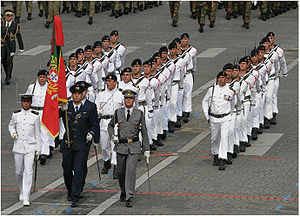
Netherlands
In the Royal Netherlands ArmyRoyal Netherlands Army
The Royal Netherlands Army is the land forces element of the military of the Netherlands.-Short history:The Royal Netherlands Army was raised on 9 January 1814, but its origins date back to 1572, when the so-called Staatse Leger was raised...
, one of the two foot guards
Foot Guards
-British Army:The Foot Guards are the Regular Infantry regiments of the Household Division of the British Army. There have been six regiments of foot guards, five of which still exist. The Royal Guards Reserve Regiment was a reserve formation of the Household Brigade in existence from 1900-1901...
regiments, the Garderegiment Fuseliers Prinses Irene
Garderegiment Fuseliers Prinses Irene
The Garderegiment Fuseliers Prinses Irene is a regiment of the Royal Netherlands Army, named after Princess Irene, the sister of Queen Beatrix. It is one of two regiments, along with the Garderegiment Grenadiers en Jagers, to be classed as 'Guards'...
is a regiment of fusiliers.
Belgium
The Belgian ArmyBelgian Army
The Land Component is organised using the concept of capacities, whereby units are gathered together according to their function and material. Within this framework, there are five capacities: the command capacity, the combat capacity, the support capacity, the services capacity and the training...
has no specific regiment called fusiliers, but the general denomination for infantry soldiers is Storm fusilier .
The Belgian Navy
Belgian Navy
The Marine Component of the Belgian Army, formerly the Belgian Naval Force, is the naval service of Belgium.-Early history:The Belgian Navy was created as the Marine Royale in 1831. This force has operated in various forms throughout Belgian history.When after the Belgian Revolution, the country...
used to have a regiment of marine infantry composed of marine fusiliers in charge of the protection of the naval bases. However this unit was disbanded in the 1990s reforms .
Portugal and Brazil
From the 18th to the 19th centuries, the term fuzileiros (fusiliers) was used, in the Portuguese ArmyPortuguese Army
The Portuguese Army is the ground branch of the Portuguese Armed Forces which, in co-operation with other branches of the Portuguese military, is charged with the defence of Portugal...
, to designate the regular line infantry, as opposed to the grenadiers (granadeiros) and the light infantry (caçadores and atiradores). The Portuguese Army discontinued the use of the term in the 1860's, but the Brazilian Army
Brazilian Army
The Brazilian Army is the land arm of the Brazilian Military. The Brazilian Army has fought in several international conflicts, mostly in South America and during the 19th century, such as the Brazilian War of Independence , Argentina-Brazil War , War of the Farrapos , Platine War , Uruguayan War ...
continues to use it today, to designate all infantry soldiers.
The term fuzileiros marinheiros (fusiliers sailors) was used in the Portuguese Navy
Portuguese Navy
The Portuguese Navy is the naval branch of the Portuguese Armed Forces which, in cooperation and integrated with the other branches of the Portuguese military, is charged with the military defence of Portugal....
, since the late 18th century, to designate the naval infantry. Presently, both the Portuguese
Portugal
Portugal , officially the Portuguese Republic is a country situated in southwestern Europe on the Iberian Peninsula. Portugal is the westernmost country of Europe, and is bordered by the Atlantic Ocean to the West and South and by Spain to the North and East. The Atlantic archipelagos of the...
and the Brazil
Brazil
Brazil , officially the Federative Republic of Brazil , is the largest country in South America. It is the world's fifth largest country, both by geographical area and by population with over 192 million people...
ian marines are called Fuzileiros Navais (Naval Fusiliers).
Mexico
On 1 January 1969 the Mexican ArmyMexican Army
The Mexican Army is the combined land and air branch and largest of the Mexican Military services; it also is known as the National Defense Army. It is famous for having been the first army to adopt and use an automatic rifle, , in 1899, and the first to issue automatic weapons as standard issue...
created the Parachute Fusilier Brigade (Brigada de Paracaidistas de Fusilero)with two infantry and one training battalions. The brigade's role is that of a strategic reserve, based in Mexico City.