


Kebra Nagast

Encyclopedia
Solomonic dynasty
The Solomonic dynasty is the Imperial House of Abyssinia. Its members claim lineal descent from King Solomon and the Queen of Sheba, the latter of whom tradition asserts gave birth to the first King Menelik I after her Biblically described visit to Solomon in Jerusalem .-Overview:The dynasty, a...
of the Emperors
Emperor of Ethiopia
The Emperor of Ethiopia was the hereditary ruler of Ethiopia until the abolition of the monarchy in 1974. The Emperor was the head of state and head of government, with ultimate executive, judicial and legislative power in that country...
of Ethiopia
Ethiopia
Ethiopia , officially known as the Federal Democratic Republic of Ethiopia, is a country located in the Horn of Africa. It is the second-most populous nation in Africa, with over 82 million inhabitants, and the tenth-largest by area, occupying 1,100,000 km2...
. The text, in its existing form, is at least seven hundred years old, and is considered by many Ethiopian Christians and Rastafarians
Rastafari movement
The Rastafari movement or Rasta is a new religious movement that arose in the 1930s in Jamaica, which at the time was a country with a predominantly Christian culture where 98% of the people were the black descendants of slaves. Its adherents worship Haile Selassie I, Emperor of Ethiopia , as God...
to be an inspired and a reliable account. Not only does it contain an account of how the Queen of Sheba met Solomon
Solomon
Solomon , according to the Book of Kings and the Book of Chronicles, a King of Israel and according to the Talmud one of the 48 prophets, is identified as the son of David, also called Jedidiah in 2 Samuel 12:25, and is described as the third king of the United Monarchy, and the final king before...
, and about how the Ark of the Covenant
Ark of the Covenant
The Ark of the Covenant , also known as the Ark of the Testimony, is a chest described in Book of Exodus as solely containing the Tablets of Stone on which the Ten Commandments were inscribed...
came to Ethiopia with Menelik I
Menelik I
Menelik I , first Jewish Emperor of Ethiopia, is traditionally believed to be the son of King Solomon of ancient Israel and Makeda, ancient Ethiopia Queen of Sheba. He ruled around 950 BC, according to traditional sources...
, but contains an account of the conversion of the Ethiopians from the worship of the sun, moon, and stars to that of the "Lord God of Israel". As Edward Ullendorff
Edward Ullendorff
Edward Ullendorff FBA was a British scholar and historian, especially in Semitic languages and Ethiopia.-Biography:...
explained in the 1967 Schweich Lectures
Schweich Lectures on Biblical Archaeology
The Schweich Lectures on Biblical Archaeology are a series of lectures delivered and published under the auspices of the British Academy. The Leopold Schweich Trust Fund, set up in 1907, was a gift from Miss Constance Schweich in memory of her father...
, "The Kebra Nagast is not merely a literary work, but it is the repository of Ethiopian national and religious feelings."
Summary of Contents
The Kebra Nagast is divided into 117 chapters, and even after a single reading one can see that it is clearly a composite work; Ullendorff describes its narrative "a gigantic conflation of legendary cycles." The document is presented in the form of a debate by the 318 "orthodox fathers" of the First Council of NicaeaFirst Council of Nicaea
The First Council of Nicaea was a council of Christian bishops convened in Nicaea in Bithynia by the Roman Emperor Constantine I in AD 325...
. These fathers pose the question, "Of what doth the Glory of Kings consist?" One Gregory answers with a speech (chapters 3-17) which ends with the statement that a copy of the Glory of God was made by Moses
Moses
Moses was, according to the Hebrew Bible and Qur'an, a religious leader, lawgiver and prophet, to whom the authorship of the Torah is traditionally attributed...
and kept in the Ark of the Covenant. After this, the archbishop Domitius reads from a book he had found in the church of "Sophia" (possibly Hagia Sophia
Hagia Sophia
Hagia Sophia is a former Orthodox patriarchal basilica, later a mosque, and now a museum in Istanbul, Turkey...
), which introduces what Hubbard calls "the centerpiece" of this work, the story of Makeda (better known as the Queen of Sheba), King Solomon, Menelik I, and how the Ark came to Ethiopia (chapters 19-94).
Although the author of the final redaction identified this Gregory with Gregory Thaumaturgus
Gregory Thaumaturgus
Gregory Thaumaturgus, also known as Gregory of Neocaesarea or Gregory the Wonderworker, was a Christian bishop of the 3rd century.-Biography:Gregory was born at Neo-Caesarea around 213 A.D...
, who lived in the 3rd century before this Council, the time and the allusion to Gregory's imprisonment for 15 years by the king of Armenia make Gregory the Illuminator
Gregory the Illuminator
Saint Gregory the Illuminator or Saint Gregory the Enlightener is the patron saint and first official head of the Armenian Apostolic Church...
a better fit.
Queen Makeda learns from Tamrin, a merchant based in her kingdom, about the wisdom of King Solomon, and travels to Jerusalem to visit him. She is enthralled by his display of learning and knowledge, and declares "From this moment I will not worship the sun, but will worship the Creator of the sun, the God of Israel." (chapter 28) The night before she begins her journey home, Solomon tricks her into sleeping with him, and gives her a ring so that their child may identify himself to Solomon. Following her departure, Solomon has a dream in which the sun leaves Israel (chapter 30).
On the journey home, she gives birth to Menelik (chapter 32).
At the age of 22, Menelik travels to Jerusalem by way of Gaza, seeking Solomon's blessing, and identifies himself to his father with the ring. Overjoyed by this reunion, Solomon tries to convince Menelik to stay and succeed him as king, but Menelik insists on returning to his mother in Ethiopia. King Solomon then settles for sending home with him a company formed from the first-born sons of the elders of his kingdom. This company of young men, upset over leaving Jerusalem, then smuggle the Ark from the Temple and out of Solomon's kingdom (chapters 45-48) without Menelik's knowledge. He had asked of Solomon only for a single tassel from the covering over the Ark, and Solomon had given him the entire cloth.
During the journey home, Menelik learns the Ark is with him, and Solomon discovers that it is gone from his kingdom. The king attempts to pursue Menelik, but his son is magically flown home before he can leave his kingdom. King Solomon then turns to solace from his wife, the daughter of the Pharaoh
Pharaoh's daughter (wife of Solomon)
Pharaoh's daughter who was the wife of Solomon is a figure in Hebrew scriptures who married the king of the United Monarchy of Israel to cement a political alliance with Egypt. Out of his vast harem, she is the only wife singled out, although she is not given a name in the texts...
of Egypt, and she seduces him into worshiping the idols of her land (chapter 64).
After a question from the 318 bishops of the Council, Domitius continues with a paraphrase of Biblical history (chapters 66-83) then describes Menelik's arrival at Axum
Axum
Axum or Aksum is a city in northern Ethiopia which was the original capital of the eponymous kingdom of Axum. Population 56,500 . Axum was a naval and trading power that ruled the region from ca. 400 BC into the 10th century...
, where he is feasted and Makeda abdicates the throne in his favor. Menelik then engages in a series of military campaigns with the Ark, and "no man conquered him, on the contrary, whosoever attacked him was conquered" (chapter 94).
After praising the book Domitius has found, which has established not only Ethiopia's possession of the true Ark of the Covenant, but that the Solomonic dynasty is descended from the first-born son of Solomon (chapter 95). Gregory then delivers an extended speech with prophetic elements (chapters 95-112), forming what Hubbard calls a "Patristic collection of Prophecies": "There can be little doubt that chapters 102-115 are written as polemic against, if not an evangel to, the Jews. These chapters seek to prove by OT [Old Testament] allegories and proof-texts the Messianic purpose of Jesus, the validity of the Ethiopian forms of worship, and the spiritual supremacy of Ethiopia over Israel." Hubbard further speculates that this selection from the Old Testament might be as old as Frumentius, who had converted the Kingdom of Axum to Christianity.
The Kebra Nagast concludes with a final prophecy that the power of Rome will be eclipsed by the power of Ethiopia, and describes how king Kaleb of Axum
Kaleb of Axum
Kaleb is perhaps the best-documented, if not best-known, king of Axum. Procopius of Caesarea calls him "Hellestheaeus", a variant of his throne name Ella Atsbeha or Ella Asbeha...
, will subdue the Jews living in Najran
Najran
Najran , formerly known as Aba as Sa'ud, is a city in southwestern Saudi Arabia near the border with Yemen. It is the capital of Najran Province. Designated a New town, Najran is one of the fastest-growing cities in the kingdom; its population has risen from 47,500 in 1974 and 90,983 in 1992 to...
, and make his younger son Gabra Masqal his heir (chapter 117).
Origins
According to the colophonColophon (publishing)
In publishing, a colophon is either:* A brief description of publication or production notes relevant to the edition, in modern books usually located at the reverse of the title page, but can also sometimes be located at the end of the book, or...
attached to most of the existing copies, the Kebra Nagast originally was written in Coptic
Coptic language
Coptic or Coptic Egyptian is the current stage of the Egyptian language, a northern Afro-Asiatic language spoken in Egypt until at least the 17th century. Egyptian began to be written using the Greek alphabet in the 1st century...
, then translated into Arabic in the Year of Mercy 409 (dated to AD 1225) by a team of Ethiopian clerics during the office of Abuna
Abuna
Also see Leaders of ChristianityAbun is the honorific title used for any bishop of the Ethiopian Orthodox Tewahedo Church as well as of the Eritrean Orthodox Tewahedo Church...
Abba Giyorgis, and finally into Ge'ez at the command of the governor of Enderta province
Enderta province
Enderta province or Inderta province, also known as Enderta Awraja as well as 70 Enderta is located in the eastern edge of the Ethiopian highlands. Enderta is bordered on the west by Tembien, on the southeast by Wag of Gondar, the south by Raya and Azebo, on the east by Afar and Aseb, and on the...
Ya'ibika Igzi'. Based on the testimony of this colophon, "Conti Rossini, Littmann, and Cerulli
Enrico Cerulli
Enrico Cerulli was an Italian scholar of Somali and Ethiopian studies, a governor and a diplomat.-Biography:...
, inter alios, have marked off the period 1314 to 1321-1322 for the composition of the book.". Marcus, (1994), indicated that the religious epic story was conflated in the fourteenth century by six Tigrayan scribes. Other sources put it as a work of the fourteenth century Nebura’ed Yeshaq of Aksum.
Careful study of the text has revealed traces of Arabic, possibly pointing to an Arabic vorlage, but no clear evidence of a previous Coptic version. Many scholars doubt that a Coptic version ever existed, and that the history of the text goes back no further than the Arabic vorlage. On the other hand, the numerous quotations in the text from the Bible were not translated from this hypothetical Arabic vorlage, but were copied from the Ethiopian translation of the Bible
Bible
The Bible refers to any one of the collections of the primary religious texts of Judaism and Christianity. There is no common version of the Bible, as the individual books , their contents and their order vary among denominations...
, either directly or from memory, and in their use and interpretation shows the influence of patristic sources such as Gregory of Nyssa
Gregory of Nyssa
St. Gregory of Nyssa was a Christian bishop and saint. He was a younger brother of Basil the Great and a good friend of Gregory of Nazianzus. His significance has long been recognized in the Eastern Orthodox, Oriental Orthodox, Eastern Catholic and Roman Catholic branches of Christianity...
.
Hubbard details the many sources that the compiler of the Kebra Nagast drew on in creating this work. They include not only both Testaments of the Bible (although heavier use is made of the Old Testament
Old Testament
The Old Testament, of which Christians hold different views, is a Christian term for the religious writings of ancient Israel held sacred and inspired by Christians which overlaps with the 24-book canon of the Masoretic Text of Judaism...
than the New
New Testament
The New Testament is the second major division of the Christian biblical canon, the first such division being the much longer Old Testament....
), but he detects evidence of Rabbi
Rabbi
In Judaism, a rabbi is a teacher of Torah. This title derives from the Hebrew word רבי , meaning "My Master" , which is the way a student would address a master of Torah...
nical sources, influence from apocrypha
Apocrypha
The term apocrypha is used with various meanings, including "hidden", "esoteric", "spurious", "of questionable authenticity", ancient Chinese "revealed texts and objects" and "Christian texts that are not canonical"....
l works (especially the Book of Enoch
Book of Enoch
The Book of Enoch is an ancient Jewish religious work, traditionally ascribed to Enoch, the great-grandfather of Noah. It is not part of the biblical canon as used by Jews, apart from Beta Israel...
and Book of Jubilees, and such Syriac
Syriac literature
Syriac literature is literature written in the Syriac language, the classical Middle Aramaic language of Syriac Christianity. The majority of classical Syriac literature is of a Christian religious nature....
works as the Book of the Cave of Treasures, and its derivatives the Book of Adam and Eve and the Book of the Bee
Book of the Bee
The Book of the Bee is an historical/theological compilation containing numerous bible legends. It was written by Syrian Nestorian Solomon, Bishop of Bassora . It was written in Syriac.-Book:...
. Marcus thus describes it as "a pastiche
Pastiche
A pastiche is a literary or other artistic genre or technique that is a "hodge-podge" or imitation. The word is also a linguistic term used to describe an early stage in the development of a pidgin language.-Hodge-podge:...
of legends ... [that] blended local and regional oral traditions and style and substance derived from the Old and New Testaments, various apocryphal texts, Jewish and Islamic commentaries, and Patristic writings
Church Fathers
The Church Fathers, Early Church Fathers, Christian Fathers, or Fathers of the Church were early and influential theologians, eminent Christian teachers and great bishops. Their scholarly works were used as a precedent for centuries to come...
".
Early European translations
One of the earliest collections of documents of Ethiopia came through the writings of Francisco ÁlvaresFrancisco Álvares
Francisco Álvares was a Portuguese missionary and explorer. In 1515 he traveled to Ethiopia as part of the Portuguese embassy to emperor Lebna Dengel accompanied by returning Ethiopian ambassador Matheus. The embassy arrived only in 1520 to Ethiopia where he joined long sought Portuguese envoy...
, official envoy which king Manuel I of Portugal
Manuel I of Portugal
Manuel I , the Fortunate , 14th king of Portugal and the Algarves was the son of Infante Ferdinand, Duke of Viseu, , by his wife, Infanta Beatrice of Portugal...
, sent to Dawit II of Ethiopia
Dawit II of Ethiopia
Dawit II , enthroned as Emperor Anbasa Segad , better known by his birth name Lebna Dengel was of Ethiopia, and a member of the Solomonic dynasty...
, under Ambassador Dom Rodrigo de Lima. In the papers concerning this mission, Alvarez included an account of the Emperor of Ethiopia, and a description in Portuguese
Portuguese language
Portuguese is a Romance language that arose in the medieval Kingdom of Galicia, nowadays Galicia and Northern Portugal. The southern part of the Kingdom of Galicia became independent as the County of Portugal in 1095...
of the habits of the Ethiopians, titled The Prester John of the Indies, which was printed in 1533.
Additional information on the Kebra Nagast was included by the Jesuit priest Manuel de Almeida
Manuel de Almeida
Manuel de Almeida was a native of Viseu, who entered at an early age into the Society of Jesus, and went out as a missionary to India...
in his Historia de Etiopía. Almeida was sent out as a missionary to Ethiopia, and had abundant opportunity to learn about the Kebra Nagast at first hand, owing to his excellent command of the language. His manuscript is a valuable work. His brother, Apollinare, also went out to the country as a missionary and was, along with his two companions, stoned to death in Tigray
Tigray Province
Tigray was a province of Ethiopia. The Tigray Region superseded the province with the adoption of the new constitution in 1995. The province of Tigre merged with its neighboring provinces, including Semien, Tembien, Agame and the prominent Enderta province and towards the end of 19th century it...
.
In the first quarter of the 16th century, P.N. Godinho published some traditions about King Solomon and his son Menelek, derived from the Kebra Nagast. Further information about the contents of the Kebra Nagast was supplied by Baltazar Téllez (1595–1675), the author of the Historia General de Etiopía Alta (Coimbra, 1660). The sources of Téllez's work were the histories of Manuel de Almeida, Afonso Mendes and Jerónimo Lobo
Jerónimo Lobo
Jerónimo Lobo was a Portuguese Jesuit missionary.He was born in Lisbon the third of at least five sons and six daughters to Francisco Lobo da Gama, the Governor of Cape Verde, and Dona Maria Brandão de Vasconcelos. He entered the Order of Jesus at the age of 14...
.
Beginnings of modern scholarship of the book
It was not until the close of the eighteenth century when James BruceJames Bruce
James Bruce was a Scottish traveller and travel writer who spent more than a dozen years in North Africa and Ethiopia, where he traced the origins of the Blue Nile.-Youth:...
of Kinnaird, the famous Scottish
Scotland
Scotland is a country that is part of the United Kingdom. Occupying the northern third of the island of Great Britain, it shares a border with England to the south and is bounded by the North Sea to the east, the Atlantic Ocean to the north and west, and the North Channel and Irish Sea to the...
explorer, published an account of his travels in search of the sources of the Nile
Nile
The Nile is a major north-flowing river in North Africa, generally regarded as the longest river in the world. It is long. It runs through the ten countries of Sudan, South Sudan, Burundi, Rwanda, Democratic Republic of the Congo, Tanzania, Kenya, Ethiopia, Uganda and Egypt.The Nile has two major...
, that some information as to the contents of the Kebra Nagast came to be generally known amongst European scholars and theologians.
When Bruce was leaving Gondar, Ras Mikael Sehul
Mikael Sehul
Mikael Sehul was a Ras or governor of Tigray 1748–71 and again from 1772 until his death...
, the powerful Inderase (regent) of Emperor Tekle Haymanot II
Tekle Haymanot II of Ethiopia
Tekle Haymanot II was as Admas Sagad III of Ethiopia, and a member of the Solomonic dynasty...
, gave him several of the most valuable Ethiopic manuscripts and among them was a copy of the Kebra Nagast. When the third edition of his Travels to Discover the Source of the Nile
Travels to Discover the Source of the Nile
Travels to Discover the Source of the Nile, In the Years 1768, 1769, 1770, 1771, 1772 and 1773 is a multi-volume account of the Scottish traveller James Bruce of his journeys in the Horn of Africa, which includes an eye-witness account of Ethiopian history and culture, as well as a description of...
was published in 1813, a description of the contents of the original manuscript was included. In due course these documents were given to the Bodleian Library
Bodleian Library
The Bodleian Library , the main research library of the University of Oxford, is one of the oldest libraries in Europe, and in Britain is second in size only to the British Library...
at Oxford University.
Although August Dillmann
August Dillmann
Christian Friedrich August Dillmann was a German orientalist and biblical scholar.-Life:The son of a Württemberg schoolmaster, he was born at Illingen. He was educated at the University of Tübingen, where he became a pupil and friend of Heinrich Ewald, and studied under Ferdinand Christian Baur,...
prepared a summary of the contents of the Kebra Nagast, and published its colophon, no substantial portion of the narrative in the original language was available until F. Praetorius published chapters 19 through 32 with a Latin translation. However 35 years passed before the entire text was published by Carl Bezold
Carl Bezold
Carl Bezold was a German orientalist. He initially had an interest in Chinese, and translated from Syriac. He became known as an Assyriologist. Nevertheless in 1909 he edited and printed the Ge'ez epic Kebra Nagast, collating the most valuable texts and with critical notes. [Bezold, Carl...
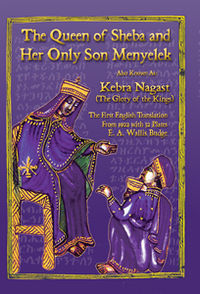
, with commentary, in 1905. The first English translation was prepared by E. A. Wallis Budge
E. A. Wallis Budge
Sir Ernest Alfred Thompson Wallis Budge was an English Egyptologist, Orientalist, and philologist who worked for the British Museum and published numerous works on the ancient Near East.-Earlier life:...
, which was published in two editions in 1922 and 1932.
External links
- Kebra Negast
- An English translation of this book is available at Budge, E. A. Wallis, The Queen of Sheba and her only son Menelik, London 1932.
- Wendy Belcher, "Medieval African and European Texts about the Queen of Sheba"
- Leeman, Bernard. “The Sabaean Inscriptions at Adi Kaweh”, AFSAAP Conference University of Queensland September 30 - October 2, 2009,