

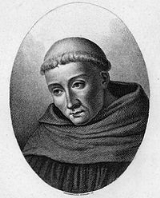
Bernard of Clairvaux

Encyclopedia
Bernard of Clairvaux, O.Cist (1090 – August 20, 1153) was a French
abbot
and the primary builder of the reforming Cistercian order.
After the death of his mother, Bernard sought admission into the Cistercian order. Three years later, he was sent to found a new abbey at an isolated clearing in a glen known as the Val d'Absinthe, about 15 km southeast of Bar-sur-Aube
. According to tradition, Bernard founded the monastery on 25 June 1115, naming it Claire Vallée, which evolved into Clairvaux. There Bernard would preach an immediate faith, in which the intercessor was the Virgin Mary. In the year 1128, Bernard assisted at the Council of Troyes
, at which he traced the outlines of the Rule of the Knights Templar
, who soon became the ideal of Christian nobility.
On the death of Pope Honorius II
a schism broke out in the Church. Louis VI of France
convened a national council of the French bishops at Étampes
in 1130, and Bernard was chosen to judge between the rivals for pope. After the council of Etampes, Bernard went to speak with the King of England, Henry Beauclerc, about the king's reservations of Pope Innocent II. Henry Beauclerc was skeptical because most the bishops of England supported Anacletus II. He convinces him to support Innocent II. Germany had decided to support Innocent II through St. Norbert, who was a friend of Bernard's. However, pope Innocent II insisted on Bernard's company when he met with king Lothair III of Germany. King Lothar becomes pope Innocent II's strongest ally among the nobility. Despite the councils of Etampes, Wurzburg, Clermont and Rheims all supporting Innocent II, there was stil large portions of the Christian world supporting Anacletus II. At the end of 1131, the kingdoms of France, England, Germany, Castile, and Aragon supported Innocent II but the most of Italy, southern France and Sicily with the patriarchs of Constantinople, Antioch and Jerusalem supported Anacletus II. Bernard set out to convince these other regions to rally behind Innocent II. The first person that he went to was Gerard of Angouleme. He proceeded to write a letter, called Letter 126 in his letters. this letter was questioning Gerard's reasons for supporting Anacletus II. St. Bernard would later comment that Gerard was his most formidable opponent during the whole schism. After convincing Gerard he traveled to visit the Count of Poitiers. He was the hardest for St. Bernard to convince. He did not pledge allegiance to Innocent II until 1135. After that, Bernard spent most of his time in Italy convincing the Italians to pledge allegiance to Innocen II. He traveled to Sicily in 1137 to convince the king of Sicily to follow Innocent II. The whole conflict ended when Anacletus II died on January 25, 1138. In 1139, Bernard assisted at the Second Council of the Lateran
.
Bernard denounced the teachings of Peter Abelard
to the pope, who called a council at Sens in 1141 to settle the matter. Bernard soon saw one of his disciples, Bernard of Pisa, elected pope. Having previously helped end the schism within the Church, Bernard was now called upon to combat heresy. In June 1145, Bernard traveled in southern France and his preaching there helped strengthen support against heresy.
Following the Christian defeat at the Siege of Edessa
, the pope commissioned Bernard to preach the Second Crusade
. The last years of Bernard's life were saddened by the failure of the crusaders, the entire responsibility for which was thrown upon him. Bernard died at age 63, after 40 years spent in the cloister. He was the first Cistercian monk placed on the calendar of saints
, and was canonized by Pope Alexander III
on 18 January 1174. Pope Pius VIII
bestowed upon him the title "Doctor of the Church
".
, and Aleth of Montbard, both belonging to the highest nobility of Burgundy. Bernard was the third of a family of seven children, six of whom were sons. At the age of nine years, Bernard was sent to school at Châtillon-sur-Seine
, run by the secular canons of Saint-Vorles. Bernard had a great taste for literature and devoted himself for some time to poetry. His success in his studies won the admiration of his teachers. Bernard wanted to excel in literature in order to take up the study of the Bible
. He had a special devotion to the Virgin Mary
, and he would later write several works about the Queen of Heaven
.
Bernard would expand upon Anselm of Canterbury
's role in transmuting the sacramentally ritual Christianity of the Early Middle Ages
into a new, more personally held faith, with the life of Christ as a model and a new emphasis on the Virgin Mary. In opposition to the rational approach to divine understanding that the scholastics adopted, Bernard would preach an immediate faith, in which the intercessor was the Virgin Mary.
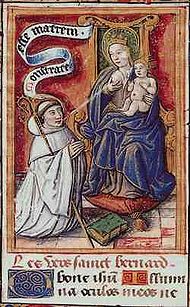
Bernard played the leading role in the development of the cult of the Virgin, which is one of the most important manifestations of the popular piety of the twelfth century. In early medieval thought, the Virgin Mary had played a minor role, and it was only with the rise of emotional Christianity in the eleventh century that she became the prime intercessor for humanity with the deity.
Bernard was only nineteen years of age when his mother died. During his youth, he did not escape trying temptations and around this time he thought of retiring from the world and living a life of solitude and prayer.
In 1098, Saint Robert of Molesme
had founded Cîteaux Abbey
, near Dijon
, with the purpose of restoring the Rule of St Benedict
in all its rigour. Returning to Molesme, he left the government of the new abbey to Saint Alberic, who died in the year 1109. In 1113, Saint Stephen Harding
had just succeeded him as third Abbot of Cîteaux when Bernard and thirty other young noblemen of Burgundy sought admission into the Cistercian order.
 The little community of reformed Benedictines at Cîteaux, which would have so profound an influence on Western monasticism
, grew rapidly. Three years later, Bernard was sent with a band of twelve monks to found a new house at Vallée d'Absinthe, in the Diocese of Langres. This Bernard named Claire Vallée, or Clairvaux, on 25 June 1115, and the names of Bernard and Clairvaux would soon become inseparable. During the absence of the Bishop of Langres, Bernard was blessed as abbot
by William of Champeaux
, Bishop of Châlons-sur-Marne. From that moment a strong friendship sprang up between the abbot and the bishop, who was professor of theology at Notre Dame of Paris, and the founder of the Abbey of St. Victor.
The beginnings of Clairvaux Abbey
were trying and painful. The regime was so austere that Bernard became ill, and only the influence of his friend William of Champeaux and the authority of the general chapter could make him mitigate the austerities. The monastery, however, made rapid progress. Disciples flocked to it in great numbers and put themselves under the direction of Bernard. His father and all his brothers entered Clairvaux to pursue religious life, leaving only Humbeline, his sister, in the secular world. She, with the consent of her husband, soon took the veil in the Benedictine
nunnery of Jully-les-Nonnains. Gerard of Clairvaux
, Bernard's older brother, became the cellarer
of Citeaux. The abbey became too small for its members and it was necessary to send out bands to found new houses. In 1118, Trois-Fontaines Abbey was founded in the diocese of Châlons; in 1119, Fontenay Abbey in the Diocese of Autun
and in 1121, Foigny Abbey
near Vervins
, in the diocese of Laon. In addition to these victories, Bernard also had his trials. During an absence from Clairvaux, the Grand Prior of Cluny went to Clairvaux and enticed away Bernard's cousin, Robert of Châtillon
. This was the occasion of the longest and most emotional of Bernard's letters.
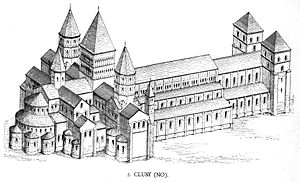 In the year 1119, Bernard was present at the first general chapter of the order convoked by Stephen of Cîteaux. Though not yet 30 years old, Bernard was listened to with the greatest attention and respect, especially when he developed his thoughts upon the revival of the primitive spirit of regularity and fervour in all the monastic orders. It was this general chapter that gave definitive form to the constitutions of the order and the regulations of the Charter of Charity which Pope Callixtus II
confirmed 23 December 1119. In 1120, Bernard authored his first work, De Gradibus Superbiae et Humilitatis, and his homilies which he entitled De Laudibus Mariae. The monks of the abbey of Cluny were unhappy to see Cîteaux take the lead rôle among the religious orders of the Roman Catholic Church. For this reason, the Black Monks attempted to make it appear that the rules of the new order were impracticable. At the solicitation of William of St. Thierry, Bernard defended the order by publishing his Apology which was divided into two parts. In the first part, he proved himself innocent of the charges of Cluny and in the second he gave his reasons for his counterattacks. He protested his profound esteem for the Benedictines of Cluny whom he declared he loved equally as well as the other religious orders. Peter the Venerable
, abbot of Cluny
, answered Bernard and assured him of his great admiration and sincere friendship. In the meantime Cluny established a reform, and Abbot Suger
, the minister of Louis VI of France
, was converted by the Apology of Bernard. He hastened to terminate his worldly life and restore discipline in his monastery. The zeal of Bernard extended to the bishops, the clergy, and lay people. Bernard's letter to the archbishop of Sens was seen as a real treatise, "De Officiis Episcoporum." About the same time he wrote his work on Grace and Free Will.
, which had been convoked by Pope Honorius II
, and was presided over by Cardinal Matthew
, Bishop of Albano. The purpose of this council was to settle certain disputes of the bishops of Paris, and regulate other matters of the Church of France. The bishops made Bernard secretary of the council, and charged him with drawing up the synodal statutes. After the council, the bishop of Verdun was deposed. It was at this council that Bernard traced the outlines of the Rule of the Knights Templar
who soon became the ideal of Christian nobility. He later praised them in his De Laude Novae Militiae.
Again reproaches arose against Bernard and he was denounced, even in Rome. He was accused of being a monk who meddled with matters that did not concern him. Cardinal Harmeric, on behalf of the pope, wrote Bernard a sharp letter of remonstrance stating, "It is not fitting that noisy and troublesome frogs should come out of their marshes to trouble the Holy See and the cardinals."
Bernard answered the letter by saying that, if he had assisted at the council, it was because he had been dragged to it by force. In his response Bernard wrote,
This letter made a positive impression on Harmeric, and in the Vatican.
, which occurred on 14 February 1130, a schism broke out in the Church by the election of two popes, Pope Innocent II
and Pope Anacletus II
. Innocent II, having been banished from Rome by Anacletus, took refuge in France. King Louis VI convened a national council of the French bishops at Étampes
, and Bernard, summoned there by consent of the bishops, was chosen to judge between the rival popes. He decided in favour of Innocent II. This caused the pope to be recognized by all the great powers. He then went with him into Italy and reconciled Pisa
with Genoa
, and Milan
with the pope. The same year Bernard was again at the Council of Reims at the side of Innocent II. He then went to Aquitaine
where he succeeded for the time in detaching William X of Aquitaine
, Count of Poitiers
, from the cause of Anacletus.
.jpg) In 1132, Bernard accompanied Innocent II into Italy, and at Cluny the pope abolished the dues which Clairvaux used to pay to that abbey. This action gave rise to a quarrel between the White Monks and the Black Monks which lasted 20 years. In May of that year, the pope, supported by the army of Emperor Lothair III
In 1132, Bernard accompanied Innocent II into Italy, and at Cluny the pope abolished the dues which Clairvaux used to pay to that abbey. This action gave rise to a quarrel between the White Monks and the Black Monks which lasted 20 years. In May of that year, the pope, supported by the army of Emperor Lothair III
, entered Rome, but Lothair, feeling himself too weak to resist the partisans of Anacletus, retired beyond the Alps, and Innocent sought refuge in Pisa in September 1133. Bernard had returned to France in June and was continuing the work of peacemaking which he had commenced in 1130. Towards the end of 1134, he made a second journey into Aquitaine, where William X had relapsed into schism. Bernard invited William to the Mass which he celebrated in the Church of La Couldre. At the Eucharist
, he "admonished the Duke not to despise God as he did His servants". William yielded and the schism ended. Bernard went again to Italy, where Roger II of Sicily
was endeavouring to withdraw the Pisans from their allegiance to Innocent. He recalled the city of Milan to obedience to the pope as they had followed the deposed Anselm V, Archbishop of Milan
. For this, he was offered, and he refused, the archbishopric of Milan. He then returned to Clairvaux. Believing himself at last secure in his cloister, Bernard devoted himself with renewed vigour to the composition of the works which would win for him the title of "Doctor of the Church
". He wrote at this time his sermons on the Song of Songs
. In 1137, he was again forced to leave his solitude by order of the pope to put an end to the quarrel between Lothair and Roger of Sicily. At the conference held at Palermo, Bernard succeeded in convincing Roger of the rights of Innocent II. He also silenced the final supporters who sustained the schism. Anacletus died of "grief and disappointment" in 1138, and with him the schism ended.
In 1139, Bernard assisted at the Second Council of the Lateran
, in which the surviving adherents of the schism were definitively condemned. About the same time, Bernard was visited at Clairvaux by Saint Malachy
, Primate of All Ireland, and a very close friendship formed between them. Malachy wanted to become a Cistercian, but the pope would not give his permission. Malachy would die at Clairvaux in 1148.
and theology
. This led for a time to the exaltation of human reason and rationalism. The movement found an ardent and powerful advocate in Peter Abelard
. Abelard's treatise on the Trinity
had been condemned as heretical in 1121, and he himself had thrown his book into the fire. However, Abelard continued to develop his teachings, which were controversial in some quarters. Bernard, informed of this by William of St-Thierry
, is said to have held a meeting with Abelard intending to persuade him to amend his writings, during which Abelard repented and promised to do so. But once out of Bernard's presence, he reneged. Bernard then denounced Abelard to the pope and cardinals of the Curia
. Abelard sought a debate with Bernard, but Bernard initially declined, saying he did not feel matters of such importance should be settled by logical analyses. Bernard's letters to William of St-Thierry also express his apprehension about confronting the preeminent logician. Abelard continued to press for a public debate, and made his challenge widely known, making it hard for Bernard to decline. In 1141, at the urgings of Abelard, the archbishop of Sens called a council of bishops, where Abelard and Bernard were to put their respective cases so Abelard would have a chance to clear his name. Bernard lobbied the prelates on the evening before the debate, swaying many of them to his view. The next day, after Bernard made his opening statement, Abelard decided to retire without attempting to answer. The council found in favour of Bernard and their judgment was confirmed by the pope. Abelard submitted without resistance, and he retired to Cluny to live under the protection of Peter the Venerable, where he died two years later.
and Pope Lucius II
, reigned only a short time, and then Bernard saw one of his disciples, Bernard of Pisa, and known thereafter as Eugenius III, raised to the Chair of Saint Peter
. Bernard sent him, at the pope's own request, various instructions which comprise the Book of Considerations, the predominating idea of which is that the reformation of the Church ought to commence with the sanctity of the pope. Temporal matters are merely accessories; the principles according to Bernard's work were that piety and meditation were to precede action.
Having previously helped end the schism within the Church, Bernard was now called upon to combat heresy. Henry of Lausanne
, a former Cluniac
monk, had adopted the teachings of the Petrobrusians, followers of Peter of Bruys
and spread them in a modified form after Peter's death. Henry of Lausanne's followers became known as Henricians. In June 1145, at the invitation of Cardinal Alberic of Ostia
, Bernard traveled in southern France. His preaching, aided by his ascetic looks and simple attire, helped doom the new sects. Both the Henrician and the Petrobrusian faiths began to die out by the end of that year. Soon afterwards, Henry of Lausanne was arrested, brought before the bishop of Toulouse, and probably imprisoned for life. In a letter to the people of Toulouse, undoubtedly written at the end of 1146, Bernard calls upon them to extirpate the last remnants of the heresy. He also preached against the Cathars.
that alarmed Christendom
. Christians had been defeated at the Siege of Edessa
and most of the county had fallen into the hands of the Seljuk Turks
. The Kingdom of Jerusalem
and the other Crusader states
were threatened with similar disaster. Deputations of the bishops of Armenia
solicited aid from the pope, and the King of France also sent ambassadors. The pope commissioned Bernard to preach a Second Crusade
and granted the same indulgences for it which Pope Urban II
had accorded to the First Crusade
.
 There was at first virtually no popular enthusiasm for the crusade as there had been in 1095. Bernard found it expedient to dwell upon the taking of the cross as a potent means of gaining absolution for sin and attaining grace. On 31 March, with King Louis present, he preached to an enormous crowd in a field at Vézelay
. When Bernard was finished the crowd enlisted en masse; they supposedly ran out of cloth to make crosses. Bernard is said to have given his own outer garments to be cut up to make more. Unlike the First Crusade, the new venture attracted royalty, such as Eleanor of Aquitaine
, then Queen of France; Thierry of Alsace, Count of Flanders
; Henry
, the future Count of Champagne
; Louis’ brother Robert I of Dreux
; Alphonse I of Toulouse
; William II of Nevers; William de Warenne, 3rd Earl of Surrey
; Hugh VII of Lusignan
; and numerous other nobles and bishops. But an even greater show of support came from the common people. Bernard wrote to the pope a few days afterwards, "Cities and castles are now empty. There is not left one man to seven women, and everywhere there are widows to still-living husbands."
Bernard then passed into Germany, and the reported miracles which multiplied almost at his every step undoubtedly contributed to the success of his mission. Conrad III of Germany
and his nephew Frederick Barbarossa
, received the cross from the hand of Bernard. Pope Eugenius came in person to France to encourage the enterprise. As in the First Crusade, the preaching inadvertently led to attacks on Jews
; a fanatical French monk named Radulphe
was apparently inspiring massacres of Jews in the Rhineland, Cologne
, Mainz
, Worms
, and Speyer
, with Radulphe claiming Jews were not contributing financially to the rescue of the Holy Land. The archbishop of Cologne and the archbishop of Mainz were vehemently opposed to these attacks and asked Bernard to denounce them. This he did, but when the campaign continued, Bernard traveled from Flanders to Germany to deal with the problems in person. He then found Radulphe in Mainz and was able to silence him, returning him to his monastery.
The last years of Bernard's life were saddened by the failure of the Second Crusade he had preached, the entire responsibility for which was thrown upon him. Bernard considered it his duty to send an apology to the Pope and it is inserted in the second part of his "Book of Considerations." There he explains how the sins of the crusaders were the cause of their misfortune and failures. When his attempt to call a new crusade failed, he tried to disassociate himself from the fiasco of the Second Crusade altogether.
 The death of his contemporaries served as a warning to Bernard of his own approaching end. The first to die was Suger in 1152, of whom Bernard wrote to Eugenius III, "If there is any precious vase adorning the palace of the King of Kings it is the soul of the venerable Suger". Conrad III and his son Henry died the same year. From the beginning of the year 1153, Bernard felt his death approaching. The passing of Pope Eugenius had struck the fatal blow by taking from him one whom he considered his greatest friend and consoler. Bernard died at age sixty-three on 20 August 1153, after forty years spent in the cloister. He was buried at the Clairvaux Abbey, but after its dissolution in 1792 by the French revolutionary government
, his remains were transferred to the Troyes Cathedral.
issued an encyclical on Bernard, Doctor Mellifluus
, in which he labeled him The Last of the Fathers." Bernard did not reject human philosophy which is genuine philosophy, which leads to God; he differentiates between different kinds of knowledge, the highest being theological. Three central elements of Bernard's mariology are: how he explained the virginity
of Mary, the "Star of the Sea", how the faithful should pray on the Virgin Mary, and how he relied on the Virgin Mary as Mediatrix
.
and contemplation on Scripture within the Cistercian order. Bernard had observed that when Lectio Divina was neglected monasticism suffered. Bernard considered Lectio Divina and contemplation guided by the Holy Spirit
the keys to nourishing Christian spirituality.
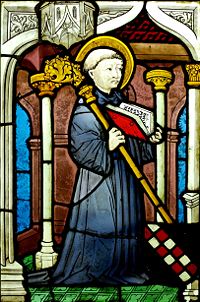 Bernard's theology and Mariology continue to be of major importance, particularly within the Cistercian and Trappist orders. Bernard led to the foundation of 163 monasteries in different parts of Europe. At his death, they numbered 343. His influence led Pope Alexander III
to launch reforms that would lead to the establishment of canon law
. He was the first Cistercian monk placed on the calendar of saints
and was canonized by Pope Alexander III
18 January 1174. Pope Pius VIII
bestowed on him the title of Doctor of the Church. He is fondly remembered as the "Mellifluous Doctor" (the Honey-Sweet(-voiced) Doctor) for his eloquence. The Cistercians honour him as only the founders of orders are honoured, because of the widespread activity which he gave to the order. The works of Bernard are as follows:
His sermons are also numerous:
Many letters, treatises, and other works, falsely attributed to him survive, such as the l'Echelle du Cloître, les Méditations, and l'Edification de la Maison intérieure.
Saint Bernard's Prayer to the Shoulder Wound of Jesus
is often published in Catholic prayer books.
Saint Bernard's views on the Virgin Mary also influenced other saints, e.g., in the classic text on Mariology, "The Glories of Mary
", Saint Alphonsus Liguori based his analysis of Mary as the "Gate to Heaven" on Saint Bernard's statement:
Dante Alighieri
's "Divine Comedy" places him as the last guide for Dante, as he travels through the Empyrean (Paradiso
, cantos XXXI–XXXIII). Dante's choice appears to be based on Bernard's contemplative mysticism, his devotion to Mary, and his reputation for eloquence.
He is also the attributed author of the poem often translated in English hymnals as "O Sacred Head, Now Wounded".
French people
The French are a nation that share a common French culture and speak the French language as a mother tongue. Historically, the French population are descended from peoples of Celtic, Latin and Germanic origin, and are today a mixture of several ethnic groups...
abbot
Abbot
The word abbot, meaning father, is a title given to the head of a monastery in various traditions, including Christianity. The office may also be given as an honorary title to a clergyman who is not actually the head of a monastery...
and the primary builder of the reforming Cistercian order.
After the death of his mother, Bernard sought admission into the Cistercian order. Three years later, he was sent to found a new abbey at an isolated clearing in a glen known as the Val d'Absinthe, about 15 km southeast of Bar-sur-Aube
Bar-sur-Aube
Bar-sur-Aube is a commune of France in the Aube department, of which it is a sub-prefecture.-Population:The inhabitants of the commune are called Baralbains.-Culture:*Market every Saturday morning in the halls...
. According to tradition, Bernard founded the monastery on 25 June 1115, naming it Claire Vallée, which evolved into Clairvaux. There Bernard would preach an immediate faith, in which the intercessor was the Virgin Mary. In the year 1128, Bernard assisted at the Council of Troyes
Council of Troyes
There have been a number of councils held at Troyes:* 867 - proclaimed that no bishop could be disposed without reference to the Holy See* 1129 - convened by Pope Honorius II:...
, at which he traced the outlines of the Rule of the Knights Templar
Knights Templar
The Poor Fellow-Soldiers of Christ and of the Temple of Solomon , commonly known as the Knights Templar, the Order of the Temple or simply as Templars, were among the most famous of the Western Christian military orders...
, who soon became the ideal of Christian nobility.
On the death of Pope Honorius II
Pope Honorius II
Pope Honorius II , born Lamberto Scannabecchi, was pope from December 21, 1124, to February 13, 1130. Although from a humble background, his obvious intellect and outstanding abilities saw him promoted through the ecclesiastical hierarchy...
a schism broke out in the Church. Louis VI of France
Louis VI of France
Louis VI , called the Fat , was King of France from 1108 until his death . Chronicles called him "roi de Saint-Denis".-Reign:...
convened a national council of the French bishops at Étampes
Étampes
Étampes is a commune in the metropolitan area of Paris, France. It is located south-southwest from the center of Paris . Étampes is a sub-prefecture of the Essonne department....
in 1130, and Bernard was chosen to judge between the rivals for pope. After the council of Etampes, Bernard went to speak with the King of England, Henry Beauclerc, about the king's reservations of Pope Innocent II. Henry Beauclerc was skeptical because most the bishops of England supported Anacletus II. He convinces him to support Innocent II. Germany had decided to support Innocent II through St. Norbert, who was a friend of Bernard's. However, pope Innocent II insisted on Bernard's company when he met with king Lothair III of Germany. King Lothar becomes pope Innocent II's strongest ally among the nobility. Despite the councils of Etampes, Wurzburg, Clermont and Rheims all supporting Innocent II, there was stil large portions of the Christian world supporting Anacletus II. At the end of 1131, the kingdoms of France, England, Germany, Castile, and Aragon supported Innocent II but the most of Italy, southern France and Sicily with the patriarchs of Constantinople, Antioch and Jerusalem supported Anacletus II. Bernard set out to convince these other regions to rally behind Innocent II. The first person that he went to was Gerard of Angouleme. He proceeded to write a letter, called Letter 126 in his letters. this letter was questioning Gerard's reasons for supporting Anacletus II. St. Bernard would later comment that Gerard was his most formidable opponent during the whole schism. After convincing Gerard he traveled to visit the Count of Poitiers. He was the hardest for St. Bernard to convince. He did not pledge allegiance to Innocent II until 1135. After that, Bernard spent most of his time in Italy convincing the Italians to pledge allegiance to Innocen II. He traveled to Sicily in 1137 to convince the king of Sicily to follow Innocent II. The whole conflict ended when Anacletus II died on January 25, 1138. In 1139, Bernard assisted at the Second Council of the Lateran
Second Council of the Lateran
The Second Council of the Lateran is believed to have been the Tenth Ecumenical Council by Roman Catholics. It was held by Pope Innocent II in April 1139, and was attended by close to a thousand clerics...
.
Bernard denounced the teachings of Peter Abelard
Peter Abelard
Peter Abelard was a medieval French scholastic philosopher, theologian and preeminent logician. The story of his affair with and love for Héloïse has become legendary...
to the pope, who called a council at Sens in 1141 to settle the matter. Bernard soon saw one of his disciples, Bernard of Pisa, elected pope. Having previously helped end the schism within the Church, Bernard was now called upon to combat heresy. In June 1145, Bernard traveled in southern France and his preaching there helped strengthen support against heresy.
Following the Christian defeat at the Siege of Edessa
Siege of Edessa
The Siege of Edessa took place from November 28 to December 24, 1144, resulting in the fall of the capital of the crusader County of Edessa to Zengi, the atabeg of Mosul and Aleppo.- Background :...
, the pope commissioned Bernard to preach the Second Crusade
Second Crusade
The Second Crusade was the second major crusade launched from Europe. The Second Crusade was started in response to the fall of the County of Edessa the previous year to the forces of Zengi. The county had been founded during the First Crusade by Baldwin of Boulogne in 1098...
. The last years of Bernard's life were saddened by the failure of the crusaders, the entire responsibility for which was thrown upon him. Bernard died at age 63, after 40 years spent in the cloister. He was the first Cistercian monk placed on the calendar of saints
Calendar of saints
The calendar of saints is a traditional Christian method of organizing a liturgical year by associating each day with one or more saints and referring to the feast day of said saint...
, and was canonized by Pope Alexander III
Pope Alexander III
Pope Alexander III , born Rolando of Siena, was Pope from 1159 to 1181. He is noted in history for laying the foundation stone for the Notre Dame de Paris.-Church career:...
on 18 January 1174. Pope Pius VIII
Pope Pius VIII
Pope Pius VIII , born Francesco Saverio Castiglioni was Pope in 1829 and 1830.-Biography:He was born in Cingoli, Marche, the son of Count Ottavio Castiglioni and his wife Sanzia Ghislieri. He studied Canon law and, in 1800 became bishop of Montalto...
bestowed upon him the title "Doctor of the Church
Doctor of the Church
Doctor of the Church is a title given by a variety of Christian churches to individuals whom they recognize as having been of particular importance, particularly regarding their contribution to theology or doctrine.-Catholic Church:In the Catholic Church, this name is given to a saint from whose...
".
Early life (1090–1113)
Bernard's parents were Tescelin, Lord of FontainesFontaine-lès-Dijon
Fontaine-lès-Dijon is a commune in the Côte-d'Or department in eastern France.-Population:-External links:*...
, and Aleth of Montbard, both belonging to the highest nobility of Burgundy. Bernard was the third of a family of seven children, six of whom were sons. At the age of nine years, Bernard was sent to school at Châtillon-sur-Seine
Châtillon-sur-Seine
Châtillon-sur-Seine is a commune of the Côte-d'Or department in eastern France.-Population:-Personalities:Châtillon-sur-Seine was the birthplace of:* Auguste Marmont, duke of Ragusa , Marshal of France...
, run by the secular canons of Saint-Vorles. Bernard had a great taste for literature and devoted himself for some time to poetry. His success in his studies won the admiration of his teachers. Bernard wanted to excel in literature in order to take up the study of the Bible
Bible
The Bible refers to any one of the collections of the primary religious texts of Judaism and Christianity. There is no common version of the Bible, as the individual books , their contents and their order vary among denominations...
. He had a special devotion to the Virgin Mary
Blessed Virgin Mary (Roman Catholic)
Roman Catholic veneration of the Blessed Virgin Mary is based on Holy Scripture: In the fullness of time, God sent his son, born of a virgin. The mystery of the incarnation of the Son of God through Mary thus signifies her honour as Mother of God...
, and he would later write several works about the Queen of Heaven
Queen of Heaven
Queen of Heaven is a title given to the Blessed Virgin Mary by Christians, mainly of the Roman Catholic Church, and also, to some extent, in the Anglican, Lutheran, and Eastern Orthodox churches, to whom the title is a consequence of the Council of Ephesus in the fifth century, where the Virgin...
.
Bernard would expand upon Anselm of Canterbury
Anselm of Canterbury
Anselm of Canterbury , also called of Aosta for his birthplace, and of Bec for his home monastery, was a Benedictine monk, a philosopher, and a prelate of the church who held the office of Archbishop of Canterbury from 1093 to 1109...
's role in transmuting the sacramentally ritual Christianity of the Early Middle Ages
Early Middle Ages
The Early Middle Ages was the period of European history lasting from the 5th century to approximately 1000. The Early Middle Ages followed the decline of the Western Roman Empire and preceded the High Middle Ages...
into a new, more personally held faith, with the life of Christ as a model and a new emphasis on the Virgin Mary. In opposition to the rational approach to divine understanding that the scholastics adopted, Bernard would preach an immediate faith, in which the intercessor was the Virgin Mary.
Bernard played the leading role in the development of the cult of the Virgin, which is one of the most important manifestations of the popular piety of the twelfth century. In early medieval thought, the Virgin Mary had played a minor role, and it was only with the rise of emotional Christianity in the eleventh century that she became the prime intercessor for humanity with the deity.
Bernard was only nineteen years of age when his mother died. During his youth, he did not escape trying temptations and around this time he thought of retiring from the world and living a life of solitude and prayer.
In 1098, Saint Robert of Molesme
Robert of Molesme
Saint Robert of Molesme was a Christian saint and abbot, one of the founders of the Cistercian Order in France.-Life:Robert was a member of the nobility in Champagne, a younger son, who entered the abbey of Montier-la-Celle, near Troyes, at age fifteen and later rose to the status of prior...
had founded Cîteaux Abbey
Cîteaux Abbey
Cîteaux Abbey is a Roman Catholic abbey located in Saint-Nicolas-lès-Cîteaux, south of Dijon, France. Today it belongs to the Trappists, or Cistercians of the Strict Observance . The Cistercian order takes its name from this mother house of Cîteaux, earlier Cisteaux, near Nuits-Saint-Georges...
, near Dijon
Dijon
Dijon is a city in eastern France, the capital of the Côte-d'Or département and of the Burgundy region.Dijon is the historical capital of the region of Burgundy. Population : 151,576 within the city limits; 250,516 for the greater Dijon area....
, with the purpose of restoring the Rule of St Benedict
Rule of St Benedict
The Rule of Saint Benedict is a book of precepts written by St. Benedict of Nursia for monks living communally under the authority of an abbot. Since about the 7th century it has also been adopted by communities of women...
in all its rigour. Returning to Molesme, he left the government of the new abbey to Saint Alberic, who died in the year 1109. In 1113, Saint Stephen Harding
Stephen Harding
Saint Stephen Harding is a Christian saint and abbot, one of the founders of the Cistercian Order.-Life:Stephen Harding was born in Dorset, England. He was placed in Sherborne Abbey at a young age, but eventually put aside the cowl and became a travelling scholar. He eventually moved to Molesme...
had just succeeded him as third Abbot of Cîteaux when Bernard and thirty other young noblemen of Burgundy sought admission into the Cistercian order.
Abbot of Clairvaux (1113–28)
Monasticism
Monasticism is a religious way of life characterized by the practice of renouncing worldly pursuits to fully devote one's self to spiritual work...
, grew rapidly. Three years later, Bernard was sent with a band of twelve monks to found a new house at Vallée d'Absinthe, in the Diocese of Langres. This Bernard named Claire Vallée, or Clairvaux, on 25 June 1115, and the names of Bernard and Clairvaux would soon become inseparable. During the absence of the Bishop of Langres, Bernard was blessed as abbot
Abbot
The word abbot, meaning father, is a title given to the head of a monastery in various traditions, including Christianity. The office may also be given as an honorary title to a clergyman who is not actually the head of a monastery...
by William of Champeaux
William of Champeaux
Guillaume de Champeaux , also known as William of Champeaux or Guglielmus de Campellis , was a French philosopher and theologian.He was born at Champeaux near Melun...
, Bishop of Châlons-sur-Marne. From that moment a strong friendship sprang up between the abbot and the bishop, who was professor of theology at Notre Dame of Paris, and the founder of the Abbey of St. Victor.
The beginnings of Clairvaux Abbey
Clairvaux Abbey
Clairvaux Abbey is a Cistercian monastery in Ville-sous-la-Ferté, 15 km from Bar-sur-Aube, in the Aube département in northeastern France. The original building, founded in 1115 by St. Bernard, is now in ruins; a high-security prison, the Clairvaux Prison, now occupies the grounds...
were trying and painful. The regime was so austere that Bernard became ill, and only the influence of his friend William of Champeaux and the authority of the general chapter could make him mitigate the austerities. The monastery, however, made rapid progress. Disciples flocked to it in great numbers and put themselves under the direction of Bernard. His father and all his brothers entered Clairvaux to pursue religious life, leaving only Humbeline, his sister, in the secular world. She, with the consent of her husband, soon took the veil in the Benedictine
Benedictine
Benedictine refers to the spirituality and consecrated life in accordance with the Rule of St Benedict, written by Benedict of Nursia in the sixth century for the cenobitic communities he founded in central Italy. The most notable of these is Monte Cassino, the first monastery founded by Benedict...
nunnery of Jully-les-Nonnains. Gerard of Clairvaux
Gerard of Clairvaux
Saint Gerard of Clairvaux was the older brother of Bernard of Clairvaux. When Bernard entered Cîteaux with a group of young relatives and friends in 1112, Gerard did not join him. Instead, he participated in the military life, but was injured during a siege of Grancy and was also imprisoned...
, Bernard's older brother, became the cellarer
Obedientiaries
Obedientiaries, the plural of Obedienciary, from the Latin Obedientiarius, meaning someone in an 'obedient', i.e. subordinate, position, is a term commonly used in medieval times for the lesser officials of a monastery who were appointed by will of the superior.In some cases the word is used to...
of Citeaux. The abbey became too small for its members and it was necessary to send out bands to found new houses. In 1118, Trois-Fontaines Abbey was founded in the diocese of Châlons; in 1119, Fontenay Abbey in the Diocese of Autun
Diocese of Autun
The Roman Catholic Diocese of Autun, is a diocese of the Latin Rite of the Roman Catholic church in France. The diocese comprises the entire Department of Saone et Loire, in the Region of Bourgogne....
and in 1121, Foigny Abbey
Foigny Abbey
Foigny Abbey was a Cistercian abbey located between Origny and Étréaupont, in a valley in the Thiérache, in the north-eastern region of the Aisne department. It was founded on 11 July 1121 by Bernard of Clairvaux and Barthélemy of Jur, bishop of Laon...
near Vervins
Vervins
Vervins is a commune in the Aisne department in Picardy in northern France. It is a sub-prefecture of the department.-Population:-References:*...
, in the diocese of Laon. In addition to these victories, Bernard also had his trials. During an absence from Clairvaux, the Grand Prior of Cluny went to Clairvaux and enticed away Bernard's cousin, Robert of Châtillon
Robert of Châtillon
Robert of Châtillon , duke and bishop of Langres from 1205 until his death. He is also notable as a peer of France and a cousin of Bernard of Clairvaux....
. This was the occasion of the longest and most emotional of Bernard's letters.
Pope Callixtus II
Pope Calixtus II , born Guy de Vienne, the fourth son of William I, Count of Burgundy , was elected Pope on February 1, 1119, after the death of Pope Gelasius II . His pontificate was shaped by the Investiture Controversy, which he was able to settle through the Concordat of Worms...
confirmed 23 December 1119. In 1120, Bernard authored his first work, De Gradibus Superbiae et Humilitatis, and his homilies which he entitled De Laudibus Mariae. The monks of the abbey of Cluny were unhappy to see Cîteaux take the lead rôle among the religious orders of the Roman Catholic Church. For this reason, the Black Monks attempted to make it appear that the rules of the new order were impracticable. At the solicitation of William of St. Thierry, Bernard defended the order by publishing his Apology which was divided into two parts. In the first part, he proved himself innocent of the charges of Cluny and in the second he gave his reasons for his counterattacks. He protested his profound esteem for the Benedictines of Cluny whom he declared he loved equally as well as the other religious orders. Peter the Venerable
Peter the Venerable
Peter the Venerable , also known as Peter of Montboissier, abbot of the Benedictine abbey of Cluny, born to Blessed Raingarde in Auvergne, France. He has been honored as a saint but has never been formally canonized.-Life:Peter was "Dedicated to God" at birth and given to the monastery at...
, abbot of Cluny
Abbot of Cluny
The Abbot of Cluny was the head of the powerful monastery of Cluny Abbey in medieval France. The following is a list.-List of abbots:-References:...
, answered Bernard and assured him of his great admiration and sincere friendship. In the meantime Cluny established a reform, and Abbot Suger
Abbot Suger
Suger was one of the last Frankish abbot-statesmen, an historian, and the influential first patron of Gothic architecture....
, the minister of Louis VI of France
Louis VI of France
Louis VI , called the Fat , was King of France from 1108 until his death . Chronicles called him "roi de Saint-Denis".-Reign:...
, was converted by the Apology of Bernard. He hastened to terminate his worldly life and restore discipline in his monastery. The zeal of Bernard extended to the bishops, the clergy, and lay people. Bernard's letter to the archbishop of Sens was seen as a real treatise, "De Officiis Episcoporum." About the same time he wrote his work on Grace and Free Will.
Doctor of the Church (1128–46)
In the year 1128, Bernard participated in the Council of TroyesCouncil of Troyes
There have been a number of councils held at Troyes:* 867 - proclaimed that no bishop could be disposed without reference to the Holy See* 1129 - convened by Pope Honorius II:...
, which had been convoked by Pope Honorius II
Pope Honorius II
Pope Honorius II , born Lamberto Scannabecchi, was pope from December 21, 1124, to February 13, 1130. Although from a humble background, his obvious intellect and outstanding abilities saw him promoted through the ecclesiastical hierarchy...
, and was presided over by Cardinal Matthew
Matthew of Albano
Matthew of Albano was a French Benedictine monk and Cardinal, and papal legate. He is a Catholic saint.He was instrumental in the recognition of the Knights Templar, at the 1129 Council of Troyes....
, Bishop of Albano. The purpose of this council was to settle certain disputes of the bishops of Paris, and regulate other matters of the Church of France. The bishops made Bernard secretary of the council, and charged him with drawing up the synodal statutes. After the council, the bishop of Verdun was deposed. It was at this council that Bernard traced the outlines of the Rule of the Knights Templar
Knights Templar
The Poor Fellow-Soldiers of Christ and of the Temple of Solomon , commonly known as the Knights Templar, the Order of the Temple or simply as Templars, were among the most famous of the Western Christian military orders...
who soon became the ideal of Christian nobility. He later praised them in his De Laude Novae Militiae.
Again reproaches arose against Bernard and he was denounced, even in Rome. He was accused of being a monk who meddled with matters that did not concern him. Cardinal Harmeric, on behalf of the pope, wrote Bernard a sharp letter of remonstrance stating, "It is not fitting that noisy and troublesome frogs should come out of their marshes to trouble the Holy See and the cardinals."
Bernard answered the letter by saying that, if he had assisted at the council, it was because he had been dragged to it by force. In his response Bernard wrote,
This letter made a positive impression on Harmeric, and in the Vatican.
Schism
Bernard's influence was soon felt in provincial affairs. He defended the rights of the Church against the encroachments of kings and princes, and recalled to their duty Henri Sanglier, archbishop of Sens and Stephen of Senlis, bishop of Paris. On the death of Pope Honorius IIPope Honorius II
Pope Honorius II , born Lamberto Scannabecchi, was pope from December 21, 1124, to February 13, 1130. Although from a humble background, his obvious intellect and outstanding abilities saw him promoted through the ecclesiastical hierarchy...
, which occurred on 14 February 1130, a schism broke out in the Church by the election of two popes, Pope Innocent II
Pope Innocent II
Pope Innocent II , born Gregorio Papareschi, was pope from 1130 to 1143, and was probably one of the clergy in personal attendance on the antipope Clement III .-Early years:...
and Pope Anacletus II
Antipope Anacletus II
Anacletus II , born Pietro Pierleoni, was an Antipope who ruled from 1130 to his death, in a schism against the contested, hasty election of Pope Innocent II....
. Innocent II, having been banished from Rome by Anacletus, took refuge in France. King Louis VI convened a national council of the French bishops at Étampes
Étampes
Étampes is a commune in the metropolitan area of Paris, France. It is located south-southwest from the center of Paris . Étampes is a sub-prefecture of the Essonne department....
, and Bernard, summoned there by consent of the bishops, was chosen to judge between the rival popes. He decided in favour of Innocent II. This caused the pope to be recognized by all the great powers. He then went with him into Italy and reconciled Pisa
Pisa
Pisa is a city in Tuscany, Central Italy, on the right bank of the mouth of the River Arno on the Tyrrhenian Sea. It is the capital city of the Province of Pisa...
with Genoa
Genoa
Genoa |Ligurian]] Zena ; Latin and, archaically, English Genua) is a city and an important seaport in northern Italy, the capital of the Province of Genoa and of the region of Liguria....
, and Milan
Milan
Milan is the second-largest city in Italy and the capital city of the region of Lombardy and of the province of Milan. The city proper has a population of about 1.3 million, while its urban area, roughly coinciding with its administrative province and the bordering Province of Monza and Brianza ,...
with the pope. The same year Bernard was again at the Council of Reims at the side of Innocent II. He then went to Aquitaine
Aquitaine
Aquitaine , archaic Guyenne/Guienne , is one of the 27 regions of France, in the south-western part of metropolitan France, along the Atlantic Ocean and the Pyrenees mountain range on the border with Spain. It comprises the 5 departments of Dordogne, :Lot et Garonne, :Pyrénées-Atlantiques, Landes...
where he succeeded for the time in detaching William X of Aquitaine
William X of Aquitaine
William X , called the Saint, was Duke of Aquitaine, Duke of Gascony, and Count of Poitou between 1126 and 1137. He was the son of William IX by his second wife, Philippa of Toulouse....
, Count of Poitiers
Count of Poitiers
Among the people who have borne the title of Count of Poitiers are:*Guerin **Hatton **Renaud...
, from the cause of Anacletus.
Lothair III, Holy Roman Emperor
Lothair III of Supplinburg , was Duke of Saxony , King of Germany , and Holy Roman Emperor from 1133 to 1137. The son of Count Gebhard of Supplinburg, his reign was troubled by the constant intriguing of Frederick I, Duke of Swabia and Duke Conrad of Franconia...
, entered Rome, but Lothair, feeling himself too weak to resist the partisans of Anacletus, retired beyond the Alps, and Innocent sought refuge in Pisa in September 1133. Bernard had returned to France in June and was continuing the work of peacemaking which he had commenced in 1130. Towards the end of 1134, he made a second journey into Aquitaine, where William X had relapsed into schism. Bernard invited William to the Mass which he celebrated in the Church of La Couldre. At the Eucharist
Eucharist
The Eucharist , also called Holy Communion, the Sacrament of the Altar, the Blessed Sacrament, the Lord's Supper, and other names, is a Christian sacrament or ordinance...
, he "admonished the Duke not to despise God as he did His servants". William yielded and the schism ended. Bernard went again to Italy, where Roger II of Sicily
Roger II of Sicily
Roger II was King of Sicily, son of Roger I of Sicily and successor to his brother Simon. He began his rule as Count of Sicily in 1105, later became Duke of Apulia and Calabria , then King of Sicily...
was endeavouring to withdraw the Pisans from their allegiance to Innocent. He recalled the city of Milan to obedience to the pope as they had followed the deposed Anselm V, Archbishop of Milan
Anselm V, Archbishop of Milan
Anselmo della Pusterla was the Archbishop of Milan, as Anselm V, from 30 June 1126 to his deposition early in 1135. He died on 14 August 1136.Like most young Milanese of his day, Anselm went to France for his education...
. For this, he was offered, and he refused, the archbishopric of Milan. He then returned to Clairvaux. Believing himself at last secure in his cloister, Bernard devoted himself with renewed vigour to the composition of the works which would win for him the title of "Doctor of the Church
Doctor of the Church
Doctor of the Church is a title given by a variety of Christian churches to individuals whom they recognize as having been of particular importance, particularly regarding their contribution to theology or doctrine.-Catholic Church:In the Catholic Church, this name is given to a saint from whose...
". He wrote at this time his sermons on the Song of Songs
Song of songs
Song of Songs, also known as the Song of Solomon, is a book of the Hebrew Bible or Old Testament. It may also refer to:In music:* Song of songs , the debut album by David and the Giants* A generic term for medleysPlays...
. In 1137, he was again forced to leave his solitude by order of the pope to put an end to the quarrel between Lothair and Roger of Sicily. At the conference held at Palermo, Bernard succeeded in convincing Roger of the rights of Innocent II. He also silenced the final supporters who sustained the schism. Anacletus died of "grief and disappointment" in 1138, and with him the schism ended.
In 1139, Bernard assisted at the Second Council of the Lateran
Second Council of the Lateran
The Second Council of the Lateran is believed to have been the Tenth Ecumenical Council by Roman Catholics. It was held by Pope Innocent II in April 1139, and was attended by close to a thousand clerics...
, in which the surviving adherents of the schism were definitively condemned. About the same time, Bernard was visited at Clairvaux by Saint Malachy
Saint Malachy
Saint Malachy was the Archbishop of Armagh, to whom were attributed several miracles and a vision of the identity of the last 112 Popes...
, Primate of All Ireland, and a very close friendship formed between them. Malachy wanted to become a Cistercian, but the pope would not give his permission. Malachy would die at Clairvaux in 1148.
Contest with Abelard
Towards the close of the 11th century, a spirit of independence flourished within schools of philosophyPhilosophy
Philosophy is the study of general and fundamental problems, such as those connected with existence, knowledge, values, reason, mind, and language. Philosophy is distinguished from other ways of addressing such problems by its critical, generally systematic approach and its reliance on rational...
and theology
Theology
Theology is the systematic and rational study of religion and its influences and of the nature of religious truths, or the learned profession acquired by completing specialized training in religious studies, usually at a university or school of divinity or seminary.-Definition:Augustine of Hippo...
. This led for a time to the exaltation of human reason and rationalism. The movement found an ardent and powerful advocate in Peter Abelard
Peter Abelard
Peter Abelard was a medieval French scholastic philosopher, theologian and preeminent logician. The story of his affair with and love for Héloïse has become legendary...
. Abelard's treatise on the Trinity
Trinity
The Christian doctrine of the Trinity defines God as three divine persons : the Father, the Son , and the Holy Spirit. The three persons are distinct yet coexist in unity, and are co-equal, co-eternal and consubstantial . Put another way, the three persons of the Trinity are of one being...
had been condemned as heretical in 1121, and he himself had thrown his book into the fire. However, Abelard continued to develop his teachings, which were controversial in some quarters. Bernard, informed of this by William of St-Thierry
William of St-Thierry
William of St-Thierry was a theologian and mystic, and abbot of the monastery of Saint-Thierry.-Biography:He was born at Liège of a noble family between 1075 and 1080 and died at Signy in 1148...
, is said to have held a meeting with Abelard intending to persuade him to amend his writings, during which Abelard repented and promised to do so. But once out of Bernard's presence, he reneged. Bernard then denounced Abelard to the pope and cardinals of the Curia
Roman Curia
The Roman Curia is the administrative apparatus of the Holy See and the central governing body of the entire Catholic Church, together with the Pope...
. Abelard sought a debate with Bernard, but Bernard initially declined, saying he did not feel matters of such importance should be settled by logical analyses. Bernard's letters to William of St-Thierry also express his apprehension about confronting the preeminent logician. Abelard continued to press for a public debate, and made his challenge widely known, making it hard for Bernard to decline. In 1141, at the urgings of Abelard, the archbishop of Sens called a council of bishops, where Abelard and Bernard were to put their respective cases so Abelard would have a chance to clear his name. Bernard lobbied the prelates on the evening before the debate, swaying many of them to his view. The next day, after Bernard made his opening statement, Abelard decided to retire without attempting to answer. The council found in favour of Bernard and their judgment was confirmed by the pope. Abelard submitted without resistance, and he retired to Cluny to live under the protection of Peter the Venerable, where he died two years later.
Cistercian Order and Heresy
Bernard had occupied himself in sending bands of monks from his overcrowded monastery into Germany, Sweden, England, Ireland, Portugal, Switzerland, and Italy. Some of these, at the command of Innocent II, took possession of Three Fountains Abbey, from which Pope Eugenius III would be chosen in 1145. Pope Innocent II died in the year 1143. His two successors, Pope Celestine IIPope Celestine II
Pope Celestine II , born Guido di Castello, was pope from 1143 to 1144.-Early life:Guido di Castello, possibly the son of a local noble, Niccolo di Castello, was born either in Città di Castello, situated in Paterna Santa Felicita upon the Apennines, or at Macerata in the March of Ancona.Guido had...
and Pope Lucius II
Pope Lucius II
Pope Lucius II , born Gherardo Caccianemici dal Orso, was pope from March 9, 1144, until his death Feb 15, 1145. His pontificate was notable for the unrest in Rome associated with the Commune of Rome, and its attempts to wrest control of the city from the papacy.-Early life:Gherardo Caccianemici...
, reigned only a short time, and then Bernard saw one of his disciples, Bernard of Pisa, and known thereafter as Eugenius III, raised to the Chair of Saint Peter
Chair of Saint Peter
The Chair of Saint Peter is a relic conserved in St. Peter's Basilica, enclosed in a gilt bronze casing that was designed by Gian Lorenzo Bernini and executed 1647-53....
. Bernard sent him, at the pope's own request, various instructions which comprise the Book of Considerations, the predominating idea of which is that the reformation of the Church ought to commence with the sanctity of the pope. Temporal matters are merely accessories; the principles according to Bernard's work were that piety and meditation were to precede action.
Having previously helped end the schism within the Church, Bernard was now called upon to combat heresy. Henry of Lausanne
Henry of Lausanne
Henry of Lausanne , French heresiarch of the first half of the 12th century. His preaching began around 1116 and he died imprisoned around 1148.-Life and teachings:Practically nothing is known of his origin or early life...
, a former Cluniac
Cluny Abbey
Cluny Abbey is a Benedictine monastery in Cluny, Saône-et-Loire, France. It was built in the Romanesque style, with three churches built in succession from the 10th to the early 12th centuries....
monk, had adopted the teachings of the Petrobrusians, followers of Peter of Bruys
Peter of Bruys
Peter of Bruys was a French heresiarch who taught doctrines that were in opposition to the Roman Catholic Church's beliefs. An angry mob killed him in or around the year 1131...
and spread them in a modified form after Peter's death. Henry of Lausanne's followers became known as Henricians. In June 1145, at the invitation of Cardinal Alberic of Ostia
Alberic of Ostia
Alberic of Ostia was a Benedictine monk, and Cardinal Bishop of Ostia from 1138 to 1148.He was born at Beauvais in France. He entered the monastery of Cluny and became its sub-prior and, later, prior of St...
, Bernard traveled in southern France. His preaching, aided by his ascetic looks and simple attire, helped doom the new sects. Both the Henrician and the Petrobrusian faiths began to die out by the end of that year. Soon afterwards, Henry of Lausanne was arrested, brought before the bishop of Toulouse, and probably imprisoned for life. In a letter to the people of Toulouse, undoubtedly written at the end of 1146, Bernard calls upon them to extirpate the last remnants of the heresy. He also preached against the Cathars.
Second Crusade (1146–49)
News came at this time from the Holy LandHoly Land
The Holy Land is a term which in Judaism refers to the Kingdom of Israel as defined in the Tanakh. For Jews, the Land's identifiction of being Holy is defined in Judaism by its differentiation from other lands by virtue of the practice of Judaism often possible only in the Land of Israel...
that alarmed Christendom
Christendom
Christendom, or the Christian world, has several meanings. In a cultural sense it refers to the worldwide community of Christians, adherents of Christianity...
. Christians had been defeated at the Siege of Edessa
Siege of Edessa
The Siege of Edessa took place from November 28 to December 24, 1144, resulting in the fall of the capital of the crusader County of Edessa to Zengi, the atabeg of Mosul and Aleppo.- Background :...
and most of the county had fallen into the hands of the Seljuk Turks
Seljuq dynasty
The Seljuq ; were a Turco-Persian Sunni Muslim dynasty that ruled parts of Central Asia and the Middle East from the 11th to 14th centuries...
. The Kingdom of Jerusalem
Kingdom of Jerusalem
The Kingdom of Jerusalem was a Catholic kingdom established in the Levant in 1099 after the First Crusade. The kingdom lasted nearly two hundred years, from 1099 until 1291 when the last remaining possession, Acre, was destroyed by the Mamluks, but its history is divided into two distinct periods....
and the other Crusader states
Crusader states
The Crusader states were a number of mostly 12th- and 13th-century feudal states created by Western European crusaders in Asia Minor, Greece and the Holy Land , and during the Northern Crusades in the eastern Baltic area...
were threatened with similar disaster. Deputations of the bishops of Armenia
Armenian Kingdom of Cilicia
The Armenian Kingdom of Cilicia , also known as the Cilician Armenia, Kingdom of Cilician Armenia or New Armenia, was an independent principality formed during the High Middle Ages by Armenian refugees fleeing the Seljuk invasion of Armenia...
solicited aid from the pope, and the King of France also sent ambassadors. The pope commissioned Bernard to preach a Second Crusade
Second Crusade
The Second Crusade was the second major crusade launched from Europe. The Second Crusade was started in response to the fall of the County of Edessa the previous year to the forces of Zengi. The county had been founded during the First Crusade by Baldwin of Boulogne in 1098...
and granted the same indulgences for it which Pope Urban II
Pope Urban II
Pope Urban II , born Otho de Lagery , was Pope from 12 March 1088 until his death on July 29 1099...
had accorded to the First Crusade
First Crusade
The First Crusade was a military expedition by Western Christianity to regain the Holy Lands taken in the Muslim conquest of the Levant, ultimately resulting in the recapture of Jerusalem...
.
Vézelay
Vézelay is a commune in the Yonne department in Burgundy in north-central France. It is a defendable hill town famous for Vézelay Abbey. The town and the Basilica of St Magdelene are designated UNESCO World Heritage sites....
. When Bernard was finished the crowd enlisted en masse; they supposedly ran out of cloth to make crosses. Bernard is said to have given his own outer garments to be cut up to make more. Unlike the First Crusade, the new venture attracted royalty, such as Eleanor of Aquitaine
Eleanor of Aquitaine
Eleanor of Aquitaine was one of the wealthiest and most powerful women in Western Europe during the High Middle Ages. As well as being Duchess of Aquitaine in her own right, she was queen consort of France and of England...
, then Queen of France; Thierry of Alsace, Count of Flanders
Count of Flanders
The Count of Flanders was the ruler or sub-ruler of the county of Flanders from the 9th century until the abolition of the position by the French revolutionaries in 1790....
; Henry
Henry I of Champagne
Henry I of Champagne , known as "the Liberal", was count of Champagne from 1152 to 1181. He was the eldest son of Count Thibaut II of Champagne and his wife, Matilda of Carinthia....
, the future Count of Champagne
Count of Champagne
The Counts of Champagne ruled the region of Champagne from 950 to 1316. Champagne evolved from the county of Troyes in the late eleventh century and Hugh I was the first to officially use the title "Count of Champagne". When Louis became King of France in 1314, upon the death of his father Philip...
; Louis’ brother Robert I of Dreux
Robert I of Dreux
Robert I of Dreux, nicknamed the Great , was the fifth son of Louis VI of France and Adélaide de Maurienne. Through his mother he was related to the Carolingians and to the Marquess William V of Montferrat.In 1137 he received the County of Dreux as an appanage from his father...
; Alphonse I of Toulouse
Alphonse I of Toulouse
Alfonso Jordan was the Count of Tripoli from 1105 until 1109 and thereafter Count of Toulouse until his death. He was the son of Raymond IV of Toulouse by his third wife, Elvira of Castile, was born in the castle of Mont-Pelerin, Tripoli, in today's Lebanon...
; William II of Nevers; William de Warenne, 3rd Earl of Surrey
William de Warenne, 3rd Earl of Surrey
William de Warenne, 3rd Earl of Surrey was the eldest son of the William de Warenne, 2nd Earl of Surrey and Elizabeth de Vermandois.He was generally loyal to king Stephen...
; Hugh VII of Lusignan
Hugh VII of Lusignan
Hugh VII the Brown of Lusignan or Hugues II de La Marche or Hugues VII & II le Brun de Lusignan , Sire de Lusignan, Couhé and Château-Larcher and Count of La Marche, was the son of Hugh VI of Lusignan. He was one of the many notable Crusaders in the Lusignan family...
; and numerous other nobles and bishops. But an even greater show of support came from the common people. Bernard wrote to the pope a few days afterwards, "Cities and castles are now empty. There is not left one man to seven women, and everywhere there are widows to still-living husbands."
Bernard then passed into Germany, and the reported miracles which multiplied almost at his every step undoubtedly contributed to the success of his mission. Conrad III of Germany
Conrad III of Germany
Conrad III was the first King of Germany of the Hohenstaufen dynasty. He was the son of Frederick I, Duke of Swabia, and Agnes, a daughter of the Salian Emperor Henry IV.-Life and reign:...
and his nephew Frederick Barbarossa
Frederick I, Holy Roman Emperor
Frederick I Barbarossa was a German Holy Roman Emperor. He was elected King of Germany at Frankfurt on 4 March 1152 and crowned in Aachen on 9 March, crowned King of Italy in Pavia in 1155, and finally crowned Roman Emperor by Pope Adrian IV, on 18 June 1155, and two years later in 1157 the term...
, received the cross from the hand of Bernard. Pope Eugenius came in person to France to encourage the enterprise. As in the First Crusade, the preaching inadvertently led to attacks on Jews
Jews
The Jews , also known as the Jewish people, are a nation and ethnoreligious group originating in the Israelites or Hebrews of the Ancient Near East. The Jewish ethnicity, nationality, and religion are strongly interrelated, as Judaism is the traditional faith of the Jewish nation...
; a fanatical French monk named Radulphe
Radulphe
Radulphe was a French monk who, without permission from his superiors, left his monastery in France and travelled to the Rhine Valley during the Second Crusade where he preached "that the Jews should be slain as the enemies of the Christian religion."At Cologne Simon "the Pious" was murdered and...
was apparently inspiring massacres of Jews in the Rhineland, Cologne
Cologne
Cologne is Germany's fourth-largest city , and is the largest city both in the Germany Federal State of North Rhine-Westphalia and within the Rhine-Ruhr Metropolitan Area, one of the major European metropolitan areas with more than ten million inhabitants.Cologne is located on both sides of the...
, Mainz
Mainz
Mainz under the Holy Roman Empire, and previously was a Roman fort city which commanded the west bank of the Rhine and formed part of the northernmost frontier of the Roman Empire...
, Worms
Worms, Germany
Worms is a city in Rhineland-Palatinate, Germany, on the Rhine River. At the end of 2004, it had 85,829 inhabitants.Established by the Celts, who called it Borbetomagus, Worms today remains embattled with the cities Trier and Cologne over the title of "Oldest City in Germany." Worms is the only...
, and Speyer
Speyer
Speyer is a city of Rhineland-Palatinate, Germany with approximately 50,000 inhabitants. Located beside the river Rhine, Speyer is 25 km south of Ludwigshafen and Mannheim. Founded by the Romans, it is one of Germany's oldest cities...
, with Radulphe claiming Jews were not contributing financially to the rescue of the Holy Land. The archbishop of Cologne and the archbishop of Mainz were vehemently opposed to these attacks and asked Bernard to denounce them. This he did, but when the campaign continued, Bernard traveled from Flanders to Germany to deal with the problems in person. He then found Radulphe in Mainz and was able to silence him, returning him to his monastery.
The last years of Bernard's life were saddened by the failure of the Second Crusade he had preached, the entire responsibility for which was thrown upon him. Bernard considered it his duty to send an apology to the Pope and it is inserted in the second part of his "Book of Considerations." There he explains how the sins of the crusaders were the cause of their misfortune and failures. When his attempt to call a new crusade failed, he tried to disassociate himself from the fiasco of the Second Crusade altogether.
Final years (1149–53)
French Revolution
The French Revolution , sometimes distinguished as the 'Great French Revolution' , was a period of radical social and political upheaval in France and Europe. The absolute monarchy that had ruled France for centuries collapsed in three years...
, his remains were transferred to the Troyes Cathedral.
Theology
At the 800th anniversary of his death, Pope Pius XIIPope Pius XII
The Venerable Pope Pius XII , born Eugenio Maria Giuseppe Giovanni Pacelli , reigned as Pope, head of the Catholic Church and sovereign of Vatican City State, from 2 March 1939 until his death in 1958....
issued an encyclical on Bernard, Doctor Mellifluus
Doctor Mellifluus
Doctor Mellifluus is an encyclical of Pope Pius XII on the doctor of the Church Bernard of Clairvaux, given at Rome, St. Peter's, on the 24th of May, on the feast of Pentecost, 1953, in the 15th year of his pontificate.-Theology:...
, in which he labeled him The Last of the Fathers." Bernard did not reject human philosophy which is genuine philosophy, which leads to God; he differentiates between different kinds of knowledge, the highest being theological. Three central elements of Bernard's mariology are: how he explained the virginity
Virginity
Virginity refers to the state of a person who has never engaged in sexual intercourse. There are cultural and religious traditions which place special value and significance on this state, especially in the case of unmarried females, associated with notions of personal purity, honor and worth...
of Mary, the "Star of the Sea", how the faithful should pray on the Virgin Mary, and how he relied on the Virgin Mary as Mediatrix
Mediatrix
Mediatrix in Roman Catholic Mariology refers to the role of the Blessed Virgin Mary as a mediator in the salvation process. It is a separate concept from Co-Redemptrix....
.
Spirituality
Bernard was instrumental in re-emphasizing the importance of Lectio DivinaLectio Divina
In Christianity, Lectio Divina is a traditional Catholic practice of scriptural reading, meditation and prayer intended to promote communion with God and to increase the knowledge of God's Word...
and contemplation on Scripture within the Cistercian order. Bernard had observed that when Lectio Divina was neglected monasticism suffered. Bernard considered Lectio Divina and contemplation guided by the Holy Spirit
Holy Spirit (Christianity)
For the majority of Christians, the Holy Spirit is the third person of the Holy Trinity—Father, Son, and Holy Spirit, and is Almighty God...
the keys to nourishing Christian spirituality.
Legacy
Pope Alexander III
Pope Alexander III , born Rolando of Siena, was Pope from 1159 to 1181. He is noted in history for laying the foundation stone for the Notre Dame de Paris.-Church career:...
to launch reforms that would lead to the establishment of canon law
Canon law (Catholic Church)
The canon law of the Catholic Church, is a fully developed legal system, with all the necessary elements: courts, lawyers, judges, a fully articulated legal code and principles of legal interpretation. It lacks the necessary binding force present in most modern day legal systems. The academic...
. He was the first Cistercian monk placed on the calendar of saints
Calendar of saints
The calendar of saints is a traditional Christian method of organizing a liturgical year by associating each day with one or more saints and referring to the feast day of said saint...
and was canonized by Pope Alexander III
Pope Alexander III
Pope Alexander III , born Rolando of Siena, was Pope from 1159 to 1181. He is noted in history for laying the foundation stone for the Notre Dame de Paris.-Church career:...
18 January 1174. Pope Pius VIII
Pope Pius VIII
Pope Pius VIII , born Francesco Saverio Castiglioni was Pope in 1829 and 1830.-Biography:He was born in Cingoli, Marche, the son of Count Ottavio Castiglioni and his wife Sanzia Ghislieri. He studied Canon law and, in 1800 became bishop of Montalto...
bestowed on him the title of Doctor of the Church. He is fondly remembered as the "Mellifluous Doctor" (the Honey-Sweet(-voiced) Doctor) for his eloquence. The Cistercians honour him as only the founders of orders are honoured, because of the widespread activity which he gave to the order. The works of Bernard are as follows:
- De Gradibus Superbiae, his first treatise.
- Homilies on the Gospel, Missus est, written in 1120.
- "Apology to William of St. Thierry" against the claims of the monks of Cluny.
- "On the Conversion of Clerics," a book addressed to the young ecclesiastics of Paris written in 1122.
- De Laude Novae Militiae, addressed to Hugues de Payens, first Grand Master and Prior of Jerusalem (1129). This is a eulogy of the military order instituted in 1118, and an exhortation to the knights to conduct themselves with courage in their several stations.
- De Amore Dei" wherein Bernard argues that the manner of loving God is to love without measure and gives the different degree of this love.
- "Book of Precepts and Dispensations" (1131), which contains answers to questions upon certain points of the Rule of St Benedict from which the abbot can, or cannot, dispense.
- De Gratia et Libero Arbitrio in which the Roman Catholic dogma of grace and free will was defended according to the principles of St Augustine.
- De Consideratione ("On Consideration"), addressed to Pope Eugenius III.
- De Officiis Episcoporum, addressed to Henry, Archbishop of Sens.
His sermons are also numerous:
- On Psalm 90, Qui habitat, written about 1125.
- "On the Song of Songs". [with an autobiographical passage, sermon 26, mourning the death of his brother, Gerard]
- There are also 86 "Sermons for the Whole Year."
- 530 letters survive.
Many letters, treatises, and other works, falsely attributed to him survive, such as the l'Echelle du Cloître, les Méditations, and l'Edification de la Maison intérieure.
Saint Bernard's Prayer to the Shoulder Wound of Jesus
Prayer to the shoulder wound of Jesus
This Roman Catholic prayer is variously attributed to Saint Bernard of Clairvaux or to St. Gertrude or St. Mechtilde. In English:According to St. Bernard, he asked Jesus which was His greatest unrecorded suffering and the wound that inflicted the most pain on Him in Calvary and Jesus answered:In...
is often published in Catholic prayer books.
Saint Bernard's views on the Virgin Mary also influenced other saints, e.g., in the classic text on Mariology, "The Glories of Mary
The Glories of Mary
The Glories of Mary is a classic book in the field of Roman Catholic Mariology, written during the 18th century by Saint Alphonsus Liguori, a Doctor of the Church....
", Saint Alphonsus Liguori based his analysis of Mary as the "Gate to Heaven" on Saint Bernard's statement:
No one can enter Heaven unless by Mary, as though through a door.
Dante Alighieri
Dante Alighieri
Durante degli Alighieri, mononymously referred to as Dante , was an Italian poet, prose writer, literary theorist, moral philosopher, and political thinker. He is best known for the monumental epic poem La commedia, later named La divina commedia ...
's "Divine Comedy" places him as the last guide for Dante, as he travels through the Empyrean (Paradiso
Paradiso (Dante)
Paradiso is the third and final part of Dante's Divine Comedy, following the Inferno and the Purgatorio. It is an allegory telling of Dante's journey through Heaven, guided by Beatrice, who symbolises theology...
, cantos XXXI–XXXIII). Dante's choice appears to be based on Bernard's contemplative mysticism, his devotion to Mary, and his reputation for eloquence.
He is also the attributed author of the poem often translated in English hymnals as "O Sacred Head, Now Wounded".
External links
- The Life and Miracles of St. Bernard of Clairvaux, Doctor of the Church
- "St. Bernard, Abbot", Butler's Lives of the Saints
- Opera omnia Sancti Bernardi Claraevallensis his complete works, in Latin
- Audio on the life of St. Bernard of Clairvaux from waysideaudio.com.
- Bernard of Clairvaux at Project Gutenberg
- St. Bernard of Clairvaux page at Christian Iconography
- "Here Followeth the Life of St. Bernard, the Mellifluous Doctor" from the Caxton translation of the Golden Legend
- "Two Accounts of the Early Career of St. Bernard" by William of Thierry and Arnold of Bonneval