


Java Man

Encyclopedia
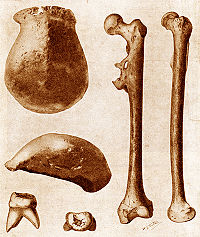
Java Man is the name given to fossils discovered in 1891 at Trinil
- Ngawi Regency
on the banks of the Solo River in East Java
, Indonesia
, one of the first known specimens of Homo erectus
. Its discoverer, Eugène Dubois
, gave it the scientific name Pithecanthropus erectus, a name derived from Greek and Latin roots meaning upright ape-man.
, a femur
, and a few teeth. There is some dissent as to whether all these bones represent the same species. A second, more complete specimen was later discovered in the village of Sangiran
, Central Java, 18 km to the north of Solo
. This find, a skullcap of similar size to that found by Dubois, was discovered by Berlin-born paleontologist GHR von Koenigswald
in 1936. Many more finds have subsequently been made at the Sangiran site, although official reports remain critical of the site's "poor" presentation and interpretation.
 The new date of the Mojokerto child, Dr. Swisher's group [of the Institute of Human Origins in Berkeley] has determined, is about 1.81 million years, and the Sangiran fossils are about 1.66 million years old. The oldest African Homo erectus fossils, found at Koobi Fora in Kenya, has been dated at about the same age as the Mojokerto child.
Until older human remains were discovered in the Great Rift Valley
in Kenya
, Dubois' and Koenigswald's discoveries were the oldest hominid remains ever found. Some scientists of the day suggested Dubois' Java Man as a potential intermediate form between modern humans and the common ancestor we share with the other great apes
. The current consensus of anthropologists is that the direct ancestors of modern humans were African populations of Homo erectus
(possibly Homo ergaster
), rather than the Asian populations exemplified by Java Man and Peking Man
. However, it is only a skull.
Trinil
Trinil is a palaeoanthropological site on the banks of the Bengawan Solo River in Ngawi Regency, East Java Province, Indonesia. It was at this site in 1891 that the Dutch anatomist Eugène Dubois discovered the first early hominid remains to be found outside of Europe: the famous "Java Man" specimen....
- Ngawi Regency
Ngawi Regency
Ngawi is a regency of East Java, Indonesia.Ngawi is well known around the world for its Pithecantropus erectus that found by Eugene Dubois, a Dutch.Ngawi located at the central of East Java province and Central Java province...
on the banks of the Solo River in East Java
East Java
East Java is a province of Indonesia. It is located on the eastern part of the island of Java and includes neighboring Madura and islands to its east and to its north East Java is a province of Indonesia. It is located on the eastern part of the island of Java and includes neighboring Madura and...
, Indonesia
Indonesia
Indonesia , officially the Republic of Indonesia , is a country in Southeast Asia and Oceania. Indonesia is an archipelago comprising approximately 13,000 islands. It has 33 provinces with over 238 million people, and is the world's fourth most populous country. Indonesia is a republic, with an...
, one of the first known specimens of Homo erectus
Homo erectus
Homo erectus is an extinct species of hominid that lived from the end of the Pliocene epoch to the later Pleistocene, about . The species originated in Africa and spread as far as India, China and Java. There is still disagreement on the subject of the classification, ancestry, and progeny of H...
. Its discoverer, Eugène Dubois
Eugène Dubois
Marie Eugène François Thomas Dubois was a Dutch paleoanthropologist. He earned worldwide fame for his discovery of Pithecanthropus erectus , or 'Java Man'...
, gave it the scientific name Pithecanthropus erectus, a name derived from Greek and Latin roots meaning upright ape-man.
History and significance
Dubois' find was a very incomplete specimen, consisting of a skullcapCalvaria (skull)
The calvaria is the upper part of the cranium and surrounds the cranial cavity containing the brain.The calvaria is made up of the frontal, occipital and right and left parietals....
, a femur
Femur
The femur , or thigh bone, is the most proximal bone of the leg in tetrapod vertebrates capable of walking or jumping, such as most land mammals, birds, many reptiles such as lizards, and amphibians such as frogs. In vertebrates with four legs such as dogs and horses, the femur is found only in...
, and a few teeth. There is some dissent as to whether all these bones represent the same species. A second, more complete specimen was later discovered in the village of Sangiran
Sangiran
Sangiran is an archaeological excavation site on the island of Java in Indonesia. The area comprises about 48 km² and is located in Central Java, about 15 kilometers north of Surakarta in the Solo River valley. In 1996 it was accepted as World Heritage by the UNESCO.-History:In 1934 the...
, Central Java, 18 km to the north of Solo
Surakarta
Surakarta, also called Solo or Sala, is a city in Central Java, Indonesia of more than 520,061 people with a population density of 11,811.5 people/km2. The 44 km2 city adjoins Karanganyar Regency and Boyolali Regency to the north, Karanganyar Regency and Sukoharjo Regency to the east and...
. This find, a skullcap of similar size to that found by Dubois, was discovered by Berlin-born paleontologist GHR von Koenigswald
Gustav Heinrich Ralph von Koenigswald
Professor Dr. Gustav Heinrich Ralph von Koenigswald was a distinguished paleontologist and geologist who conducted research on hominins, including Homo erectus. Ralph von Koenigswald made many contributions to paleontology during his career...
in 1936. Many more finds have subsequently been made at the Sangiran site, although official reports remain critical of the site's "poor" presentation and interpretation.
Until older human remains were discovered in the Great Rift Valley
Great Rift Valley
The Great Rift Valley is a name given in the late 19th century by British explorer John Walter Gregory to the continuous geographic trench, approximately in length, that runs from northern Syria in Southwest Asia to central Mozambique in South East Africa...
in Kenya
Kenya
Kenya , officially known as the Republic of Kenya, is a country in East Africa that lies on the equator, with the Indian Ocean to its south-east...
, Dubois' and Koenigswald's discoveries were the oldest hominid remains ever found. Some scientists of the day suggested Dubois' Java Man as a potential intermediate form between modern humans and the common ancestor we share with the other great apes
Great Apes
Great Apes may refer to*Great apes, species in the biological family Hominidae, including humans, chimpanzees, gorillas, and orangutans*Great Apes , a 1997 novel by Will Self...
. The current consensus of anthropologists is that the direct ancestors of modern humans were African populations of Homo erectus
Homo erectus
Homo erectus is an extinct species of hominid that lived from the end of the Pliocene epoch to the later Pleistocene, about . The species originated in Africa and spread as far as India, China and Java. There is still disagreement on the subject of the classification, ancestry, and progeny of H...
(possibly Homo ergaster
Homo ergaster
Homo ergaster is an extinct chronospecies of Homo that lived in eastern and southern Africa during the early Pleistocene, about 2.5–1.7 million years ago.There is still disagreement on the subject of the classification, ancestry, and progeny of H...
), rather than the Asian populations exemplified by Java Man and Peking Man
Peking Man
Peking Man , Homo erectus pekinensis, is an example of Homo erectus. A group of fossil specimens was discovered in 1923-27 during excavations at Zhoukoudian near Beijing , China...
. However, it is only a skull.
See also
- Peking ManPeking ManPeking Man , Homo erectus pekinensis, is an example of Homo erectus. A group of fossil specimens was discovered in 1923-27 during excavations at Zhoukoudian near Beijing , China...
- List of fossil sites (with link directory)
- Homo erectus soloensisHomo erectus soloensisHomo erectus soloensis, known as Solo Man and formerly classified as Homo sapiens soloensis, is generally now regarded as a subspecies of the extinct hominin, Homo erectus. The only known specimens of this anomalous hominid were retrieved from sites along the Bengawan Solo River, on the Indonesian...