
Home      Discussion      Topics      Dictionary      Almanac
Signup       Login
Peking Man

Peking Man

Overview
Peking Man Homo erectus pekinensis, is an example of Homo erectus
Homo erectus
Homo erectus is an extinct species of hominid that lived from the end of the Pliocene epoch to the later Pleistocene, about . The species originated in Africa and spread as far as India, China and Java. There is still disagreement on the subject of the classification, ancestry, and progeny of H...

. A group of fossil specimens was discovered in 1923-27 during excavations at Zhoukoudian
Zhoukoudian
Zhoukoudian or Choukoutien is a cave system in Beijing, China. It has yielded many archaeological discoveries, including one of the first specimens of Homo erectus, dubbed Peking Man, and a fine assemblage of bones of the gigantic hyena Pachycrocuta brevirostris...

 (Chou K'ou-tien) near Beijing
Beijing
Beijing , also known as Peking , is the capital of the People's Republic of China and one of the most populous cities in the world, with a population of 19,612,368 as of 2010. The city is the country's political, cultural, and educational center, and home to the headquarters for most of China's...

 (written 'Peking' before the adoption of the Pinyin romanization system), China
China
Chinese civilization may refer to:* China for more general discussion of the country.* Chinese culture* Greater China, the transnational community of ethnic Chinese.* History of China* Sinosphere, the area historically affected by Chinese culture...

. More recently, the finds have been dated from roughly 750,000 years ago, although a new 26Al/10Be dating suggests they may be as much as 680,000-780,000 years old.
Discussion
Ask a question about 'Peking Man'
Start a new discussion about 'Peking Man'
Answer questions from other users
Full Discussion Forum
 
Unanswered Questions
Encyclopedia
Peking Man Homo erectus pekinensis, is an example of Homo erectus
Homo erectus
Homo erectus is an extinct species of hominid that lived from the end of the Pliocene epoch to the later Pleistocene, about . The species originated in Africa and spread as far as India, China and Java. There is still disagreement on the subject of the classification, ancestry, and progeny of H...

. A group of fossil specimens was discovered in 1923-27 during excavations at Zhoukoudian
Zhoukoudian
Zhoukoudian or Choukoutien is a cave system in Beijing, China. It has yielded many archaeological discoveries, including one of the first specimens of Homo erectus, dubbed Peking Man, and a fine assemblage of bones of the gigantic hyena Pachycrocuta brevirostris...

 (Chou K'ou-tien) near Beijing
Beijing
Beijing , also known as Peking , is the capital of the People's Republic of China and one of the most populous cities in the world, with a population of 19,612,368 as of 2010. The city is the country's political, cultural, and educational center, and home to the headquarters for most of China's...

 (written 'Peking' before the adoption of the Pinyin romanization system), China
China
Chinese civilization may refer to:* China for more general discussion of the country.* Chinese culture* Greater China, the transnational community of ethnic Chinese.* History of China* Sinosphere, the area historically affected by Chinese culture...

. More recently, the finds have been dated from roughly 750,000 years ago, although a new 26Al/10Be dating suggests they may be as much as 680,000-780,000 years old.

Between 1929 and 1937, 15 partial craniums, 11 lower jaws, many teeth, some skeletal bones and large numbers of stone tools were discovered in the Lower Cave at Locality 1 of the Peking Man site at Zhoukoudian, near Beijing, in China. Their age is estimated to be between 500,000 and 300,000 years old. (A number of fossils of modern humans were also discovered in the Upper Cave at the same site in 1933.) The most complete fossils, all of which were braincases or skullcaps, are:
  • Skull III, discovered at Locus E in 1929 is an adolescent or juvenile with a brain size of 915 cc.
  • Skull II, discovered at Locus D in 1929 but only recognized in 1930, is an adult or adolescent with a brain size of 1030 cc.
  • Skulls X, XI and XII (sometimes called LI, LII and LIII) were discovered at Locus L in 1936. They are thought to belong to an adult man, an adult woman and a young adult, with brain sizes of 1225 cc, 1015 cc and 1030 cc respectively. (Weidenreich 1937)
  • Skull V: two cranial fragments were discovered in 1966 which fit with (casts of) two other fragments found in 1934 and 1936 to form much of a skullcap with a brain size of 1140 cc. These pieces were found at a higher level, and appear to be more modern than the other skullcaps. (Jia and Huang 1990)


Most of the study on these fossils was done by Davidson Black until his death in 1934. Franz Weidenreich replaced him and studied the fossils until leaving China in 1941. The original fossils disappeared in 1941 while being shipped to the United States for safety during World War II, but excellent casts and descriptions remain.

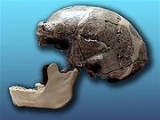
The illustration above is of a reconstruction done by Franz Weidenreich
Franz Weidenreich
-External references:*...

, based on bones from at least four different individuals (none of the fossils were this complete).

Discovery and identification


Swedish
Sweden
Sweden , officially the Kingdom of Sweden , is a Nordic country on the Scandinavian Peninsula in Northern Europe. Sweden borders with Norway and Finland and is connected to Denmark by a bridge-tunnel across the Öresund....

 geologist
Geologist
A geologist is a scientist who studies the solid and liquid matter that constitutes the Earth as well as the processes and history that has shaped it. Geologists usually engage in studying geology. Geologists, studying more of an applied science than a theoretical one, must approach Geology using...

 Johan Gunnar Andersson
Johan Gunnar Andersson
Johan Gunnar Andersson , Swedish archaeologist, paleontologist and geologist, closely associated with the beginnings of Chinese archaeology in the 1920s...

 and American
United States
The United States of America is a federal constitutional republic comprising fifty states and a federal district...

 palaeontologist Walter W. Granger
Walter W. Granger
Walter Willis Granger was an American vertebrate paleontologist who participated in important fossil explorations in the United States, Egypt, China and Mongolia.-Early life and career:...

 came to Zhoukoudian
Zhoukoudian
Zhoukoudian or Choukoutien is a cave system in Beijing, China. It has yielded many archaeological discoveries, including one of the first specimens of Homo erectus, dubbed Peking Man, and a fine assemblage of bones of the gigantic hyena Pachycrocuta brevirostris...

, China
China
Chinese civilization may refer to:* China for more general discussion of the country.* Chinese culture* Greater China, the transnational community of ethnic Chinese.* History of China* Sinosphere, the area historically affected by Chinese culture...

 in search of prehistoric fossils in 1921
1921 in archaeology
The year 1921 in archaeology involved some significant events.-Explorations:*Peking Man Site at Zhoukoudian, China is discovered by Swedish geologist Johan Gunnar Andersson and American palaeontologist Walter W...

. They were directed to the site at Dragon Bone Hill by local quarrymen, where Andersson recognised deposits of quartz that were not native to the area. Immediately realising the importance of this find he turned to his colleague and announced, "Here is primitive man, now all we have to do is find him!"

Excavation work was begun immediately by Andersson's assistant Austria
Austria
Austria , officially the Republic of Austria , is a landlocked country of roughly 8.4 million people in Central Europe. It is bordered by the Czech Republic and Germany to the north, Slovakia and Hungary to the east, Slovenia and Italy to the south, and Switzerland and Liechtenstein to the...

n palaeontologist Otto Zdansky
Otto Zdansky
Otto A. Zdansky was an Austrian paleontologist.He is best known for his work in China, where he, as an assistant to Johan Gunnar Andersson, discovered a fossil tooth of the Peking Man in 1921 at the Dragon Bone Hill, although he did not disclose it until 1926 when he published it in Nature after...

, who found what appeared to be a fossilised human
molar
Molar (tooth)
Molars are the rearmost and most complicated kind of tooth in most mammals. In many mammals they grind food; hence the Latin name mola, "millstone"....

. He returned to the site in 1923
1923 in archaeology
The year 1923 in archaeology involved some significant events.-Explorations:*Expedition under Neil Merton Judd to collect dendrochronological specimens in order to date habitation of Chaco Canyon- Excavations:...

 and materials excavated in the two subsequent digs were sent back to Uppsala University
Uppsala University
Uppsala University is a research university in Uppsala, Sweden, and is the oldest university in Scandinavia, founded in 1477. It consistently ranks among the best universities in Northern Europe in international rankings and is generally considered one of the most prestigious institutions of...

 in Sweden for analysis. In 1926
1926 in archaeology
The year 1926 saw a number of significant events in the field of archaeology:-Explorations:* February: Thomas Gann visits the Mayan ruin of Coba, and publishes the first first-hand description of the site later in the year....

 Andersson announced the discovery of two human molars found in this material and Zdansky published his findings.

Canadian anatomist Davidson Black
Davidson Black
Davidson Black, FRS was a Canadian paleoanthropologist, best known for his naming of Sinanthropus pekinensis . He was Chairman of the Geological Survey of China and a Fellow of the Royal Society...

 of Peking Union Medical College
Peking Union Medical College
Peking Union Medical College is among the most selective medical colleges in the People's Republic of China and is renowned both in its own right and for being connected to one of China's most prestigious institutions of higher learning.-History:...

, excited by Andersson and Zdansky’s find, secured funding from the Rockefeller Foundation
Rockefeller Foundation
The Rockefeller Foundation is a prominent philanthropic organization and private foundation based at 420 Fifth Avenue, New York City. The preeminent institution established by the six-generation Rockefeller family, it was founded by John D. Rockefeller , along with his son John D. Rockefeller, Jr...

 and recommenced excavations at the site in 1927
1927 in archaeology
The year 1927 in archaeology involved some significant events.- Excavations:* Large scale excavations begin at Peking Man Site in Zhoukoudian, China under Canadian paleoanthropologist Davidson Black with support from the Rockefeller Foundation....

 with both Western and Chinese scientists. Swedish palaeontologist Anders Birger Bohlin unearthed a tooth that fall, and Black placed it in a locket around his neck.

Black published his analysis in the journal Nature
Nature (journal)
Nature, first published on 4 November 1869, is ranked the world's most cited interdisciplinary scientific journal by the Science Edition of the 2010 Journal Citation Reports...

, identifying his find as belonging to a new species and genus which he named Sinanthropus pekinensis, but many fellow scientists were skeptical of such an identification based on a single tooth and the Foundation demanded more specimens before they would give an additional grant.

A lower jaw, several teeth, and skull fragments were unearthed in 1928
1928 in archaeology
The year 1928 in archaeology involved some significant events.-Explorations:* American astronomer and University of Arizona professor A. E. Douglass participates in a National Geographic Society research project under Neil Merton Judd exploring Chaco Canyon...

. Black presented these finds to the Foundation and was rewarded with an $80,000 grant that he used to establish the Cenozoic Research Laboratory
Cenozoic Research Laboratory
The Cenozoic Research Laboratory of the Geological Survey of China was established at the Peking Union Medical College in 1928 by Canadian paleoanthropologist Davidson Black and Chinese geologists Ding Wenjing and Weng Wenhao for the research and appraisal of Peking Man fossils unearthed at...

.

Excavations at the site under the supervision of Chinese archaeologists Yang Zhongjian
Yang Zhongjian
Yang Zhongjian , courtesy name Keqiang , also known as C.C. Young, was one of China's foremost paleontologists. He has been called the 'Father of Chinese vertebrate paleontology'...

, Pei Wenzhong
Pei Wenzhong
Pei Wenzhong was a Chinese paleontologist, archaeologist and anthropologist. Professor Pei is considered the founding father of Chinese anthropology....

, and Jia Lanpo
Jia Lanpo
Jia Lanpo was a Chinese prehistorian. Professor Jia was one of the founders of Chinese anthropology.He graduated from the Huiwen Academy in 1929 and went on to work as a trainee at the Cenozoic Research Laboratory of the Geological Survey of China...

 uncovered 200 human fossils (including 6 nearly complete skullcaps
Calvaria (skull)
The calvaria is the upper part of the cranium and surrounds the cranial cavity containing the brain.The calvaria is made up of the frontal, occipital and right and left parietals....

) from more than 40 individual specimens. These excavation came to an end in 1937
1937 in archaeology
The year 1937 in archaeology involved some significant events.-Excavations:* Uaxactun project by Carnegie Institution led by Oliver Ricketson ends.* Excavations at Vergina conducted by University of Thessaloniki....

 with the Japanese invasion
Second Sino-Japanese War
The Second Sino-Japanese War was a military conflict fought primarily between the Republic of China and the Empire of Japan. From 1937 to 1941, China fought Japan with some economic help from Germany , the Soviet Union and the United States...

.

Fossils of Peking Man were placed in the safe at the Cenozoic Research Laboratory of the Peking Union Medical College. Eventually, in November 1941, secretary Hu Chengzi packed up the fossils so they could be sent to USA
United States
The United States of America is a federal constitutional republic comprising fifty states and a federal district...

 for safekeeping until the end of the war. They vanished en route to the port city of Qinhuangdao
Qinhuangdao
Qinhuangdao is a port city in northeastern Hebei province of North China. It is about 300 km east of Beijing, on the Bohai Sea, the innermost gulf of the Yellow Sea....

 in northern China.

Various parties have tried to locate the fossils, but so far they have been without result. In 1972, a US financier Christopher Janus promised a $5,000 (USD) reward for the missing skulls; one woman contacted him, asking for $500,000 (USD) but she later vanished. In July 2005, the Chinese government founded a committee to find the bones to coincide with the 60th anniversary of the end of World War II
World War II
World War II, or the Second World War , was a global conflict lasting from 1939 to 1945, involving most of the world's nations—including all of the great powers—eventually forming two opposing military alliances: the Allies and the Axis...

.

There are various theories of what might have happened, including a theory that the bones sank with the Japanese ship Awa Maru
Awa Maru (1943)
The was a Japanese ocean liner owned by Nippon Yusen Kaisha. The ship was built in 1941-1943 by Mitsubishi Shipbuilding & Engineering Co. at Nagasaki, Japan...

in 1945. Three of the teeth can, however, be found at the Paleontological Museum of Uppsala University
Paleontological Museum of Uppsala University
The Paleontological Museum of Uppsala University, also known as Evolutionsmuseet, is a museum in Sweden containing the largest fossil collection in Scandinavia. The number of items in today's collection is approximately around 5 million unique pieces...

.

Subsequent research


Excavations at Zhoukoudian resumed after the war, and parts of another skull were found in 1966. To date a number of other partial fossil remains have been found. The Peking Man Site at Zhoukoudian was listed by UNESCO
UNESCO
The United Nations Educational, Scientific and Cultural Organization is a specialized agency of the United Nations...

 as a World Heritage Site
World Heritage Site
A UNESCO World Heritage Site is a place that is listed by the UNESCO as of special cultural or physical significance...

 in 1987. New excavations were started at the site in June 2009.

Paleontological conclusions


The first specimens of Homo erectus had been found in Java in 1891
1891 in archaeology
The year 1891 in archaeology involved some significant events.-Explorations:* Brahmagiri first explored by Benjamin L. Rice.- Excavations:* Peabody Museum - Harvard University project at Copan begins....

 by Eugene Dubois
Eugène Dubois
Marie Eugène François Thomas Dubois was a Dutch paleoanthropologist. He earned worldwide fame for his discovery of Pithecanthropus erectus , or 'Java Man'...

, but were dismissed by many as the remains of a deformed ape. The discovery of the great quantity of finds at Zhoukoudian put this to rest and Java Man
Java Man
Java Man is the name given to fossils discovered in 1891 at Trinil - Ngawi Regency on the banks of the Solo River in East Java, Indonesia, one of the first known specimens of Homo erectus...

, who had initially been named Pithecanthropus erectus, was transferred to the genus Homo
Homo (genus)
Homo is the genus that includes modern humans and species closely related to them. The genus is estimated to be about 2.3 to 2.4 million years old, evolving from australopithecine ancestors with the appearance of Homo habilis....

 along with Peking Man.

Contiguous findings of animal remains and evidence of fire and tool usage, as well as the manufacturing of tools, were used to support H. erectus being the first "faber" or tool-worker. The analysis of the remains of "Peking Man" led to the claim that the Zhoukoudian and Java fossils were examples of the same broad stage of human evolution.

This interpretation was challenged in 1985 by Lewis Binford
Lewis Binford
Lewis Roberts Binford was an American archaeologist known for his influential work in archaeological theory, ethnoarchaeology and the Paleolithic period...

, who claimed that the Peking Man was a scavenger
Scavenger
Scavenging is both a carnivorous and herbivorous feeding behavior in which individual scavengers search out dead animal and dead plant biomass on which to feed. The eating of carrion from the same species is referred to as cannibalism. Scavengers play an important role in the ecosystem by...

, not a hunter
Hunting
Hunting is the practice of pursuing any living thing, usually wildlife, for food, recreation, or trade. In present-day use, the term refers to lawful hunting, as distinguished from poaching, which is the killing, trapping or capture of the hunted species contrary to applicable law...

. The 1998 team of Steve Weiner
Steve Weiner
Steve Weiner is a Canadian writer and animator. He was born in Wisconsin and studied writing at the University of California. He lives in Vancouver and in London, England.-Books:Weiner's 1994 debut novel The Museum of Love earned comparisons to William S...

 of the Weizmann Institute of Science
Weizmann Institute of Science
The Weizmann Institute of Science , known as Machon Weizmann, is a university and research institute in Rehovot, Israel. It differs from other Israeli universities in that it offers only graduate and post-graduate studies in the sciences....

 concluded that they had not found evidence that the Peking Man had used fire.

Relation to modern Chinese people


Franz Weidenreich
Franz Weidenreich
-External references:*...

 considered Peking Man as a human ancestor and specifically an ancestor of the Chinese people, as seen in his original multiregional model of human evolution in 1946. Chinese writings on human evolution in 1950 generally considered evidence insufficient to determine whether Peking Man was ancestral to modern humans. One view was that Peking Man in some ways resembled modern Europeans more than modern Asians. However, this debate of the origin has sometimes become complicated by issues of Chinese nationalism. By 1952, however, Peking Man had been considered by some to be a direct ancestor of modern humans. Some paleontologists have noted a perceived continuity in skeletal remains.

A 1999 study undertaken by Chinese geneticist Jin Li
Jin Li
Jin Li is a Chinese geneticist. Jin is a professor at the National Human Genome Center in Shanghai as well as at the Institute of Genetics of Fudan University...

 showed that the genetic diversity of modern Chinese people is well within that of the whole world population, which suggests there was no inter-breeding between modern human immigrants to East Asia and Homo erectus, such as Peking Man, and that the Chinese are descended from Africa, like all other modern humans, in accordance with the recent single-origin hypothesis. However, the RRM2P4
Ribonucleotide reductase
Ribonucleotide reductase is an enzyme that catalyzes the formation of deoxyribonucleotides from ribonucleotides. Deoxyribonucleotides in turn are used in the synthesis of DNA. The reaction catalyzed by RNR is strictly conserved in all living organisms...

 gene data suggests that the Chinese, while largely descending from Africa like others, nevertheless have some genetic legacy from hybridization with older Eurasian populations, consistent with limited multiregional evolution.

See also


  • Zhoukoudian
    Zhoukoudian
    Zhoukoudian or Choukoutien is a cave system in Beijing, China. It has yielded many archaeological discoveries, including one of the first specimens of Homo erectus, dubbed Peking Man, and a fine assemblage of bones of the gigantic hyena Pachycrocuta brevirostris...

  • List of fossil sites (with link directory)
  • List of hominina (hominid) fossils (with images)
  • Human evolution
    Human evolution
    Human evolution refers to the evolutionary history of the genus Homo, including the emergence of Homo sapiens as a distinct species and as a unique category of hominids and mammals...


Footnotes