


Battle of Wagram

Encyclopedia
The Battle of Wagram was the decisive military engagement
of the War of the Fifth Coalition
. It took place on the Marchfeld plain, on the north bank of the Danube
. An important site of the battle was the village of Deutsch-Wagram
, 10 kilometres northeast of Vienna
, which would give its name to the battle. The two-day struggle saw an Imperial French
, German and Italian
army under the command of Emperor
Napoleon I
defeat an army of the Austrian Empire
under the command of Archduke Charles of Austria-Teschen
.
At the end of May, following a setback at the battle of Aspern-Essling
, Napoleon remained with his army on the right (southern) bank of the Danube and concentrated significant resources on the great island of Lobau
, northeast of the occupied Austrian capital. Using the island as a springboard for another crossing, the French and their German and Italian allies began crossing the river to the north bank, as night fell, on 4 July. During the next morning, they had successfully deployed on the Marchfeld, pushing back all Austrian opposition in the area. The evening saw a series of violent French and Allied attacks on the strong Austrian positions, the latter managing to hold their ground. On 6 July, at dawn, the Austrians moved forward and launched an aggressive series of attacks, seeking to take the opposing army in double envelopment. Despite the fact that this offensive nearly shattered the French and Allied centre and left flank, Napoleon masterfully redeployed his forces to counter the Austrian plan. Then, by setting up a Grand Battery
and ordering a violent attack on the Austrian left and centre, the Emperor of the French managed to push back Archduke Charles' line, the latter promptly organising a phased retreat. Hostilities ended at about 20:00 hours, with the Austrians retreating in relatively good order, while the exhausted French and Allies were unable to launch a proper pursuit. Commanding a secondary army, Archduke John of Austria was in the vicinity of the battlefield on 6 July, but was unable to join the main Austrian force and thus played no part in the battle of Wagram. After the battle, Archduke Charles remained in command of a significant and still cohesive force and decided to retreat to Bohemia
, where he clashed again with the French and was again defeated, at the battle of Znaim. This forced him to sign an armistice
, which was to be sanctioned by Emperor Francis I of Austria
.
The two-day battle of Wagram was particularly bloody, mainly due to the extensive use of artillery on a flat battlefield packed with some 300,000 men. Despite the fact that Napoleon was the uncontested winner, he failed to secure a complete victory and the Austrian casualties were only slightly greater than those of the French and Allies. Nonetheless, the defeat was serious enough to shatter the morale of the Austrians, who could no longer find the will to continue the struggle, hence deciding to accept the harsh Treaty of Schönbrunn
(1809), which meant the loss of one sixth of the Empire's subjects, alongside significant territories.
in 1805, Emperor Francis II signed the Treaty of Pressburg with France. Its terms were harsh. Austria paid France a war indemnity of 40 million francs and ceded 2.5 million of the Austrian Empire's 24 million subjects, which also amounted to giving up one-sixth of the Austrian Empire's revenues. The population lost went mostly to expand French client kingdoms
, such as those of Italy
and Bavaria
, and also to elements of the Confederation of the Rhine
, created by Napoleon to act as a buffer
against enemies in the east and to provide him with troops. In 1806, after Napoleon's comprehensive defeat of Prussia
and under French pressure, Francis II relinquished the centuries-old title of Holy Roman Emperor
and became (simply) Francis I, Emperor of Austria
—not at least aiming to preserve the imperial title to his family, the danger of Napoleon becoming Roman Emperor was imminent. Not surprisingly, the Treaty of Pressburg was unpopular in Habsburg
ruling circles and a war party began to form. The Archduke Charles, the emperor's brother and Austria's ablest general, was appointed Generalissimus (supreme commander) with a remit to reform the army and the military establishment, whose incompetence had been exposed by the 1805 defeat. Austria also began to seek allies for the coming conflict, but met with little success. Following the 1807 Treaty of Tilsit, Russia was a French ally. Prussia procrastinated and eventually declined to participate. Britain, already at war with France, was receptive but her army was already fully committed in Spain
and was unable to offer more than the prospect of a diversionary intervention in northern Europe, which eventually did not take place until after Austria's defeat. Austria therefore went to war essentially alone, although with high hopes of rallying nascent nationalism in Germany and northern Italy to her cause. In the end, although a pro-Austrian revolt under Andreas Hofer
erupted in the Bavarian Tyrol
, Napoleon's German clients and allies remained aligned to the French cause.
 On 9 April 1809, armies under the overall command of Archduke Charles invaded Bavaria and northern Italy. There was no declaration of war
. A simple message from Charles was conveyed to the outlying outposts of the French army—"I have orders to advance with my forces and to treat as enemies any who oppose me"—and hours later the Austrian army attacked. Although Napoleon was aware that an Austrian attack was likely, it came sooner than he expected, and he was still in Paris when the Archduke Charles advanced. Though slow-moving, the Austrian attack was initially successful, capturing Munich
and almost splitting the French army in Bavaria in two. When Napoleon arrived with the Imperial Guard, however, he counter-attacked vigorously and defeated various Austrian columns at Abensberg
, Landshut
, Eckmühl
and Ratisbon
. Charles retreated along the north bank of the Danube
with Napoleon in pursuit. On 12 May the French captured Vienna
, on the Danube's south bank. The Austrians did not capitulate or ask for terms despite the loss of their capital, and Charles' main body, north-east of Vienna, was still undefeated. Napoleon's bridging trains had not caught up with the main body, but on 21 May, he crossed the Danube east of Vienna, aiming to find and attack the Archduke's army. Napoleon chose a crossing point where sandbars and islands broke the Danube up into several smaller, relatively manageable spans that could be bridged with the extemporised pontoons and trestles available. Archduke Charles, who had anticipated this move, waited until part of Napoleon's army had occupied the Mühlau salient and the villages of Aspern and Essling
, which flanked it, and then attacked the bridgehead. Napoleon's attempts to reinforce the outnumbered defenders were thwarted by the Austrians' successful ploy of sending heavy stone-laden barges—and even, at one point, an entire floating watermill—downstream to ram and break the flimsy French bridges. This prevented both reinforcements and ammunition from reaching the French defenders. After a fierce two-day battle in which Marshal Lannes
, one of Napoleon's abler subordinates, was mortally wounded, the Austrians took Aspern and forced Napoleon to abandon the bridgehead. He withdrew to the island of Lobau
, a large island in the middle of the Danube that the French army was using as a staging post across the river.
Lobau, with its masses of densely-packed French troops, was a lucrative artillery target within easy range of the opposite shore, but Charles made no attempt to bombard it. Instead he left an observation force on the left bank and withdrew several miles. Napoleon recognised that a second attempt to cross the Danube would have to be made, and would require much more thorough preparation this time. On 1 June, French engineers and naval battalions began construction of pontoon
and trestle bridges
across each span, built far more robustly than the previous efforts. The works, which amounted to three major bridges and eight smaller ones swung into position on commencement of the assault, were completed on 21 June. Upstream of the bridges, piles were driven into the river bed to form an 800-metre long double palisade to prevent a repeat of the previous ramming tactics. Boats were requisitioned, fitted with guns, and used to patrol the river to prevent attacks on the bridges. Lobau remained the main staging post, but became an armed camp filled with ammunition, supplies, and troops. In early July, the French army recrossed the Danube and created a decoy bridgehead in the Mühlau salient, directly north of Lobau. On the night of 4 to 5 July, all was ready and 162,000 French troops executed a masterly crossing of the river onto the opposite bank east of Lobau. There, pivoting on Gross-Enzersdorf, they began to fan out across the Marchfeld, a plain enclosed on the south by the Danube, on the west by the Bisamberg escarpment
, on the north by the hills of the Weinviertel
, and on the east by the river Morava (March). The Danube floodplain ist limited on the north by the "Wagram", the southern slope of an old river terraces, which next to the village of Deutsch-Wagram is about 10 m high and to the south is followed by the Russbach, a small watercourse. The Marchfeld was regularly used in peacetime by the Austrian army for manoeuvres and was familiar ground to Archduke Charles, who had deployed the center of his army in defensive positions on higher ground along the Wagram behind the Russbach.
The Austrian
army was divided into several corps, as follows.
Although in the vicinity of the battlefield, the V Corps (9,000 men) under Feldmarschall-Leutnant Prince Heinrich XV Reuss of Plauen
had been left behind on the Bisamberg heights as a strategic reserve and would not see any major action during the two-day battle. The V Corps was deployed to cover the Austrian communication lines towards Bohemia
and Moravia
and were thus not a part of Charles’ effective fighting force.
and was led by Napoleon's stepson, the Viceroy of Italy, Prince Eugène
. The second was the XI Corps, which formed the Army of Dalmatia, under general of division Auguste de Marmont. However, the Army of Dalmatia, as well as much of the Army of Italy only arrived on the battlefield towards midday on 6 July, at about the same time as an additional force, a Bavarian
division under general Karl Philipp von Wrede
from VII Corps.
Thus, Napoleon could muster an army of around 166,000 men, with 433 artillery. They were organized in the usual French
Corps system and the main army, La Grande Armée d'Allemagne ("the Grand Army of Germany") was divided as follows:
The much smaller "Army of Italy", under the command of Viceroy Eugène was made up of one guard formation and two small Army Corps:
Napoleon also massed a massive additional artillery on the island of Lobau – 28 18-pounders, 24 12-pounders, 17 28-centimetre heavy mortars, 10 howitzers and a number of small calibre guns (4 and 6-pounders). Also stationed on the island of Lobau during the battle were one regiment and 5 battalions defending the crucial communications with Vienna. These troops would not see action at Wagram, although the batteries would open an artillery barrage when Austrians from Klenau's
VI Corps came within range, on the second day of the battle. All the forces that remained on this island were placed under the command of general Aubry, later under the command of general Jean-Louis Reynier.
Finally, the VIII Corps, under general of division Dominique Vandamme
was left out of the battle and was left behind to cover Vienna and the southern bank of the Danube upstream from the Austrian capital.
, on the Marchfeld. Situated on the left bank of the Danube
, the city of Pressburg, where Archduke John of Austria’s secondary army was situated, was only 40 km away from this field of battle. The Marchfeld was a wide, almost entirely flat plain, which at the time of the battle, however, was partially covered with high corn crops that did obstruct observation of certain parts of the battlefield. In 1809, several small villages existed and were situated at a small distance one of the other. At the northern limit of the Marchfeld, there was a small river called the Russbach, flowing from northwest to southeast; while unimpressive in width and depth, the banks of the river were covered by underbrush and trees, and beyond the river there was an area of around 100 metres of boggy ground. Thus, the Russbach did represent a formidable obstacle for cavalry and it needed to be bridged in order for artillery to cross. North of the Russbach there was an escarpment called Wagram (between 10 and 20 metres high), situated in the sector of the villages of Deutsch-Wagram
and Markgrafneusiedl
. Along the Russbach, the villages of Deutsch-Wagram, Baumersdorf and Markgrafneusiedl would represent key positions for the Austrian defensive system. Behind the Russbach lay the Wagram escarpment, which constituted an excellent observation point. The 9-km long, 6-km wide battlefield would be delimited by the village of Kagran and the 350-m high Bisamberg plateau at the west, Glinzerdorf at the east, Aspen
and Essling
at the south and Deutsch-Wagram at the north.
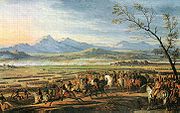 By the day of the battle, Lobau Island was a massive warehouse and Napoleon was ready to move out.
Charles, for his part, recognised that Napoleon would have to cross the river in much the same place as previously. Rather than defending likely stretches of the river bank, under heavy French fire from the island of Lobau, or attempting to hold the Marchfeld itself — whose broken terrain he thought would offer too much advantage to the French light troops — he pulled most of his army back behind the Russbach, a semicircular watercourse to the north. His army, deployed behind the Russbach, formed a V-shaped line nearly twelve miles long, anchored in the west on Süssenbrunn, at the apex on Wagram and Aderklaa, and in the east on Markgrafneusiedl. Charles vacillated between offensive and defensive battle plans and only on the very eve of the battle did he decide to hold this position and to use one wing to pin and the other to outflank any French attack. This revised plan was not communicated effectively to his formation commanders, with the result that FML Nordmann, commanding the Advance Guard corps on the Austrian left, was incorrectly left in an exposed position that he mistakenly thought he was supposed to hold.
's 2nd Corps, Louis Davout
's 3rd Corps, 4th Corps under André Masséna
, the Army of Italy under de Beauharnais, the Saxon 9th Corps under Jean-Baptiste Bernadotte, and Auguste Marmont's 11th Corps. Additionally present were the Imperial Guard and Jean-Baptiste Bessières
's Cavalry Reserve, and Karl Wrede
's Bavarian contingent, which marched 120 miles in 6 days to arrive on the second day.
On the other side of the Marchfeld, Archduke Charles had neglected to concentrate every man available. A brigade of Johann Kollowrat
's Corps was not recalled, the 5th Corps of Prince Heinrich XV of Reuss-Plauen was left to the north-west as a reserve upon which to rally, and the Archduke John's 15,000 men were allowed to loiter at Bratislava
(Pressburg). Other formations were left doing little useful in Galicia and Bohemia. Had all these troops been recalled, Charles could have faced Napoleon with over 60,000 more troops than he actually did. The force he did have was composed of Armand von Nordmann
's Advance Guard, Heinrich Graf von Bellegarde
's 1st Corps, Prince Friedrich of Hohenzollern-Hechingen
's 2nd Corps, Kollowrat's 3rd Corps, Prince Franz Seraph of Rosenberg-Orsini
's 4th Corps, Johann von Klenau
's 6th Corps (Klenau took over command of this formation from Johann von Hiller
on the eve of the battle), and Johann Liechtenstein's Reserve Corps of grenadiers and cavalry.
Marshal Louis Berthier
, Napoleon's chief of staff, when giving orders to the various corps, accidentally assigned the same bridge to two of them. Although a delay ensued, Davout, Masséna and Oudinot and their corps were across. Bernadotte and his Saxons joined them, and on the 5th of July, Napoleon began his deployment near Aspern and Essling.
At around 6 o'clock, in an attempt to decide the battle in a single day and to prevent the Austrian reserves under Archduke John coming up, Napoleon ordered an attack on the Austrian centre. This was manned by the corps of Bellegarde and Hohenzollern along the line of the Russbach. This extemporised attack was poorly co-ordinated and went in piecemeal. It initially carried the high ground beyond Wagram. But Archduke Charles personally rallied his troops and the attack faltered under the heavy Austrian fire and was bloodily repulsed. Austrian counterattacks then retook all the lost ground. In a foretaste of the following day's fighting, the encounters in the streets and hedgerows of Aderklaa were fierce and characterised by friendly-fire incidents, as French troops followed Saxons into action and mistook their white uniforms for those of the Austrians. The fighting drew Masséna's corps to the north, leaving few troops in the area.
In the centre, the Austrians succeeded in throwing back Bernadotte's 9th Corps. Bernadotte had abandoned Aderklaa without orders and this key village fell to the Austrians without a shot. Advancing past the village, the Austrians broke the Saxons, who fled the field with Bernadotte galloping in front of them trying to rally them. Napoleon met Bernadotte as he was doing this and dismissed him from command of his corps on the spot. To stem the Austrian attack, Napoleon created a Grand Battery
of 112 cannon which poured shot into the advancing Austrian formations. The effects of this fire and cavalry attacks halted Kollowrat's corps. Klenau brushed aside a single French division but then ran into a ferocious bombardment from Jean Reynier
's massed cannon on Lobau Island. Masséna's Corps pulled out of the center and executed a five-mile march south, within gunshot of the Austrian positions, to fall upon Klenau's left flank as he fought his way into Napoleon's left rear. This stabilised the French left flank.
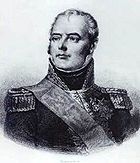
A major attack was now launched against the advancing Austrian centre by General of Division Jacques MacDonald's corps, which formed part of Eugene's command. MacDonald formed 27 battalions into a hollow square about 8,000 strong and launched this formation at the Austrian centre. The Austrians responded with intense artillery fire and local charges by their light cavalry. Hussar Gen. Antoine Lasalle rode to Macdonald's support with French light cavalry, but was killed doing so. After ferocious fighting at bayonet point, Macdonald's attack ground to a halt without breaking through the Austrian centre. He succeeded, however, in preventing Charles from reinforcing his left flank, and the Austrians now began to evacuate the position, falling back in an orderly fashion towards Znaim to the north-west.
Exhausted by forty hours of marching and fighting, the French army followed rather than pursued Charles. MacDonald was granted a Marshal
's baton on the field of battle.
 Charles had sent for help from his brother, Archduke John, but John only got his troops on the road by the next morning, far too late to help Charles. Five days after the battle, the French defeated the rear guard of the retreating Austrians at Znaim
and Charles proposed an armistice, to which Napoleon agreed.
MacDonald was promoted to Marshal on the battlefield, for his leadership in attacking the Austrian centre. Oudinot and Marmont received Marshal's batons at Znaim, Marmont being somewhat surprised to receive his. The army soon had a new chant about the three men: La France a nommé MacDonald, L'armée a nommé Oudinot, L'amitié a nommé Marmont (France chose MacDonald, the army chose Oudinot, friendship chose Marmont).
Avenue de Wagram
, one of the avenues leading up to the Arc de Triomphe
on the Place de l'Etoile
in Paris, France, was renamed after this battle in 1864.
, Josef Philipp Vukassovich
, Peter Vecsey, and Konstantin Ghilian Karl d'Aspré
.
Battle
Generally, a battle is a conceptual component in the hierarchy of combat in warfare between two or more armed forces, or combatants. In a battle, each combatant will seek to defeat the others, with defeat determined by the conditions of a military campaign...
of the War of the Fifth Coalition
War of the Fifth Coalition
The War of the Fifth Coalition, fought in the year 1809, pitted a coalition of the Austrian Empire and the United Kingdom against Napoleon's French Empire and Bavaria. Major engagements between France and Austria, the main participants, unfolded over much of Central Europe from April to July, with...
. It took place on the Marchfeld plain, on the north bank of the Danube
Danube
The Danube is a river in the Central Europe and the Europe's second longest river after the Volga. It is classified as an international waterway....
. An important site of the battle was the village of Deutsch-Wagram
Deutsch-Wagram
Deutsch-Wagram is a city in Austria in the federal state of Lower Austria. It lies 15 km northeast of Vienna and has a population of 6,808 as of the 2001 census.- History :...
, 10 kilometres northeast of Vienna
Vienna
Vienna is the capital and largest city of the Republic of Austria and one of the nine states of Austria. Vienna is Austria's primary city, with a population of about 1.723 million , and is by far the largest city in Austria, as well as its cultural, economic, and political centre...
, which would give its name to the battle. The two-day struggle saw an Imperial French
First French Empire
The First French Empire , also known as the Greater French Empire or Napoleonic Empire, was the empire of Napoleon I of France...
, German and Italian
Kingdom of Italy (Napoleonic)
The Kingdom of Italy was a state founded in Northern Italy by Napoleon, fully influenced by revolutionary France, that ended with his defeat and fall.-Constitutional statutes:...
army under the command of Emperor
Emperor of the French
The Emperor of the French was the title used by the Bonaparte Dynasty starting when Napoleon Bonaparte was given the title Emperor on 18 May 1804 by the French Senate and was crowned emperor of the French on 02 December 1804 at the cathedral of Notre Dame de Paris, in Paris with the Crown of...
Napoleon I
Napoleon I
Napoleon Bonaparte was a French military and political leader during the latter stages of the French Revolution.As Napoleon I, he was Emperor of the French from 1804 to 1815...
defeat an army of the Austrian Empire
Austrian Empire
The Austrian Empire was a modern era successor empire, which was centered on what is today's Austria and which officially lasted from 1804 to 1867. It was followed by the Empire of Austria-Hungary, whose proclamation was a diplomatic move that elevated Hungary's status within the Austrian Empire...
under the command of Archduke Charles of Austria-Teschen
Archduke Charles, Duke of Teschen
Archduke Charles of Austria, Duke of Teschen was an Austrian field-marshal, the third son of emperor Leopold II and his wife Infanta Maria Luisa of Spain...
.
At the end of May, following a setback at the battle of Aspern-Essling
Battle of Aspern-Essling
In the Battle of Aspern-Essling , Napoleon attempted a forced crossing of the Danube near Vienna, but the French and their allies were driven back by the Austrians under Archduke Charles...
, Napoleon remained with his army on the right (southern) bank of the Danube and concentrated significant resources on the great island of Lobau
Lobau
The Lobau is a Vienna floodplain on the northern side of the Danube and partly in Großenzersdorf, Lower Austria. It has been part of the Danube-Auen National Park since 1996 and has been a protected area since 1978. It is used as a recreational area and is known as a site of nudism. There is...
, northeast of the occupied Austrian capital. Using the island as a springboard for another crossing, the French and their German and Italian allies began crossing the river to the north bank, as night fell, on 4 July. During the next morning, they had successfully deployed on the Marchfeld, pushing back all Austrian opposition in the area. The evening saw a series of violent French and Allied attacks on the strong Austrian positions, the latter managing to hold their ground. On 6 July, at dawn, the Austrians moved forward and launched an aggressive series of attacks, seeking to take the opposing army in double envelopment. Despite the fact that this offensive nearly shattered the French and Allied centre and left flank, Napoleon masterfully redeployed his forces to counter the Austrian plan. Then, by setting up a Grand Battery
Grand Battery
Grand Battery was a French artillery tactic of the Napoleonic wars. It involved massing all available batteries into a single large, temporary one, and concentrating the firepower of their guns at a single point in the enemy's lines.Substituting volume of fire for accuracy, rate of fire and rapid...
and ordering a violent attack on the Austrian left and centre, the Emperor of the French managed to push back Archduke Charles' line, the latter promptly organising a phased retreat. Hostilities ended at about 20:00 hours, with the Austrians retreating in relatively good order, while the exhausted French and Allies were unable to launch a proper pursuit. Commanding a secondary army, Archduke John of Austria was in the vicinity of the battlefield on 6 July, but was unable to join the main Austrian force and thus played no part in the battle of Wagram. After the battle, Archduke Charles remained in command of a significant and still cohesive force and decided to retreat to Bohemia
Bohemia
Bohemia is a historical region in central Europe, occupying the western two-thirds of the traditional Czech Lands. It is located in the contemporary Czech Republic with its capital in Prague...
, where he clashed again with the French and was again defeated, at the battle of Znaim. This forced him to sign an armistice
Armistice of Znaim
The Armistice of Znaim was a ceasefire agreed between Archduke Charles and Napoleon I on 12 July 1809 following the Battle of Znaim, effectively ending hostilities between Austria and France in the War of the Fifth Coalition....
, which was to be sanctioned by Emperor Francis I of Austria
Francis II, Holy Roman Emperor
Francis II was the last Holy Roman Emperor, ruling from 1792 until 6 August 1806, when he dissolved the Empire after the disastrous defeat of the Third Coalition by Napoleon at the Battle of Austerlitz...
.
The two-day battle of Wagram was particularly bloody, mainly due to the extensive use of artillery on a flat battlefield packed with some 300,000 men. Despite the fact that Napoleon was the uncontested winner, he failed to secure a complete victory and the Austrian casualties were only slightly greater than those of the French and Allies. Nonetheless, the defeat was serious enough to shatter the morale of the Austrians, who could no longer find the will to continue the struggle, hence deciding to accept the harsh Treaty of Schönbrunn
Treaty of Schönbrunn
The Treaty of Schönbrunn , sometimes known as the Treaty of Vienna, was signed between France and Austria at the Schönbrunn Palace of Vienna on 14 October 1809. This treaty ended the Fifth Coalition during the Napoleonic Wars...
(1809), which meant the loss of one sixth of the Empire's subjects, alongside significant territories.
Background
After defeat at the battle of AusterlitzBattle of Austerlitz
The Battle of Austerlitz, also known as the Battle of the Three Emperors, was one of Napoleon's greatest victories, where the French Empire effectively crushed the Third Coalition...
in 1805, Emperor Francis II signed the Treaty of Pressburg with France. Its terms were harsh. Austria paid France a war indemnity of 40 million francs and ceded 2.5 million of the Austrian Empire's 24 million subjects, which also amounted to giving up one-sixth of the Austrian Empire's revenues. The population lost went mostly to expand French client kingdoms
Vassal state
A vassal state is any state that is subordinate to another. The vassal in these cases is the ruler, rather than the state itself. Being a vassal most commonly implies providing military assistance to the dominant state when requested to do so; it sometimes implies paying tribute, but a state which...
, such as those of Italy
Kingdom of Italy (Napoleonic)
The Kingdom of Italy was a state founded in Northern Italy by Napoleon, fully influenced by revolutionary France, that ended with his defeat and fall.-Constitutional statutes:...
and Bavaria
Bavaria
Bavaria, formally the Free State of Bavaria is a state of Germany, located in the southeast of Germany. With an area of , it is the largest state by area, forming almost 20% of the total land area of Germany...
, and also to elements of the Confederation of the Rhine
Confederation of the Rhine
The Confederation of the Rhine was a confederation of client states of the First French Empire. It was formed initially from 16 German states by Napoleon after he defeated Austria's Francis II and Russia's Alexander I in the Battle of Austerlitz. The Treaty of Pressburg, in effect, led to the...
, created by Napoleon to act as a buffer
Buffer state
A buffer state is a country lying between two rival or potentially hostile greater powers, which by its sheer existence is thought to prevent conflict between them. Buffer states, when authentically independent, typically pursue a neutralist foreign policy, which distinguishes them from satellite...
against enemies in the east and to provide him with troops. In 1806, after Napoleon's comprehensive defeat of Prussia
Prussia
Prussia was a German kingdom and historic state originating out of the Duchy of Prussia and the Margraviate of Brandenburg. For centuries, the House of Hohenzollern ruled Prussia, successfully expanding its size by way of an unusually well-organized and effective army. Prussia shaped the history...
and under French pressure, Francis II relinquished the centuries-old title of Holy Roman Emperor
Holy Roman Emperor
The Holy Roman Emperor is a term used by historians to denote a medieval ruler who, as German King, had also received the title of "Emperor of the Romans" from the Pope...
and became (simply) Francis I, Emperor of Austria
Emperor of Austria
The Emperor of Austria was a hereditary imperial title and position proclaimed in 1804 by the Holy Roman Emperor Francis II, a member of the House of Habsburg-Lorraine, and continually held by him and his heirs until the last emperor relinquished power in 1918. The emperors retained the title of...
—not at least aiming to preserve the imperial title to his family, the danger of Napoleon becoming Roman Emperor was imminent. Not surprisingly, the Treaty of Pressburg was unpopular in Habsburg
Habsburg
The House of Habsburg , also found as Hapsburg, and also known as House of Austria is one of the most important royal houses of Europe and is best known for being an origin of all of the formally elected Holy Roman Emperors between 1438 and 1740, as well as rulers of the Austrian Empire and...
ruling circles and a war party began to form. The Archduke Charles, the emperor's brother and Austria's ablest general, was appointed Generalissimus (supreme commander) with a remit to reform the army and the military establishment, whose incompetence had been exposed by the 1805 defeat. Austria also began to seek allies for the coming conflict, but met with little success. Following the 1807 Treaty of Tilsit, Russia was a French ally. Prussia procrastinated and eventually declined to participate. Britain, already at war with France, was receptive but her army was already fully committed in Spain
Peninsular War
The Peninsular War was a war between France and the allied powers of Spain, the United Kingdom, and Portugal for control of the Iberian Peninsula during the Napoleonic Wars. The war began when French and Spanish armies crossed Spain and invaded Portugal in 1807. Then, in 1808, France turned on its...
and was unable to offer more than the prospect of a diversionary intervention in northern Europe, which eventually did not take place until after Austria's defeat. Austria therefore went to war essentially alone, although with high hopes of rallying nascent nationalism in Germany and northern Italy to her cause. In the end, although a pro-Austrian revolt under Andreas Hofer
Andreas Hofer
Andreas Hofer was a Tirolean innkeeper and patriot. He was the leader of a rebellion against Napoleon's forces....
erupted in the Bavarian Tyrol
German Tyrol
German Tyrol is a historical region in the Alps now divided between Austria and Italy. It includes largely ethnic German areas of historical County of Tyrol: the Austrian state of Tyrol and the province of South Tyrol but not the largely Italian-speaking province of Trentino .-History:German...
, Napoleon's German clients and allies remained aligned to the French cause.
Initial hostilities
Declaration of war
A declaration of war is a formal act by which one nation goes to war against another. The declaration is a performative speech act by an authorized party of a national government in order to create a state of war between two or more states.The legality of who is competent to declare war varies...
. A simple message from Charles was conveyed to the outlying outposts of the French army—"I have orders to advance with my forces and to treat as enemies any who oppose me"—and hours later the Austrian army attacked. Although Napoleon was aware that an Austrian attack was likely, it came sooner than he expected, and he was still in Paris when the Archduke Charles advanced. Though slow-moving, the Austrian attack was initially successful, capturing Munich
Munich
Munich The city's motto is "" . Before 2006, it was "Weltstadt mit Herz" . Its native name, , is derived from the Old High German Munichen, meaning "by the monks' place". The city's name derives from the monks of the Benedictine order who founded the city; hence the monk depicted on the city's coat...
and almost splitting the French army in Bavaria in two. When Napoleon arrived with the Imperial Guard, however, he counter-attacked vigorously and defeated various Austrian columns at Abensberg
Battle of Abensberg
The Battle of Abensberg took place on 20 April 1809, between a Franco-German force under the command of Emperor Napoleon I of France and a reinforced Austrian corps led by Feldmarschall-Leutnant Archduke Louis of Austria. As the day wore on, Feldmarschall-Leutnant Johann von Hiller arrived with...
, Landshut
Battle of Landshut (1809)
The Battle of Landshut took place on April 21, 1809, between the French, Württembergers and Bavarians under Napoleon which numbered about 77,000 strong, and 36,000 Austrians under the General Johann von Hiller...
, Eckmühl
Battle of Eckmühl
The Battle of Eckmühl fought on 21 April – 22 April 1809, was the turning point of the 1809 Campaign, also known as the War of the Fifth Coalition...
and Ratisbon
Battle of Ratisbon
The Battle of Ratisbon, also called the Battle of Regensburg, of the Napoleonic Wars was fought on the 23 April 1809 between the army of the First French Empire, led by Napoleon I, and that of the Austrian Empire, led by Archduke Charles...
. Charles retreated along the north bank of the Danube
Danube
The Danube is a river in the Central Europe and the Europe's second longest river after the Volga. It is classified as an international waterway....
with Napoleon in pursuit. On 12 May the French captured Vienna
Vienna
Vienna is the capital and largest city of the Republic of Austria and one of the nine states of Austria. Vienna is Austria's primary city, with a population of about 1.723 million , and is by far the largest city in Austria, as well as its cultural, economic, and political centre...
, on the Danube's south bank. The Austrians did not capitulate or ask for terms despite the loss of their capital, and Charles' main body, north-east of Vienna, was still undefeated. Napoleon's bridging trains had not caught up with the main body, but on 21 May, he crossed the Danube east of Vienna, aiming to find and attack the Archduke's army. Napoleon chose a crossing point where sandbars and islands broke the Danube up into several smaller, relatively manageable spans that could be bridged with the extemporised pontoons and trestles available. Archduke Charles, who had anticipated this move, waited until part of Napoleon's army had occupied the Mühlau salient and the villages of Aspern and Essling
Battle of Aspern-Essling
In the Battle of Aspern-Essling , Napoleon attempted a forced crossing of the Danube near Vienna, but the French and their allies were driven back by the Austrians under Archduke Charles...
, which flanked it, and then attacked the bridgehead. Napoleon's attempts to reinforce the outnumbered defenders were thwarted by the Austrians' successful ploy of sending heavy stone-laden barges—and even, at one point, an entire floating watermill—downstream to ram and break the flimsy French bridges. This prevented both reinforcements and ammunition from reaching the French defenders. After a fierce two-day battle in which Marshal Lannes
Jean Lannes
Jean Lannes, 1st Duc de Montebello, was a Marshal of France. He was one of Napoleon's most daring and talented generals. Napoleon once commented on Lannes: "I found him a pygmy and left him a giant"...
, one of Napoleon's abler subordinates, was mortally wounded, the Austrians took Aspern and forced Napoleon to abandon the bridgehead. He withdrew to the island of Lobau
Lobau
The Lobau is a Vienna floodplain on the northern side of the Danube and partly in Großenzersdorf, Lower Austria. It has been part of the Danube-Auen National Park since 1996 and has been a protected area since 1978. It is used as a recreational area and is known as a site of nudism. There is...
, a large island in the middle of the Danube that the French army was using as a staging post across the river.
Lobau, with its masses of densely-packed French troops, was a lucrative artillery target within easy range of the opposite shore, but Charles made no attempt to bombard it. Instead he left an observation force on the left bank and withdrew several miles. Napoleon recognised that a second attempt to cross the Danube would have to be made, and would require much more thorough preparation this time. On 1 June, French engineers and naval battalions began construction of pontoon
Pontoon bridge
A pontoon bridge or floating bridge is a bridge that floats on water and in which barge- or boat-like pontoons support the bridge deck and its dynamic loads. While pontoon bridges are usually temporary structures, some are used for long periods of time...
and trestle bridges
Trestle
A trestle is a rigid frame used as a support, especially referring to a bridge composed of a number of short spans supported by such frames. In the context of trestle bridges, each supporting frame is generally referred to as a bent...
across each span, built far more robustly than the previous efforts. The works, which amounted to three major bridges and eight smaller ones swung into position on commencement of the assault, were completed on 21 June. Upstream of the bridges, piles were driven into the river bed to form an 800-metre long double palisade to prevent a repeat of the previous ramming tactics. Boats were requisitioned, fitted with guns, and used to patrol the river to prevent attacks on the bridges. Lobau remained the main staging post, but became an armed camp filled with ammunition, supplies, and troops. In early July, the French army recrossed the Danube and created a decoy bridgehead in the Mühlau salient, directly north of Lobau. On the night of 4 to 5 July, all was ready and 162,000 French troops executed a masterly crossing of the river onto the opposite bank east of Lobau. There, pivoting on Gross-Enzersdorf, they began to fan out across the Marchfeld, a plain enclosed on the south by the Danube, on the west by the Bisamberg escarpment
Escarpment
An escarpment is a steep slope or long cliff that occurs from erosion or faulting and separates two relatively level areas of differing elevations.-Description and variants:...
, on the north by the hills of the Weinviertel
Weinviertel
The Weinviertel or Viertel unter dem Manhartsberg is located in the northeast of Lower Austria....
, and on the east by the river Morava (March). The Danube floodplain ist limited on the north by the "Wagram", the southern slope of an old river terraces, which next to the village of Deutsch-Wagram is about 10 m high and to the south is followed by the Russbach, a small watercourse. The Marchfeld was regularly used in peacetime by the Austrian army for manoeuvres and was familiar ground to Archduke Charles, who had deployed the center of his army in defensive positions on higher ground along the Wagram behind the Russbach.
The Austrian Army
During the two-day battle, Archduke Charles of Austria would be able to count only on the troops of the Kaiserlich-königliche Hauptarmee, the main Austrian army. Archduke Charles had planned for the small Army of Inner Austria under Archduke John of Austria to participate in the battle, but this force would arrive towards the end of the second day of battle, too late to have any effect on the outcome. Thus, the forces that Charles had available for the two days of battle were about 145,000 men, with 414 artillery pieces.The Austrian
Austrian Empire
The Austrian Empire was a modern era successor empire, which was centered on what is today's Austria and which officially lasted from 1804 to 1867. It was followed by the Empire of Austria-Hungary, whose proclamation was a diplomatic move that elevated Hungary's status within the Austrian Empire...
army was divided into several corps, as follows.
- Advance Guard: Feldmarschall-Leutnant Armand von NordmannArmand von NordmannJoseph-Armand Ritter von Nordmann, born 31 August 1759 – died 6 July 1809, was a French officer in the French Royal Army. He transferred his allegiance to Habsburg Austria during the French Revolution, like other French émigrés...
- I Corps: General der Kavallerie Count Heinrich von Bellegarde
- II Corps: Feldmarschall-Leutnant Prince Friedrich Franz Xaver of Hohenzollern-Hechingen
- III Corps: FeldzeugmeisterFeldzeugmeisterFeldzeugmeister was a military rank in various European armies , especially in the artillery. It was commonly used in the 16th or 17th century, but could even be found in the beginning of the 20th century in some European countries...
Johann KollowratJohann KollowratKollowrat-Krakowsky, Johann Karl, Graf von joined the Austrian army, fought against the Kingdom of Prussia and Ottoman Turkey before being promoted to general officer rank. During combat against the French in the French Revolutionary Wars, he first became known as an artillery specialist... - IV Corps: Feldmarschall-Leutnant Prince Franz Seraph of Rosenberg-OrsiniPrince Franz Seraph of Rosenberg-OrsiniPrince Franz Seraph of Orsini-Rosenberg, born 18 October 1761 – died 4 August 1832, joined the army of Habsburg Austria and fought against the Ottoman Turks, winning a prestigious award for bravery. In the 1790s, he served in the wars against the First French Republic and received promotion...
- VI Corps: Feldmarschall-Leutnant Johann von KlenauJohann von KlenauJohann von Klenau , also called Johann Josef Cajetan von Klenau und Janowitz, the son of a Bohemian noble, was a field marshal in the Habsburg army...
- I Reserve Corps: General der Kavallerie Johann I Joseph, Prince of Liechtenstein.
Although in the vicinity of the battlefield, the V Corps (9,000 men) under Feldmarschall-Leutnant Prince Heinrich XV Reuss of Plauen
Prince Heinrich XV Reuss of Plauen
Prince Heinrich XV of Reuss-Plauen, Viceroy of Lombardy-Venetia was the fourth of six sons born into a high-ranking noble family. At the age of fifteen he joined the army of Habsburg Austria and later fought against Ottoman Turkey. During the French Revolutionary Wars he became a general officer...
had been left behind on the Bisamberg heights as a strategic reserve and would not see any major action during the two-day battle. The V Corps was deployed to cover the Austrian communication lines towards Bohemia
Bohemia
Bohemia is a historical region in central Europe, occupying the western two-thirds of the traditional Czech Lands. It is located in the contemporary Czech Republic with its capital in Prague...
and Moravia
Moravia
Moravia is a historical region in Central Europe in the east of the Czech Republic, and one of the former Czech lands, together with Bohemia and Silesia. It takes its name from the Morava River which rises in the northwest of the region...
and were thus not a part of Charles’ effective fighting force.
The French Army
As opposed to his Austrian counterpart, Napoleon managed to muster two secondary armies for the upcoming battle. The first, called the Army of Italy, had marched from northern Italy to the main theatre of operations north of ViennaVienna
Vienna is the capital and largest city of the Republic of Austria and one of the nine states of Austria. Vienna is Austria's primary city, with a population of about 1.723 million , and is by far the largest city in Austria, as well as its cultural, economic, and political centre...
and was led by Napoleon's stepson, the Viceroy of Italy, Prince Eugène
Eugène de Beauharnais
Eugène Rose de Beauharnais, Prince Français, Prince of Venice, Viceroy of the Kingdom of Italy, Hereditary Grand Duke of Frankfurt, 1st Duke of Leuchtenberg and 1st Prince of Eichstätt ad personam was the first child and only son of Alexandre, Vicomte de Beauharnais and Joséphine Tascher de la...
. The second was the XI Corps, which formed the Army of Dalmatia, under general of division Auguste de Marmont. However, the Army of Dalmatia, as well as much of the Army of Italy only arrived on the battlefield towards midday on 6 July, at about the same time as an additional force, a Bavarian
Kingdom of Bavaria
The Kingdom of Bavaria was a German state that existed from 1806 to 1918. The Bavarian Elector Maximilian IV Joseph of the House of Wittelsbach became the first King of Bavaria in 1806 as Maximilian I Joseph. The monarchy would remain held by the Wittelsbachs until the kingdom's dissolution in 1918...
division under general Karl Philipp von Wrede
Karl Philipp von Wrede
Karl Philipp Josef Wrede, Freiherr von Wrede, 1st Fürst von Wrede , Bavarian field-marshal, was born at Heidelberg, the youngest of three children of Ferdinand Josef Wrede , created in 1791 1st Freiherr von Wrede, and wife, married on 21 March 1746, Anna Katharina Jünger , by whom he had two more...
from VII Corps.
Thus, Napoleon could muster an army of around 166,000 men, with 433 artillery. They were organized in the usual French
First French Empire
The First French Empire , also known as the Greater French Empire or Napoleonic Empire, was the empire of Napoleon I of France...
Corps system and the main army, La Grande Armée d'Allemagne ("the Grand Army of Germany") was divided as follows:
- The Imperial Guard, under the direct command of Napoleon;
- II Corps under Général de division Nicolas OudinotNicolas OudinotNicolas Charles Oudinot, 1st Comte Oudinot, 1st Duc de Reggio , was a Marshal of France.-Early life:...
; - III Corps under Maréchal d'Empire Louis-Nicolas Davout;
- IV Corps under Maréchal d'Empire André MassénaAndré MassénaAndré Masséna 1st Duc de Rivoli, 1st Prince d'Essling was a French military commander during the Revolutionary and Napoleonic Wars....
; - VII Corps under Maréchal d'Empire François Joseph LefebvreFrançois Joseph LefebvreFrançois Joseph Lefebvre, First Duc de Dantzig was a French military commander during the Revolutionary and Napoleonic Wars and one of the original eighteen Marshals of the Empire created by Napoleon....
(absent): one Bavarian division under general von Wrede; - IX Corps (Franco-SaxonKingdom of SaxonyThe Kingdom of Saxony , lasting between 1806 and 1918, was an independent member of a number of historical confederacies in Napoleonic through post-Napoleonic Germany. From 1871 it was part of the German Empire. It became a Free state in the era of Weimar Republic in 1918 after the end of World War...
) under Maréchal d'Empire Jean-Baptiste Bernadotte; - XI Corps ("Army of Dalmatia") under Général de division Auguste de Marmont;
- The Cavalry Reserve Corps (3 heavy cavalryHeavy cavalryHeavy cavalry is a class of cavalry whose primary role was to engage in direct combat with enemy forces . Although their equipment differed greatly depending on the region and historical period, they were generally mounted on large powerful horses, and were often equipped with some form of scale,...
divisions), under Maréchal d'Empire Jean-Baptiste BessièresJean-Baptiste BessièresJean-Baptiste Bessières, 1st Duc d' Istria was a Marshal of France of the Napoleonic Era. His younger brother, Bertrand, followed in his footsteps and eventually became a Divisional General...
.
The much smaller "Army of Italy", under the command of Viceroy Eugène was made up of one guard formation and two small Army Corps:
- the small Royal Italian Guard under Général de division Fontanelli;
- V Corps under Général de division Jacques MacDonald;
- VI Corps under Général de division Paul GrenierPaul GrenierPaul Grenier joined the French royal army and rapidly rose to general officer rank during the French Revolutionary Wars. He led a division in the 1796-1797 campaign in southern Germany. During the 1800 campaign in the Electorate of Bavaria he was a wing commander...
.
Napoleon also massed a massive additional artillery on the island of Lobau – 28 18-pounders, 24 12-pounders, 17 28-centimetre heavy mortars, 10 howitzers and a number of small calibre guns (4 and 6-pounders). Also stationed on the island of Lobau during the battle were one regiment and 5 battalions defending the crucial communications with Vienna. These troops would not see action at Wagram, although the batteries would open an artillery barrage when Austrians from Klenau's
Johann von Klenau
Johann von Klenau , also called Johann Josef Cajetan von Klenau und Janowitz, the son of a Bohemian noble, was a field marshal in the Habsburg army...
VI Corps came within range, on the second day of the battle. All the forces that remained on this island were placed under the command of general Aubry, later under the command of general Jean-Louis Reynier.
Finally, the VIII Corps, under general of division Dominique Vandamme
Dominique Vandamme
General Dominique-Joseph René Vandamme, Count of Unseburg was a French military officer, who fought in the Napoleonic Wars....
was left out of the battle and was left behind to cover Vienna and the southern bank of the Danube upstream from the Austrian capital.
Battlefield
The battle took place approximately 10 km northeast of ViennaVienna
Vienna is the capital and largest city of the Republic of Austria and one of the nine states of Austria. Vienna is Austria's primary city, with a population of about 1.723 million , and is by far the largest city in Austria, as well as its cultural, economic, and political centre...
, on the Marchfeld. Situated on the left bank of the Danube
Danube
The Danube is a river in the Central Europe and the Europe's second longest river after the Volga. It is classified as an international waterway....
, the city of Pressburg, where Archduke John of Austria’s secondary army was situated, was only 40 km away from this field of battle. The Marchfeld was a wide, almost entirely flat plain, which at the time of the battle, however, was partially covered with high corn crops that did obstruct observation of certain parts of the battlefield. In 1809, several small villages existed and were situated at a small distance one of the other. At the northern limit of the Marchfeld, there was a small river called the Russbach, flowing from northwest to southeast; while unimpressive in width and depth, the banks of the river were covered by underbrush and trees, and beyond the river there was an area of around 100 metres of boggy ground. Thus, the Russbach did represent a formidable obstacle for cavalry and it needed to be bridged in order for artillery to cross. North of the Russbach there was an escarpment called Wagram (between 10 and 20 metres high), situated in the sector of the villages of Deutsch-Wagram
Deutsch-Wagram
Deutsch-Wagram is a city in Austria in the federal state of Lower Austria. It lies 15 km northeast of Vienna and has a population of 6,808 as of the 2001 census.- History :...
and Markgrafneusiedl
Markgrafneusiedl
Markgrafneusiedl is a town in the district of Gänserndorf in the Austrian state of Lower Austria....
. Along the Russbach, the villages of Deutsch-Wagram, Baumersdorf and Markgrafneusiedl would represent key positions for the Austrian defensive system. Behind the Russbach lay the Wagram escarpment, which constituted an excellent observation point. The 9-km long, 6-km wide battlefield would be delimited by the village of Kagran and the 350-m high Bisamberg plateau at the west, Glinzerdorf at the east, Aspen
Aspen
Populus section Populus, of the Populus genus, includes the aspen trees and the white poplar Populus alba. The five typical aspens are all native to cold regions with cool summers, in the north of the Northern Hemisphere, extending south at high altitudes in the mountains. The White Poplar, by...
and Essling
Essling
Essling is part of Donaustadt, the 22nd district of Vienna.The area is known because of the Battle of Aspern-Essling, which was fought nearby on May 21 and May 22, 1809....
at the south and Deutsch-Wagram at the north.
Battle of Wagram
Plans
Napoleon's plan was to create a diversion to the north of Lobau, in the same area as the battle of Aspern-Essling had been fought, that would pin the Austrians in place. Crossing the Danube east of that point, he hoped to swing his army around the Austrian flank in a right hook that would enable him to roll the position up without a direct assault across the Russbach. Ultimately, he would encircle the Austrian army against the Danube.Charles, for his part, recognised that Napoleon would have to cross the river in much the same place as previously. Rather than defending likely stretches of the river bank, under heavy French fire from the island of Lobau, or attempting to hold the Marchfeld itself — whose broken terrain he thought would offer too much advantage to the French light troops — he pulled most of his army back behind the Russbach, a semicircular watercourse to the north. His army, deployed behind the Russbach, formed a V-shaped line nearly twelve miles long, anchored in the west on Süssenbrunn, at the apex on Wagram and Aderklaa, and in the east on Markgrafneusiedl. Charles vacillated between offensive and defensive battle plans and only on the very eve of the battle did he decide to hold this position and to use one wing to pin and the other to outflank any French attack. This revised plan was not communicated effectively to his formation commanders, with the result that FML Nordmann, commanding the Advance Guard corps on the Austrian left, was incorrectly left in an exposed position that he mistakenly thought he was supposed to hold.
Initial moves
Using a fortified bridgehead, Napoleon started a full-scale crossing of the island with his 162,000 men on the night of 5–6 July. His army was composed of Nicolas OudinotNicolas Oudinot
Nicolas Charles Oudinot, 1st Comte Oudinot, 1st Duc de Reggio , was a Marshal of France.-Early life:...
's 2nd Corps, Louis Davout
Louis Nicolas Davout
Louis-Nicolas d'Avout , better known as Davout, 1st Duke of Auerstaedt, 1st Prince of Eckmühl, was a Marshal of France during the Napoleonic Era. His prodigious talent for war along with his reputation as a stern disciplinarian, earned him the title "The Iron Marshal"...
's 3rd Corps, 4th Corps under André Masséna
André Masséna
André Masséna 1st Duc de Rivoli, 1st Prince d'Essling was a French military commander during the Revolutionary and Napoleonic Wars....
, the Army of Italy under de Beauharnais, the Saxon 9th Corps under Jean-Baptiste Bernadotte, and Auguste Marmont's 11th Corps. Additionally present were the Imperial Guard and Jean-Baptiste Bessières
Jean-Baptiste Bessières
Jean-Baptiste Bessières, 1st Duc d' Istria was a Marshal of France of the Napoleonic Era. His younger brother, Bertrand, followed in his footsteps and eventually became a Divisional General...
's Cavalry Reserve, and Karl Wrede
Karl Philipp von Wrede
Karl Philipp Josef Wrede, Freiherr von Wrede, 1st Fürst von Wrede , Bavarian field-marshal, was born at Heidelberg, the youngest of three children of Ferdinand Josef Wrede , created in 1791 1st Freiherr von Wrede, and wife, married on 21 March 1746, Anna Katharina Jünger , by whom he had two more...
's Bavarian contingent, which marched 120 miles in 6 days to arrive on the second day.
On the other side of the Marchfeld, Archduke Charles had neglected to concentrate every man available. A brigade of Johann Kollowrat
Johann Kollowrat
Kollowrat-Krakowsky, Johann Karl, Graf von joined the Austrian army, fought against the Kingdom of Prussia and Ottoman Turkey before being promoted to general officer rank. During combat against the French in the French Revolutionary Wars, he first became known as an artillery specialist...
's Corps was not recalled, the 5th Corps of Prince Heinrich XV of Reuss-Plauen was left to the north-west as a reserve upon which to rally, and the Archduke John's 15,000 men were allowed to loiter at Bratislava
Bratislava
Bratislava is the capital of Slovakia and, with a population of about 431,000, also the country's largest city. Bratislava is in southwestern Slovakia on both banks of the Danube River. Bordering Austria and Hungary, it is the only national capital that borders two independent countries.Bratislava...
(Pressburg). Other formations were left doing little useful in Galicia and Bohemia. Had all these troops been recalled, Charles could have faced Napoleon with over 60,000 more troops than he actually did. The force he did have was composed of Armand von Nordmann
Armand von Nordmann
Joseph-Armand Ritter von Nordmann, born 31 August 1759 – died 6 July 1809, was a French officer in the French Royal Army. He transferred his allegiance to Habsburg Austria during the French Revolution, like other French émigrés...
's Advance Guard, Heinrich Graf von Bellegarde
Heinrich Graf von Bellegarde
Count Heinrich von Bellegarde, Viceroy of Lombardy-Venetia , was born in Saxony, later joined the Austrian army, became a general officer, and fought in the French Revolutionary Wars and the Napoleonic Wars...
's 1st Corps, Prince Friedrich of Hohenzollern-Hechingen
Friedrich Franz Xaver Prince of Hohenzollern-Hechingen
Friedrich Franz Xaver Prince of Hohenzollern-Hechingen was an Austrian general. He joined the Austrian military and fought against the Kingdom of Prussia, Ottoman Turkey, and the First French Republic. He was promoted to the rank of general officer during the French Revolutionary Wars...
's 2nd Corps, Kollowrat's 3rd Corps, Prince Franz Seraph of Rosenberg-Orsini
Prince Franz Seraph of Rosenberg-Orsini
Prince Franz Seraph of Orsini-Rosenberg, born 18 October 1761 – died 4 August 1832, joined the army of Habsburg Austria and fought against the Ottoman Turks, winning a prestigious award for bravery. In the 1790s, he served in the wars against the First French Republic and received promotion...
's 4th Corps, Johann von Klenau
Johann von Klenau
Johann von Klenau , also called Johann Josef Cajetan von Klenau und Janowitz, the son of a Bohemian noble, was a field marshal in the Habsburg army...
's 6th Corps (Klenau took over command of this formation from Johann von Hiller
Johann von Hiller
Johann Baron von Hiller, June 10, 1754 – June 5, 1819, was an Austrian general during the French Revolutionary Wars and the Napoleonic Wars...
on the eve of the battle), and Johann Liechtenstein's Reserve Corps of grenadiers and cavalry.
Marshal Louis Berthier
Louis Alexandre Berthier
Louis Alexandre Berthier, 1st Prince de Wagram, 1st Duc de Valangin, 1st Sovereign Prince de Neuchâtel , was a Marshal of France, Vice-Constable of France beginning in 1808, and Chief of Staff under Napoleon.-Early life:Alexandre was born at Versailles to Lieutenant-Colonel Jean Baptiste Berthier ,...
, Napoleon's chief of staff, when giving orders to the various corps, accidentally assigned the same bridge to two of them. Although a delay ensued, Davout, Masséna and Oudinot and their corps were across. Bernadotte and his Saxons joined them, and on the 5th of July, Napoleon began his deployment near Aspern and Essling.
First day
Artillery smashed up the area around the two towns whilst the French army deployed. A few outpost divisions under generals Nordmann and Klenau were sent reeling back, Nordmann's troops suffering 50% losses but remaining cohesive and effective. By noon all of the area around Aspern and Essling was in the hands of the French. By late afternoon, the French army formed a semicircle with Masséna on the extreme left, Bernadotte, Eugène and Oudinot in the centre, and Davout on the right flank, with two extra brigades of cavalry to cover his own right against the anticipated arrival of the Archduke John.At around 6 o'clock, in an attempt to decide the battle in a single day and to prevent the Austrian reserves under Archduke John coming up, Napoleon ordered an attack on the Austrian centre. This was manned by the corps of Bellegarde and Hohenzollern along the line of the Russbach. This extemporised attack was poorly co-ordinated and went in piecemeal. It initially carried the high ground beyond Wagram. But Archduke Charles personally rallied his troops and the attack faltered under the heavy Austrian fire and was bloodily repulsed. Austrian counterattacks then retook all the lost ground. In a foretaste of the following day's fighting, the encounters in the streets and hedgerows of Aderklaa were fierce and characterised by friendly-fire incidents, as French troops followed Saxons into action and mistook their white uniforms for those of the Austrians. The fighting drew Masséna's corps to the north, leaving few troops in the area.
Second day: Austrian offensive
Reflecting on the tactical position, Charles determined that the shorter front of the French position and their greater depth would enable Napoleon to attack and break his line almost anywhere he chose. To forestall this, he issued orders for a dawn general attack on both French flanks and the centre. One attack, against the right, was a feint to draw French reserves away. The real attack was aimed at the French left around the village of Aderklaa. Had this plan succeeded, it would have resulted in a veritable Cannae as the French were encircled with a river at their backs. The length of the Austrian front, poor staffwork, and Archduke John's non-arrival prevented any such success. At 4 am the following day, the Austrians' first attacks went in against the French right flank. Poorly co-ordinated, this attack was stopped by Davout's men. However, the Austrian III and VI corps launched a dangerous attack against the weakened French left flank.In the centre, the Austrians succeeded in throwing back Bernadotte's 9th Corps. Bernadotte had abandoned Aderklaa without orders and this key village fell to the Austrians without a shot. Advancing past the village, the Austrians broke the Saxons, who fled the field with Bernadotte galloping in front of them trying to rally them. Napoleon met Bernadotte as he was doing this and dismissed him from command of his corps on the spot. To stem the Austrian attack, Napoleon created a Grand Battery
Grand Battery
Grand Battery was a French artillery tactic of the Napoleonic wars. It involved massing all available batteries into a single large, temporary one, and concentrating the firepower of their guns at a single point in the enemy's lines.Substituting volume of fire for accuracy, rate of fire and rapid...
of 112 cannon which poured shot into the advancing Austrian formations. The effects of this fire and cavalry attacks halted Kollowrat's corps. Klenau brushed aside a single French division but then ran into a ferocious bombardment from Jean Reynier
Jean Reynier
Jean Louis Ebénézer Reynier rose in rank to become a French army general officer during the French Revolutionary Wars. He led a division under Napoleon Bonaparte in the French Campaign in Egypt and Syria...
's massed cannon on Lobau Island. Masséna's Corps pulled out of the center and executed a five-mile march south, within gunshot of the Austrian positions, to fall upon Klenau's left flank as he fought his way into Napoleon's left rear. This stabilised the French left flank.
Second day: French counterstroke
Meanwhile, on the French right flank, things were going better, with Oudinot and Davout advancing towards the village of Markgrafsneusiedl. A large conflict erupted around the village and Davout's Corps forced back the troops under Orsini-Rosenberg and eventually took the village around 3 pm. Soon Davout was rolling up the Austrian left.A major attack was now launched against the advancing Austrian centre by General of Division Jacques MacDonald's corps, which formed part of Eugene's command. MacDonald formed 27 battalions into a hollow square about 8,000 strong and launched this formation at the Austrian centre. The Austrians responded with intense artillery fire and local charges by their light cavalry. Hussar Gen. Antoine Lasalle rode to Macdonald's support with French light cavalry, but was killed doing so. After ferocious fighting at bayonet point, Macdonald's attack ground to a halt without breaking through the Austrian centre. He succeeded, however, in preventing Charles from reinforcing his left flank, and the Austrians now began to evacuate the position, falling back in an orderly fashion towards Znaim to the north-west.
Exhausted by forty hours of marching and fighting, the French army followed rather than pursued Charles. MacDonald was granted a Marshal
Marshal of France
The Marshal of France is a military distinction in contemporary France, not a military rank. It is granted to generals for exceptional achievements...
's baton on the field of battle.
Aftermath
Armistice of Znaim
The Armistice of Znaim was a ceasefire agreed between Archduke Charles and Napoleon I on 12 July 1809 following the Battle of Znaim, effectively ending hostilities between Austria and France in the War of the Fifth Coalition....
and Charles proposed an armistice, to which Napoleon agreed.
MacDonald was promoted to Marshal on the battlefield, for his leadership in attacking the Austrian centre. Oudinot and Marmont received Marshal's batons at Znaim, Marmont being somewhat surprised to receive his. The army soon had a new chant about the three men: La France a nommé MacDonald, L'armée a nommé Oudinot, L'amitié a nommé Marmont (France chose MacDonald, the army chose Oudinot, friendship chose Marmont).
Avenue de Wagram
Avenue de Wagram
L’avenue de Wagram is a street in the 8th and 17th arrondissements of Paris, between the place de Wagram and the place Charles-de-Gaulle . It is 1.5 km long and 36m wide. It is named after Napoleon's 1809 victory at the battle of Wagram and is cut by the place des Ternes...
, one of the avenues leading up to the Arc de Triomphe
Arc de Triomphe
-The design:The astylar design is by Jean Chalgrin , in the Neoclassical version of ancient Roman architecture . Major academic sculptors of France are represented in the sculpture of the Arc de Triomphe: Jean-Pierre Cortot; François Rude; Antoine Étex; James Pradier and Philippe Joseph Henri Lemaire...
on the Place de l'Etoile
Place de l'Étoile
The Place Charles de Gaulle, , historically known as the Place de l'Étoile , is a large road junction in Paris, France, the meeting point of twelve straight avenues including the Champs-Élysées which continues to the east. It was renamed in 1970 following the death of General and President Charles...
in Paris, France, was renamed after this battle in 1864.
Analysis
Wagram was the first battle in which Napoleon failed to score an uncontested victory with relatively few casualties. The French forces suffered 34,000 casualties, a number compounded by the 20,000 suffered only weeks earlier at Aspern-Essling. This would be indicative of the gradual decline in quality of Napoleon's troops and the increasing experience and competence of his opponents, who were learning from previous errors. The heavy losses suffered, which included many seasoned troops as well as over thirty generals of varying rank, was something that the French would not be able to recover from with ease. Bernadotte's dismissal from the Grande Armée for his failure would have severe consequences for Napoleon in later years. Unexpectedly elected heir to the throne of Sweden the following year, the former Marshal would eventually prove an asset to the Allies. According to I. Castle, Austrian casualties were as follows: 41,250 total, of which 23,750 killed or wounded, 10,000 missing, 7,500 captured, while French and Allied casualties amounted to 37,500, with 27,500 killed or wounded and 10,000 missing or captured. Four Austrian generals were killed or mortally wounded during the fighting, Armand von NordmannArmand von Nordmann
Joseph-Armand Ritter von Nordmann, born 31 August 1759 – died 6 July 1809, was a French officer in the French Royal Army. He transferred his allegiance to Habsburg Austria during the French Revolution, like other French émigrés...
, Josef Philipp Vukassovich
Josef Philipp Vukassovich
Josef Philipp von Vukassovich , also Josef Wukassovitch, was a Croatian soldier who joined the army of Habsburg Monarchy and fought against both Ottoman Empire and the First French Republic. During the French Revolutionary Wars, he commanded a brigade in the 1796–1797 Italian campaign against...
, Peter Vecsey, and Konstantin Ghilian Karl d'Aspré
Konstantin Ghilian Karl d'Aspré
Konstantin Ghilian Karl d'Aspré von Hoobreuk, born 27 December 1754 – died 8 July 1809, served in the army of Habsburg Austria during the French Revolutionary Wars. In the Napoleonic Wars, he made a mark in two major campaigns. In 1809, he was briefy Proprietor of an infantry regiment and...
.