

Babenberg

Encyclopedia
Originally from Bamberg
in Franconia
, now northern Bavaria
, an apparent branch of the Babenbergs or Babenberger went on to rule Austria
as counts of the march and dukes from 976–1248, before the rise of the house of Habsburg
.
and the Counts of Schweinfurt
. 2) Austrian Babenbergs which ruled Austria. The second group claimed to have originated from the first but scholars have not been able to verify that claim.
, the Elder Babenbergs descended from the Robertians. The earliest known Babenberg was one Poppo
, maybe a descendant of the Frankish
count Cancor
. In the early 9th century he appeared as a count in the Grabfeld
, a historic region in northeastern Franconia bordering on Thuringia
. One of his sons, Henry
, sometimes called margrave and duke in Franconia under King Charles the Fat
of East Francia, fell fighting against the Normans
in 886; another, Poppo, was margrave in Thuringia from 880 to 892, when he was deposed by King Charles successor Arnulf of Carinthia
. The Popponids had been favoured by Charles the Fat, but Arnulf reversed this policy in favour of the rival family of the Conradines from the Lahngau
in Rhenish Franconia
.
The leaders of the Babenbergs were the three sons of Duke Henry, who called themselves after their castle of Babenberg on the upper Main
, around which their possessions centred. The city of Bamberg
was built around the ancestral castle of the family.
. In the battle of Fritzlar
in 906, the Conradines won a decisive victory, although count Conrad the Elder fell in the battle. Two of the Babenberg brothers were also killed. The third, Adalbert of Prague, was summoned before the imperial court by the regent Hatto I, Archbishop of Mainz, a partisan of the Conradines. He refused to appear, held his own for a time in his castle at Theres
against the king's forces, but surrendered in 906, and in spite of a promise of safe-conduct by Hatto was beheaded
.
The Conradines became dukes of Franconia, while the Babenbergs lost their influence in Franconia.
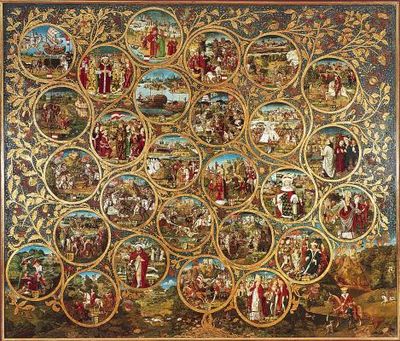 In 976 Leopold I, a member of the Babenberg family, who was a count in the Donnegau, is described as count of the Eastern March, a district not more than 60 miles in breadth on the eastern frontier of Bavaria
which grew into the duchy of Austria. Leopold, who received the mark as a reward for his fidelity to the emperor Otto II
during the Bavarian rising in 976, extended its area at the expense of the Hungarians, and was succeeded in 994 by his son Henry I. Henry, who continued his father's policy, was followed in 1018 by his brother Adalbert and in 1055 by his nephew, Ernest, whose marked loyalty to the emperors Henry II
and Henry III
was rewarded by many tokens of favour.
The succeeding margrave, Leopold II, quarrelled with Henry III, who was unable to oust him from the mark or to prevent the succession of his son Leopold III in 1096. Leopold supported Henry, the son of Henry IV, in his rising against his father, but was soon drawn over to the emperor's side, and in 1106 married the daughter of emperor Henry IV, Agnes, widow of Frederick I of Swabia. He declined the imperial crown in 1125. His zeal in founding monasteries earned for him his surname "the Pious", and canonization by Pope Innocent VIII
in 1485. He is regarded as the patron saint of Austria
.
, bishop of Freising. His eldest son, Leopold IV, became margrave in 1136, and in 1139 received from the German king Conrad III
the duchy of Bavaria
, which had been forfeited by Henry the Proud. Leopold's brother Henry (surnamed Jasomirgott, allegedly from his favourite oath, "So help me God!") was made count palatine of the Rhine in 1140, and became margrave of Austria on Leopold's death in 1141. Having married Gertrude, the widow of Henry the Proud, he was invested in 1143 with the duchy of Bavaria, and resigned his office as count palatine
. In 1147 he went on crusade, and after his return, renounced Bavaria at the instance of the new king Frederick I
who gave the duchy of Bavaria to Henry the Lion
of Saxony. As compensation for this, Austria, the capital of which had been transferred to Vienna
in 1156, was elevated into a duchy in the Privilegium Minus
.
, captured him on his homeward journey and handed him over to the emperor Henry VI
. Leopold increased the territories of the Babenbergs by acquiring Styria under the will of his kinsman Duke Ottokar IV. He died in 1194, and Austria fell to one son, Frederick, and Styria to another, Leopold; but on Frederick's death in 1198 they were again united by Duke Leopold VI, surnamed "the Glorious".
The new duke fought against the infidels in Spain
, Egypt
and Palestine
, but is more celebrated as a lawgiver, a patron of letters and a founder of towns. Under him Vienna became the centre of culture in Germany
and the great school of Minnesingers. His later years were spent in strife with his son Frederick, and he died in 1230 at San Germano, now re-named Cassino
, whither he had gone to arrange the peace between the emperor Frederick II
and Pope Gregory IX
.
son by Theodora Angelina
, succeeded his father as duke upon the elder man's death in 1230. Frederick II soon earned the epithet "the Quarrelsome" as a result of his ongoing disputes with the kings of Hungary
and Bohemia
and with the Holy Roman Emperor, also named Frederick II
. The Austrian Frederick II deprived his mother and sisters of their possessions, was hated by his subjects on account of his oppressive rule, and, in 1236, was placed under the imperial ban and driven from Austria. However, he was later restored to his duchy when the Emperor Frederick II
was excommunicated. Subsequently, the Austrian Frederick II treated with the Emperor Frederick II
in vain to make Austria a kingdom.
The male line of the Babenbergs became extinct in 1246, when Frederick II "the Quarrelsome" was killed in battle (the Henneberg
branch of the Franconian Babenbergs lived on until 1583 when its lands where divided among the two branches of the Wettin family).
His heir general was Gertrude of Austria, the only child of his late elder brother, Henry of Austria by that man's wife, Agnes of Thuringia. However, neither her husbands or her son succeeded in settling the Babenberg inheritance under their power.
After some years of struggle known as the Interregnum, the Duchies of Austria and Styria fell to Otakar II of Bohemia, and subsequently to Rudolph I
of Habsburg
, whose descendants were to rule Austria until 1918.

onward were descended from Byzantine emperors
- Leopold
's mother, Theodora Komnene
, being a granddaughter of the Emperor, John II Komnenos
. Subsequently, Leopold V
's younger son, Leopold VI
, also married a Byzantine
princess (Theodora Angelina
), as did his youngest son (by Theodora
), Frederick II
, who married Sophia Laskarina.
that the Babenberg blood was brought into the Habsburg line, though this blood was from the pre-ducal Babenbergs. A side effect of this marriage was the use of the Babenberg name Leopold by the Habsburgs for one of their sons.
The Habsburgs did eventually gain descent from the Babenberg dukes, though at different times. The first Habsburg line to be descended from the Babenbergs was the Albertine line. This was achieved through the marriage of Albert III, Duke of Austria
to Beatrix of Nuremberg. As such, their son, Albert IV, Duke of Austria
, was the first Habsburg duke who was descended from the Babenberg dukes. However, the male line of that branch of the Habsburgs died out in 1457 with Ladislas V Posthumus of Bohemia.
The next Habsburg line to gain Babenberg blood was the Styrian line, which occurred with the children of Ferdinand I, Holy Roman Emperor
and Anna of Bohemia and Hungary
, the latter of whom descended from Babenberg dukes. It was actually from Elizabeth of Austria
, the sister of Ladislas V Posthumus of Bohemia, that the Styrian line gained their Babenberg blood.
The Spanish line was the last Habsburg line to gain Babenberg blood. Again it was via the previous Habsburg line to gain Babenberg blood (i.e. the Styrian) that the Spanish Habsburg gained their descent from the Babenbergs - Anna of Austria, the wife of Philip II of Spain
and mother of Philip
(from whom all subsequent Spanish Habsburgs were descended), was a male-line granddaughter of Ferdinand
and Anna
. As a result, after 1598, all Habsburg males descended from the Babenberg Dukes.
Bamberg
Bamberg is a city in Bavaria, Germany. It is located in Upper Franconia on the river Regnitz, close to its confluence with the river Main. Bamberg is one of the few cities in Germany that was not destroyed by World War II bombings because of a nearby Artillery Factory that prevented planes from...
in Franconia
Franconia
Franconia is a region of Germany comprising the northern parts of the modern state of Bavaria, a small part of southern Thuringia, and a region in northeastern Baden-Württemberg called Tauberfranken...
, now northern Bavaria
Bavaria
Bavaria, formally the Free State of Bavaria is a state of Germany, located in the southeast of Germany. With an area of , it is the largest state by area, forming almost 20% of the total land area of Germany...
, an apparent branch of the Babenbergs or Babenberger went on to rule Austria
Austria
Austria , officially the Republic of Austria , is a landlocked country of roughly 8.4 million people in Central Europe. It is bordered by the Czech Republic and Germany to the north, Slovakia and Hungary to the east, Slovenia and Italy to the south, and Switzerland and Liechtenstein to the...
as counts of the march and dukes from 976–1248, before the rise of the house of Habsburg
Habsburg
The House of Habsburg , also found as Hapsburg, and also known as House of Austria is one of the most important royal houses of Europe and is best known for being an origin of all of the formally elected Holy Roman Emperors between 1438 and 1740, as well as rulers of the Austrian Empire and...
.
One or two families
The Babenberg family can be broken down into two distinct groups: 1) The Franconian Babenbergs, the so called Elder House of Babenberg, or Popponids out of which came the HennebergsHouse of Henneberg
-Origins:The distant origins of this family are speculative yet seem to originate in the Rhine Valley, east of modern-day France. Charibert, a nobleman in Neustria is the earliest recorded ancestor of the family, dating before 636. Five generations pass between Charibert and the next descendant...
and the Counts of Schweinfurt
Schweinfurt
Schweinfurt is a city in the Lower Franconia region of Bavaria in Germany on the right bank of the canalized Main, which is here spanned by several bridges, 27 km northeast of Würzburg.- History :...
. 2) Austrian Babenbergs which ruled Austria. The second group claimed to have originated from the first but scholars have not been able to verify that claim.
Popponids
Like the French royal Capetian dynastyCapetian dynasty
The Capetian dynasty , also known as the House of France, is the largest and oldest European royal house, consisting of the descendants of King Hugh Capet of France in the male line. Hugh Capet himself was a cognatic descendant of the Carolingians and the Merovingians, earlier rulers of France...
, the Elder Babenbergs descended from the Robertians. The earliest known Babenberg was one Poppo
Poppo of Grapfeld
Poppo I was a Frankish count in the Grapfeld from 819–839. Probably a descendant of the Robertian count Cancor, he became the ancestor of the Frankish House of Babenberg ....
, maybe a descendant of the Frankish
Franks
The Franks were a confederation of Germanic tribes first attested in the third century AD as living north and east of the Lower Rhine River. From the third to fifth centuries some Franks raided Roman territory while other Franks joined the Roman troops in Gaul. Only the Salian Franks formed a...
count Cancor
Cancor
Cancor was a Frankish count, possibly of Hesbaye.In 764 he founded Lorsch Abbey together with his widowed mother Williswinda as a proprietary church and monastery on their estate, Laurissa. They entrusted its government to Cancor's nephew Chrodegang, Archbishop of Metz, son of Cancor's sister...
. In the early 9th century he appeared as a count in the Grabfeld
Grabfeld
The Grabfeld is a region in Germany, on the border between Bavaria and Thuringia. It is situated southeast of the Rhön Mountains. Its highest elevation is 679 m . The Grabfeld gave its name to the Bavarian district Rhön-Grabfeld and the Thuringian municipality Grabfeld....
, a historic region in northeastern Franconia bordering on Thuringia
Thuringia
The Free State of Thuringia is a state of Germany, located in the central part of the country.It has an area of and 2.29 million inhabitants, making it the sixth smallest by area and the fifth smallest by population of Germany's sixteen states....
. One of his sons, Henry
Henry of Franconia
Henry , a son of Count Poppo of Grapfeld, one of the first Babenbergs, was the most important East Frankish general during the reign of Charles the Fat. He was variously titled Count or Margrave of Saxony and Duke of Franconia....
, sometimes called margrave and duke in Franconia under King Charles the Fat
Charles the Fat
Charles the Fat was the King of Alemannia from 876, King of Italy from 879, western Emperor from 881, King of East Francia from 882, and King of West Francia from 884. In 887, he was deposed in East Francia, Lotharingia, and possibly Italy, where the records are not clear...
of East Francia, fell fighting against the Normans
Normans
The Normans were the people who gave their name to Normandy, a region in northern France. They were descended from Norse Viking conquerors of the territory and the native population of Frankish and Gallo-Roman stock...
in 886; another, Poppo, was margrave in Thuringia from 880 to 892, when he was deposed by King Charles successor Arnulf of Carinthia
Arnulf of Carinthia
Arnulf of Carinthia was the Carolingian King of East Francia from 887, the disputed King of Italy from 894 and the disputed Holy Roman Emperor from February 22, 896 until his death.-Birth and Illegitimacy:...
. The Popponids had been favoured by Charles the Fat, but Arnulf reversed this policy in favour of the rival family of the Conradines from the Lahngau
Lahngau
The Lahngau was a medieval territory comprising the middle and lower Lahn River valley in the current German states of Hesse and Rhineland-Palatinate. The traditional names of the Gau are Loganahe Pagus or Pagus Logenensis....
in Rhenish Franconia
Rhenish Franconia
Rhenish Franconia or Western Franconia denotes the western half of the central German stem duchy of Franconia in the 10th and 11th century, with its residence at the city of Worms...
.
The leaders of the Babenbergs were the three sons of Duke Henry, who called themselves after their castle of Babenberg on the upper Main
Main river
Main rivers are a statutory type of watercourse in England and Wales, usually larger streams and rivers, but also include some smaller watercourses. A main river is defined as a watercourse marked as such on a main river map, and can include any structure or appliance for controlling or regulating...
, around which their possessions centred. The city of Bamberg
Bamberg
Bamberg is a city in Bavaria, Germany. It is located in Upper Franconia on the river Regnitz, close to its confluence with the river Main. Bamberg is one of the few cities in Germany that was not destroyed by World War II bombings because of a nearby Artillery Factory that prevented planes from...
was built around the ancestral castle of the family.
The Babenberg feud
The rivalry between the Babenberg and Conradine families was intensified by their efforts to extend their authority in the region of the middle Main, and this quarrel, known as the "Babenberg feud", came to a head at the beginning of the 10th century during the troubled reign of the German king Louis the ChildLouis the Child
Louis the Child , sometimes called Louis IV or Louis III, was the last Carolingian ruler of East Francia....
. In the battle of Fritzlar
Fritzlar
Fritzlar is a small German town in the Schwalm-Eder district in northern Hesse, north of Frankfurt, with a storied history. It can reasonably be argued that the town is the site where the Christianization of northern Germany began and the birthplace of the German empire as a political entity.The...
in 906, the Conradines won a decisive victory, although count Conrad the Elder fell in the battle. Two of the Babenberg brothers were also killed. The third, Adalbert of Prague, was summoned before the imperial court by the regent Hatto I, Archbishop of Mainz, a partisan of the Conradines. He refused to appear, held his own for a time in his castle at Theres
Theres
Theres is a municipality in the district of Haßberge in Bavaria in Germany....
against the king's forces, but surrendered in 906, and in spite of a promise of safe-conduct by Hatto was beheaded
Decapitation
Decapitation is the separation of the head from the body. Beheading typically refers to the act of intentional decapitation, e.g., as a means of murder or execution; it may be accomplished, for example, with an axe, sword, knife, wire, or by other more sophisticated means such as a guillotine...
.
The Conradines became dukes of Franconia, while the Babenbergs lost their influence in Franconia.
Margraves of Austria
Bavaria
Bavaria, formally the Free State of Bavaria is a state of Germany, located in the southeast of Germany. With an area of , it is the largest state by area, forming almost 20% of the total land area of Germany...
which grew into the duchy of Austria. Leopold, who received the mark as a reward for his fidelity to the emperor Otto II
Otto II, Holy Roman Emperor
Otto II , called the Red, was the third ruler of the Saxon or Ottonian dynasty, the son of Otto the Great and Adelaide of Italy.-Early years and co-ruler with Otto I:...
during the Bavarian rising in 976, extended its area at the expense of the Hungarians, and was succeeded in 994 by his son Henry I. Henry, who continued his father's policy, was followed in 1018 by his brother Adalbert and in 1055 by his nephew, Ernest, whose marked loyalty to the emperors Henry II
Henry II, Holy Roman Emperor
Henry II , also referred to as Saint Henry, Obl.S.B., was the fifth and last Holy Roman Emperor of the Ottonian dynasty, from his coronation in Rome in 1014 until his death a decade later. He was crowned King of the Germans in 1002 and King of Italy in 1004...
and Henry III
Henry III, Holy Roman Emperor
Henry III , called the Black or the Pious, was a member of the Salian Dynasty of Holy Roman Emperors...
was rewarded by many tokens of favour.
The succeeding margrave, Leopold II, quarrelled with Henry III, who was unable to oust him from the mark or to prevent the succession of his son Leopold III in 1096. Leopold supported Henry, the son of Henry IV, in his rising against his father, but was soon drawn over to the emperor's side, and in 1106 married the daughter of emperor Henry IV, Agnes, widow of Frederick I of Swabia. He declined the imperial crown in 1125. His zeal in founding monasteries earned for him his surname "the Pious", and canonization by Pope Innocent VIII
Pope Innocent VIII
Pope Innocent VIII , born Giovanni Battista Cybo , was Pope from 1484 until his death.-Early years:Giovanni Battista Cybo was born at Genoa of Greek extraction...
in 1485. He is regarded as the patron saint of Austria
Austria
Austria , officially the Republic of Austria , is a landlocked country of roughly 8.4 million people in Central Europe. It is bordered by the Czech Republic and Germany to the north, Slovakia and Hungary to the east, Slovenia and Italy to the south, and Switzerland and Liechtenstein to the...
.
Elevation to dukes
One of Leopold's sons was OttoOtto of Freising
Otto von Freising was a German bishop and chronicler.-Life:He was the fifth son of Leopold III, margrave of Austria, by his wife Agnes, daughter of the emperor Henry IV...
, bishop of Freising. His eldest son, Leopold IV, became margrave in 1136, and in 1139 received from the German king Conrad III
Conrad III of Germany
Conrad III was the first King of Germany of the Hohenstaufen dynasty. He was the son of Frederick I, Duke of Swabia, and Agnes, a daughter of the Salian Emperor Henry IV.-Life and reign:...
the duchy of Bavaria
Bavaria
Bavaria, formally the Free State of Bavaria is a state of Germany, located in the southeast of Germany. With an area of , it is the largest state by area, forming almost 20% of the total land area of Germany...
, which had been forfeited by Henry the Proud. Leopold's brother Henry (surnamed Jasomirgott, allegedly from his favourite oath, "So help me God!") was made count palatine of the Rhine in 1140, and became margrave of Austria on Leopold's death in 1141. Having married Gertrude, the widow of Henry the Proud, he was invested in 1143 with the duchy of Bavaria, and resigned his office as count palatine
Count palatine
Count palatine is a high noble title, used to render several comital styles, in some cases also shortened to Palatine, which can have other meanings as well.-Comes palatinus:...
. In 1147 he went on crusade, and after his return, renounced Bavaria at the instance of the new king Frederick I
Frederick I, Holy Roman Emperor
Frederick I Barbarossa was a German Holy Roman Emperor. He was elected King of Germany at Frankfurt on 4 March 1152 and crowned in Aachen on 9 March, crowned King of Italy in Pavia in 1155, and finally crowned Roman Emperor by Pope Adrian IV, on 18 June 1155, and two years later in 1157 the term...
who gave the duchy of Bavaria to Henry the Lion
Henry the Lion
Henry the Lion was a member of the Welf dynasty and Duke of Saxony, as Henry III, from 1142, and Duke of Bavaria, as Henry XII, from 1156, which duchies he held until 1180....
of Saxony. As compensation for this, Austria, the capital of which had been transferred to Vienna
Vienna
Vienna is the capital and largest city of the Republic of Austria and one of the nine states of Austria. Vienna is Austria's primary city, with a population of about 1.723 million , and is by far the largest city in Austria, as well as its cultural, economic, and political centre...
in 1156, was elevated into a duchy in the Privilegium Minus
Privilegium Minus
The Privilegium Minus is a document issued by Emperor Frederick I on September 17, 1156. It included the elevation of the Margraviate of Austria to a Duchy, which was given as an inheritable fief to the House of Babenberg. Its recipient was Frederick's paternal uncle Margrave Henry II Jasomirgott...
.
The rise of Babenberg power
The second duke was Henry's son Leopold V, who succeeded him in 1177 and took part in, the crusades of 1182 and 1190. In Palestine he quarrelled with Richard I of EnglandRichard I of England
Richard I was King of England from 6 July 1189 until his death. He also ruled as Duke of Normandy, Duke of Aquitaine, Duke of Gascony, Lord of Cyprus, Count of Anjou, Count of Maine, Count of Nantes, and Overlord of Brittany at various times during the same period...
, captured him on his homeward journey and handed him over to the emperor Henry VI
Henry VI, Holy Roman Emperor
Henry VI was King of Germany from 1190 to 1197, Holy Roman Emperor from 1191 to 1197 and King of Sicily from 1194 to 1197.-Early years:Born in Nijmegen,...
. Leopold increased the territories of the Babenbergs by acquiring Styria under the will of his kinsman Duke Ottokar IV. He died in 1194, and Austria fell to one son, Frederick, and Styria to another, Leopold; but on Frederick's death in 1198 they were again united by Duke Leopold VI, surnamed "the Glorious".
The new duke fought against the infidels in Spain
Spain
Spain , officially the Kingdom of Spain languages]] under the European Charter for Regional or Minority Languages. In each of these, Spain's official name is as follows:;;;;;;), is a country and member state of the European Union located in southwestern Europe on the Iberian Peninsula...
, Egypt
Egypt
Egypt , officially the Arab Republic of Egypt, Arabic: , is a country mainly in North Africa, with the Sinai Peninsula forming a land bridge in Southwest Asia. Egypt is thus a transcontinental country, and a major power in Africa, the Mediterranean Basin, the Middle East and the Muslim world...
and Palestine
Palestine
Palestine is a conventional name, among others, used to describe the geographic region between the Mediterranean Sea and the Jordan River, and various adjoining lands....
, but is more celebrated as a lawgiver, a patron of letters and a founder of towns. Under him Vienna became the centre of culture in Germany
Germany
Germany , officially the Federal Republic of Germany , is a federal parliamentary republic in Europe. The country consists of 16 states while the capital and largest city is Berlin. Germany covers an area of 357,021 km2 and has a largely temperate seasonal climate...
and the great school of Minnesingers. His later years were spent in strife with his son Frederick, and he died in 1230 at San Germano, now re-named Cassino
Cassino
Cassino is a comune in the province of Frosinone, Italy, at the southern end of the region of Lazio.Cassino is located at the foot of Monte Cairo near the confluence of the Rapido and Liri rivers...
, whither he had gone to arrange the peace between the emperor Frederick II
Frederick II, Holy Roman Emperor
Frederick II , was one of the most powerful Holy Roman Emperors of the Middle Ages and head of the House of Hohenstaufen. His political and cultural ambitions, based in Sicily and stretching through Italy to Germany, and even to Jerusalem, were enormous...
and Pope Gregory IX
Pope Gregory IX
Pope Gregory IX, born Ugolino di Conti, was pope from March 19, 1227 to August 22, 1241.The successor of Pope Honorius III , he fully inherited the traditions of Pope Gregory VII and of his uncle Pope Innocent III , and zealously continued their policy of Papal supremacy.-Early life:Ugolino was...
.
The Last of the Babenbergs
Frederick II, Leopold VI'sLeopold VI, Duke of Austria
Leopold VI , called the Glorious, from the House of Babenberg, was Duke of Austria from 1198 to 1230 and of Styria from 1194 to 1230....
son by Theodora Angelina
Theodora Angelina (wife of Leopold VI of Austria)
Theodora Angelina was the wife of Leopold VI of Austria, by whom she had several children.-Birth and parentage and early life:...
, succeeded his father as duke upon the elder man's death in 1230. Frederick II soon earned the epithet "the Quarrelsome" as a result of his ongoing disputes with the kings of Hungary
Hungary
Hungary , officially the Republic of Hungary , is a landlocked country in Central Europe. It is situated in the Carpathian Basin and is bordered by Slovakia to the north, Ukraine and Romania to the east, Serbia and Croatia to the south, Slovenia to the southwest and Austria to the west. The...
and Bohemia
Bohemia
Bohemia is a historical region in central Europe, occupying the western two-thirds of the traditional Czech Lands. It is located in the contemporary Czech Republic with its capital in Prague...
and with the Holy Roman Emperor, also named Frederick II
Frederick II, Holy Roman Emperor
Frederick II , was one of the most powerful Holy Roman Emperors of the Middle Ages and head of the House of Hohenstaufen. His political and cultural ambitions, based in Sicily and stretching through Italy to Germany, and even to Jerusalem, were enormous...
. The Austrian Frederick II deprived his mother and sisters of their possessions, was hated by his subjects on account of his oppressive rule, and, in 1236, was placed under the imperial ban and driven from Austria. However, he was later restored to his duchy when the Emperor Frederick II
Frederick II, Holy Roman Emperor
Frederick II , was one of the most powerful Holy Roman Emperors of the Middle Ages and head of the House of Hohenstaufen. His political and cultural ambitions, based in Sicily and stretching through Italy to Germany, and even to Jerusalem, were enormous...
was excommunicated. Subsequently, the Austrian Frederick II treated with the Emperor Frederick II
Frederick II, Holy Roman Emperor
Frederick II , was one of the most powerful Holy Roman Emperors of the Middle Ages and head of the House of Hohenstaufen. His political and cultural ambitions, based in Sicily and stretching through Italy to Germany, and even to Jerusalem, were enormous...
in vain to make Austria a kingdom.
The male line of the Babenbergs became extinct in 1246, when Frederick II "the Quarrelsome" was killed in battle (the Henneberg
Henneberg
Henneberg may refer to:*the House of Henneberg, German nobility*County of Henneberg, a mediæval state in the Holy Roman Empire*Henneberg, Thuringia, a municipality in Thuringia, Germany*Mary Jane Henneberg, b. 1973, TV reporter...
branch of the Franconian Babenbergs lived on until 1583 when its lands where divided among the two branches of the Wettin family).
His heir general was Gertrude of Austria, the only child of his late elder brother, Henry of Austria by that man's wife, Agnes of Thuringia. However, neither her husbands or her son succeeded in settling the Babenberg inheritance under their power.
After some years of struggle known as the Interregnum, the Duchies of Austria and Styria fell to Otakar II of Bohemia, and subsequently to Rudolph I
Rudolph I of Germany
Rudolph I was King of the Romans from 1273 until his death. He played a vital role in raising the Habsburg dynasty to a leading position among the Imperial feudal dynasties...
of Habsburg
Habsburg
The House of Habsburg , also found as Hapsburg, and also known as House of Austria is one of the most important royal houses of Europe and is best known for being an origin of all of the formally elected Holy Roman Emperors between 1438 and 1740, as well as rulers of the Austrian Empire and...
, whose descendants were to rule Austria until 1918.
Genetic Legacy
Byzantine Blood
All the Babenberg dukes from Leopold VLeopold V, Duke of Austria
Leopold V , the Virtuous, was a Babenberg duke of Austria from 1177 and of Styria from 1192 until his death...
onward were descended from Byzantine emperors
Byzantine Empire
The Byzantine Empire was the Eastern Roman Empire during the periods of Late Antiquity and the Middle Ages, centred on the capital of Constantinople. Known simply as the Roman Empire or Romania to its inhabitants and neighbours, the Empire was the direct continuation of the Ancient Roman State...
- Leopold
Leopold V, Duke of Austria
Leopold V , the Virtuous, was a Babenberg duke of Austria from 1177 and of Styria from 1192 until his death...
's mother, Theodora Komnene
Theodora Komnene
Theodora Komnene or Comnena was a niece of Byzantine emperor Manuel I Comnenus, and wife of King Baldwin III of Jerusalem.-Family:Theodora was a daughter of the sebastokratōr Isaac Komnenos by his second wife, Eirene Synadene...
, being a granddaughter of the Emperor, John II Komnenos
John II Komnenos
John II Komnenos was Byzantine Emperor from 1118 to 1143. Also known as Kaloïōannēs , he was the eldest son of Emperor Alexios I Komnenos and Irene Doukaina...
. Subsequently, Leopold V
Leopold V, Duke of Austria
Leopold V , the Virtuous, was a Babenberg duke of Austria from 1177 and of Styria from 1192 until his death...
's younger son, Leopold VI
Leopold VI, Duke of Austria
Leopold VI , called the Glorious, from the House of Babenberg, was Duke of Austria from 1198 to 1230 and of Styria from 1194 to 1230....
, also married a Byzantine
Byzantine Empire
The Byzantine Empire was the Eastern Roman Empire during the periods of Late Antiquity and the Middle Ages, centred on the capital of Constantinople. Known simply as the Roman Empire or Romania to its inhabitants and neighbours, the Empire was the direct continuation of the Ancient Roman State...
princess (Theodora Angelina
Theodora Angelina (wife of Leopold VI of Austria)
Theodora Angelina was the wife of Leopold VI of Austria, by whom she had several children.-Birth and parentage and early life:...
), as did his youngest son (by Theodora
Theodora Angelina (wife of Leopold VI of Austria)
Theodora Angelina was the wife of Leopold VI of Austria, by whom she had several children.-Birth and parentage and early life:...
), Frederick II
Frederick II, Duke of Austria
Frederick II, known as the Quarrelsome or the Warlike , from the House of Babenberg, was the duke of Austria and Styria from 1230 to 1246....
, who married Sophia Laskarina.
The Babenbergs and the Habsburgs
The next dynasty in Austria - the Habsburgs - were originally not descendants of the Babenbergs. It was not until the children of Albert I of GermanyAlbert I of Germany
Albert I of Habsburg was King of the Romans and Duke of Austria, the eldest son of German King Rudolph I of Habsburg and his first wife Gertrude of Hohenburg.-Life:...
that the Babenberg blood was brought into the Habsburg line, though this blood was from the pre-ducal Babenbergs. A side effect of this marriage was the use of the Babenberg name Leopold by the Habsburgs for one of their sons.
The Habsburgs did eventually gain descent from the Babenberg dukes, though at different times. The first Habsburg line to be descended from the Babenbergs was the Albertine line. This was achieved through the marriage of Albert III, Duke of Austria
Albert III, Duke of Austria
Albert III of Austria , known as Albert with the Pigtail , was a duke of Austria and a member of the House of Habsburg.-Life:...
to Beatrix of Nuremberg. As such, their son, Albert IV, Duke of Austria
Albert IV, Duke of Austria
Albert IV of Austria was a duke of Austria.He was born in Vienna, the son of Duke Albert III of Austria and Beatrix of Nuremberg...
, was the first Habsburg duke who was descended from the Babenberg dukes. However, the male line of that branch of the Habsburgs died out in 1457 with Ladislas V Posthumus of Bohemia.
The next Habsburg line to gain Babenberg blood was the Styrian line, which occurred with the children of Ferdinand I, Holy Roman Emperor
Ferdinand I, Holy Roman Emperor
Ferdinand I was Holy Roman Emperor from 1558 and king of Bohemia and Hungary from 1526 until his death. Before his accession, he ruled the Austrian hereditary lands of the Habsburgs in the name of his elder brother, Charles V, Holy Roman Emperor.The key events during his reign were the contest...
and Anna of Bohemia and Hungary
Anna of Bohemia and Hungary
Anna of Bohemia and Hungary, also sometimes known as Anna Jagellonica was, by marriage to Ferdinand I, King of the Romans and later Holy Roman Emperor, Queen of the Romans.-Family:She was the elder child and only daughter of king Vladislaus II of Bohemia and Hungary and his third...
, the latter of whom descended from Babenberg dukes. It was actually from Elizabeth of Austria
Elisabeth of Austria (d. 1505)
Elisabeth of Austria , , was a Polish-Lithuanian queen...
, the sister of Ladislas V Posthumus of Bohemia, that the Styrian line gained their Babenberg blood.
The Spanish line was the last Habsburg line to gain Babenberg blood. Again it was via the previous Habsburg line to gain Babenberg blood (i.e. the Styrian) that the Spanish Habsburg gained their descent from the Babenbergs - Anna of Austria, the wife of Philip II of Spain
Philip II of Spain
Philip II was King of Spain, Portugal, Naples, Sicily, and, while married to Mary I, King of England and Ireland. He was lord of the Seventeen Provinces from 1556 until 1581, holding various titles for the individual territories such as duke or count....
and mother of Philip
Philip III of Spain
Philip III , also known as Philip the Pious, was the King of Spain and King of Portugal and the Algarves, where he ruled as Philip II , from 1598 until his death...
(from whom all subsequent Spanish Habsburgs were descended), was a male-line granddaughter of Ferdinand
Ferdinand I, Holy Roman Emperor
Ferdinand I was Holy Roman Emperor from 1558 and king of Bohemia and Hungary from 1526 until his death. Before his accession, he ruled the Austrian hereditary lands of the Habsburgs in the name of his elder brother, Charles V, Holy Roman Emperor.The key events during his reign were the contest...
and Anna
Anna of Bohemia and Hungary
Anna of Bohemia and Hungary, also sometimes known as Anna Jagellonica was, by marriage to Ferdinand I, King of the Romans and later Holy Roman Emperor, Queen of the Romans.-Family:She was the elder child and only daughter of king Vladislaus II of Bohemia and Hungary and his third...
. As a result, after 1598, all Habsburg males descended from the Babenberg Dukes.
See also
- List of rulers of Austria
- Slavnik's dynastySlavník's dynastyThe Slavniks/Slavníks or Slavnikids was a powerful dynasty in Bohemia during the 10th century. It governed Zličané, one of the oldest Czech tribes. The center of the principality was the gord of Libice located at the confluence of the rivers Cidlina and Elbe...
- House of HennebergHouse of Henneberg-Origins:The distant origins of this family are speculative yet seem to originate in the Rhine Valley, east of modern-day France. Charibert, a nobleman in Neustria is the earliest recorded ancestor of the family, dating before 636. Five generations pass between Charibert and the next descendant...
- Henneberg portion of Franconian Babenbergs and early Babenberg origins - Senior Capets
- March of NeustriaMarch of NeustriaThe marches of Neustria were creations of the Carolingian king of West Francia covering the ancient Merovingian kingdom of Neustria. Originally, there were two marches, one against the Bretons and one against the Norsemen created by Charles the Bald in 861. These two marches are often called the...
- Duke of Brittany
External links
- Direct male descent of Babenberger from Robertiner (Capet) family in German Wikipedia
- Early Babenberger Genealogy in German Wikipedia