
Flat tax

Encyclopedia
A flat tax is a tax
system with a constant marginal tax rate. Typically the term flat tax is applied in the context of an individual or corporate income that will be taxed at one marginal rate. Flat taxes in application often allow certain deductions and thus are a special case of a proportional tax
.
There are many proposed marginal flat taxes systems. Specific flat tax systems enumerated at the bottom of this article primarily intermix aspects of three high level approaches:
Modified flat taxes have been proposed which would allow deductions for a very few items, while still eliminating the vast majority of existing deductions. Charitable deductions and home mortgage interest are the most discussed exceptions, as these are popular with voters and often used. Another common theme is a single, large, fixed deduction; the concept here is that this blanket deduction rolls up a myriad of ubiquitous, fixed, living costs and has the simplifying side-effect that many (low income) people will not even have to file tax returns.
, Hall–Rabushka is flat tax on consumption
. Principally, Hall–Rabushka accomplishes a consumption tax effect by taxing income and then excluding investment. Robert Hall
and Alvin Rabushka
have consulted extensively in designing the flat tax systems in Eastern Europe.
in his 1962 book Capitalism and Freedom
includes a flat tax. The system assesses a flat tax with personal deductions, except that when deductions exceed income, the taxable income is allowed to become negative rather than being set to zero. The flat tax rate is then applied to the resulting "negative income," resulting in a "negative income tax" that the government remits to the household (unlike the usual "positive" income tax, which the household owes the government).
s must be able to deduct operating expenses even if individual citizens cannot. A practical difficulty now arises as to identifying what is an expense for a business. For example, if a peanut butter maker purchases a jar manufacturer, is that an expense (since they have to purchase jars somehow) or a sheltering of their income through investment? Flat tax systems can differ greatly in how they accommodate such gray areas. For example, the "9-9-9" flat tax proposal would allow businesses to deduct purchases but not labor costs. (And thus effectively tax labor intensive industrial revenue at a higher rate.) How deductions are implemented will dramatically change the effective total tax, and thus flatness, of the tax. Thus a Flat Tax proposal is not fully defined until it differentiates deductible and non-deductible expenses.
One of the concerns with many flat tax systems is that they are not true flat taxes, which in turn makes the debate over the equitability of the tax difficult. If a system has a large per-citizen deductible (such as the "Armey" scheme below), then it is a progressive tax -- one where the tax rate on total income increases as income increases. The admission that such a tax is not actually flat at all undermines the notion that the "flatness" of the tax is itself a desirable feature. As a result, sometimes the term Flat Tax is actually a shorthand for the more proper marginally flat tax.
Proponents of the flat tax claim a single marginal rate is more fair than stepped marginal tax rates (a.k.a "progressive"), since everybody pays the same proportion of taxable income. Critics of the flat tax, on the other hand, claim that the marginal value
of income declines with the amount of income (the last $100 of income of a family living near poverty being considerably more valuable than the last $100 of income of a millionaire), and thus assert that taxing that last $100 of income the same amount despite vast differences in the marginal value of money is unfair. However, true flat tax proponents contest the concept of the diminishing marginal utility of money and that a marginal dollar should be taxed differently.
Under a pure flat tax without deductions, companies could simply, every period, make a single payment to the government covering the flat tax liabilities of their employees and the taxes owed on their business income. For example, suppose that in a given year, ACME earns a profit of 3 million, pays 2 million in salaries, and spends an added 1 million on other expenses the IRS deems to be taxable income, such as stock options, bonuses, and certain executive privileges. Given a flat rate of 15%, ACME would then owe the IRS (3M + 2M + 1M) × 0.15 = 900,000. This payment would, in one fell swoop, settle the tax liabilities of ACME's employees as well as taxes it owed by being a firm. Most employees throughout the economy would never need to interact with the IRS, as all tax owed on wages, interest, dividends, royalties, etc. would be withheld at the source. The main exceptions would be employees with incomes from personal ventures. The Economist claims that such a system would reduce the number of entities required to file returns from about 130 million individuals, households, and businesses, as at present, to a mere 8 million businesses and self-employed.
This simplicity would remain even if realized capital gains were subject to the flat tax. In that case, the law would require brokers and mutual funds to calculate the realized capital gain on all sales and redemptions. If there were a gain, 15% of the gain would be withheld and sent to the IRS. If there were a loss, the amount would be reported to the IRS, which would offset gains with losses and settle up with taxpayers at the end of the period.
Under a flat tax, the government's cost of processing tax returns would become much smaller, and the relevant tax bodies could be abolished or massively downsized. The people freed from working in administering taxes will then be employed in jobs that are more productive. If combined with a provision to allow for negative taxation
, the flat tax itself can be implemented in an even simpler way.
predicts such an outcome, attributing the primary reason for the greater revenue to higher levels of economic growth stemming from the introduction of the flat tax.
The Russian example is often used as proof of the validity of this analysis, despite an International Monetary Fund
study in 2006 found that there was no sign "of Laffer-type behavioral responses generating revenue increases from the tax cut elements of these reforms" in Russia or in other countries.
overall tax structure. Under such a structure, those with lower incomes tend to pay a higher proportion of their income in total taxes than the affluent do. The fraction of household income that is a return to capital (dividends, interest, royalties, profits of unincorporated businesses) is positively correlated with total household income. Hence a flat tax limited to wages would seem to leave the wealthy better off. Modifying the tax base can change the effects. A flat tax could be targeted at income (rather than wages), which could place the tax burden equally on all earners, including those who earn income primarily from returns on investment. Tax systems could utilize a flat sales tax
to target all consumption, which can be modified with rebates or exemptions to remove regressive effects (such as the proposed FairTax
in the U.S.).
es and payroll tax
es) are not removed when exported to a foreign country (see Effect of taxes and subsidies on price
). Taxation systems such as a sales tax
or value added tax
can remove the tax component when goods are exported and apply the tax component on imports. The domestic products could be at a disadvantage to foreign products (at home and abroad) that are border-adjustable, which would impact the global competitiveness of a country. However, it's possible that a flat tax system could be combined with tariffs and credits to act as border adjustments (the proposed Border Tax Equity Act in the U.S. attempts this). Implementing an income tax with a border adjustment tax credit is a violation of the World Trade Organization
agreement. Tax exemptions (allowances) on low income wages, a component of most income tax systems could mitigate this issue for high labour content industries like textiles that compete Globally.
In a subsequent section, various proposals for flat tax-like schemes are discussed, these differ mainly on how they approach with the following issues of deductions, defining income, and policy implementation.
, former House Majority Leader Dick Armey
and FreedomWorks
have sought support for the flat tax (Taxpayer Choice Act
). In other countries, flat tax systems have also been proposed, largely as a result of flat tax systems being introduced in several countries of the former Eastern Bloc
, where it is generally thought to have been successful, although this assessment has been disputed (see below). This has elicited much interest from countries such as the United Kingdom, where it has gone hand in hand with a general swing towards conservatism
.
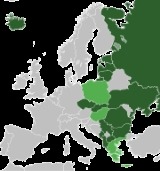
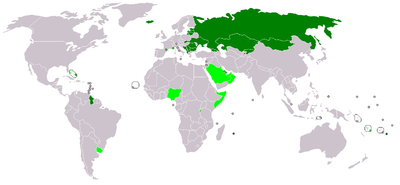
The countries that have recently reintroduced flat taxes have done so largely in the hope of boosting economic growth. The Baltic countries
of Estonia
, Latvia
and Lithuania
have had flat taxes of 24%, 25% and 33% respectively with a tax exempt
amount, since the mid-1990s. On 1 January 2001, a 13% flat tax on personal income took effect in Russia
. Ukraine
followed Russia with a 13% flat tax in 2003, which later increased to 15% in 2007. Slovakia
introduced a 19% flat tax on most taxes (that is, on corporate and personal income, for VAT
, etc., almost without exceptions) in 2004; Romania
introduced a 16% flat tax on personal income and corporate profit on January 1, 2005. Macedonia
introduced a 12% flat tax on personal income and corporate profit on January 1, 2007 and promised to cut it to 10% in 2008. Albania has implemented a 10% flat tax from 2008. Bulgaria applies flat tax rate of 10% for corporate profits and personal income tax since 2008.
In the United States
, while the Federal income tax is progressive, seven states — Colorado
, Illinois
, Indiana
, Massachusetts
, Michigan
, Pennsylvania
, and Utah
— tax household incomes at a single rate, ranging from 3.07% (Pennsylvania) to 5.3% (Massachusetts). Pennsylvania even has a pure flat tax with no zero-bracket amount.
Paul Kirchhof
, who was suggested as the next finance minister of Germany in 2005, proposed introducing a flat tax rate of 25% in Germany as early as 2001, which sparked widespread controversy. Some claim the German tax system
is the most complex one in the world.
On 27 September 2005, the Dutch Council of Economic Advisors recommended a flat rate of 40% for income tax in the Netherlands
. Some deductions would be allowed, and persons over 65 years of age would be taxed at a lower rate.
In the United States, proposals for a flat tax at the federal level have emerged repeatedly in recent decades during various political debates. Jerry Brown
, former and current Democratic Governor of California
, made the adoption of a flat tax part of his platform when running for President of the United States
in 1992. At the time, rival Democratic candidate Tom Harkin
ridiculed the proposal as having originated with the "Flat Earth Society
". Four years later, Republican candidate Steve Forbes
proposed a similar idea as part of his core platform. Although neither captured his party's nomination, their proposals prompted widespread debate about the current U.S. income tax system.
Flat tax plans that are presently being advanced in the United States also seek to redefine "sources of income"; current progressive taxes count interest
, dividends and capital gains as income, for example, while Steve Forbes
's variant of the flat tax would apply to wages only.
In 2005 Senator
Sam Brownback
, a Republican
from Kansas
, stated he had a plan to implement a flat tax in Washington, D.C.
. This version is one flat rate of 15% on all earned income. Unearned income (in particular capital gains) would be exempt. His plan also calls for an exemption of $30,000 per family and $25,000 for singles. Mississippi
Republican Senator Trent Lott
stated he supports it and would add a $5,000 credit for first time home buyers and exemptions for out of town businesses. DC Delegate Eleanor Holmes Norton
's position seems unclear, however DC mayor Anthony Williams
has stated he is "open" to the idea.
Flat taxes have also been considered in the United Kingdom by the Conservative Party
. However, it has been roundly rejected by Gordon Brown
, then Chancellor of the Exchequer
for Britain's ruling Labour Party
, who said that it was "An idea that they say is sweeping the world, well sweeping Estonia, well a wing of the neo-conservatives in Estonia", and criticised it thus: "The millionaire to pay exactly the same tax rate as the young nurse, the home help, the worker on the minimum wage".
The negative income tax (NIT), which Milton Friedman
proposed in his 1962 book Capitalism and Freedom
, is a type of flat tax. The basic idea is the same as a flat tax with personal deductions, except that when deductions exceed income, the taxable income is allowed to become negative rather than being set to zero. The flat tax rate is then applied to the resulting "negative income," resulting in a "negative income tax" the government owes the household, unlike the usual "positive" income tax, which the household owes the government.
For example, let the flat rate be 20%, and let the deductions be $20,000 per adult and $7,000 per dependent. Under such a system, a family of four making $54,000 a year would owe no tax. A family of four making $74,000 a year would owe tax amounting to 0.20 × (74,000 − 54,000) = $4,000, as under a flat tax with deductions. But families of four earning less than $54,000 per year would owe a "negative" amount of tax (that is, it would receive money from the government). For example, if it earned $34,000 a year, it would receive a check for $4,000. The NIT is intended to replace not just the USA
's income tax, but also many benefits low income American households receive, such as food stamps and Medicaid
. The NIT is designed to avoid the welfare trap
—effective high marginal tax rates arising from the rules reducing benefits as market income rises. An objection to the NIT is that it is welfare without a work requirement. Those who would owe negative tax would be receiving a form of welfare without having to make an effort to obtain employment. Another objection is that the NIT subsidizes industries employing low cost labor, but this objection can also be made against current systems of benefits for the working poor
.
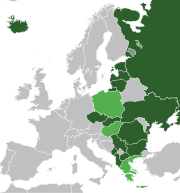 Advocates of the flat tax argue that the former communist state
s of Eastern Europe
have benefited from the adoption of a flat tax. Most of these nations have experienced strong economic growth of 6% and higher in recent years, some of them, particularly the Baltic countries
, experience exceptional GDP growth
of around 10% yearly. Some argue that other factors, primarily the advent of capitalist economic systems and rapid market expansion after Soviet (communist) domination explain the rapid growth. Some argue that economic growth in these countries would likely have occurred regardless of the chosen tax system.
 http://www.fmf.gov.ba/download.php?id=budzet-08/Zakon%20o%20porezu%20na%20dohodak%20(bosanski%20jezik).pdf
(10%)
Czech Republic
It is not clear how effectively the Iraqi tax is being collected in practice.
Also:
A flat tax (short for flat tax rate) is a tax
system with a constant marginal tax rate. Typically the term flat tax is applied in the context of an individual or corporate income that will be taxed at one marginal rate. Flat taxes in application often allow certain deductions and thus are a special case of a proportional tax
.
There are many proposed marginal flat taxes systems. Specific flat tax systems enumerated at the bottom of this article primarily intermix aspects of three high level approaches:
Modified flat taxes have been proposed which would allow deductions for a very few items, while still eliminating the vast majority of existing deductions. Charitable deductions and home mortgage interest are the most discussed exceptions, as these are popular with voters and often used. Another common theme is a single, large, fixed deduction; the concept here is that this blanket deduction rolls up a myriad of ubiquitous, fixed, living costs and has the simplifying side-effect that many (low income) people will not even have to file tax returns.
, Hall–Rabushka is flat tax on consumption
. Principally, Hall–Rabushka accomplishes a consumption tax effect by taxing income and then excluding investment. Robert Hall
and Alvin Rabushka
have consulted extensively in designing the flat tax systems in Eastern Europe.
in his 1962 book Capitalism and Freedom
includes a flat tax. The system assesses a flat tax with personal deductions, except that when deductions exceed income, the taxable income is allowed to become negative rather than being set to zero. The flat tax rate is then applied to the resulting "negative income," resulting in a "negative income tax" that the government remits to the household (unlike the usual "positive" income tax, which the household owes the government).
s must be able to deduct operating expenses even if individual citizens cannot. A practical difficulty now arises as to identifying what is an expense for a business. For example, if a peanut butter maker purchases a jar manufacturer, is that an expense (since they have to purchase jars somehow) or a sheltering of their income through investment? Flat tax systems can differ greatly in how they accommodate such gray areas. For example, the "9-9-9" flat tax proposal would allow businesses to deduct purchases but not labor costs. (And thus effectively tax labor intensive industrial revenue at a higher rate.) How deductions are implemented will dramatically change the effective total tax, and thus flatness, of the tax. Thus a Flat Tax proposal is not fully defined until it differentiates deductible and non-deductible expenses.
One of the concerns with many flat tax systems is that they are not true flat taxes, which in turn makes the debate over the equitability of the tax difficult. If a system has a large per-citizen deductible (such as the "Armey" scheme below), then it is a progressive tax -- one where the tax rate on total income increases as income increases. The admission that such a tax is not actually flat at all undermines the notion that the "flatness" of the tax is itself a desirable feature. As a result, sometimes the term Flat Tax is actually a shorthand for the more proper marginally flat tax.
Proponents of the flat tax claim a single marginal rate is more fair than stepped marginal tax rates (a.k.a "progressive"), since everybody pays the same proportion of taxable income. Critics of the flat tax, on the other hand, claim that the marginal value
of income declines with the amount of income (the last $100 of income of a family living near poverty being considerably more valuable than the last $100 of income of a millionaire), and thus assert that taxing that last $100 of income the same amount despite vast differences in the marginal value of money is unfair. However, true flat tax proponents contest the concept of the diminishing marginal utility of money and that a marginal dollar should be taxed differently.
Under a pure flat tax without deductions, companies could simply, every period, make a single payment to the government covering the flat tax liabilities of their employees and the taxes owed on their business income. For example, suppose that in a given year, ACME earns a profit of 3 million, pays 2 million in salaries, and spends an added 1 million on other expenses the IRS deems to be taxable income, such as stock options, bonuses, and certain executive privileges. Given a flat rate of 15%, ACME would then owe the IRS (3M + 2M + 1M) × 0.15 = 900,000. This payment would, in one fell swoop, settle the tax liabilities of ACME's employees as well as taxes it owed by being a firm. Most employees throughout the economy would never need to interact with the IRS, as all tax owed on wages, interest, dividends, royalties, etc. would be withheld at the source. The main exceptions would be employees with incomes from personal ventures. The Economist claims that such a system would reduce the number of entities required to file returns from about 130 million individuals, households, and businesses, as at present, to a mere 8 million businesses and self-employed.
This simplicity would remain even if realized capital gains were subject to the flat tax. In that case, the law would require brokers and mutual funds to calculate the realized capital gain on all sales and redemptions. If there were a gain, 15% of the gain would be withheld and sent to the IRS. If there were a loss, the amount would be reported to the IRS, which would offset gains with losses and settle up with taxpayers at the end of the period.
Under a flat tax, the government's cost of processing tax returns would become much smaller, and the relevant tax bodies could be abolished or massively downsized. The people freed from working in administering taxes will then be employed in jobs that are more productive. If combined with a provision to allow for negative taxation
, the flat tax itself can be implemented in an even simpler way.
predicts such an outcome, attributing the primary reason for the greater revenue to higher levels of economic growth stemming from the introduction of the flat tax.
The Russian example is often used as proof of the validity of this analysis, despite an International Monetary Fund
study in 2006 found that there was no sign "of Laffer-type behavioral responses generating revenue increases from the tax cut elements of these reforms" in Russia or in other countries.
overall tax structure. Under such a structure, those with lower incomes tend to pay a higher proportion of their income in total taxes than the affluent do. The fraction of household income that is a return to capital (dividends, interest, royalties, profits of unincorporated businesses) is positively correlated with total household income. Hence a flat tax limited to wages would seem to leave the wealthy better off. Modifying the tax base can change the effects. A flat tax could be targeted at income (rather than wages), which could place the tax burden equally on all earners, including those who earn income primarily from returns on investment. Tax systems could utilize a flat sales tax
to target all consumption, which can be modified with rebates or exemptions to remove regressive effects (such as the proposed FairTax
in the U.S.).
es and payroll tax
es) are not removed when exported to a foreign country (see Effect of taxes and subsidies on price
). Taxation systems such as a sales tax
or value added tax
can remove the tax component when goods are exported and apply the tax component on imports. The domestic products could be at a disadvantage to foreign products (at home and abroad) that are border-adjustable, which would impact the global competitiveness of a country. However, it's possible that a flat tax system could be combined with tariffs and credits to act as border adjustments (the proposed Border Tax Equity Act in the U.S. attempts this). Implementing an income tax with a border adjustment tax credit is a violation of the World Trade Organization
agreement. Tax exemptions (allowances) on low income wages, a component of most income tax systems could mitigate this issue for high labour content industries like textiles that compete Globally.
In a subsequent section, various proposals for flat tax-like schemes are discussed, these differ mainly on how they approach with the following issues of deductions, defining income, and policy implementation.
, former House Majority Leader Dick Armey
and FreedomWorks
have sought support for the flat tax (Taxpayer Choice Act
). In other countries, flat tax systems have also been proposed, largely as a result of flat tax systems being introduced in several countries of the former Eastern Bloc
, where it is generally thought to have been successful, although this assessment has been disputed (see below). This has elicited much interest from countries such as the United Kingdom, where it has gone hand in hand with a general swing towards conservatism
.
The countries that have recently reintroduced flat taxes have done so largely in the hope of boosting economic growth. The Baltic countries
of Estonia
, Latvia
and Lithuania
have had flat taxes of 24%, 25% and 33% respectively with a tax exempt
amount, since the mid-1990s. On 1 January 2001, a 13% flat tax on personal income took effect in Russia
. Ukraine
followed Russia with a 13% flat tax in 2003, which later increased to 15% in 2007. Slovakia
introduced a 19% flat tax on most taxes (that is, on corporate and personal income, for VAT
, etc., almost without exceptions) in 2004; Romania
introduced a 16% flat tax on personal income and corporate profit on January 1, 2005. Macedonia
introduced a 12% flat tax on personal income and corporate profit on January 1, 2007 and promised to cut it to 10% in 2008. Albania has implemented a 10% flat tax from 2008. Bulgaria applies flat tax rate of 10% for corporate profits and personal income tax since 2008.
In the United States
, while the Federal income tax is progressive, seven states — Colorado
, Illinois
, Indiana
, Massachusetts
, Michigan
, Pennsylvania
, and Utah
— tax household incomes at a single rate, ranging from 3.07% (Pennsylvania) to 5.3% (Massachusetts). Pennsylvania even has a pure flat tax with no zero-bracket amount.
Paul Kirchhof
, who was suggested as the next finance minister of Germany in 2005, proposed introducing a flat tax rate of 25% in Germany as early as 2001, which sparked widespread controversy. Some claim the German tax system
is the most complex one in the world.
On 27 September 2005, the Dutch Council of Economic Advisors recommended a flat rate of 40% for income tax in the Netherlands
. Some deductions would be allowed, and persons over 65 years of age would be taxed at a lower rate.
In the United States, proposals for a flat tax at the federal level have emerged repeatedly in recent decades during various political debates. Jerry Brown
, former and current Democratic Governor of California
, made the adoption of a flat tax part of his platform when running for President of the United States
in 1992. At the time, rival Democratic candidate Tom Harkin
ridiculed the proposal as having originated with the "Flat Earth Society
". Four years later, Republican candidate Steve Forbes
proposed a similar idea as part of his core platform. Although neither captured his party's nomination, their proposals prompted widespread debate about the current U.S. income tax system.
Flat tax plans that are presently being advanced in the United States also seek to redefine "sources of income"; current progressive taxes count interest
, dividends and capital gains as income, for example, while Steve Forbes
's variant of the flat tax would apply to wages only.
In 2005 Senator
Sam Brownback
, a Republican
from Kansas
, stated he had a plan to implement a flat tax in Washington, D.C.
. This version is one flat rate of 15% on all earned income. Unearned income (in particular capital gains) would be exempt. His plan also calls for an exemption of $30,000 per family and $25,000 for singles. Mississippi
Republican Senator Trent Lott
stated he supports it and would add a $5,000 credit for first time home buyers and exemptions for out of town businesses. DC Delegate Eleanor Holmes Norton
's position seems unclear, however DC mayor Anthony Williams
has stated he is "open" to the idea.
Flat taxes have also been considered in the United Kingdom by the Conservative Party
. However, it has been roundly rejected by Gordon Brown
, then Chancellor of the Exchequer
for Britain's ruling Labour Party
, who said that it was "An idea that they say is sweeping the world, well sweeping Estonia, well a wing of the neo-conservatives in Estonia", and criticised it thus: "The millionaire to pay exactly the same tax rate as the young nurse, the home help, the worker on the minimum wage".
The negative income tax (NIT), which Milton Friedman
proposed in his 1962 book Capitalism and Freedom
, is a type of flat tax. The basic idea is the same as a flat tax with personal deductions, except that when deductions exceed income, the taxable income is allowed to become negative rather than being set to zero. The flat tax rate is then applied to the resulting "negative income," resulting in a "negative income tax" the government owes the household, unlike the usual "positive" income tax, which the household owes the government.
For example, let the flat rate be 20%, and let the deductions be $20,000 per adult and $7,000 per dependent. Under such a system, a family of four making $54,000 a year would owe no tax. A family of four making $74,000 a year would owe tax amounting to 0.20 × (74,000 − 54,000) = $4,000, as under a flat tax with deductions. But families of four earning less than $54,000 per year would owe a "negative" amount of tax (that is, it would receive money from the government). For example, if it earned $34,000 a year, it would receive a check for $4,000. The NIT is intended to replace not just the USA
's income tax, but also many benefits low income American households receive, such as food stamps and Medicaid
. The NIT is designed to avoid the welfare trap
—effective high marginal tax rates arising from the rules reducing benefits as market income rises. An objection to the NIT is that it is welfare without a work requirement. Those who would owe negative tax would be receiving a form of welfare without having to make an effort to obtain employment. Another objection is that the NIT subsidizes industries employing low cost labor, but this objection can also be made against current systems of benefits for the working poor
.
Advocates of the flat tax argue that the former communist state
s of Eastern Europe
have benefited from the adoption of a flat tax. Most of these nations have experienced strong economic growth of 6% and higher in recent years, some of them, particularly the Baltic countries
, experience exceptional GDP growth
of around 10% yearly. Some argue that other factors, primarily the advent of capitalist economic systems and rapid market expansion after Soviet (communist) domination explain the rapid growth. Some argue that economic growth in these countries would likely have occurred regardless of the chosen tax system.
http://www.fmf.gov.ba/download.php?id=budzet-08/Zakon%20o%20porezu%20na%20dohodak%20(bosanski%20jezik).pdf
(10%)
Czech Republic
It is not clear how effectively the Iraqi tax is being collected in practice.
Also:
A flat tax (short for flat tax rate) is a tax
system with a constant marginal tax rate. Typically the term flat tax is applied in the context of an individual or corporate income that will be taxed at one marginal rate. Flat taxes in application often allow certain deductions and thus are a special case of a proportional tax
.
There are many proposed marginal flat taxes systems. Specific flat tax systems enumerated at the bottom of this article primarily intermix aspects of three high level approaches:
Modified flat taxes have been proposed which would allow deductions for a very few items, while still eliminating the vast majority of existing deductions. Charitable deductions and home mortgage interest are the most discussed exceptions, as these are popular with voters and often used. Another common theme is a single, large, fixed deduction; the concept here is that this blanket deduction rolls up a myriad of ubiquitous, fixed, living costs and has the simplifying side-effect that many (low income) people will not even have to file tax returns.
, Hall–Rabushka is flat tax on consumption
. Principally, Hall–Rabushka accomplishes a consumption tax effect by taxing income and then excluding investment. Robert Hall
and Alvin Rabushka
have consulted extensively in designing the flat tax systems in Eastern Europe.
in his 1962 book Capitalism and Freedom
includes a flat tax. The system assesses a flat tax with personal deductions, except that when deductions exceed income, the taxable income is allowed to become negative rather than being set to zero. The flat tax rate is then applied to the resulting "negative income," resulting in a "negative income tax" that the government remits to the household (unlike the usual "positive" income tax, which the household owes the government).
s must be able to deduct operating expenses even if individual citizens cannot. A practical difficulty now arises as to identifying what is an expense for a business. For example, if a peanut butter maker purchases a jar manufacturer, is that an expense (since they have to purchase jars somehow) or a sheltering of their income through investment? Flat tax systems can differ greatly in how they accommodate such gray areas. For example, the "9-9-9" flat tax proposal would allow businesses to deduct purchases but not labor costs. (And thus effectively tax labor intensive industrial revenue at a higher rate.) How deductions are implemented will dramatically change the effective total tax, and thus flatness, of the tax. Thus a Flat Tax proposal is not fully defined until it differentiates deductible and non-deductible expenses.
One of the concerns with many flat tax systems is that they are not true flat taxes, which in turn makes the debate over the equitability of the tax difficult. If a system has a large per-citizen deductible (such as the "Armey" scheme below), then it is a progressive tax -- one where the tax rate on total income increases as income increases. The admission that such a tax is not actually flat at all undermines the notion that the "flatness" of the tax is itself a desirable feature. As a result, sometimes the term Flat Tax is actually a shorthand for the more proper marginally flat tax.
Proponents of the flat tax claim a single marginal rate is more fair than stepped marginal tax rates (a.k.a "progressive"), since everybody pays the same proportion of taxable income. Critics of the flat tax, on the other hand, claim that the marginal value
of income declines with the amount of income (the last $100 of income of a family living near poverty being considerably more valuable than the last $100 of income of a millionaire), and thus assert that taxing that last $100 of income the same amount despite vast differences in the marginal value of money is unfair. However, true flat tax proponents contest the concept of the diminishing marginal utility of money and that a marginal dollar should be taxed differently.
Under a pure flat tax without deductions, companies could simply, every period, make a single payment to the government covering the flat tax liabilities of their employees and the taxes owed on their business income. For example, suppose that in a given year, ACME earns a profit of 3 million, pays 2 million in salaries, and spends an added 1 million on other expenses the IRS deems to be taxable income, such as stock options, bonuses, and certain executive privileges. Given a flat rate of 15%, ACME would then owe the IRS (3M + 2M + 1M) × 0.15 = 900,000. This payment would, in one fell swoop, settle the tax liabilities of ACME's employees as well as taxes it owed by being a firm. Most employees throughout the economy would never need to interact with the IRS, as all tax owed on wages, interest, dividends, royalties, etc. would be withheld at the source. The main exceptions would be employees with incomes from personal ventures. The Economist claims that such a system would reduce the number of entities required to file returns from about 130 million individuals, households, and businesses, as at present, to a mere 8 million businesses and self-employed.
This simplicity would remain even if realized capital gains were subject to the flat tax. In that case, the law would require brokers and mutual funds to calculate the realized capital gain on all sales and redemptions. If there were a gain, 15% of the gain would be withheld and sent to the IRS. If there were a loss, the amount would be reported to the IRS, which would offset gains with losses and settle up with taxpayers at the end of the period.
Under a flat tax, the government's cost of processing tax returns would become much smaller, and the relevant tax bodies could be abolished or massively downsized. The people freed from working in administering taxes will then be employed in jobs that are more productive. If combined with a provision to allow for negative taxation
, the flat tax itself can be implemented in an even simpler way.
predicts such an outcome, attributing the primary reason for the greater revenue to higher levels of economic growth stemming from the introduction of the flat tax.
The Russian example is often used as proof of the validity of this analysis, despite an International Monetary Fund
study in 2006 found that there was no sign "of Laffer-type behavioral responses generating revenue increases from the tax cut elements of these reforms" in Russia or in other countries.
overall tax structure. Under such a structure, those with lower incomes tend to pay a higher proportion of their income in total taxes than the affluent do. The fraction of household income that is a return to capital (dividends, interest, royalties, profits of unincorporated businesses) is positively correlated with total household income. Hence a flat tax limited to wages would seem to leave the wealthy better off. Modifying the tax base can change the effects. A flat tax could be targeted at income (rather than wages), which could place the tax burden equally on all earners, including those who earn income primarily from returns on investment. Tax systems could utilize a flat sales tax
to target all consumption, which can be modified with rebates or exemptions to remove regressive effects (such as the proposed FairTax
in the U.S.).
es and payroll tax
es) are not removed when exported to a foreign country (see Effect of taxes and subsidies on price
). Taxation systems such as a sales tax
or value added tax
can remove the tax component when goods are exported and apply the tax component on imports. The domestic products could be at a disadvantage to foreign products (at home and abroad) that are border-adjustable, which would impact the global competitiveness of a country. However, it's possible that a flat tax system could be combined with tariffs and credits to act as border adjustments (the proposed Border Tax Equity Act in the U.S. attempts this). Implementing an income tax with a border adjustment tax credit is a violation of the World Trade Organization
agreement. Tax exemptions (allowances) on low income wages, a component of most income tax systems could mitigate this issue for high labour content industries like textiles that compete Globally.
In a subsequent section, various proposals for flat tax-like schemes are discussed, these differ mainly on how they approach with the following issues of deductions, defining income, and policy implementation.
, former House Majority Leader Dick Armey
and FreedomWorks
have sought support for the flat tax (Taxpayer Choice Act
). In other countries, flat tax systems have also been proposed, largely as a result of flat tax systems being introduced in several countries of the former Eastern Bloc
, where it is generally thought to have been successful, although this assessment has been disputed (see below). This has elicited much interest from countries such as the United Kingdom, where it has gone hand in hand with a general swing towards conservatism
.
The countries that have recently reintroduced flat taxes have done so largely in the hope of boosting economic growth. The Baltic countries
of Estonia
, Latvia
and Lithuania
have had flat taxes of 24%, 25% and 33% respectively with a tax exempt
amount, since the mid-1990s. On 1 January 2001, a 13% flat tax on personal income took effect in Russia
. Ukraine
followed Russia with a 13% flat tax in 2003, which later increased to 15% in 2007. Slovakia
introduced a 19% flat tax on most taxes (that is, on corporate and personal income, for VAT
, etc., almost without exceptions) in 2004; Romania
introduced a 16% flat tax on personal income and corporate profit on January 1, 2005. Macedonia
introduced a 12% flat tax on personal income and corporate profit on January 1, 2007 and promised to cut it to 10% in 2008. Albania has implemented a 10% flat tax from 2008. Bulgaria applies flat tax rate of 10% for corporate profits and personal income tax since 2008.
In the United States
, while the Federal income tax is progressive, seven states — Colorado
, Illinois
, Indiana
, Massachusetts
, Michigan
, Pennsylvania
, and Utah
— tax household incomes at a single rate, ranging from 3.07% (Pennsylvania) to 5.3% (Massachusetts). Pennsylvania even has a pure flat tax with no zero-bracket amount.
Paul Kirchhof
, who was suggested as the next finance minister of Germany in 2005, proposed introducing a flat tax rate of 25% in Germany as early as 2001, which sparked widespread controversy. Some claim the German tax system
is the most complex one in the world.
On 27 September 2005, the Dutch Council of Economic Advisors recommended a flat rate of 40% for income tax in the Netherlands
. Some deductions would be allowed, and persons over 65 years of age would be taxed at a lower rate.
In the United States, proposals for a flat tax at the federal level have emerged repeatedly in recent decades during various political debates. Jerry Brown
, former and current Democratic Governor of California
, made the adoption of a flat tax part of his platform when running for President of the United States
in 1992. At the time, rival Democratic candidate Tom Harkin
ridiculed the proposal as having originated with the "Flat Earth Society
". Four years later, Republican candidate Steve Forbes
proposed a similar idea as part of his core platform. Although neither captured his party's nomination, their proposals prompted widespread debate about the current U.S. income tax system.
Flat tax plans that are presently being advanced in the United States also seek to redefine "sources of income"; current progressive taxes count interest
, dividends and capital gains as income, for example, while Steve Forbes
's variant of the flat tax would apply to wages only.
In 2005 Senator
Sam Brownback
, a Republican
from Kansas
, stated he had a plan to implement a flat tax in Washington, D.C.
. This version is one flat rate of 15% on all earned income. Unearned income (in particular capital gains) would be exempt. His plan also calls for an exemption of $30,000 per family and $25,000 for singles. Mississippi
Republican Senator Trent Lott
stated he supports it and would add a $5,000 credit for first time home buyers and exemptions for out of town businesses. DC Delegate Eleanor Holmes Norton
's position seems unclear, however DC mayor Anthony Williams
has stated he is "open" to the idea.
Flat taxes have also been considered in the United Kingdom by the Conservative Party
. However, it has been roundly rejected by Gordon Brown
, then Chancellor of the Exchequer
for Britain's ruling Labour Party
, who said that it was "An idea that they say is sweeping the world, well sweeping Estonia, well a wing of the neo-conservatives in Estonia", and criticised it thus: "The millionaire to pay exactly the same tax rate as the young nurse, the home help, the worker on the minimum wage".
The negative income tax (NIT), which Milton Friedman
proposed in his 1962 book Capitalism and Freedom
, is a type of flat tax. The basic idea is the same as a flat tax with personal deductions, except that when deductions exceed income, the taxable income is allowed to become negative rather than being set to zero. The flat tax rate is then applied to the resulting "negative income," resulting in a "negative income tax" the government owes the household, unlike the usual "positive" income tax, which the household owes the government.
For example, let the flat rate be 20%, and let the deductions be $20,000 per adult and $7,000 per dependent. Under such a system, a family of four making $54,000 a year would owe no tax. A family of four making $74,000 a year would owe tax amounting to 0.20 × (74,000 − 54,000) = $4,000, as under a flat tax with deductions. But families of four earning less than $54,000 per year would owe a "negative" amount of tax (that is, it would receive money from the government). For example, if it earned $34,000 a year, it would receive a check for $4,000. The NIT is intended to replace not just the USA
's income tax, but also many benefits low income American households receive, such as food stamps and Medicaid
. The NIT is designed to avoid the welfare trap
—effective high marginal tax rates arising from the rules reducing benefits as market income rises. An objection to the NIT is that it is welfare without a work requirement. Those who would owe negative tax would be receiving a form of welfare without having to make an effort to obtain employment. Another objection is that the NIT subsidizes industries employing low cost labor, but this objection can also be made against current systems of benefits for the working poor
.
Advocates of the flat tax argue that the former communist state
s of Eastern Europe
have benefited from the adoption of a flat tax. Most of these nations have experienced strong economic growth of 6% and higher in recent years, some of them, particularly the Baltic countries
, experience exceptional GDP growth
of around 10% yearly. Some argue that other factors, primarily the advent of capitalist economic systems and rapid market expansion after Soviet (communist) domination explain the rapid growth. Some argue that economic growth in these countries would likely have occurred regardless of the chosen tax system.
http://www.fmf.gov.ba/download.php?id=budzet-08/Zakon%20o%20porezu%20na%20dohodak%20(bosanski%20jezik).pdf
(10%)
Czech Republic
It is not clear how effectively the Iraqi tax is being collected in practice.
Also:
During the 2008–2009 political campaign, presidential candidate Ricardo Martinelli
has included on his government plan the replacement of the current tax system implemented by president Martin Torrijos
with a 10 or 15% flat tax rate in order to raise employment and wages. In 2007 elections, the Civic Platform
gained 41.5% of the votes, running on a 15% flat tax as one of the main points in the party program. There are some articles from 2005 indicating that the Greek government considered a flat tax. If it is still on the table, it apparently hasn't passed yet as of May 2011. The current leader of the Australian opposition party Tony Abbott
, has expressed his desire for a tax debate that includes the implementation of a flat tax system. However, the current Australian government believes that a flat tax would be detrimental to middle income earners, who would see a rise in taxation from their current levels. It is expected that Tony Abbott will unveil his positions on tax policy early next year. The cabinet appointed in November 2011, consisting of the Union Party, People's Party
, Self-Government Party and Centre Party
, defined a flat tax system as a part of its financial policy.
Tax Systems
Tax
To tax is to impose a financial charge or other levy upon a taxpayer by a state or the functional equivalent of a state such that failure to pay is punishable by law. Taxes are also imposed by many subnational entities...
system with a constant marginal tax rate. Typically the term flat tax is applied in the context of an individual or corporate income that will be taxed at one marginal rate. Flat taxes in application often allow certain deductions and thus are a special case of a proportional tax
Proportional tax
A proportional tax is a tax imposed so that the tax rate is fixed. The amount of the tax is in proportion to the amount subject to taxation. "Proportional" describes a distribution effect on income or expenditure, referring to the way the rate remains consistent , where the marginal tax rate is...
.
"True" flat rate income tax
A true flat rate tax is a system of taxation where one tax rate is applied to all income with no deductions or exemptions.Marginal flat tax
When deductions are allowed a 'flat tax' is a progressive tax with the special characteristic that above the maximum deduction, the rate on all further income is constant. Thus it is said to be marginally flat above that point. The conceptual difference between a true flat tax and a marginally flat tax, can be unified by recognizing that the latter simply excludes certain kinds of funds from being defined as income. Then they are both flat on "taxable" income.There are many proposed marginal flat taxes systems. Specific flat tax systems enumerated at the bottom of this article primarily intermix aspects of three high level approaches:
Flat tax with limited deductions
Modified flat taxes have been proposed which would allow deductions for a very few items, while still eliminating the vast majority of existing deductions. Charitable deductions and home mortgage interest are the most discussed exceptions, as these are popular with voters and often used. Another common theme is a single, large, fixed deduction; the concept here is that this blanket deduction rolls up a myriad of ubiquitous, fixed, living costs and has the simplifying side-effect that many (low income) people will not even have to file tax returns.
Hall–Rabushka flat tax
Designed by economists at the Hoover InstitutionHoover Institution
The Hoover Institution on War, Revolution and Peace is a public policy think tank and library founded in 1919 by then future U.S. president, Herbert Hoover, an early alumnus of Stanford....
, Hall–Rabushka is flat tax on consumption
Consumption tax
A consumption tax is a tax on spending on goods and services. The tax base of such a tax is the money spent on consumption. Consumption taxes are usually indirect, such as a sales tax or a value added tax...
. Principally, Hall–Rabushka accomplishes a consumption tax effect by taxing income and then excluding investment. Robert Hall
Robert Hall (economist)
Robert Ernest "Bob" Hall is an American economist and a Robert and Carole McNeil Senior Fellow at Stanford University's Hoover Institution. He is generally considered a macroeconomist, but he describes himself as an "applied economist"....
and Alvin Rabushka
Alvin Rabushka
Alvin Rabushka is an American political scientist. He is a David and Joan Traitel Senior Fellow at the Hoover Institution at Stanford University, and member of the Mont Pelerin Society. He is best known for his work on taxation and transition economies...
have consulted extensively in designing the flat tax systems in Eastern Europe.
Negative income tax
The negative income tax system proposed by Milton FriedmanMilton Friedman
Milton Friedman was an American economist, statistician, academic, and author who taught at the University of Chicago for more than three decades...
in his 1962 book Capitalism and Freedom
Capitalism and Freedom
Capitalism and Freedom is a book by Milton Friedman originally published in 1962 by the University of Chicago Press which discusses the role of economic capitalism in liberal society. It sold over 400,000 copies in the first 18 years and more than half a million since 1962. It has been translated...
includes a flat tax. The system assesses a flat tax with personal deductions, except that when deductions exceed income, the taxable income is allowed to become negative rather than being set to zero. The flat tax rate is then applied to the resulting "negative income," resulting in a "negative income tax" that the government remits to the household (unlike the usual "positive" income tax, which the household owes the government).
Requirements for a fully defined schema
In devising a flat tax system, several recurring issues must be enumerated, principally with deductions and the identification of when money is earned.Defining when income occurs
Since a central philosophy of the flat tax is to minimize the compartmentalization of incomes into myriad special or sheltered cases, a vexing problem is deciding when income occurs. This is demonstrated by the taxation of interest income and stock dividends. The shareholders own the company and so the company's profits belong to them. If a company is taxed on its profits, then the funds paid out as dividends have already been taxed. It's a debatable question if they should subsequently be treated as income to the shareholders and thus subject to further tax. A similar philosophical issue arises in deciding if interest paid on loans should be deductible from the taxable income since that interest is in-turn taxed as income to the loan provider. There is no universally agreed answer to what is fair. For example, in the United States, dividends are not deductible but mortgage interest is deductible. Thus a Flat Tax proposal is not fully defined until it differentiates new untaxed income from a pass-through of already taxed income.Policy Administration
Taxes, in addition to providing revenue, can be potent instruments of policy. For example, it is common for governments to encourage social policy such as home insulation or low income housing with tax credits rather than constituting a ministry to implement these policies. In a flat tax system with limited deductions such policy administration mechanisms are curtailed. In addition to social policy, flat taxes can remove tools for adjusting economic policy as well. For example, in the US short term gains are taxed at a higher rate than long term gains as means to promote long term investment horizons and damp speculative fluctuation. Thus claims that flat taxes are cheaper/simpler to administer than others are incomplete until they factor in costs for alternative policy administration.Avoiding deductions
In general, the question of how to eliminate deductions is fundamental to the flat tax design: deductions dramatically affect the effective "flatness" in the tax rate. Perhaps the single biggest necessary deduction is for business expenses. If businesses were not allowed to deduct expenses then businesses with a profit margin below the flat tax rate could never earn any money since the tax on revenues would always exceed the earnings. For example, grocery stores typically earn pennies on every dollar of revenue; they could not pay a tax rate of 25% on revenues unless their markup exceeded 25%. Thus corporationCorporation
A corporation is created under the laws of a state as a separate legal entity that has privileges and liabilities that are distinct from those of its members. There are many different forms of corporations, most of which are used to conduct business. Early corporations were established by charter...
s must be able to deduct operating expenses even if individual citizens cannot. A practical difficulty now arises as to identifying what is an expense for a business. For example, if a peanut butter maker purchases a jar manufacturer, is that an expense (since they have to purchase jars somehow) or a sheltering of their income through investment? Flat tax systems can differ greatly in how they accommodate such gray areas. For example, the "9-9-9" flat tax proposal would allow businesses to deduct purchases but not labor costs. (And thus effectively tax labor intensive industrial revenue at a higher rate.) How deductions are implemented will dramatically change the effective total tax, and thus flatness, of the tax. Thus a Flat Tax proposal is not fully defined until it differentiates deductible and non-deductible expenses.
Equity of Distribution
Tax distribution across varying income levels is a hotly debated aspect of flat taxes. The question of fairness is centered on what tax deductions are abolished when a flat tax is introduced, and who is most affected by the abolition of those deductions. The controversy over the equity of distribution can be divided into fundamental implementation and philosophical issues. Identification of philosophical issues is important for governments moving towards a flat tax, as the ideals of financial fairness are the starting point for comparison.One of the concerns with many flat tax systems is that they are not true flat taxes, which in turn makes the debate over the equitability of the tax difficult. If a system has a large per-citizen deductible (such as the "Armey" scheme below), then it is a progressive tax -- one where the tax rate on total income increases as income increases. The admission that such a tax is not actually flat at all undermines the notion that the "flatness" of the tax is itself a desirable feature. As a result, sometimes the term Flat Tax is actually a shorthand for the more proper marginally flat tax.
Proponents of the flat tax claim a single marginal rate is more fair than stepped marginal tax rates (a.k.a "progressive"), since everybody pays the same proportion of taxable income. Critics of the flat tax, on the other hand, claim that the marginal value
Marginalism
Marginalism refers to the use of marginal concepts in economic theory. Marginalism is associated with arguments concerning changes in the quantity used of a good or service, as opposed to some notion of the over-all significance of that class of good or service, or of some total quantity...
of income declines with the amount of income (the last $100 of income of a family living near poverty being considerably more valuable than the last $100 of income of a millionaire), and thus assert that taxing that last $100 of income the same amount despite vast differences in the marginal value of money is unfair. However, true flat tax proponents contest the concept of the diminishing marginal utility of money and that a marginal dollar should be taxed differently.
Effects on government spending
Proponents of the flat tax system point out that there is a strong likelihood that another positive effect would be to discourage increased spending by government. The reason for this would be that any tax increase would affect all taxpayers. In the current tax system, government officials are able to win the approval of the public by raising taxes on certain groups to pay for new spending. If everyone's taxes had to go up with any new spending, every new government program would have to be carefully scrutinized. In the long run, the hope would be that government would become more efficient.Administration and enforcement
One type of flat tax taxes all income once at its source. Hall and Rabushka (1995) includes a proposed amendment to the US Revenue Code implementing the variant of the flat tax they advocate. This amendment, only a few pages long, would replace hundreds of pages of statutory language (although it is important to note that much statutory language in taxation statutes is not directed at specifying graduated tax rates). As it now stands, the USA Revenue Code is over 9 million words long and contains many loopholes, deductions, and exemptions which, advocates of flat taxes claim, render the collection of taxes and the enforcement of tax law complicated and inefficient. It is further argued that current tax law retards economic growth by distorting economic incentives, and by allowing, even encouraging, tax avoidance. With a flat tax, there are fewer incentives than in the current system to create tax shelters and to engage in other forms of tax avoidance. Flat tax critics contend that a flat tax system could be created with many loopholes, or a progressive tax system without loopholes, and that a progressive tax system could be as simple, or simpler, than a flat tax system. A simple progressive tax would also discourage tax avoidance.Under a pure flat tax without deductions, companies could simply, every period, make a single payment to the government covering the flat tax liabilities of their employees and the taxes owed on their business income. For example, suppose that in a given year, ACME earns a profit of 3 million, pays 2 million in salaries, and spends an added 1 million on other expenses the IRS deems to be taxable income, such as stock options, bonuses, and certain executive privileges. Given a flat rate of 15%, ACME would then owe the IRS (3M + 2M + 1M) × 0.15 = 900,000. This payment would, in one fell swoop, settle the tax liabilities of ACME's employees as well as taxes it owed by being a firm. Most employees throughout the economy would never need to interact with the IRS, as all tax owed on wages, interest, dividends, royalties, etc. would be withheld at the source. The main exceptions would be employees with incomes from personal ventures. The Economist claims that such a system would reduce the number of entities required to file returns from about 130 million individuals, households, and businesses, as at present, to a mere 8 million businesses and self-employed.
This simplicity would remain even if realized capital gains were subject to the flat tax. In that case, the law would require brokers and mutual funds to calculate the realized capital gain on all sales and redemptions. If there were a gain, 15% of the gain would be withheld and sent to the IRS. If there were a loss, the amount would be reported to the IRS, which would offset gains with losses and settle up with taxpayers at the end of the period.
Under a flat tax, the government's cost of processing tax returns would become much smaller, and the relevant tax bodies could be abolished or massively downsized. The people freed from working in administering taxes will then be employed in jobs that are more productive. If combined with a provision to allow for negative taxation
Negative income tax
In economics, a negative income tax is a progressive income tax system where people earning below a certain amount receive supplemental pay from the government instead of paying taxes to the government. Such a system has been discussed by economists but never fully implemented...
, the flat tax itself can be implemented in an even simpler way.
Revenues
The Russian Federation is a considered a prime case of the success of a flat tax; the real revenues from its Personal Income Tax rose by 25.2% in the first year after the Federation introduced a flat tax, followed by a 24.6% increase in the second year, and a 15.2% increase in the third year. The Laffer curveLaffer curve
In economics, the Laffer curve is a theoretical representation of the relationship between government revenue raised by taxation and all possible rates of taxation. It is used to illustrate the concept of taxable income elasticity . The curve is constructed by thought experiment...
predicts such an outcome, attributing the primary reason for the greater revenue to higher levels of economic growth stemming from the introduction of the flat tax.
The Russian example is often used as proof of the validity of this analysis, despite an International Monetary Fund
International Monetary Fund
The International Monetary Fund is an organization of 187 countries, working to foster global monetary cooperation, secure financial stability, facilitate international trade, promote high employment and sustainable economic growth, and reduce poverty around the world...
study in 2006 found that there was no sign "of Laffer-type behavioral responses generating revenue increases from the tax cut elements of these reforms" in Russia or in other countries.
Overall structure
Some taxes other than the income tax (for example, taxes on sales and payrolls) tend to be regressive. Hence, making the income tax flat could result in a regressiveRegressive tax
A regressive tax is a tax imposed in such a manner that the tax rate decreases as the amount subject to taxation increases. "Regressive" describes a distribution effect on income or expenditure, referring to the way the rate progresses from high to low, where the average tax rate exceeds the...
overall tax structure. Under such a structure, those with lower incomes tend to pay a higher proportion of their income in total taxes than the affluent do. The fraction of household income that is a return to capital (dividends, interest, royalties, profits of unincorporated businesses) is positively correlated with total household income. Hence a flat tax limited to wages would seem to leave the wealthy better off. Modifying the tax base can change the effects. A flat tax could be targeted at income (rather than wages), which could place the tax burden equally on all earners, including those who earn income primarily from returns on investment. Tax systems could utilize a flat sales tax
Sales tax
A sales tax is a tax, usually paid by the consumer at the point of purchase, itemized separately from the base price, for certain goods and services. The tax amount is usually calculated by applying a percentage rate to the taxable price of a sale....
to target all consumption, which can be modified with rebates or exemptions to remove regressive effects (such as the proposed FairTax
FairTax
The FairTax is a tax reform proposal for the federal government of the United States that would replace all federal taxes on personal and corporate income with a single broad national consumption tax on retail sales. The Fair Tax Act would apply a tax once at the point of purchase on all new goods...
in the U.S.).
Border adjustable
A flat tax system and income taxes overall are not inherently border-adjustable; meaning the tax component embedded into products via taxes imposed on companies (including corporate taxCorporate tax
Many countries impose corporate tax or company tax on the income or capital of some types of legal entities. A similar tax may be imposed at state or lower levels. The taxes may also be referred to as income tax or capital tax. Entities treated as partnerships are generally not taxed at the...
es and payroll tax
Payroll tax
Payroll tax generally refers to two different kinds of similar taxes. The first kind is a tax that employers are required to withhold from employees' wages, also known as withholding tax, pay-as-you-earn tax , or pay-as-you-go tax...
es) are not removed when exported to a foreign country (see Effect of taxes and subsidies on price
Effect of taxes and subsidies on price
Taxes and subsidies change the price of goods and, as a result, the quantity consumed.- Tax impact :A marginal tax on the sellers of a good will shift the supply curve to the left until the vertical distance between the two supply curves is equal to the per unit tax; when other things remain equal,...
). Taxation systems such as a sales tax
Sales tax
A sales tax is a tax, usually paid by the consumer at the point of purchase, itemized separately from the base price, for certain goods and services. The tax amount is usually calculated by applying a percentage rate to the taxable price of a sale....
or value added tax
Value added tax
A value added tax or value-added tax is a form of consumption tax. From the perspective of the buyer, it is a tax on the purchase price. From that of the seller, it is a tax only on the "value added" to a product, material or service, from an accounting point of view, by this stage of its...
can remove the tax component when goods are exported and apply the tax component on imports. The domestic products could be at a disadvantage to foreign products (at home and abroad) that are border-adjustable, which would impact the global competitiveness of a country. However, it's possible that a flat tax system could be combined with tariffs and credits to act as border adjustments (the proposed Border Tax Equity Act in the U.S. attempts this). Implementing an income tax with a border adjustment tax credit is a violation of the World Trade Organization
World Trade Organization
The World Trade Organization is an organization that intends to supervise and liberalize international trade. The organization officially commenced on January 1, 1995 under the Marrakech Agreement, replacing the General Agreement on Tariffs and Trade , which commenced in 1948...
agreement. Tax exemptions (allowances) on low income wages, a component of most income tax systems could mitigate this issue for high labour content industries like textiles that compete Globally.
In a subsequent section, various proposals for flat tax-like schemes are discussed, these differ mainly on how they approach with the following issues of deductions, defining income, and policy implementation.
Tax simplification
Flat tax has been proposed as a means of simplifying the tax code from the current progressive or graduated marginal tax rates. Yet of the 72,000+ pages in the tax code as of 2009, less than a quarter of one of those pages is needed to list the progressive marginal tax rates. Calculating the progressive tax after determining the net taxable income may be the simplest activity one performs in manually calculating one's income tax liability. Extreme simplification could be achieved by merely eliminating all tax deductions, exclusions, subsidies, rebates etc. and retaining the six tier progressive marginal tax structure.Recent and current proposals
Flat tax proposals have made something of a "comeback" in recent years. In the United StatesUnited States
The United States of America is a federal constitutional republic comprising fifty states and a federal district...
, former House Majority Leader Dick Armey
Dick Armey
Richard Keith "Dick" Armey is a former U.S. Representative from Texas's and House Majority Leader . He was one of the engineers of the "Republican Revolution" of the 1990s, in which Republicans were elected to majorities of both houses of Congress for the first time in four decades. Armey was...
and FreedomWorks
FreedomWorks
FreedomWorks is a conservative non-profit organization based in Washington D.C., United States. FreedomWorks trains volunteers, assists in campaigns, and encourages them to mobilize, interacting with both fellow citizens and their political representatives....
have sought support for the flat tax (Taxpayer Choice Act
Taxpayer Choice Act
The Taxpayer Choice Act was a proposed bill in the United States Congress which, if enacted, would have amended the Internal Revenue Code to eliminate the alternative minimum tax on individual taxpayers. The bill was . The bill was not voted upon in either session...
). In other countries, flat tax systems have also been proposed, largely as a result of flat tax systems being introduced in several countries of the former Eastern Bloc
Eastern bloc
The term Eastern Bloc or Communist Bloc refers to the former communist states of Eastern and Central Europe, generally the Soviet Union and the countries of the Warsaw Pact...
, where it is generally thought to have been successful, although this assessment has been disputed (see below). This has elicited much interest from countries such as the United Kingdom, where it has gone hand in hand with a general swing towards conservatism
Conservatism
Conservatism is a political and social philosophy that promotes the maintenance of traditional institutions and supports, at the most, minimal and gradual change in society. Some conservatives seek to preserve things as they are, emphasizing stability and continuity, while others oppose modernism...
.
The countries that have recently reintroduced flat taxes have done so largely in the hope of boosting economic growth. The Baltic countries
Baltic countries
The term Baltic states refers to the Baltic territories which gained independence from the Russian Empire in the wake of World War I: primarily the contiguous trio of Estonia, Latvia, Lithuania ; Finland also fell within the scope of the term after initially gaining independence in the 1920s.The...
of Estonia
Estonia
Estonia , officially the Republic of Estonia , is a state in the Baltic region of Northern Europe. It is bordered to the north by the Gulf of Finland, to the west by the Baltic Sea, to the south by Latvia , and to the east by Lake Peipsi and the Russian Federation . Across the Baltic Sea lies...
, Latvia
Latvia
Latvia , officially the Republic of Latvia , is a country in the Baltic region of Northern Europe. It is bordered to the north by Estonia , to the south by Lithuania , to the east by the Russian Federation , to the southeast by Belarus and shares maritime borders to the west with Sweden...
and Lithuania
Lithuania
Lithuania , officially the Republic of Lithuania is a country in Northern Europe, the biggest of the three Baltic states. It is situated along the southeastern shore of the Baltic Sea, whereby to the west lie Sweden and Denmark...
have had flat taxes of 24%, 25% and 33% respectively with a tax exempt
Tax exemption
Various tax systems grant a tax exemption to certain organizations, persons, income, property or other items taxable under the system. Tax exemption may also refer to a personal allowance or specific monetary exemption which may be claimed by an individual to reduce taxable income under some...
amount, since the mid-1990s. On 1 January 2001, a 13% flat tax on personal income took effect in Russia
Russia
Russia or , officially known as both Russia and the Russian Federation , is a country in northern Eurasia. It is a federal semi-presidential republic, comprising 83 federal subjects...
. Ukraine
Ukraine
Ukraine is a country in Eastern Europe. It has an area of 603,628 km², making it the second largest contiguous country on the European continent, after Russia...
followed Russia with a 13% flat tax in 2003, which later increased to 15% in 2007. Slovakia
Slovakia
The Slovak Republic is a landlocked state in Central Europe. It has a population of over five million and an area of about . Slovakia is bordered by the Czech Republic and Austria to the west, Poland to the north, Ukraine to the east and Hungary to the south...
introduced a 19% flat tax on most taxes (that is, on corporate and personal income, for VAT
Vat
Vat or VAT may refer to:* A type of container such as a barrel, storage tank, or tub, often constructed of welded sheet stainless steel, and used for holding, storing, and processing liquids such as milk, wine, and beer...
, etc., almost without exceptions) in 2004; Romania
Romania
Romania is a country located at the crossroads of Central and Southeastern Europe, on the Lower Danube, within and outside the Carpathian arch, bordering on the Black Sea...
introduced a 16% flat tax on personal income and corporate profit on January 1, 2005. Macedonia
Republic of Macedonia
Macedonia , officially the Republic of Macedonia , is a country located in the central Balkan peninsula in Southeast Europe. It is one of the successor states of the former Yugoslavia, from which it declared independence in 1991...
introduced a 12% flat tax on personal income and corporate profit on January 1, 2007 and promised to cut it to 10% in 2008. Albania has implemented a 10% flat tax from 2008. Bulgaria applies flat tax rate of 10% for corporate profits and personal income tax since 2008.
In the United States
United States
The United States of America is a federal constitutional republic comprising fifty states and a federal district...
, while the Federal income tax is progressive, seven states — Colorado
Colorado
Colorado is a U.S. state that encompasses much of the Rocky Mountains as well as the northeastern portion of the Colorado Plateau and the western edge of the Great Plains...
, Illinois
Illinois
Illinois is the fifth-most populous state of the United States of America, and is often noted for being a microcosm of the entire country. With Chicago in the northeast, small industrial cities and great agricultural productivity in central and northern Illinois, and natural resources like coal,...
, Indiana
Indiana
Indiana is a US state, admitted to the United States as the 19th on December 11, 1816. It is located in the Midwestern United States and Great Lakes Region. With 6,483,802 residents, the state is ranked 15th in population and 16th in population density. Indiana is ranked 38th in land area and is...
, Massachusetts
Massachusetts
The Commonwealth of Massachusetts is a state in the New England region of the northeastern United States of America. It is bordered by Rhode Island and Connecticut to the south, New York to the west, and Vermont and New Hampshire to the north; at its east lies the Atlantic Ocean. As of the 2010...
, Michigan
Michigan
Michigan is a U.S. state located in the Great Lakes Region of the United States of America. The name Michigan is the French form of the Ojibwa word mishigamaa, meaning "large water" or "large lake"....
, Pennsylvania
Pennsylvania
The Commonwealth of Pennsylvania is a U.S. state that is located in the Northeastern and Mid-Atlantic regions of the United States. The state borders Delaware and Maryland to the south, West Virginia to the southwest, Ohio to the west, New York and Ontario, Canada, to the north, and New Jersey to...
, and Utah
Utah
Utah is a state in the Western United States. It was the 45th state to join the Union, on January 4, 1896. Approximately 80% of Utah's 2,763,885 people live along the Wasatch Front, centering on Salt Lake City. This leaves vast expanses of the state nearly uninhabited, making the population the...
— tax household incomes at a single rate, ranging from 3.07% (Pennsylvania) to 5.3% (Massachusetts). Pennsylvania even has a pure flat tax with no zero-bracket amount.
Paul Kirchhof
Paul Kirchhof
Paul Kirchhof is a German jurist and tax law expert. He is also a professor of law, member of the Pontifical Academy of Social Sciences and a former judge in the Federal Constitutional Court of Germany , the highest court in Germany.Kirchhof obtained a doctorate at the early age of 25 having...
, who was suggested as the next finance minister of Germany in 2005, proposed introducing a flat tax rate of 25% in Germany as early as 2001, which sparked widespread controversy. Some claim the German tax system
Taxation in Germany
Taxes in Germany—being a Federal Republic—are levied by the Federation , the States as well as the Municipalities . Many direct and indirect taxes exist, whereof income tax and VAT are the most relevant. The German word for tax is die Steuer which originates from the Old High German word stiura...
is the most complex one in the world.
On 27 September 2005, the Dutch Council of Economic Advisors recommended a flat rate of 40% for income tax in the Netherlands
Netherlands
The Netherlands is a constituent country of the Kingdom of the Netherlands, located mainly in North-West Europe and with several islands in the Caribbean. Mainland Netherlands borders the North Sea to the north and west, Belgium to the south, and Germany to the east, and shares maritime borders...
. Some deductions would be allowed, and persons over 65 years of age would be taxed at a lower rate.
In the United States, proposals for a flat tax at the federal level have emerged repeatedly in recent decades during various political debates. Jerry Brown
Jerry Brown
Edmund Gerald "Jerry" Brown, Jr. is an American politician. Brown served as the 34th Governor of California , and is currently serving as the 39th California Governor...
, former and current Democratic Governor of California
Governor of California
The Governor of California is the chief executive of the California state government, whose responsibilities include making annual State of the State addresses to the California State Legislature, submitting the budget, and ensuring that state laws are enforced...
, made the adoption of a flat tax part of his platform when running for President of the United States
President of the United States
The President of the United States of America is the head of state and head of government of the United States. The president leads the executive branch of the federal government and is the commander-in-chief of the United States Armed Forces....
in 1992. At the time, rival Democratic candidate Tom Harkin
Tom Harkin
Thomas Richard "Tom" Harkin is the junior United States Senator from Iowa and a member of the Democratic Party. He previously served in the United States House of Representatives ....
ridiculed the proposal as having originated with the "Flat Earth Society
Flat Earth Society
The Flat Earth Society is an organization that seeks to further the belief that the Earth is flat instead of an oblate spheroid. The modern organization was founded by Englishman Samuel Shenton in 1956 and was later led by Charles K...
". Four years later, Republican candidate Steve Forbes
Steve Forbes
Malcolm Stevenson "Steve" Forbes, Jr. is an American editor, publisher, and businessman. He is the editor-in-chief of business magazine Forbes as well as president and chief executive officer of its publisher, Forbes Inc. He was a Republican candidate in the U.S. Presidential primaries in 1996...
proposed a similar idea as part of his core platform. Although neither captured his party's nomination, their proposals prompted widespread debate about the current U.S. income tax system.
Flat tax plans that are presently being advanced in the United States also seek to redefine "sources of income"; current progressive taxes count interest
Interest
Interest is a fee paid by a borrower of assets to the owner as a form of compensation for the use of the assets. It is most commonly the price paid for the use of borrowed money, or money earned by deposited funds....
, dividends and capital gains as income, for example, while Steve Forbes
Steve Forbes
Malcolm Stevenson "Steve" Forbes, Jr. is an American editor, publisher, and businessman. He is the editor-in-chief of business magazine Forbes as well as president and chief executive officer of its publisher, Forbes Inc. He was a Republican candidate in the U.S. Presidential primaries in 1996...
's variant of the flat tax would apply to wages only.
In 2005 Senator
United States Senate
The United States Senate is the upper house of the bicameral legislature of the United States, and together with the United States House of Representatives comprises the United States Congress. The composition and powers of the Senate are established in Article One of the U.S. Constitution. Each...
Sam Brownback
Sam Brownback
Samuel Dale "Sam" Brownback is the 46th and current Governor of Kansas. A member of the Republican Party, he served as a U.S. Senator from Kansas from 1996 to 2011, and as a U.S. Representative for Kansas's 2nd congressional district from 1995 to 1996...
, a Republican
Republican Party (United States)
The Republican Party is one of the two major contemporary political parties in the United States, along with the Democratic Party. Founded by anti-slavery expansion activists in 1854, it is often called the GOP . The party's platform generally reflects American conservatism in the U.S...
from Kansas
Kansas
Kansas is a US state located in the Midwestern United States. It is named after the Kansas River which flows through it, which in turn was named after the Kansa Native American tribe, which inhabited the area. The tribe's name is often said to mean "people of the wind" or "people of the south...
, stated he had a plan to implement a flat tax in Washington, D.C.
Washington, D.C.
Washington, D.C., formally the District of Columbia and commonly referred to as Washington, "the District", or simply D.C., is the capital of the United States. On July 16, 1790, the United States Congress approved the creation of a permanent national capital as permitted by the U.S. Constitution....
. This version is one flat rate of 15% on all earned income. Unearned income (in particular capital gains) would be exempt. His plan also calls for an exemption of $30,000 per family and $25,000 for singles. Mississippi
Mississippi
Mississippi is a U.S. state located in the Southern United States. Jackson is the state capital and largest city. The name of the state derives from the Mississippi River, which flows along its western boundary, whose name comes from the Ojibwe word misi-ziibi...
Republican Senator Trent Lott
Trent Lott
Chester Trent Lott, Sr. , is a former United States Senator from Mississippi and has served in numerous leadership positions in the House of Representatives and the Senate....
stated he supports it and would add a $5,000 credit for first time home buyers and exemptions for out of town businesses. DC Delegate Eleanor Holmes Norton
Eleanor Holmes Norton
Eleanor Holmes Norton is a Delegate to Congress representing the District of Columbia. In her position she is able to serve on and vote with committees, as well as speak from the House floor...
's position seems unclear, however DC mayor Anthony Williams
Anthony A. Williams
Anthony Allen "Tony" Williams is an American politician who served as the fifth mayor of the District of Columbia for two terms, from 1999 to 2007. He had previously served as chief financial officer for the District, managing to balance the budget and achieve a surplus within two years of...
has stated he is "open" to the idea.
Flat taxes have also been considered in the United Kingdom by the Conservative Party
Conservative Party (UK)
The Conservative Party, formally the Conservative and Unionist Party, is a centre-right political party in the United Kingdom that adheres to the philosophies of conservatism and British unionism. It is the largest political party in the UK, and is currently the largest single party in the House...
. However, it has been roundly rejected by Gordon Brown
Gordon Brown
James Gordon Brown is a British Labour Party politician who was the Prime Minister of the United Kingdom and Leader of the Labour Party from 2007 until 2010. He previously served as Chancellor of the Exchequer in the Labour Government from 1997 to 2007...
, then Chancellor of the Exchequer
Chancellor of the Exchequer
The Chancellor of the Exchequer is the title held by the British Cabinet minister who is responsible for all economic and financial matters. Often simply called the Chancellor, the office-holder controls HM Treasury and plays a role akin to the posts of Minister of Finance or Secretary of the...
for Britain's ruling Labour Party
Labour Party (UK)
The Labour Party is a centre-left democratic socialist party in the United Kingdom. It surpassed the Liberal Party in general elections during the early 1920s, forming minority governments under Ramsay MacDonald in 1924 and 1929-1931. The party was in a wartime coalition from 1940 to 1945, after...
, who said that it was "An idea that they say is sweeping the world, well sweeping Estonia, well a wing of the neo-conservatives in Estonia", and criticised it thus: "The millionaire to pay exactly the same tax rate as the young nurse, the home help, the worker on the minimum wage".
The negative income tax (NIT), which Milton Friedman
Milton Friedman
Milton Friedman was an American economist, statistician, academic, and author who taught at the University of Chicago for more than three decades...
proposed in his 1962 book Capitalism and Freedom
Capitalism and Freedom
Capitalism and Freedom is a book by Milton Friedman originally published in 1962 by the University of Chicago Press which discusses the role of economic capitalism in liberal society. It sold over 400,000 copies in the first 18 years and more than half a million since 1962. It has been translated...
, is a type of flat tax. The basic idea is the same as a flat tax with personal deductions, except that when deductions exceed income, the taxable income is allowed to become negative rather than being set to zero. The flat tax rate is then applied to the resulting "negative income," resulting in a "negative income tax" the government owes the household, unlike the usual "positive" income tax, which the household owes the government.
For example, let the flat rate be 20%, and let the deductions be $20,000 per adult and $7,000 per dependent. Under such a system, a family of four making $54,000 a year would owe no tax. A family of four making $74,000 a year would owe tax amounting to 0.20 × (74,000 − 54,000) = $4,000, as under a flat tax with deductions. But families of four earning less than $54,000 per year would owe a "negative" amount of tax (that is, it would receive money from the government). For example, if it earned $34,000 a year, it would receive a check for $4,000. The NIT is intended to replace not just the USA
United States
The United States of America is a federal constitutional republic comprising fifty states and a federal district...
's income tax, but also many benefits low income American households receive, such as food stamps and Medicaid
Medicaid
Medicaid is the United States health program for certain people and families with low incomes and resources. It is a means-tested program that is jointly funded by the state and federal governments, and is managed by the states. People served by Medicaid are U.S. citizens or legal permanent...
. The NIT is designed to avoid the welfare trap
Welfare trap
The welfare trap theory asserts that taxation and welfare systems can jointly contribute to keep people on social insurance because the withdrawal of means tested benefits that comes with entering low-paid work causes there to be no significant increase in total income...
—effective high marginal tax rates arising from the rules reducing benefits as market income rises. An objection to the NIT is that it is welfare without a work requirement. Those who would owe negative tax would be receiving a form of welfare without having to make an effort to obtain employment. Another objection is that the NIT subsidizes industries employing low cost labor, but this objection can also be made against current systems of benefits for the working poor
Working poor
- Definition in the United States :There are several popular definitions of "working poor" in the United States. According to the US Department of Labor, the working poor "are persons who spent at least 27 weeks [in the past year] in the labor force , but whose incomes fell below the official...
.
Eastern Europe
Communist state
A communist state is a state with a form of government characterized by single-party rule or dominant-party rule of a communist party and a professed allegiance to a Leninist or Marxist-Leninist communist ideology as the guiding principle of the state...
s of Eastern Europe
Eastern Europe
Eastern Europe is the eastern part of Europe. The term has widely disparate geopolitical, geographical, cultural and socioeconomic readings, which makes it highly context-dependent and even volatile, and there are "almost as many definitions of Eastern Europe as there are scholars of the region"...
have benefited from the adoption of a flat tax. Most of these nations have experienced strong economic growth of 6% and higher in recent years, some of them, particularly the Baltic countries
Baltic countries
The term Baltic states refers to the Baltic territories which gained independence from the Russian Empire in the wake of World War I: primarily the contiguous trio of Estonia, Latvia, Lithuania ; Finland also fell within the scope of the term after initially gaining independence in the 1920s.The...
, experience exceptional GDP growth
Baltic Tiger
Baltic Tiger is a term used to refer to any of the three Baltic states of Estonia, Latvia, and Lithuania during their periods of economic boom, which started after the year 2000 and continued until 2006–2007...
of around 10% yearly. Some argue that other factors, primarily the advent of capitalist economic systems and rapid market expansion after Soviet (communist) domination explain the rapid growth. Some argue that economic growth in these countries would likely have occurred regardless of the chosen tax system.
- Whilst in some countries the introduction of a flat tax has coincided with strong increases in growth and tax revenue, some argue that there is no proven causal link between the two. Some argue that it is also possible that both are due to a third factor, such as new government that may institute other reforms along with the flat tax. Eastern Europe has for example greatly benefited from access to the European Union markets since the fall of the Iron CurtainIron CurtainThe concept of the Iron Curtain symbolized the ideological fighting and physical boundary dividing Europe into two separate areas from the end of World War II in 1945 until the end of the Cold War in 1989...
.
- LithuaniaLithuaniaLithuania , officially the Republic of Lithuania is a country in Northern Europe, the biggest of the three Baltic states. It is situated along the southeastern shore of the Baltic Sea, whereby to the west lie Sweden and Denmark...
, which levies a flat tax rate of 24% (previously 27%) on its citizens, has experienced amongst the fastest growth in Europe. Advocates of the flat tax speak of this country's declining unemployment and rising standard of living. They also state that tax revenues have increased following the adoption of the flat tax, due to a subsequent decline in tax evasion and the Laffer curveLaffer curveIn economics, the Laffer curve is a theoretical representation of the relationship between government revenue raised by taxation and all possible rates of taxation. It is used to illustrate the concept of taxable income elasticity . The curve is constructed by thought experiment...
effect. Others point out, however, that Lithuanian unemployment is falling at least partly as a result of mass emigration to Western EuropeWestern EuropeWestern Europe is a loose term for the collection of countries in the western most region of the European continents, though this definition is context-dependent and carries cultural and political connotations. One definition describes Western Europe as a geographic entity—the region lying in the...
. The argument is that Lithuania's comparatively very low wages, on which a non-progressive flat tax is levied, combined with the possibility now to work legally in Western Europe since accessionEnlargement of the European UnionThe Enlargement of the European Union is the process of expanding the European Union through the accession of new member states. This process began with the Inner Six, who founded the European Coal and Steel Community in 1952...
to the European UnionEuropean UnionThe European Union is an economic and political union of 27 independent member states which are located primarily in Europe. The EU traces its origins from the European Coal and Steel Community and the European Economic Community , formed by six countries in 1958...
, is forcing people to leave the country en masse. The Ministry of Labour estimated in 2004 that as many as 360,000 workers might have left the country by the end of that year, a prediction that is now thought to have been broadly accurate. The impact is already evident: in September 2004, the Lithuanian Trucking Association reported a shortage of 3,000-4,000 truck drivers. Large retail stores have also reported some difficulty in filling positions. However, the emigration trend has recently stopped as enormous real wageReal wageThe term real wages refers to wages that have been adjusted for inflation. This term is used in contrast to nominal wages or unadjusted wages. Real wages provide a clearer representation of an individual's wages....
gains in Lithuania (presumably due to the shortage of workers) have caused a return of many migrants from Western Europe. In addition to that, it is clear that countries not levying a flat tax such as Poland also temporarily faced large waves of emigration after EU membership in 2004.
- In EstoniaEstoniaEstonia , officially the Republic of Estonia , is a state in the Baltic region of Northern Europe. It is bordered to the north by the Gulf of Finland, to the west by the Baltic Sea, to the south by Latvia , and to the east by Lake Peipsi and the Russian Federation . Across the Baltic Sea lies...
, which has had a 26% (24% in 2005, 23% in 2006, 22% in 2007, 21% in 2008, 21% in 2009, planned 20% in 2010, 19% in 2011, 18% in 2012) flat tax rate since 1994, studies have shown that the significant increase in tax revenue experienced was caused partly by a disproportionately rising VATValue added taxA value added tax or value-added tax is a form of consumption tax. From the perspective of the buyer, it is a tax on the purchase price. From that of the seller, it is a tax only on the "value added" to a product, material or service, from an accounting point of view, by this stage of its...
revenue. Moreover, Estonia and Slovakia have high social contributions, pegged to wage levels. Both matters raise questions regarding the justice of the flat tax system, and thus its long-term political sustainability. The Estonian economist and former chairman of his country's parliamentary budget committee Olev Raju, stated in September 2005 that "income disparities are rising and calls for a progressive system of taxation are getting louder - this could put an end to the flat tax after the next election" http://www.zeit.de/2005/36/Osteuropa. However, this did not happen, since after the 2007 elections a right-wing coalition was formed which has stated its will to keep the flat tax in existence. However, critics argue that the tax rates these countries have are actually more progressive than flat.
- HungaryHungaryHungary , officially the Republic of Hungary , is a landlocked country in Central Europe. It is situated in the Carpathian Basin and is bordered by Slovakia to the north, Ukraine and Romania to the east, Serbia and Croatia to the south, Slovenia to the southwest and Austria to the west. The...
introduced a flax tax at 16% on 1 January 2011.
- According to a 2010 study published in the Brussels newspaper L'Anglophone, the tax burden for typical workers in Central and Eastern Europe's "flat tax" countries is slightly higher (40.3% versus 40.2% of the total cost of employment) than that of the progressive systems elsewhere in the EU. "Slovakia has a “flat tax” rate of 19%," wrote the authors, "but its employers pay a 35.2% contribution to social security (higher than the 34.8% in Belgium) and, in addition to the flat income tax, employees have 13.4% deducted for social security (also higher than the 13.07% in Belgium)," adding that a typical Slovak worker's Tax Freedom DayTax Freedom DayTax Freedom Day is the first day of the year in which a nation as a whole has theoretically earned enough income to fund its annual tax burden. It is annually calculated in the United States by the Tax Foundation—a Washington, D.C.-based tax research organization...
is a day later than a Finnish worker's.
Countries that have flat tax systems
These are countries, as well as minor jurisdictions with the autonomous power to tax, that have adopted tax systems that are commonly described in the media and the professional economics literature as a flat tax.(10%)
Czech Republic
Czech Republic
The Czech Republic is a landlocked country in Central Europe. The country is bordered by Poland to the northeast, Slovakia to the east, Austria to the south, and Germany to the west and northwest....
It is not clear how effectively the Iraqi tax is being collected in practice.
Also:
- TransnistriaTransnistriaTransnistria is a breakaway territory located mostly on a strip of land between the Dniester River and the eastern Moldovan border to Ukraine...
, also known as Transnistrian Moldova or Pridnestrovie. This is a disputed territory, but the authority that seems to have de facto government power in the area claims to levy a flat tax.
A flat tax (short for flat tax rate) is a tax
Tax
To tax is to impose a financial charge or other levy upon a taxpayer by a state or the functional equivalent of a state such that failure to pay is punishable by law. Taxes are also imposed by many subnational entities...
system with a constant marginal tax rate. Typically the term flat tax is applied in the context of an individual or corporate income that will be taxed at one marginal rate. Flat taxes in application often allow certain deductions and thus are a special case of a proportional tax
Proportional tax
A proportional tax is a tax imposed so that the tax rate is fixed. The amount of the tax is in proportion to the amount subject to taxation. "Proportional" describes a distribution effect on income or expenditure, referring to the way the rate remains consistent , where the marginal tax rate is...
.
"True" flat rate income tax
A true flat rate tax is a system of taxation where one tax rate is applied to all income with no deductions or exemptions.Marginal flat tax
When deductions are allowed a 'flat tax' is a progressive tax with the special characteristic that above the maximum deduction, the rate on all further income is constant. Thus it is said to be marginally flat above that point. The conceptual difference between a true flat tax and a marginally flat tax, can be unified by recognizing that the latter simply excludes certain kinds of funds from being defined as income. Then they are both flat on "taxable" income.There are many proposed marginal flat taxes systems. Specific flat tax systems enumerated at the bottom of this article primarily intermix aspects of three high level approaches:
Flat tax with limited deductions
Modified flat taxes have been proposed which would allow deductions for a very few items, while still eliminating the vast majority of existing deductions. Charitable deductions and home mortgage interest are the most discussed exceptions, as these are popular with voters and often used. Another common theme is a single, large, fixed deduction; the concept here is that this blanket deduction rolls up a myriad of ubiquitous, fixed, living costs and has the simplifying side-effect that many (low income) people will not even have to file tax returns.
Hall–Rabushka flat tax
Designed by economists at the Hoover InstitutionHoover Institution
The Hoover Institution on War, Revolution and Peace is a public policy think tank and library founded in 1919 by then future U.S. president, Herbert Hoover, an early alumnus of Stanford....
, Hall–Rabushka is flat tax on consumption
Consumption tax
A consumption tax is a tax on spending on goods and services. The tax base of such a tax is the money spent on consumption. Consumption taxes are usually indirect, such as a sales tax or a value added tax...
. Principally, Hall–Rabushka accomplishes a consumption tax effect by taxing income and then excluding investment. Robert Hall
Robert Hall (economist)
Robert Ernest "Bob" Hall is an American economist and a Robert and Carole McNeil Senior Fellow at Stanford University's Hoover Institution. He is generally considered a macroeconomist, but he describes himself as an "applied economist"....
and Alvin Rabushka
Alvin Rabushka
Alvin Rabushka is an American political scientist. He is a David and Joan Traitel Senior Fellow at the Hoover Institution at Stanford University, and member of the Mont Pelerin Society. He is best known for his work on taxation and transition economies...
have consulted extensively in designing the flat tax systems in Eastern Europe.
Negative income tax
The negative income tax system proposed by Milton FriedmanMilton Friedman
Milton Friedman was an American economist, statistician, academic, and author who taught at the University of Chicago for more than three decades...
in his 1962 book Capitalism and Freedom
Capitalism and Freedom
Capitalism and Freedom is a book by Milton Friedman originally published in 1962 by the University of Chicago Press which discusses the role of economic capitalism in liberal society. It sold over 400,000 copies in the first 18 years and more than half a million since 1962. It has been translated...
includes a flat tax. The system assesses a flat tax with personal deductions, except that when deductions exceed income, the taxable income is allowed to become negative rather than being set to zero. The flat tax rate is then applied to the resulting "negative income," resulting in a "negative income tax" that the government remits to the household (unlike the usual "positive" income tax, which the household owes the government).
Requirements for a fully defined schema
In devising a flat tax system, several recurring issues must be enumerated, principally with deductions and the identification of when money is earned.Defining when income occurs
Since a central philosophy of the flat tax is to minimize the compartmentalization of incomes into myriad special or sheltered cases, a vexing problem is deciding when income occurs. This is demonstrated by the taxation of interest income and stock dividends. The shareholders own the company and so the company's profits belong to them. If a company is taxed on its profits, then the funds paid out as dividends have already been taxed. It's a debatable question if they should subsequently be treated as income to the shareholders and thus subject to further tax. A similar philosophical issue arises in deciding if interest paid on loans should be deductible from the taxable income since that interest is in-turn taxed as income to the loan provider. There is no universally agreed answer to what is fair. For example, in the United States, dividends are not deductible but mortgage interest is deductible. Thus a Flat Tax proposal is not fully defined until it differentiates new untaxed income from a pass-through of already taxed income.Policy Administration
Taxes, in addition to providing revenue, can be potent instruments of policy. For example, it is common for governments to encourage social policy such as home insulation or low income housing with tax credits rather than constituting a ministry to implement these policies. In a flat tax system with limited deductions such policy administration mechanisms are curtailed. In addition to social policy, flat taxes can remove tools for adjusting economic policy as well. For example, in the US short term gains are taxed at a higher rate than long term gains as means to promote long term investment horizons and damp speculative fluctuation. Thus claims that flat taxes are cheaper/simpler to administer than others are incomplete until they factor in costs for alternative policy administration.Avoiding deductions
In general, the question of how to eliminate deductions is fundamental to the flat tax design: deductions dramatically affect the effective "flatness" in the tax rate. Perhaps the single biggest necessary deduction is for business expenses. If businesses were not allowed to deduct expenses then businesses with a profit margin below the flat tax rate could never earn any money since the tax on revenues would always exceed the earnings. For example, grocery stores typically earn pennies on every dollar of revenue; they could not pay a tax rate of 25% on revenues unless their markup exceeded 25%. Thus corporationCorporation
A corporation is created under the laws of a state as a separate legal entity that has privileges and liabilities that are distinct from those of its members. There are many different forms of corporations, most of which are used to conduct business. Early corporations were established by charter...
s must be able to deduct operating expenses even if individual citizens cannot. A practical difficulty now arises as to identifying what is an expense for a business. For example, if a peanut butter maker purchases a jar manufacturer, is that an expense (since they have to purchase jars somehow) or a sheltering of their income through investment? Flat tax systems can differ greatly in how they accommodate such gray areas. For example, the "9-9-9" flat tax proposal would allow businesses to deduct purchases but not labor costs. (And thus effectively tax labor intensive industrial revenue at a higher rate.) How deductions are implemented will dramatically change the effective total tax, and thus flatness, of the tax. Thus a Flat Tax proposal is not fully defined until it differentiates deductible and non-deductible expenses.
Equity of Distribution
Tax distribution across varying income levels is a hotly debated aspect of flat taxes. The question of fairness is centered on what tax deductions are abolished when a flat tax is introduced, and who is most affected by the abolition of those deductions. The controversy over the equity of distribution can be divided into fundamental implementation and philosophical issues. Identification of philosophical issues is important for governments moving towards a flat tax, as the ideals of financial fairness are the starting point for comparison.One of the concerns with many flat tax systems is that they are not true flat taxes, which in turn makes the debate over the equitability of the tax difficult. If a system has a large per-citizen deductible (such as the "Armey" scheme below), then it is a progressive tax -- one where the tax rate on total income increases as income increases. The admission that such a tax is not actually flat at all undermines the notion that the "flatness" of the tax is itself a desirable feature. As a result, sometimes the term Flat Tax is actually a shorthand for the more proper marginally flat tax.
Proponents of the flat tax claim a single marginal rate is more fair than stepped marginal tax rates (a.k.a "progressive"), since everybody pays the same proportion of taxable income. Critics of the flat tax, on the other hand, claim that the marginal value
Marginalism
Marginalism refers to the use of marginal concepts in economic theory. Marginalism is associated with arguments concerning changes in the quantity used of a good or service, as opposed to some notion of the over-all significance of that class of good or service, or of some total quantity...
of income declines with the amount of income (the last $100 of income of a family living near poverty being considerably more valuable than the last $100 of income of a millionaire), and thus assert that taxing that last $100 of income the same amount despite vast differences in the marginal value of money is unfair. However, true flat tax proponents contest the concept of the diminishing marginal utility of money and that a marginal dollar should be taxed differently.
Effects on government spending
Proponents of the flat tax system point out that there is a strong likelihood that another positive effect would be to discourage increased spending by government. The reason for this would be that any tax increase would affect all taxpayers. In the current tax system, government officials are able to win the approval of the public by raising taxes on certain groups to pay for new spending. If everyone's taxes had to go up with any new spending, every new government program would have to be carefully scrutinized. In the long run, the hope would be that government would become more efficient.Administration and enforcement
One type of flat tax taxes all income once at its source. Hall and Rabushka (1995) includes a proposed amendment to the US Revenue Code implementing the variant of the flat tax they advocate. This amendment, only a few pages long, would replace hundreds of pages of statutory language (although it is important to note that much statutory language in taxation statutes is not directed at specifying graduated tax rates). As it now stands, the USA Revenue Code is over 9 million words long and contains many loopholes, deductions, and exemptions which, advocates of flat taxes claim, render the collection of taxes and the enforcement of tax law complicated and inefficient. It is further argued that current tax law retards economic growth by distorting economic incentives, and by allowing, even encouraging, tax avoidance. With a flat tax, there are fewer incentives than in the current system to create tax shelters and to engage in other forms of tax avoidance. Flat tax critics contend that a flat tax system could be created with many loopholes, or a progressive tax system without loopholes, and that a progressive tax system could be as simple, or simpler, than a flat tax system. A simple progressive tax would also discourage tax avoidance.Under a pure flat tax without deductions, companies could simply, every period, make a single payment to the government covering the flat tax liabilities of their employees and the taxes owed on their business income. For example, suppose that in a given year, ACME earns a profit of 3 million, pays 2 million in salaries, and spends an added 1 million on other expenses the IRS deems to be taxable income, such as stock options, bonuses, and certain executive privileges. Given a flat rate of 15%, ACME would then owe the IRS (3M + 2M + 1M) × 0.15 = 900,000. This payment would, in one fell swoop, settle the tax liabilities of ACME's employees as well as taxes it owed by being a firm. Most employees throughout the economy would never need to interact with the IRS, as all tax owed on wages, interest, dividends, royalties, etc. would be withheld at the source. The main exceptions would be employees with incomes from personal ventures. The Economist claims that such a system would reduce the number of entities required to file returns from about 130 million individuals, households, and businesses, as at present, to a mere 8 million businesses and self-employed.
This simplicity would remain even if realized capital gains were subject to the flat tax. In that case, the law would require brokers and mutual funds to calculate the realized capital gain on all sales and redemptions. If there were a gain, 15% of the gain would be withheld and sent to the IRS. If there were a loss, the amount would be reported to the IRS, which would offset gains with losses and settle up with taxpayers at the end of the period.
Under a flat tax, the government's cost of processing tax returns would become much smaller, and the relevant tax bodies could be abolished or massively downsized. The people freed from working in administering taxes will then be employed in jobs that are more productive. If combined with a provision to allow for negative taxation
Negative income tax
In economics, a negative income tax is a progressive income tax system where people earning below a certain amount receive supplemental pay from the government instead of paying taxes to the government. Such a system has been discussed by economists but never fully implemented...
, the flat tax itself can be implemented in an even simpler way.
Revenues
The Russian Federation is a considered a prime case of the success of a flat tax; the real revenues from its Personal Income Tax rose by 25.2% in the first year after the Federation introduced a flat tax, followed by a 24.6% increase in the second year, and a 15.2% increase in the third year. The Laffer curveLaffer curve
In economics, the Laffer curve is a theoretical representation of the relationship between government revenue raised by taxation and all possible rates of taxation. It is used to illustrate the concept of taxable income elasticity . The curve is constructed by thought experiment...
predicts such an outcome, attributing the primary reason for the greater revenue to higher levels of economic growth stemming from the introduction of the flat tax.
The Russian example is often used as proof of the validity of this analysis, despite an International Monetary Fund
International Monetary Fund
The International Monetary Fund is an organization of 187 countries, working to foster global monetary cooperation, secure financial stability, facilitate international trade, promote high employment and sustainable economic growth, and reduce poverty around the world...
study in 2006 found that there was no sign "of Laffer-type behavioral responses generating revenue increases from the tax cut elements of these reforms" in Russia or in other countries.
Overall structure
Some taxes other than the income tax (for example, taxes on sales and payrolls) tend to be regressive. Hence, making the income tax flat could result in a regressiveRegressive tax
A regressive tax is a tax imposed in such a manner that the tax rate decreases as the amount subject to taxation increases. "Regressive" describes a distribution effect on income or expenditure, referring to the way the rate progresses from high to low, where the average tax rate exceeds the...
overall tax structure. Under such a structure, those with lower incomes tend to pay a higher proportion of their income in total taxes than the affluent do. The fraction of household income that is a return to capital (dividends, interest, royalties, profits of unincorporated businesses) is positively correlated with total household income. Hence a flat tax limited to wages would seem to leave the wealthy better off. Modifying the tax base can change the effects. A flat tax could be targeted at income (rather than wages), which could place the tax burden equally on all earners, including those who earn income primarily from returns on investment. Tax systems could utilize a flat sales tax
Sales tax
A sales tax is a tax, usually paid by the consumer at the point of purchase, itemized separately from the base price, for certain goods and services. The tax amount is usually calculated by applying a percentage rate to the taxable price of a sale....
to target all consumption, which can be modified with rebates or exemptions to remove regressive effects (such as the proposed FairTax
FairTax
The FairTax is a tax reform proposal for the federal government of the United States that would replace all federal taxes on personal and corporate income with a single broad national consumption tax on retail sales. The Fair Tax Act would apply a tax once at the point of purchase on all new goods...
in the U.S.).
Border adjustable
A flat tax system and income taxes overall are not inherently border-adjustable; meaning the tax component embedded into products via taxes imposed on companies (including corporate taxCorporate tax
Many countries impose corporate tax or company tax on the income or capital of some types of legal entities. A similar tax may be imposed at state or lower levels. The taxes may also be referred to as income tax or capital tax. Entities treated as partnerships are generally not taxed at the...
es and payroll tax
Payroll tax
Payroll tax generally refers to two different kinds of similar taxes. The first kind is a tax that employers are required to withhold from employees' wages, also known as withholding tax, pay-as-you-earn tax , or pay-as-you-go tax...
es) are not removed when exported to a foreign country (see Effect of taxes and subsidies on price
Effect of taxes and subsidies on price
Taxes and subsidies change the price of goods and, as a result, the quantity consumed.- Tax impact :A marginal tax on the sellers of a good will shift the supply curve to the left until the vertical distance between the two supply curves is equal to the per unit tax; when other things remain equal,...
). Taxation systems such as a sales tax
Sales tax
A sales tax is a tax, usually paid by the consumer at the point of purchase, itemized separately from the base price, for certain goods and services. The tax amount is usually calculated by applying a percentage rate to the taxable price of a sale....
or value added tax
Value added tax
A value added tax or value-added tax is a form of consumption tax. From the perspective of the buyer, it is a tax on the purchase price. From that of the seller, it is a tax only on the "value added" to a product, material or service, from an accounting point of view, by this stage of its...
can remove the tax component when goods are exported and apply the tax component on imports. The domestic products could be at a disadvantage to foreign products (at home and abroad) that are border-adjustable, which would impact the global competitiveness of a country. However, it's possible that a flat tax system could be combined with tariffs and credits to act as border adjustments (the proposed Border Tax Equity Act in the U.S. attempts this). Implementing an income tax with a border adjustment tax credit is a violation of the World Trade Organization
World Trade Organization
The World Trade Organization is an organization that intends to supervise and liberalize international trade. The organization officially commenced on January 1, 1995 under the Marrakech Agreement, replacing the General Agreement on Tariffs and Trade , which commenced in 1948...
agreement. Tax exemptions (allowances) on low income wages, a component of most income tax systems could mitigate this issue for high labour content industries like textiles that compete Globally.
In a subsequent section, various proposals for flat tax-like schemes are discussed, these differ mainly on how they approach with the following issues of deductions, defining income, and policy implementation.
Tax simplification
Flat tax has been proposed as a means of simplifying the tax code from the current progressive or graduated marginal tax rates. Yet of the 72,000+ pages in the tax code as of 2009, less than a quarter of one of those pages is needed to list the progressive marginal tax rates. Calculating the progressive tax after determining the net taxable income may be the simplest activity one performs in manually calculating one's income tax liability. Extreme simplification could be achieved by merely eliminating all tax deductions, exclusions, subsidies, rebates etc. and retaining the six tier progressive marginal tax structure.Recent and current proposals
Flat tax proposals have made something of a "comeback" in recent years. In the United StatesUnited States
The United States of America is a federal constitutional republic comprising fifty states and a federal district...
, former House Majority Leader Dick Armey
Dick Armey
Richard Keith "Dick" Armey is a former U.S. Representative from Texas's and House Majority Leader . He was one of the engineers of the "Republican Revolution" of the 1990s, in which Republicans were elected to majorities of both houses of Congress for the first time in four decades. Armey was...
and FreedomWorks
FreedomWorks
FreedomWorks is a conservative non-profit organization based in Washington D.C., United States. FreedomWorks trains volunteers, assists in campaigns, and encourages them to mobilize, interacting with both fellow citizens and their political representatives....
have sought support for the flat tax (Taxpayer Choice Act
Taxpayer Choice Act
The Taxpayer Choice Act was a proposed bill in the United States Congress which, if enacted, would have amended the Internal Revenue Code to eliminate the alternative minimum tax on individual taxpayers. The bill was . The bill was not voted upon in either session...
). In other countries, flat tax systems have also been proposed, largely as a result of flat tax systems being introduced in several countries of the former Eastern Bloc
Eastern bloc
The term Eastern Bloc or Communist Bloc refers to the former communist states of Eastern and Central Europe, generally the Soviet Union and the countries of the Warsaw Pact...
, where it is generally thought to have been successful, although this assessment has been disputed (see below). This has elicited much interest from countries such as the United Kingdom, where it has gone hand in hand with a general swing towards conservatism
Conservatism
Conservatism is a political and social philosophy that promotes the maintenance of traditional institutions and supports, at the most, minimal and gradual change in society. Some conservatives seek to preserve things as they are, emphasizing stability and continuity, while others oppose modernism...
.
The countries that have recently reintroduced flat taxes have done so largely in the hope of boosting economic growth. The Baltic countries
Baltic countries
The term Baltic states refers to the Baltic territories which gained independence from the Russian Empire in the wake of World War I: primarily the contiguous trio of Estonia, Latvia, Lithuania ; Finland also fell within the scope of the term after initially gaining independence in the 1920s.The...
of Estonia
Estonia
Estonia , officially the Republic of Estonia , is a state in the Baltic region of Northern Europe. It is bordered to the north by the Gulf of Finland, to the west by the Baltic Sea, to the south by Latvia , and to the east by Lake Peipsi and the Russian Federation . Across the Baltic Sea lies...
, Latvia
Latvia
Latvia , officially the Republic of Latvia , is a country in the Baltic region of Northern Europe. It is bordered to the north by Estonia , to the south by Lithuania , to the east by the Russian Federation , to the southeast by Belarus and shares maritime borders to the west with Sweden...
and Lithuania
Lithuania
Lithuania , officially the Republic of Lithuania is a country in Northern Europe, the biggest of the three Baltic states. It is situated along the southeastern shore of the Baltic Sea, whereby to the west lie Sweden and Denmark...
have had flat taxes of 24%, 25% and 33% respectively with a tax exempt
Tax exemption
Various tax systems grant a tax exemption to certain organizations, persons, income, property or other items taxable under the system. Tax exemption may also refer to a personal allowance or specific monetary exemption which may be claimed by an individual to reduce taxable income under some...
amount, since the mid-1990s. On 1 January 2001, a 13% flat tax on personal income took effect in Russia
Russia
Russia or , officially known as both Russia and the Russian Federation , is a country in northern Eurasia. It is a federal semi-presidential republic, comprising 83 federal subjects...
. Ukraine
Ukraine
Ukraine is a country in Eastern Europe. It has an area of 603,628 km², making it the second largest contiguous country on the European continent, after Russia...
followed Russia with a 13% flat tax in 2003, which later increased to 15% in 2007. Slovakia
Slovakia
The Slovak Republic is a landlocked state in Central Europe. It has a population of over five million and an area of about . Slovakia is bordered by the Czech Republic and Austria to the west, Poland to the north, Ukraine to the east and Hungary to the south...
introduced a 19% flat tax on most taxes (that is, on corporate and personal income, for VAT
Vat
Vat or VAT may refer to:* A type of container such as a barrel, storage tank, or tub, often constructed of welded sheet stainless steel, and used for holding, storing, and processing liquids such as milk, wine, and beer...
, etc., almost without exceptions) in 2004; Romania
Romania
Romania is a country located at the crossroads of Central and Southeastern Europe, on the Lower Danube, within and outside the Carpathian arch, bordering on the Black Sea...
introduced a 16% flat tax on personal income and corporate profit on January 1, 2005. Macedonia
Republic of Macedonia
Macedonia , officially the Republic of Macedonia , is a country located in the central Balkan peninsula in Southeast Europe. It is one of the successor states of the former Yugoslavia, from which it declared independence in 1991...
introduced a 12% flat tax on personal income and corporate profit on January 1, 2007 and promised to cut it to 10% in 2008. Albania has implemented a 10% flat tax from 2008. Bulgaria applies flat tax rate of 10% for corporate profits and personal income tax since 2008.
In the United States
United States
The United States of America is a federal constitutional republic comprising fifty states and a federal district...
, while the Federal income tax is progressive, seven states — Colorado
Colorado
Colorado is a U.S. state that encompasses much of the Rocky Mountains as well as the northeastern portion of the Colorado Plateau and the western edge of the Great Plains...
, Illinois
Illinois
Illinois is the fifth-most populous state of the United States of America, and is often noted for being a microcosm of the entire country. With Chicago in the northeast, small industrial cities and great agricultural productivity in central and northern Illinois, and natural resources like coal,...
, Indiana
Indiana
Indiana is a US state, admitted to the United States as the 19th on December 11, 1816. It is located in the Midwestern United States and Great Lakes Region. With 6,483,802 residents, the state is ranked 15th in population and 16th in population density. Indiana is ranked 38th in land area and is...
, Massachusetts
Massachusetts
The Commonwealth of Massachusetts is a state in the New England region of the northeastern United States of America. It is bordered by Rhode Island and Connecticut to the south, New York to the west, and Vermont and New Hampshire to the north; at its east lies the Atlantic Ocean. As of the 2010...
, Michigan
Michigan
Michigan is a U.S. state located in the Great Lakes Region of the United States of America. The name Michigan is the French form of the Ojibwa word mishigamaa, meaning "large water" or "large lake"....
, Pennsylvania
Pennsylvania
The Commonwealth of Pennsylvania is a U.S. state that is located in the Northeastern and Mid-Atlantic regions of the United States. The state borders Delaware and Maryland to the south, West Virginia to the southwest, Ohio to the west, New York and Ontario, Canada, to the north, and New Jersey to...
, and Utah
Utah
Utah is a state in the Western United States. It was the 45th state to join the Union, on January 4, 1896. Approximately 80% of Utah's 2,763,885 people live along the Wasatch Front, centering on Salt Lake City. This leaves vast expanses of the state nearly uninhabited, making the population the...
— tax household incomes at a single rate, ranging from 3.07% (Pennsylvania) to 5.3% (Massachusetts). Pennsylvania even has a pure flat tax with no zero-bracket amount.
Paul Kirchhof
Paul Kirchhof
Paul Kirchhof is a German jurist and tax law expert. He is also a professor of law, member of the Pontifical Academy of Social Sciences and a former judge in the Federal Constitutional Court of Germany , the highest court in Germany.Kirchhof obtained a doctorate at the early age of 25 having...
, who was suggested as the next finance minister of Germany in 2005, proposed introducing a flat tax rate of 25% in Germany as early as 2001, which sparked widespread controversy. Some claim the German tax system
Taxation in Germany
Taxes in Germany—being a Federal Republic—are levied by the Federation , the States as well as the Municipalities . Many direct and indirect taxes exist, whereof income tax and VAT are the most relevant. The German word for tax is die Steuer which originates from the Old High German word stiura...
is the most complex one in the world.
On 27 September 2005, the Dutch Council of Economic Advisors recommended a flat rate of 40% for income tax in the Netherlands
Netherlands
The Netherlands is a constituent country of the Kingdom of the Netherlands, located mainly in North-West Europe and with several islands in the Caribbean. Mainland Netherlands borders the North Sea to the north and west, Belgium to the south, and Germany to the east, and shares maritime borders...
. Some deductions would be allowed, and persons over 65 years of age would be taxed at a lower rate.
In the United States, proposals for a flat tax at the federal level have emerged repeatedly in recent decades during various political debates. Jerry Brown
Jerry Brown
Edmund Gerald "Jerry" Brown, Jr. is an American politician. Brown served as the 34th Governor of California , and is currently serving as the 39th California Governor...
, former and current Democratic Governor of California
Governor of California
The Governor of California is the chief executive of the California state government, whose responsibilities include making annual State of the State addresses to the California State Legislature, submitting the budget, and ensuring that state laws are enforced...
, made the adoption of a flat tax part of his platform when running for President of the United States
President of the United States
The President of the United States of America is the head of state and head of government of the United States. The president leads the executive branch of the federal government and is the commander-in-chief of the United States Armed Forces....
in 1992. At the time, rival Democratic candidate Tom Harkin
Tom Harkin
Thomas Richard "Tom" Harkin is the junior United States Senator from Iowa and a member of the Democratic Party. He previously served in the United States House of Representatives ....
ridiculed the proposal as having originated with the "Flat Earth Society
Flat Earth Society
The Flat Earth Society is an organization that seeks to further the belief that the Earth is flat instead of an oblate spheroid. The modern organization was founded by Englishman Samuel Shenton in 1956 and was later led by Charles K...
". Four years later, Republican candidate Steve Forbes
Steve Forbes
Malcolm Stevenson "Steve" Forbes, Jr. is an American editor, publisher, and businessman. He is the editor-in-chief of business magazine Forbes as well as president and chief executive officer of its publisher, Forbes Inc. He was a Republican candidate in the U.S. Presidential primaries in 1996...
proposed a similar idea as part of his core platform. Although neither captured his party's nomination, their proposals prompted widespread debate about the current U.S. income tax system.
Flat tax plans that are presently being advanced in the United States also seek to redefine "sources of income"; current progressive taxes count interest
Interest
Interest is a fee paid by a borrower of assets to the owner as a form of compensation for the use of the assets. It is most commonly the price paid for the use of borrowed money, or money earned by deposited funds....
, dividends and capital gains as income, for example, while Steve Forbes
Steve Forbes
Malcolm Stevenson "Steve" Forbes, Jr. is an American editor, publisher, and businessman. He is the editor-in-chief of business magazine Forbes as well as president and chief executive officer of its publisher, Forbes Inc. He was a Republican candidate in the U.S. Presidential primaries in 1996...
's variant of the flat tax would apply to wages only.
In 2005 Senator
United States Senate
The United States Senate is the upper house of the bicameral legislature of the United States, and together with the United States House of Representatives comprises the United States Congress. The composition and powers of the Senate are established in Article One of the U.S. Constitution. Each...
Sam Brownback
Sam Brownback
Samuel Dale "Sam" Brownback is the 46th and current Governor of Kansas. A member of the Republican Party, he served as a U.S. Senator from Kansas from 1996 to 2011, and as a U.S. Representative for Kansas's 2nd congressional district from 1995 to 1996...
, a Republican
Republican Party (United States)
The Republican Party is one of the two major contemporary political parties in the United States, along with the Democratic Party. Founded by anti-slavery expansion activists in 1854, it is often called the GOP . The party's platform generally reflects American conservatism in the U.S...
from Kansas
Kansas
Kansas is a US state located in the Midwestern United States. It is named after the Kansas River which flows through it, which in turn was named after the Kansa Native American tribe, which inhabited the area. The tribe's name is often said to mean "people of the wind" or "people of the south...
, stated he had a plan to implement a flat tax in Washington, D.C.
Washington, D.C.
Washington, D.C., formally the District of Columbia and commonly referred to as Washington, "the District", or simply D.C., is the capital of the United States. On July 16, 1790, the United States Congress approved the creation of a permanent national capital as permitted by the U.S. Constitution....
. This version is one flat rate of 15% on all earned income. Unearned income (in particular capital gains) would be exempt. His plan also calls for an exemption of $30,000 per family and $25,000 for singles. Mississippi
Mississippi
Mississippi is a U.S. state located in the Southern United States. Jackson is the state capital and largest city. The name of the state derives from the Mississippi River, which flows along its western boundary, whose name comes from the Ojibwe word misi-ziibi...
Republican Senator Trent Lott
Trent Lott
Chester Trent Lott, Sr. , is a former United States Senator from Mississippi and has served in numerous leadership positions in the House of Representatives and the Senate....
stated he supports it and would add a $5,000 credit for first time home buyers and exemptions for out of town businesses. DC Delegate Eleanor Holmes Norton
Eleanor Holmes Norton
Eleanor Holmes Norton is a Delegate to Congress representing the District of Columbia. In her position she is able to serve on and vote with committees, as well as speak from the House floor...
's position seems unclear, however DC mayor Anthony Williams
Anthony A. Williams
Anthony Allen "Tony" Williams is an American politician who served as the fifth mayor of the District of Columbia for two terms, from 1999 to 2007. He had previously served as chief financial officer for the District, managing to balance the budget and achieve a surplus within two years of...
has stated he is "open" to the idea.
Flat taxes have also been considered in the United Kingdom by the Conservative Party
Conservative Party (UK)
The Conservative Party, formally the Conservative and Unionist Party, is a centre-right political party in the United Kingdom that adheres to the philosophies of conservatism and British unionism. It is the largest political party in the UK, and is currently the largest single party in the House...
. However, it has been roundly rejected by Gordon Brown
Gordon Brown
James Gordon Brown is a British Labour Party politician who was the Prime Minister of the United Kingdom and Leader of the Labour Party from 2007 until 2010. He previously served as Chancellor of the Exchequer in the Labour Government from 1997 to 2007...
, then Chancellor of the Exchequer
Chancellor of the Exchequer
The Chancellor of the Exchequer is the title held by the British Cabinet minister who is responsible for all economic and financial matters. Often simply called the Chancellor, the office-holder controls HM Treasury and plays a role akin to the posts of Minister of Finance or Secretary of the...
for Britain's ruling Labour Party
Labour Party (UK)
The Labour Party is a centre-left democratic socialist party in the United Kingdom. It surpassed the Liberal Party in general elections during the early 1920s, forming minority governments under Ramsay MacDonald in 1924 and 1929-1931. The party was in a wartime coalition from 1940 to 1945, after...
, who said that it was "An idea that they say is sweeping the world, well sweeping Estonia, well a wing of the neo-conservatives in Estonia", and criticised it thus: "The millionaire to pay exactly the same tax rate as the young nurse, the home help, the worker on the minimum wage".
The negative income tax (NIT), which Milton Friedman
Milton Friedman
Milton Friedman was an American economist, statistician, academic, and author who taught at the University of Chicago for more than three decades...
proposed in his 1962 book Capitalism and Freedom
Capitalism and Freedom
Capitalism and Freedom is a book by Milton Friedman originally published in 1962 by the University of Chicago Press which discusses the role of economic capitalism in liberal society. It sold over 400,000 copies in the first 18 years and more than half a million since 1962. It has been translated...
, is a type of flat tax. The basic idea is the same as a flat tax with personal deductions, except that when deductions exceed income, the taxable income is allowed to become negative rather than being set to zero. The flat tax rate is then applied to the resulting "negative income," resulting in a "negative income tax" the government owes the household, unlike the usual "positive" income tax, which the household owes the government.
For example, let the flat rate be 20%, and let the deductions be $20,000 per adult and $7,000 per dependent. Under such a system, a family of four making $54,000 a year would owe no tax. A family of four making $74,000 a year would owe tax amounting to 0.20 × (74,000 − 54,000) = $4,000, as under a flat tax with deductions. But families of four earning less than $54,000 per year would owe a "negative" amount of tax (that is, it would receive money from the government). For example, if it earned $34,000 a year, it would receive a check for $4,000. The NIT is intended to replace not just the USA
United States
The United States of America is a federal constitutional republic comprising fifty states and a federal district...
's income tax, but also many benefits low income American households receive, such as food stamps and Medicaid
Medicaid
Medicaid is the United States health program for certain people and families with low incomes and resources. It is a means-tested program that is jointly funded by the state and federal governments, and is managed by the states. People served by Medicaid are U.S. citizens or legal permanent...
. The NIT is designed to avoid the welfare trap
Welfare trap
The welfare trap theory asserts that taxation and welfare systems can jointly contribute to keep people on social insurance because the withdrawal of means tested benefits that comes with entering low-paid work causes there to be no significant increase in total income...
—effective high marginal tax rates arising from the rules reducing benefits as market income rises. An objection to the NIT is that it is welfare without a work requirement. Those who would owe negative tax would be receiving a form of welfare without having to make an effort to obtain employment. Another objection is that the NIT subsidizes industries employing low cost labor, but this objection can also be made against current systems of benefits for the working poor
Working poor
- Definition in the United States :There are several popular definitions of "working poor" in the United States. According to the US Department of Labor, the working poor "are persons who spent at least 27 weeks [in the past year] in the labor force , but whose incomes fell below the official...
.
Eastern Europe
Communist state
A communist state is a state with a form of government characterized by single-party rule or dominant-party rule of a communist party and a professed allegiance to a Leninist or Marxist-Leninist communist ideology as the guiding principle of the state...
s of Eastern Europe
Eastern Europe
Eastern Europe is the eastern part of Europe. The term has widely disparate geopolitical, geographical, cultural and socioeconomic readings, which makes it highly context-dependent and even volatile, and there are "almost as many definitions of Eastern Europe as there are scholars of the region"...
have benefited from the adoption of a flat tax. Most of these nations have experienced strong economic growth of 6% and higher in recent years, some of them, particularly the Baltic countries
Baltic countries
The term Baltic states refers to the Baltic territories which gained independence from the Russian Empire in the wake of World War I: primarily the contiguous trio of Estonia, Latvia, Lithuania ; Finland also fell within the scope of the term after initially gaining independence in the 1920s.The...
, experience exceptional GDP growth
Baltic Tiger
Baltic Tiger is a term used to refer to any of the three Baltic states of Estonia, Latvia, and Lithuania during their periods of economic boom, which started after the year 2000 and continued until 2006–2007...
of around 10% yearly. Some argue that other factors, primarily the advent of capitalist economic systems and rapid market expansion after Soviet (communist) domination explain the rapid growth. Some argue that economic growth in these countries would likely have occurred regardless of the chosen tax system.
- Whilst in some countries the introduction of a flat tax has coincided with strong increases in growth and tax revenue, some argue that there is no proven causal link between the two. Some argue that it is also possible that both are due to a third factor, such as new government that may institute other reforms along with the flat tax. Eastern Europe has for example greatly benefited from access to the European Union markets since the fall of the Iron CurtainIron CurtainThe concept of the Iron Curtain symbolized the ideological fighting and physical boundary dividing Europe into two separate areas from the end of World War II in 1945 until the end of the Cold War in 1989...
.
- LithuaniaLithuaniaLithuania , officially the Republic of Lithuania is a country in Northern Europe, the biggest of the three Baltic states. It is situated along the southeastern shore of the Baltic Sea, whereby to the west lie Sweden and Denmark...
, which levies a flat tax rate of 24% (previously 27%) on its citizens, has experienced amongst the fastest growth in Europe. Advocates of the flat tax speak of this country's declining unemployment and rising standard of living. They also state that tax revenues have increased following the adoption of the flat tax, due to a subsequent decline in tax evasion and the Laffer curveLaffer curveIn economics, the Laffer curve is a theoretical representation of the relationship between government revenue raised by taxation and all possible rates of taxation. It is used to illustrate the concept of taxable income elasticity . The curve is constructed by thought experiment...
effect. Others point out, however, that Lithuanian unemployment is falling at least partly as a result of mass emigration to Western EuropeWestern EuropeWestern Europe is a loose term for the collection of countries in the western most region of the European continents, though this definition is context-dependent and carries cultural and political connotations. One definition describes Western Europe as a geographic entity—the region lying in the...
. The argument is that Lithuania's comparatively very low wages, on which a non-progressive flat tax is levied, combined with the possibility now to work legally in Western Europe since accessionEnlargement of the European UnionThe Enlargement of the European Union is the process of expanding the European Union through the accession of new member states. This process began with the Inner Six, who founded the European Coal and Steel Community in 1952...
to the European UnionEuropean UnionThe European Union is an economic and political union of 27 independent member states which are located primarily in Europe. The EU traces its origins from the European Coal and Steel Community and the European Economic Community , formed by six countries in 1958...
, is forcing people to leave the country en masse. The Ministry of Labour estimated in 2004 that as many as 360,000 workers might have left the country by the end of that year, a prediction that is now thought to have been broadly accurate. The impact is already evident: in September 2004, the Lithuanian Trucking Association reported a shortage of 3,000-4,000 truck drivers. Large retail stores have also reported some difficulty in filling positions. However, the emigration trend has recently stopped as enormous real wageReal wageThe term real wages refers to wages that have been adjusted for inflation. This term is used in contrast to nominal wages or unadjusted wages. Real wages provide a clearer representation of an individual's wages....
gains in Lithuania (presumably due to the shortage of workers) have caused a return of many migrants from Western Europe. In addition to that, it is clear that countries not levying a flat tax such as Poland also temporarily faced large waves of emigration after EU membership in 2004.
- In EstoniaEstoniaEstonia , officially the Republic of Estonia , is a state in the Baltic region of Northern Europe. It is bordered to the north by the Gulf of Finland, to the west by the Baltic Sea, to the south by Latvia , and to the east by Lake Peipsi and the Russian Federation . Across the Baltic Sea lies...
, which has had a 26% (24% in 2005, 23% in 2006, 22% in 2007, 21% in 2008, 21% in 2009, planned 20% in 2010, 19% in 2011, 18% in 2012) flat tax rate since 1994, studies have shown that the significant increase in tax revenue experienced was caused partly by a disproportionately rising VATValue added taxA value added tax or value-added tax is a form of consumption tax. From the perspective of the buyer, it is a tax on the purchase price. From that of the seller, it is a tax only on the "value added" to a product, material or service, from an accounting point of view, by this stage of its...
revenue. Moreover, Estonia and Slovakia have high social contributions, pegged to wage levels. Both matters raise questions regarding the justice of the flat tax system, and thus its long-term political sustainability. The Estonian economist and former chairman of his country's parliamentary budget committee Olev Raju, stated in September 2005 that "income disparities are rising and calls for a progressive system of taxation are getting louder - this could put an end to the flat tax after the next election" http://www.zeit.de/2005/36/Osteuropa. However, this did not happen, since after the 2007 elections a right-wing coalition was formed which has stated its will to keep the flat tax in existence. However, critics argue that the tax rates these countries have are actually more progressive than flat.
- HungaryHungaryHungary , officially the Republic of Hungary , is a landlocked country in Central Europe. It is situated in the Carpathian Basin and is bordered by Slovakia to the north, Ukraine and Romania to the east, Serbia and Croatia to the south, Slovenia to the southwest and Austria to the west. The...
introduced a flax tax at 16% on 1 January 2011.
- According to a 2010 study published in the Brussels newspaper L'Anglophone, the tax burden for typical workers in Central and Eastern Europe's "flat tax" countries is slightly higher (40.3% versus 40.2% of the total cost of employment) than that of the progressive systems elsewhere in the EU. "Slovakia has a “flat tax” rate of 19%," wrote the authors, "but its employers pay a 35.2% contribution to social security (higher than the 34.8% in Belgium) and, in addition to the flat income tax, employees have 13.4% deducted for social security (also higher than the 13.07% in Belgium)," adding that a typical Slovak worker's Tax Freedom DayTax Freedom DayTax Freedom Day is the first day of the year in which a nation as a whole has theoretically earned enough income to fund its annual tax burden. It is annually calculated in the United States by the Tax Foundation—a Washington, D.C.-based tax research organization...
is a day later than a Finnish worker's.
Countries that have flat tax systems
These are countries, as well as minor jurisdictions with the autonomous power to tax, that have adopted tax systems that are commonly described in the media and the professional economics literature as a flat tax.(10%)
Czech Republic
Czech Republic
The Czech Republic is a landlocked country in Central Europe. The country is bordered by Poland to the northeast, Slovakia to the east, Austria to the south, and Germany to the west and northwest....
It is not clear how effectively the Iraqi tax is being collected in practice.
Also:
- TransnistriaTransnistriaTransnistria is a breakaway territory located mostly on a strip of land between the Dniester River and the eastern Moldovan border to Ukraine...
, also known as Transnistrian Moldova or Pridnestrovie. This is a disputed territory, but the authority that seems to have de facto government power in the area claims to levy a flat tax.
A flat tax (short for flat tax rate) is a tax
Tax
To tax is to impose a financial charge or other levy upon a taxpayer by a state or the functional equivalent of a state such that failure to pay is punishable by law. Taxes are also imposed by many subnational entities...
system with a constant marginal tax rate. Typically the term flat tax is applied in the context of an individual or corporate income that will be taxed at one marginal rate. Flat taxes in application often allow certain deductions and thus are a special case of a proportional tax
Proportional tax
A proportional tax is a tax imposed so that the tax rate is fixed. The amount of the tax is in proportion to the amount subject to taxation. "Proportional" describes a distribution effect on income or expenditure, referring to the way the rate remains consistent , where the marginal tax rate is...
.
"True" flat rate income tax
A true flat rate tax is a system of taxation where one tax rate is applied to all income with no deductions or exemptions.Marginal flat tax
When deductions are allowed a 'flat tax' is a progressive tax with the special characteristic that above the maximum deduction, the rate on all further income is constant. Thus it is said to be marginally flat above that point. The conceptual difference between a true flat tax and a marginally flat tax, can be unified by recognizing that the latter simply excludes certain kinds of funds from being defined as income. Then they are both flat on "taxable" income.There are many proposed marginal flat taxes systems. Specific flat tax systems enumerated at the bottom of this article primarily intermix aspects of three high level approaches:
Flat tax with limited deductions
Modified flat taxes have been proposed which would allow deductions for a very few items, while still eliminating the vast majority of existing deductions. Charitable deductions and home mortgage interest are the most discussed exceptions, as these are popular with voters and often used. Another common theme is a single, large, fixed deduction; the concept here is that this blanket deduction rolls up a myriad of ubiquitous, fixed, living costs and has the simplifying side-effect that many (low income) people will not even have to file tax returns.
Hall–Rabushka flat tax
Designed by economists at the Hoover InstitutionHoover Institution
The Hoover Institution on War, Revolution and Peace is a public policy think tank and library founded in 1919 by then future U.S. president, Herbert Hoover, an early alumnus of Stanford....
, Hall–Rabushka is flat tax on consumption
Consumption tax
A consumption tax is a tax on spending on goods and services. The tax base of such a tax is the money spent on consumption. Consumption taxes are usually indirect, such as a sales tax or a value added tax...
. Principally, Hall–Rabushka accomplishes a consumption tax effect by taxing income and then excluding investment. Robert Hall
Robert Hall (economist)
Robert Ernest "Bob" Hall is an American economist and a Robert and Carole McNeil Senior Fellow at Stanford University's Hoover Institution. He is generally considered a macroeconomist, but he describes himself as an "applied economist"....
and Alvin Rabushka
Alvin Rabushka
Alvin Rabushka is an American political scientist. He is a David and Joan Traitel Senior Fellow at the Hoover Institution at Stanford University, and member of the Mont Pelerin Society. He is best known for his work on taxation and transition economies...
have consulted extensively in designing the flat tax systems in Eastern Europe.
Negative income tax
The negative income tax system proposed by Milton FriedmanMilton Friedman
Milton Friedman was an American economist, statistician, academic, and author who taught at the University of Chicago for more than three decades...
in his 1962 book Capitalism and Freedom
Capitalism and Freedom
Capitalism and Freedom is a book by Milton Friedman originally published in 1962 by the University of Chicago Press which discusses the role of economic capitalism in liberal society. It sold over 400,000 copies in the first 18 years and more than half a million since 1962. It has been translated...
includes a flat tax. The system assesses a flat tax with personal deductions, except that when deductions exceed income, the taxable income is allowed to become negative rather than being set to zero. The flat tax rate is then applied to the resulting "negative income," resulting in a "negative income tax" that the government remits to the household (unlike the usual "positive" income tax, which the household owes the government).
Requirements for a fully defined schema
In devising a flat tax system, several recurring issues must be enumerated, principally with deductions and the identification of when money is earned.Defining when income occurs
Since a central philosophy of the flat tax is to minimize the compartmentalization of incomes into myriad special or sheltered cases, a vexing problem is deciding when income occurs. This is demonstrated by the taxation of interest income and stock dividends. The shareholders own the company and so the company's profits belong to them. If a company is taxed on its profits, then the funds paid out as dividends have already been taxed. It's a debatable question if they should subsequently be treated as income to the shareholders and thus subject to further tax. A similar philosophical issue arises in deciding if interest paid on loans should be deductible from the taxable income since that interest is in-turn taxed as income to the loan provider. There is no universally agreed answer to what is fair. For example, in the United States, dividends are not deductible but mortgage interest is deductible. Thus a Flat Tax proposal is not fully defined until it differentiates new untaxed income from a pass-through of already taxed income.Policy Administration
Taxes, in addition to providing revenue, can be potent instruments of policy. For example, it is common for governments to encourage social policy such as home insulation or low income housing with tax credits rather than constituting a ministry to implement these policies. In a flat tax system with limited deductions such policy administration mechanisms are curtailed. In addition to social policy, flat taxes can remove tools for adjusting economic policy as well. For example, in the US short term gains are taxed at a higher rate than long term gains as means to promote long term investment horizons and damp speculative fluctuation. Thus claims that flat taxes are cheaper/simpler to administer than others are incomplete until they factor in costs for alternative policy administration.Avoiding deductions
In general, the question of how to eliminate deductions is fundamental to the flat tax design: deductions dramatically affect the effective "flatness" in the tax rate. Perhaps the single biggest necessary deduction is for business expenses. If businesses were not allowed to deduct expenses then businesses with a profit margin below the flat tax rate could never earn any money since the tax on revenues would always exceed the earnings. For example, grocery stores typically earn pennies on every dollar of revenue; they could not pay a tax rate of 25% on revenues unless their markup exceeded 25%. Thus corporationCorporation
A corporation is created under the laws of a state as a separate legal entity that has privileges and liabilities that are distinct from those of its members. There are many different forms of corporations, most of which are used to conduct business. Early corporations were established by charter...
s must be able to deduct operating expenses even if individual citizens cannot. A practical difficulty now arises as to identifying what is an expense for a business. For example, if a peanut butter maker purchases a jar manufacturer, is that an expense (since they have to purchase jars somehow) or a sheltering of their income through investment? Flat tax systems can differ greatly in how they accommodate such gray areas. For example, the "9-9-9" flat tax proposal would allow businesses to deduct purchases but not labor costs. (And thus effectively tax labor intensive industrial revenue at a higher rate.) How deductions are implemented will dramatically change the effective total tax, and thus flatness, of the tax. Thus a Flat Tax proposal is not fully defined until it differentiates deductible and non-deductible expenses.
Equity of Distribution
Tax distribution across varying income levels is a hotly debated aspect of flat taxes. The question of fairness is centered on what tax deductions are abolished when a flat tax is introduced, and who is most affected by the abolition of those deductions. The controversy over the equity of distribution can be divided into fundamental implementation and philosophical issues. Identification of philosophical issues is important for governments moving towards a flat tax, as the ideals of financial fairness are the starting point for comparison.One of the concerns with many flat tax systems is that they are not true flat taxes, which in turn makes the debate over the equitability of the tax difficult. If a system has a large per-citizen deductible (such as the "Armey" scheme below), then it is a progressive tax -- one where the tax rate on total income increases as income increases. The admission that such a tax is not actually flat at all undermines the notion that the "flatness" of the tax is itself a desirable feature. As a result, sometimes the term Flat Tax is actually a shorthand for the more proper marginally flat tax.
Proponents of the flat tax claim a single marginal rate is more fair than stepped marginal tax rates (a.k.a "progressive"), since everybody pays the same proportion of taxable income. Critics of the flat tax, on the other hand, claim that the marginal value
Marginalism
Marginalism refers to the use of marginal concepts in economic theory. Marginalism is associated with arguments concerning changes in the quantity used of a good or service, as opposed to some notion of the over-all significance of that class of good or service, or of some total quantity...
of income declines with the amount of income (the last $100 of income of a family living near poverty being considerably more valuable than the last $100 of income of a millionaire), and thus assert that taxing that last $100 of income the same amount despite vast differences in the marginal value of money is unfair. However, true flat tax proponents contest the concept of the diminishing marginal utility of money and that a marginal dollar should be taxed differently.
Effects on government spending
Proponents of the flat tax system point out that there is a strong likelihood that another positive effect would be to discourage increased spending by government. The reason for this would be that any tax increase would affect all taxpayers. In the current tax system, government officials are able to win the approval of the public by raising taxes on certain groups to pay for new spending. If everyone's taxes had to go up with any new spending, every new government program would have to be carefully scrutinized. In the long run, the hope would be that government would become more efficient.Administration and enforcement
One type of flat tax taxes all income once at its source. Hall and Rabushka (1995) includes a proposed amendment to the US Revenue Code implementing the variant of the flat tax they advocate. This amendment, only a few pages long, would replace hundreds of pages of statutory language (although it is important to note that much statutory language in taxation statutes is not directed at specifying graduated tax rates). As it now stands, the USA Revenue Code is over 9 million words long and contains many loopholes, deductions, and exemptions which, advocates of flat taxes claim, render the collection of taxes and the enforcement of tax law complicated and inefficient. It is further argued that current tax law retards economic growth by distorting economic incentives, and by allowing, even encouraging, tax avoidance. With a flat tax, there are fewer incentives than in the current system to create tax shelters and to engage in other forms of tax avoidance. Flat tax critics contend that a flat tax system could be created with many loopholes, or a progressive tax system without loopholes, and that a progressive tax system could be as simple, or simpler, than a flat tax system. A simple progressive tax would also discourage tax avoidance.Under a pure flat tax without deductions, companies could simply, every period, make a single payment to the government covering the flat tax liabilities of their employees and the taxes owed on their business income. For example, suppose that in a given year, ACME earns a profit of 3 million, pays 2 million in salaries, and spends an added 1 million on other expenses the IRS deems to be taxable income, such as stock options, bonuses, and certain executive privileges. Given a flat rate of 15%, ACME would then owe the IRS (3M + 2M + 1M) × 0.15 = 900,000. This payment would, in one fell swoop, settle the tax liabilities of ACME's employees as well as taxes it owed by being a firm. Most employees throughout the economy would never need to interact with the IRS, as all tax owed on wages, interest, dividends, royalties, etc. would be withheld at the source. The main exceptions would be employees with incomes from personal ventures. The Economist claims that such a system would reduce the number of entities required to file returns from about 130 million individuals, households, and businesses, as at present, to a mere 8 million businesses and self-employed.
This simplicity would remain even if realized capital gains were subject to the flat tax. In that case, the law would require brokers and mutual funds to calculate the realized capital gain on all sales and redemptions. If there were a gain, 15% of the gain would be withheld and sent to the IRS. If there were a loss, the amount would be reported to the IRS, which would offset gains with losses and settle up with taxpayers at the end of the period.
Under a flat tax, the government's cost of processing tax returns would become much smaller, and the relevant tax bodies could be abolished or massively downsized. The people freed from working in administering taxes will then be employed in jobs that are more productive. If combined with a provision to allow for negative taxation
Negative income tax
In economics, a negative income tax is a progressive income tax system where people earning below a certain amount receive supplemental pay from the government instead of paying taxes to the government. Such a system has been discussed by economists but never fully implemented...
, the flat tax itself can be implemented in an even simpler way.
Revenues
The Russian Federation is a considered a prime case of the success of a flat tax; the real revenues from its Personal Income Tax rose by 25.2% in the first year after the Federation introduced a flat tax, followed by a 24.6% increase in the second year, and a 15.2% increase in the third year. The Laffer curveLaffer curve
In economics, the Laffer curve is a theoretical representation of the relationship between government revenue raised by taxation and all possible rates of taxation. It is used to illustrate the concept of taxable income elasticity . The curve is constructed by thought experiment...
predicts such an outcome, attributing the primary reason for the greater revenue to higher levels of economic growth stemming from the introduction of the flat tax.
The Russian example is often used as proof of the validity of this analysis, despite an International Monetary Fund
International Monetary Fund
The International Monetary Fund is an organization of 187 countries, working to foster global monetary cooperation, secure financial stability, facilitate international trade, promote high employment and sustainable economic growth, and reduce poverty around the world...
study in 2006 found that there was no sign "of Laffer-type behavioral responses generating revenue increases from the tax cut elements of these reforms" in Russia or in other countries.
Overall structure
Some taxes other than the income tax (for example, taxes on sales and payrolls) tend to be regressive. Hence, making the income tax flat could result in a regressiveRegressive tax
A regressive tax is a tax imposed in such a manner that the tax rate decreases as the amount subject to taxation increases. "Regressive" describes a distribution effect on income or expenditure, referring to the way the rate progresses from high to low, where the average tax rate exceeds the...
overall tax structure. Under such a structure, those with lower incomes tend to pay a higher proportion of their income in total taxes than the affluent do. The fraction of household income that is a return to capital (dividends, interest, royalties, profits of unincorporated businesses) is positively correlated with total household income. Hence a flat tax limited to wages would seem to leave the wealthy better off. Modifying the tax base can change the effects. A flat tax could be targeted at income (rather than wages), which could place the tax burden equally on all earners, including those who earn income primarily from returns on investment. Tax systems could utilize a flat sales tax
Sales tax
A sales tax is a tax, usually paid by the consumer at the point of purchase, itemized separately from the base price, for certain goods and services. The tax amount is usually calculated by applying a percentage rate to the taxable price of a sale....
to target all consumption, which can be modified with rebates or exemptions to remove regressive effects (such as the proposed FairTax
FairTax
The FairTax is a tax reform proposal for the federal government of the United States that would replace all federal taxes on personal and corporate income with a single broad national consumption tax on retail sales. The Fair Tax Act would apply a tax once at the point of purchase on all new goods...
in the U.S.).
Border adjustable
A flat tax system and income taxes overall are not inherently border-adjustable; meaning the tax component embedded into products via taxes imposed on companies (including corporate taxCorporate tax
Many countries impose corporate tax or company tax on the income or capital of some types of legal entities. A similar tax may be imposed at state or lower levels. The taxes may also be referred to as income tax or capital tax. Entities treated as partnerships are generally not taxed at the...
es and payroll tax
Payroll tax
Payroll tax generally refers to two different kinds of similar taxes. The first kind is a tax that employers are required to withhold from employees' wages, also known as withholding tax, pay-as-you-earn tax , or pay-as-you-go tax...
es) are not removed when exported to a foreign country (see Effect of taxes and subsidies on price
Effect of taxes and subsidies on price
Taxes and subsidies change the price of goods and, as a result, the quantity consumed.- Tax impact :A marginal tax on the sellers of a good will shift the supply curve to the left until the vertical distance between the two supply curves is equal to the per unit tax; when other things remain equal,...
). Taxation systems such as a sales tax
Sales tax
A sales tax is a tax, usually paid by the consumer at the point of purchase, itemized separately from the base price, for certain goods and services. The tax amount is usually calculated by applying a percentage rate to the taxable price of a sale....
or value added tax
Value added tax
A value added tax or value-added tax is a form of consumption tax. From the perspective of the buyer, it is a tax on the purchase price. From that of the seller, it is a tax only on the "value added" to a product, material or service, from an accounting point of view, by this stage of its...
can remove the tax component when goods are exported and apply the tax component on imports. The domestic products could be at a disadvantage to foreign products (at home and abroad) that are border-adjustable, which would impact the global competitiveness of a country. However, it's possible that a flat tax system could be combined with tariffs and credits to act as border adjustments (the proposed Border Tax Equity Act in the U.S. attempts this). Implementing an income tax with a border adjustment tax credit is a violation of the World Trade Organization
World Trade Organization
The World Trade Organization is an organization that intends to supervise and liberalize international trade. The organization officially commenced on January 1, 1995 under the Marrakech Agreement, replacing the General Agreement on Tariffs and Trade , which commenced in 1948...
agreement. Tax exemptions (allowances) on low income wages, a component of most income tax systems could mitigate this issue for high labour content industries like textiles that compete Globally.
In a subsequent section, various proposals for flat tax-like schemes are discussed, these differ mainly on how they approach with the following issues of deductions, defining income, and policy implementation.
Tax simplification
Flat tax has been proposed as a means of simplifying the tax code from the current progressive or graduated marginal tax rates. Yet of the 72,000+ pages in the tax code as of 2009, less than a quarter of one of those pages is needed to list the progressive marginal tax rates. Calculating the progressive tax after determining the net taxable income may be the simplest activity one performs in manually calculating one's income tax liability. Extreme simplification could be achieved by merely eliminating all tax deductions, exclusions, subsidies, rebates etc. and retaining the six tier progressive marginal tax structure.Recent and current proposals
Flat tax proposals have made something of a "comeback" in recent years. In the United StatesUnited States
The United States of America is a federal constitutional republic comprising fifty states and a federal district...
, former House Majority Leader Dick Armey
Dick Armey
Richard Keith "Dick" Armey is a former U.S. Representative from Texas's and House Majority Leader . He was one of the engineers of the "Republican Revolution" of the 1990s, in which Republicans were elected to majorities of both houses of Congress for the first time in four decades. Armey was...
and FreedomWorks
FreedomWorks
FreedomWorks is a conservative non-profit organization based in Washington D.C., United States. FreedomWorks trains volunteers, assists in campaigns, and encourages them to mobilize, interacting with both fellow citizens and their political representatives....
have sought support for the flat tax (Taxpayer Choice Act
Taxpayer Choice Act
The Taxpayer Choice Act was a proposed bill in the United States Congress which, if enacted, would have amended the Internal Revenue Code to eliminate the alternative minimum tax on individual taxpayers. The bill was . The bill was not voted upon in either session...
). In other countries, flat tax systems have also been proposed, largely as a result of flat tax systems being introduced in several countries of the former Eastern Bloc
Eastern bloc
The term Eastern Bloc or Communist Bloc refers to the former communist states of Eastern and Central Europe, generally the Soviet Union and the countries of the Warsaw Pact...
, where it is generally thought to have been successful, although this assessment has been disputed (see below). This has elicited much interest from countries such as the United Kingdom, where it has gone hand in hand with a general swing towards conservatism
Conservatism
Conservatism is a political and social philosophy that promotes the maintenance of traditional institutions and supports, at the most, minimal and gradual change in society. Some conservatives seek to preserve things as they are, emphasizing stability and continuity, while others oppose modernism...
.
The countries that have recently reintroduced flat taxes have done so largely in the hope of boosting economic growth. The Baltic countries
Baltic countries
The term Baltic states refers to the Baltic territories which gained independence from the Russian Empire in the wake of World War I: primarily the contiguous trio of Estonia, Latvia, Lithuania ; Finland also fell within the scope of the term after initially gaining independence in the 1920s.The...
of Estonia
Estonia
Estonia , officially the Republic of Estonia , is a state in the Baltic region of Northern Europe. It is bordered to the north by the Gulf of Finland, to the west by the Baltic Sea, to the south by Latvia , and to the east by Lake Peipsi and the Russian Federation . Across the Baltic Sea lies...
, Latvia
Latvia
Latvia , officially the Republic of Latvia , is a country in the Baltic region of Northern Europe. It is bordered to the north by Estonia , to the south by Lithuania , to the east by the Russian Federation , to the southeast by Belarus and shares maritime borders to the west with Sweden...
and Lithuania
Lithuania
Lithuania , officially the Republic of Lithuania is a country in Northern Europe, the biggest of the three Baltic states. It is situated along the southeastern shore of the Baltic Sea, whereby to the west lie Sweden and Denmark...
have had flat taxes of 24%, 25% and 33% respectively with a tax exempt
Tax exemption
Various tax systems grant a tax exemption to certain organizations, persons, income, property or other items taxable under the system. Tax exemption may also refer to a personal allowance or specific monetary exemption which may be claimed by an individual to reduce taxable income under some...
amount, since the mid-1990s. On 1 January 2001, a 13% flat tax on personal income took effect in Russia
Russia
Russia or , officially known as both Russia and the Russian Federation , is a country in northern Eurasia. It is a federal semi-presidential republic, comprising 83 federal subjects...
. Ukraine
Ukraine
Ukraine is a country in Eastern Europe. It has an area of 603,628 km², making it the second largest contiguous country on the European continent, after Russia...
followed Russia with a 13% flat tax in 2003, which later increased to 15% in 2007. Slovakia
Slovakia
The Slovak Republic is a landlocked state in Central Europe. It has a population of over five million and an area of about . Slovakia is bordered by the Czech Republic and Austria to the west, Poland to the north, Ukraine to the east and Hungary to the south...
introduced a 19% flat tax on most taxes (that is, on corporate and personal income, for VAT
Vat
Vat or VAT may refer to:* A type of container such as a barrel, storage tank, or tub, often constructed of welded sheet stainless steel, and used for holding, storing, and processing liquids such as milk, wine, and beer...
, etc., almost without exceptions) in 2004; Romania
Romania
Romania is a country located at the crossroads of Central and Southeastern Europe, on the Lower Danube, within and outside the Carpathian arch, bordering on the Black Sea...
introduced a 16% flat tax on personal income and corporate profit on January 1, 2005. Macedonia
Republic of Macedonia
Macedonia , officially the Republic of Macedonia , is a country located in the central Balkan peninsula in Southeast Europe. It is one of the successor states of the former Yugoslavia, from which it declared independence in 1991...
introduced a 12% flat tax on personal income and corporate profit on January 1, 2007 and promised to cut it to 10% in 2008. Albania has implemented a 10% flat tax from 2008. Bulgaria applies flat tax rate of 10% for corporate profits and personal income tax since 2008.
In the United States
United States
The United States of America is a federal constitutional republic comprising fifty states and a federal district...
, while the Federal income tax is progressive, seven states — Colorado
Colorado
Colorado is a U.S. state that encompasses much of the Rocky Mountains as well as the northeastern portion of the Colorado Plateau and the western edge of the Great Plains...
, Illinois
Illinois
Illinois is the fifth-most populous state of the United States of America, and is often noted for being a microcosm of the entire country. With Chicago in the northeast, small industrial cities and great agricultural productivity in central and northern Illinois, and natural resources like coal,...
, Indiana
Indiana
Indiana is a US state, admitted to the United States as the 19th on December 11, 1816. It is located in the Midwestern United States and Great Lakes Region. With 6,483,802 residents, the state is ranked 15th in population and 16th in population density. Indiana is ranked 38th in land area and is...
, Massachusetts
Massachusetts
The Commonwealth of Massachusetts is a state in the New England region of the northeastern United States of America. It is bordered by Rhode Island and Connecticut to the south, New York to the west, and Vermont and New Hampshire to the north; at its east lies the Atlantic Ocean. As of the 2010...
, Michigan
Michigan
Michigan is a U.S. state located in the Great Lakes Region of the United States of America. The name Michigan is the French form of the Ojibwa word mishigamaa, meaning "large water" or "large lake"....
, Pennsylvania
Pennsylvania
The Commonwealth of Pennsylvania is a U.S. state that is located in the Northeastern and Mid-Atlantic regions of the United States. The state borders Delaware and Maryland to the south, West Virginia to the southwest, Ohio to the west, New York and Ontario, Canada, to the north, and New Jersey to...
, and Utah
Utah
Utah is a state in the Western United States. It was the 45th state to join the Union, on January 4, 1896. Approximately 80% of Utah's 2,763,885 people live along the Wasatch Front, centering on Salt Lake City. This leaves vast expanses of the state nearly uninhabited, making the population the...
— tax household incomes at a single rate, ranging from 3.07% (Pennsylvania) to 5.3% (Massachusetts). Pennsylvania even has a pure flat tax with no zero-bracket amount.
Paul Kirchhof
Paul Kirchhof
Paul Kirchhof is a German jurist and tax law expert. He is also a professor of law, member of the Pontifical Academy of Social Sciences and a former judge in the Federal Constitutional Court of Germany , the highest court in Germany.Kirchhof obtained a doctorate at the early age of 25 having...
, who was suggested as the next finance minister of Germany in 2005, proposed introducing a flat tax rate of 25% in Germany as early as 2001, which sparked widespread controversy. Some claim the German tax system
Taxation in Germany
Taxes in Germany—being a Federal Republic—are levied by the Federation , the States as well as the Municipalities . Many direct and indirect taxes exist, whereof income tax and VAT are the most relevant. The German word for tax is die Steuer which originates from the Old High German word stiura...
is the most complex one in the world.
On 27 September 2005, the Dutch Council of Economic Advisors recommended a flat rate of 40% for income tax in the Netherlands
Netherlands
The Netherlands is a constituent country of the Kingdom of the Netherlands, located mainly in North-West Europe and with several islands in the Caribbean. Mainland Netherlands borders the North Sea to the north and west, Belgium to the south, and Germany to the east, and shares maritime borders...
. Some deductions would be allowed, and persons over 65 years of age would be taxed at a lower rate.
In the United States, proposals for a flat tax at the federal level have emerged repeatedly in recent decades during various political debates. Jerry Brown
Jerry Brown
Edmund Gerald "Jerry" Brown, Jr. is an American politician. Brown served as the 34th Governor of California , and is currently serving as the 39th California Governor...
, former and current Democratic Governor of California
Governor of California
The Governor of California is the chief executive of the California state government, whose responsibilities include making annual State of the State addresses to the California State Legislature, submitting the budget, and ensuring that state laws are enforced...
, made the adoption of a flat tax part of his platform when running for President of the United States
President of the United States
The President of the United States of America is the head of state and head of government of the United States. The president leads the executive branch of the federal government and is the commander-in-chief of the United States Armed Forces....
in 1992. At the time, rival Democratic candidate Tom Harkin
Tom Harkin
Thomas Richard "Tom" Harkin is the junior United States Senator from Iowa and a member of the Democratic Party. He previously served in the United States House of Representatives ....
ridiculed the proposal as having originated with the "Flat Earth Society
Flat Earth Society
The Flat Earth Society is an organization that seeks to further the belief that the Earth is flat instead of an oblate spheroid. The modern organization was founded by Englishman Samuel Shenton in 1956 and was later led by Charles K...
". Four years later, Republican candidate Steve Forbes
Steve Forbes
Malcolm Stevenson "Steve" Forbes, Jr. is an American editor, publisher, and businessman. He is the editor-in-chief of business magazine Forbes as well as president and chief executive officer of its publisher, Forbes Inc. He was a Republican candidate in the U.S. Presidential primaries in 1996...
proposed a similar idea as part of his core platform. Although neither captured his party's nomination, their proposals prompted widespread debate about the current U.S. income tax system.
Flat tax plans that are presently being advanced in the United States also seek to redefine "sources of income"; current progressive taxes count interest
Interest
Interest is a fee paid by a borrower of assets to the owner as a form of compensation for the use of the assets. It is most commonly the price paid for the use of borrowed money, or money earned by deposited funds....
, dividends and capital gains as income, for example, while Steve Forbes
Steve Forbes
Malcolm Stevenson "Steve" Forbes, Jr. is an American editor, publisher, and businessman. He is the editor-in-chief of business magazine Forbes as well as president and chief executive officer of its publisher, Forbes Inc. He was a Republican candidate in the U.S. Presidential primaries in 1996...
's variant of the flat tax would apply to wages only.
In 2005 Senator
United States Senate
The United States Senate is the upper house of the bicameral legislature of the United States, and together with the United States House of Representatives comprises the United States Congress. The composition and powers of the Senate are established in Article One of the U.S. Constitution. Each...
Sam Brownback
Sam Brownback
Samuel Dale "Sam" Brownback is the 46th and current Governor of Kansas. A member of the Republican Party, he served as a U.S. Senator from Kansas from 1996 to 2011, and as a U.S. Representative for Kansas's 2nd congressional district from 1995 to 1996...
, a Republican
Republican Party (United States)
The Republican Party is one of the two major contemporary political parties in the United States, along with the Democratic Party. Founded by anti-slavery expansion activists in 1854, it is often called the GOP . The party's platform generally reflects American conservatism in the U.S...
from Kansas
Kansas
Kansas is a US state located in the Midwestern United States. It is named after the Kansas River which flows through it, which in turn was named after the Kansa Native American tribe, which inhabited the area. The tribe's name is often said to mean "people of the wind" or "people of the south...
, stated he had a plan to implement a flat tax in Washington, D.C.
Washington, D.C.
Washington, D.C., formally the District of Columbia and commonly referred to as Washington, "the District", or simply D.C., is the capital of the United States. On July 16, 1790, the United States Congress approved the creation of a permanent national capital as permitted by the U.S. Constitution....
. This version is one flat rate of 15% on all earned income. Unearned income (in particular capital gains) would be exempt. His plan also calls for an exemption of $30,000 per family and $25,000 for singles. Mississippi
Mississippi
Mississippi is a U.S. state located in the Southern United States. Jackson is the state capital and largest city. The name of the state derives from the Mississippi River, which flows along its western boundary, whose name comes from the Ojibwe word misi-ziibi...
Republican Senator Trent Lott
Trent Lott
Chester Trent Lott, Sr. , is a former United States Senator from Mississippi and has served in numerous leadership positions in the House of Representatives and the Senate....
stated he supports it and would add a $5,000 credit for first time home buyers and exemptions for out of town businesses. DC Delegate Eleanor Holmes Norton
Eleanor Holmes Norton
Eleanor Holmes Norton is a Delegate to Congress representing the District of Columbia. In her position she is able to serve on and vote with committees, as well as speak from the House floor...
's position seems unclear, however DC mayor Anthony Williams
Anthony A. Williams
Anthony Allen "Tony" Williams is an American politician who served as the fifth mayor of the District of Columbia for two terms, from 1999 to 2007. He had previously served as chief financial officer for the District, managing to balance the budget and achieve a surplus within two years of...
has stated he is "open" to the idea.
Flat taxes have also been considered in the United Kingdom by the Conservative Party
Conservative Party (UK)
The Conservative Party, formally the Conservative and Unionist Party, is a centre-right political party in the United Kingdom that adheres to the philosophies of conservatism and British unionism. It is the largest political party in the UK, and is currently the largest single party in the House...
. However, it has been roundly rejected by Gordon Brown
Gordon Brown
James Gordon Brown is a British Labour Party politician who was the Prime Minister of the United Kingdom and Leader of the Labour Party from 2007 until 2010. He previously served as Chancellor of the Exchequer in the Labour Government from 1997 to 2007...
, then Chancellor of the Exchequer
Chancellor of the Exchequer
The Chancellor of the Exchequer is the title held by the British Cabinet minister who is responsible for all economic and financial matters. Often simply called the Chancellor, the office-holder controls HM Treasury and plays a role akin to the posts of Minister of Finance or Secretary of the...
for Britain's ruling Labour Party
Labour Party (UK)
The Labour Party is a centre-left democratic socialist party in the United Kingdom. It surpassed the Liberal Party in general elections during the early 1920s, forming minority governments under Ramsay MacDonald in 1924 and 1929-1931. The party was in a wartime coalition from 1940 to 1945, after...
, who said that it was "An idea that they say is sweeping the world, well sweeping Estonia, well a wing of the neo-conservatives in Estonia", and criticised it thus: "The millionaire to pay exactly the same tax rate as the young nurse, the home help, the worker on the minimum wage".
The negative income tax (NIT), which Milton Friedman
Milton Friedman
Milton Friedman was an American economist, statistician, academic, and author who taught at the University of Chicago for more than three decades...
proposed in his 1962 book Capitalism and Freedom
Capitalism and Freedom
Capitalism and Freedom is a book by Milton Friedman originally published in 1962 by the University of Chicago Press which discusses the role of economic capitalism in liberal society. It sold over 400,000 copies in the first 18 years and more than half a million since 1962. It has been translated...
, is a type of flat tax. The basic idea is the same as a flat tax with personal deductions, except that when deductions exceed income, the taxable income is allowed to become negative rather than being set to zero. The flat tax rate is then applied to the resulting "negative income," resulting in a "negative income tax" the government owes the household, unlike the usual "positive" income tax, which the household owes the government.
For example, let the flat rate be 20%, and let the deductions be $20,000 per adult and $7,000 per dependent. Under such a system, a family of four making $54,000 a year would owe no tax. A family of four making $74,000 a year would owe tax amounting to 0.20 × (74,000 − 54,000) = $4,000, as under a flat tax with deductions. But families of four earning less than $54,000 per year would owe a "negative" amount of tax (that is, it would receive money from the government). For example, if it earned $34,000 a year, it would receive a check for $4,000. The NIT is intended to replace not just the USA
United States
The United States of America is a federal constitutional republic comprising fifty states and a federal district...
's income tax, but also many benefits low income American households receive, such as food stamps and Medicaid
Medicaid
Medicaid is the United States health program for certain people and families with low incomes and resources. It is a means-tested program that is jointly funded by the state and federal governments, and is managed by the states. People served by Medicaid are U.S. citizens or legal permanent...
. The NIT is designed to avoid the welfare trap
Welfare trap
The welfare trap theory asserts that taxation and welfare systems can jointly contribute to keep people on social insurance because the withdrawal of means tested benefits that comes with entering low-paid work causes there to be no significant increase in total income...
—effective high marginal tax rates arising from the rules reducing benefits as market income rises. An objection to the NIT is that it is welfare without a work requirement. Those who would owe negative tax would be receiving a form of welfare without having to make an effort to obtain employment. Another objection is that the NIT subsidizes industries employing low cost labor, but this objection can also be made against current systems of benefits for the working poor
Working poor
- Definition in the United States :There are several popular definitions of "working poor" in the United States. According to the US Department of Labor, the working poor "are persons who spent at least 27 weeks [in the past year] in the labor force , but whose incomes fell below the official...
.
Eastern Europe
Communist state
A communist state is a state with a form of government characterized by single-party rule or dominant-party rule of a communist party and a professed allegiance to a Leninist or Marxist-Leninist communist ideology as the guiding principle of the state...
s of Eastern Europe
Eastern Europe
Eastern Europe is the eastern part of Europe. The term has widely disparate geopolitical, geographical, cultural and socioeconomic readings, which makes it highly context-dependent and even volatile, and there are "almost as many definitions of Eastern Europe as there are scholars of the region"...
have benefited from the adoption of a flat tax. Most of these nations have experienced strong economic growth of 6% and higher in recent years, some of them, particularly the Baltic countries
Baltic countries
The term Baltic states refers to the Baltic territories which gained independence from the Russian Empire in the wake of World War I: primarily the contiguous trio of Estonia, Latvia, Lithuania ; Finland also fell within the scope of the term after initially gaining independence in the 1920s.The...
, experience exceptional GDP growth
Baltic Tiger
Baltic Tiger is a term used to refer to any of the three Baltic states of Estonia, Latvia, and Lithuania during their periods of economic boom, which started after the year 2000 and continued until 2006–2007...
of around 10% yearly. Some argue that other factors, primarily the advent of capitalist economic systems and rapid market expansion after Soviet (communist) domination explain the rapid growth. Some argue that economic growth in these countries would likely have occurred regardless of the chosen tax system.
- Whilst in some countries the introduction of a flat tax has coincided with strong increases in growth and tax revenue, some argue that there is no proven causal link between the two. Some argue that it is also possible that both are due to a third factor, such as new government that may institute other reforms along with the flat tax. Eastern Europe has for example greatly benefited from access to the European Union markets since the fall of the Iron CurtainIron CurtainThe concept of the Iron Curtain symbolized the ideological fighting and physical boundary dividing Europe into two separate areas from the end of World War II in 1945 until the end of the Cold War in 1989...
.
- LithuaniaLithuaniaLithuania , officially the Republic of Lithuania is a country in Northern Europe, the biggest of the three Baltic states. It is situated along the southeastern shore of the Baltic Sea, whereby to the west lie Sweden and Denmark...
, which levies a flat tax rate of 24% (previously 27%) on its citizens, has experienced amongst the fastest growth in Europe. Advocates of the flat tax speak of this country's declining unemployment and rising standard of living. They also state that tax revenues have increased following the adoption of the flat tax, due to a subsequent decline in tax evasion and the Laffer curveLaffer curveIn economics, the Laffer curve is a theoretical representation of the relationship between government revenue raised by taxation and all possible rates of taxation. It is used to illustrate the concept of taxable income elasticity . The curve is constructed by thought experiment...
effect. Others point out, however, that Lithuanian unemployment is falling at least partly as a result of mass emigration to Western EuropeWestern EuropeWestern Europe is a loose term for the collection of countries in the western most region of the European continents, though this definition is context-dependent and carries cultural and political connotations. One definition describes Western Europe as a geographic entity—the region lying in the...
. The argument is that Lithuania's comparatively very low wages, on which a non-progressive flat tax is levied, combined with the possibility now to work legally in Western Europe since accessionEnlargement of the European UnionThe Enlargement of the European Union is the process of expanding the European Union through the accession of new member states. This process began with the Inner Six, who founded the European Coal and Steel Community in 1952...
to the European UnionEuropean UnionThe European Union is an economic and political union of 27 independent member states which are located primarily in Europe. The EU traces its origins from the European Coal and Steel Community and the European Economic Community , formed by six countries in 1958...
, is forcing people to leave the country en masse. The Ministry of Labour estimated in 2004 that as many as 360,000 workers might have left the country by the end of that year, a prediction that is now thought to have been broadly accurate. The impact is already evident: in September 2004, the Lithuanian Trucking Association reported a shortage of 3,000-4,000 truck drivers. Large retail stores have also reported some difficulty in filling positions. However, the emigration trend has recently stopped as enormous real wageReal wageThe term real wages refers to wages that have been adjusted for inflation. This term is used in contrast to nominal wages or unadjusted wages. Real wages provide a clearer representation of an individual's wages....
gains in Lithuania (presumably due to the shortage of workers) have caused a return of many migrants from Western Europe. In addition to that, it is clear that countries not levying a flat tax such as Poland also temporarily faced large waves of emigration after EU membership in 2004.
- In EstoniaEstoniaEstonia , officially the Republic of Estonia , is a state in the Baltic region of Northern Europe. It is bordered to the north by the Gulf of Finland, to the west by the Baltic Sea, to the south by Latvia , and to the east by Lake Peipsi and the Russian Federation . Across the Baltic Sea lies...
, which has had a 26% (24% in 2005, 23% in 2006, 22% in 2007, 21% in 2008, 21% in 2009, planned 20% in 2010, 19% in 2011, 18% in 2012) flat tax rate since 1994, studies have shown that the significant increase in tax revenue experienced was caused partly by a disproportionately rising VATValue added taxA value added tax or value-added tax is a form of consumption tax. From the perspective of the buyer, it is a tax on the purchase price. From that of the seller, it is a tax only on the "value added" to a product, material or service, from an accounting point of view, by this stage of its...
revenue. Moreover, Estonia and Slovakia have high social contributions, pegged to wage levels. Both matters raise questions regarding the justice of the flat tax system, and thus its long-term political sustainability. The Estonian economist and former chairman of his country's parliamentary budget committee Olev Raju, stated in September 2005 that "income disparities are rising and calls for a progressive system of taxation are getting louder - this could put an end to the flat tax after the next election" http://www.zeit.de/2005/36/Osteuropa. However, this did not happen, since after the 2007 elections a right-wing coalition was formed which has stated its will to keep the flat tax in existence. However, critics argue that the tax rates these countries have are actually more progressive than flat.
- HungaryHungaryHungary , officially the Republic of Hungary , is a landlocked country in Central Europe. It is situated in the Carpathian Basin and is bordered by Slovakia to the north, Ukraine and Romania to the east, Serbia and Croatia to the south, Slovenia to the southwest and Austria to the west. The...
introduced a flax tax at 16% on 1 January 2011.
- According to a 2010 study published in the Brussels newspaper L'Anglophone, the tax burden for typical workers in Central and Eastern Europe's "flat tax" countries is slightly higher (40.3% versus 40.2% of the total cost of employment) than that of the progressive systems elsewhere in the EU. "Slovakia has a “flat tax” rate of 19%," wrote the authors, "but its employers pay a 35.2% contribution to social security (higher than the 34.8% in Belgium) and, in addition to the flat income tax, employees have 13.4% deducted for social security (also higher than the 13.07% in Belgium)," adding that a typical Slovak worker's Tax Freedom DayTax Freedom DayTax Freedom Day is the first day of the year in which a nation as a whole has theoretically earned enough income to fund its annual tax burden. It is annually calculated in the United States by the Tax Foundation—a Washington, D.C.-based tax research organization...
is a day later than a Finnish worker's.
Countries that have flat tax systems
These are countries, as well as minor jurisdictions with the autonomous power to tax, that have adopted tax systems that are commonly described in the media and the professional economics literature as a flat tax.(10%)
Czech Republic
Czech Republic
The Czech Republic is a landlocked country in Central Europe. The country is bordered by Poland to the northeast, Slovakia to the east, Austria to the south, and Germany to the west and northwest....
It is not clear how effectively the Iraqi tax is being collected in practice.
Also:
- TransnistriaTransnistriaTransnistria is a breakaway territory located mostly on a strip of land between the Dniester River and the eastern Moldovan border to Ukraine...
, also known as Transnistrian Moldova or Pridnestrovie. This is a disputed territory, but the authority that seems to have de facto government power in the area claims to levy a flat tax.
Countries reputed to have a flat tax
Some sources claim that Hong Kong has a flat tax, though its salary tax structure has several different rates ranging from 2% to 20% after deductions. Taxes are capped at 16% of gross income, so this rate is applied to upper income returns if taxes would exceed 16% of gross otherwise. Accordingly, Duncan B. Black of Media Matters for America, says "Hong Kong's 'flat tax' is better described as an 'alternative maximum tax.'" Alan Reynolds of the Cato Institute similarly notes that Hong Kong's "tax on salaries is not flat but steeply progressive." Hong Kong has, nevertheless, a flat profit tax regime.Countries considering a flat tax system
These are countries where concrete flat tax proposals are currently being considered by influential politicians or political parties.During the 2008–2009 political campaign, presidential candidate Ricardo Martinelli
Ricardo Martinelli
Ricardo Alberto Martinelli Berrocal is a Panamanian politician and businessman who was elected the 49th President of Panama in 2009. He is a Panamanian of Italian descent from his father's side.- Early life :...
has included on his government plan the replacement of the current tax system implemented by president Martin Torrijos
Martín Torrijos
Martín Erasto Torrijos Espino is a Panamanian politician and the former President of the Republic of Panama.Torrijos was elected President on May 2, 2004...
with a 10 or 15% flat tax rate in order to raise employment and wages. In 2007 elections, the Civic Platform
Civic Platform
Civic Platform , abbreviated to PO, is a centre-right, liberal conservative political party in Poland. It has been the major coalition partner in Poland's government since the 2007 general election, with party leader Donald Tusk as Prime Minister of Poland and Bronisław Komorowski as President...
gained 41.5% of the votes, running on a 15% flat tax as one of the main points in the party program. There are some articles from 2005 indicating that the Greek government considered a flat tax. If it is still on the table, it apparently hasn't passed yet as of May 2011. The current leader of the Australian opposition party Tony Abbott
Tony Abbott
Anthony John "Tony" Abbott is the Leader of the Opposition in the Australian House of Representatives and federal leader of the centre-right Liberal Party of Australia. Abbott has represented the seat of Warringah since the 1994 by-election...
, has expressed his desire for a tax debate that includes the implementation of a flat tax system. However, the current Australian government believes that a flat tax would be detrimental to middle income earners, who would see a rise in taxation from their current levels. It is expected that Tony Abbott will unveil his positions on tax policy early next year. The cabinet appointed in November 2011, consisting of the Union Party, People's Party
People's Party (Faroe Islands)
The Faroese People's Party – Radical Self-Government is a liberal conservative political party in the Faroe Islands, led by Jørgen Niclasen. One of the four major parties, it's had eight seats in the Løgting since the 2011 election, making it the joint-largest party, but neither of the Faroes'...
, Self-Government Party and Centre Party
Centre Party (Faroe Islands)
The Centre Party is a Christianity-based, agrarian and conservative political party in the Faroe Islands, led by Jenis av Rana.At the 2008 parliamentary election, the party won 8.4% of the popular vote and 3 out of 33 seats...
, defined a flat tax system as a part of its financial policy.
See also
Economic Concepts- Fiscal dragFiscal dragFiscal drag happens when the government's net fiscal position fails to cover the net savings desires of the private economy, also called the private economy's spending gap...
(also known as Bracket creep) - Taxable income elasticity (also known as Laffer Curve)
Tax Systems
- Consumption taxConsumption taxA consumption tax is a tax on spending on goods and services. The tax base of such a tax is the money spent on consumption. Consumption taxes are usually indirect, such as a sales tax or a value added tax...
- FairTaxFairTaxThe FairTax is a tax reform proposal for the federal government of the United States that would replace all federal taxes on personal and corporate income with a single broad national consumption tax on retail sales. The Fair Tax Act would apply a tax once at the point of purchase on all new goods...
- Income taxIncome taxAn income tax is a tax levied on the income of individuals or businesses . Various income tax systems exist, with varying degrees of tax incidence. Income taxation can be progressive, proportional, or regressive. When the tax is levied on the income of companies, it is often called a corporate...
- Negative income taxNegative income taxIn economics, a negative income tax is a progressive income tax system where people earning below a certain amount receive supplemental pay from the government instead of paying taxes to the government. Such a system has been discussed by economists but never fully implemented...
- Progressive taxProgressive taxA progressive tax is a tax by which the tax rate increases as the taxable base amount increases. "Progressive" describes a distribution effect on income or expenditure, referring to the way the rate progresses from low to high, where the average tax rate is less than the marginal tax rate...
- Regressive taxRegressive taxA regressive tax is a tax imposed in such a manner that the tax rate decreases as the amount subject to taxation increases. "Regressive" describes a distribution effect on income or expenditure, referring to the way the rate progresses from high to low, where the average tax rate exceeds the...
- Sales taxSales taxA sales tax is a tax, usually paid by the consumer at the point of purchase, itemized separately from the base price, for certain goods and services. The tax amount is usually calculated by applying a percentage rate to the taxable price of a sale....
- Value added taxValue added taxA value added tax or value-added tax is a form of consumption tax. From the perspective of the buyer, it is a tax on the purchase price. From that of the seller, it is a tax only on the "value added" to a product, material or service, from an accounting point of view, by this stage of its...
External links
- The Laffer Curve: Past, Present and Future: A detailed examination of the theory behind the Laffer curve, and many case studies of tax cuts on government revenue in the United States
- Podcast of Rabushka discussing the flat tax Alvin Rabushka discusses the flat tax with Russ RobertsRussell Roberts (economist)Russell Roberts is a professor of economics at the George Mason University Mercatus Center. Roberts founded and directed the Management Center at the John M. Olin School of Business at Washington University in St. Louis...
on EconTalkEconTalkEconTalk is a weekly podcast hosted by professor Russell Roberts at George Mason University. Roberts interviews guests—often professional economists—on topics in economics....
. - Podcast of Rabushka discussing the flat tax Alvin Rabushka discusses the flat tax on PoliTalk.
- The Flat Tax: How it Works and Why it is Good for America
