

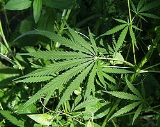
Cannabis sativa

Overview
Cannabis sativa is an annual herbaceous plant in the Cannabaceae
family. Humans have cultivated this herb
throughout recorded history as a source of industrial fibre, seed oil
, food, recreation
, spiritual enlightenment
and medicine
. Each part of the plant is harvested differently, depending on the purpose of its use.
Its seed, chiefly used as caged-bird feed, is a valuable source of protein. The flowers (and to a lesser extent the leaves, stems, and seeds) contain psychoactive and physiologically active chemical compound
s known as cannabinoids
that are consumed for recreational, medicinal, and spiritual purposes.
Cannabaceae
Cannabaceae are a small family of flowering plants. As now circumscribed, the family includes about 170 species grouped in about 11 genera, including Cannabis , Humulus and Celtis...
family. Humans have cultivated this herb
Herb
Except in botanical usage, an herb is "any plant with leaves, seeds, or flowers used for flavoring, food, medicine, or perfume" or "a part of such a plant as used in cooking"...
throughout recorded history as a source of industrial fibre, seed oil
Hemp oil
Hempseed oil is pressed from the seed of the hemp plant irrespective of the strain of cannabis. Cold pressed, unrefined hemp oil is dark to clear light green in color, with a pleasant nutty flavor. The darker the color, the grassier the flavour....
, food, recreation
Cannabis (drug)
Cannabis, also known as marijuana among many other names, refers to any number of preparations of the Cannabis plant intended for use as a psychoactive drug or for medicinal purposes. The English term marijuana comes from the Mexican Spanish word marihuana...
, spiritual enlightenment
Entheogen
An entheogen , in the strict sense, is a psychoactive substance used in a religious, shamanic, or spiritual context. Historically, entheogens were mostly derived from plant sources and have been used in a variety of traditional religious contexts...
and medicine
Medical cannabis
Medical cannabis refers to the use of parts of the herb cannabis as a physician-recommended form of medicine or herbal therapy, or to synthetic forms of specific cannabinoids such as THC as a physician-recommended form of medicine...
. Each part of the plant is harvested differently, depending on the purpose of its use.
Its seed, chiefly used as caged-bird feed, is a valuable source of protein. The flowers (and to a lesser extent the leaves, stems, and seeds) contain psychoactive and physiologically active chemical compound
Chemical compound
A chemical compound is a pure chemical substance consisting of two or more different chemical elements that can be separated into simpler substances by chemical reactions. Chemical compounds have a unique and defined chemical structure; they consist of a fixed ratio of atoms that are held together...
s known as cannabinoids
Cannabinoids
Cannabinoids are a class of chemical compounds that include the phytocannabinoids , and chemical compounds that mimic the actions of phytocannabinoids or have a similar structure...
that are consumed for recreational, medicinal, and spiritual purposes.
Discussions
