
All Topics  
Yarn

 
Yarn

   Email Print
   Bookmark   Link


Yarn


Yarn is a long continuous length of interlocked fiber
Fiber

Fiber or fibre is a class of materials that are continuous filaments or are in discrete elongated pieces, similar to lengths of yarn. They are very important in the biology of both plants and animals, for holding tissue s together....
s, suitable for use in the production of textile
Textile

A textile is a flexible material consisting of a network of natural or artificial fibres often referred to as thread or yarn. Yarn is produced by Spinning raw wool fibres, linen, cotton, or other material on a spinning wheel to produce long strands known as yarn....
s, sewing
Sewing

Sewing or stitching is the fastening of cloth, leather, furs, bark, or other flexible materials, using Sewing needle and yarn. Its use is nearly universal among human populations and dates back to Paleolithic times ....
, crochet
Crochet

Crochet is a process of creating fabric from yarn or thread using a crochet hook. The word is derived from the Middle French word croc or croche, meaning hook. Crocheting, similar to knitting, consists of pulling loops of yarn through other loops....
ing, knitting
Knitting

Knitting is a method by which yarn may be turned into cloth. Knitting consists of loops called stitches pulled through each other. The active stitches are held on a needle until another loop can be passed through them....
, weaving
Weaving

Weaving is the textile arts in which two distinct sets of yarn, called the Warp and the filling or weft , are interlaced with each other to form a textile....
, embroidery
Embroidery

File:Kazakh rug chain stitch embroidery.jpgEmbroidery is the art or handicraft of decorating Textile or other materials with sewing needle and yarn....
 and rope
Rope

A rope is a length of fibers, twisted or braided together to improve strength for pulling and connecting. It has tensile strength but is too flexible to provide compressive strength ....
making.


Discussion
Ask a question about 'Yarn'
Start a new discussion about 'Yarn'
Answer questions from other users
Full Discussion Forum


Recent Posts


Encyclopedia


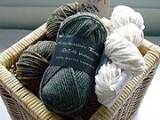
A Basket of Yarn
Spoolsofthread
Yarn is a long continuous length of interlocked fiber
Fiber

Fiber or fibre is a class of materials that are continuous filaments or are in discrete elongated pieces, similar to lengths of yarn. They are very important in the biology of both plants and animals, for holding tissue s together....
s, suitable for use in the production of textile
Textile

A textile is a flexible material consisting of a network of natural or artificial fibres often referred to as thread or yarn. Yarn is produced by Spinning raw wool fibres, linen, cotton, or other material on a spinning wheel to produce long strands known as yarn....
s, sewing
Sewing

Sewing or stitching is the fastening of cloth, leather, furs, bark, or other flexible materials, using Sewing needle and yarn. Its use is nearly universal among human populations and dates back to Paleolithic times ....
, crochet
Crochet

Crochet is a process of creating fabric from yarn or thread using a crochet hook. The word is derived from the Middle French word croc or croche, meaning hook. Crocheting, similar to knitting, consists of pulling loops of yarn through other loops....
ing, knitting
Knitting

Knitting is a method by which yarn may be turned into cloth. Knitting consists of loops called stitches pulled through each other. The active stitches are held on a needle until another loop can be passed through them....
, weaving
Weaving

Weaving is the textile arts in which two distinct sets of yarn, called the Warp and the filling or weft , are interlaced with each other to form a textile....
, embroidery
Embroidery

File:Kazakh rug chain stitch embroidery.jpgEmbroidery is the art or handicraft of decorating Textile or other materials with sewing needle and yarn....
 and rope
Rope

A rope is a length of fibers, twisted or braided together to improve strength for pulling and connecting. It has tensile strength but is too flexible to provide compressive strength ....
making. Thread is a type of yarn intended for sewing by hand or machine
Sewing machine

A sewing machine is a textile machine used to stitch fabric or other material together with thread. Sewing machines were invented during the first Industrial Revolution to decrease the amount of manual sewing work performed in clothing companies....
. Modern manufactured sewing threads may be finished with wax
Wax

Wax has traditionally referred to a substance that is secreted by bees and used by them in constructing their honeycombs.It is an imprecisely defined term generally understood to be a substance with properties similar to beeswax, namely...
 or other lubricants to withstand the stresses involved in sewing. Embroidery thread
Embroidery thread

Embroidery thread is yarn that is manufactured or hand-Spinning specifically for embroidery and other forms of needlework.Threads for hand embroidery include:...
s are yarns specifically designed for hand or machine embroidery
Machine embroidery

Machine embroidery is a term that can be used to describe two different actions. The first is using a sewing machine to "manually" create a design on a piece of fabric or other similar item....
.

Structure

See main article Spinning (textiles)
Spinning (textiles)

Spinning is an ancient textile arts in which fiber crop, animal fiber or synthetic fiber fibers are twisted together to form yarn . For thousands of years, fiber was spun by hand using simple tools, the Spindle and distaff....


Spinning Jenny
Spun yarn is made by twisting or otherwise bonding staple
Staple (textiles)

Staple is a term referring to naturally formed clusters or locks of wool fibres throughout a fleece that are held together by cross fibres. The staple strength of wool is one of the major determining factors when Spinning yarn as well as the sale price of greasy wool....
 fiber
Fiber

Fiber or fibre is a class of materials that are continuous filaments or are in discrete elongated pieces, similar to lengths of yarn. They are very important in the biology of both plants and animals, for holding tissue s together....
s together to make a cohesive thread. Twisting fibers into yarn in the process called spinning
Spinning (textiles)

Spinning is an ancient textile arts in which fiber crop, animal fiber or synthetic fiber fibers are twisted together to form yarn . For thousands of years, fiber was spun by hand using simple tools, the Spindle and distaff....
 can be dated back to the Upper Paleolithic
Upper Paleolithic

The Upper Paleolithic is the third and last subdivision of the Paleolithic or Old Stone Age as it is understood in Europe, Africa and Asia. Very broadly it dates to between 40,000 and 9th millennium BC years ago, roughly coinciding with the appearance of "high" culture and before the advent of agriculture....
, and yarn spinning was one of the very first processes to be industrialized. Spun yarns may contain a single type of fiber, or be a blend of various types. Combining synthetic fibers (which have high strength, artificial lustre, and fire retardant qualities) with natural fibers (which have good water absorbance and skin comforting qualities) is very common. The most widely used blends are cotton
Cotton

Cotton is a soft, staple fiber that grows in a form known as a boll around the seeds of the cotton plant a shrub native to tropical and subtropical regions around the world, including the Americas, India and Africa....
-polyester
Polyester

Polyester is a category of polymers which contain the ester functional group in their main chain. Although there are many polyesters, the term "polyester" as a specific material most commonly refers to polyethylene terephthalate ....
 and wool
Wool

Wool is the fiber derived from the specialized skin cells, called follicles, of animals in the Caprinae family, principally domestic sheep, but the hair of certain species of other Mammalia such as cashmere goat, llamas, rabbits and keeshonds may also be called wool....
-acrylic fiber
Acrylic fiber

Acrylic fibers are synthetic fibers made from a polymer with an average molecular weight of ~100,000, about 1900 monomer units. To be called acrylic in the U.S, the polymer must contain at least 85% acrylonitrile monomer....
 blends. Blends of different natural
Natural

Natural can refer to various topics within science and mathematics, music, and other areas.In science and mathematics, natural may refer to:...
 fibers are common too, especially with more expensive fibers such as angora
Angora wool

Angora wool or Angora fiber refers to the downy coat produced by the Angora rabbit. While their names are similar, Angora fiber is distinct from mohair, which comes from the Angora goat....
 and cashmere
Cashmere wool

Cashmere wool, usually simply known as cashmere, is a fiber obtained from the Cashmere goat. The word cashmere derives from an archaic spelling of Kashmir....
.

Yarns are made up of a number of plies, each ply
Plying

In the textile arts, plying is a process used to create a strong, balanced yarn. It is done by taking two or more strands of yarn that each have a twist to them and putting them together....
 being a single spun yarn. These single plies of yarn are twisted in the opposite direction (plied) together to make a thicker yarn. Depending on the direction of this final twist, the yarn will be known as s-twist or z-twist. For a single ply, the direction of the final twist is the same as its original twist.

Filament yarn consists of filament fibers twisted together. Thicker monofilament
Monofilament line

Monofilament line is a thin string made from a single fiber. Most fishing line is made from monofilament because of its strength, availability in all pound-test kinds, and low cost....
s are typically used for industrial purposes rather than fabric production or decoration. Silk
Silk

Silk is a natural protein fiber, some forms of which can be weaving into textiles. The best-known type of silk is obtained from Pupa#Cocoons made by the larvae of the mulberry silkworm Bombyx mori reared in captivity ....
 is a natural filament, and synthetic filament yarns are used to produce silk-like effects.

Texturized yarns are made by a process of air texturizing (sometimes referred to as taslanizing
Taslanizing

Taslanizing or the Taslan process, is the copyrighted trade name for air textured yarns. In German the word is Luftex. The process is simply feeding a bundle of continuous filament yarns into a small jet nozzle with various amounts of slack....
), which combines multiple filament yarns into a yarn with some of the characteristics of spun yarns.

Measurement


Craft yarns

Yarn quantities are usually measured by weight in ounces or grams. In the United States, Canada and Europe, balls of yarn for handcrafts are sold by weight. Common sizes include 25g, 50g, and 100g skein
Skein

Skein may refer to:* A long coil of yarn or hair intended for weaving, dyeing, or heat setting. Yarn sold in skeins often needs to be re-wound into spools or balls using a swift depending on the application....
s. Some companies also primarily measure in ounces with common sizes being three-ounce
Ounce

This article is about the unit of mass. For the unit of force, see Pound-force. For the unit of volume, see Fluid ounce. For all other uses, see Ounce ....
, four-ounce, six-ounce, and eight-ounce skeins. These measurements are taken at a standard temperature and humidity, because yarn can absorb moisture from the air. The actual length of the yarn contained in a ball or skein can vary due to the inherent heaviness of the fiber and the thickness of the strand; for instance, a 50 g skein of lace weight mohair may contain several hundred meters, while a 50 g skein of bulky wool may contain only 60 meters.

There are several thicknesses of yarn, also referred to as weight. This is not to be confused with the measurement of weight listed above. The Craft Yarn Council of America is making an effort to promote a standardized industry system for measuring this, numbering the weights from 1 (finest) to 6 (heaviest). Some of the names for the various weights of yarn from finest to thickest are called lace, fingering, sock, sport, double-knit (or DK), worsted, aran, bulky, and super-bulky. This naming convention is more descriptive than precise; fiber artists disagree about where on the continuum each lies, and the precise relationships between the sizes.

A more precise measurement of yarn weight, often used by weavers, is wraps per inch (wpi). The yarn is wrapped snugly around a ruler and the number of wraps that fit in an inch are counted.

Labels on yarn for handcrafts often include information on gauge
Gauge (knitting)

In knitting, the word Gauge, technical abbreviation GG, refers to "Knitting Machines" fineness size .Indeed "Gauge" is the unit of measure, a ?size? that expressed by a well precise number of needle gives the Power Workable Size of a Knitting Machine....
, known in the UK as tension, which is a measurement of how many stitches and rows are produced per inch or per centimeter on a specified size of knitting needle or crochet hook. The proposed standardization uses a four-by-four inch/ten-by-ten centimeter knitted or crocheted square, with the resultant number of stitches across and rows high made by the suggested tools on the label to determine the gauge.

In Europe textile engineers often use the unit tex, which is the weight in grams of a kilometer of yarn, or decitex, which is a finer measurement corresponding to the weight in grams of 10 kilometers of yarn. Many other units have been used over time by different industries.

Thread

Most types of embroidery thread come in a single size or weight; an exception is pearl or perle cotton, which comes in three weights, No. 3 (heaviest), No. 5, and No. 8 (finest).

Color

Conner Prairie Yarn Drying
Yarn may be used undyed, or may be colored with natural or artificial dye
Dye

A dye can generally be described as a colored substance that has an Chemical affinity to the Wiktionary:substrate to which it is being applied....
s. Most yarns have a single uniform hue, but there is also a wide selection of variegated yarns:

  • heathered or tweed: yarn with flecks of different colored fiber
  • ombre: variegated yarn with light and dark shades of a single hue
  • multi-colored: variegated yarn with two or more distinct hues (a "parrot colorway" might have green, yellow and red)
  • self-striping: yarn dyed with lengths of color that will automatically create stripes in a knitted or crocheted object
  • marled: yarn made from strands of different-colored yarn twisted together, sometimes in closely-related hues


See also

  • Embroidery thread
    Embroidery thread

    Embroidery thread is yarn that is manufactured or hand-Spinning specifically for embroidery and other forms of needlework.Threads for hand embroidery include:...
  • List of novelty yarns
  • Textile manufacturing
    Textile manufacturing

    Textile manufacture is a major industry. It is based in the conversion of three types of fiber into yarn, then fabric, then textiles. These are then fabricated into clothing or other artifacts....
  • Electrically conducting yarn
    Electrically conducting yarn

    An electrically conducting yarn is yarn that conducts electricity. Conducting yarns are used to manufacture carpets and other items that dissipate static electricity, such as work clothes in highly flammable environments, e.g., in the petrochemistry industry....
  • Dye lot
    Dye lot

    A dye lot is a record taken during the dyeing of yarn to identify yarn that received its coloration in the same vat at the same time. Yarn manufacturers assign each lot a unique identification number and stamp it on the label before shipping....
  • Crochet thread
    Crochet thread

    Crochet thread is specially formulated thread usually made from mercerized cotton for crafting decorative crochet items such as doily or filet crochet....
  • ISO 2
    ISO 2

    ISO 2 is an International Organization for Standardization standard for direction of twist designation for Yarn, complex yarns and related product, Sliver , slubbings and Roving....


External links