
Home      Discussion      Topics      Dictionary      Almanac
Signup       Login
Ultra high molecular weight polyethylene

Ultra high molecular weight polyethylene

Overview
Ultra-high-molecular-weight polyethylene (UHMWPE or sometimes shortened to UHMW), also known as high-modulus polyethylene (HMPE) or high-performance polyethylene (HPPE), is a subset of the thermoplastic
Thermoplastic
Thermoplastic, also known as a thermosoftening plastic, is a polymer that turns to a liquid when heated and freezes to a very glassy state when cooled sufficiently...

 polyethylene
Polyethylene
Polyethylene or polythene is the most widely used plastic, with an annual production of approximately 80 million metric tons...

. It has extremely long chains, with molecular weight numbering in the millions, usually between 2 and 6 million. The longer chain serves to transfer load more effectively to the polymer backbone by strengthening intermolecular interactions. This results in a very tough material, with the highest impact strength
Impact force
In mechanics, an impact is a high force or shock applied over a short time period when two or more bodies collide. Such a force or acceleration usually has a greater effect than a lower force applied over a proportionally longer time period of time...

 of any thermoplastic presently made. It is highly resistant to corrosive chemicals with exception of oxidizing acid
Oxidizing acid
An oxidizing acid is a Brønsted acid that is also a strong oxidizing agent . All Brønsted acids can act as moderately strong oxidizing agents, because the acidic proton can be reduced to hydrogen gas. Some acids contain other structures that act as stronger oxidizing agents than hydrogen....

s; has extremely low moisture absorption and a very low coefficient of friction; is self-lubricating; and is highly resistant to abrasion, in some forms being 15 times more resistant to abrasion than carbon steel. Its coefficient of friction is significantly lower than that of nylon
Nylon
Nylon is a generic designation for a family of synthetic polymers known generically as polyamides, first produced on February 28, 1935, by Wallace Carothers at DuPont's research facility at the DuPont Experimental Station...

 and acetal
Polyoxymethylene
Polyoxymethylene , also known as acetal, polyacetal, and polyformaldehyde, is an engineering thermoplastic used in precision parts that require high stiffness, low friction and excellent dimensional stability....

, and is comparable to that of polytetrafluoroethylene
Polytetrafluoroethylene
Polytetrafluoroethylene is a synthetic fluoropolymer of tetrafluoroethylene that finds numerous applications. PTFE is most well known by the DuPont brand name Teflon....

 (Teflon), but UHMWPE has better abrasion resistance than PTFE. It is odorless, tasteless, and nontoxic.
Discussion
Ask a question about 'Ultra high molecular weight polyethylene'
Start a new discussion about 'Ultra high molecular weight polyethylene'
Answer questions from other users
Full Discussion Forum
 
Unanswered Questions
Encyclopedia
Ultra-high-molecular-weight polyethylene (UHMWPE or sometimes shortened to UHMW), also known as high-modulus polyethylene (HMPE) or high-performance polyethylene (HPPE), is a subset of the thermoplastic
Thermoplastic
Thermoplastic, also known as a thermosoftening plastic, is a polymer that turns to a liquid when heated and freezes to a very glassy state when cooled sufficiently...

 polyethylene
Polyethylene
Polyethylene or polythene is the most widely used plastic, with an annual production of approximately 80 million metric tons...

. It has extremely long chains, with molecular weight numbering in the millions, usually between 2 and 6 million. The longer chain serves to transfer load more effectively to the polymer backbone by strengthening intermolecular interactions. This results in a very tough material, with the highest impact strength
Impact force
In mechanics, an impact is a high force or shock applied over a short time period when two or more bodies collide. Such a force or acceleration usually has a greater effect than a lower force applied over a proportionally longer time period of time...

 of any thermoplastic presently made. It is highly resistant to corrosive chemicals with exception of oxidizing acid
Oxidizing acid
An oxidizing acid is a Brønsted acid that is also a strong oxidizing agent . All Brønsted acids can act as moderately strong oxidizing agents, because the acidic proton can be reduced to hydrogen gas. Some acids contain other structures that act as stronger oxidizing agents than hydrogen....

s; has extremely low moisture absorption and a very low coefficient of friction; is self-lubricating; and is highly resistant to abrasion, in some forms being 15 times more resistant to abrasion than carbon steel. Its coefficient of friction is significantly lower than that of nylon
Nylon
Nylon is a generic designation for a family of synthetic polymers known generically as polyamides, first produced on February 28, 1935, by Wallace Carothers at DuPont's research facility at the DuPont Experimental Station...

 and acetal
Polyoxymethylene
Polyoxymethylene , also known as acetal, polyacetal, and polyformaldehyde, is an engineering thermoplastic used in precision parts that require high stiffness, low friction and excellent dimensional stability....

, and is comparable to that of polytetrafluoroethylene
Polytetrafluoroethylene
Polytetrafluoroethylene is a synthetic fluoropolymer of tetrafluoroethylene that finds numerous applications. PTFE is most well known by the DuPont brand name Teflon....

 (Teflon), but UHMWPE has better abrasion resistance than PTFE. It is odorless, tasteless, and nontoxic.

Polymerisation of UHMWPE was commercialised in the 1950s by Ruhrchemie AG, which changed names over the years; today UHMWPE powder materials are produced by Ticona
Ticona
Ticona is an international manufacturer of engineering polymers. The company's head office is located at the Ticona/Celanese-Plant in Florence, Kentucky, USA, since 2005.-Company history:...

, Braskem
Braskem
Braskem is a Brazilian petrochemical company headquartered in São Paulo. The company is the largest petrochemical in the Americas by production capacity and the fifth largest in the world...

, and Mitsui
Mitsui
is one of the largest corporate conglomerates in Japan and one of the largest publicly traded companies in the world.-History:Founded by Mitsui Takatoshi , who was the fourth son of a shopkeeper in Matsusaka, in what is now today's Mie prefecture...

. UHMWPE is available commercially either as consolidated forms, such as sheets or rods, and as fibers. UHMWPE powder may also be directly molded into the final shape of a product. Because of its resistance to wear and impact, UHMWPE continues to find increasing industrial applications, including the automotive and bottling sectors, for example. Since the 1960s, UHMWPE has also been the material of choice for total joint arthroplasty
Arthroplasty
Arthroplasty is an operative procedure of orthopedic surgery performed, in which the arthritic or dysfunctional joint surface is replaced with something better or by remodeling or realigning the joint by osteotomy or some other procedure.-Background:Previously, a popular form of arthroplasty was...

 in orthopedic and spine
Vertebral column
In human anatomy, the vertebral column is a column usually consisting of 24 articulating vertebrae, and 9 fused vertebrae in the sacrum and the coccyx. It is situated in the dorsal aspect of the torso, separated by intervertebral discs...

 implants.

UHMWPE fibers, commercialized in the late 1970s by the Dutch chemicals company DSM
DSM (company)
DSM is a multinational life sciences and materials sciences-based company. DSM's global end markets include food and dietary supplements, personal care, feed, pharmaceuticals, medical devices, automotive, paints, electrical and electronics, life protection, alternative energy and bio-based materials...

, are widely used in ballistic protection, defense applications, and increasingly in medical devices as well.

Structure and properties


UHMWPE is a type of polyolefin
Polyolefin
A polyolefin is a polymer produced from a simple olefin as a monomer. For example, polyethylene is the polyolefin produced by polymerizing the olefin ethylene. An equivalent term is polyalkene; this is a more modern term, although polyolefin is still used in the petrochemical industry...

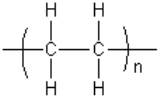
. It is made up of extremely long chains of polyethylene, which all align in the same direction. It derives its strength largely from the length of each individual molecule (chain). Van der Waals bonds between the molecules are relatively weak for each atom of overlap between the molecules, but because the molecules are very long, large overlaps can exist, adding up to the ability to carry larger shear forces from molecule to molecule. Each chain is bonded to the others with so many Van der Waals bonds that the whole of the inter-molecule strength is high. In this way, large tensile loads are not limited as much by the comparative weakness of each Van der Waals bond.

When formed to fibers, the polymer chains can attain a parallel orientation greater than 95% and a level of crystallinity
Crystallinity
Crystallinity refers to the degree of structural order in a solid. In a crystal, the atoms or molecules are arranged in a regular, periodic manner. The degree of crystallinity has a big influence on hardness, density, transparency and diffusion. In a gas, the relative positions of the atoms or...

 of up to 85%. In contrast, Kevlar
Kevlar
Kevlar is the registered trademark for a para-aramid synthetic fiber, related to other aramids such as Nomex and Technora. Developed at DuPont in 1965, this high strength material was first commercially used in the early 1970s as a replacement for steel in racing tires...

 derives its strength from strong bonding between relatively short molecules.

The weak bonding between olefin molecules allows local thermal excitations to disrupt the crystalline order of a given chain piece-by-piece, giving it much poorer heat resistance than other high-strength fibers. Its melting point
Melting point
The melting point of a solid is the temperature at which it changes state from solid to liquid. At the melting point the solid and liquid phase exist in equilibrium. The melting point of a substance depends on pressure and is usually specified at standard atmospheric pressure...

 is around 144 to 152 °C (291.2 to 305.6 F), and, according to DSM, it is not advisable to use UHMWPE fibers at temperatures exceeding 80 to 100 °C (176 to 212 F) for long periods of time. It becomes brittle
Brittle
A material is brittle if, when subjected to stress, it breaks without significant deformation . Brittle materials absorb relatively little energy prior to fracture, even those of high strength. Breaking is often accompanied by a snapping sound. Brittle materials include most ceramics and glasses ...

 at temperatures below -150 C.

The simple structure of the molecule also gives rise to surface and chemical properties that are rare in high-performance polymers. For example, the polar groups in most polymers easily bond to water. Because olefins have no such groups, UHMWPE does not absorb water readily, nor wet
Wetting
Wetting is the ability of a liquid to maintain contact with a solid surface, resulting from intermolecular interactions when the two are brought together. The degree of wetting is determined by a force balance between adhesive and cohesive forces.Wetting is important in the bonding or adherence of...

 easily, which makes bonding it to other polymers difficult. For the same reasons, skin does not interact with it strongly, making the UHMWPE fiber surface feel slippery. In a similar manner, aromatic polymers are often susceptible to aromatic solvents due to aromatic stacking interactions, an effect aliphatic polymers like UHMWPE are immune to. Since UHMWPE does not contain chemical groups (such as ester
Ester
Esters are chemical compounds derived by reacting an oxoacid with a hydroxyl compound such as an alcohol or phenol. Esters are usually derived from an inorganic acid or organic acid in which at least one -OH group is replaced by an -O-alkyl group, and most commonly from carboxylic acids and...

s, amide
Amide
In chemistry, an amide is an organic compound that contains the functional group consisting of a carbonyl group linked to a nitrogen atom . The term refers both to a class of compounds and a functional group within those compounds. The term amide also refers to deprotonated form of ammonia or an...

s or hydroxyl
Hydroxyl
A hydroxyl is a chemical group containing an oxygen atom covalently bonded with a hydrogen atom. In inorganic chemistry, the hydroxyl group is known as the hydroxide ion, and scientists and reference works generally use these different terms though they refer to the same chemical structure in...

ic groups) that are susceptible to attack from aggressive agents, it is very resistant to water, moisture, most chemicals, UV radiation, and micro-organisms.

Under tensile load, UHMWPE will deform continually as long as the stress is present - an effect called creep
Creep (deformation)
In materials science, creep is the tendency of a solid material to slowly move or deform permanently under the influence of stresses. It occurs as a result of long term exposure to high levels of stress that are below the yield strength of the material....

.

Annealing


When UHMWPE is annealed
Annealing (metallurgy)
Annealing, in metallurgy and materials science, is a heat treatment wherein a material is altered, causing changes in its properties such as strength and hardness. It is a process that produces conditions by heating to above the recrystallization temperature, maintaining a suitable temperature, and...

 , the material is heated to 135 °C to 138 °C in an oven or a liquid bath of silicone oil
Silicone oil
A silicone oil is any polymerized siloxanes with organic side chains. They are formed of alternating silicon-oxygen atoms or siloxane, rather than carbon atoms . Other species attach to the tetravalent silicon atoms, not to the divalent oxygen atoms which are fully committed to forming the...

 or glycerine. The material is then cooled down at a rate of 5 °C/h to at least 65 °C. Finally, the material is wrapped in an insulating blanket for 24 hours to bring to room temperature.

Production


UHMWPE is synthesized
Chemical synthesis
In chemistry, chemical synthesis is purposeful execution of chemical reactions to get a product, or several products. This happens by physical and chemical manipulations usually involving one or more reactions...

 from monomer of ethylene
Ethylene
Ethylene is a gaseous organic compound with the formula . It is the simplest alkene . Because it contains a carbon-carbon double bond, ethylene is classified as an unsaturated hydrocarbon. Ethylene is widely used in industry and is also a plant hormone...

, which are bonded together to form ultra-high-molecular-weight polyethylene (or UHMWPE). These are molecules of polyethylene that are several orders of magnitude longer than familiar high-density polyethylene due to a synthesis process based on metallocene
Metallocene
A metallocene is a compound typically consisting of two cyclopentadienyl anions bound to a metal center in the oxidation state II, with the resulting general formula 2M. Closely related to the metallocenes are the metallocene derivatives, e.g. titanocene dichloride, vanadocene dichloride...

 catalysts
Kaminsky catalyst
A Kaminsky catalyst is a catalytic system for alkene polymerization discovered in 1980. Kaminsky catalysts are based on metallocenes of group 4 transition metals with methylaluminoxane . These catalysts are a type of Ziegler-Natta catalyst, but they are homogeneous and show extremely high activity...

. In general, HDPE molecules have between 700 and 1,800 monomer units per molecule, whereas UHMWPE molecules tend to have 100,000 to 250,000 monomers each.

UHMWPE is processed using the following methods: compression molding
Compression molding
Compression molding is a method of molding in which the molding material, generally preheated, is first placed in an open, heated mold cavity. The mold is closed with a top force or plug member, pressure is applied to force the material into contact with all mold areas, while heat and pressure are...

, ram extrusion
Extrusion
Extrusion is a process used to create objects of a fixed cross-sectional profile. A material is pushed or drawn through a die of the desired cross-section...

, gel spinning, and sintering
Sintering
Sintering is a method used to create objects from powders. It is based on atomic diffusion. Diffusion occurs in any material above absolute zero, but it occurs much faster at higher temperatures. In most sintering processes, the powdered material is held in a mold and then heated to a temperature...

. Several European companies began compression molding UHMW in the early 1960s. Gel-spinning arrived much later and was intended for different applications.

In gel spinning, a precisely heated gel of UHMWPE is processed by an extruder through a spinneret
Spinneret (polymers)
Spinneret refers to a multi-pored device through which a plastic polymer melt is extruded to form fibers. Streams of viscous polymer usually exit into cool air or liquid to solidify. The individual polymer chains tend to align in the fiber because of viscous flow. This airstream liquid-to-fiber...

. The extrudate is drawn through the air and then cooled in a water bath. The end-result is a fiber with a high degree of molecular orientation, and therefore exceptional tensile strength
Tensile strength
Ultimate tensile strength , often shortened to tensile strength or ultimate strength, is the maximum stress that a material can withstand while being stretched or pulled before necking, which is when the specimen's cross-section starts to significantly contract...

. Gel spinning depends on isolating individual chain molecules in the solvent so that intermolecular entanglement
Entanglement
Entanglement may refer to:* Quantum entanglement* Orientation entanglement* Entanglement * Entanglement of polymer chains, see Reptation* Wire entanglement...

s are minimal. Entanglements make chain orientation more difficult, and lower the strength of the final product.

Fiber applications


Ballistic vests can be made of UHMWPE.

Dyneema and Spectra are gel spun through a spinneret to form oriented-strand synthetic fiber
Synthetic fiber
Synthetic fibers are the result of extensive research by scientists to improve on naturally occurring animal and plant fibers. In general, synthetic fibers are created by forcing, usually through extrusion, fiber forming materials through holes into the air, forming a thread...

s of UHMWPE, which have yield strengths as high as 2.4 GPa (350,000 psi
Psi
-Alphabetic letters:* Psi 23rd letter of the Greek alphabet* Psi , a letter of the early Cyrillic alphabet, adopted from Greek-Mathematics:* Tangential angle of a curve*Chebyshev function*Dedekind psi function*Digamma function...

) and specific gravity
Specific gravity
Specific gravity is the ratio of the density of a substance to the density of a reference substance. Apparent specific gravity is the ratio of the weight of a volume of the substance to the weight of an equal volume of the reference substance. The reference substance is nearly always water for...

 as low as 0.97 (for Dyneema SK75). High-strength steels have comparable yield strengths, and low-carbon steels have yield strengths much lower (around 0.5 GPa). Since steel has a specific gravity of roughly 7.8, this gives strength-to-weight ratios for these materials in a range from 10 to 100 times higher than steel. Strength-to-weight ratios for Dyneema are about 40% higher than for aramid
Aramid
Aramid fibers are a class of heat-resistant and strong synthetic fibers. They are used in aerospace and military applications, for ballistic rated body armor fabric and ballistic composites, in bicycle tires, and as an asbestos substitute. The name is a portmanteau of "aromatic polyamide"...

.

UHMWPE fibers are used in armor, in particular, personal armor
Personal armor
Personal armor is the whole of protecting clothing, designed to absorb and/or deflect slashing, bludgeoning, and penetrating attacks. They were historically used to protect soldiers, whereas today, they are also used to protect police forces, private citizens and private security guards or...

 and on occasion as vehicle armor, cut-resistant gloves, bow
Bow (weapon)
The bow and arrow is a projectile weapon system that predates recorded history and is common to most cultures.-Description:A bow is a flexible arc that shoots aerodynamic projectiles by means of elastic energy. Essentially, the bow is a form of spring powered by a string or cord...

 strings, climbing equipment
Sling (climbing equipment)
A sling or runner is an item of climbing equipment consisting of a tied or sewn loop of webbing that can be wrapped around sections of rock, hitched to other pieces of equipment or tied directly to a tensioned line using a prusik knot; for anchor extension , equalization, or climbing the...

, fishing line
Fishing line
A fishing line is a cord used or made for angling. Important parameters of a fishing line are its length, material, and weight...

, spear lines for spearguns
Spearfishing
Spearfishing is an ancient method of fishing that has been used throughout the world for millennia. Early civilizations were familiar with the custom of spearing fish from rivers and streams using sharpened sticks....

, high-performance sail
Sail
A sail is any type of surface intended to move a vessel, vehicle or rotor by being placed in a wind—in essence a propulsion wing. Sails are used in sailing.-History of sails:...

s, suspension lines on sport parachute
Parachute
A parachute is a device used to slow the motion of an object through an atmosphere by creating drag, or in the case of ram-air parachutes, aerodynamic lift. Parachutes are usually made out of light, strong cloth, originally silk, now most commonly nylon...

s and paragliders, rigging in yachting
Yachting
Yachting refers to recreational sailing or boating, the specific act of sailing or using other water vessels for sporting purposes.-Competitive sailing:...

, kites, and kites lines for kites sports. Spectra is also used as a high-end wakeboard line.

For personal armor, the fibers are, in general, aligned and bonded into sheets, which are then layered at various angles to give the resulting composite material
Composite material
Composite materials, often shortened to composites or called composition materials, are engineered or naturally occurring materials made from two or more constituent materials with significantly different physical or chemical properties which remain separate and distinct at the macroscopic or...

 strength in all directions. Recently developed additions to the US Military's Interceptor body armor
Interceptor body armor
Interceptor Body Armor is the United States Army's primary bulletproof vest. The Interceptor design replaced the older fragmentation protective Personnel Armor System for Ground Troops body armor system, introduced in the early 1980s...

, designed to offer arm and leg protection, are said to utilize a form of Spectra or Dyneema fabric. Dyneema provides puncture resistance
Puncture resistance
Puncture resistance denotes the relative ability of a material to inhibit the progression of a tear once it has been pierced by a cut or a nick. Tests devised to measure puncture resistance are generally application-specific, covering items such as roofing and packaging materials, protective...

 to protective clothing in the sport of fencing
Fencing
Fencing, which is also known as modern fencing to distinguish it from historical fencing, is a family of combat sports using bladed weapons.Fencing is one of four sports which have been featured at every one of the modern Olympic Games...

.

Spun UHMWPE fibers excel as fishing line, as they have less stretch, are more abrasion
Abrasion (mechanical)
Abrasion is the process of scuffing, scratching, wearing down, marring, or rubbing away. It can be intentionally imposed in a controlled process using an abrasive...

-resistant, and are thinner than traditional monofilament line
Monofilament line
Monofilament fishing line is fishing line made from a single fiber of plastic. Most fishing lines are now monofilament because monofilament fibers are cheap to produce and are produced in a range of diameters which have different tensile strengths...

.

In climbing
Climbing
Climbing is the activity of using one's hands and feet to ascend a steep object. It is done both for recreation and professionally, as part of activities such as maintenance of a structure, or military operations.Climbing activities include:* Bouldering: Ascending boulders or small...

, cord and webbing
Webbing
Webbing is a strong fabric woven as a flat strip or tube of varying width and fibres often used in place of rope. The name webbing comes from the meshed material frequently used in its construction, which resembles a web...

 made of combinations of UHMWPE and nylon yarn have gained popularity for their low weight and bulk, though, unlike their nylon counterparts, they exhibit very low elasticity, making them unsuitable for limiting forces in a fall. Also, low elasticity translates to low toughness
Toughness
In materials science and metallurgy, toughness is the ability of a material to absorb energy and plastically deform without fracturing; Material toughness is defined as the amount of energy per volume that a material can absorb before rupturing...

. The fiber's very high lubricity leads to poor knot-holding ability, and has led to the recommendation to use the triple fisherman's knot
Triple fisherman's knot
The triple fisherman's knot is a bend knot, used to join two ends of rope together. It is an extension of the double fisherman's knot and is recommended for tying slippery, stiff ultra high molecular weight polyethylene and aramid cored ropes....

 rather than the traditional double fisherman's knot
Double fisherman's knot
The double fisherman's knot or grapevine knot is a bend, or a knot used to join two lengths of rope. This knot and the triple fisherman's knot are the variations used most often in climbing, arboriculture, and search and rescue...

 in 6mm UHMWPE core cord to avoid a particular failure mechanism of the double fisherman's, where first the sheath fails at the knot, then the core slips through.

Owing to its low density, ships' hawser
Hawser
Hawser is a nautical term for a thick cable or rope used in mooring or towing a ship. A hawser passes through a hawsehole, also known as a cat hole, located on the hawse....

s and cables can be made from the fibre, and float on sea water. "Spec Lines" as they are called in the towboat community are commonly used for face wires.

It is used in skis and snowboards, often in combination with carbon fiber
Carbon fiber
Carbon fiber, alternatively graphite fiber, carbon graphite or CF, is a material consisting of fibers about 5–10 μm in diameter and composed mostly of carbon atoms. The carbon atoms are bonded together in crystals that are more or less aligned parallel to the long axis of the fiber...

, reinforcing the fiberglass
Fiberglass
Glass fiber is a material consisting of numerous extremely fine fibers of glass.Glassmakers throughout history have experimented with glass fibers, but mass manufacture of glass fiber was only made possible with the invention of finer machine tooling...

 composite material, adding stiffness and improving its flex characteristics. The UHMWPE is often used as the base layer, which contacts the snow, and includes abrasives to absorb and retain wax.

It is also used in lifting applications for manufacturing low weight, and heavy duty lifting slings .

High-performance lines (such as backstay
Backstay
On a sailing vessel, a backstay is the piece of standing rigging that runs from the mast to the transom of the boat, counteracting the forestay and jib...

s) for sailing
Sailing
Sailing is the propulsion of a vehicle and the control of its movement with large foils called sails. By changing the rigging, rudder, and sometimes the keel or centre board, a sailor manages the force of the wind on the sails in order to move the boat relative to its surrounding medium and...

 and parasailing
Parasailing
Parasailing, also known as parascending, or "parakiting" is a recreational kiting activity where a person is towed behind a vehicle while attached to a specially designed canopy wing that reminds one of a parachute, known as a parasail wing...

 are made of UHMWPE, due to their low stretch, high strength, and low weight.

Dyneema was used for the 30-kilometre space tether in the ESA/Russian Young Engineers' Satellite 2
Young Engineers' Satellite 2
The Young Engineers' Satellite 2 is a 36 kg student-built tether satellite that is part of ESA's Foton-M3 microgravity mission. The launch of the Russian Foton-M3 occurred on September 14, 2007 at 13:00 by a Soyuz-U launcher...

 of September, 2007.

The extremely low friction coefficient of UHMWPE makes it a common topsheet for boxes in terrain parks.

Medical applications in total joint replacement


UHMWPE has over 40 years of clinical history as a successful biomaterial for use in hip, knee, and (since the 1980s), for spine implants. An online repository of information and review articles related to medical grade UHMWPE, known as the UHMWPE Lexicon, was started online in 2000.

Joint replacement components have historically been made from "GUR" resins. These powder materials are produced by Ticona, typically converted into semi-forms by companies such as Quadrant and Orthoplastics, and then machined into implant components and sterilised by device manufacturers.

UHMWPE was first used clinically in 1962 by Sir John Charnley
John Charnley
Sir John Charnley was a British orthopaedic surgeon. He pioneered the hip replacement operation, which is now one of the most common operations both in the UK and elsewhere in the world...

 and emerged as the dominant bearing material for total hip and knee replacements in the 1970s. Details about the "discovery" of UHMWPE for orthopedic applications by Charnley and his engineering associate Harry Craven are available
Throughout its history, there were unsuccessful attempts to modify UHMWPE to improve its clinical performance until the development of highly crosslinked UHMWPE in the late 1990s.

One unsuccessful attempt to modify UHMWPE was by blending the powder with carbon fibers. This reinforced UHMWPE was released clinically as "Poly Two" by Zimmer in the 1970s. The carbon fibers had poor compatibility with the UHMWPE matrix and its clinical performance was inferior to virgin UHMWPE.

A second attempt to modify UHMWPE was by high-pressure recrystallisation. This recrystallised UHMWPE was released clinically as "Hylamer" by DePuy in the late 1980s. When gamma irradiated in air, this material exhibited susceptibility to oxidation, resulting in inferior clinical performance related to virgin UHMWPE. Today, the poor clinical history of Hylamer is largely attributed to its sterilisation method, and there has been a resurgence of interest in studying this material (at least among certain research circles). Hylamer fell out of favor in the United States in the late 1990s with the development of highly crosslinked UHMWPE materials, however negative clinical reports from Europe about Hylamer continue to surface in the literature.

Highly crosslinked UHMWPE materials were clinically introduced starting in 1998 and have rapidly become the standard of care for total hip replacements, at least in the United States. These new materials are crosslinked with gamma or electron beam radiation (50-105 kGy) and then thermally processed to improve their oxidation resistance. Five-year clinical data, from several centers, are now available demonstrating their superiority relative to conventional UHMWPE for total hip replacement (see Arthroplasty
Arthroplasty
Arthroplasty is an operative procedure of orthopedic surgery performed, in which the arthritic or dysfunctional joint surface is replaced with something better or by remodeling or realigning the joint by osteotomy or some other procedure.-Background:Previously, a popular form of arthroplasty was...

). Clinical studies are still underway to investigate the performance of highly crosslinked UHMWPE for knee replacement.

Another important medical advancement for UHMWPE in the past decade has been the increase in use of fibers for sutures. Medical-grade fibers for surgical applications are produced by DSM under the "Dyneema Purity" trade name.

Manufacturing


UHMW is used in the manufacture of PVC (vinyl) windows and doors, as it can stand up to the heat required to soften the PVC-based materials and is used as a form/chamber filler for the various PVC
PVC
Polyvinyl chloride is a plastic.PVC may also refer to:*Param Vir Chakra, India's highest military honor*Peripheral venous catheter, a small, flexible tube placed into a peripheral vein in order to administer medication or fluids...

 shape profiles in order for those materials to be 'bent' or shaped around a template.

UHMWPE is also used in the manufacture of Hydraulic Seals and Bearings. It is best suited for Medium mechanical duties in water, Oil Hydraulics, pneumatics, and unlubricated applications. It has a good abrasion resistance but is better suited to soft mating surfaces.

See also

  • Cross-linked polyethylene (PEX)
  • High-density polyethylene (HDPE)
  • Linear low-density polyethylene (LLDPE)
  • Low-density polyethylene (LDPE)
  • Medium-density polyethylene (MDPE)
  • Stretch wrap
    Stretch wrap
    Stretch wrap or stretch film is a highly stretchable plastic film that is wrapped around items. The elastic recovery keeps the items tightly bound...

  • Olefin
  • Twaron
    Twaron
    Twaron is the brandname of Teijin Aramid for a para-aramid. It is a heat-resistant and strong synthetic fibre developed in the early 1970s by the Dutch company AKZO, division Enka, later Akzo Industrial Fibers. The research name of the para-aramid fibre was originally Fiber X, but it was soon...

  • Zylon
    Zylon
    Zylon is a trademarked name for a range of thermoset liquid crystalline polyoxazole...


Further reading

  • Southern et al., The Properties of Polyethylene Crystallized Under the Orientation and Pressure Effects of a Pressure Capillary Viscometer, Journal of Applied Polymer Science
    Journal of Applied Polymer Science
    The Journal of Applied Polymer Science is a peer-reviewed scientific journal covering polymer science. Its 2008 ISI impact factor is 1.187...

    vol. 14, pp. 2305–2317 (1970).
  • Kanamoto, On Ultra-High Tensile by Drawing Single Crystal Mats of High Molecular Weight Polyethylene, Polymer Journal vol. 15, No. 4, pp. 327–329 (1983).

External links