
|
|
|
|
Dashiell Hammett
|
| |
|
| |
Samuel Dashiell Hammett (May 27, 1894—January 10, 1961) was an American author of hardboiled detective novels and short stories. Among the enduring characters he created are Sam Spade (The Maltese Falcon), Nick and Nora Charles (The Thin Man), and the Continental Op (Red Harvest and The Dain Curse). In addition to the significant influence his novels and stories had on film, Hammett "is now widely regarded as one of the finest mystery writers of all time" and was called, in his obituary in the New York Times, "the dean of the...

Discussion
Ask a question about 'Dashiell Hammett'
Start a new discussion about 'Dashiell Hammett'
Answer questions from other users
|
Encyclopedia
Samuel Dashiell Hammett (May 27, 1894—January 10, 1961) was an American author of hardboiled detective novels and short stories. Among the enduring characters he created are Sam Spade (The Maltese Falcon), Nick and Nora Charles (The Thin Man), and the Continental Op (Red Harvest and The Dain Curse). In addition to the significant influence his novels and stories had on film, Hammett "is now widely regarded as one of the finest mystery writers of all time" and was called, in his obituary in the New York Times, "the dean of the... 'hard-boiled' school of detective fiction".
Early life
Hammett was born on a farm called "Hopewell and Aim" off Great Mills Road, St. Mary's County, in southern Maryland. His parents were Richard Thomas Hammett and Anne Bond Dashiell. (The Dashiells are an old Maryland family, the name being an Anglicization of the French De Chiel; it is pronounced "da-SHEEL", not "DASH-el".) He grew up in Philadelphia and Baltimore. "Sam", as he was known before he began writing, left school when he was 13 years old and held several jobs before working for the Pinkerton National Detective Agency (this later became his influence for most his books) He served as an operative for the Pinkerton Agency from 1915 to 1921, with time off to serve in World War I. However, the agency's role in union strike-breaking eventually disillusioned him.
During World War I, Hammett enlisted in the United States Army and served in the Motor Ambulance Corps. However, he became ill with the Spanish flu and later contracted tuberculosis. He spent the war as a patient in Cushman Hospital, Tacoma, Washington. While hospitalized he met and married a nurse, Josephine Dolan, and had two daughters, Mary Jane (1921) and Josephine (1926). Shortly after the birth of their second child, Health Services nurses informed Josephine that due to Hammett's tuberculosis, she and the children should not live with him. So they rented a place in San Francisco. Hammett would visit on weekends, but the marriage soon fell apart. Hammett still supported his wife and daughters financially with the income he made from his writing.
Hammett turned to drinking, advertising, and eventually, writing. His work at the detective agency provided him the inspiration for his writings.
Early work
The detective who goes by no name other than "The Continental Operative" served as the hero in many of Hammett's early short stories, largely following a simple investigative formula. His writing was composed largely of minimalist sentences, and a steady accumulation of evidence. These stories culminated in the two Continental Op novels, Red Harvest and The Dain Curse. In Red Harvest, Hammett achieved a "Poetry of violence" as the Continental Op took a hand in the purging of mob bosses from a corrupt mining town. The Dain Curse was a more straighforward murder mystery as everyone close to a young woman met their demise, leading to the twisted mind of the murderer.
Later novels
As Hammett's literary style matured, he relied less and less on the super-criminal and turned more to the kind of realistic, hardboiled fiction seen in The Maltese Falcon or The Thin Man. In The Simple Art of Murder, Hammett's successor in the field, Raymond Chandler, summarized Hammett's accomplishments:
Hammett was the ace performer... He is said to have lacked heart; yet the story he himself thought the most of [The Glass Key] is the record of a man's devotion to a friend. He was spare, frugal, hard-boiled, but he did over and over again what only the best writers can ever do at all. He wrote scenes that seemed never to have been written before.
Later years
From 1929 to 1930 Dashiell was romantically involved with Nell Martin, an author of short stories and several novels. He dedicated The Glass Key to her, and in turn, she dedicated her novel Lovers Should Marry to Hammett.
In 1931, Hammett embarked on a thirty-year affair with playwright Lillian Hellman. He wrote his final novel in 1934, and devoted much of the rest of his life to left-wing activism. He was a strong anti-fascist throughout the 1930s and in 1937 he joined the American Communist Party. As a member of the League of American Writers, he served on its Keep America Out of War Committee in January 1940 during the period of the Hitler-Stalin pact.
Service in World War Two
In 1942, after Pearl Harbor, Hammett enlisted in the United States Army. Though he was a disabled veteran of WWI, and a victim of tuberculosis, he pulled strings in order to be admitted to the service. He spent most of World War II as an Army Sergeant in the Aleutian Islands, where he edited an Army newspaper. He came out of the war suffering from emphysema. As a corporal in 1943, he co-authored The Battle of the Aleutians with Cpl. Robert Colodny under the direction of Infantry Intelligence Officer Major Henry W. Hall.
Post-war political activity
After the war, Hammett returned to political activism, "but he played that role with less fervor than before." He was elected President of the Civil Rights Congress of New York on 5 June, 1946 at a meeting held at the Hotel Diplomat in New York City, and "devoted the largest portion of his working time to CRC activities." In 1946, a bail fund was created by the CRC "to be used at the discretion of three trustees to gain the release of defendants arrested for political reasons." Those three trustees were Hammett, who was chairman, Robert W. Dunn, and Frederick Vanderbilt Field, "millionaire Communist supporter." On 3 April, 1947, the CRC was designated a Communist front group on the Attorney General's List of Subversive Organizations, as directed by U.S. President Harry S. Truman’s Executive Order 9835.
Imprisonment and the blacklist
The CRC's bail fund gained national attention on 4 November, 1949, when bail in the amount of "$260,000 in negotiable government bonds" was posted "to free eleven men appealing their convictions under the Smith Act for criminal conspiracy to teach and advocate the overthrow of the United States government by force and violence." On 2 July, 1951, their appeals exhausted, four of the convicted men fled rather than surrender themselves to Federal agents and begin serving their sentences. "At that time the U.S. District Court, Southern District of New York, issued subpoenas for the trustees of the CRC bail fund in an attempt to learn the whereabouts of the fugitives...". Hammett testified on 9 July, 1951 in front of United States District Court Judge Sylvester Ryan, facing questioning by U.S. District Attorney Irving Saypol, described by Time as "the nation's number one legal hunter of top Communists". During the hearing Hammett refused to provide the information the government wanted, specifically, the list of contributors to the bail fund, "people who might be sympathetic enough to harbor the fugitives." Instead, on every question regarding the CRC or the bail fund, Hammett took the Fifth Amendment, refusing to even identify his signature or initials on CRC documents the government had subpoenaed. As soon as his testimony concluded, Hammett was immediately found guilty of contempt of court.
During the 1950s he was investigated by Congress (see McCarthyism), and testified on March 26, 1953 before the House Committee on Un-American Activities. Although he testified to his own activities, he refused to cooperate with the committee, and was blacklisted.
Death
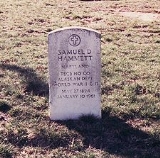
On January 10, 1961, Hammett died in New York City's Lenox Hill Hospital, of lung cancer, diagnosed just two months before. As a veteran of two World Wars, he was buried at Arlington National Cemetery.
Works
- Red Harvest (published on February 1, 1929)
- The Dain Curse (July 19, 1929)
- The Maltese Falcon (February 14, 1930)
- The Glass Key (April 24, 1931)
- Creeps by Night; Chills and Thrills (Anthology edited by Hammett, 1931)
- Woman in the Dark: A Novel of Dangerous Romance (published in Liberty magazine in three installments in 1933)
- The Thin Man (January 8, 1934)
- The Big Knockover (a collection of short stories)
- The Continental Op (a collection of four short stories with "Meet the Continental Op", an introduction by Ellery Queen) (published as Dell mapback #129
- The Return of the Continental Op (a collection of five short stories with "The Return of the Continental Op", an introduction by Ellery Queen) (published as Dell mapback #154)
- Nightmare Town (a collection of four short stories) (published with an introduction titled "A Letter from Ellery Queen" as Dell mapback #379)
- Blood Money (two novellas) (published as Dell mapback #53 and #486)
- A Man Called Spade (five short stories, only three Sam Spade stories, with "Meet Sam Spade", an introduction by Ellery Queen) (published as Dell mapback #90 and #411)
- Dead Yellow Women (four Continental Op stories, two other stories, and an introduction titled "A Letter from Ellery Queen") (published as Dell mapback #308)
- Hammett Homicides (four Continental Op stories, two other stories, and an introduction titled "A Letter from Ellery Queen") (published as Dell mapback #223)
- The Creeping Siamese (three Continental Op stories, three other stories and an introduction titled "A Letter from Ellery Queen") (published as Dell mapback #538)
Published as
- Complete Novels (Steven Marcus, ed.) (Library of America, 1999) ISBN 978-1-88301167-3.
- Crime Stories and Other Writings (Steven Marcus, ed.) (Library of America, 2001) ISBN 978-1-93108200-6.
Quotes
See also
Bibliography
- Hammett, Jo, A Daughter Remembers, 2001, Carroll and Graf Publishers.
External links
- by Hammett estate trustee and biographer Richard Layman on the 75th anniversary of The Maltese Falcon
- of where every Hammett story appeared
- portrait of Hammett
- at the Harry Ransom Center at the University of Texas at Austin
- (KQED-TV, San Francisco, 1982). Written and produced by Stephen Talbot. Winner of Peabody Award and a special Edgar Allan Poe Award from the Mystery Writers of America.
|
| |
|
|