

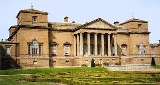
English country house

Encyclopedia
The English country house is a large house
or mansion
in the English countryside. Such houses were often owned by individuals who also owned a London house. This allowed to them to spend time in the country and in the city—hence, for these people, the term distinguished between town and country. However, the term also encompasses houses that were, and often still are, the full time residence for the landed gentry
. These people were central to the squirearchy that ruled rural Britain until the Reform Act 1832
. Frequently, the formal business of the counties was transacted in these country houses.
With large indoor and outdoor staffs, country house were important as places of employment for many rural communities. In turn, until the agricultural depressions of 1870s, the estates, of which country houses were the hub, provided their owners with incomes. However, the late 19th and early 20th centuries were the swan song of the traditional English country house lifestyle, increased taxation and the results of World War I were to result in the demolition of thousands of houses
, those that remained had to adapt to survive.
 The term "stately home" is subject to debate and indifferent use, and avoided by historians and other academics. As a description of a country house, the term was first used in a poem by Felicia Hemans
, The Homes of England, originally published in Blackwood's Magazine
in 1827. In the 20th century, the term was later popularised in a song by the late Noel Coward
, and in modern usage it often implies a country house that is open to visitors at least some of the time.
In England, the terms "country house" and "stately home" are sometimes used vaguely and interchangeably, however, many country houses such as Ascott
in Buckinghamshire were deliberately designed not to be stately, and to harmonise with the landscape, while some of the great houses such as Kedleston Hall
and Holkham Hall
were built as "power houses" to impress and dominate the landscape, and were most certainly intended to be "stately" and impressive. In his book, Historic Houses: Conversations in Stately Homes, the author and journalist Robert Harling
documents nineteen "stately homes", these range in size from the vast Blenheim palace to the miniscule Ebberston Hall and in architecture from the Jacobean Renaissance of Hatfield House
to the eccentricities of Sezincote. The book's collection of stately homes also includes George IV's Brighton town palace, the Royal Pavilion
.
 The country houses of England have evolved over the last five hundred years. Before this time, larger houses were usually fortified, reflecting the position of their owners as feudal lords
, de facto overlords of their manors
. The Tudor period
of stability in the country saw the building of the first of the unfortified great houses. Henry VIII
's Dissolution of the Monasteries
saw many former ecclesiastical properties granted to the King's favourites, who then converted them into private country houses. Woburn Abbey
, Forde Abbey
and many other mansions with Abbey
or Priory
in their name often date from this period as private houses. Other terms used in the name of houses to describe their origin or importance include Palace
, Castle
, Court
, Hall
, Mansion
, Park
, House
, Manor
, Place
and Tower
.
It was during the second half of the reign of Elizabeth I
and under her successor James I
that the first architect-designed mansions, thought of today as epitomising the English country house, began to make their appearance. Burghley House
, Longleat House
, and Hatfield House
are among the best known. Hatfield House was one of the first houses in England to show the Italianate
influence of the Renaissance
, which was eventually to see the end of the hinting-at-castle-architecture "turrets and towers" Gothic style. By the reign of Charles I
, Inigo Jones
and his form of Palladianism had changed the face of British domestic architecture completely. While there were later various Gothic Revival styles, the Palladian style in various forms, interrupted briefly by baroque
, was to predominate until the second half of the 18th century when, influenced by ancient Greek styles, it gradually evolved into the neoclassicism
championed by such architects as Robert Adam
.
Some of the best known of England's country houses were built by one architect
at one particular time: Montacute House
, Chatsworth House
, and Blenheim Palace
are examples. It is interesting that while the latter two are ducal
palace
s, Montacute, although built by a Master of the Rolls
to Queen Elizabeth I, spent the next 400 years in the occupation of his descendants who were gentry without a London townhouse
, rather than aristocracy. They finally ran out of funds in the early 20th century.
However, the vast majority of the lesser-known English country houses, often owned at different times by gentlemen and peers
, are an evolution of one or more styles with facade
s and wings in various styles in a mixture of high architecture, often as interpreted by a local architect or surveyor and determined by practicality as much as by the whims of architectural taste. An example of this is Brympton d'Evercy
in Somerset, a house of many periods that is unified architecturally by the continuing use of the same mellow local Ham Hill stone.
The fashionable William Kent
redesigned Rousham House
only to have it quickly and drastically altered to accommodate space for the owner's twelve children. Canons Ashby
, home to poet
John Dryden
's family, exemplifies this: a medieval farmhouse enlarged in the Tudor era around a courtyard, given grandiose plaster ceilings in the Stewart
period and then given Georgian
façades in the 18th century. The whole is a glorious mismatch of styles and fashions that seamlessly blend together. These could be called the true English country house. Wilton House
, one of England's grandest houses, is in a remarkably similar vein; although, while the Drydens, mere squires, at Canons Ashby employed a local architect, at Wilton the mighty Earls of Pembroke employed the finest architects of the day: first Holbein, 150 years later Inigo Jones, and then Wyatt followed by Chambers. Each employed a different style of architecture, seemingly unaware of the design of the wing around the next corner. These varying "improvements", often criticised at the time, today are the qualities that make English country houses unique. Scarcely anywhere else in the world would an elite class have allowed, or indeed pursued, such an indifference to style.
 The great houses are the greatest of the country houses; in truth palaces, built by the country's most powerful - these were the "power houses" designed to display their owners power or ambitions to power. Really large un-fortified or barely fortified houses began to take over from the traditional castle
s of the crown and magnates during the Tudor period with vast houses such as Hampton Court Palace
and Burghley
and continued until the 18th century - with houses such as Kedleston Hall
and Holkham Hall
. Such building reached its zenith from the late 17th century until the mid 18th century; these houses were often completely built or rebuilt in their entirety by one eminent architect in the most fashionable architectural style of the day and often have a suite of Baroque state apartments, typically in enfilade, reserved for the most eminent guests - the entertainment of whom was paramount to maintaining and gaining the required power of the owner. The common denominator of this category of English country house, is that they were designed to be lived in with a certain degree of ceremony and pomp. It was not unusual for the family to have a small suite of rooms for withdrawing in privacy away from the multitude that lived in the household. These houses were always an alternative residence to a London house.
During the 18th and 19th centuries to the highest echelons of British society the country house served as a place for relaxing, hunting
and running the country with one's equals at the end of the week, with some houses having their own theatre where performances were held.
The country house however, was not just an oasis of pleasure for a fortunate few; it was the centre of its own world, providing employment to hundreds of people in the vicinity of its estate
. In previous eras when state benefits were unheard of, those working on an estate were among the most fortunate, receiving secured employment and rent-free accommodation. At the summit of these fortunate people was the indoor staff of the country house. Unlike many of their contemporaries prior to the 20th century, they slept in proper beds, wore well-made adequate clothes and received three proper meals a day, plus a small wage. In an era when many still died for lack of medicine
or malnutrition, the long working hours were a small price to pay.
As a result of the aristocratic habit of only marrying within the aristocracy, and whenever possible to a sole heiress, many owners of country houses owned several country mansions, and would visit each according to the season: Grouse
shooting in Scotland
, pheasant
shooting and fox hunting
in England. The Earl of Rosebery
, for instance, had Dalmeny House
in Scotland, Mentmore Towers
in Buckinghamshire
and another near Epsom
just for the racing season. For many, this way of life, which began a steady decline in 1914, continued well into the 20th century and for a very few continues to this day.
 The second category of England's country houses are those that belonged to the squirearchy or gentry
. These tend to either have evolved from Medieval hall houses, with rooms added as required or were built by relatively unknown local architects. Smaller and far greater in number than the power houses, these smaller houses, like their grander counterparts the power houses were still the epicentre of their own estate, but were often the principal or only residence of their owner.
However, whether the owner of a power house or a small manor, the inhabitants of the English country house have become collectively referred to as the Ruling class, because this is exactly what they did in varying degrees, whether by holding high political influence and power in national government or in the day-to-day running of their own localities in such offices as magistrates, or occasionally even clergy
.
of the 19th century, a third category of country houses were built as newly rich industrialists and bankers were eager to display their newly found wealth and taste. By the 1850s, with the British economy was booming, new mansions were built in one of the many revivalist
architectural styles popular throughout the 19th century. The builders of these new houses were able to take advantage of the political unrest in Europe that gave rise to a large trade in architectural salvage. This new wave of country house building are exemplified by the Rothschild properties in the Home counties.
, sought American heiresses to save their country houses and lifestyles.
The ultimate demise began immediately following World War I
. The huge staff required to maintain large houses had either left to fight and never returned, departed to work in the munitions factories, or to fulfil the void left by the fighting men in other workplaces. Of those who returned with the cessation of war, many left the countryside for better-paid jobs in towns. The final blow for many country houses came following World War II
; having been requisitioned during the war, they were returned to the owners in poor repair. Many of whom having lost their heirs, if not in the immediately preceding war then in World War I, were now paying far higher rates of tax
, and agricultural incomes from the accompanying estates had dropped. Thus, the solution appeared to be to hold contents auctions
and then demolish the house and sell its stone, fireplace
s, and panelling
. And this is exactly what happened to many of Britain's finest houses.
Despite this slow decline, as late as 1920, so necessary was the country house for entertaining and prestige, that following the election of the first Labour Government in 1921, Viscount Lee of Fareham
donated his country house Chequers
to the nation for the use of a Prime Minister
who might not possess one of his own. Chequers still fulfils that need today as do both Chevening House and Dorneywood
country houses, donated for sole use of high-ranking ministers of the crown.
. Houses that survived destruction are now mostly listed as buildings of historic interest, Grade I or II and can only be maintained under Government supervision—and only the most faithful, most accurate, and most precise restoration and re-creation is permitted. This is, however, also usually the most expensive. This system does, however, ensure that all work is correctly and authentically done. The negative side is that many owners cannot afford the work, so a roof remains leaking for the sake of a cheap roof tile.
Although the ownership or management of some houses has been transferred to a private trust
, most notably at Chatsworth
, other houses have transferred art works and furnishings under the Acceptance in Lieu
scheme to ownership by various national or local museums, but are retained for display in the building. This enables the former owners to offset tax, the payment of which would otherwise have necessitated the sale of the art works, for example tapestries and furniture at Houghton Hall
are now owned by the Victoria and Albert Museum
. Increasing numbers of country houses hold licenses for wedding
s and civil ceremonies
. Another source of income is use as a film location
and Corporate entertainment
venue. While many country houses are open to the public, they remain inhabited private houses, and in some cases, by the descendents of their original builders.
House
A house is a building or structure that has the ability to be occupied for dwelling by human beings or other creatures. The term house includes many kinds of different dwellings ranging from rudimentary huts of nomadic tribes to free standing individual structures...
or mansion
Mansion
A mansion is a very large dwelling house. U.S. real estate brokers define a mansion as a dwelling of over . A traditional European mansion was defined as a house which contained a ballroom and tens of bedrooms...
in the English countryside. Such houses were often owned by individuals who also owned a London house. This allowed to them to spend time in the country and in the city—hence, for these people, the term distinguished between town and country. However, the term also encompasses houses that were, and often still are, the full time residence for the landed gentry
Landed gentry
Landed gentry is a traditional British social class, consisting of land owners who could live entirely off rental income. Often they worked only in an administrative capacity looking after the management of their own lands....
. These people were central to the squirearchy that ruled rural Britain until the Reform Act 1832
Reform Act 1832
The Representation of the People Act 1832 was an Act of Parliament that introduced wide-ranging changes to the electoral system of England and Wales...
. Frequently, the formal business of the counties was transacted in these country houses.
With large indoor and outdoor staffs, country house were important as places of employment for many rural communities. In turn, until the agricultural depressions of 1870s, the estates, of which country houses were the hub, provided their owners with incomes. However, the late 19th and early 20th centuries were the swan song of the traditional English country house lifestyle, increased taxation and the results of World War I were to result in the demolition of thousands of houses
Destruction of country houses in 20th-century Britain
The destruction of country houses in 20th-century Britain was a phenomenon brought about by a change in social conditions during which a large number of country houses of varying architectural merit were demolished...
, those that remained had to adapt to survive.
The stately homes of England
Felicia Hemans
-Ancestry:Felicia Heman's paternal grandfather was George Browne of Passage, co. Cork, Ireland; her maternal grandparents were Elizabeth Haydock Wagner of Lancashire and Benedict Paul Wagner , wine importer at 9 Wolstenholme Square, Liverpool. Family legend gave the Wagners a Venetian origin;...
, The Homes of England, originally published in Blackwood's Magazine
Blackwood's Magazine
Blackwood's Magazine was a British magazine and miscellany printed between 1817 and 1980. It was founded by the publisher William Blackwood and was originally called the Edinburgh Monthly Magazine. The first number appeared in April 1817 under the editorship of Thomas Pringle and James Cleghorn...
in 1827. In the 20th century, the term was later popularised in a song by the late Noel Coward
Noël Coward
Sir Noël Peirce Coward was an English playwright, composer, director, actor and singer, known for his wit, flamboyance, and what Time magazine called "a sense of personal style, a combination of cheek and chic, pose and poise".Born in Teddington, a suburb of London, Coward attended a dance academy...
, and in modern usage it often implies a country house that is open to visitors at least some of the time.
In England, the terms "country house" and "stately home" are sometimes used vaguely and interchangeably, however, many country houses such as Ascott
Ascott House
Ascott House, sometimes referred to as simply Ascott, is situated in the hamlet of Ascott near Wing in Buckinghamshire, England. It is set in a estate....
in Buckinghamshire were deliberately designed not to be stately, and to harmonise with the landscape, while some of the great houses such as Kedleston Hall
Kedleston Hall
Kedleston Hall is an English country house in Kedleston, Derbyshire, approximately four miles north-west of Derby, and is the seat of the Curzon family whose name originates in Notre-Dame-de-Courson in Normandy...
and Holkham Hall
Holkham Hall
Holkham Hall is an eighteenth-century country house located adjacent to the village of Holkham, on the north coast of the English county of Norfolk...
were built as "power houses" to impress and dominate the landscape, and were most certainly intended to be "stately" and impressive. In his book, Historic Houses: Conversations in Stately Homes, the author and journalist Robert Harling
Robert Harling (typographer)
Robert Henry Harling was a British typographer, designer, journalist and novelist who lived to the age of 98.-Books and other work:* The Letterforms and Type Designs of Eric Gill...
documents nineteen "stately homes", these range in size from the vast Blenheim palace to the miniscule Ebberston Hall and in architecture from the Jacobean Renaissance of Hatfield House
Hatfield House
Hatfield House is a country house set in a large park, the Great Park, on the eastern side of the town of Hatfield, Hertfordshire, England. The present Jacobean house was built in 1611 by Robert Cecil, First Earl of Salisbury and Chief Minister to King James I and has been the home of the Cecil...
to the eccentricities of Sezincote. The book's collection of stately homes also includes George IV's Brighton town palace, the Royal Pavilion
Royal Pavilion
The Royal Pavilion is a former royal residence located in Brighton, England. It was built in three campaigns, beginning in 1787, as a seaside retreat for George, Prince of Wales, from 1811 Prince Regent. It is often referred to as the Brighton Pavilion...
.
Evolution
Feudalism
Feudalism was a set of legal and military customs in medieval Europe that flourished between the 9th and 15th centuries, which, broadly defined, was a system for ordering society around relationships derived from the holding of land in exchange for service or labour.Although derived from the...
, de facto overlords of their manors
Manorialism
Manorialism, an essential element of feudal society, was the organizing principle of rural economy that originated in the villa system of the Late Roman Empire, was widely practiced in medieval western and parts of central Europe, and was slowly replaced by the advent of a money-based market...
. The Tudor period
Tudor period
The Tudor period usually refers to the period between 1485 and 1603, specifically in relation to the history of England. This coincides with the rule of the Tudor dynasty in England whose first monarch was Henry VII...
of stability in the country saw the building of the first of the unfortified great houses. Henry VIII
Henry VIII of England
Henry VIII was King of England from 21 April 1509 until his death. He was Lord, and later King, of Ireland, as well as continuing the nominal claim by the English monarchs to the Kingdom of France...
's Dissolution of the Monasteries
Dissolution of the Monasteries
The Dissolution of the Monasteries, sometimes referred to as the Suppression of the Monasteries, was the set of administrative and legal processes between 1536 and 1541 by which Henry VIII disbanded monasteries, priories, convents and friaries in England, Wales and Ireland; appropriated their...
saw many former ecclesiastical properties granted to the King's favourites, who then converted them into private country houses. Woburn Abbey
Woburn Abbey
Woburn Abbey , near Woburn, Bedfordshire, England, is a country house, the seat of the Duke of Bedford and the location of the Woburn Safari Park.- Pre-20th century :...
, Forde Abbey
Forde Abbey
Forde Abbey is a privately owned former Cistercian monastery in Dorset, England. The house and gardens are run as a tourist attraction while the estate is farmed to provide additional revenue...
and many other mansions with Abbey
Abbey
An abbey is a Catholic monastery or convent, under the authority of an Abbot or an Abbess, who serves as the spiritual father or mother of the community.The term can also refer to an establishment which has long ceased to function as an abbey,...
or Priory
Priory
A priory is a house of men or women under religious vows that is headed by a prior or prioress. Priories may be houses of mendicant friars or religious sisters , or monasteries of monks or nuns .The Benedictines and their offshoots , the Premonstratensians, and the...
in their name often date from this period as private houses. Other terms used in the name of houses to describe their origin or importance include Palace
Palace
A palace is a grand residence, especially a royal residence or the home of a head of state or some other high-ranking dignitary, such as a bishop or archbishop. The word itself is derived from the Latin name Palātium, for Palatine Hill, one of the seven hills in Rome. In many parts of Europe, the...
, Castle
Castle
A castle is a type of fortified structure built in Europe and the Middle East during the Middle Ages by European nobility. Scholars debate the scope of the word castle, but usually consider it to be the private fortified residence of a lord or noble...
, Court
Court (disambiguation)
Court is an English word known since 1175, from Old French curt, from Latin cohors Court is an English word known since 1175, from Old French curt, from Latin cohors Court is an English word known since 1175, from Old French curt, from Latin cohors ("enclosed yard," and by extension, perhaps...
, Hall
Hall
In architecture, a hall is fundamentally a relatively large space enclosed by a roof and walls. In the Iron Age, a mead hall was such a simple building and was the residence of a lord and his retainers...
, Mansion
Mansion
A mansion is a very large dwelling house. U.S. real estate brokers define a mansion as a dwelling of over . A traditional European mansion was defined as a house which contained a ballroom and tens of bedrooms...
, Park
Park
A park is a protected area, in its natural or semi-natural state, or planted, and set aside for human recreation and enjoyment, or for the protection of wildlife or natural habitats. It may consist of rocks, soil, water, flora and fauna and grass areas. Many parks are legally protected by...
, House
House
A house is a building or structure that has the ability to be occupied for dwelling by human beings or other creatures. The term house includes many kinds of different dwellings ranging from rudimentary huts of nomadic tribes to free standing individual structures...
, Manor
Manor house
A manor house is a country house that historically formed the administrative centre of a manor, the lowest unit of territorial organisation in the feudal system in Europe. The term is applied to country houses that belonged to the gentry and other grand stately homes...
, Place
Location (geography)
The terms location and place in geography are used to identify a point or an area on the Earth's surface or elsewhere. The term 'location' generally implies a higher degree of can certainty than "place" which often has an ambiguous boundary relying more on human/social attributes of place identity...
and Tower
Tower house
A tower house is a particular type of stone structure, built for defensive purposes as well as habitation.-History:Tower houses began to appear in the Middle Ages, especially in mountain or limited access areas, in order to command and defend strategic points with reduced forces...
.
It was during the second half of the reign of Elizabeth I
Elizabeth I of England
Elizabeth I was queen regnant of England and Ireland from 17 November 1558 until her death. Sometimes called The Virgin Queen, Gloriana, or Good Queen Bess, Elizabeth was the fifth and last monarch of the Tudor dynasty...
and under her successor James I
James I of England
James VI and I was King of Scots as James VI from 24 July 1567 and King of England and Ireland as James I from the union of the English and Scottish crowns on 24 March 1603...
that the first architect-designed mansions, thought of today as epitomising the English country house, began to make their appearance. Burghley House
Burghley House
Burghley House is a grand 16th-century country house near the town of Stamford, Lincolnshire, England...
, Longleat House
Longleat
Longleat is an English stately home, currently the seat of the Marquesses of Bath, adjacent to the village of Horningsham and near the towns of Warminster in Wiltshire and Frome in Somerset. It is noted for its Elizabethan country house, maze, landscaped parkland and safari park. The house is set...
, and Hatfield House
Hatfield House
Hatfield House is a country house set in a large park, the Great Park, on the eastern side of the town of Hatfield, Hertfordshire, England. The present Jacobean house was built in 1611 by Robert Cecil, First Earl of Salisbury and Chief Minister to King James I and has been the home of the Cecil...
are among the best known. Hatfield House was one of the first houses in England to show the Italianate
Italianate architecture
The Italianate style of architecture was a distinct 19th-century phase in the history of Classical architecture. In the Italianate style, the models and architectural vocabulary of 16th-century Italian Renaissance architecture, which had served as inspiration for both Palladianism and...
influence of the Renaissance
Renaissance
The Renaissance was a cultural movement that spanned roughly the 14th to the 17th century, beginning in Italy in the Late Middle Ages and later spreading to the rest of Europe. The term is also used more loosely to refer to the historical era, but since the changes of the Renaissance were not...
, which was eventually to see the end of the hinting-at-castle-architecture "turrets and towers" Gothic style. By the reign of Charles I
Charles I of England
Charles I was King of England, King of Scotland, and King of Ireland from 27 March 1625 until his execution in 1649. Charles engaged in a struggle for power with the Parliament of England, attempting to obtain royal revenue whilst Parliament sought to curb his Royal prerogative which Charles...
, Inigo Jones
Inigo Jones
Inigo Jones is the first significant British architect of the modern period, and the first to bring Italianate Renaissance architecture to England...
and his form of Palladianism had changed the face of British domestic architecture completely. While there were later various Gothic Revival styles, the Palladian style in various forms, interrupted briefly by baroque
Baroque
The Baroque is a period and the style that used exaggerated motion and clear, easily interpreted detail to produce drama, tension, exuberance, and grandeur in sculpture, painting, literature, dance, and music...
, was to predominate until the second half of the 18th century when, influenced by ancient Greek styles, it gradually evolved into the neoclassicism
Neoclassicism
Neoclassicism is the name given to Western movements in the decorative and visual arts, literature, theatre, music, and architecture that draw inspiration from the "classical" art and culture of Ancient Greece or Ancient Rome...
championed by such architects as Robert Adam
Robert Adam
Robert Adam was a Scottish neoclassical architect, interior designer and furniture designer. He was the son of William Adam , Scotland's foremost architect of the time, and trained under him...
.
Some of the best known of England's country houses were built by one architect
Architect
An architect is a person trained in the planning, design and oversight of the construction of buildings. To practice architecture means to offer or render services in connection with the design and construction of a building, or group of buildings and the space within the site surrounding the...
at one particular time: Montacute House
Montacute House
Montacute House is a late Elizabethan country house situated in the South Somerset village of Montacute. This house is a textbook example of English architecture during a period that was moving from the medieval Gothic to the Renaissance Classical; this has resulted in Montacute being regarded as...
, Chatsworth House
Chatsworth House
Chatsworth House is a stately home in North Derbyshire, England, northeast of Bakewell and west of Chesterfield . It is the seat of the Duke of Devonshire, and has been home to his family, the Cavendish family, since Bess of Hardwick settled at Chatsworth in 1549.Standing on the east bank of the...
, and Blenheim Palace
Blenheim Palace
Blenheim Palace is a monumental country house situated in Woodstock, Oxfordshire, England, residence of the dukes of Marlborough. It is the only non-royal non-episcopal country house in England to hold the title of palace. The palace, one of England's largest houses, was built between...
are examples. It is interesting that while the latter two are ducal
Duke
A duke or duchess is a member of the nobility, historically of highest rank below the monarch, and historically controlling a duchy...
palace
Palace
A palace is a grand residence, especially a royal residence or the home of a head of state or some other high-ranking dignitary, such as a bishop or archbishop. The word itself is derived from the Latin name Palātium, for Palatine Hill, one of the seven hills in Rome. In many parts of Europe, the...
s, Montacute, although built by a Master of the Rolls
Master of the Rolls
The Keeper or Master of the Rolls and Records of the Chancery of England, known as the Master of the Rolls, is the second most senior judge in England and Wales, after the Lord Chief Justice. The Master of the Rolls is the presiding officer of the Civil Division of the Court of Appeal...
to Queen Elizabeth I, spent the next 400 years in the occupation of his descendants who were gentry without a London townhouse
Townhouse
A townhouse is the term historically used in the United Kingdom, Ireland and in many other countries to describe a residence of a peer or member of the aristocracy in the capital or major city. Most such figures owned one or more country houses in which they lived for much of the year...
, rather than aristocracy. They finally ran out of funds in the early 20th century.
However, the vast majority of the lesser-known English country houses, often owned at different times by gentlemen and peers
Peerage
The Peerage is a legal system of largely hereditary titles in the United Kingdom, which constitute the ranks of British nobility and is part of the British honours system...
, are an evolution of one or more styles with facade
Facade
A facade or façade is generally one exterior side of a building, usually, but not always, the front. The word comes from the French language, literally meaning "frontage" or "face"....
s and wings in various styles in a mixture of high architecture, often as interpreted by a local architect or surveyor and determined by practicality as much as by the whims of architectural taste. An example of this is Brympton d'Evercy
Brympton d'Evercy
Brympton d'Evercy is a manor house near Yeovil in the county of Somerset, England. It has been described as the most beautiful house in England, in a country of architecturally pleasing country houses; whatever the truth of that statement, in 1927 the British magazine Country Life published a set...
in Somerset, a house of many periods that is unified architecturally by the continuing use of the same mellow local Ham Hill stone.
The fashionable William Kent
William Kent
William Kent , born in Bridlington, Yorkshire, was an eminent English architect, landscape architect and furniture designer of the early 18th century.He was baptised as William Cant.-Education:...
redesigned Rousham House
Rousham House
Rousham House is a Jacobean country house at Rousham in Oxfordshire, England. The house has been in the ownership of one family since it was built.-History:...
only to have it quickly and drastically altered to accommodate space for the owner's twelve children. Canons Ashby
Canons Ashby
Canons Ashby is a small village and civil parish in the Daventry district of the county of Northamptonshire, England.Its most notable building is Canons Ashby House, a National Trust property. The parish church is a surviving fragment of Canons Ashby Priory.It is situated one mile from Moreton...
, home to poet
Poet
A poet is a person who writes poetry. A poet's work can be literal, meaning that his work is derived from a specific event, or metaphorical, meaning that his work can take on many meanings and forms. Poets have existed since antiquity, in nearly all languages, and have produced works that vary...
John Dryden
John Dryden
John Dryden was an influential English poet, literary critic, translator, and playwright who dominated the literary life of Restoration England to such a point that the period came to be known in literary circles as the Age of Dryden.Walter Scott called him "Glorious John." He was made Poet...
's family, exemplifies this: a medieval farmhouse enlarged in the Tudor era around a courtyard, given grandiose plaster ceilings in the Stewart
Stewart
Stewart is a popular Scottish given name and surname. The word Stewart is derived from an occupational surname. It originally belonged to a person who was a steward by profession. It is derived from a combination of two Old English words, the word stig, which means house, and the word weard, which...
period and then given Georgian
Georgian architecture
Georgian architecture is the name given in most English-speaking countries to the set of architectural styles current between 1720 and 1840. It is eponymous for the first four British monarchs of the House of Hanover—George I of Great Britain, George II of Great Britain, George III of the United...
façades in the 18th century. The whole is a glorious mismatch of styles and fashions that seamlessly blend together. These could be called the true English country house. Wilton House
Wilton House
Wilton House is an English country house situated at Wilton near Salisbury in Wiltshire. It has been the country seat of the Earls of Pembroke for over 400 years....
, one of England's grandest houses, is in a remarkably similar vein; although, while the Drydens, mere squires, at Canons Ashby employed a local architect, at Wilton the mighty Earls of Pembroke employed the finest architects of the day: first Holbein, 150 years later Inigo Jones, and then Wyatt followed by Chambers. Each employed a different style of architecture, seemingly unaware of the design of the wing around the next corner. These varying "improvements", often criticised at the time, today are the qualities that make English country houses unique. Scarcely anywhere else in the world would an elite class have allowed, or indeed pursued, such an indifference to style.
Sizes and types of country house
Confusingly, there are no written terms for distinguishing between vast country palaces and comparatively small country houses; all descriptive terms, which can include castle, manor and court provide no firm clue and are often only used because of a historical connection with the site of such a building. Therefore, for ease or explanation, England's country houses can be categorised according to the circumstances of their creation.Power houses
Castle
A castle is a type of fortified structure built in Europe and the Middle East during the Middle Ages by European nobility. Scholars debate the scope of the word castle, but usually consider it to be the private fortified residence of a lord or noble...
s of the crown and magnates during the Tudor period with vast houses such as Hampton Court Palace
Hampton Court Palace
Hampton Court Palace is a royal palace in the London Borough of Richmond upon Thames, Greater London; it has not been inhabited by the British royal family since the 18th century. The palace is located south west of Charing Cross and upstream of Central London on the River Thames...
and Burghley
Burghley
Burghley may refer to:*William Cecil, 1st Baron Burghley , chief minister of queen Elizabeth I of England*Burghley House, a sixteenth century country house in Lincolnshire, built for the above...
and continued until the 18th century - with houses such as Kedleston Hall
Kedleston
Kedleston is a village and civil parish in the Amber Valley district of Derbyshire. It lies to the north-west of Derby, and nearby places include Quarndon, Weston Underwood, Mugginton, and Kirk Langley.-History:...
and Holkham Hall
Holkham Hall
Holkham Hall is an eighteenth-century country house located adjacent to the village of Holkham, on the north coast of the English county of Norfolk...
. Such building reached its zenith from the late 17th century until the mid 18th century; these houses were often completely built or rebuilt in their entirety by one eminent architect in the most fashionable architectural style of the day and often have a suite of Baroque state apartments, typically in enfilade, reserved for the most eminent guests - the entertainment of whom was paramount to maintaining and gaining the required power of the owner. The common denominator of this category of English country house, is that they were designed to be lived in with a certain degree of ceremony and pomp. It was not unusual for the family to have a small suite of rooms for withdrawing in privacy away from the multitude that lived in the household. These houses were always an alternative residence to a London house.
During the 18th and 19th centuries to the highest echelons of British society the country house served as a place for relaxing, hunting
Hunting
Hunting is the practice of pursuing any living thing, usually wildlife, for food, recreation, or trade. In present-day use, the term refers to lawful hunting, as distinguished from poaching, which is the killing, trapping or capture of the hunted species contrary to applicable law...
and running the country with one's equals at the end of the week, with some houses having their own theatre where performances were held.
The country house however, was not just an oasis of pleasure for a fortunate few; it was the centre of its own world, providing employment to hundreds of people in the vicinity of its estate
Estate (house)
An estate comprises the houses and outbuildings and supporting farmland and woods that surround the gardens and grounds of a very large property, such as a country house or mansion. It is the modern term for a manor, but lacks the latter's now abolished jurisdictional authority...
. In previous eras when state benefits were unheard of, those working on an estate were among the most fortunate, receiving secured employment and rent-free accommodation. At the summit of these fortunate people was the indoor staff of the country house. Unlike many of their contemporaries prior to the 20th century, they slept in proper beds, wore well-made adequate clothes and received three proper meals a day, plus a small wage. In an era when many still died for lack of medicine
Medicine
Medicine is the science and art of healing. It encompasses a variety of health care practices evolved to maintain and restore health by the prevention and treatment of illness....
or malnutrition, the long working hours were a small price to pay.
As a result of the aristocratic habit of only marrying within the aristocracy, and whenever possible to a sole heiress, many owners of country houses owned several country mansions, and would visit each according to the season: Grouse
Grouse
Grouse are a group of birds from the order Galliformes. They are sometimes considered a family Tetraonidae, though the American Ornithologists' Union and many others include grouse as a subfamily Tetraoninae in the family Phasianidae...
shooting in Scotland
Scotland
Scotland is a country that is part of the United Kingdom. Occupying the northern third of the island of Great Britain, it shares a border with England to the south and is bounded by the North Sea to the east, the Atlantic Ocean to the north and west, and the North Channel and Irish Sea to the...
, pheasant
Pheasant
Pheasants refer to some members of the Phasianinae subfamily of Phasianidae in the order Galliformes.Pheasants are characterised by strong sexual dimorphism, males being highly ornate with bright colours and adornments such as wattles and long tails. Males are usually larger than females and have...
shooting and fox hunting
Fox hunting
Fox hunting is an activity involving the tracking, chase, and sometimes killing of a fox, traditionally a red fox, by trained foxhounds or other scent hounds, and a group of followers led by a master of foxhounds, who follow the hounds on foot or on horseback.Fox hunting originated in its current...
in England. The Earl of Rosebery
Earl of Rosebery
Earl of Rosebery is a title in the Peerage of Scotland. It was created in 1703 for Archibald Primrose, 1st Viscount of Rosebery, with remainder to his issue male and female successively...
, for instance, had Dalmeny House
Dalmeny House
Dalmeny House is a Gothic revival mansion located in an estate close to Dalmeny on the Firth of Forth, to the north-west of Edinburgh, Scotland. It was designed by William Wilkins, and completed in 1817.Dalmeny House is the home of the Earl and Countess of Rosebery. The house was the first in...
in Scotland, Mentmore Towers
Mentmore Towers
Mentmore Towers is a 19th century English country house in the village of Mentmore in Buckinghamshire. The house was designed by Joseph Paxton and his son-in-law, George Henry Stokes, in the revival Elizabethan and Jacobean style of the late 16th century called Jacobethan, for the banker and...
in Buckinghamshire
Buckinghamshire
Buckinghamshire is a ceremonial and non-metropolitan home county in South East England. The county town is Aylesbury, the largest town in the ceremonial county is Milton Keynes and largest town in the non-metropolitan county is High Wycombe....
and another near Epsom
Epsom
Epsom is a town in the borough of Epsom and Ewell in Surrey, England. Small parts of Epsom are in the Borough of Reigate and Banstead. The town is located south-south-west of Charing Cross, within the Greater London Urban Area. The town lies on the chalk downland of Epsom Downs.-History:Epsom lies...
just for the racing season. For many, this way of life, which began a steady decline in 1914, continued well into the 20th century and for a very few continues to this day.
Squire's Houses
Gentry
Gentry denotes "well-born and well-bred people" of high social class, especially in the past....
. These tend to either have evolved from Medieval hall houses, with rooms added as required or were built by relatively unknown local architects. Smaller and far greater in number than the power houses, these smaller houses, like their grander counterparts the power houses were still the epicentre of their own estate, but were often the principal or only residence of their owner.
However, whether the owner of a power house or a small manor, the inhabitants of the English country house have become collectively referred to as the Ruling class, because this is exactly what they did in varying degrees, whether by holding high political influence and power in national government or in the day-to-day running of their own localities in such offices as magistrates, or occasionally even clergy
Clergy
Clergy is the generic term used to describe the formal religious leadership within a given religion. A clergyman, churchman or cleric is a member of the clergy, especially one who is a priest, preacher, pastor, or other religious professional....
.
Victorian Houses
Following the industrial revolutionIndustrial Revolution
The Industrial Revolution was a period from the 18th to the 19th century where major changes in agriculture, manufacturing, mining, transportation, and technology had a profound effect on the social, economic and cultural conditions of the times...
of the 19th century, a third category of country houses were built as newly rich industrialists and bankers were eager to display their newly found wealth and taste. By the 1850s, with the British economy was booming, new mansions were built in one of the many revivalist
Revivalism (architecture)
Revivalism in architecture is the use of visual styles that consciously echo the style of a previous architectural era.There were a number of architectural revivalist movements in the United States in the 19th and early 20th centuries....
architectural styles popular throughout the 19th century. The builders of these new houses were able to take advantage of the political unrest in Europe that gave rise to a large trade in architectural salvage. This new wave of country house building are exemplified by the Rothschild properties in the Home counties.
Decline
The slow decline of the English country house coincided with the rise in not just of taxation, but also of modern industry and the agricultural depression of the 1870s. By 1880, this had led some owners into financial shortfalls as they tried to balance maintenance of their estate with the income it provided. Some relied on funds from secondary sources such as banking and trade while others, like the severely impoverished Duke Of MarlboroughCharles Spencer-Churchill, 9th Duke of Marlborough
Charles Richard John Spencer-Churchill, 9th Duke of Marlborough KG, PC , styled Earl of Sunderland until 1883 and Marquess of Blandford between 1883 and 1892, was a British soldier and Conservative politician...
, sought American heiresses to save their country houses and lifestyles.
The ultimate demise began immediately following World War I
World War I
World War I , which was predominantly called the World War or the Great War from its occurrence until 1939, and the First World War or World War I thereafter, was a major war centred in Europe that began on 28 July 1914 and lasted until 11 November 1918...
. The huge staff required to maintain large houses had either left to fight and never returned, departed to work in the munitions factories, or to fulfil the void left by the fighting men in other workplaces. Of those who returned with the cessation of war, many left the countryside for better-paid jobs in towns. The final blow for many country houses came following World War II
World War II
World War II, or the Second World War , was a global conflict lasting from 1939 to 1945, involving most of the world's nations—including all of the great powers—eventually forming two opposing military alliances: the Allies and the Axis...
; having been requisitioned during the war, they were returned to the owners in poor repair. Many of whom having lost their heirs, if not in the immediately preceding war then in World War I, were now paying far higher rates of tax
Tax
To tax is to impose a financial charge or other levy upon a taxpayer by a state or the functional equivalent of a state such that failure to pay is punishable by law. Taxes are also imposed by many subnational entities...
, and agricultural incomes from the accompanying estates had dropped. Thus, the solution appeared to be to hold contents auctions
English country house contents auctions
English country house contents auctions are usually held on site at the country house, and have been used to raise funds for their owners, usually before selling the house and estate...
and then demolish the house and sell its stone, fireplace
Fireplace
A fireplace is an architectural structure to contain a fire for heating and, especially historically, for cooking. A fire is contained in a firebox or firepit; a chimney or other flue allows gas and particulate exhaust to escape...
s, and panelling
Panelling
Panelling is a wall covering constructed from rigid or semi-rigid components. These are traditionally interlocking wood, but could be plastic or other materials....
. And this is exactly what happened to many of Britain's finest houses.
Despite this slow decline, as late as 1920, so necessary was the country house for entertaining and prestige, that following the election of the first Labour Government in 1921, Viscount Lee of Fareham
Arthur Lee, 1st Viscount Lee of Fareham
Arthur Hamilton Lee, 1st Viscount Lee of Fareham, GCB, GBE, GCSI, PC was a British soldier, diplomat, politician and patron of the arts. After military postings and an assignment to the British Embassy in Washington, he entered politics and served as Minster of Agriculture and Fisheries and First...
donated his country house Chequers
Chequers
Chequers, or Chequers Court, is a country house near Ellesborough, to the south of Aylesbury in Buckinghamshire, England, at the foot of the Chiltern Hills...
to the nation for the use of a Prime Minister
Prime minister
A prime minister is the most senior minister of cabinet in the executive branch of government in a parliamentary system. In many systems, the prime minister selects and may dismiss other members of the cabinet, and allocates posts to members within the government. In most systems, the prime...
who might not possess one of his own. Chequers still fulfils that need today as do both Chevening House and Dorneywood
Dorneywood
Dorneywood is a moderately large Queen Anne style house built in 1920, near Burnham in the South Bucks District of Buckinghamshire, England. It was given to the National Trust by Lord Courtauld-Thomson in 1947 as a country home for a senior member of the Government, usually a Secretary of State or...
country houses, donated for sole use of high-ranking ministers of the crown.
Today's English country house
Today, many country houses have become hotels, schools, hospitals, museums and prisons, while others have survived as conserved ruins, but from the early 20th century until to the early 1970s, thousands of country houses were demolishedDestruction of country houses in 20th-century Britain
The destruction of country houses in 20th-century Britain was a phenomenon brought about by a change in social conditions during which a large number of country houses of varying architectural merit were demolished...
. Houses that survived destruction are now mostly listed as buildings of historic interest, Grade I or II and can only be maintained under Government supervision—and only the most faithful, most accurate, and most precise restoration and re-creation is permitted. This is, however, also usually the most expensive. This system does, however, ensure that all work is correctly and authentically done. The negative side is that many owners cannot afford the work, so a roof remains leaking for the sake of a cheap roof tile.
Although the ownership or management of some houses has been transferred to a private trust
Trust law
In common law legal systems, a trust is a relationship whereby property is held by one party for the benefit of another...
, most notably at Chatsworth
Chatsworth House
Chatsworth House is a stately home in North Derbyshire, England, northeast of Bakewell and west of Chesterfield . It is the seat of the Duke of Devonshire, and has been home to his family, the Cavendish family, since Bess of Hardwick settled at Chatsworth in 1549.Standing on the east bank of the...
, other houses have transferred art works and furnishings under the Acceptance in Lieu
Acceptance in Lieu
Acceptance in Lieu is a provision in British tax law under which Inheritance Tax debts can be written off in exchange for the acquisition of objects of national importance...
scheme to ownership by various national or local museums, but are retained for display in the building. This enables the former owners to offset tax, the payment of which would otherwise have necessitated the sale of the art works, for example tapestries and furniture at Houghton Hall
Houghton Hall
Houghton Hall is a country house in Norfolk, England. It was built for the de facto first British Prime Minister, Sir Robert Walpole, and it is a key building in the history of Palladian architecture in England...
are now owned by the Victoria and Albert Museum
Victoria and Albert Museum
The Victoria and Albert Museum , set in the Brompton district of The Royal Borough of Kensington and Chelsea, London, England, is the world's largest museum of decorative arts and design, housing a permanent collection of over 4.5 million objects...
. Increasing numbers of country houses hold licenses for wedding
Wedding
A wedding is the ceremony in which two people are united in marriage or a similar institution. Wedding traditions and customs vary greatly between cultures, ethnic groups, religions, countries, and social classes...
s and civil ceremonies
Civil ceremony
A civil registrar ceremony is a non-religious legal marriage ceremony performed by a government official or functionary. In the UK, this person is normally called a registrar...
. Another source of income is use as a film location
Filming location
A filming location is a place where some or all of a film or television series is produced, in addition to or instead of using sets constructed on a movie studio backlot or soundstage...
and Corporate entertainment
Corporate entertainment
Corporate entertainment relates to private events held by corporations or businesses for their staff, clients or stakeholders.These events can be for large audiences such as conventions and conferences, or smaller events such as retreats, holiday parties or even private concerts.It is also commonly...
venue. While many country houses are open to the public, they remain inhabited private houses, and in some cases, by the descendents of their original builders.
See also
- English country houses with changed useEnglish country houses with changed useMany English country houses have experienced a change of use and are no longer privately occupied.-English Country Homes that have become Luxury Hotels:* Cliveden* Coworth House* Hartwell House* Peckforton Castle* Taymouth Castle...
- List of country houses in the United Kingdom
- List of National Trust properties in England
- List of English Heritage properties
- List of castles in England
- List of historic buildings and architects of the United Kingdom - country house architectural periods and styles
- Historic houseHistoric houseA historic house can be a stately home, the birthplace of a famous person, or a house with an interesting history or architecture.- Background :...
- Manor HouseManor houseA manor house is a country house that historically formed the administrative centre of a manor, the lowest unit of territorial organisation in the feudal system in Europe. The term is applied to country houses that belonged to the gentry and other grand stately homes...
- Great houseGreat houseA great house is a large and stately residence; the term encompasses different styles of dwelling in different countries. The name refers to the makeup of the household rather than to any particular architectural style...
- English country house contents auctionsEnglish country house contents auctionsEnglish country house contents auctions are usually held on site at the country house, and have been used to raise funds for their owners, usually before selling the house and estate...
- Country House Theatres
- Treasure Houses of EnglandTreasure Houses of EnglandThe Treasure Houses of England is a heritage consortium founded in the early 1970s by ten of the foremost stately homes in England still in private ownership, with the aim of marketing and promoting themselves as tourist venues....
- Country house poemsCountry house poemsA country house poem is a poem in which the author compliments a wealthy patron or a friend through a description of his country house. Such poems were popular in early 17th century England...
- Country LifeCountry Life (magazine)Country Life is a British weekly magazine, based in London at 110 Southwark Street, and owned by IPC Media, a Time Warner subsidiary.- Topics :The magazine covers the pleasures and joys of rural life, as well as the concerns of rural people...
External links
- The National Trust - England, Wales, & Northern Ireland
- The National Trust for Scotland
- English Heritage
- Historic Houses Association
- Hudson's Historic Houses and Gardens - Hudson'sNorman HudsonNorman Hudson OBE is an English publisher, founder of annual guidebook, and advisor to owners of historic houses on management, development of tourism and location filming.- Career :...
list of 2,000 properties open to the public - The DiCamillo Companion to British & Irish Country Houses
- Lost Heritage - A Memorial to the Lost Country Houses of England
- Country House news blog
- Country Houses currently for sale blog
- An English Manor House Head Gardener's Online Diary