

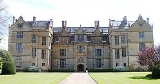
Montacute House

Encyclopedia

South Somerset
South Somerset is a local government district in Somerset, England.The South Somerset district covers and area of ranging from the borders with Devon and Dorset to the edge of the Somerset Levels. It has a population of approximately 158,000...
village
Village
A village is a clustered human settlement or community, larger than a hamlet with the population ranging from a few hundred to a few thousand , Though often located in rural areas, the term urban village is also applied to certain urban neighbourhoods, such as the West Village in Manhattan, New...
of Montacute
Montacute
Montacute is a small village and civil parish in Somerset, England, west of Yeovil. The village has a population of 680 . The name Montacute is thought by some to derive from the Latin "Mons Acutus", referring to the small but still quite acute hill dominating the village to the west.The village...
. This house is a textbook example of English architecture during a period that was moving from the medieval Gothic to the Renaissance Classical; this has resulted in Montacute being regarded as one of the finest houses to survive from the Elizabethan era. It has been designated by English Heritage
English Heritage
English Heritage . is an executive non-departmental public body of the British Government sponsored by the Department for Culture, Media and Sport...
as a grade I listed building, and Scheduled Ancient Monument
Scheduled Ancient Monument
In the United Kingdom, a scheduled monument is a 'nationally important' archaeological site or historic building, given protection against unauthorized change. The various pieces of legislation used for legally protecting heritage assets from damage and destruction are grouped under the term...
. It was visited by 110,529 people in 2009.
Designed by an unknown architect, the three floored mansion
Mansion
A mansion is a very large dwelling house. U.S. real estate brokers define a mansion as a dwelling of over . A traditional European mansion was defined as a house which contained a ballroom and tens of bedrooms...
, constructed of the local Ham Hill stone, was built circa 1598 by Sir Edward Phelips
Edward Phelips
Sir Edward Phelips was an English lawyer and politician, the Speaker of the English House of Commons from 1604 until 1611, and subsequently Master of the Rolls from 1611 until his death in 1614. He was an elected MP from 1584, and in 1588, following a successful career as a lawyer, he commissioned...
, Master of the Rolls
Master of the Rolls
The Keeper or Master of the Rolls and Records of the Chancery of England, known as the Master of the Rolls, is the second most senior judge in England and Wales, after the Lord Chief Justice. The Master of the Rolls is the presiding officer of the Civil Division of the Court of Appeal...
. His descendants occupied the house until the early 20th century. Following a brief period, when the house was let to tenants, it was acquired by the National Trust
National Trust for Places of Historic Interest or Natural Beauty
The National Trust for Places of Historic Interest or Natural Beauty, usually known as the National Trust, is a conservation organisation in England, Wales and Northern Ireland...
in 1927. Today, it is fully open to the public. Since 1975, the mansion's Long Gallery
Long gallery
Long gallery is an architectural term given to a long, narrow room, often with a high ceiling. In British architecture, long galleries were popular in Elizabethan and Jacobean houses. They were often located on the upper floor of the great houses of the time, and stretched across the entire...
, the longest in England, has served as a regional outpost of the National Portrait Gallery and displays an important collection of oils and watercolours contemporary to the house.
History
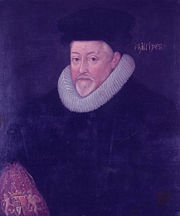
Edward Phelips
Sir Edward Phelips was an English lawyer and politician, the Speaker of the English House of Commons from 1604 until 1611, and subsequently Master of the Rolls from 1611 until his death in 1614. He was an elected MP from 1584, and in 1588, following a successful career as a lawyer, he commissioned...
, whose family had been resident in the Montacute area since at least 1460, first as yeomen farmer
Yeoman
Yeoman refers chiefly to a free man owning his own farm, especially from the Elizabethan era to the 17th century. Work requiring a great deal of effort or labor, such as would be done by a yeoman farmer, came to be described as "yeoman's work"...
s before rising in status. Edward Phelips was a lawyer who had been in Parliament since 1584. He was knighted in 1603 and a year later became Speaker of the House. James I
James I of England
James VI and I was King of Scots as James VI from 24 July 1567 and King of England and Ireland as James I from the union of the English and Scottish crowns on 24 March 1603...
appointed him Master of the Rolls and Chancellor to his son and heir Henry, Prince of Wales
Henry Frederick, Prince of Wales
Henry Frederick Stuart, Prince of Wales was the elder son of King James I & VI and Anne of Denmark. His name derives from his grandfathers: Henry Stuart, Lord Darnley and Frederick II of Denmark. Prince Henry was widely seen as a bright and promising heir to his father's throne...
. Phelips remained at the hub of English political life, and his legal skills were employed when he became opening prosecutor during the trial of the Gunpowder Plot
Gunpowder Plot
The Gunpowder Plot of 1605, in earlier centuries often called the Gunpowder Treason Plot or the Jesuit Treason, was a failed assassination attempt against King James I of England and VI of Scotland by a group of provincial English Catholics led by Robert Catesby.The plan was to blow up the House of...
ters.
Sir Edward's choice of architect is unknown. although it has been attributed to the mason, William Arnold
William Arnold (architect)
William Arnold was an important master mason in Somerset, England.Little is known about him, but he is known to have been living in Charlton Musgrove near Wincanton in 1595 where he was church warden. His first known commission was for the design of Montacute House in c1598...
, who was responsible for the designs of Cranborne Manor
Cranborne Manor
Cranborne Manor is a grade I listed country house in the county of Dorset in southern England.The manor dates back to the thirteenth century, and was originally a hunting lodge. It was remodelled for the 1st Earl of Salisbury in the early 17th century...
and Wadham College, Oxford, and had worked at Dunster Castle
Dunster Castle
Dunster Castle is a former motte and bailey castle, now a country house, in the village of Dunster, Somerset, England. The castle lies on the top of a steep hill called the Tor, and has been fortified since the late Anglo-Saxon period. After the Norman conquest of England in the 11th century,...
, also in Somerset. Dunster has architectural motifs similar to those found at Montacute. Phelips chose as the site for his new mansion a spot close by the existing house, built by his father. The date work commenced is not documented, but generally thought to be circa 1598/9; this assumption is based on dates on a fireplace and in stained glass within the house. The date, 1601 engraved above a doorcase, is considered the date of completion.
Sir Edward Phelips died in 1614, leaving his family wealthy and landed; he was succeeded by his son, Sir Robert Phelips
Robert Phelips
Sir Robert Phelips was an English politician. He was the son of Sir Edward Phelips, Speaker of the House of Commons and Master of the Rolls...
, who represented various West Country constituencies in Parliament. Robert Phelips has the distinction of being arrested at Montacute. A staunch protestant, he was subsequently imprisoned in the Tower of London
Tower of London
Her Majesty's Royal Palace and Fortress, more commonly known as the Tower of London, is a historic castle on the north bank of the River Thames in central London, England. It lies within the London Borough of Tower Hamlets, separated from the eastern edge of the City of London by the open space...
as a result of his opposition to the "Spanish Match
Spanish Match
The Spanish Match was a proposed marriage between Prince Charles, the son of King James I of England, and Infanta Maria Anna of Spain, the daughter of Philip III of Spain...
" between the Prince of Wales
Charles I of England
Charles I was King of England, King of Scotland, and King of Ireland from 27 March 1625 until his execution in 1649. Charles engaged in a struggle for power with the Parliament of England, attempting to obtain royal revenue whilst Parliament sought to curb his Royal prerogative which Charles...
and a Catholic Spanish Infanta.
The family's fame and notoriety were to be short-lived. Subsequent generations settled down in Somerset to live the lives of county gentry
Gentry
Gentry denotes "well-born and well-bred people" of high social class, especially in the past....
, representing Somerset in Parliament and when necessary following occupations in the army and the church. This peaceful existence was severely jolted when the estate was inherited by William Phelips (1823–1889). In his early days he made many improvement and renovations to Montacute. He was responsible for the Base Court, a low service range adjoining the south side of the mansion. and the restoration of the Great Chamber, which he transformed into a library. Later, William Phelips was to become insane; an addicted gambler, he was eventually incarcerated for his own good. Sadly for his family, this was after he had gambled away the family fortune and vast tracts of the Montacute Estate. In 1875, when his son, William Phelips (1846–1919) took control of the estate, agricultural rents from what remained of the mortgaged estate were low, and the huge house was a drain on limited resources. Selling the family silver and art works delayed the inevitable by a few years, but in 1911 the family were forced to let the house, for an annual sum of £650, and move out. The Phelips never returned.
By 1915, the original tenant, Robert Davidson, had departed and the house was let to George Nathaniel Curzon, 1st Marquess Curzon of Kedleston. A later tenant was the American writer, Henry Lane Eno
Henry Lane Eno
Henry Lane Eno was born in New York City on July 8, 1871; he died at Montacute House, Somerset, on September 28, 1928. A member of the Eno real estate and banking family, he was the son of Henry Clay Eno and his wife Cornelia, the daughter of George W...
, who died at the house in 1928. Finally, in 1929, the house was sold to philanthropist Ernest Cook who presented it to the Society for the Protection of Ancient Buildings
Society for the Protection of Ancient Buildings
The Society for the Protection of Ancient Buildings was founded by William Morris, Philip Webb and J.J.Stevenson, and other notable members of the Pre Raphaelite brotherhood, in 1877, to oppose what they saw as the insensitive renovation of ancient buildings then occurring in Victorian...
, and from that Society, it passed to the National Trust
National Trust for Places of Historic Interest or Natural Beauty
The National Trust for Places of Historic Interest or Natural Beauty, usually known as the National Trust, is a conservation organisation in England, Wales and Northern Ireland...
. It was one of the Trust's first great houses. Just a few years later, in 1932, it featured on the cover of the very first National Trust Bulletin
National Trust Magazine
National Trust Magazine is the members’ publication of National Trust for Places of Historic Interest or Natural Beauty. With a readership of 3.76 million it currently has the sixth highest magazine circulation in Britain...
.
Architecture
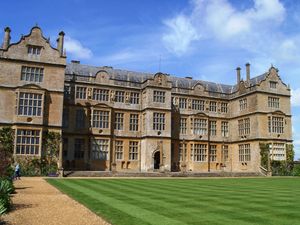
Dutch gable
A Dutch gable or Flemish gable is a gable whose sides have a shape made up of one or more curves and has a pediment at the top. The gable may be an entirely decorative projection above a flat section of roof line, or may be the termination of a roof, like a normal gable...
s decorated with romping stone monkey
Monkey
A monkey is a primate, either an Old World monkey or a New World monkey. There are about 260 known living species of monkey. Many are arboreal, although there are species that live primarily on the ground, such as baboons. Monkeys are generally considered to be intelligent. Unlike apes, monkeys...
s and other animals.
The architecture of the early English Renaissance was far less formal than that of mainland Europe and drew from a greater selection of motifs both ancient and modern and less emphasis was placed on the strict obervance of rules derived from antique architecture. This has led to an argument that the style was an evolution of Gothic rather than an innovation imported from Europe. This argument is evident at Montacute, where Gothic pinnacle
Pinnacle
A pinnacle is an architectural ornament originally forming the cap or crown of a buttress or small turret, but afterwards used on parapets at the corners of towers and in many other situations. The pinnacle looks like a small spire...
s, albeit obelisk
Obelisk
An obelisk is a tall, four-sided, narrow tapering monument which ends in a pyramid-like shape at the top, and is said to resemble a petrified ray of the sun-disk. A pair of obelisks usually stood in front of a pylon...
in form, are combined with Renaissance gables, pediments, classical statuary, ogee
Ogee
An ogee is a curve , shaped somewhat like an S, consisting of two arcs that curve in opposite senses, so that the ends are parallel....
roofs and windows appearing as bands of glass. This profusion of large, mullion
Mullion
A mullion is a vertical structural element which divides adjacent window units. The primary purpose of the mullion is as a structural support to an arch or lintel above the window opening. Its secondary purpose may be as a rigid support to the glazing of the window...
ed windows, an innovation of their day, give the appearance that the principal façade is built entirely of glass; a similar fenestration
Building envelope
The building envelope is the physical separator between the interior and the exterior environments of a building. Another emerging term is "Building Enclosure". It serves as the outer shell to help maintain the indoor environment and facilitate its climate control...
was employed at Hardwick Hall
Hardwick Hall
Hardwick Hall , in Derbyshire, is one of the most significant Elizabethan country houses in England. In common with its architect Robert Smythson's other works at both Longleat House and Wollaton Hall, Hardwick Hall is one of the earliest examples of the English interpretation of the Renaissance...
in Derbyshire
Derbyshire
Derbyshire is a county in the East Midlands of England. A substantial portion of the Peak District National Park lies within Derbyshire. The northern part of Derbyshire overlaps with the Pennines, a famous chain of hills and mountains. The county contains within its boundary of approx...
. However, despite the Dutch gables, a feature of the English Renaissance acquired as the style spread from France across the Low Countries to England, and the Gothic elements, much of the architectural influence is directly Italian. The windows of the second floor Long Gallery are divided by niches containing statues, a feature copied from the Palazzo degli Uffizi in Florence(1560–1581), which at Montacute depict the Nine Worthies
Nine Worthies
The Nine Worthies are nine historical, scriptural and legendary personages who personify the ideals of chivalry as were established in the Middle Ages. All are commonly referred to as 'Princes' in their own right, despite whatever true titles each man may have held...
; the bay windows have shallow segmented pediments – a very early and primitive occurrence of this motif in England – while beneath the bay windows are curious circular hollows, probably intended for the reception of terracotta medallions, again emulating the palazzi of Florence. Such medallions were one of the Renaissance motifs introduce to English Gothic architecture when Henry VIII was rebuilding Hampton Court
Hampton Court Palace
Hampton Court Palace is a royal palace in the London Borough of Richmond upon Thames, Greater London; it has not been inhabited by the British royal family since the 18th century. The palace is located south west of Charing Cross and upstream of Central London on the River Thames...
and supporting the claim that the English Renaissance was little more than Gothic architecture with Renaissance ornament. At Montacute, however, the Renaissance style is not confined to ornament, the house also has perfect symmetry. Paired stair towers stand in the angles between the main body of the house and the wings that project forward, a sign of modern symmetry in the plan of the house as well as its elevation, and a symptom of the times, in that the hall no longer had a "high end" of greater state.
Montacute, like many Elizabethan
Elizabethan architecture
Elizabethan architecture is the term given to early Renaissance architecture in England, during the reign of Queen Elizabeth I. Historically, the period corresponds to the Cinquecento in Italy, the Early Renaissance in France, and the Plateresque style in Spain...
mansion
Mansion
A mansion is a very large dwelling house. U.S. real estate brokers define a mansion as a dwelling of over . A traditional European mansion was defined as a house which contained a ballroom and tens of bedrooms...
s, is built in an 'E' shape, a much-used plan in this era, often said to be a tribute to Elizabeth I
Elizabeth I of England
Elizabeth I was queen regnant of England and Ireland from 17 November 1558 until her death. Sometimes called The Virgin Queen, Gloriana, or Good Queen Bess, Elizabeth was the fifth and last monarch of the Tudor dynasty...
. On the ground floor was the great hall
Great hall
A great hall is the main room of a royal palace, nobleman's castle or a large manor house in the Middle Ages, and in the country houses of the 16th and early 17th centuries. At that time the word great simply meant big, and had not acquired its modern connotations of excellence...
, kitchen
Kitchen
A kitchen is a room or part of a room used for cooking and food preparation.In the West, a modern residential kitchen is typically equipped with a stove, a sink with hot and cold running water, a refrigerator and kitchen cabinets arranged according to a modular design. Many households have a...
s and pantries, on the upper floors, retiring rooms for the family
Family
In human context, a family is a group of people affiliated by consanguinity, affinity, or co-residence. In most societies it is the principal institution for the socialization of children...
and honoured guests. Over the centuries, the layout and use of rooms changed: drawing and dining rooms evolved on the ground floor.
The original approach to the house would have been far more impressive than the picturesque approach today. The east front was then the entrance façade and faced onto a large entrance court. The two remaining pavilions flanked a large gatehouse; this long demolished structure contained secondary lodgings. In turn, the entrance court and gatehouse was approached through a larger outer court. The courts were however not fortified, but bordered by ornate balustrading which, with the ogee roofs of the pavilions, were a purely ornamental and domestic acknowledgement of the fortified courts and approaches found in earlier medieval English manors and castles.
As in all houses of the Elizabethan era
Elizabethan era
The Elizabethan era was the epoch in English history of Queen Elizabeth I's reign . Historians often depict it as the golden age in English history...
, Montacute had no corridors: the rooms led directly from one to another. This changed in 1787 when stonework from a nearby mansion at Clifton Maybank
Clifton Maybank
Clifton Maybank is a hamlet in west Dorset, England. It is perhaps best known for Clifton Maybank House, a country house with surviving Tudor fabric.-Clifton Maybank settlement:...
(which was being partly demolished) was purchased by Edward Phelips (1725–1797) and used to rebuild Montacute's west front. This provided the much-needed corridor giving privacy to the ground floor rooms and first floor bedrooms. Now, with the new frontage in place, the house was virtually turned around: the 'Clifton Maybank' façade becoming the front entrance of the house, and the impressive former front elevation now overlooking a lawn
Lawn
A lawn is an area of aesthetic and recreational land planted with grasses or other durable plants, which usually are maintained at a low and consistent height. Low ornamental meadows in natural landscaping styles are a contemporary option of a lawn...
surrounded by flower
Flower
A flower, sometimes known as a bloom or blossom, is the reproductive structure found in flowering plants . The biological function of a flower is to effect reproduction, usually by providing a mechanism for the union of sperm with eggs...
borders, rather than the original entrance courtyard
Courtyard
A court or courtyard is an enclosed area, often a space enclosed by a building that is open to the sky. These areas in inns and public buildings were often the primary meeting places for some purposes, leading to the other meanings of court....
. The small pavilions
Pavilion (structure)
In architecture a pavilion has two main meanings.-Free-standing structure:Pavilion may refer to a free-standing structure sited a short distance from a main residence, whose architecture makes it an object of pleasure. Large or small, there is usually a connection with relaxation and pleasure in...
, probably banqueting house
Banqueting House
In Tudor and Early Stuart English architecture a banqueting house is a separate building reached through pleasure gardens from the main residence, whose use is purely for entertaining. It may be raised for additional air or a vista, and it may be richly decorated, but it contains no bedrooms or...
s, that flanked the demolished gatehouse still remain, resembling twin summer-houses with their ogee
Ogee
An ogee is a curve , shaped somewhat like an S, consisting of two arcs that curve in opposite senses, so that the ends are parallel....
shaped roofs.
Ground floor
- 1: East terrace, the columns are lamp posts added in the 19th century.
- 2: Servant's hall, a staircase in the bay window descends to the basement. This room became the servant's dining room at the beginning of the 18th century. In a period of social change in country houses, staff began to be confined to their own designated areas of the house. In the 19th century, when servants quarters of monumental proportions became the norm, a low base court was built on to the southern end of the house providing extra domestic accommodation.
- 3: Kitchen
- 4: Service rooms
- 5: Originally two rooms comprising both the "pannetryPantryA pantry is a room where food, provisions or dishes are stored and served in an ancillary capacity to the kitchen. The derivation of the word is from the same source as the Old French term paneterie; that is from pain, the French form of the Latin panis for bread.In a late medieval hall, there were...
" and "butteryButtery (room)A buttery was a domestic room in a large medieval house. Along with the pantry, it was generally part of the offices pertaining to the kitchen. Reached from the screens passage at the low end of the Great Hall the buttery was traditionally the place from which the yeoman of the buttery served beer...
." In a large household the buttery and "pannetry" were part of the offices pertaining to the kitchen. As at Montacute, they were generally close to the Great Hall. The buttery was traditionally the place from which the yeoman of the buttery served beer and candles to those lower members of the household not entitled to drink wine. Montacute's buttery is typical, as it had a staircase to the beer cellar below. The "pannetry" was the room from which the yeoman of the pantry served bread. By the time of Montacute's completion, upper servants often dined and entertained visiting servants in the pantry. This layout was a medieval concept and later, as custom dictated that servants withdraw from the principal areas of the house, these rooms became used by the family as reception and private dining rooms. Eventually, in the early 20th century, Lord Curzon amalgamated the two rooms to create the grand, and socially necessary, dining room, that Montacute had lacked since the Great Chamber had been abandoned over 100 years before. - 6: The Clifton Maybank corridor, built from stone brought form another house undergoing alteration in the 18th century. It allowed the principal ground and first floor room to have privacy and linked the two staircases.
- 7: The west-facing principal entrance, the addition of the new corridor allowed the house to be turned around, creating a new entrance facade.
- 8: The Great Hall: in a medieval house this was the most important communal eating and living room, but by the time Montacute was completed the traditional Great Hall was largely an anachronism. However, such halls continued to be built, albeit, as at Montacute, on a smaller scale. For the first few years after its completion, the servants continued to dine in the hall, but the family and honoured guests now ate in the Great Chamber above. The hall now served as a room to receive and also for processions to commence to the grander rooms above.
- 9: The Drawing Room, originally a bedroom known as the White Chamber, it later became a drawing room, the "Round Parlour." The National Trust imported an incongruous 18th century fireplace, from Coleshill House to this room in the mid 20th century. It is now furnished in 18th century style.
- 10: The Parlour. In the 16 and early 17th centuries, in a house such as Montacute, the parlour was where the family would dine, possibly with some of their upper servants. It allowed them not only privacy from dining publicly in the hall, but also less state and pomp than if dining in the Great Chamber above. Like its grander cousin above, the parlour also had an adjoining principal bed chamber (room number 9, now the Drawing Room). As fashions and uses changed, and privacy from servants became desirable, like the later Baroque state apartments, these ground floor rooms lost their original purpose and became a series of seemingly meaningless drawing rooms.
First floor
- 1: Today, the Library. Formerly as the Great Chamber, it was one of the grandest rooms in the house. In a 16th century mansion, such as Montacute, the Great Chamber was the epicentre of all ceremony and state: hence, its position at the head of the principal staircase, making it the finale of a processional route. This is where the most important guests would have been received, and where the Phelips dined formally with their guests and where musical entertainments and dancing would take place. The Great Chamber at Montacute contains the finest chimney-piece in the house, however, its classical statuary depicting nudes are long gone, victims of Victorian prudery. During the 18th century the room was shut up and used a store and permitted to decay; this explains why in the 19th century it was completely restored in "Elizabethan style." The strapwork ceiling, panelling and bookcases all date from this period. The only original features remaining are the heraldic stained glass in the windows and the Portland stonePortland stonePortland stone is a limestone from the Tithonian stage of the Jurassic period quarried on the Isle of Portland, Dorset. The quarries consist of beds of white-grey limestone separated by chert beds. It has been used extensively as a building stone throughout the British Isles, notably in major...
chimney-piece. The room contains an ornate carved wooden porch; installed in the library in the 1830s, it was originally in the parlour below. - 2: AnteroomAntechamberAn antechamber is a smaller room or vestibule serving as an entryway into a larger one. The word is formed of the Latin ante camera, meaning "room before"....
. This small room at the head of the principal staircase divides the former Great Chamber from what would have been a principal bedroom. During the 19th century, the Ante-room was furnished as an armoury. - 3: Garden Chamber. Originally one of the principal bedrooms, during the early 20th century it became Lord Curzon's bedroom and as such was equipped with a plumbed bath hidden in a wardrobe, one of the few in the house.
- 4: Crimson Chamber, originally this room and its small adjoining dressing room formed one room accessed from the Great Chamber. Described in 1638 the "withdrawinge roome", it was used by the family to withdrew from the more public ceremonies held in the Great Chamber and also could be used to form a suite with the neighbouring bedroom (room 5) when eminent guests were entertained in the house.
- 5: The Hall Chamber. At the time of Montacute's building, it was customary to have a principal bedchamber adjoining the Great Chamber. Reserved for the most important of guests, the best bedchamber, as this room was described in 1638, would be one room of a suite. This was the case at Montacute where the present Crimson Chamber (4) served as the bed chamber's "withdrawinge roome", the suite being accessed from a now-blocked door in the Great Chamber. If a very important guest came to stay, they would then take over the entire suite including the Great Chamber. Although Montacute was equipped for a visiting sovereign, by the time it was completed Elizabeth I was dead and the family's prominence was waning.
- 6: Brown Room
- 7: Jerusalem Chamber
- 8: Print Room, when required used as a nursery.
- 9: Blue Parlour, later the children's school room.
- 10: Green Chamber
- 11: Yellow Chamber
- 12: Blue Chamber.
- 13:Upper floor of the Clifton Maybank corridor.
Second floor
On the top floor, the windows of the gallery are interspaced by statues of the Nine WorthiesNine Worthies
The Nine Worthies are nine historical, scriptural and legendary personages who personify the ideals of chivalry as were established in the Middle Ages. All are commonly referred to as 'Princes' in their own right, despite whatever true titles each man may have held...
dressed in Roman
Ancient Rome
Ancient Rome was a thriving civilization that grew on the Italian Peninsula as early as the 8th century BC. Located along the Mediterranean Sea and centered on the city of Rome, it expanded to one of the largest empires in the ancient world....
costume. Inside, two broad stone staircases give access to each floor. This floor remains completely unaltered from the its date of completion.
- 1: The Long Gallery. A notable feature of the house is the 172 ft second floor Long Gallery, spanning the entire top floor of the house, it is the longest surviving long galleryLong galleryLong gallery is an architectural term given to a long, narrow room, often with a high ceiling. In British architecture, long galleries were popular in Elizabethan and Jacobean houses. They were often located on the upper floor of the great houses of the time, and stretched across the entire...
in England. Long galleries were a feature of large sixteenth and seventeenth century houses and had many purposes from entertaining to exercise during inclement weather; the Phelips children would lead their ponies up these stairs to ride here. Today, it is used by the National Portrait Gallery to display part of their collection.
From the Long Gallery lead various former bedchambers. Today, these rooms, like the Gallery, are hung with paintings on loan from the National Portrait Gallery
- 2: Today, an exhibition room. In 1635, it was the "Blew Chamber"
- 3: Today, an exhibition room. In 1635, it was the "Wainscott Chamber"
- 4: Former bedroom, not open to the public.
- 5: Today, an exhibition room. In 1635, it was the "Primrose Chamber"
- 6: Today, an exhibition room. In 1635, it was the "White Chamber"
Above the second floor is an attic floor (not open to the public); this contains some garret
Attic
An attic is a space found directly below the pitched roof of a house or other building . Attic is generally the American/Canadian reference to it...
rooms which would always have been secondary bedchambers. In the sixteenth and seventeenth century, these are likely to have been inhabited by senior servants; the lower servants would have slept in any vacant corner or space on the ground or basement floors.
Gardens
The garden planting, laid out within the former forecourt and in the slightly sunken grassed parterreParterre
A parterre is a formal garden construction on a level surface consisting of planting beds, edged in stone or tightly clipped hedging, and gravel paths arranged to form a pleasing, usually symmetrical pattern. Parterres need not have any flowers at all...
square, was the work of Mrs Ellen Phelips, who lived at Montacute from the 1840s to her death in 1911, and her gardener, Mr Pridham. The avenue of clipped yews that reinforces the slightly gappy mature avenue of trees stretching away from the outer walls of the former forecourt to end in fields, and the clipped yews that outline the grassed parterre date from that time, though the famous "melted" shape of the giant hedge, was inspired by the effects of a freak snowfall in 1947. The sunken parterre garden design, with its convincingly Jacobean central fountain, designed by Robert Shekelton Balfour (1869–1942), is of 1894; Balfour's dated design is conserved in the library of the Royal Institute of British Architects. Mixed borders in the East court were replanted by Phyllis Reiss of Tintinhull
Tintinhull
This article is about a village in England. For the Australian village, see Tintinhull, New South Wales.Tintinhull is a village and civil parish close to the A303 near Yeovil, south west of Ilchester, in Somerset, England...
in powerful hot colours when the earlier tender colour scheme laid down by Vita Sackville-West
Vita Sackville-West
The Hon Victoria Mary Sackville-West, Lady Nicolson, CH , best known as Vita Sackville-West, was an English author, poet and gardener. She won the Hawthornden Prize in 1927 and 1933...
proved insipid to modern taste.
Present-day Montacute
During the last quarter of the 20th century, the gardens and grounds were restored and replanted. The house and village have often featured as locations for films. Several scenes of the 1995 film versionSense and Sensibility (1995 film)
Sense and Sensibility is a 1995 British drama film directed by Ang Lee. The screenplay by Emma Thompson is based on the 1811 novel of the same name by English author Jane Austen...
of Jane Austen
Jane Austen
Jane Austen was an English novelist whose works of romantic fiction, set among the landed gentry, earned her a place as one of the most widely read writers in English literature, her realism and biting social commentary cementing her historical importance among scholars and critics.Austen lived...
's novel Sense and Sensibility
Sense and Sensibility
Sense and Sensibility, published in 1811, is a British romance novel by Jane Austen, her first published work under the pseudonym, "A Lady." Jane Austen is considered a pioneer of the romance genre of novels, and for the realism portrayed in her novels, is one the most widely read writers in...
were filmed at Montacute, while it was used as Baskerville Hall for a version of The Hound of the Baskervilles
The Hound of the Baskervilles
The Hound of the Baskervilles is the third of four crime novels by Sir Arthur Conan Doyle featuring the detective Sherlock Holmes. Originally serialised in The Strand Magazine from August 1901 to April 1902, it is set largely on Dartmoor in Devon in England's West Country and tells the story of an...
filmed in 2000 for Canadian television. In 1975, London's National Portrait Gallery formed the first of its regional partnerships, a partnership which marries large antique, but empty spaces, with the many painting the National portrait Gallery has insufficient space to display. This has seen Montacute's Long gallery redecorated and restored and hung with an important collection of 16th and 17th century old master portraits.
Each year, from March to October the house and grounds are opened to the public.