

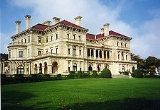
Mansion

Encyclopedia
A mansion is a very large dwelling house
. U.S. real estate broker
s define a mansion as a dwelling of over 8000 square feet (743.2 m²). A traditional European mansion was defined as a house which contained a ballroom
and tens of bedrooms. Today, however, there is no formal definition beyond being a large and well-appointed house.
The word itself derives (through Old French
) from the Latin
word mansiō ("act of remaining or staying", a verbal noun from manere "to remain" or "to stay".) In the Roman Empire
, a mansio
was an official stopping place on a Roman road
, or via, where cities sprang up, and where the villa
s of provincial officials came to be placed. The Scots
word "manse
" originally defined a property large enough for the Minister of the parish to maintain himself, but a mansion is no longer self-sustaining in this way (compare a Roman
or medieval villa
). 'Manor' comes from the same root — territorial holdings granted to a lord who would remain there — hence it can be seen how the word 'Mansion' came to have its meaning.
In British English a mansion block refers to a block of flats or apartments. In many parts of Asia, including Hong Kong and Japan, the word mansion also refers to a block of apartments.
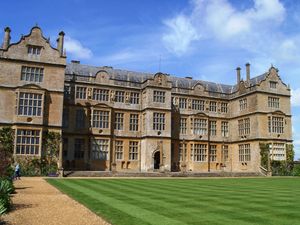 The "country house," as it is known in English-speaking places, is a distinct variety of mansion.
In the past, it was fashionable for the elite society of Europe
to pursue the social circuit from country home to country home, with intervals at town homes, so unfortified country houses supplanted castles and the modern mansion began to evolve.
It was in the 16th century that mansions really began to be built in a completely unfortified and gracious style, with gardens, parks, and drives. This was the era of Renaissance architecture
. Hatfield House
is a superb example of a house built during the transition period in England. In Italy
, classic villa
s such as Villa Farnese
and Villa Giulia
were typical, albeit individually diverse forms, of the new style of mansion.
The uses of these edifices paralleled that of the Roman villas. It was vital for powerful people and families to keep in social contact with each other as they were the primary moulders of society. The rounds of visits and entertainments were an essential part of the societal process, as painted in the novels of Jane Austen
. State business was often discussed and determined in informal settings. Times of revolution reversed this value. During its revolution
, France lost a large part of its country homes to incendiary committees, who destroyed the estates as a reaction to/rejection of the ancient régimes.
Until World War I
it was not unusual for a moderately sized mansion in England
such as Cliveden
to have an indoor staff of 20 and an outside staff of the same size, and in ducal mansions such as Chatsworth House
the numbers could be far higher. In the great houses of Italy, the number of retainers was often even greater than in England; whole families plus extended relations would often inhabit warrens of rooms in basements and attics. It is doubtful that a 19th century Marchesa would even know the exact number of individuals who served her. Most Europe
an mansions also were the hub of vast estate
s. A true estate (the medieval villa, French ville) always contains at least one complete village
and its church. Large estates such as that of Woburn Abbey
have several villages attached.
a new type of mansion being built, often smaller than the older Europe
an mansions. The Breakers
in Rhode Island
is a fine example, as is the nearby, but completely different, Watts Sherman House.
Fifth Avenue, New York
, at this time was lined with numerous mansions, designed by the leading architects of the day, many in European gothic
styles, built by the many families who were making their fortunes, and thus achieving their social aspirations, in the mid 19th century. However, nearly all of these have now been demolished, thus depriving New York of a boulevard
to rival, in the architectural sense, any in Paris
, London
or Rome
—where the many large mansions and palazzi built or remodeled during this era still survive. Mansions built in the countryside were not spared either. One of the most spectacular estates of the U.S., Whitemarsh Hall
, was demolished in 1980, along with its extensive gardens, to make way for suburban developments.
Grand Federal Style mansions designed by Samuel McIntire inhabit an area that, in 2008, is the largest collection of 17th & 18th century structures in the United States of America. This district in Salem, Massachusetts
is called the McIntire Historic District with the center being Chestnut Street.
Little is known about McIntire's personal life. He was born in Salem in 1757 and grew up in a family of housewrights. Samuel married Sally Fields in 1778, and the couple had one son. He built a simple home and workshop on Summer Street in 1786. His favorite hobby was playing and teaching music.
McIntire's training came from his father and from books. He and his brothers, Joseph and Angler, began their careers as housewrights and carpenters while in their teens but, early on, Samuel's work caught the eye of Salem's pre-eminent merchant, Elias Hasket Derby. Over the next quarter century, McIntire built or remodeled a number of homes for Derby and members of his extended family. McIntire also worked occasionally on Derby's vessels, and wasn't averse to fixing a wagon or building a birdhouse if his patron so desired.
"King" Derby's stamp of approval opened many other doors for McIntire, who went on to design and build mansions for John Gardner, Jerethmiel Peirce, Simon Forrester, and other wealthy Salem shipowners. He also built, on elegant Chestnut Street, a function hall (named for Alexander Hamilton) and church for the town's merchant class. McIntire also designed the former Salem Court House and Registry of Deeds.
After 1793, Samuel McIntire worked exclusively in the architectural style developed by Robert Adam
in Great Britain and brought to America by the great Boston architect, Charles Bulfinch. The delicate Adamesque style, which emphasized decorative elements and ornamentation, was tailor made for McIntire whose unerring sense of design and proportion was exceeded only by his skill as a woodcarver. Carved swags, rosettes, garlands, and his signature sheaths of wheat dominate wood surfaces in McIntire homes built between 1793 and his death in 1811.
 Even in Europe some 19th-century mansions were often built as replicas of older houses, the Château de Ferrières
in France
was inspired by Mentmore Towers
which in turn is a copy of Wollaton Hall
. Other mansions were built in the new and innovative styles of the new era such as the arts and crafts
style: The Breakers is a pastiche of an Italian
Renaissance
Palazzo
; Waddesdon Manor
in Buckinghamshire
is a faithful mixture of various French
château
x. One of the most enduring and most frequently copied styles for a mansion is the palladian - particularly so in the 18th century. However, the gothic
style was probably the most popular choice of design in the 19th century. The most bizarre example of this was probably Fonthill Abbey
which actually set out to imitate the mansions which had truly evolved from medieval gothic abbey
s following the Dissolution of the Monasteries
in the 16th century.
Mansions built during and after the 19th century seldom were supported by the large estates of their predecessors. These new mansions were often built as the week-end retreats of businessmen who commuted to their offices by the new railways, which enabled them to leave the city
more easily. Before this era most owners of mansions were the old aristocracy
.
and post-colonial past, the grand rural
estate, the Hacienda
, Estancia, in Portuguese
speaking Brazil
Fazenda or Estância, with the mansion as its stately center, is a characteristic feature.
Naturally mansions followed European architectural styles. Whereas until the second half of the 19th century Portugal
and Spain
as the colonial (or former colonial) powers were the eminent models for architecture and upperclass lifestyle, towards the end of the 19th century they were sometimes replaced by then more dominant powers like France
or England
.
In comparably developed, densely populated countries like Mexico, feudal estates and their mansions were as grand and stately as in the Mediterranean old world, whereas where estates were founded in the sparsely populated remote areas like the Pampa of Argentina
or Uruguay
, where iron pillars, doors, windows, furniture had to be brought from Europe by ship and afterwards oxcart, buildings were smaller, but normally still aspiring to evoke a stately impression, often featuring the Mirador (the lookout or tower, see also belvedere
)
In Venezuela, the traditional Spanish Mansion with the garden in the center of the property are usually referred as "Quinta".
, while others will have an infinity pool
or a home theatre
. Some have all of these features. The relative importance of these specially designed rooms changes with the times: At the beginning of the 20th century no true mansion would have been built without a room to house a private library
or office
, while at the beginning of the 21st century the presence of a room designed for a home theatre
or cinema
is a must. Most recently, mansions have been built with integrated domotics.
A modern mansion today may not necessarily be limited to a single house standing alone. Compounds, or a grouping of larger houses have become more popular. The Kennedy Compound
is an example of one family building surrounded by large houses on a single plot. There is no single accepted size where a big house would instead be called a "mansion". As the word itself derives from the Latin word mansiō ("act of remaining or staying"), many city villas suitable for receiving guests are operated as bed and breakfasts, like Valencia Mansion in Spain.
House
A house is a building or structure that has the ability to be occupied for dwelling by human beings or other creatures. The term house includes many kinds of different dwellings ranging from rudimentary huts of nomadic tribes to free standing individual structures...
. U.S. real estate broker
Real estate broker
A real estate broker, real estate agent or realtor is a party who acts as an intermediary between sellers and buyers of real estate/real property and attempts to find sellers who wish to sell and buyers who wish to buy...
s define a mansion as a dwelling of over 8000 square feet (743.2 m²). A traditional European mansion was defined as a house which contained a ballroom
Ballroom
A ballroom is a large room inside a building, the designated purpose of which is holding formal dances called balls. Traditionally, most balls were held in private residences; many mansions contain one or more ballrooms...
and tens of bedrooms. Today, however, there is no formal definition beyond being a large and well-appointed house.
The word itself derives (through Old French
Old French
Old French was the Romance dialect continuum spoken in territories that span roughly the northern half of modern France and parts of modern Belgium and Switzerland from the 9th century to the 14th century...
) from the Latin
Latin
Latin is an Italic language originally spoken in Latium and Ancient Rome. It, along with most European languages, is a descendant of the ancient Proto-Indo-European language. Although it is considered a dead language, a number of scholars and members of the Christian clergy speak it fluently, and...
word mansiō ("act of remaining or staying", a verbal noun from manere "to remain" or "to stay".) In the Roman Empire
Roman Empire
The Roman Empire was the post-Republican period of the ancient Roman civilization, characterised by an autocratic form of government and large territorial holdings in Europe and around the Mediterranean....
, a mansio
Mansio
In the Roman Empire, a mansio was an official stopping place on a Roman road, or via, maintained by the central government for the use of officials and those on official business whilst travelling.-Background:The roads which traversed the Ancient World, were later surveyed,...
was an official stopping place on a Roman road
Roman road
The Roman roads were a vital part of the development of the Roman state, from about 500 BC through the expansion during the Roman Republic and the Roman Empire. Roman roads enabled the Romans to move armies and trade goods and to communicate. The Roman road system spanned more than 400,000 km...
, or via, where cities sprang up, and where the villa
Villa
A villa was originally an ancient Roman upper-class country house. Since its origins in the Roman villa, the idea and function of a villa have evolved considerably. After the fall of the Roman Republic, villas became small farming compounds, which were increasingly fortified in Late Antiquity,...
s of provincial officials came to be placed. The Scots
Scots language
Scots is the Germanic language variety spoken in Lowland Scotland and parts of Ulster . It is sometimes called Lowland Scots to distinguish it from Scottish Gaelic, the Celtic language variety spoken in most of the western Highlands and in the Hebrides.Since there are no universally accepted...
word "manse
Manse
A manse is a house inhabited by, or formerly inhabited by, a minister, usually used in the context of a Presbyterian, Methodist, Baptist or United Church...
" originally defined a property large enough for the Minister of the parish to maintain himself, but a mansion is no longer self-sustaining in this way (compare a Roman
Ancient Rome
Ancient Rome was a thriving civilization that grew on the Italian Peninsula as early as the 8th century BC. Located along the Mediterranean Sea and centered on the city of Rome, it expanded to one of the largest empires in the ancient world....
or medieval villa
Villa
A villa was originally an ancient Roman upper-class country house. Since its origins in the Roman villa, the idea and function of a villa have evolved considerably. After the fall of the Roman Republic, villas became small farming compounds, which were increasingly fortified in Late Antiquity,...
). 'Manor' comes from the same root — territorial holdings granted to a lord who would remain there — hence it can be seen how the word 'Mansion' came to have its meaning.
In British English a mansion block refers to a block of flats or apartments. In many parts of Asia, including Hong Kong and Japan, the word mansion also refers to a block of apartments.
History
In the past, it was fashionable for the elite society of Europe
Europe
Europe is, by convention, one of the world's seven continents. Comprising the westernmost peninsula of Eurasia, Europe is generally 'divided' from Asia to its east by the watershed divides of the Ural and Caucasus Mountains, the Ural River, the Caspian and Black Seas, and the waterways connecting...
to pursue the social circuit from country home to country home, with intervals at town homes, so unfortified country houses supplanted castles and the modern mansion began to evolve.
It was in the 16th century that mansions really began to be built in a completely unfortified and gracious style, with gardens, parks, and drives. This was the era of Renaissance architecture
Renaissance architecture
Renaissance architecture is the architecture of the period between the early 15th and early 17th centuries in different regions of Europe, demonstrating a conscious revival and development of certain elements of ancient Greek and Roman thought and material culture. Stylistically, Renaissance...
. Hatfield House
Hatfield House
Hatfield House is a country house set in a large park, the Great Park, on the eastern side of the town of Hatfield, Hertfordshire, England. The present Jacobean house was built in 1611 by Robert Cecil, First Earl of Salisbury and Chief Minister to King James I and has been the home of the Cecil...
is a superb example of a house built during the transition period in England. In Italy
Italy
Italy , officially the Italian Republic languages]] under the European Charter for Regional or Minority Languages. In each of these, Italy's official name is as follows:;;;;;;;;), is a unitary parliamentary republic in South-Central Europe. To the north it borders France, Switzerland, Austria and...
, classic villa
Villa
A villa was originally an ancient Roman upper-class country house. Since its origins in the Roman villa, the idea and function of a villa have evolved considerably. After the fall of the Roman Republic, villas became small farming compounds, which were increasingly fortified in Late Antiquity,...
s such as Villa Farnese
Villa Farnese
The Villa Farnese, also known as Villa Caprarola, is a mansion in the town of Caprarola in the province of Viterbo, Northern Lazio, Italy, approximately 50 kilometres north-west of Rome...
and Villa Giulia
Villa Giulia
The Villa Giulia is a villa in Rome, Italy. It was built by Pope Julius III in 1550–1555 on what was then the edge of the city. Today it is publicly owned, and houses the Museo Nazionale Etrusco, an impressive collection of Etruscan art and artifacts....
were typical, albeit individually diverse forms, of the new style of mansion.
The uses of these edifices paralleled that of the Roman villas. It was vital for powerful people and families to keep in social contact with each other as they were the primary moulders of society. The rounds of visits and entertainments were an essential part of the societal process, as painted in the novels of Jane Austen
Jane Austen
Jane Austen was an English novelist whose works of romantic fiction, set among the landed gentry, earned her a place as one of the most widely read writers in English literature, her realism and biting social commentary cementing her historical importance among scholars and critics.Austen lived...
. State business was often discussed and determined in informal settings. Times of revolution reversed this value. During its revolution
Revolution
A revolution is a fundamental change in power or organizational structures that takes place in a relatively short period of time.Aristotle described two types of political revolution:...
, France lost a large part of its country homes to incendiary committees, who destroyed the estates as a reaction to/rejection of the ancient régimes.
Until World War I
World War I
World War I , which was predominantly called the World War or the Great War from its occurrence until 1939, and the First World War or World War I thereafter, was a major war centred in Europe that began on 28 July 1914 and lasted until 11 November 1918...
it was not unusual for a moderately sized mansion in England
England
England is a country that is part of the United Kingdom. It shares land borders with Scotland to the north and Wales to the west; the Irish Sea is to the north west, the Celtic Sea to the south west, with the North Sea to the east and the English Channel to the south separating it from continental...
such as Cliveden
Cliveden
Cliveden is an Italianate mansion and estate at Taplow, Buckinghamshire, England. Set on banks above the River Thames, its grounds slope down to the river. The site has been home to an Earl, two Dukes, a Prince of Wales and the Viscounts Astor....
to have an indoor staff of 20 and an outside staff of the same size, and in ducal mansions such as Chatsworth House
Chatsworth House
Chatsworth House is a stately home in North Derbyshire, England, northeast of Bakewell and west of Chesterfield . It is the seat of the Duke of Devonshire, and has been home to his family, the Cavendish family, since Bess of Hardwick settled at Chatsworth in 1549.Standing on the east bank of the...
the numbers could be far higher. In the great houses of Italy, the number of retainers was often even greater than in England; whole families plus extended relations would often inhabit warrens of rooms in basements and attics. It is doubtful that a 19th century Marchesa would even know the exact number of individuals who served her. Most Europe
Europe
Europe is, by convention, one of the world's seven continents. Comprising the westernmost peninsula of Eurasia, Europe is generally 'divided' from Asia to its east by the watershed divides of the Ural and Caucasus Mountains, the Ural River, the Caspian and Black Seas, and the waterways connecting...
an mansions also were the hub of vast estate
Estate (house)
An estate comprises the houses and outbuildings and supporting farmland and woods that surround the gardens and grounds of a very large property, such as a country house or mansion. It is the modern term for a manor, but lacks the latter's now abolished jurisdictional authority...
s. A true estate (the medieval villa, French ville) always contains at least one complete village
Village
A village is a clustered human settlement or community, larger than a hamlet with the population ranging from a few hundred to a few thousand , Though often located in rural areas, the term urban village is also applied to certain urban neighbourhoods, such as the West Village in Manhattan, New...
and its church. Large estates such as that of Woburn Abbey
Woburn Abbey
Woburn Abbey , near Woburn, Bedfordshire, England, is a country house, the seat of the Duke of Bedford and the location of the Woburn Safari Park.- Pre-20th century :...
have several villages attached.
Nineteenth century development
The 19th century saw particularly in the United StatesUnited States
The United States of America is a federal constitutional republic comprising fifty states and a federal district...
a new type of mansion being built, often smaller than the older Europe
Europe
Europe is, by convention, one of the world's seven continents. Comprising the westernmost peninsula of Eurasia, Europe is generally 'divided' from Asia to its east by the watershed divides of the Ural and Caucasus Mountains, the Ural River, the Caspian and Black Seas, and the waterways connecting...
an mansions. The Breakers
The Breakers
The Breakers is a Vanderbilt mansion located on Ochre Point Avenue, Newport, Rhode Island, United States on the Atlantic Ocean. It is a National Historic Landmark, a contributing property to the Bellevue Avenue Historic District, and is owned and operated by the Preservation Society of Newport...
in Rhode Island
Rhode Island
The state of Rhode Island and Providence Plantations, more commonly referred to as Rhode Island , is a state in the New England region of the United States. It is the smallest U.S. state by area...
is a fine example, as is the nearby, but completely different, Watts Sherman House.
Fifth Avenue, New York
New York City
New York is the most populous city in the United States and the center of the New York Metropolitan Area, one of the most populous metropolitan areas in the world. New York exerts a significant impact upon global commerce, finance, media, art, fashion, research, technology, education, and...
, at this time was lined with numerous mansions, designed by the leading architects of the day, many in European gothic
Gothic architecture
Gothic architecture is a style of architecture that flourished during the high and late medieval period. It evolved from Romanesque architecture and was succeeded by Renaissance architecture....
styles, built by the many families who were making their fortunes, and thus achieving their social aspirations, in the mid 19th century. However, nearly all of these have now been demolished, thus depriving New York of a boulevard
Boulevard
A Boulevard is type of road, usually a wide, multi-lane arterial thoroughfare, divided with a median down the centre, and roadways along each side designed as slow travel and parking lanes and for bicycle and pedestrian usage, often with an above-average quality of landscaping and scenery...
to rival, in the architectural sense, any in Paris
Paris
Paris is the capital and largest city in France, situated on the river Seine, in northern France, at the heart of the Île-de-France region...
, London
London
London is the capital city of :England and the :United Kingdom, the largest metropolitan area in the United Kingdom, and the largest urban zone in the European Union by most measures. Located on the River Thames, London has been a major settlement for two millennia, its history going back to its...
or Rome
Rome
Rome is the capital of Italy and the country's largest and most populated city and comune, with over 2.7 million residents in . The city is located in the central-western portion of the Italian Peninsula, on the Tiber River within the Lazio region of Italy.Rome's history spans two and a half...
—where the many large mansions and palazzi built or remodeled during this era still survive. Mansions built in the countryside were not spared either. One of the most spectacular estates of the U.S., Whitemarsh Hall
Whitemarsh Hall
Whitemarsh Hall was a huge estate located on of land in Wyndmoor, Pennsylvania, USA, and owned by banking executive Edward T. Stotesbury and his wife, Eva...
, was demolished in 1980, along with its extensive gardens, to make way for suburban developments.
Grand Federal Style mansions designed by Samuel McIntire inhabit an area that, in 2008, is the largest collection of 17th & 18th century structures in the United States of America. This district in Salem, Massachusetts
Salem, Massachusetts
Salem is a city in Essex County, Massachusetts, United States. The population was 40,407 at the 2000 census. It and Lawrence are the county seats of Essex County...
is called the McIntire Historic District with the center being Chestnut Street.
Little is known about McIntire's personal life. He was born in Salem in 1757 and grew up in a family of housewrights. Samuel married Sally Fields in 1778, and the couple had one son. He built a simple home and workshop on Summer Street in 1786. His favorite hobby was playing and teaching music.
McIntire's training came from his father and from books. He and his brothers, Joseph and Angler, began their careers as housewrights and carpenters while in their teens but, early on, Samuel's work caught the eye of Salem's pre-eminent merchant, Elias Hasket Derby. Over the next quarter century, McIntire built or remodeled a number of homes for Derby and members of his extended family. McIntire also worked occasionally on Derby's vessels, and wasn't averse to fixing a wagon or building a birdhouse if his patron so desired.
"King" Derby's stamp of approval opened many other doors for McIntire, who went on to design and build mansions for John Gardner, Jerethmiel Peirce, Simon Forrester, and other wealthy Salem shipowners. He also built, on elegant Chestnut Street, a function hall (named for Alexander Hamilton) and church for the town's merchant class. McIntire also designed the former Salem Court House and Registry of Deeds.
After 1793, Samuel McIntire worked exclusively in the architectural style developed by Robert Adam
Robert Adam
Robert Adam was a Scottish neoclassical architect, interior designer and furniture designer. He was the son of William Adam , Scotland's foremost architect of the time, and trained under him...
in Great Britain and brought to America by the great Boston architect, Charles Bulfinch. The delicate Adamesque style, which emphasized decorative elements and ornamentation, was tailor made for McIntire whose unerring sense of design and proportion was exceeded only by his skill as a woodcarver. Carved swags, rosettes, garlands, and his signature sheaths of wheat dominate wood surfaces in McIntire homes built between 1793 and his death in 1811.
Château de Ferrières
Château de Ferrières is a French château built between 1855 and 1859 by Baron James de Rothschild in the Goût Rothschild. Rothschild ownership of the Château de Ferrières was passed down through the male line according to the rule of primogeniture...
in France
France
The French Republic , The French Republic , The French Republic , (commonly known as France , is a unitary semi-presidential republic in Western Europe with several overseas territories and islands located on other continents and in the Indian, Pacific, and Atlantic oceans. Metropolitan France...
was inspired by Mentmore Towers
Mentmore Towers
Mentmore Towers is a 19th century English country house in the village of Mentmore in Buckinghamshire. The house was designed by Joseph Paxton and his son-in-law, George Henry Stokes, in the revival Elizabethan and Jacobean style of the late 16th century called Jacobethan, for the banker and...
which in turn is a copy of Wollaton Hall
Wollaton Hall
Wollaton Hall is a country house standing on a small but prominent hill in Wollaton, Nottingham, England. Wollaton Park is the area of parkland that the stately house stands in. The house itself is a natural history museum, with other museums in the out-buildings...
. Other mansions were built in the new and innovative styles of the new era such as the arts and crafts
Arts and crafts
Arts and crafts comprise a whole host of activities and hobbies that are related to making things with one's hands and skill. These can be sub-divided into handicrafts or "traditional crafts" and "the rest"...
style: The Breakers is a pastiche of an Italian
Italy
Italy , officially the Italian Republic languages]] under the European Charter for Regional or Minority Languages. In each of these, Italy's official name is as follows:;;;;;;;;), is a unitary parliamentary republic in South-Central Europe. To the north it borders France, Switzerland, Austria and...
Renaissance
Renaissance
The Renaissance was a cultural movement that spanned roughly the 14th to the 17th century, beginning in Italy in the Late Middle Ages and later spreading to the rest of Europe. The term is also used more loosely to refer to the historical era, but since the changes of the Renaissance were not...
Palazzo
Palazzo
Palazzo, an Italian word meaning a large building , may refer to:-Buildings:*Palazzo, an Italian type of building**Palazzo style architecture, imitative of Italian palazzi...
; Waddesdon Manor
Waddesdon Manor
Waddesdon Manor is a country house in the village of Waddesdon, in Buckinghamshire, England. The house was built in the Neo-Renaissance style of a French château between 1874 and 1889 for Baron Ferdinand de Rothschild . Since this was the preferred style of the Rothschilds it became also known as...
in Buckinghamshire
Buckinghamshire
Buckinghamshire is a ceremonial and non-metropolitan home county in South East England. The county town is Aylesbury, the largest town in the ceremonial county is Milton Keynes and largest town in the non-metropolitan county is High Wycombe....
is a faithful mixture of various French
France
The French Republic , The French Republic , The French Republic , (commonly known as France , is a unitary semi-presidential republic in Western Europe with several overseas territories and islands located on other continents and in the Indian, Pacific, and Atlantic oceans. Metropolitan France...
château
Château
A château is a manor house or residence of the lord of the manor or a country house of nobility or gentry, with or without fortifications, originally—and still most frequently—in French-speaking regions...
x. One of the most enduring and most frequently copied styles for a mansion is the palladian - particularly so in the 18th century. However, the gothic
Gothic architecture
Gothic architecture is a style of architecture that flourished during the high and late medieval period. It evolved from Romanesque architecture and was succeeded by Renaissance architecture....
style was probably the most popular choice of design in the 19th century. The most bizarre example of this was probably Fonthill Abbey
Fonthill Abbey
Fonthill Abbey — also known as Beckford's Folly — was a large Gothic revival country house built around the turn of the 19th century at Fonthill Gifford in Wiltshire, England, at the direction of William Thomas Beckford and architect James Wyatt...
which actually set out to imitate the mansions which had truly evolved from medieval gothic abbey
Abbey
An abbey is a Catholic monastery or convent, under the authority of an Abbot or an Abbess, who serves as the spiritual father or mother of the community.The term can also refer to an establishment which has long ceased to function as an abbey,...
s following the Dissolution of the Monasteries
Dissolution of the Monasteries
The Dissolution of the Monasteries, sometimes referred to as the Suppression of the Monasteries, was the set of administrative and legal processes between 1536 and 1541 by which Henry VIII disbanded monasteries, priories, convents and friaries in England, Wales and Ireland; appropriated their...
in the 16th century.
Mansions built during and after the 19th century seldom were supported by the large estates of their predecessors. These new mansions were often built as the week-end retreats of businessmen who commuted to their offices by the new railways, which enabled them to leave the city
City
A city is a relatively large and permanent settlement. Although there is no agreement on how a city is distinguished from a town within general English language meanings, many cities have a particular administrative, legal, or historical status based on local law.For example, in the U.S...
more easily. Before this era most owners of mansions were the old aristocracy
Aristocracy
Aristocracy , is a form of government in which a few elite citizens rule. The term derives from the Greek aristokratia, meaning "rule of the best". In origin in Ancient Greece, it was conceived of as rule by the best qualified citizens, and contrasted with monarchy...
.
Latin America
In Latin America, with its feudal colonialColonialism
Colonialism is the establishment, maintenance, acquisition and expansion of colonies in one territory by people from another territory. It is a process whereby the metropole claims sovereignty over the colony and the social structure, government, and economics of the colony are changed by...
and post-colonial past, the grand rural
Rural
Rural areas or the country or countryside are areas that are not urbanized, though when large areas are described, country towns and smaller cities will be included. They have a low population density, and typically much of the land is devoted to agriculture...
estate, the Hacienda
Hacienda
Hacienda is a Spanish word for an estate. Some haciendas were plantations, mines, or even business factories. Many haciendas combined these productive activities...
, Estancia, in Portuguese
Portuguese language
Portuguese is a Romance language that arose in the medieval Kingdom of Galicia, nowadays Galicia and Northern Portugal. The southern part of the Kingdom of Galicia became independent as the County of Portugal in 1095...
speaking Brazil
Brazil
Brazil , officially the Federative Republic of Brazil , is the largest country in South America. It is the world's fifth largest country, both by geographical area and by population with over 192 million people...
Fazenda or Estância, with the mansion as its stately center, is a characteristic feature.
Naturally mansions followed European architectural styles. Whereas until the second half of the 19th century Portugal
Portugal
Portugal , officially the Portuguese Republic is a country situated in southwestern Europe on the Iberian Peninsula. Portugal is the westernmost country of Europe, and is bordered by the Atlantic Ocean to the West and South and by Spain to the North and East. The Atlantic archipelagos of the...
and Spain
Spain
Spain , officially the Kingdom of Spain languages]] under the European Charter for Regional or Minority Languages. In each of these, Spain's official name is as follows:;;;;;;), is a country and member state of the European Union located in southwestern Europe on the Iberian Peninsula...
as the colonial (or former colonial) powers were the eminent models for architecture and upperclass lifestyle, towards the end of the 19th century they were sometimes replaced by then more dominant powers like France
France
The French Republic , The French Republic , The French Republic , (commonly known as France , is a unitary semi-presidential republic in Western Europe with several overseas territories and islands located on other continents and in the Indian, Pacific, and Atlantic oceans. Metropolitan France...
or England
England
England is a country that is part of the United Kingdom. It shares land borders with Scotland to the north and Wales to the west; the Irish Sea is to the north west, the Celtic Sea to the south west, with the North Sea to the east and the English Channel to the south separating it from continental...
.
In comparably developed, densely populated countries like Mexico, feudal estates and their mansions were as grand and stately as in the Mediterranean old world, whereas where estates were founded in the sparsely populated remote areas like the Pampa of Argentina
Argentina
Argentina , officially the Argentine Republic , is the second largest country in South America by land area, after Brazil. It is constituted as a federation of 23 provinces and an autonomous city, Buenos Aires...
or Uruguay
Uruguay
Uruguay ,officially the Oriental Republic of Uruguay,sometimes the Eastern Republic of Uruguay; ) is a country in the southeastern part of South America. It is home to some 3.5 million people, of whom 1.8 million live in the capital Montevideo and its metropolitan area...
, where iron pillars, doors, windows, furniture had to be brought from Europe by ship and afterwards oxcart, buildings were smaller, but normally still aspiring to evoke a stately impression, often featuring the Mirador (the lookout or tower, see also belvedere
Belvedere (structure)
Belvedere is an architectural term adopted from Italian , which refers to any architectural structure sited to take advantage of such a view. A belvedere may be built in the upper part of a building so as to command a fine view...
)
In Venezuela, the traditional Spanish Mansion with the garden in the center of the property are usually referred as "Quinta".
The "modern" mansion
Mansions built during the last and present centuries usually have specially designed rooms meant to accommodate leisure activities of a particular kind. Many will have a conservatory or greenhouseConservatory (greenhouse)
A conservatory is a room having glass roof and walls, typically attached to a house on only one side, used as a greenhouse or a sunroom...
, while others will have an infinity pool
Infinity pool
An infinity edge pool is a swimming or reflecting pool which produces a visual effect of water extending to the horizon, vanishing, or extending to "infinity"...
or a home theatre
Home cinema
Home cinema, also commonly called home theater, are home entertainment set-ups that seek to reproduce a movie theater experience and mood with the help of video and audio equipment in a private home....
. Some have all of these features. The relative importance of these specially designed rooms changes with the times: At the beginning of the 20th century no true mansion would have been built without a room to house a private library
Library
In a traditional sense, a library is a large collection of books, and can refer to the place in which the collection is housed. Today, the term can refer to any collection, including digital sources, resources, and services...
or office
Office
An office is generally a room or other area in which people work, but may also denote a position within an organization with specific duties attached to it ; the latter is in fact an earlier usage, office as place originally referring to the location of one's duty. When used as an adjective, the...
, while at the beginning of the 21st century the presence of a room designed for a home theatre
Home cinema
Home cinema, also commonly called home theater, are home entertainment set-ups that seek to reproduce a movie theater experience and mood with the help of video and audio equipment in a private home....
or cinema
Movie theater
A movie theater, cinema, movie house, picture theater, film theater is a venue, usually a building, for viewing motion pictures ....
is a must. Most recently, mansions have been built with integrated domotics.
A modern mansion today may not necessarily be limited to a single house standing alone. Compounds, or a grouping of larger houses have become more popular. The Kennedy Compound
Kennedy Compound
The Kennedy Compound or Hyannis Port Historic District is the name given to six acres of waterfront property on Cape Cod along Nantucket Sound in Hyannis Port, Massachusetts, United States....
is an example of one family building surrounded by large houses on a single plot. There is no single accepted size where a big house would instead be called a "mansion". As the word itself derives from the Latin word mansiō ("act of remaining or staying"), many city villas suitable for receiving guests are operated as bed and breakfasts, like Valencia Mansion in Spain.
See also
- CastleCastleA castle is a type of fortified structure built in Europe and the Middle East during the Middle Ages by European nobility. Scholars debate the scope of the word castle, but usually consider it to be the private fortified residence of a lord or noble...
- ChateauChâteauA château is a manor house or residence of the lord of the manor or a country house of nobility or gentry, with or without fortifications, originally—and still most frequently—in French-speaking regions...
- EstanciaEstânciaEstância is a municipality located in the Brazilian state of Sergipe. Its population was 62,218 and its area is 642 km². The city is the seat of the Roman Catholic Diocese of Estância....
- Estate
- HaciendaHaciendaHacienda is a Spanish word for an estate. Some haciendas were plantations, mines, or even business factories. Many haciendas combined these productive activities...
- Hôtel particulierHôtel particulierIn French contexts an hôtel particulier is an urban "private house" of a grand sort. Whereas an ordinary maison was built as part of a row, sharing party walls with the houses on either side and directly fronting on a street, an hôtel particulier was often free-standing, and by the 18th century it...
- Manor houseManor houseA manor house is a country house that historically formed the administrative centre of a manor, the lowest unit of territorial organisation in the feudal system in Europe. The term is applied to country houses that belonged to the gentry and other grand stately homes...
- PalacePalaceA palace is a grand residence, especially a royal residence or the home of a head of state or some other high-ranking dignitary, such as a bishop or archbishop. The word itself is derived from the Latin name Palātium, for Palatine Hill, one of the seven hills in Rome. In many parts of Europe, the...
- PalazzoPalazzoPalazzo, an Italian word meaning a large building , may refer to:-Buildings:*Palazzo, an Italian type of building**Palazzo style architecture, imitative of Italian palazzi...
- VillaVillaA villa was originally an ancient Roman upper-class country house. Since its origins in the Roman villa, the idea and function of a villa have evolved considerably. After the fall of the Roman Republic, villas became small farming compounds, which were increasingly fortified in Late Antiquity,...
External links
- Historic Mansions and Estates in Latin America
- Estonian Manors Portal the English version introduces 438 well-preserved historical manors (mansions, estates) in Estonia
- "Mansion" in 1911 Britannica