

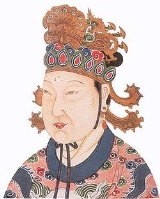
Wu Zetian

Encyclopedia
Wu Zetian (17 February 624 – 16 December 705), personal name Wu Zhao (武曌), often referred to as Tian Hou (天后) during the Tang Dynasty and Empress Consort Wu (武后) in later times, was the only woman in the history of China
to assume the title of Empress Regnant
(Huangdi). As de facto
ruler of China first through her husband and her sons from 665 to 690, not unprecedented in Chinese history, she then broke all precedents when she founded her own dynasty in 690, the Zhou (周) (interrupting the Tang Dynasty
), and ruled personally under the name Sacred and Divine Empress Regnant (聖神皇帝) and variations thereof from 690 to 705. Her rise and reign has been criticized harshly by Confucian historians but has been viewed in a different light after the 1950s.
City in Sichuan Province) in 624, the seventh year of Emperor Gaozu of Tang
’s reign. In the same year, a total eclipse of the Sun was visible across China. Her father Wu Shihuo
was engaged in the timber business and the family was relatively well off. During the final years of Emperor Yang of Sui
, Li Yuan (李淵) (who would go on to become Emperor Gaozu of Tang), whilst holding appointments in both Hedong and Taiyuan
, Li stayed in the Wu household many times and became close to the Wu family. After Li Yuan overthrew Emperor Yang, he was generous to the Wu family, providing them with money, grain, land and clothing. Once the Tang Dynasty became established, Wu Shihou held a succession of senior ministerial posts including governor of Yangzhou
, Lizhou and Jingzhou (荊州) (modern day Jiangling County, Hubei Province).
Wu Zetian was a strong willed child who refused to study needlework like most girls of the time. Instead she was only interested in reading, from which she gained a wide political awareness. During her childhood she travelled widely with her parents and thus developed a cultured and knowledgeable personality.
. She did not become a favorite of Taizong's, and after his death in 649, she might have been expected to spend the rest of her life as a Buddhist nun, like his other childless concubines. She was fortunate in that Empress Wang
, the wife and empress of Emperor Taizong's son and successor Emperor Gaozong
, wanted another beautiful concubine to divert Emperor Gaozong's favors from Consort Xiao
, with whom Empress Wang was having a desperate struggle. Wang had Wu brought back to the palace and made her a concubine of Emperor Gaozong. Consort Wu as she became known proceeded to defeat both Empress Wang and Consort Xiao in the struggle for Emperor Gaozong's affection, and subsequently, both Empress Wang and Consort Xiao were killed, and she was made empress.
in a power struggle. She subsequently had another son, Li Xián, deposed and exiled.
and proceeded to depose a third son, Emperor Zhongzong
, for displaying independence. She then had her youngest son Emperor Ruizong
made emperor, but was ruler not only in substance but in appearance as well, as she presided over imperial gatherings and prevented Emperor Ruizong from taking an active role in governance. In 690, she had Emperor Ruizong yield the throne to her and established the Zhou Dynasty. The early part of her reign was characterized by secret police terror, which moderated as the years went by. She was, on the other hand, recognized as a capable and attentive ruler even by traditional historians who despised her, and her ability at selecting capable men to serve as officials was admired throughout the rest of the Tang Dynasty as well as in subsequent dynasties. In 705, she was overthrown in a coup, and Emperor Zhongzong was returned to the throne. She continued to carry the title of "emperor" until her death later in the year.
's palace when she was 13 years old—i.e., sometime between 636 and 638—after Emperor Taizong heard of her beauty. She was given the title of cairen
, title for one of the consorts with the fifth rank in Tang's nine-rank system for imperial officials, nobles, and consorts. Emperor Taizong gave her the name Mei (媚), meaning "pretty." (Thus, today Chinese people often refer to her as Wu Mei or Wu Meiniang (武媚娘) when they write about her youth, whereas they refer to her as Empress Wu (武后) when referring to her as empress and empress dowager and Wu Zetian (武則天) when referring to her reign as "emperor.") When she was summoned to the palace, her mother Lady Yang wept bitterly when saying farewell to her, but she responded, "How do you know that it is not my fortune to meet the Son of Heaven
?" Lady Yang understood her ambitions, and therefore stopped crying.
Consort Wu, however, did not appear to be much favored by Emperor Taizong, although it appeared that she did have sexual relations with him at one point. According to her own account during her reign later while rebuking the chancellor Ji Xu
, there was an occasion during the time she was Emperor Taizong's concubine when she impressed Emperor Taizong with her fortitude:
Consort Wu did not have any children with Emperor Taizong. It was said that on one occasion, when Emperor Taizong's crown prince
Li Zhi
saw her, he was shocked by her beauty. After Emperor Taizong died in 649, Li Zhi became emperor (as Emperor Gaozong), and she and the other imperial consorts who did not have children went to Ganye Temple (感業寺) and became Buddhist nuns.
. At that time, Emperor Gaozong did not favor Empress Wang, and much favored his concubine Consort Xiao
; further, Empress Wang did not have any children, and Consort Xiao had one son (Li Sujie
) and two daughters (Princesses Yiyang and Xuancheng). Empress Wang, seeing that Emperor Gaozong was still impressed by Consort Wu's beauty, hoped that the arrival of a new concubine would divert the emperor from Consort Xiao, and therefore secretly told Consort Wu to stop shaving her hair and, at a later point, welcomed her to the palace. (Some modern historians dispute this traditional account, and some think that Consort Wu never actually left the imperial palace and might have had an affair with Emperor Gaozong while Emperor Taizong was still alive.) Wherever the truth lies, by the early 650s Consort Wu was a concubine of Emperor Gaozong, and she was titled Zhaoyi (昭儀), i.e. the highest ranking of the nine concubines of the second rank. Consort Wu soon overtook Consort Xiao in her favor from Emperor Gaozong. (The taking of a father's concubine—one who was believed to have had sexual relations with the deceased Emperor Taizong—was considered incest
by traditional Confucian principles.) In 652, she gave birth to her first child, a son named Li Hong
. In 653, she gave birth to another son, Li Xián. (Later, after she became empress, she would bear two more sons (Li Xiǎn
(note different tone) and Li Dan
), and one daughter (the later Princess Taiping
). For the time being, however, neither of these sons were in contention to be Emperor Gaozong's heir, as Emperor Gaozong had, pursuant to requests of officials instigated by Empress Wang and her uncle, the chancellor Liu Shi
, created his oldest son Li Zhong
, whose mother Consort Liu was of lowly birth and whose gratitude Empress Wang expected. By 654, both Empress Wang and Consort Xiao had lost favor with Emperor Gaozong, and the former romantic rivals joined forces against Consort Wu, but to no avail, and as a sign of his love to Consort Wu, in 654 he conferred posthumous honors on her father Wu Shihuo
.
Also in 654, shortly after Consort Wu gave birth to a daughter, the daughter died. Empress Wang was allegedly seen near the child's room by eyewitnesses, and Emperor Gaozong suspected that she killed the child out of jealousy. She was unable to clear herself in Emperor Gaozong's eyes. (Traditional historians believed that Consort Wu actually killed her own daughter to frame Empress Wang, although it was possible that this allegation was manufactured by historians.) In anger, Emperor Gaozong considered deposing Empress Wang and replacing her with Consort Wu, but wanted to make sure that the chancellors would support this, and so visited the house of his uncle Zhangsun Wuji
, the leader among chancellors, with Consort Wu, awarding him with much treasure, but when he brought up the topic that Empress Wang was sonless (as an excuse for deposing her), Zhangsun repeatedly found ways to divert the conversation, and subsequent visits by Consort Wu's mother Lady Yang and the official Xu Jingzong
, who was allied with Consort Wu, to seek support from Zhangsun were also to no avail.
In summer 655, Consort Wu accused Empress Wang and her mother Lady Liu of using witchcraft. In response, Emperor Gaozong barred Lady Liu from the palace and demoted Liu Shi. Meanwhile, a faction of officials began to form around Consort Wu, including Li Yifu
, Xu, Cui Yixuan (崔義玄), and Yuan Gongyu (袁公瑜). On an occasion in fall 655, Emperor Gaozong summoned the chancellors Zhangsun, Li Ji
, Yu Zhining
, and Chu Suiliang
to the palace—which Chu deduced to be regarding the matter of changing the empress. Li Ji claimed an illness and refused to attend. At the meeting, Chu vehemently opposed deposing Empress Wang, while Zhangsun and Yu showed their disapproval by silence. Meanwhile, other chancellors Han Yuan
and Lai Ji
also opposed the move, but when Emperor Gaozong asked Li Ji again, Li Ji's response was, "This is your family matter, Your Imperial Majesty. Why ask anyone else?" Emperor Gaozong therefore became resolved. He demoted Chu to be a commandant at Tan Prefecture (潭州, roughly modern Changsha, Hunan
), and then deposed both Empress Wang and Consort Xiao, putting them under arrest and creating Consort Wu empress instead to replace Empress Wang. (Later that year, Empress Wang and Consort Xiao were killed on orders by the new Empress Wu after Emperor Gaozong showed signs of considering to release them. After their deaths, however, Empress Wu was often haunted by them in her dreams, for the rest of Emperor Gaozong's reign, Emperor Gaozong and she often took up residence at the eastern capital Luoyang
and only infrequently spent time in Chang'an
.)
In 657, Empress Wu and her allies began reprisals against officials who had opposed her ascension. She first had Xu and Li Yifu, who were by now chancellors, falsely accuse Han Yuan and Lai Ji of being complicit with Chu Suiliang in planning treason. The three of them, along with Liu Shi, were demoted to be prefects of remote prefectures, with provisions that they would never be allowed to return to Chang'an. In 659, she further had Xu accuse Zhangsun Wuji of plotting treason with the low level officials Wei Jifang (韋季方) and Li Chao (李巢). Zhangsun was exiled and, later in the year, was forced to commit suicide in exile. Xu further implicated Chu, Liu, Han, and Yu Zhining in the plot as well. Chu, who had died in 658, was posthumously stripped of his titles, and his sons Chu Yanfu (褚彥甫) and Chu Yanchong (褚彥沖) were executed. Orders were also issued to execute Liu and Han, although Han died before the execution order reached his location. It was said that after this point, no official dared to criticize the emperor any longer. In 660, Li Zhong, who had been fearful that he would be next and had sought out advice of fortune tellers, was also exiled and put under house arrest.
Also in 660, Emperor Gaozong and Empress Wu toured Bian Prefecture (i.e., Taiyuan), and Empress Wu had the opportunity to invite her old neighbors and relatives to a feast. Later that year, Emperor Gaozong began to suffer from an illness that carried the symptoms of painful headache and loss of vision, generally thought to be hypertension-related, but which some historians thought might be slow-poisoning by Empress Wu, and he began to have Empress Wu make rulings on the petitions by the officials. It was said that Empress Wu had quick reactions and understood both literature and history, and therefore was making correct rulings. Thereafter, her authority began to rival Emperor Gaozong's.
By 664, however, Empress Wu was said to be so interfering in the imperial governance that she was angering Emperor Gaozong. Further, she had engaged the Taoist sorcerer Guo Xingzhen (郭行真) in using witchcraft — an act that was prohibited by regulations and which had led to Empress Wang's downfall — and the eunuch Wang Fusheng (王伏勝) reported this to Emperor Gaozong, further angering him. He consulted the chancellor Shangguan Yi
, who suggested that he depose Empress Wu. He had Shangguan draft an edict, but as Shangguan was doing so, Empress Wu received news of what was happening, and she went to him to plead her case, as he was holding the edict that Shangguan had drafted. Emperor Gaozong could not bear to depose her, and therefore blamed the episode on Shangguan. As both Shangguan and Wang had served on Li Zhong's staff, Empress Wu had Xu falsely accuse Shangguan, Wang, and Li Zhong of planning treason. Shangguan, Wang, and Shangguan's son Shangguan Tingzhi (上官庭芝) were executed, while Li Zhong was forced to commit suicide. (Shangguan Tingzhi's daughter Shangguan Wan'er
, then an infant, and her mother Lady Zheng became slaves in the inner palace. After Shangguan Wan'er grew up, she eventually became a trusted secretary for Empress Wu.) Thereafter, at imperial meetings, she would sit behind a curtain behind Emperor Gaozong, and they became referred to by the public as the "Two Holy Ones" (二聖, Er Sheng).
Meanwhile, on Empress Wu's account, her mother Lady Yang had been created the Lady of Rong, and her older sister, now widowed, the Lady of Han. Her brothers Wu Yuanqing and Wu Yuanshuang and cousins Wu Weiliang and Wu Huaiyun, despite the poor relations that they had with Lady Yang, were promoted. However, at a feast that Lady Yang held for them, Wu Weiliang offended Lady Yang by stating that they did not find it honorable for them to be promoted on account of Empress Wu. Empress Wu therefore requested to have them demoted to remote prefectures—outwardly to show modesty, but in reality to avenge the offense to her mother. Wu Yuanqing and Wu Yuanshuang died in effective exile. Meanwhile, in or before 666, Lady of Han died as well, and after her death, Emperor Gaozong created her daughter the Lady of Wei and considered keeping her in the palace—possibly as a concubine—but did not immediately do so as he feared that Empress Wu would be displeased. It was said that Empress Wu heard of this and was nevertheless displeased, and she had the Lady of Wei poisoned, by placing poison in food offerings that Wu Weiliang and Wu Huaiyun had made, and then blaming Wu Weiliang and Wu Huaiyun for the murder. Wu Weiliang and Wu Huaiyun were executed.
Also in 666, when Emperor Gaozong offered sacrifices to the gods of heaven and earth at Mount Tai
, Empress Wu, in an unprecedented action, offered sacrifices after him, with Princess Dowager Yan, the mother of Emperor Gaozong's brother Li Zhen
the Prince of Yue, offering sacrifices after her.
In 670, Lady Yang died, and by Emperor Gaozong's orders, all of the imperial officials and their wives attended her wake and mourned her. Later that year, with the realm suffering from a major draught, Empress Wu offered to be deposed, an offer Emperor Gaozong rejected. He further posthumously honored Wu Shihuo (who had previously been posthumously honored the Duke of Zhou) and Lady Yang the Prince and Princess of Taiyuan.
Meanwhile, the Lady of Han's son Helan Minzhi (賀蘭敏之) had been given the surname of Wu and allowed to inherit the title of Duke of Zhou. However, as it was becoming clear that he was suspecting Empress Wu of having murdered his sister, Empress Wu began to take precautions against him, who was also said to have had an incestuous relationship with his grandmother Lady Yang. In 671, Helan Minzhi was accused of having disobeyed regulations on mourning during Lady Yang's mourning period, and also of raping the daughter of the official Yang Sijian (楊思儉), whom Emperor Gaozong and Empress Wu had previously selected to be the wife and crown princess for Li Hong. Helan Minzhi was exiled and either was executed in exile or committed suicide. In 674, Empress Wu had Wu Yuanshuang's son Wu Chengsi
recalled from exile to inherit the title of Duke of Zhou.
Around the new year 675, Empress Wu submitted 12 suggestions—the chief of which were that Laozi
(whose name was Li Er), to whom the Tang imperial clan traced its ancestry), should have his work Tao Te Ching
be added to the required reading for imperial university students, and that a three-year mourning period should be observed for a mother's death in all cases. (Previously, such a mourning period was not observed if the father were still alive, but was observed if the father was no longer alive.) Emperor Gaozong praised her for her suggestions and adopted them.
In 675, with Emperor Gaozong's illness getting worse, he considered having Empress Wu formally rule as regent
. The chancellor Hao Chujun
and the official Li Yiyan
both opposed, and he did not formally make her regent. However, she began engaging a number of mid-level officials who were literarily talented, including Yuan Wanqing (元萬頃), Liu Yizhi
, Fan Lübing
, Miao Chuke (苗楚客), Zhou Simao (周思茂), and Han Chubin (韓楚賓), to write a number of works on her behalf, including the Biographies of Notable Women (列女傳), Guidelines for Imperial Subjects (臣軌), and New Teachings for Official Staff Members (百僚新誡). Collectively, they became known as the "North Gate Scholars" (北門學士), because they served inside the palace, which was to the north of the imperial government buildings, and Empress Wu sought advice from them to divert the powers of the chancellors.
Also in 675, a number of persons would fall victim to Empress Wu's ire. Empress Wu had been displeased at the favor that Emperor Gaozong had shown his aunt Princess Changle, who had married the general Zhao Gui (趙瓌) and whose daughter had become the wife and princess of her third son Li Xiǎn the Prince of Zhou. Princess Zhao was therefore accused of unspecified crimes and put under arrest, and was eventually starved to death. Zhao Gui and Princess Changle were exiled. Meanwhile, later that month, Li Hong the Crown Prince, who had been trying to urge Empress Wu not to exercise so much influence on Emperor Gaozong's governance and who had offended Empress Wu by requesting that his half-sisters, Consort Xiao's daughters Princess Yiyang and Xuancheng, who had been under house arrest, be allowed to marry, died suddenly. Traditional historians generally believed that Empress Wu poisoned Li Hong to death. Li Xián, then carrying the title of Prince of Yong, was created crown prince. Meanwhile, Consort Xiao's son Li Sujie and another son of Emperor Gaozong's, Li Shangjin
(李上金), were repeatedly accused by her of crimes and demoted.
Empress Wu's relationship with Li Xián also soon deteriorated, as Li Xián had become unsettled after hearing rumors that he was not actually born of Empress Wu but of her sister the Lady of Han, and when Empress Wu heard of his fearfulness, she became angry at him. Further, the sorcerer Ming Chongyan (明崇儼), whom both she and Emperor Gaozong respected and who had stated that Li Xián was unsuitable to inherit the throne, was assassinated in 679, and the assassins were not caught—causing her to suspect Li Xián to be behind the assassination. In 680, Li Xián was accused of crimes, and during investigation by the officials Xue Yuanchao
, Pei Yan
, and Gao Zhizhou
, a large amount of arms was found in Li Xián's palace, and Empress Wu formally accused Li Xián of treason and of assassinating Ming. Li Xián was deposed and exiled, and Li Xiǎn (who had by now been renamed Li Zhe) was created crown prince.
In 681, Princess Taiping was married to Xue Shao (薛紹), the son of Emperor Gaozong's sister Princess Chengyang, in a grand ceremony. Empress Wu, initially unimpressed with the lineages of Xue Shao's brothers' wives, wanted to order his brothers to divorce their wives—stopping only after it was pointed out to her that Lady Xiao, the wife of Xue Shao's older brother Xue Yi (薛顗), was a grandniece of the deceased chancellor Xiao Yu
.
In late 683, Emperor Gaozong died while at Luoyang. Li Zhe took the throne (as Emperor Zhongzong), but Empress Wu retained actual authority as empress dowager
and regent.
's son—despite stern opposition by the chancellor Pei Yan, at one point remarking to Pei:
Pei reported this to Empress Dowager Wu, and she, after planning with Pei, Liu Yizhi, and the generals Cheng Wuting (程務挺) and Zhang Qianxu (張虔勖), deposed him and replaced him with her youngest son Li Dan the Prince of Yu (as Emperor Ruizong). Emperor Zhongzong was reduced to the title of Prince of Luling and exiled. Empress Dowager Wu also sent the general Qiu Shenji (丘神勣) to Li Xián's place in exile and forced Li Xián to commit suicide. Although Emperor Ruizong held the title of emperor, Empress Dowager Wu held onto power even more firmly, and the officials were not allowed to meet with Emperor Ruizong, nor was he allowed to rule on matters of state. Rather, the matters of state were ruled on by Empress Dowager Wu. At the suggestion of her nephew Wu Chengsi, she also expanded the ancestral shrine of the Wu ancestors and gave them greater posthumous honors.
Soon thereafter, Li Ji's grandson Li Jingye
the Duke of Ying, who had been disaffected by his own exile, started a rebellion at Yang Prefecture (揚州, roughly modern Yangzhou
, Jiangsu
) -- a rebellion that initially drew much popular support in the region. However, Li Jingye progressed slowly in his attack and did not take advantage of that popular support. Meanwhile, Pei suggested to Empress Dowager Wu that she return imperial authority to the Emperor and argued that doing so would cause the rebellion to collapse on its own. This offended her, and she accused him of being complicit with Li Jingye and had him executed; she also demoted, exiled, and killed a number of officials who, when Pei was arrested, tried to speak on his behalf. She sent the general Li Xiaoyi (李孝逸) to attack Li Jingye, and while Li Xiaoyi was initially unsuccessful, he pushed on at the urging of his assistant Wei Yuanzhong
and was eventually able to crush Li Jingye's forces. Li Jingye fled and was killed in flight.
By 685, Empress Dowager Wu began to carry on an affair with the Buddhist monk Huaiyi
, and during the next few years, Huaiyi would be progressively bestowed with greater and greater honors.
In 686, Empress Dowager Wu offered to return imperial authorities to Emperor Ruizong, but Emperor Ruizong, knowing that she did not truly intend to do so, declined, and she continued to exercise imperial authority. Meanwhile, she created copper mailboxes outside the imperial government to encourage the people of the realm to secretly report on others, as she suspected many officials of opposing her. Under these beliefs of hers, secret police officials, including Suo Yuanli
, Zhou Xing
, and Lai Junchen
, began to rise in power and began to carry out systematic false accusations, tortures, and executions of individuals.
In 688, when Empress Dowager Wu was set to make sacrifices to the god of the Luo River (洛水, flowing through Luoyang), she summoned senior members of Tang's Li imperial clan to Luoyang, and the imperial princes, already concerned that she was considering slaughtering them and taking the throne herself, plotted to resist her. However, before a rebellion could be comprehensively planned out, Li Zhen and his son Li Chong
the Prince of Langye rose first, at their respective posts as prefects of Yu Prefecture (豫州, roughly modern Zhumadian
, Henan
) and Bo Prefecture (博州, roughly modern Liaocheng
, Shandong
). The other princes were not yet ready, however, and did not rise, and forces sent by Empress Dowager Wu and the local forces crushed Li Chong and Li Zhen's forces quickly. Empress Dowager Wu took this opportunity to arrest Emperor Gaozong's granduncles Li Yuanjia (李元嘉) the Prince of Han, Li Lingkui (李靈夔) the Prince of Lu, and Princess Changle, as well as many other members of the Li clan and forced them to commit suicide. Even Princess Taiping's husband Xue Shao was implicated and starved to death. In the subsequent years, there continued to be many politically motivated massacres of officials and Li clan members.

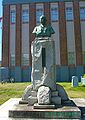 In 690, Empress Dowager Wu's cousin's son Zong Qinke
submitted a number of modified Chinese characters
intended to showcase Empress Dowager Wu's greatness. She adopted them, and she took one of the modified characters, Zhao (曌), to be her formal name (i.e., the name by which the people would exercise naming taboo
on). 曌 was made from two other characters: Ming (明) on top, meaning "light" or "clarity", and Kong (空) on the bottom, meaning "sky." The implication appeared to be that she would be like the light shining from the sky. (Zhao (照), meaning "shine", from which 曌 was derived, might have been her original name, but evidence of that is inconclusive.) Later that year, after successive petition drives, initially started by the low-level official Fu Youyi, began to occur in waves, asking her to take the throne herself, Emperor Ruizong offered to take the name of Wu as well. On 18 August, 690, she approved of the requests. She changed the name of the state to Zhou, claiming ancestry from Zhou Dynasty
, and took the throne herself as Empress Regnant (with the title of Empress Regnant Shengshen (聖神皇帝), literally "Divine and Sacred Emperor or Empress Regnant"). Emperor Ruizong was deposed and made crown prince with the atypical title of Huangsi (皇嗣). This thus interrupted Tang Dynasty, and she became the first (and only) woman to reign over China as Empress Regnant.
(akin to the Salic law
in Europe) did not allow a woman to ascend the throne, but Wu Zetian was determined to quash the opposition, and the use of the secret police did not subside, but continued, after her taking the throne. However, while her organization of the civil service system was criticized for its laxity of the promotion of officials, Wu Zetian was considered capable of evaluating the performance of the officials once they were in office. The Song Dynasty
historian Sima Guang
, in his Zizhi Tongjian
, commented:
, officially sanctioning the religion by building temples named Dayun Temple (大雲寺) in each prefecture belonging to the capital regions of the two capitals Luoyang and Chang'an, and also created nine senior monks dukes. She also enshrined seven generations of Wu ancestors at the imperial ancestral temple, although she also continued to offer sacrifices to the three emperors of Tang (Emperors Gaozu, Taizong, and Gaozong).
She faced the issue of succession. At the time she took the throne, she created Li Dan, the former Emperor Ruizong, crown prince, and bestowed the name of Wu on him. However, the official Zhang Jiafu
instigated the commoner Wang Qingzhi (王慶之) into starting a petition drive to make her nephew Wu Chengsi crown prince, arguing that an emperor named Wu should pass the throne to a member of the Wu clan. Wu Zetian was tempted to do so, and when the chancellors Cen Changqian
and Ge Fuyuan
opposed sternly, they, along with fellow chancellor Ouyang Tong
, were executed. Nevertheless, she declined Wang's request to make Wu Chengsi crown prince, but for a time allowed Wang to freely enter the palace to see her. On one occasion, however, when Wang angered her by coming to the palace too much, she asked the official Li Zhaode
to batter Wang—and Li Zhaode took the opportunity to batter Wang to death, and his group of petitioners scattered. Li Zhaode then persuaded Wu Zetian to keep Li Dan as crown prince—pointing out that a son was closer in relations than a nephew, and also that if Wu Chengsi became emperor, Emperor Gaozong would never again be worshipped. Wu Zetian agreed, and for some time did not again consider the matter. Further, at Li Zhaode's warning that Wu Chengsi was becoming too powerful, Wu Zetian stripped Wu Chengsi of his chancellor authority and bestowed on him largely honorific titles without actual authority.
Meanwhile, the powers of the secret police officials continued, but appeared to be curbed starting about 692, when Lai Junchen was foiled in his attempt to have the chancellors Ren Zhigu
, Di Renjie
, Pei Xingben
, and other officials Cui Xuanli (崔宣禮), Lu Xian (盧獻), Wei Yuanzhong, and Li Sizhen (李嗣真) executed, as Di, under arrest, hid a secret petition inside a change of clothes and had it submitted by his son Di Guangyuan (狄光遠). The seven were still exiled, but after this incident, particularly at the urging of Li Zhaode, Zhu Jingze
, and Zhou Ju (周矩), the waves of politically motivated massacres decreased, although did not end entirely.
Also in 692, Wu Zetian commissioned the general Wang Xiaojie
to attack Tufan, and Wang recaptured the four garrisons of Xiyu that had fallen to Tufan in 670 -- Qiuzi, Yutian, Shule
, and Suiye
.
In 693, after Wu Zetian's trusted lady in waiting
Wei Tuan'er (韋團兒), who hated Li Dan (the reason why she did so is lost to history), falsely accused Li Dan's wife Crown Princess Liu
and Consort Dou of using witchcraft, Wu Zetian had Crown Princess Liu and Consort Dou killed. Li Dan, fearful that he was to be next, did not dare to speak of them. When Wei further planned to falsely accuse Li Dan, however, someone else informed on her, and she was executed. Wu Zetian nevertheless had Li Dan's sons demoted in their princely titles, and when the officials Pei Feigong (裴匪躬) and Fan Yunxian (范雲仙) were accused of secretly meeting Li Dan, she executed Pei and Fan and further barred officials from meeting Li Dan. There were then accusations that Li Dan was plotting treason, and under Wu Zetian's direction, Lai launched an investigation. Lai arrested Li Dan's servants and tortured them—and the torture was such that many of them were ready to falsely implicate themselves and Li Dan. One of Li Dan's servants, An Jinzang
, however, proclaimed Li Dan's innocence and cut his own belly open to swear to that fact. When Wu Zetian heard of what An did, she had doctors attend to An and barely saved his life, and then ordered Lai to end the investigation, thus saving Li Dan.
In 694, Li Zhaode, who had become powerful after Wu Chengsi's removal, was himself thought to be too powerful, and Wu Zetian removed him. Also around this time, she became highly impressed with a group of mystic individuals—the hermit Wei Shifang
(on whom she bestowed a chancellor title briefly), who claimed to be over 350 years old; an old Buddhist nun who claimed to be a Buddha and capable of predicting the future; and a non-Han
man who claimed to be 500 years old. During this time, Wu briefly claimed to be and adopted the cult imagery of Maitreya
, the future Buddha
, in order to build popular support for her reign. However, in 695, after the imperial meeting hall (明堂) and the Heavenly Hall (天堂) were burned by Huaiyi (who was jealous at Wu Zetian's taking on another lover, the imperial physician Shen Nanqiu (沈南璆)), Wu Zetian became angry at these individuals for failing to predict the fire; the old nun and her students were arrested and made into slaves; Wei committed suicide; and the old non-Han man fled. Subsequently, she also put Huaiyi to death. After this incident, she appeared to pay less attention to mysticism and was even more dedicated than before to the affairs of state.
against Tufan, was soundly defeated by Tufan generals, the brothers Lun Qinling (論欽陵) and Lun Zanpo (論贊婆), and as a result, she demoted Wang to commoner rank and Lou to be a low level prefectural official, although she eventually restored both of them to general positions. In April of the same year, Wu Zetian recast the Nine Tripod Cauldrons
, symbol of ultimate power in ancient China, to reinforce her authority.
A much more serious threat arose in summer 696. The Khitan chieftains Li Jinzhong
and Sun Wanrong
, brothers-in-law, angry over the mistreatment of the Khitan people by the Zhou official Zhao Wenhui (趙文翽), the prefect of Ying Prefecture (營州, roughly modern Zhaoyang, Liaoning
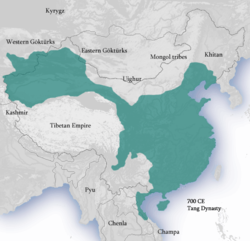
), rebelled, with Li assuming the title of Wushang Khan (無上可汗). Armies that Wu Zetian sent to suppress Li and Sun's rebellion were defeated by Khitan forces, which in turn attacked Zhou proper. Meanwhile, the Eastern Tujue Khan Ashina Mochuo offered to submit, and yet was also launching attacks against Zhou and Khitan—including an attack against Khitan base of operations in winter 696 shortly after Li's death at that time that captured Li's and Sun's families and temporarily halted Khitan operations against Zhou. Sun, after taking over as khan and reorganizing Khitan forces, again attacked Zhou territory and had many victories over Zhou forces, including a battle during which Wang Shijie was killed. Wu Zetian tried to allay the situation by making peace with Ashina Mochuo at fairly costly terms—the return of Tujue people who had previously submitted to Zhou and providing Ashina Mochuo with seeds, silk, tools, and iron. In summer 697, Ashina Mochuo launched another attack on Khitan's base of operations, and this time, after his attack, Khitan forces collapsed, and Sun was killed in flight, ending the Khitan threat.
Meanwhile, also in 697, Lai Junchen, who had at one point lost power but had then returned to power, falsely accused Li Zhaode (who had been pardoned) of crimes, and then planned to falsely accuse Li Dan, Li Zhe, the Wu clan princes, and Princess Taiping, of treason. The Wu clan princes and Princess Taiping acted first against him, accusing him of crimes, and he and Li Zhaode were executed together. After Lai's death, the reign of the secret police largely ended, and many of the victims of Lai and the other secret police officials were gradually exonerated posthumously. Meanwhile, around this time, Wu Zetian began to engage herself with two new lovers—the brothers Zhang Yizhi
and Zhang Changzong
, who became honored within the palace and were eventually created dukes.
Around 698, Wu Chengsi and another nephew of Wu Zetian's, Wu Sansi
the Prince of Liang, were repeatedly making attempts to have officials persuade Wu Zetian to create one of them crown prince—again citing the reason that an emperor should pass the throne to someone of the same clan. However, Di Renjie, who by now had become a trusted chancellor, was firmly against the idea and instead proposed that Li Zhe be recalled. He was supported in this by fellow chancellors Wang Fangqing
and Wang Jishan
, as well as Wu Zetian's close advisor Ji Xu
, who further persuaded the Zhang brothers to support the idea as well. In spring 698, Wu Zetian agreed and recalled Li Zhe from exile. Soon, Li Dan offered to yield the crown prince position to Li Zhe, and Wu Zetian created Li Zhe crown prince, and soon changed his name back to Li Xiǎn and then Wu Xian.
Later, Ashina Mochuo demanded a Tang dynasty
prince for marriage to his daughter, part of a plot to join his family with the Tang, displace the Zhou, and restore Tang rule over China (under his influence). When Wu Zetian sent a member of her own family, grandnephew Wu Yanxiu (武延秀), to marry Mochuo's daughter instead, he rejected him. Ashina Mochuo had no actual intention to cement the peace treaty with a marriage; instead, when Wu Yanxiu arrived, he detained Wu Yanxiu and then launched a major attack on Zhou, advancing as far south as Zhao Prefecture (趙州, in modern Shijiazhuang
, Hebei
) before withdrawing.
In 699, however, at least the Tufan threat would cease. The Tufan king Tridu Songtsen, unhappy that Lun Qinling was monopolizing power, took an opportunity when Lun Qinling was away from the capital Lhasa
to slaughter Lun Qinling's associates. He then defeated Lun Qinling in battle, and Lun Qinling committed suicide. Lun Zanpo and Lun Qinling's son Lun Gongren (論弓仁) surrendered to Zhou. After this, Tufan was under internal turmoil for several years, and there was peace for Zhou on the Tufan border.
Also in 699, Wu Zetian, realizing that she was growing old, feared that after her death, Li Xian and the Wu clan princes would not be able to have peace with each other, and she made him, Li Dan, Princess Taiping, Princess Taiping's second husband Wu Youji
(a nephew of hers) the Prince of Ding, and other Wu clan princes to swear an oath to each other.
 As Wu Zetian grew older, Zhang Yizhi and Zhang Changzong became increasingly powerful, and even the princes of the Wu clan flattered them. She also increasingly relied on them to handle the affairs of state. This was secretly discussed and criticized by her grandson Li Chongrun
the Prince of Shao (Li Xian's son), granddaughter Li Xianhui (李仙蕙) the Lady Yongtai (Li Chongrun's sister), and Li Xianhui's husband Wu Yanji (武延基) the Prince of Wei (Wu Zetian's grandnephew and Wu Chengsi's son), but somehow the discussion was leaked, and Zhang Yizhi reported this to Wu Zetian. She ordered the three of them to commit suicide.
Despite her old age, however, Wu Zetian continued to be interested in finding talented officials and promoting them, and individuals that she promoted in her old age included, among others, Cui Xuanwei
and Zhang Jiazhen.
By 703, Zhang Yizhi and Zhang Changzong had become resentful of Wei Yuanzhong, who by now was a senior chancellor, for dressing down their brother Zhang Changyi (張昌儀) and rejecting the promotion of another brother Zhang Changqi (張昌期). They were also fearful that if Wu Zetian died, Wei would find a way to execute them, and therefore accused Wei and Gao Jian (高戩), an official favored by Princess Taiping, of speculating on Wu Zetian's old age and death. They initially got Wei's subordinate Zhang Shuo to agree to corroborate the charges, but once Zhang Shuo was before Wu Zetian, he instead accused Zhang Yizhi and Zhang Changzong of forcing him to bear false witness. As a result, Wei, Gao, and Zhang Shuo were exiled, but escaped death.
advocated that Zhang Yizhi and Zhang Changzong be removed as well, Wu Zetian, taking the suggestion of the chancellor Yang Zaisi
, did not remove them. Subsequently, charges of corruption against Zhang Yizhi and Zhang Changzong were renewed by the chancellor Wei Anshi
.
In winter 704, Wu Zetian became seriously ill for a period, and only the Zhang brothers were allowed to see her; the chancellors were not. This led to speculation that Zhang Yizhi and Zhang Changzong were plotting to take over the throne, and there were repeated accusations of treason. Once her condition improved, Cui Xuanwei advocated that only Li Xian and Li Dan be allowed to attend to her—a suggestion that she did not accept. After further accusations against the Zhang brothers by Huan and Song Jing
, Wu Zetian allowed Song to investigate, but before the investigation was completed, she issued a pardon for Zhang Yizhi, derailing Song's investigation.
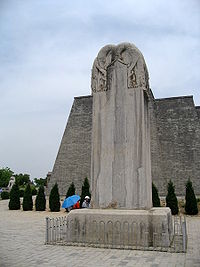 By spring 705, Wu Zetian was again seriously ill. Zhang Jianzhi
, Jing Hui
, and Yuan Shuji
, planned a coup to kill the Zhang brothers. They convinced the generals Li Duozuo
, Li Dan (李湛, note different character than the former emperor), and Yang Yuanyan (楊元琰) and another chancellor, Yao Yuanzhi
, to be involved. With agreement from Li Xian as well, they acted on 20 February, killing Zhang Yizhi and Zhang Changzong, and then had Changsheng Hall (長生殿), where Wu Zetian was residing, surrounded. They then reported to her that the Zhang brothers had been executed for treason, and then forced her to yield the throne to Li Xian. On 21 February, an edict was issued in her name that made Li Xian regent, and on 22 February, an edict was issued in her name passing the throne to Li Xian. On 23 February, Li Xian formally retook the throne, and the next day, Wu Zetian, under heavy guard, was moved to the subsidiary palace Shangyang Palace (上陽宮), but was nevertheless honored with the title of Empress Regnant Zetian Dasheng (則天大聖皇帝). On 3 March, Tang Dynasty was restored, ending Zhou. She died on 16 December, and, pursuant to a final edict issued in her name, was no longer referred to as emperor, but instead as Empress Zetian Dasheng (則天大聖皇后). In 706, Wu Zetian's son Emperor Zhongzong
had Wu Zetian interred in a joint burial with his father Emperor Gaozong
at the Qianling Mausoleum
, located near the capital Chang'an
on Mount Liang. Emperor Zhongzong also buried at Qianling his brother Li Xián, son Li Chongrun
, and daughter Li Xianhui (李仙蕙) the Lady Yongtai (posthumously honored as the Princess Yongtai) — victims of Wu Zetian's wrath.
(Collected Tang Poems) and sixty-one essays under her name are recorded in the Quantangwen (Collected Tang Essays). Though a lot of those writings serve political ends, there is one poem in which she laments her mother after she died and expresses her despair at not being able to see her again.
between the sexes
during the succeeding Tang Dynasty.
In early period of Tang Dynasty, because the Confucian ideology has not dominated China entirely and all the emperors were her direct descendents, the evaluation for Wu Zetian were relatively positive during that time. Commentary in subsequent periods, however, especially the book Zizhi Tongjian
complied by Sima Guang, criticized Wu Zetian harshly. By the period of Southern Song Dynasty
, when Neo-Confucianism
was firmly established as the mainstream political ideology of China, their sexist ideology determined the evaluation for Wu Zetian.
Considering the events of her life, literary allusions to Wu Zetian can carry several connotations: a woman who has inappropriately overstepped her bounds, the hypocrisy
of preaching compassion
while simultaneously engaging in a pattern of corrupt
and vicious behavior, and ruling by pulling strings in the background. For many centuries, Wu was used by the Chinese establishment as an example of what can go wrong when a woman is placed in charge. Such sexist opposition to her was only lifted during the late 1960s, when Mao Zedong
's wife Jiang Qing
rehabilitated Wu as part of a propaganda campaign to suggest herself as a successor to her ailing husband. In his biography Wu, British author Jonathan Clements
has pointed out that these wildly differing uses of a historical figure have often led to schizophrenic and often hysterical characterizations. Many alleged poisonings and other incidents, such as the premature death of her daughter, may have rational explanations—for example, Empress Wang did smother the child—but have been twisted by later opponents.
The traditional Chinese historical view on her was generally mixed—admiring her for her abilities in governing the state, but vilifying her for her actions in seizing imperial power. Typical was a commentary by the Later Jin Dynasty
historian Liu Xu, the lead editor of the Book of Tang
:
|- style="text-align: center;"
History of China
Chinese civilization originated in various regional centers along both the Yellow River and the Yangtze River valleys in the Neolithic era, but the Yellow River is said to be the Cradle of Chinese Civilization. With thousands of years of continuous history, China is one of the world's oldest...
to assume the title of Empress Regnant
Emperor of China
The Emperor of China refers to any sovereign of Imperial China reigning between the founding of Qin Dynasty of China, united by the King of Qin in 221 BCE, and the fall of Yuan Shikai's Empire of China in 1916. When referred to as the Son of Heaven , a title that predates the Qin unification, the...
(Huangdi). As de facto
De facto
De facto is a Latin expression that means "concerning fact." In law, it often means "in practice but not necessarily ordained by law" or "in practice or actuality, but not officially established." It is commonly used in contrast to de jure when referring to matters of law, governance, or...
ruler of China first through her husband and her sons from 665 to 690, not unprecedented in Chinese history, she then broke all precedents when she founded her own dynasty in 690, the Zhou (周) (interrupting the Tang Dynasty
Tang Dynasty
The Tang Dynasty was an imperial dynasty of China preceded by the Sui Dynasty and followed by the Five Dynasties and Ten Kingdoms Period. It was founded by the Li family, who seized power during the decline and collapse of the Sui Empire...
), and ruled personally under the name Sacred and Divine Empress Regnant (聖神皇帝) and variations thereof from 690 to 705. Her rise and reign has been criticized harshly by Confucian historians but has been viewed in a different light after the 1950s.
Family background and birth
Wu was born in Lizhou (利州) (modern day GuangyuanGuangyuan
Guangyuan is a prefecture-level city in Sichuan Province, China. It has an area of 16313.78 square kilometers and a population of 2,484,123 in 2010...
City in Sichuan Province) in 624, the seventh year of Emperor Gaozu of Tang
Emperor Gaozu of Tang
Emperor Gāozǔ of Táng , born Lǐ Yuān , courtesy name Shūdé , was the founder of the Tang Dynasty of China, and the first emperor of this dynasty from 618 to 626. Under the Sui dynasty, Li Yuan was the governor in the area of modern-day Shanxi, and was based in Taiyuan.In 615, Li Yuan was assigned...
’s reign. In the same year, a total eclipse of the Sun was visible across China. Her father Wu Shihuo
Wu Shihuo
Wǔ Shìhuò , was the father of Wu Zetian, the only woman in the history of China to assume the title of Empress Regnant. Posthumously honored with the title of King Zhongxiao, Wu was the son of Wu Hua and became a timber merchant. He was also known as the Duke of Ying and King of Wei serving as army...
was engaged in the timber business and the family was relatively well off. During the final years of Emperor Yang of Sui
Emperor Yang of Sui
Emperor Yang of Sui , personal name Yang Guang , alternative name Ying , nickname Amo , known as Emperor Ming during the brief reign of his grandson Yang Tong), was the second son of Emperor Wen of Sui, and the second emperor of China's Sui Dynasty.Emperor Yang's original name was Yang Ying, but...
, Li Yuan (李淵) (who would go on to become Emperor Gaozu of Tang), whilst holding appointments in both Hedong and Taiyuan
Taiyuan
Taiyuan is the capital and largest city of Shanxi province in North China. At the 2010 census, it had a total population of 4,201,591 inhabitants on 6959 km² whom 3,212,500 are urban on 1,460 km². The name of the city literally means "Great Plains", referring to the location where the Fen River...
, Li stayed in the Wu household many times and became close to the Wu family. After Li Yuan overthrew Emperor Yang, he was generous to the Wu family, providing them with money, grain, land and clothing. Once the Tang Dynasty became established, Wu Shihou held a succession of senior ministerial posts including governor of Yangzhou
Yangzhou
Yangzhou is a prefecture-level city in central Jiangsu Province, People's Republic of China. Sitting on the northern bank of the Yangtze River, it borders the provincial capital of Nanjing to the southwest, Huai'an to the north, Yancheng to the northeast, Taizhou to the east, and Zhenjiang across...
, Lizhou and Jingzhou (荊州) (modern day Jiangling County, Hubei Province).
Wu Zetian was a strong willed child who refused to study needlework like most girls of the time. Instead she was only interested in reading, from which she gained a wide political awareness. During her childhood she travelled widely with her parents and thus developed a cultured and knowledgeable personality.
Initial concubinage
Wu Zetian entered the Tang palace at 13 and became a concubine of Emperor Taizong of TangEmperor Taizong of Tang
Emperor Taizong of Tang , personal name Lǐ Shìmín , was the second emperor of the Tang Dynasty of China, ruling from 626 to 649...
. She did not become a favorite of Taizong's, and after his death in 649, she might have been expected to spend the rest of her life as a Buddhist nun, like his other childless concubines. She was fortunate in that Empress Wang
Empress Wang (Gaozong)
Empress Wang was an empress of the Chinese dynasty Tang Dynasty. She was the first wife and empress of Emperor Gaozong and became empress shortly after he became emperor in 649. She, however, did not bear any sons for him and was not favored...
, the wife and empress of Emperor Taizong's son and successor Emperor Gaozong
Emperor Gaozong of Tang
Emperor Gaozong of Tang , personal name Li Zhi , was the third emperor of the Tang Dynasty in China, ruling from 649 to 683...
, wanted another beautiful concubine to divert Emperor Gaozong's favors from Consort Xiao
Consort Xiao (Gaozong)
Consort Xiao, imperial consort rank Shufei was a concubine of Emperor Gaozong of Tang...
, with whom Empress Wang was having a desperate struggle. Wang had Wu brought back to the palace and made her a concubine of Emperor Gaozong. Consort Wu as she became known proceeded to defeat both Empress Wang and Consort Xiao in the struggle for Emperor Gaozong's affection, and subsequently, both Empress Wang and Consort Xiao were killed, and she was made empress.
As Empress
As Empress Wu progressively gained more and more influence over the governance of the empire throughout Emperor Gaozong's reign, and toward the end of Emperor Gaozong's reign, she was effectively making most of the major decisions. She was regarded as ruthless in her endeavors to grab power, and was believed by traditional historians to have even killed her own daughter to frame Empress Wang, and her own eldest son Li HongLi Hong
Li Hong , formally Emperor Xiaojing with the temple name of Yizong , was a crown prince of the Chinese dynasty Tang Dynasty...
in a power struggle. She subsequently had another son, Li Xián, deposed and exiled.
As Empress Dowager
After Emperor Gaozong's death in 683, Empress Wu became the empress dowagerEmpress Dowager
Empress Dowager was the title given to the mother of a Chinese, Korean, Japanese or Vietnamese emperor.The title was also given occasionally to another woman of the same generation, while a woman from the previous generation was sometimes given the title of Grand empress dowager. Numerous empress...
and proceeded to depose a third son, Emperor Zhongzong
Emperor Zhongzong of Tang
Emperor Zhongzong of Tang , personal name Lǐ Xiǎn , at times during his life Li Zhe and Wu Xian , was the fourth Emperor of the Tang Dynasty of China, ruling briefly in 684 and again from 705 to 710.Emperor Zhongzong was the son of Emperor Gaozong of Tang and Empress Wu...
, for displaying independence. She then had her youngest son Emperor Ruizong
Emperor Ruizong of Tang
Emperor Ruizong of Tang , personal name Lǐ Dàn , known at times during his life as Li Xulun , Li Lun , Wu Lun , and Wu Dan , was the fifth and ninth emperor of Tang Dynasty...
made emperor, but was ruler not only in substance but in appearance as well, as she presided over imperial gatherings and prevented Emperor Ruizong from taking an active role in governance. In 690, she had Emperor Ruizong yield the throne to her and established the Zhou Dynasty. The early part of her reign was characterized by secret police terror, which moderated as the years went by. She was, on the other hand, recognized as a capable and attentive ruler even by traditional historians who despised her, and her ability at selecting capable men to serve as officials was admired throughout the rest of the Tang Dynasty as well as in subsequent dynasties. In 705, she was overthrown in a coup, and Emperor Zhongzong was returned to the throne. She continued to carry the title of "emperor" until her death later in the year.
As Emperor Taizong's concubine
The future Wu Zetian entered Emperor TaizongEmperor Taizong of Tang
Emperor Taizong of Tang , personal name Lǐ Shìmín , was the second emperor of the Tang Dynasty of China, ruling from 626 to 649...
's palace when she was 13 years old—i.e., sometime between 636 and 638—after Emperor Taizong heard of her beauty. She was given the title of cairen
Imperial consorts of Tang China
Imperial consorts of Tang China are organized in eight or nine ranks, in addition to the empress. They are also called the "inner officials" , as opposed to "palace officials" , the bureaucracy....
, title for one of the consorts with the fifth rank in Tang's nine-rank system for imperial officials, nobles, and consorts. Emperor Taizong gave her the name Mei (媚), meaning "pretty." (Thus, today Chinese people often refer to her as Wu Mei or Wu Meiniang (武媚娘) when they write about her youth, whereas they refer to her as Empress Wu (武后) when referring to her as empress and empress dowager and Wu Zetian (武則天) when referring to her reign as "emperor.") When she was summoned to the palace, her mother Lady Yang wept bitterly when saying farewell to her, but she responded, "How do you know that it is not my fortune to meet the Son of Heaven
Son of Heaven
Son of Heaven may refer to:* Emperor of China* Emperor of Japan* Emperors of Vietnam* Son of God* Son of Heaven , book on Guangxu Emperor by Princess Der Ling...
?" Lady Yang understood her ambitions, and therefore stopped crying.
Consort Wu, however, did not appear to be much favored by Emperor Taizong, although it appeared that she did have sexual relations with him at one point. According to her own account during her reign later while rebuking the chancellor Ji Xu
Ji Xu
Ji Xu was an official of Wu Zetian's Zhou Dynasty, serving briefly as chancellor.- Background :It is not known when Ji Xu was born, but it is known that he was from the Zhou capital Luoyang. He was said to be tall, good at hiding his emotions, but daring to speak...
, there was an occasion during the time she was Emperor Taizong's concubine when she impressed Emperor Taizong with her fortitude:
Consort Wu did not have any children with Emperor Taizong. It was said that on one occasion, when Emperor Taizong's crown prince
Crown Prince
A crown prince or crown princess is the heir or heiress apparent to the throne in a royal or imperial monarchy. The wife of a crown prince is also titled crown princess....
Li Zhi
Emperor Gaozong of Tang
Emperor Gaozong of Tang , personal name Li Zhi , was the third emperor of the Tang Dynasty in China, ruling from 649 to 683...
saw her, he was shocked by her beauty. After Emperor Taizong died in 649, Li Zhi became emperor (as Emperor Gaozong), and she and the other imperial consorts who did not have children went to Ganye Temple (感業寺) and became Buddhist nuns.
As Emperor Gaozong's concubine
On an anniversary of Emperor Taizong's death, Emperor Gaozong went to Ganye Temple to offer incense, and when he and Consort Wu saw each other, both of them wept—and were seen by Emperor Gaozong's wife Empress WangEmpress Wang (Gaozong)
Empress Wang was an empress of the Chinese dynasty Tang Dynasty. She was the first wife and empress of Emperor Gaozong and became empress shortly after he became emperor in 649. She, however, did not bear any sons for him and was not favored...
. At that time, Emperor Gaozong did not favor Empress Wang, and much favored his concubine Consort Xiao
Consort Xiao (Gaozong)
Consort Xiao, imperial consort rank Shufei was a concubine of Emperor Gaozong of Tang...
; further, Empress Wang did not have any children, and Consort Xiao had one son (Li Sujie
Li Sujie
Li Sujie , formally the Prince of Xu , was an imperial prince of the Chinese dynasty Tang Dynasty. He was the fourth son of Emperor Gaozong, born of his one-time favorite Consort Xiao...
) and two daughters (Princesses Yiyang and Xuancheng). Empress Wang, seeing that Emperor Gaozong was still impressed by Consort Wu's beauty, hoped that the arrival of a new concubine would divert the emperor from Consort Xiao, and therefore secretly told Consort Wu to stop shaving her hair and, at a later point, welcomed her to the palace. (Some modern historians dispute this traditional account, and some think that Consort Wu never actually left the imperial palace and might have had an affair with Emperor Gaozong while Emperor Taizong was still alive.) Wherever the truth lies, by the early 650s Consort Wu was a concubine of Emperor Gaozong, and she was titled Zhaoyi (昭儀), i.e. the highest ranking of the nine concubines of the second rank. Consort Wu soon overtook Consort Xiao in her favor from Emperor Gaozong. (The taking of a father's concubine—one who was believed to have had sexual relations with the deceased Emperor Taizong—was considered incest
Incest
Incest is sexual intercourse between close relatives that is usually illegal in the jurisdiction where it takes place and/or is conventionally considered a taboo. The term may apply to sexual activities between: individuals of close "blood relationship"; members of the same household; step...
by traditional Confucian principles.) In 652, she gave birth to her first child, a son named Li Hong
Li Hong
Li Hong , formally Emperor Xiaojing with the temple name of Yizong , was a crown prince of the Chinese dynasty Tang Dynasty...
. In 653, she gave birth to another son, Li Xián. (Later, after she became empress, she would bear two more sons (Li Xiǎn
Emperor Zhongzong of Tang
Emperor Zhongzong of Tang , personal name Lǐ Xiǎn , at times during his life Li Zhe and Wu Xian , was the fourth Emperor of the Tang Dynasty of China, ruling briefly in 684 and again from 705 to 710.Emperor Zhongzong was the son of Emperor Gaozong of Tang and Empress Wu...
(note different tone) and Li Dan
Emperor Ruizong of Tang
Emperor Ruizong of Tang , personal name Lǐ Dàn , known at times during his life as Li Xulun , Li Lun , Wu Lun , and Wu Dan , was the fifth and ninth emperor of Tang Dynasty...
), and one daughter (the later Princess Taiping
Princess Taiping
Princess Taiping was a princess of the Chinese dynasty Tang Dynasty and her mother Wu Zetian's Zhou Dynasty. She was the youngest daughter of Wu Zetian and Emperor Gaozong and was powerful during the reigns of her mother and her elder brothers Emperor Zhongzong and Emperor Ruizong , particularly...
). For the time being, however, neither of these sons were in contention to be Emperor Gaozong's heir, as Emperor Gaozong had, pursuant to requests of officials instigated by Empress Wang and her uncle, the chancellor Liu Shi
Liu Shi (chancellor)
Liu Shi , courtesy name Zishao , was a chancellor of the Chinese dynasty Tang Dynasty, during the reign of Emperor Gaozong. His niece was Emperor Gaozong's first wife Empress Wang, and as Emperor Gaozong's favors for her waned, Liu found himself in a precarious position...
, created his oldest son Li Zhong
Li Zhong
Li Zhong is a fictional character in the Water Margin, one of the Four Great Classical Novels of Chinese literature. He ranks 86th of the 108 Liangshan heroes and 50th of the 72 Earthly Fiends. He is nicknamed "Tiger Slaying General".-Background:...
, whose mother Consort Liu was of lowly birth and whose gratitude Empress Wang expected. By 654, both Empress Wang and Consort Xiao had lost favor with Emperor Gaozong, and the former romantic rivals joined forces against Consort Wu, but to no avail, and as a sign of his love to Consort Wu, in 654 he conferred posthumous honors on her father Wu Shihuo
Wu Shihuo
Wǔ Shìhuò , was the father of Wu Zetian, the only woman in the history of China to assume the title of Empress Regnant. Posthumously honored with the title of King Zhongxiao, Wu was the son of Wu Hua and became a timber merchant. He was also known as the Duke of Ying and King of Wei serving as army...
.
Also in 654, shortly after Consort Wu gave birth to a daughter, the daughter died. Empress Wang was allegedly seen near the child's room by eyewitnesses, and Emperor Gaozong suspected that she killed the child out of jealousy. She was unable to clear herself in Emperor Gaozong's eyes. (Traditional historians believed that Consort Wu actually killed her own daughter to frame Empress Wang, although it was possible that this allegation was manufactured by historians.) In anger, Emperor Gaozong considered deposing Empress Wang and replacing her with Consort Wu, but wanted to make sure that the chancellors would support this, and so visited the house of his uncle Zhangsun Wuji
Zhangsun Wuji
Zhangsun Wuji , courtesy name Fuji , formally Duke of Zhao , was a chancellor of the Chinese dynasty Tang Dynasty during the reigns of his brother-in-law Emperor Taizong and nephew Emperor Gaozong...
, the leader among chancellors, with Consort Wu, awarding him with much treasure, but when he brought up the topic that Empress Wang was sonless (as an excuse for deposing her), Zhangsun repeatedly found ways to divert the conversation, and subsequent visits by Consort Wu's mother Lady Yang and the official Xu Jingzong
Xu Jingzong
Xu Jingzong , courtesy name Yanzu , formally Duke Gong of Gaoyang , was a chancellor of the Chinese dynasty Tang Dynasty...
, who was allied with Consort Wu, to seek support from Zhangsun were also to no avail.
In summer 655, Consort Wu accused Empress Wang and her mother Lady Liu of using witchcraft. In response, Emperor Gaozong barred Lady Liu from the palace and demoted Liu Shi. Meanwhile, a faction of officials began to form around Consort Wu, including Li Yifu
Li Yifu
Li Yifu was a chancellor of the Chinese dynasty Tang Dynasty, during the reign of Emperor Gaozong. He became particularly powerful because of his support for Emperor Gaozong's second wife Empress Wu when her ascension was opposed by then-chancellors, and he had a reputation for treachery...
, Xu, Cui Yixuan (崔義玄), and Yuan Gongyu (袁公瑜). On an occasion in fall 655, Emperor Gaozong summoned the chancellors Zhangsun, Li Ji
Li Shiji
Li Shiji , né Xu Shiji , later known in the reign of Emperor Gaozong of Tang as Li Ji , courtesy name Maogong , formally Duke Zhenwu of Ying , was one of the most celebrated generals early in the Chinese Tang Dynasty...
, Yu Zhining
Yu Zhining
Yu Zhining , courtesy name Zhongmi , formally Duke Ding of Yan , was a chancellor of the Chinese dynasty Tang Dynasty, during the reigns of Emperor Taizong and Emperor Gaozong...
, and Chu Suiliang
Chu Suiliang
Chu Suiliang , courtesy name Dengshan , formally Duke of Henan , was a chancellor of the Chinese dynasty Tang Dynasty, during the reigns of Emperor Taizong and Emperor Taizong's son Emperor Gaozong...
to the palace—which Chu deduced to be regarding the matter of changing the empress. Li Ji claimed an illness and refused to attend. At the meeting, Chu vehemently opposed deposing Empress Wang, while Zhangsun and Yu showed their disapproval by silence. Meanwhile, other chancellors Han Yuan
Han Yuan
Han Yuan , courtesy name Boyu , formally Duke of Yingchuan , was an official of the Chinese dynasty Tang Dynasty, serving as chancellor during the reign of Emperor Gaozong...
and Lai Ji
Lai Ji
Lai Ji was an official of the Chinese dynasty Tang Dynasty, serving as a chancellor during the reign of Emperor Gaozong. He later offended Emperor Gaozong by opposing the ascension of Emperor Gaozong's second wife Empress Wu and was exiled to be a prefect in the extreme western part of the state...
also opposed the move, but when Emperor Gaozong asked Li Ji again, Li Ji's response was, "This is your family matter, Your Imperial Majesty. Why ask anyone else?" Emperor Gaozong therefore became resolved. He demoted Chu to be a commandant at Tan Prefecture (潭州, roughly modern Changsha, Hunan
Hunan
' is a province of South-Central China, located to the south of the middle reaches of the Yangtze River and south of Lake Dongting...
), and then deposed both Empress Wang and Consort Xiao, putting them under arrest and creating Consort Wu empress instead to replace Empress Wang. (Later that year, Empress Wang and Consort Xiao were killed on orders by the new Empress Wu after Emperor Gaozong showed signs of considering to release them. After their deaths, however, Empress Wu was often haunted by them in her dreams, for the rest of Emperor Gaozong's reign, Emperor Gaozong and she often took up residence at the eastern capital Luoyang
Luoyang
Luoyang is a prefecture-level city in western Henan province of Central China. It borders the provincial capital of Zhengzhou to the east, Pingdingshan to the southeast, Nanyang to the south, Sanmenxia to the west, Jiyuan to the north, and Jiaozuo to the northeast.Situated on the central plain of...
and only infrequently spent time in Chang'an
Chang'an
Chang'an is an ancient capital of more than ten dynasties in Chinese history, today known as Xi'an. Chang'an literally means "Perpetual Peace" in Classical Chinese. During the short-lived Xin Dynasty, the city was renamed "Constant Peace" ; yet after its fall in AD 23, the old name was restored...
.)
As empress consort
In 656, per advice of Xu Jingzong, Emperor Gaozong deposed Li Zhong to be the Prince of Liang, while creating Li Hong, then carrying the title of Prince of Dai, to be crown prince.In 657, Empress Wu and her allies began reprisals against officials who had opposed her ascension. She first had Xu and Li Yifu, who were by now chancellors, falsely accuse Han Yuan and Lai Ji of being complicit with Chu Suiliang in planning treason. The three of them, along with Liu Shi, were demoted to be prefects of remote prefectures, with provisions that they would never be allowed to return to Chang'an. In 659, she further had Xu accuse Zhangsun Wuji of plotting treason with the low level officials Wei Jifang (韋季方) and Li Chao (李巢). Zhangsun was exiled and, later in the year, was forced to commit suicide in exile. Xu further implicated Chu, Liu, Han, and Yu Zhining in the plot as well. Chu, who had died in 658, was posthumously stripped of his titles, and his sons Chu Yanfu (褚彥甫) and Chu Yanchong (褚彥沖) were executed. Orders were also issued to execute Liu and Han, although Han died before the execution order reached his location. It was said that after this point, no official dared to criticize the emperor any longer. In 660, Li Zhong, who had been fearful that he would be next and had sought out advice of fortune tellers, was also exiled and put under house arrest.
Also in 660, Emperor Gaozong and Empress Wu toured Bian Prefecture (i.e., Taiyuan), and Empress Wu had the opportunity to invite her old neighbors and relatives to a feast. Later that year, Emperor Gaozong began to suffer from an illness that carried the symptoms of painful headache and loss of vision, generally thought to be hypertension-related, but which some historians thought might be slow-poisoning by Empress Wu, and he began to have Empress Wu make rulings on the petitions by the officials. It was said that Empress Wu had quick reactions and understood both literature and history, and therefore was making correct rulings. Thereafter, her authority began to rival Emperor Gaozong's.
By 664, however, Empress Wu was said to be so interfering in the imperial governance that she was angering Emperor Gaozong. Further, she had engaged the Taoist sorcerer Guo Xingzhen (郭行真) in using witchcraft — an act that was prohibited by regulations and which had led to Empress Wang's downfall — and the eunuch Wang Fusheng (王伏勝) reported this to Emperor Gaozong, further angering him. He consulted the chancellor Shangguan Yi
Shangguan Yi
Shangguan Yi , courtesy name Youshao , formally Duke of Chu , was an official of the Chinese dynasty Tang Dynasty, serving as chancellor during the reign of Emperor Gaozong...
, who suggested that he depose Empress Wu. He had Shangguan draft an edict, but as Shangguan was doing so, Empress Wu received news of what was happening, and she went to him to plead her case, as he was holding the edict that Shangguan had drafted. Emperor Gaozong could not bear to depose her, and therefore blamed the episode on Shangguan. As both Shangguan and Wang had served on Li Zhong's staff, Empress Wu had Xu falsely accuse Shangguan, Wang, and Li Zhong of planning treason. Shangguan, Wang, and Shangguan's son Shangguan Tingzhi (上官庭芝) were executed, while Li Zhong was forced to commit suicide. (Shangguan Tingzhi's daughter Shangguan Wan'er
Shangguan Wan'er
Shangguan Wan'er , imperial consort rank Zhaorong , posthumous name Wenhui , was the granddaughter of Shangguan Yi and was one of the women most famous in Chinese history for her talent...
, then an infant, and her mother Lady Zheng became slaves in the inner palace. After Shangguan Wan'er grew up, she eventually became a trusted secretary for Empress Wu.) Thereafter, at imperial meetings, she would sit behind a curtain behind Emperor Gaozong, and they became referred to by the public as the "Two Holy Ones" (二聖, Er Sheng).
Meanwhile, on Empress Wu's account, her mother Lady Yang had been created the Lady of Rong, and her older sister, now widowed, the Lady of Han. Her brothers Wu Yuanqing and Wu Yuanshuang and cousins Wu Weiliang and Wu Huaiyun, despite the poor relations that they had with Lady Yang, were promoted. However, at a feast that Lady Yang held for them, Wu Weiliang offended Lady Yang by stating that they did not find it honorable for them to be promoted on account of Empress Wu. Empress Wu therefore requested to have them demoted to remote prefectures—outwardly to show modesty, but in reality to avenge the offense to her mother. Wu Yuanqing and Wu Yuanshuang died in effective exile. Meanwhile, in or before 666, Lady of Han died as well, and after her death, Emperor Gaozong created her daughter the Lady of Wei and considered keeping her in the palace—possibly as a concubine—but did not immediately do so as he feared that Empress Wu would be displeased. It was said that Empress Wu heard of this and was nevertheless displeased, and she had the Lady of Wei poisoned, by placing poison in food offerings that Wu Weiliang and Wu Huaiyun had made, and then blaming Wu Weiliang and Wu Huaiyun for the murder. Wu Weiliang and Wu Huaiyun were executed.
Also in 666, when Emperor Gaozong offered sacrifices to the gods of heaven and earth at Mount Tai
Mount Tai
Mount Tai is a mountain of historical and cultural significance located north of the city of Tai'an, in Shandong province, People's Republic of China. The tallest peak is the Jade Emperor Peak , which is commonly reported as tall, but is described by the PRC government as .Mount Tai is one of the...
, Empress Wu, in an unprecedented action, offered sacrifices after him, with Princess Dowager Yan, the mother of Emperor Gaozong's brother Li Zhen
Li Zhen (Tang Dynasty)
Li Zhen , formally Prince Jing of Yue , posthumously known during Wu Zetian's reign as Hui Zhen , was an imperial prince of the Chinese dynasty Tang Dynasty who, along with his son Li Chong rose against Wu Zetian, then empress dowager and regent, as they feared that she was about to slaughter the...
the Prince of Yue, offering sacrifices after her.
In 670, Lady Yang died, and by Emperor Gaozong's orders, all of the imperial officials and their wives attended her wake and mourned her. Later that year, with the realm suffering from a major draught, Empress Wu offered to be deposed, an offer Emperor Gaozong rejected. He further posthumously honored Wu Shihuo (who had previously been posthumously honored the Duke of Zhou) and Lady Yang the Prince and Princess of Taiyuan.
Meanwhile, the Lady of Han's son Helan Minzhi (賀蘭敏之) had been given the surname of Wu and allowed to inherit the title of Duke of Zhou. However, as it was becoming clear that he was suspecting Empress Wu of having murdered his sister, Empress Wu began to take precautions against him, who was also said to have had an incestuous relationship with his grandmother Lady Yang. In 671, Helan Minzhi was accused of having disobeyed regulations on mourning during Lady Yang's mourning period, and also of raping the daughter of the official Yang Sijian (楊思儉), whom Emperor Gaozong and Empress Wu had previously selected to be the wife and crown princess for Li Hong. Helan Minzhi was exiled and either was executed in exile or committed suicide. In 674, Empress Wu had Wu Yuanshuang's son Wu Chengsi
Wu Chengsi
Wu Chengsi , formally Prince Xuan of Wei , was a nephew of Chinese sovereign Wu Zetian and an imperial prince during her Zhou Dynasty...
recalled from exile to inherit the title of Duke of Zhou.
Around the new year 675, Empress Wu submitted 12 suggestions—the chief of which were that Laozi
Laozi
Laozi was a mystic philosopher of ancient China, best known as the author of the Tao Te Ching . His association with the Tao Te Ching has led him to be traditionally considered the founder of Taoism...
(whose name was Li Er), to whom the Tang imperial clan traced its ancestry), should have his work Tao Te Ching
Tao Te Ching
The Tao Te Ching, Dao De Jing, or Daodejing , also simply referred to as the Laozi, whose authorship has been attributed to Laozi, is a Chinese classic text...
be added to the required reading for imperial university students, and that a three-year mourning period should be observed for a mother's death in all cases. (Previously, such a mourning period was not observed if the father were still alive, but was observed if the father was no longer alive.) Emperor Gaozong praised her for her suggestions and adopted them.
In 675, with Emperor Gaozong's illness getting worse, he considered having Empress Wu formally rule as regent
Regent
A regent, from the Latin regens "one who reigns", is a person selected to act as head of state because the ruler is a minor, not present, or debilitated. Currently there are only two ruling Regencies in the world, sovereign Liechtenstein and the Malaysian constitutive state of Terengganu...
. The chancellor Hao Chujun
Hao Chujun
Hao Chujun , formally Duke of Zengshan , was an official and general of the Chinese dynasty Tang Dynasty, serving as chancellor during the reign of Emperor Gaozong. He was known for his honesty and willingness to advise Emperor Gaozong against actions he considered unwise...
and the official Li Yiyan
Li Yiyan
Li Yiyan was an official of the Chinese dynasty Tang Dynasty, serving as a chancellor during the reign of Emperor Gaozong.- Background :It is not known when Li Yiyan was born...
both opposed, and he did not formally make her regent. However, she began engaging a number of mid-level officials who were literarily talented, including Yuan Wanqing (元萬頃), Liu Yizhi
Liu Yizhi
Liu Yizhi , courtesy name Ximei , was an official of the Chinese dynasty Tang Dynasty, serving as chancellor during the first reign of Emperor Ruizong...
, Fan Lübing
Fan Lübing
Fan Lübing was an official of the Chinese dynasty Tang Dynasty, serving as chancellor during the first reign of Emperor Ruizong.- During Emperor Gaozong's reign :...
, Miao Chuke (苗楚客), Zhou Simao (周思茂), and Han Chubin (韓楚賓), to write a number of works on her behalf, including the Biographies of Notable Women (列女傳), Guidelines for Imperial Subjects (臣軌), and New Teachings for Official Staff Members (百僚新誡). Collectively, they became known as the "North Gate Scholars" (北門學士), because they served inside the palace, which was to the north of the imperial government buildings, and Empress Wu sought advice from them to divert the powers of the chancellors.
Also in 675, a number of persons would fall victim to Empress Wu's ire. Empress Wu had been displeased at the favor that Emperor Gaozong had shown his aunt Princess Changle, who had married the general Zhao Gui (趙瓌) and whose daughter had become the wife and princess of her third son Li Xiǎn the Prince of Zhou. Princess Zhao was therefore accused of unspecified crimes and put under arrest, and was eventually starved to death. Zhao Gui and Princess Changle were exiled. Meanwhile, later that month, Li Hong the Crown Prince, who had been trying to urge Empress Wu not to exercise so much influence on Emperor Gaozong's governance and who had offended Empress Wu by requesting that his half-sisters, Consort Xiao's daughters Princess Yiyang and Xuancheng, who had been under house arrest, be allowed to marry, died suddenly. Traditional historians generally believed that Empress Wu poisoned Li Hong to death. Li Xián, then carrying the title of Prince of Yong, was created crown prince. Meanwhile, Consort Xiao's son Li Sujie and another son of Emperor Gaozong's, Li Shangjin
Li Shangjin
Li Shangjin was the third son of Emperor Gaozong of Tang. His mother was a palace maid surnamed Yang . When Gaozong ascended the throne, Shangjin was created Prince of Qi . In 652, he was appointed grand governor of Yizhou in titular. In 666, he was appointed prefect of Shou , then prefect of Lu...
(李上金), were repeatedly accused by her of crimes and demoted.
Empress Wu's relationship with Li Xián also soon deteriorated, as Li Xián had become unsettled after hearing rumors that he was not actually born of Empress Wu but of her sister the Lady of Han, and when Empress Wu heard of his fearfulness, she became angry at him. Further, the sorcerer Ming Chongyan (明崇儼), whom both she and Emperor Gaozong respected and who had stated that Li Xián was unsuitable to inherit the throne, was assassinated in 679, and the assassins were not caught—causing her to suspect Li Xián to be behind the assassination. In 680, Li Xián was accused of crimes, and during investigation by the officials Xue Yuanchao
Xue Yuanchao
Xue Yuanchao , formal name Xue Zhen but went by the courtesy name of Yuanchao, formally Baron of Fenyin , was an official of the Chinese dynasty Tang Dynasty who served as a chancellor during the reign of Emperor Gaozong....
, Pei Yan
Pei Yan
Pei Yan , courtesy name Zilong , was an official of the Chinese dynasty Tang Dynasty, serving as a chancellor during the reign of Emperor Gaozong, as well as regency by his wife Empress Wu over their sons Emperor Zhongzong and Emperor Ruizong...
, and Gao Zhizhou
Gao Zhizhou
Gao Zhizhou was an official of the Chinese dynasty Tang Dynasty, serving as chancellor during the reign of Emperor Gaozong.Gao Zhizhou was born in 602, during the reign of Emperor Wen of Sui, the founding emperor of Tang's predecessor Sui Dynasty. His family was from what would become Chang...
, a large amount of arms was found in Li Xián's palace, and Empress Wu formally accused Li Xián of treason and of assassinating Ming. Li Xián was deposed and exiled, and Li Xiǎn (who had by now been renamed Li Zhe) was created crown prince.
In 681, Princess Taiping was married to Xue Shao (薛紹), the son of Emperor Gaozong's sister Princess Chengyang, in a grand ceremony. Empress Wu, initially unimpressed with the lineages of Xue Shao's brothers' wives, wanted to order his brothers to divorce their wives—stopping only after it was pointed out to her that Lady Xiao, the wife of Xue Shao's older brother Xue Yi (薛顗), was a grandniece of the deceased chancellor Xiao Yu
Xiao Yu
Xiao Yu , courtesy name Shiwen , formally Duke Zhenbian of Song , was an imperial prince of the Chinese dynasty Liang Dynasty who later became an official for Sui Dynasty and Tang Dynasty, serving as a chancellor at times during the reigns of Emperor Gaozu of Tang and Emperor Taizong of Tang.-...
.
In late 683, Emperor Gaozong died while at Luoyang. Li Zhe took the throne (as Emperor Zhongzong), but Empress Wu retained actual authority as empress dowager
Empress Dowager
Empress Dowager was the title given to the mother of a Chinese, Korean, Japanese or Vietnamese emperor.The title was also given occasionally to another woman of the same generation, while a woman from the previous generation was sometimes given the title of Grand empress dowager. Numerous empress...
and regent.
As empress dowager
Immediately, Emperor Zhongzong showed signs of disobeying Empress Dowager Wu—including an insistence on making his father-in-law Wei Xuanzhen (韋玄貞) Shizhong (侍中, the head of the examination bureau of government (門下省, Menxia Sheng) and a post considered one for a chancellor) and giving a mid-level office to his wet nurseWet nurse
A wet nurse is a woman who is used to breast feed and care for another's child. Wet nurses are used when the mother is unable or chooses not to nurse the child herself. Wet-nursed children may be known as "milk-siblings", and in some cultures the families are linked by a special relationship of...
's son—despite stern opposition by the chancellor Pei Yan, at one point remarking to Pei:
Pei reported this to Empress Dowager Wu, and she, after planning with Pei, Liu Yizhi, and the generals Cheng Wuting (程務挺) and Zhang Qianxu (張虔勖), deposed him and replaced him with her youngest son Li Dan the Prince of Yu (as Emperor Ruizong). Emperor Zhongzong was reduced to the title of Prince of Luling and exiled. Empress Dowager Wu also sent the general Qiu Shenji (丘神勣) to Li Xián's place in exile and forced Li Xián to commit suicide. Although Emperor Ruizong held the title of emperor, Empress Dowager Wu held onto power even more firmly, and the officials were not allowed to meet with Emperor Ruizong, nor was he allowed to rule on matters of state. Rather, the matters of state were ruled on by Empress Dowager Wu. At the suggestion of her nephew Wu Chengsi, she also expanded the ancestral shrine of the Wu ancestors and gave them greater posthumous honors.
Soon thereafter, Li Ji's grandson Li Jingye
Li Jingye
Li Jingye , also known as Xu Jingye , was a grandson of the great Tang Dynasty general Li Shiji who, after Emperor Gaozong's wife Empress Wu had seized power after Emperor Gaozong's death, rose in rebellion against her, but who was quickly defeated and killed in flight.- Background :It is not...
the Duke of Ying, who had been disaffected by his own exile, started a rebellion at Yang Prefecture (揚州, roughly modern Yangzhou
Yangzhou
Yangzhou is a prefecture-level city in central Jiangsu Province, People's Republic of China. Sitting on the northern bank of the Yangtze River, it borders the provincial capital of Nanjing to the southwest, Huai'an to the north, Yancheng to the northeast, Taizhou to the east, and Zhenjiang across...
, Jiangsu
Jiangsu
' is a province of the People's Republic of China, located along the east coast of the country. The name comes from jiang, short for the city of Jiangning , and su, for the city of Suzhou. The abbreviation for this province is "苏" , the second character of its name...
) -- a rebellion that initially drew much popular support in the region. However, Li Jingye progressed slowly in his attack and did not take advantage of that popular support. Meanwhile, Pei suggested to Empress Dowager Wu that she return imperial authority to the Emperor and argued that doing so would cause the rebellion to collapse on its own. This offended her, and she accused him of being complicit with Li Jingye and had him executed; she also demoted, exiled, and killed a number of officials who, when Pei was arrested, tried to speak on his behalf. She sent the general Li Xiaoyi (李孝逸) to attack Li Jingye, and while Li Xiaoyi was initially unsuccessful, he pushed on at the urging of his assistant Wei Yuanzhong
Wei Yuanzhong
Wei Yuanzhong , né Wei Zhenzai , formally Duke Zhen of Qi , was an official of the Chinese dynasty Tang Dynasty and Wu Zetian's Zhou Dynasty, serving as chancellor during the reigns of Wu Zetian and her son Emperor Zhongzong.- Background :It is not known which year Wei Yuanzhong was born, but it...
and was eventually able to crush Li Jingye's forces. Li Jingye fled and was killed in flight.
By 685, Empress Dowager Wu began to carry on an affair with the Buddhist monk Huaiyi
Huaiyi
Huaiyi , né Feng Xiaobao , sometimes referred to as Xue Huaiyi , was a Buddhist monk who was known for being the lover of Wu Zetian, the only woman to be commonly recognized as "emperor" in the history of China....
, and during the next few years, Huaiyi would be progressively bestowed with greater and greater honors.
In 686, Empress Dowager Wu offered to return imperial authorities to Emperor Ruizong, but Emperor Ruizong, knowing that she did not truly intend to do so, declined, and she continued to exercise imperial authority. Meanwhile, she created copper mailboxes outside the imperial government to encourage the people of the realm to secretly report on others, as she suspected many officials of opposing her. Under these beliefs of hers, secret police officials, including Suo Yuanli
Suo Yuanli
Suo Yuanli was a secret police official during the Chinese dynasty Tang Dynasty and Wu Zetian's Zhou Dynasty, who came to prominence due to his cruelty in acting against officials that Wu Zetian was suspicious toward. However, when he became increasingly hated by the people, she executed him in...
, Zhou Xing
Zhou Xing (Tang Dynasty)
Zhou Xing was a secret police official of the Chinese dynasty Tang Dynasty and Wu Zetian's Zhou Dynasty. He was largely responsible for carrying out her actions to wipe out senior members of Tang's Li imperial clan, but, in a turnabout, was in 691 himself accused of crimes and, under threats of...
, and Lai Junchen
Lai Junchen
Lai Junchen was a secret police official during the Chinese dynasty Tang Dynasty and Wu Zetian's Zhou Dynasty, whose ability to interrogate and falsely implicate officials of crimes made him a subject of fear and hatred...
, began to rise in power and began to carry out systematic false accusations, tortures, and executions of individuals.
In 688, when Empress Dowager Wu was set to make sacrifices to the god of the Luo River (洛水, flowing through Luoyang), she summoned senior members of Tang's Li imperial clan to Luoyang, and the imperial princes, already concerned that she was considering slaughtering them and taking the throne herself, plotted to resist her. However, before a rebellion could be comprehensively planned out, Li Zhen and his son Li Chong
Li Chong (Tang Dynasty)
Li Chong , formally the Prince of Langye , posthumously known during Wu Zetian's reign as Hui Chong , was an imperial prince of the Chinese dynasty Tang Dynasty. Along with his father Li Zhen, Li Chong rose against Wu Zetian, then empress dowager and regent, as they feared that she was about to...
the Prince of Langye rose first, at their respective posts as prefects of Yu Prefecture (豫州, roughly modern Zhumadian
Zhumadian
Zhumadian is a prefecture-level city in southern Henan province, People's Republic of China. It borders Xinyang to the south, Nanyang to the west, Pingdingshan to the northwest, Luohe to the north, Zhoukou to the northeast, and the province of Anhui to the east.Its population is 7,230,744 at the...
, Henan
Henan
Henan , is a province of the People's Republic of China, located in the central part of the country. Its one-character abbreviation is "豫" , named after Yuzhou , a Han Dynasty state that included parts of Henan...
) and Bo Prefecture (博州, roughly modern Liaocheng
Liaocheng
Liaocheng , also known as the Water City, is a prefecture-level city in western Shandong province, People's Republic of China. It borders the provincial capital of Jinan to the southeast, Dezhou to the northeast, Tai'an to the south, and the province of Hebei and Henan to the west...
, Shandong
Shandong
' is a Province located on the eastern coast of the People's Republic of China. Shandong has played a major role in Chinese history from the beginning of Chinese civilization along the lower reaches of the Yellow River and served as a pivotal cultural and religious site for Taoism, Chinese...
). The other princes were not yet ready, however, and did not rise, and forces sent by Empress Dowager Wu and the local forces crushed Li Chong and Li Zhen's forces quickly. Empress Dowager Wu took this opportunity to arrest Emperor Gaozong's granduncles Li Yuanjia (李元嘉) the Prince of Han, Li Lingkui (李靈夔) the Prince of Lu, and Princess Changle, as well as many other members of the Li clan and forced them to commit suicide. Even Princess Taiping's husband Xue Shao was implicated and starved to death. In the subsequent years, there continued to be many politically motivated massacres of officials and Li clan members.
Modified Chinese characters
Zong Qinke
Zong Qinke was an official of the Chinese dynasty Tang Dynasty and Wu Zetian's Zhou Dynasty, serving briefly as chancellor during Wu Zetian's reign....
submitted a number of modified Chinese characters
Chinese characters of Empress Wu
Chinese characters of Empress Wu, or the Zetian characters , are Chinese characters introduced by Empress Wu Zetian, the only reigning female in the history of China, to demonstrate her power. The characters were not created by the Empress herself, but were suggested by an official named Zong...
intended to showcase Empress Dowager Wu's greatness. She adopted them, and she took one of the modified characters, Zhao (曌), to be her formal name (i.e., the name by which the people would exercise naming taboo
Naming taboo
Naming taboo is a cultural taboo against speaking or writing the given names of exalted persons in China and neighboring nations in the ancient Chinese cultural sphere.-Kinds of naming taboo:...
on). 曌 was made from two other characters: Ming (明) on top, meaning "light" or "clarity", and Kong (空) on the bottom, meaning "sky." The implication appeared to be that she would be like the light shining from the sky. (Zhao (照), meaning "shine", from which 曌 was derived, might have been her original name, but evidence of that is inconclusive.) Later that year, after successive petition drives, initially started by the low-level official Fu Youyi, began to occur in waves, asking her to take the throne herself, Emperor Ruizong offered to take the name of Wu as well. On 18 August, 690, she approved of the requests. She changed the name of the state to Zhou, claiming ancestry from Zhou Dynasty
Zhou Dynasty
The Zhou Dynasty was a Chinese dynasty that followed the Shang Dynasty and preceded the Qin Dynasty. Although the Zhou Dynasty lasted longer than any other dynasty in Chinese history, the actual political and military control of China by the Ji family lasted only until 771 BC, a period known as...
, and took the throne herself as Empress Regnant (with the title of Empress Regnant Shengshen (聖神皇帝), literally "Divine and Sacred Emperor or Empress Regnant"). Emperor Ruizong was deposed and made crown prince with the atypical title of Huangsi (皇嗣). This thus interrupted Tang Dynasty, and she became the first (and only) woman to reign over China as Empress Regnant.
As Empress Regnant of the Zhou Dynasty
Traditional Chinese order of successionOrder of succession
An order of succession is a formula or algorithm that determines who inherits an office upon the death, resignation, or removal of its current occupant.-Monarchies and nobility:...
(akin to the Salic law
Salic law
Salic law was a body of traditional law codified for governing the Salian Franks in the early Middle Ages during the reign of King Clovis I in the 6th century...
in Europe) did not allow a woman to ascend the throne, but Wu Zetian was determined to quash the opposition, and the use of the secret police did not subside, but continued, after her taking the throne. However, while her organization of the civil service system was criticized for its laxity of the promotion of officials, Wu Zetian was considered capable of evaluating the performance of the officials once they were in office. The Song Dynasty
Song Dynasty
The Song Dynasty was a ruling dynasty in China between 960 and 1279; it succeeded the Five Dynasties and Ten Kingdoms Period, and was followed by the Yuan Dynasty. It was the first government in world history to issue banknotes or paper money, and the first Chinese government to establish a...
historian Sima Guang
Sima Guang
Sīmǎ Guāng was a Chinese historian, scholar, and high chancellor of the Song Dynasty, jinshi 1038.-Life, profession, and works:...
, in his Zizhi Tongjian
Zizhi Tongjian
The Zizhi Tongjian was a pioneering reference work in Chinese historiography, published in 1084, under the form of a chronicles. In 1065 CE, Emperor Yingzong of Song ordered the great historian Sima Guang to lead with other scholars such as his chief assistants Liu Shu, Liu Ban and Fan Zuyu, the...
, commented:
Early reign
Shortly after Wu Zetian took the throne, she elevated the status of Buddhism to be above TaoismTaoism
Taoism refers to a philosophical or religious tradition in which the basic concept is to establish harmony with the Tao , which is the mechanism of everything that exists...
, officially sanctioning the religion by building temples named Dayun Temple (大雲寺) in each prefecture belonging to the capital regions of the two capitals Luoyang and Chang'an, and also created nine senior monks dukes. She also enshrined seven generations of Wu ancestors at the imperial ancestral temple, although she also continued to offer sacrifices to the three emperors of Tang (Emperors Gaozu, Taizong, and Gaozong).
She faced the issue of succession. At the time she took the throne, she created Li Dan, the former Emperor Ruizong, crown prince, and bestowed the name of Wu on him. However, the official Zhang Jiafu
Zhang Jiafu
Zhang Jiafu was an official of the Chinese dynasty Tang Dynasty and Wu Zetian's Zhou Dynasty, briefly serving as chancellor during the reign of Emperor Shang....
instigated the commoner Wang Qingzhi (王慶之) into starting a petition drive to make her nephew Wu Chengsi crown prince, arguing that an emperor named Wu should pass the throne to a member of the Wu clan. Wu Zetian was tempted to do so, and when the chancellors Cen Changqian
Cen Changqian
Cen Changqian , briefly known as Wu Changqian during the reign of Wu Zetian, formally the Duke of Deng , was an official of the Chinese dynasty Tang Dynasty and Wu Zetian's Zhou Dynasty, serving as chancellor during the reign of Emperor Gaozong, as well as Wu Zetian's reign and her earlier...
and Ge Fuyuan
Ge Fuyuan
Ge Fuyuan was an official of the Chinese dynasty Tang Dynasty and Wu Zetian's Zhou Dynasty, serving briefly as a chancellor during Wu Zetian's reign....
opposed sternly, they, along with fellow chancellor Ouyang Tong
Ouyang Tong
Ouyang Tong , formally the Viscount of Bohai , was an official of the Chinese dynasty Tang Dynasty and Wu Zetian's Zhou Dynasty, serving briefly as chancellor during Wu Zetian's reign.- Background :...
, were executed. Nevertheless, she declined Wang's request to make Wu Chengsi crown prince, but for a time allowed Wang to freely enter the palace to see her. On one occasion, however, when Wang angered her by coming to the palace too much, she asked the official Li Zhaode
Li Zhaode
Li Zhaode was an official of Wu Zetian's Zhou Dynasty and at one point served as chancellor. He was known for his abilities and strong will, which eventually led to a conflict with Wu Zetian's secret police official Lai Junchen...
to batter Wang—and Li Zhaode took the opportunity to batter Wang to death, and his group of petitioners scattered. Li Zhaode then persuaded Wu Zetian to keep Li Dan as crown prince—pointing out that a son was closer in relations than a nephew, and also that if Wu Chengsi became emperor, Emperor Gaozong would never again be worshipped. Wu Zetian agreed, and for some time did not again consider the matter. Further, at Li Zhaode's warning that Wu Chengsi was becoming too powerful, Wu Zetian stripped Wu Chengsi of his chancellor authority and bestowed on him largely honorific titles without actual authority.
Meanwhile, the powers of the secret police officials continued, but appeared to be curbed starting about 692, when Lai Junchen was foiled in his attempt to have the chancellors Ren Zhigu
Ren Zhigu
Ren Zhigu was an official of Wu Zetian's Zhou Dynasty, serving briefly as chancellor.Despite Ren's high status, little is firmly established about his background or career except for the time that he served as chancellor—as, unusual for a chancellor, he did not have a biography in either the Book...
, Di Renjie
Di Renjie
Dí Rénjié , courtesy name Huaiying , formally Duke Wenhui of Liang , was an official of the Chinese Tang Dynasty and Wu Zetian's Zhou Dynasty, twice serving as chancellor during her reign...
, Pei Xingben
Pei Xingben
Pei Xingben was an official of Wu Zetian's Zhou Dynasty, serving briefly as chancellor.Despite Pei's high status, little is firmly established about his background or career except for the time that he served as chancellor—as, unusual for a chancellor, he did not have a biography in either the...
, and other officials Cui Xuanli (崔宣禮), Lu Xian (盧獻), Wei Yuanzhong, and Li Sizhen (李嗣真) executed, as Di, under arrest, hid a secret petition inside a change of clothes and had it submitted by his son Di Guangyuan (狄光遠). The seven were still exiled, but after this incident, particularly at the urging of Li Zhaode, Zhu Jingze
Zhu Jingze
Zhu Jingze , courtesy name Shaolian , was an official of China's Tang Dynasty and Wu Zetian's Zhou Dynasty, serving as a chancellor during Wu Zetian's reign.- Background :Zhu Jingze was born in 635, during the reign of Emperor Taizong...
, and Zhou Ju (周矩), the waves of politically motivated massacres decreased, although did not end entirely.
Also in 692, Wu Zetian commissioned the general Wang Xiaojie
Wang Xiaojie
Wang Xiaojie , formally the Duke of Geng , was a general of the Chinese dynasty Tang Dynasty and Wu Zetian's Zhou Dynasty, serving in campaigns against Tufan, Eastern Tujue, and Khitan and briefly serving as chancellor during Wu Zetian's reign...
to attack Tufan, and Wang recaptured the four garrisons of Xiyu that had fallen to Tufan in 670 -- Qiuzi, Yutian, Shule
Kashgar
Kashgar or Kashi is an oasis city with approximately 350,000 residents in the western part of the Xinjiang Uyghur Autonomous Region of the People's Republic of China. Kashgar is the administrative centre of Kashgar Prefecture which has an area of 162,000 km² and a population of approximately...
, and Suiye
Suyab
Suyab was an ancient Silk Road city located some 50 km east from Bishkek, and 8 km west southwest from Tokmok, in the Chui River valley, present-day Kyrgyzstan.- History :...
.
In 693, after Wu Zetian's trusted lady in waiting
Lady in Waiting
Lady in Waiting is the 2nd album by American southern rock band Outlaws, released in 1976. -Track listing:#"Breaker-Breaker" – 2:59#"South Carolina" – 3:05#"Ain't So Bad" – 3:48...
Wei Tuan'er (韋團兒), who hated Li Dan (the reason why she did so is lost to history), falsely accused Li Dan's wife Crown Princess Liu
Empress Liu (Ruizong)
Empress Liu , formally Empress Sumingshunsheng or Empress Suming in short, was an empress of the Chinese dynasty Tang Dynasty. She was the wife of Emperor Ruizong.- Background :It is not known when the future Empress Liu was born...
and Consort Dou of using witchcraft, Wu Zetian had Crown Princess Liu and Consort Dou killed. Li Dan, fearful that he was to be next, did not dare to speak of them. When Wei further planned to falsely accuse Li Dan, however, someone else informed on her, and she was executed. Wu Zetian nevertheless had Li Dan's sons demoted in their princely titles, and when the officials Pei Feigong (裴匪躬) and Fan Yunxian (范雲仙) were accused of secretly meeting Li Dan, she executed Pei and Fan and further barred officials from meeting Li Dan. There were then accusations that Li Dan was plotting treason, and under Wu Zetian's direction, Lai launched an investigation. Lai arrested Li Dan's servants and tortured them—and the torture was such that many of them were ready to falsely implicate themselves and Li Dan. One of Li Dan's servants, An Jinzang
An Jinzang
An Jincang was a Tang Dynasty court official responsible for saving the life of Li Dan, the future emperor.A native of Luoyang, he was employed in the Court of Sacrificial Worship under the Empress Wu Zetian...
, however, proclaimed Li Dan's innocence and cut his own belly open to swear to that fact. When Wu Zetian heard of what An did, she had doctors attend to An and barely saved his life, and then ordered Lai to end the investigation, thus saving Li Dan.
In 694, Li Zhaode, who had become powerful after Wu Chengsi's removal, was himself thought to be too powerful, and Wu Zetian removed him. Also around this time, she became highly impressed with a group of mystic individuals—the hermit Wei Shifang
Wei Shifang
Wei Shifang , also known as Wu Shifang , was briefly a chancellor during Wu Zetian's Zhou Dynasty.-Rise to top:Wei Shifang had a highly unusual rise to his position. As of 694, Wu Zetian was said to be attracted to the teaching of three individuals involved in mystic teachings...
(on whom she bestowed a chancellor title briefly), who claimed to be over 350 years old; an old Buddhist nun who claimed to be a Buddha and capable of predicting the future; and a non-Han
Han Chinese
Han Chinese are an ethnic group native to China and are the largest single ethnic group in the world.Han Chinese constitute about 92% of the population of the People's Republic of China , 98% of the population of the Republic of China , 78% of the population of Singapore, and about 20% of the...
man who claimed to be 500 years old. During this time, Wu briefly claimed to be and adopted the cult imagery of Maitreya
Maitreya
Maitreya , Metteyya , or Jampa , is foretold as a future Buddha of this world in Buddhist eschatology. In some Buddhist literature, such as the Amitabha Sutra and the Lotus Sutra, he or she is referred to as Ajita Bodhisattva.Maitreya is a bodhisattva who in the Buddhist tradition is to appear on...
, the future Buddha
Buddha
In Buddhism, buddhahood is the state of perfect enlightenment attained by a buddha .In Buddhism, the term buddha usually refers to one who has become enlightened...
, in order to build popular support for her reign. However, in 695, after the imperial meeting hall (明堂) and the Heavenly Hall (天堂) were burned by Huaiyi (who was jealous at Wu Zetian's taking on another lover, the imperial physician Shen Nanqiu (沈南璆)), Wu Zetian became angry at these individuals for failing to predict the fire; the old nun and her students were arrested and made into slaves; Wei committed suicide; and the old non-Han man fled. Subsequently, she also put Huaiyi to death. After this incident, she appeared to pay less attention to mysticism and was even more dedicated than before to the affairs of state.
Middle reign
However, Wu Zetian's administration was soon in for various troubles on the western and then northern borders. In spring 696, an army she sent, commanded by Wang Xiaojie and Lou ShideLou Shide
Lou Shide , courtesy name Zongren , formally Viscount Zhen of Qiao , was an official and general of the Chinese dynasty Tang Dynasty and Wu Zetian's Zhou Dynasty, twice serving as chancellor during Wu Zetian's reign....
against Tufan, was soundly defeated by Tufan generals, the brothers Lun Qinling (論欽陵) and Lun Zanpo (論贊婆), and as a result, she demoted Wang to commoner rank and Lou to be a low level prefectural official, although she eventually restored both of them to general positions. In April of the same year, Wu Zetian recast the Nine Tripod Cauldrons
Nine Tripod Cauldrons
According to legend the Nine Tripod Cauldrons were created following the foundation of the Xia Dynasty by Yu the Great, using tribute metal presented by the governors of the Nine Provinces of ancient China....
, symbol of ultimate power in ancient China, to reinforce her authority.
A much more serious threat arose in summer 696. The Khitan chieftains Li Jinzhong
Li Jinzhong
Li Jinzhong , titled Wushang Khan , was a khan of the Khitan who, along with his brother-in-law Sun Wanrong, rose against Chinese hegemony in 696 and further invaded Chinese territory then under the rule of Wu Zetian's Zhou Dynasty...
and Sun Wanrong
Sun Wanrong
Sun Wanrong was a khan of the Khitan people who, along with his brother-in-law Li Jinzhong, rose against Chinese hegemony in 696, with Li Jinzhong as khan, and they further invaded Chinese territory then under the rule of Wu Zetian's Zhou Dynasty...
, brothers-in-law, angry over the mistreatment of the Khitan people by the Zhou official Zhao Wenhui (趙文翽), the prefect of Ying Prefecture (營州, roughly modern Zhaoyang, Liaoning
Liaoning
' is a province of the People's Republic of China, located in the northeast of the country. Its one-character abbreviation is "辽" , a name taken from the Liao River that flows through the province. "Níng" means "peace"...
), rebelled, with Li assuming the title of Wushang Khan (無上可汗). Armies that Wu Zetian sent to suppress Li and Sun's rebellion were defeated by Khitan forces, which in turn attacked Zhou proper. Meanwhile, the Eastern Tujue Khan Ashina Mochuo offered to submit, and yet was also launching attacks against Zhou and Khitan—including an attack against Khitan base of operations in winter 696 shortly after Li's death at that time that captured Li's and Sun's families and temporarily halted Khitan operations against Zhou. Sun, after taking over as khan and reorganizing Khitan forces, again attacked Zhou territory and had many victories over Zhou forces, including a battle during which Wang Shijie was killed. Wu Zetian tried to allay the situation by making peace with Ashina Mochuo at fairly costly terms—the return of Tujue people who had previously submitted to Zhou and providing Ashina Mochuo with seeds, silk, tools, and iron. In summer 697, Ashina Mochuo launched another attack on Khitan's base of operations, and this time, after his attack, Khitan forces collapsed, and Sun was killed in flight, ending the Khitan threat.
Meanwhile, also in 697, Lai Junchen, who had at one point lost power but had then returned to power, falsely accused Li Zhaode (who had been pardoned) of crimes, and then planned to falsely accuse Li Dan, Li Zhe, the Wu clan princes, and Princess Taiping, of treason. The Wu clan princes and Princess Taiping acted first against him, accusing him of crimes, and he and Li Zhaode were executed together. After Lai's death, the reign of the secret police largely ended, and many of the victims of Lai and the other secret police officials were gradually exonerated posthumously. Meanwhile, around this time, Wu Zetian began to engage herself with two new lovers—the brothers Zhang Yizhi
Zhang Yizhi
Zhang Yizhi , formally the Duke of Heng , nickname Wulang , was an official of Wu Zetian's Zhou Dynasty who, along with his brother Zhang Changzong, became a lover of Wu Zetian and became very powerful late in her reign...
and Zhang Changzong
Zhang Changzong
Zhang Changzong , formally the Duke of Ye , nickname Liulang , was an official of Wu Zetian's Zhou Dynasty who, along with his brother Zhang Yizhi, became a lover of Wu Zetian and became very powerful late in her reign...
, who became honored within the palace and were eventually created dukes.
Around 698, Wu Chengsi and another nephew of Wu Zetian's, Wu Sansi
Wu Sansi
Wu Sansi , formally Prince Xuan of Liang , was an official of the Chinese dynasty Tang Dynasty and his aunt Wu Zetian's Zhou Dynasty, becoming an imperial prince and chancellor during the reign of Wu Zetian and subsequently, while only briefly chancellor during the second reign of Wu Zetian's son...
the Prince of Liang, were repeatedly making attempts to have officials persuade Wu Zetian to create one of them crown prince—again citing the reason that an emperor should pass the throne to someone of the same clan. However, Di Renjie, who by now had become a trusted chancellor, was firmly against the idea and instead proposed that Li Zhe be recalled. He was supported in this by fellow chancellors Wang Fangqing
Wang Fangqing
Wang Fangqing , formal name Wang Lin but went by the courtesy name of Fangqing, formally Duke Zhen of Shiquan , was an official of the Chinese dynasty Tang Dynasty and Wu Zetian's Zhou Dynasty, serving as a chancellor during Wu Zetian's reign.- Background :It is not known when Wang Fangqing was...
and Wang Jishan
Wang Jishan
Wang Jishan , formally Duke Zhen of Xing , was an official of the Chinese dynasty Tang Dynasty and Wu Zetian's Zhou Dynasty, serving as a chancellor during Wu Zetian's reign.- Background :...
, as well as Wu Zetian's close advisor Ji Xu
Ji Xu
Ji Xu was an official of Wu Zetian's Zhou Dynasty, serving briefly as chancellor.- Background :It is not known when Ji Xu was born, but it is known that he was from the Zhou capital Luoyang. He was said to be tall, good at hiding his emotions, but daring to speak...
, who further persuaded the Zhang brothers to support the idea as well. In spring 698, Wu Zetian agreed and recalled Li Zhe from exile. Soon, Li Dan offered to yield the crown prince position to Li Zhe, and Wu Zetian created Li Zhe crown prince, and soon changed his name back to Li Xiǎn and then Wu Xian.
Later, Ashina Mochuo demanded a Tang dynasty
Tang Dynasty
The Tang Dynasty was an imperial dynasty of China preceded by the Sui Dynasty and followed by the Five Dynasties and Ten Kingdoms Period. It was founded by the Li family, who seized power during the decline and collapse of the Sui Empire...
prince for marriage to his daughter, part of a plot to join his family with the Tang, displace the Zhou, and restore Tang rule over China (under his influence). When Wu Zetian sent a member of her own family, grandnephew Wu Yanxiu (武延秀), to marry Mochuo's daughter instead, he rejected him. Ashina Mochuo had no actual intention to cement the peace treaty with a marriage; instead, when Wu Yanxiu arrived, he detained Wu Yanxiu and then launched a major attack on Zhou, advancing as far south as Zhao Prefecture (趙州, in modern Shijiazhuang
Shijiazhuang
Shijiazhuang is the capital and largest city of North China's Hebei province. Administratively a prefecture-level city, it is about south of Beijing...
, Hebei
Hebei
' is a province of the People's Republic of China in the North China region. Its one-character abbreviation is "" , named after Ji Province, a Han Dynasty province that included what is now southern Hebei...
) before withdrawing.
In 699, however, at least the Tufan threat would cease. The Tufan king Tridu Songtsen, unhappy that Lun Qinling was monopolizing power, took an opportunity when Lun Qinling was away from the capital Lhasa
Lhasa
Lhasa is the administrative capital of the Tibet Autonomous Region in the People's Republic of China and the second most populous city on the Tibetan Plateau, after Xining. At an altitude of , Lhasa is one of the highest cities in the world...
to slaughter Lun Qinling's associates. He then defeated Lun Qinling in battle, and Lun Qinling committed suicide. Lun Zanpo and Lun Qinling's son Lun Gongren (論弓仁) surrendered to Zhou. After this, Tufan was under internal turmoil for several years, and there was peace for Zhou on the Tufan border.
Also in 699, Wu Zetian, realizing that she was growing old, feared that after her death, Li Xian and the Wu clan princes would not be able to have peace with each other, and she made him, Li Dan, Princess Taiping, Princess Taiping's second husband Wu Youji
Wu Youji
Wu Youji , formally Prince Zhongjian of Ding , was an imperial prince of Wu Zetian's Zhou Dynasty and an official of Tang Dynasty. He is best known as the second husband of Wu Zetian's powerful daughter Princess Taiping....
(a nephew of hers) the Prince of Ding, and other Wu clan princes to swear an oath to each other.
Late reign
Li Chongrun
Li Chongrun , né Li Chongzhao , formally Crown Prince Yide , was an imperial prince of the Chinese dynasties Tang Dynasty and Wu Zetian's Zhou Dynasty. He was the only son of Emperor Zhongzong and Emperor Zhongzong's second wife Empress Wei...
the Prince of Shao (Li Xian's son), granddaughter Li Xianhui (李仙蕙) the Lady Yongtai (Li Chongrun's sister), and Li Xianhui's husband Wu Yanji (武延基) the Prince of Wei (Wu Zetian's grandnephew and Wu Chengsi's son), but somehow the discussion was leaked, and Zhang Yizhi reported this to Wu Zetian. She ordered the three of them to commit suicide.
Despite her old age, however, Wu Zetian continued to be interested in finding talented officials and promoting them, and individuals that she promoted in her old age included, among others, Cui Xuanwei
Cui Xuanwei
Cui Xuanwei , né Cui Ye , formally Prince Wenxian of Boling , was an official of the Chinese dynasty Tang Dynasty and Wu Zetian's Zhou Dynasty, serving as a chancellor during the reigns of Wu Zetian and her son Emperor Zhongzong...
and Zhang Jiazhen.
By 703, Zhang Yizhi and Zhang Changzong had become resentful of Wei Yuanzhong, who by now was a senior chancellor, for dressing down their brother Zhang Changyi (張昌儀) and rejecting the promotion of another brother Zhang Changqi (張昌期). They were also fearful that if Wu Zetian died, Wei would find a way to execute them, and therefore accused Wei and Gao Jian (高戩), an official favored by Princess Taiping, of speculating on Wu Zetian's old age and death. They initially got Wei's subordinate Zhang Shuo to agree to corroborate the charges, but once Zhang Shuo was before Wu Zetian, he instead accused Zhang Yizhi and Zhang Changzong of forcing him to bear false witness. As a result, Wei, Gao, and Zhang Shuo were exiled, but escaped death.
Removal and death
In autumn of 704, there began to be accusations of corruption levied against Zhang Yizhi and Zhang Changzong, as well as their brothers Zhang Changqi, Zhang Changyi, and Zhang Tongxiu (張同休). Zhang Tongxiu and Zhang Changyi were demoted, but even though the officials Li Chengjia (李承嘉) and Huan YanfanHuan Yanfan
Huan Yanfan , courtesy name Shize , formally Prince Zhonglie of Fuyang , briefly known during the reign of Emperor Zhongzong of Tang as Wei Yanfan , was an official of the Chinese dynasty Tang Dynasty and Wu Zetian's Zhou Dynasty, serving as chancellor during the reign of Emperor Zhongzong...
advocated that Zhang Yizhi and Zhang Changzong be removed as well, Wu Zetian, taking the suggestion of the chancellor Yang Zaisi
Yang Zaisi
Yang Zaisi , formally Duke Gong of Zheng , was an official of the Chinese dynasty Tang Dynasty and Wu Zetian's Zhou Dynasty, serving several times as chancellor during the reigns of Wu Zetian and her son Emperor Zhongzong...
, did not remove them. Subsequently, charges of corruption against Zhang Yizhi and Zhang Changzong were renewed by the chancellor Wei Anshi
Wei Anshi
Wei Anshi , formally Duke Wenzhen of Xun , was an official of the Chinese dynasty Tang Dynasty and Wu Zetian's Zhou Dynasty, serving as a chancellor several times, during the reigns of Wu Zetian, her sons Emperor Zhongzong and Emperor Ruizong, and her grandson Emperor Shang.- Background :Wei Anshi...
.
In winter 704, Wu Zetian became seriously ill for a period, and only the Zhang brothers were allowed to see her; the chancellors were not. This led to speculation that Zhang Yizhi and Zhang Changzong were plotting to take over the throne, and there were repeated accusations of treason. Once her condition improved, Cui Xuanwei advocated that only Li Xian and Li Dan be allowed to attend to her—a suggestion that she did not accept. After further accusations against the Zhang brothers by Huan and Song Jing
Song Jing
Song Jing , formally Duke Wenzhen of Guangping , was an official of the Chinese Tang Dynasty and Wu Zetian's Zhou Dynasty, serving as the chancellor during the reigns of Emperor Ruizong and Emperor Xuanzong...
, Wu Zetian allowed Song to investigate, but before the investigation was completed, she issued a pardon for Zhang Yizhi, derailing Song's investigation.
Zhang Jianzhi
Zhang Jianzhi , courtesy name Mengjiang , formally Prince Wenzhen of Hanyang , was an official of the Chinese dynasty Tang Dynasty and Wu Zetian's Zhou Dynasty, serving as chancellor during the reigns of Wu Zetian and her son Emperor Zhongzong...
, Jing Hui
Jing Hui
JIng Hui , courtesy name Zhongye , formally Prince Sumin of Pingyang , was an official of the Chinese dynasty Tang Dynasty and Wu Zetian's Zhou Dynasty, serving as chancellor during the reign of Emperor Zhongzong...
, and Yuan Shuji
Yuan Shuji
Yuan Shuji , formally Prince Zhenlie of Nanyang , was an official of the Chinese dynasty Tang Dynasty and Wu Zetian's Zhou Dynasty, serving as chancellor during the reign of Emperor Zhongzong...
, planned a coup to kill the Zhang brothers. They convinced the generals Li Duozuo
Li Duozuo
Li Duozuo , formally the Prince of Liaoyang , was an ethnically Mohe general of the Chinese dynasty Tang Dynasty and Wu Zetian's Zhou Dynasty...
, Li Dan (李湛, note different character than the former emperor), and Yang Yuanyan (楊元琰) and another chancellor, Yao Yuanzhi
Yao Chong
Yao Chong , né Yao Yuanchong , known 700s-713 by the courtesy name of Yuanzhi , formally Duke Wenxian of Liang , was an official of the Chinese dynasty Tang Dynasty and Wu Zetian's Zhou Dynasty, serving as chancellor under four sovereigns—Wu Zetian, her sons Emperor Zhongzong and Emperor Ruizong,...
, to be involved. With agreement from Li Xian as well, they acted on 20 February, killing Zhang Yizhi and Zhang Changzong, and then had Changsheng Hall (長生殿), where Wu Zetian was residing, surrounded. They then reported to her that the Zhang brothers had been executed for treason, and then forced her to yield the throne to Li Xian. On 21 February, an edict was issued in her name that made Li Xian regent, and on 22 February, an edict was issued in her name passing the throne to Li Xian. On 23 February, Li Xian formally retook the throne, and the next day, Wu Zetian, under heavy guard, was moved to the subsidiary palace Shangyang Palace (上陽宮), but was nevertheless honored with the title of Empress Regnant Zetian Dasheng (則天大聖皇帝). On 3 March, Tang Dynasty was restored, ending Zhou. She died on 16 December, and, pursuant to a final edict issued in her name, was no longer referred to as emperor, but instead as Empress Zetian Dasheng (則天大聖皇后). In 706, Wu Zetian's son Emperor Zhongzong
Emperor Zhongzong of Tang
Emperor Zhongzong of Tang , personal name Lǐ Xiǎn , at times during his life Li Zhe and Wu Xian , was the fourth Emperor of the Tang Dynasty of China, ruling briefly in 684 and again from 705 to 710.Emperor Zhongzong was the son of Emperor Gaozong of Tang and Empress Wu...
had Wu Zetian interred in a joint burial with his father Emperor Gaozong
Emperor Gaozong of Tang
Emperor Gaozong of Tang , personal name Li Zhi , was the third emperor of the Tang Dynasty in China, ruling from 649 to 683...
at the Qianling Mausoleum
Qianling Mausoleum
The Qianling Mausoleum is a Tang Dynasty tomb site located in Qian County, Shaanxi province, China, and is northwest from Xi'an, formerly the Tang capital. Built by 684 , the tombs of the mausoleum complex house the remains of various members of the royal Li family. This includes Emperor...
, located near the capital Chang'an
Chang'an
Chang'an is an ancient capital of more than ten dynasties in Chinese history, today known as Xi'an. Chang'an literally means "Perpetual Peace" in Classical Chinese. During the short-lived Xin Dynasty, the city was renamed "Constant Peace" ; yet after its fall in AD 23, the old name was restored...
on Mount Liang. Emperor Zhongzong also buried at Qianling his brother Li Xián, son Li Chongrun
Li Chongrun
Li Chongrun , né Li Chongzhao , formally Crown Prince Yide , was an imperial prince of the Chinese dynasties Tang Dynasty and Wu Zetian's Zhou Dynasty. He was the only son of Emperor Zhongzong and Emperor Zhongzong's second wife Empress Wei...
, and daughter Li Xianhui (李仙蕙) the Lady Yongtai (posthumously honored as the Princess Yongtai) — victims of Wu Zetian's wrath.
Writings
Forty-six of her poems are collected in the QuantangshiQuantangshi
The Quantangshi , and also translated as the Complete Tang Poems, is a collection of Tang poetry...
(Collected Tang Poems) and sixty-one essays under her name are recorded in the Quantangwen (Collected Tang Essays). Though a lot of those writings serve political ends, there is one poem in which she laments her mother after she died and expresses her despair at not being able to see her again.
Evaluation
Although short-lived, the Zhou Dynasty, according to some historians, resulted in better equalitySocial equality
Social equality is a social state of affairs in which all people within a specific society or isolated group have the same status in a certain respect. At the very least, social equality includes equal rights under the law, such as security, voting rights, freedom of speech and assembly, and the...
between the sexes
Sexism
Sexism, also known as gender discrimination or sex discrimination, is the application of the belief or attitude that there are characteristics implicit to one's gender that indirectly affect one's abilities in unrelated areas...
during the succeeding Tang Dynasty.
In early period of Tang Dynasty, because the Confucian ideology has not dominated China entirely and all the emperors were her direct descendents, the evaluation for Wu Zetian were relatively positive during that time. Commentary in subsequent periods, however, especially the book Zizhi Tongjian
Zizhi Tongjian
The Zizhi Tongjian was a pioneering reference work in Chinese historiography, published in 1084, under the form of a chronicles. In 1065 CE, Emperor Yingzong of Song ordered the great historian Sima Guang to lead with other scholars such as his chief assistants Liu Shu, Liu Ban and Fan Zuyu, the...
complied by Sima Guang, criticized Wu Zetian harshly. By the period of Southern Song Dynasty
Song Dynasty
The Song Dynasty was a ruling dynasty in China between 960 and 1279; it succeeded the Five Dynasties and Ten Kingdoms Period, and was followed by the Yuan Dynasty. It was the first government in world history to issue banknotes or paper money, and the first Chinese government to establish a...
, when Neo-Confucianism
Neo-Confucianism
Neo-Confucianism is an ethical and metaphysical Chinese philosophy influenced by Confucianism, that was primarily developed during the Song Dynasty and Ming Dynasty, but which can be traced back to Han Yu and Li Ao in the Tang Dynasty....
was firmly established as the mainstream political ideology of China, their sexist ideology determined the evaluation for Wu Zetian.
Considering the events of her life, literary allusions to Wu Zetian can carry several connotations: a woman who has inappropriately overstepped her bounds, the hypocrisy
Hypocrisy
Hypocrisy is the state of pretending to have virtues, moral or religious beliefs, principles, etc., that one does not actually have. Hypocrisy involves the deception of others and is thus a kind of lie....
of preaching compassion
Compassion
Compassion is a virtue — one in which the emotional capacities of empathy and sympathy are regarded as a part of love itself, and a cornerstone of greater social interconnection and humanism — foundational to the highest principles in philosophy, society, and personhood.There is an aspect of...
while simultaneously engaging in a pattern of corrupt
Political corruption
Political corruption is the use of legislated powers by government officials for illegitimate private gain. Misuse of government power for other purposes, such as repression of political opponents and general police brutality, is not considered political corruption. Neither are illegal acts by...
and vicious behavior, and ruling by pulling strings in the background. For many centuries, Wu was used by the Chinese establishment as an example of what can go wrong when a woman is placed in charge. Such sexist opposition to her was only lifted during the late 1960s, when Mao Zedong
Mao Zedong
Mao Zedong, also transliterated as Mao Tse-tung , and commonly referred to as Chairman Mao , was a Chinese Communist revolutionary, guerrilla warfare strategist, Marxist political philosopher, and leader of the Chinese Revolution...
's wife Jiang Qing
Jiang Qing
Jiang Qing was the pseudonym that was used by Chinese leader Mao Zedong's last wife and major Communist Party of China power figure. She went by the stage name Lan Ping during her acting career, and was known by various other names during her life...
rehabilitated Wu as part of a propaganda campaign to suggest herself as a successor to her ailing husband. In his biography Wu, British author Jonathan Clements
Jonathan Clements
Jonathan Clements is a British author and scriptwriter. His non-fiction works include biographies of Confucius, Koxinga and Qin Shihuangdi , as well as monthly opinion columns for Neo magazine...
has pointed out that these wildly differing uses of a historical figure have often led to schizophrenic and often hysterical characterizations. Many alleged poisonings and other incidents, such as the premature death of her daughter, may have rational explanations—for example, Empress Wang did smother the child—but have been twisted by later opponents.
The traditional Chinese historical view on her was generally mixed—admiring her for her abilities in governing the state, but vilifying her for her actions in seizing imperial power. Typical was a commentary by the Later Jin Dynasty
Later Jin Dynasty (Five Dynasties)
Note that there are four periods of Chinese history using the name "Jin" The Later Jìn was one of the Five Dynasties during the Five Dynasties and Ten Kingdoms Period in China. It was founded by Shi Jingtang, posthumously known as Gaozu of Later Jin...
historian Liu Xu, the lead editor of the Book of Tang
Book of Tang
The Book of Tang , Jiu Tangshu or the Old Book of Tang is the first classic work about the Tang Dynasty. The book began when Gaozu of Later Jin ordered its commencement in 941...
:
Second Zhou Dynasty (690–705)
| Convention: use personal name | |||
| Temple name Temple name Temple names are commonly used when naming most Chinese, Korean , and Vietnamese royalty. They should not be confused with era names. Compared to posthumous names, the use of temple names is more exclusive... s |
Family name and first name Chinese name Personal names in Chinese culture follow a number of conventions different from those of personal names in Western cultures. Most noticeably, a Chinese name is written with the family name first and the given name next, therefore "John-Paul Smith" as a Chinese name would be "Smith John-Paul"... |
Period of reign | Era names and their associated dates |
|---|---|---|---|
| None | Wǔ Zhào(武曌) | 690-705 | Tiānshòu (天授): 16 October 690 – 21 April 692 (18 months) Rúyì (如意): 22 April - 22 October 692 (6 months) Chángshòu (長壽): 23 October 692 – 8 June 694 (19 ½ months) Yánzài (延載): 9 June 694 – 21 January 695 (7 ½ months) Zhèngshèng (證聖): 22 January - 21 October 695 (9 months) Tiāncèwànsuì (天冊萬歲): 22 October 695 – 19 January 696 (3 months) Wànsuìdēngfēng (萬歲登封): 20 January - 21 April 696 (3 months) Wànsuìtōngtiān (萬歲通天): 22 April 696 – 28 September 697 (17 months) Shéngōng (神功): 29 September - 19 December 697 (2 ½ months) Shènglì (聖曆): 20 December 697 – 26 May 700 (29 months) Jiǔshì (久視): 27 May 700 – 14 February 701 (8 ½ months) Dàzú (大足): 15 February - 25 November 701 (9 ½ months) Cháng'ān (長安): 26 November 701 – 29 January 705 (38 months) Shénlóng (神龍): 30 January - 3 March 705 (Zhou Dynasty was abolished on 3 March 705, and the Tang Dynasty Tang Dynasty The Tang Dynasty was an imperial dynasty of China preceded by the Sui Dynasty and followed by the Five Dynasties and Ten Kingdoms Period. It was founded by the Li family, who seized power during the decline and collapse of the Sui Empire... was restored that same day, but the Shenlong era continued to be used by Emperor Zhongzong until 707) |
Chancellors during reign
- Cen ChangqianCen ChangqianCen Changqian , briefly known as Wu Changqian during the reign of Wu Zetian, formally the Duke of Deng , was an official of the Chinese dynasty Tang Dynasty and Wu Zetian's Zhou Dynasty, serving as chancellor during the reign of Emperor Gaozong, as well as Wu Zetian's reign and her earlier...
(690-691) - Wu ChengsiWu ChengsiWu Chengsi , formally Prince Xuan of Wei , was a nephew of Chinese sovereign Wu Zetian and an imperial prince during her Zhou Dynasty...
(690-692, 697) - Xing WenweiXing WenweiXing Wenwei was an official of the Chinese dynasty Tang Dynasty, serving as a chancellor during the first reign of Emperor Ruizong and his mother Wu Zetian's Zhou Dynasty.- During Emperor Gaozong's reign :...
(690) - Wu YouningWu YouningWu Youning , formally the Duke of Jiang , was an imperial prince during the reign of Wu Zetian and served as chancellor both during her regency over her son Emperor Ruizong of Tang and her own reign....
(690-691, 691-692, 698-699) - Fu Youyi (690-691)
- Shi WuziShi WuziShi Wuzi was an official of the Chinese dynasty Tang Dynasty and Wu Zetian's Zhou Dynasty, serving briefly as chancellor during Wu Zetian's reign....
(690-691) - Zong QinkeZong QinkeZong Qinke was an official of the Chinese dynasty Tang Dynasty and Wu Zetian's Zhou Dynasty, serving briefly as chancellor during Wu Zetian's reign....
(690) - Le SihuiLe SihuiLe Sihui was an official during Wu Zetian's Zhou Dynasty, briefly serving as chancellor.It is not known when Le Sihui was born. His father Le Yanwei served as chancellor during the reign of Wu Zetian's husband Emperor Gaozong of Tang...
(691) - Ren ZhiguRen ZhiguRen Zhigu was an official of Wu Zetian's Zhou Dynasty, serving briefly as chancellor.Despite Ren's high status, little is firmly established about his background or career except for the time that he served as chancellor—as, unusual for a chancellor, he did not have a biography in either the Book...
(691-692) - Ge FuyuanGe FuyuanGe Fuyuan was an official of the Chinese dynasty Tang Dynasty and Wu Zetian's Zhou Dynasty, serving briefly as a chancellor during Wu Zetian's reign....
(691) - Ouyang TongOuyang TongOuyang Tong , formally the Viscount of Bohai , was an official of the Chinese dynasty Tang Dynasty and Wu Zetian's Zhou Dynasty, serving briefly as chancellor during Wu Zetian's reign.- Background :...
(691) - Pei XingbenPei XingbenPei Xingben was an official of Wu Zetian's Zhou Dynasty, serving briefly as chancellor.Despite Pei's high status, little is firmly established about his background or career except for the time that he served as chancellor—as, unusual for a chancellor, he did not have a biography in either the...
(691-692) - Di RenjieDi RenjieDí Rénjié , courtesy name Huaiying , formally Duke Wenhui of Liang , was an official of the Chinese Tang Dynasty and Wu Zetian's Zhou Dynasty, twice serving as chancellor during her reign...
(691-692, 697-700) - Yang ZhirouYang ZhirouYang Zhirou was an official of Wu Zetian's Zhou Dynasty, serving briefly as chancellor.It is not known when Yang Zhirou was born. What is known is that his grandfather Yang Xu , a member of Tang Dynasty's predecessor Sui Dynasty's imperial clan, was a brother of the early Tang chancellors Yang...
(692) - Li YoudaoLi YoudaoLi Youdao was an official of Wu Zetian's Zhou Dynasty, briefly serving as chancellor.Despite Li's high status, little is firmly established about his career except for the time that he served as chancellor -- as, unusual for a chancellor, he did not have a biography in either the Book of Tang or...
(692) - Yuan ZhihongYuan ZhihongYuan Zhihong was an official of Wu Zetian's Zhou Dynasty, briefly serving as chancellor.Despite Yuan high status, little is firmly established about his background or career except for the time that he served as chancellor -- as, unusual for a chancellor, he did not have a biography in either the...
(692) - Cui ShenjiCui ShenjiCui Shenji , formally the Duke of Qingqiu , was an official of the Chinese dynasty Tang Dynasty and Wu Zetian's Zhou Dynasty, briefly serving as chancellor during Wu Zetian's reign....
(692) - Cui YuanzongCui YuanzongCui Yuanzong was an official of the Chinese dynasty Tang Dynasty and Wu Zetian's Zhou Dynasty, serving as a chancellor during Wu Zetian's reign.- Background :...
(692-694) - Li ZhaodeLi ZhaodeLi Zhaode was an official of Wu Zetian's Zhou Dynasty and at one point served as chancellor. He was known for his abilities and strong will, which eventually led to a conflict with Wu Zetian's secret police official Lai Junchen...
(692-694) - Yao ShuYao ShuYao Shu , courtesy name Lingzhang , formally Count Cheng of Wuxing , was an official of the Chinese dynasty Tang Dynasty and Wu Zetian's Zhou Dynasty, serving twice as chancellor during Wu Zetian's reign.- Background :...
(692, 694-697) - Li YuansuLi YuansuLi Yuansu was an official of Wu Zetian's Zhou Dynasty, serving twice as chancellor.Li Yuansu was the younger brother of Li Jingxuan, who served as chancellor during the reign of Wu Zetian's husband Emperor Gaozong of Tang. It was said that he, like Li Jingxuan, showed abilities as an official...
(692, 694-696) - Wang XuanWang Xuan (Second Zhou)Wang Xuan was an official of Wu Zetian's Zhou Dynasty, briefly serving as chancellor.Despite Wang's high status, little is firmly established about his career except for the time that he served as chancellor—as, unusual for a chancellor, he did not have a biography in either the Book of Tang or...
(692) - Lou ShideLou ShideLou Shide , courtesy name Zongren , formally Viscount Zhen of Qiao , was an official and general of the Chinese dynasty Tang Dynasty and Wu Zetian's Zhou Dynasty, twice serving as chancellor during Wu Zetian's reign....
(693-696, 697-699) - Wei JuyuanWei JuyuanWei Juyuan , formally Duke Zhao of Shu , was an official of the Chinese dynasty Tang Dynasty and Wu Zetian's Zhou Dynasty, serving multiple times as chancellor during the reigns of Wu Zetian, her son Emperor Zhongzong, and her grandson Emperor Shang...
(693-694, 700) - Lu YuanfangLu YuanfangLu Yuanfang , courtesy name Xizhong , was an official of Wu Zetian's Zhou Dynasty, twice serving as chancellor.It is not known when Lu Yuanfang was born, but it is known that his family was from Su Prefecture and that he was from a line that had long served as officials during the Southern Dynasties...
(693-694, 699-700) - Doulu QinwangDoulu QinwangDoulu Qinwang , né Lu Qinwang , formally Duke Yuan of Rui , was an official of the Chinese dynasty Tang Dynasty and Wu Zetian's Zhou Dynasty, serving several terms as chancellor during the reigns of Wu Zetian and her son Emperor Zhongzong.- Background :Doulu Qinwang might have been born in 630,...
(693-694, 697-698, 699-700) - Su WeidaoSu WeidaoSu Weidao , was an official of the Chinese dynasty Tang Dynasty and Wu Zetian's Zhou Dynasty, twice serving as chancellor during Wu Zetian's reign.- Background :...
(693-694, 698-704) - Wang XiaojieWang XiaojieWang Xiaojie , formally the Duke of Geng , was a general of the Chinese dynasty Tang Dynasty and Wu Zetian's Zhou Dynasty, serving in campaigns against Tufan, Eastern Tujue, and Khitan and briefly serving as chancellor during Wu Zetian's reign...
(693-696) - Wei ShifangWei ShifangWei Shifang , also known as Wu Shifang , was briefly a chancellor during Wu Zetian's Zhou Dynasty.-Rise to top:Wei Shifang had a highly unusual rise to his position. As of 694, Wu Zetian was said to be attracted to the teaching of three individuals involved in mystic teachings...
(694) - Yang ZaisiYang ZaisiYang Zaisi , formally Duke Gong of Zheng , was an official of the Chinese dynasty Tang Dynasty and Wu Zetian's Zhou Dynasty, serving several times as chancellor during the reigns of Wu Zetian and her son Emperor Zhongzong...
(694-699, 704-705) - Du JingjianDu JingjianDu Jingjian was an official of the Chinese dynasty Tang Dynasty and Wu Zetian's Zhou Dynasty, twice serving as chancellor during Wu Zetian's reign....
(694, 697-698) - Zhou YunyuanZhou YunyuanZhou Yunyuan , courtesy name Ruliang , was an official of Wu Zetian's Zhou Dynasty, briefing serving as chancellor....
(694-695) - Sun YuanhengSun YuanhengSun Yuanheng was an official of Wu Zetian's Zhou Dynasty, serving briefly as chancellor.Despite Sun's high status, little is firmly established about his career except for the time that he served as chancellor—as, unusual for a chancellor, he did not have a biography in either the Book of Tang or...
(696) - Wang FangqingWang FangqingWang Fangqing , formal name Wang Lin but went by the courtesy name of Fangqing, formally Duke Zhen of Shiquan , was an official of the Chinese dynasty Tang Dynasty and Wu Zetian's Zhou Dynasty, serving as a chancellor during Wu Zetian's reign.- Background :It is not known when Wang Fangqing was...
(696-698) - Li DaoguangLi DaoguangLi Daoguang , courtesy name Taiqiu , formally Marquess Cheng of Jincheng , was an official of Wu Zetian's Zhou Dynasty, serving as chancellor for about two years.- Background :It is not known when Li Daoguang was born...
(696-698) - Wang JishanWang JishanWang Jishan , formally Duke Zhen of Xing , was an official of the Chinese dynasty Tang Dynasty and Wu Zetian's Zhou Dynasty, serving as a chancellor during Wu Zetian's reign.- Background :...
(697-699) - Zong ChukeZong ChukeZong Chuke , courtesy name Shu'ao , was an official of the Chinese dynasty Tang Dynasty and Wu Zetian's Zhou Dynasty, serving as chancellor during the reigns of Wu Zetian, her son Emperor Zhongzong, and her grandson Emperor Shang.- Background :It is not known when Zong Chuke was born, but it is...
(697-698, 704) - Wu SansiWu SansiWu Sansi , formally Prince Xuan of Liang , was an official of the Chinese dynasty Tang Dynasty and his aunt Wu Zetian's Zhou Dynasty, becoming an imperial prince and chancellor during the reign of Wu Zetian and subsequently, while only briefly chancellor during the second reign of Wu Zetian's son...
(697, 698-700) - Yao ChongYao ChongYao Chong , né Yao Yuanchong , known 700s-713 by the courtesy name of Yuanzhi , formally Duke Wenxian of Liang , was an official of the Chinese dynasty Tang Dynasty and Wu Zetian's Zhou Dynasty, serving as chancellor under four sovereigns—Wu Zetian, her sons Emperor Zhongzong and Emperor Ruizong,...
(698-704, 704-705) - Li Jiao (698-700, 703-704)
- Ji XuJi XuJi Xu was an official of Wu Zetian's Zhou Dynasty, serving briefly as chancellor.- Background :It is not known when Ji Xu was born, but it is known that he was from the Zhou capital Luoyang. He was said to be tall, good at hiding his emotions, but daring to speak...
(699-700) - Wei YuanzhongWei YuanzhongWei Yuanzhong , né Wei Zhenzai , formally Duke Zhen of Qi , was an official of the Chinese dynasty Tang Dynasty and Wu Zetian's Zhou Dynasty, serving as chancellor during the reigns of Wu Zetian and her son Emperor Zhongzong.- Background :It is not known which year Wei Yuanzhong was born, but it...
(699-703) - Zhang Xi (700-701)
- Wei AnshiWei AnshiWei Anshi , formally Duke Wenzhen of Xun , was an official of the Chinese dynasty Tang Dynasty and Wu Zetian's Zhou Dynasty, serving as a chancellor several times, during the reigns of Wu Zetian, her sons Emperor Zhongzong and Emperor Ruizong, and her grandson Emperor Shang.- Background :Wei Anshi...
(700-705) - Li HuaiyuanLi HuaiyuanLi Huaiyuan , courtesy name Guangde , formally Duke Cheng of Zhao Commandery , was an official of the Chinese dynasty Tang Dynasty and Wu Zetian's Zhou Dynasty, serving twice as chancellor during the reigns of Wu Zetian and her son Emperor Zhongzong.- Background :It is not known when Li Huaiyuan...
(701) - Gu CongGu CongGu Cong was an official of Wu Zetian's Zhou Dynasty, China, briefly serving as chancellor.Despite Gu's high status, little is firmly established about his career except for the time that he served as chancellor -- as, unusual for a chancellor, he did not have a biography in either the Book of...
(701-702) - Li JiongxiuLi JiongxiuLi Jiongxiu , courtesy name Maozhi , was an official of the Chinese dynasty Tang Dynasty and Wu Zetian's Zhou Dynasty, serving as chancellor during Wu Zetian's reign.- Background :...
(701-704) - Zhu JingzeZhu JingzeZhu Jingze , courtesy name Shaolian , was an official of China's Tang Dynasty and Wu Zetian's Zhou Dynasty, serving as a chancellor during Wu Zetian's reign.- Background :Zhu Jingze was born in 635, during the reign of Emperor Taizong...
(703-704) - Tang XiujingTang XiujingTang Xiujing , formal name Tang Xuan but went by the courtesy name of Xiujing, formally Duke Zhong of Song , was an official and general of the Chinese dynasty Tang Dynasty and Wu Zetian's Zhou Dynasty, serving as chancellor during the reigns of Wu Zetian, her sons Emperor Zhongzong and Emperor...
(703-705) - Wei SiliWei SiliWei Sili , courtesy name Yan'gou , formally Duke Xiao of Xiaoyao , was an official of the Chinese dynasty Tang Dynasty and Wu Zetian's Zhou Dynasty, serving as a chancellor during the reigns of Wu Zetian, her sons Emperor Zhongzong and Emperor Ruizong, and her grandson Emperor Shang.- Background...
(704) - Cui XuanweiCui XuanweiCui Xuanwei , né Cui Ye , formally Prince Wenxian of Boling , was an official of the Chinese dynasty Tang Dynasty and Wu Zetian's Zhou Dynasty, serving as a chancellor during the reigns of Wu Zetian and her son Emperor Zhongzong...
(704-705) - Zhang JianzhiZhang JianzhiZhang Jianzhi , courtesy name Mengjiang , formally Prince Wenzhen of Hanyang , was an official of the Chinese dynasty Tang Dynasty and Wu Zetian's Zhou Dynasty, serving as chancellor during the reigns of Wu Zetian and her son Emperor Zhongzong...
(704-705) - Fang RongFang RongFang Rong was an official of Wu Zetian's Zhou Dynasty, briefly serving as chancellor.Despite Fang's high status, little is firmly established about his career except for the time that he served as chancellor -- as, unusual for a chancellor, he did not have a biography in either the Book of Tang...
(704-705) - Wei ChengqingWei ChengqingWei Chengqing , courtesy name Yanxiu , formally Viscount Wen of Fuyang , was an official of the Chinese dynasty Tang Dynasty and Wu Zetian's Zhou Dynasty, serving as a chancellor during Wu Zetian's reign.- Background :...
(704-705) - Yuan ShujiYuan ShujiYuan Shuji , formally Prince Zhenlie of Nanyang , was an official of the Chinese dynasty Tang Dynasty and Wu Zetian's Zhou Dynasty, serving as chancellor during the reign of Emperor Zhongzong...
(705)
Personal information
- Great-Great-Great-Grandfather
- Wu Heje (武克已), posthumously honored as Emperor Cheng 成皇帝 (with the temple name of Yanzu 嚴祖)
- Great-Great-Great-Grandmother
- Lady Pei, Wu Heje's wife, posthumously honored as Empress Chengzhuang (成莊皇后)
- Great-Great-Grandfather
- Wu Juchang (武居常), posthumously honored as Emperor Jianjin 章敬皇帝 (with the temple name of Suzu 肅祖)
- Great-Great-Grandmother
- Lady Liu, Wu Juichang's wife, posthumously honored as Empress Zhangjing (章敬皇后)
- Great-Grandfather
- Wu Jian (武儉), posthumously honored as Emperor Zhaoan 昭安皇帝 (with the temple name of Lizu 烈祖)
- Great-grandmother
- Lady Song, Wu Jian's wife, posthumously honored as Empress Zhao'an (昭安皇后)
- Grandfather
- Wu Hua (武華), posthumously honored as Emperor Wenmu 文穆皇帝 (with the temple name of Xuanzu 顯祖)
- Grandmother
- Lady Zhao, Wu Hua's wife, posthumously honored as Empress Wenmu (文穆皇后)
- Father
- Wu Shihuo (武士彠) (559 - 635), Duke Ding of Ying, later further successively posthumously honored as the Duke of Zhou, the Prince of Taiyuan, King Zhongxiao (忠孝王), and Emperor Wushangxiaominggao 無上孝明高皇帝(with the temple nameTemple nameTemple names are commonly used when naming most Chinese, Korean , and Vietnamese royalty. They should not be confused with era names. Compared to posthumous names, the use of temple names is more exclusive...
of Taizu 太祖)
- Wu Shihuo (武士彠) (559 - 635), Duke Ding of Ying, later further successively posthumously honored as the Duke of Zhou, the Prince of Taiyuan, King Zhongxiao (忠孝王), and Emperor Wushangxiaominggao 無上孝明高皇帝(with the temple name
- Mother
- Lady Yang (579 - 3 October 670), Wu Shihuo's second wife, daughter of Yang Da (551 - 612), honored as the Lady of Rong, Lady of Zuan, Lady of Wei, and finally Lady Zhonglie of Lu, later further successively posthumously honored with titles corresponding to Wu Shihuo's; she came from the aristocratic Yang family of the Hong Ning region and was of the same clan as the imperial family of the Sui DynastySui DynastyThe Sui Dynasty was a powerful, but short-lived Imperial Chinese dynasty. Preceded by the Southern and Northern Dynasties, it ended nearly four centuries of division between rival regimes. It was followed by the Tang Dynasty....
- Lady Yang (579 - 3 October 670), Wu Shihuo's second wife, daughter of Yang Da (551 - 612), honored as the Lady of Rong, Lady of Zuan, Lady of Wei, and finally Lady Zhonglie of Lu, later further successively posthumously honored with titles corresponding to Wu Shihuo's; she came from the aristocratic Yang family of the Hong Ning region and was of the same clan as the imperial family of the Sui Dynasty
- Husband
- Emperor Gaozong of TangEmperor Gaozong of TangEmperor Gaozong of Tang , personal name Li Zhi , was the third emperor of the Tang Dynasty in China, ruling from 649 to 683...
- Emperor Gaozong of Tang
- Major known lovers
- HuaiyiHuaiyiHuaiyi , né Feng Xiaobao , sometimes referred to as Xue Huaiyi , was a Buddhist monk who was known for being the lover of Wu Zetian, the only woman to be commonly recognized as "emperor" in the history of China....
, né Feng Xiaobao (馮小寶) (name changed 685), the Duke of Liang (created 688) then the Duke of E (created 690, killed 695) - Shen Nanqiu (沈南璆), imperial physician
- Zhang YizhiZhang YizhiZhang Yizhi , formally the Duke of Heng , nickname Wulang , was an official of Wu Zetian's Zhou Dynasty who, along with his brother Zhang Changzong, became a lover of Wu Zetian and became very powerful late in her reign...
, the Duke of Heng (created 702, killed 705) - Zhang ChangzongZhang ChangzongZhang Changzong , formally the Duke of Ye , nickname Liulang , was an official of Wu Zetian's Zhou Dynasty who, along with his brother Zhang Yizhi, became a lover of Wu Zetian and became very powerful late in her reign...
, the Duke of Ye (created 702, killed 705)
- Huaiyi
- Children
- Li HongLi HongLi Hong , formally Emperor Xiaojing with the temple name of Yizong , was a crown prince of the Chinese dynasty Tang Dynasty...
(李弘) (b. 652), originally the Prince of Dai (created 653), later the Crown Prince (created 656, poisoned 675), posthumously honored Emperor Xiaojing with the temple name Yizong - Li Xián (李賢) (note different tone than his brother) (b. 653), name changed to Li De (李德) 672, changed back to Li Xián 674, originally the Prince of Lu (created 655), later the Prince of Pei (created 661), later the Prince of Yong (created 672), later the Crown Prince (created 675), later demoted to commoner rank (demoted 680, forced to commit suicide 684), posthumously initially honored the Prince of Yong, later honored Crown Prince Zhanghuai
- Li Xiǎn (李顯) (note different tone than his brother) (b. 655), name changed to Li Zhe (李哲) 677, changed back to Li Xiǎn 698, changed to Wu Xian (武顯) 700, changed back to Li Xian 705, initially the Prince of Zhou (created 656), later the Prince of Ying (created 677), later the Crown Prince (created 680), later Emperor Zhongzong of TangEmperor Zhongzong of TangEmperor Zhongzong of Tang , personal name Lǐ Xiǎn , at times during his life Li Zhe and Wu Xian , was the fourth Emperor of the Tang Dynasty of China, ruling briefly in 684 and again from 705 to 710.Emperor Zhongzong was the son of Emperor Gaozong of Tang and Empress Wu...
(enthroned 684), later demoted to Prince of Luling (demoted 684), later the Crown Prince (created 698), later emperor again (705) - Li Dan (李旦), né Li Xulun (李旭輪) (b. 662), name changed to Li Lun (李輪) 669, changed again to Li Dan 678, changed again to Wu Lun (武輪) 690, changed again to Wu Dan (武旦) 698, changed back to Li Dan 705, originally the Prince of Yin (created 662), later the Prince of Yu (created 666), later the Prince of Ji (created 669), later the Prince of Xiang (created 675), later the Prince of Yu (created 678), later Emperor Ruizong of TangEmperor Ruizong of TangEmperor Ruizong of Tang , personal name Lǐ Dàn , known at times during his life as Li Xulun , Li Lun , Wu Lun , and Wu Dan , was the fifth and ninth emperor of Tang Dynasty...
(enthroned 684), later demoted to Crown Prince (demoted 690), later demoted to Prince of Xiang (demoted 698), later emperor again (710) - Princess Si of Anding (born and died 654), supposedly murdered by Emperor Gaozong'sEmperor Gaozong of TangEmperor Gaozong of Tang , personal name Li Zhi , was the third emperor of the Tang Dynasty in China, ruling from 649 to 683...
first wife Empress WangEmpress Wang (Gaozong)Empress Wang was an empress of the Chinese dynasty Tang Dynasty. She was the first wife and empress of Emperor Gaozong and became empress shortly after he became emperor in 649. She, however, did not bear any sons for him and was not favored... - Princess TaipingPrincess TaipingPrincess Taiping was a princess of the Chinese dynasty Tang Dynasty and her mother Wu Zetian's Zhou Dynasty. She was the youngest daughter of Wu Zetian and Emperor Gaozong and was powerful during the reigns of her mother and her elder brothers Emperor Zhongzong and Emperor Ruizong , particularly...
(forced to commit suicide 713)
- Li Hong
Titles carried, in chronological order
- Lady Wu (maiden style) 624-637
- Cairen (才人) (15th ranked imperial consort) 637-649
- Zhaoyi (昭儀) (Fourth ranked imperial consort) 650?-655
- Empress (Huanghou (皇后)) 655-683
- Also known as Tianhou (天后) 674-683
- Empress dowager (Huang Taihou (皇太后)) 683-690
- Also known as Shengmu Shenhuang (聖母神皇) 688-690
- Emperor (Huangdi (皇帝)) 690-705
- Shengshen Huangdi (聖神皇帝) 690-693
- Jinlun Shengshen Huangdi (金輪聖神皇帝) 693-694
- Yuegu Jinlun Shengshen Huangdi (越古金輪聖神皇帝) 694-695
- Jinlun Shengshen Huangdi 695
- Tiance Jinlun Dasheng Huangdi 695-705
- Zetian Dasheng Huangdi (則天大聖皇帝) 705
- Posthumous empress titles
- Zetian Dasheng Huanghou (則天大聖皇后) 705-710
- Tianhou (天后) 710
- Dasheng Tianhou (大聖天后) 710-712
- Tianhou Shengdi (天后聖帝) 712
- Shenghou (聖后) 712-716
- Zetian Huanghou (則天皇后) 716-749
- Zetian Shunsheng Huanghou (則天順聖皇后) (final version)
Ancestry
Works of fiction
- A fictionalized Wu Zetian appears together with Di RenjieDi RenjieDí Rénjié , courtesy name Huaiying , formally Duke Wenhui of Liang , was an official of the Chinese Tang Dynasty and Wu Zetian's Zhou Dynasty, twice serving as chancellor during her reign...
(Judge DeeJudge DeeJudge Dee is a semi-fictional character based on the historical figure Di Renjie , magistrate and statesman of the Tang court. The character first appeared in the 18th century Chinese detective novel Di Gong An...
) in Eleanor Cooney & Daniel Alteri's mystery novel Deception: A Novel of Mystery and Madness in Ancient China - A novel, titled The Walking Boy, by Lydia Kwa was published in 2005 by Key Porter Books, Canada.
- Lady Wu, written by Lin Yutang, combines thoroughly researched historical data and storytelling to weave a sensually vicious portrayal of the woman who would be Emperor.
- Impératrice (French), biographical novelBiographical novelThe biographical novel is a genre of novel which provides a fictional and usually entertaining account of a person's life. This kind of novel concentrates on the experiences a person had during his lifetime, the people he met and the incidents which occurred are detailed and sometimes...
by Shan SaShan SaShan Sa is the pseudonym of Yan Ni , a French author and painter. The Girl Who Played Go was the first of her novels to be published outside of France, and won the Prix Goncourt des Lycéens . Her second novel to appear in English translation was Empress...
, born in BeijingBeijingBeijing , also known as Peking , is the capital of the People's Republic of China and one of the most populous cities in the world, with a population of 19,612,368 as of 2010. The city is the country's political, cultural, and educational center, and home to the headquarters for most of China's...
, and based on Empress Wu's life. Translated into:
Empress, for English ; Jotei: Waga na wa Sokuten Bukō , for Japanese; Kaiserin, for German. - A historical novel with the title Cairen Wu Zhao was written by Chinese novelist Su TongSu TongSu Tong is the pen name of a Chinese writer born in Suzhou who is now based in Nanjing. His real name is Tong Zhonggui .He entered into the Department of Chinese of Beijing Normal University in 1980 and started to publish novels in 1983. He is now the vice president of Jiangsu Writers Association...
elaborating her life and her emotional experience. - Isle of Woman (Tor Fantasy, 1993) by Piers Anthony contains a chapter about Wu Zetian's rise to power.
- Green Dragon, White Tiger (Onyx, 1988) by Irish writer Annette Motley, a historical romantic fiction of the empress.
Films
- Wu Zetian, a 1939 film.
- Detective Dee and the Mystery of the Phantom Flame, a 2010 epic mystery film.
Television
- Empress Wu, a 1984 television series by ATVAsia Television LimitedAsia Television Limited is one of the two free-to-air television broadcasters in Hong Kong, the other being rival Television Broadcasts Limited . It launched in 1957 under the name Rediffusion Television as the first television station in Hong Kong...
- Zhizun HongyanZhizun HongyanZhizun Hongyan is a 2004 Chinese television series based on the biography of Wu Zetian, the only woman in Chinese history to assume the title of Empress Regnant...
, a 2004 television series by CTSChinese Television SystemChinese Television System is a broadcast television station in Republic of China .-History:Founded on October 31, 1971, CTS started off as a joint venture between the ROC's Ministry of National Defense and the Ministry of Education. At the time of its establishment, CTS was the only VHF-supported... - The Greatness of a HeroThe Greatness of a HeroThe Greatness of a Hero is a Hong Kong television series produced by TVB. The series aired on Malaysia's Astro On Demand in February 2009.-Synopsis:...
, a Hong KongHong KongHong Kong is one of two Special Administrative Regions of the People's Republic of China , the other being Macau. A city-state situated on China's south coast and enclosed by the Pearl River Delta and South China Sea, it is renowned for its expansive skyline and deep natural harbour...
TVBTelevision Broadcasts LimitedTelevision Broadcasts Limited, commonly known as TVB, is the second over-the-air commercial television station in Hong Kong. It commenced broadcasting on 19 November 1967...
television series aired in February 2009, outlines Wu Zetian as Emperor, also with Di RenjieDi RenjieDí Rénjié , courtesy name Huaiying , formally Duke Wenhui of Liang , was an official of the Chinese Tang Dynasty and Wu Zetian's Zhou Dynasty, twice serving as chancellor during her reign...
.
Computer games
- Wu Zetian is depicted as a leader of China in Sid Meier's Civilization IICivilization IISid Meier's Civilization II is a turn-based strategy computer game designed by Brian Reynolds, Douglas Caspian-Kaufman and Jeff Briggs. Although it is a sequel to Sid Meier's Civilization, neither Sid Meier nor Bruce Shelley was involved in its development.Civilization II was first released in...
(1996) and Civilization VCivilization VSid Meier's Civilization V is a turn-based strategy, 4X computer game developed by Firaxis, released on Microsoft Windows in September 2010 and on Mac OS X on November 23, 2010...
(2010).
Sources
- Book of TangBook of TangThe Book of Tang , Jiu Tangshu or the Old Book of Tang is the first classic work about the Tang Dynasty. The book began when Gaozu of Later Jin ordered its commencement in 941...
, vol. 6.http://ef.cdpa.nsysu.edu.tw/ccw/02/tan01.htm - New Book of TangNew Book of TangThe New Book of Tang , is a classic work of history about the Tang Dynasty edited by Ouyang Xiu and Song Qi and other official scholars of the Song Dynasty. The emperor called for a revision of the former Book of Tang in 1044. The New Book was presented to the throne in 1060. It was given its...
, vols. 4,http://ef.cdpa.nsysu.edu.tw/ccw/02/ntan01.htm 76.http://ef.cdpa.nsysu.edu.tw/ccw/02/ntan13.htm - Zizhi TongjianZizhi TongjianThe Zizhi Tongjian was a pioneering reference work in Chinese historiography, published in 1084, under the form of a chronicles. In 1065 CE, Emperor Yingzong of Song ordered the great historian Sima Guang to lead with other scholars such as his chief assistants Liu Shu, Liu Ban and Fan Zuyu, the...
, vols. 195, 199, 200, 201, 202, 203, 204, 205, 206, 207, 208. - Empress of China: Wu Ze Tian, by Jiang, Cheng An, Victory Press 1998
Further reading
- Wu Zhao: China's Only Woman Emperor, written by N. Harry Rothschild and published 2008 by Pearson Education, Inc.
- Empress Wu Zetian in Fiction and in History: Female Defiance in Confucian China by Dora Shu-fang Dien (Nova Publishing, 2003) explores the life of Empress Wu Zetian and the ways women found to participate in public life, despite the societal constraints of dynastic China.
- Wu: The Chinese Empress Who Schemed, Seduced and Murdered Her Way to Become a Living God by Jonathan ClementsJonathan ClementsJonathan Clements is a British author and scriptwriter. His non-fiction works include biographies of Confucius, Koxinga and Qin Shihuangdi , as well as monthly opinion columns for Neo magazine...
offers a critical appraisal of many primary sources and includes an appendix comparing fictional accounts.
|- style="text-align: center;"