


Edible mushroom

Encyclopedia

Flesh
In vertebrate animals, flesh is the colloquial for biological tissue which consists of skeletal muscles and fat as opposed to bones, viscera and integuments. Flesh may be used as food, in which case it is called meat....
y and edible fruiting bodies of several species of fungi. Mushroom
Mushroom
A mushroom is the fleshy, spore-bearing fruiting body of a fungus, typically produced above ground on soil or on its food source. The standard for the name "mushroom" is the cultivated white button mushroom, Agaricus bisporus; hence the word "mushroom" is most often applied to those fungi that...
s belong to the macrofungi, because their fruiting structures are large enough to be seen with the naked eye
Naked eye
The naked eye is a figure of speech referring to human visual perception unaided by a magnifying or light-collecting optical device, such as a telescope or microscope. Vision corrected to normal acuity using corrective lenses is considered "naked"...
. They can appear either below ground (hypogeous) or above ground (epigeous) where they may be picked by hand. Edibility may be defined by criteria that include absence of poisonous effects on human
Human
Humans are the only living species in the Homo genus...
s and desirable taste
Taste
Taste is one of the traditional five senses. It refers to the ability to detect the flavor of substances such as food, certain minerals, and poisons, etc....
and aroma. Of the estimated 1.5 million species of fungi, only about 150 are considered toxic.
Edible mushrooms are consumed by humans for their nutrition
Nutrition
Nutrition is the provision, to cells and organisms, of the materials necessary to support life. Many common health problems can be prevented or alleviated with a healthy diet....
al and occasionally medicinal value as comestibles. Mushrooms consumed for health reasons are known as medicinal mushrooms
Medicinal mushrooms
Medicinal mushrooms are mushrooms, or mushroom extracts, that are used or studied as possible treatments for diseases. Lentinula edodes , Grifola frondosa , Ganoderma lucidum , and Cordyceps, have a history of medicinal use spanning millennia in parts of Asia...
. While hallucinogenic mushrooms (e.g. Psilocybin mushroom
Psilocybin mushroom
Psilocybin mushrooms are fungi that contain the psychoactive compounds psilocybin and psilocin. There are multiple colloquial terms for psilocybin mushrooms, the most common being shrooms or magic mushrooms....
s) are occasionally consumed for recreational
Recreational drug use
Recreational drug use is the use of a drug, usually psychoactive, with the intention of creating or enhancing recreational experience. Such use is controversial, however, often being considered to be also drug abuse, and it is often illegal...
or religious purposes, they can produce severe nausea
Nausea
Nausea , is a sensation of unease and discomfort in the upper stomach with an involuntary urge to vomit. It often, but not always, precedes vomiting...
and disorientation, and are therefore not commonly considered edible mushrooms.
Edible mushrooms include many fungal species that are either harvested wild
Mushroom hunting
Mushroom hunting, mushrooming, mushroom picking, and similar terms describe the activity of gathering mushrooms in the wild, typically for eating...
or cultivated
Fungiculture
Fungiculture is the process of producing food, medicine, and other products by the cultivation of mushrooms and other fungi.The word is also commonly used to refer to the practice of cultivating fungi by leafcutter ants, termites, ambrosia beetles, and marsh periwinkles.- Introduction :Mushrooms...
. Easily cultivatable and common wild mushrooms are often available in market
Market
A market is one of many varieties of systems, institutions, procedures, social relations and infrastructures whereby parties engage in exchange. While parties may exchange goods and services by barter, most markets rely on sellers offering their goods or services in exchange for money from buyers...
s, and those that are more difficult to obtain (such as the prized truffle and matsutake
Matsutake
Matsutake is the common name for a highly sought after mycorrhizal mushroom that grows in Asia, Europe, and North America...
) may be collected on a smaller scale by private gatherers. Some preparations may render certain poisonous mushrooms fit for consumption.
Before assuming that any wild mushroom is edible, it should be identified. Proper identification of a species is the only safe way to ensure edibility. Some mushrooms that are edible for most people can cause allergic reactions in some individuals, and old or improperly stored specimens can cause food poisoning. Deadly poisonous mushrooms that are frequently confused with edible mushrooms and responsible for many fatal poisonings include several species of the Amanita
Amanita
The genus Amanita contains about 600 species of agarics including some of the most toxic known mushrooms found worldwide. This genus is responsible for approximately 95% of the fatalities resulting from mushroom poisoning, with the death cap accounting for about 50% on its own...
genus, in particular, Amanita phalloides, the death cap.
History of mushroom use
Mycophagy (icon), the act of consuming mushrooms, dates to ancient times. Edible mushroom species have been found in association with 13,000 year old ruins in ChileChile
Chile ,officially the Republic of Chile , is a country in South America occupying a long, narrow coastal strip between the Andes mountains to the east and the Pacific Ocean to the west. It borders Peru to the north, Bolivia to the northeast, Argentina to the east, and the Drake Passage in the far...
, but the first reliable evidence of mushroom consumption dates to several hundred years BC
Anno Domini
and Before Christ are designations used to label or number years used with the Julian and Gregorian calendars....
in China
China
Chinese civilization may refer to:* China for more general discussion of the country.* Chinese culture* Greater China, the transnational community of ethnic Chinese.* History of China* Sinosphere, the area historically affected by Chinese culture...
. The Chinese value mushrooms for medicinal properties as well as for food. Ancient Romans
Ancient Rome
Ancient Rome was a thriving civilization that grew on the Italian Peninsula as early as the 8th century BC. Located along the Mediterranean Sea and centered on the city of Rome, it expanded to one of the largest empires in the ancient world....
and Greeks
Ancient Greece
Ancient Greece is a civilization belonging to a period of Greek history that lasted from the Archaic period of the 8th to 6th centuries BC to the end of antiquity. Immediately following this period was the beginning of the Early Middle Ages and the Byzantine era. Included in Ancient Greece is the...
ate mushrooms, particularly the upper class
Upper class
In social science, the "upper class" is the group of people at the top of a social hierarchy. Members of an upper class may have great power over the allocation of resources and governmental policy in their area.- Historical meaning :...
. The Roman Caesars
Roman Emperor
The Roman emperor was the ruler of the Roman State during the imperial period . The Romans had no single term for the office although at any given time, a given title was associated with the emperor...
would have a food taster
Food taster
A food taster is a person that takes food to be served to someone else to confirm that it is safe to eat and does not contain toxins or poisons. The person to whom the food is going to be served is usually an important person, like an emperor or monarch, or anyone that could possibly be under...
taste the mushrooms before the Caesar to make sure they were safe.
Mushrooms are also easily preserved
Food preservation
Food preservation is the process of treating and handling food to stop or slow down spoilage and thus allow for longer storage....
, and historically have provided additional nutrition over winter.
Many cultures around the world have either used or continue to use psilocybin mushrooms for spiritual purposes as well as medicinal mushrooms
Medicinal mushrooms
Medicinal mushrooms are mushrooms, or mushroom extracts, that are used or studied as possible treatments for diseases. Lentinula edodes , Grifola frondosa , Ganoderma lucidum , and Cordyceps, have a history of medicinal use spanning millennia in parts of Asia...
in folk medicine
Folk medicine
-Description:Refers to healing practices and ideas of body physiology and health preservation known to a limited segment of the population in a culture, transmitted informally as general knowledge, and practiced or applied by anyone in the culture having prior experience.All cultures and societies...
. Mushroom cultivation reached the United States
United States
The United States of America is a federal constitutional republic comprising fifty states and a federal district...
in the late 1800s with imported spores from Mexico
Mexico
The United Mexican States , commonly known as Mexico , is a federal constitutional republic in North America. It is bordered on the north by the United States; on the south and west by the Pacific Ocean; on the southeast by Guatemala, Belize, and the Caribbean Sea; and on the east by the Gulf of...
.
Current culinary use
A fraction of the many fungi consumed by humans are currently cultivated and sold commercially. Commercial cultivation is important ecologically, as there have been concerns of depletion of larger fungi such as chanterelleChanterelle
Cantharellus cibarius, commonly known as the chanterelle, golden chanterelle or girolle, is a fungus. It is probably the best known species of the genus Cantharellus, if not the entire family of Cantharellaceae. It is orange or yellow, meaty and funnel-shaped...
s in Europe, possibly because the group has grown so popular yet remains a challenge to cultivate.
Commercially cultivated

China
Chinese civilization may refer to:* China for more general discussion of the country.* Chinese culture* Greater China, the transnational community of ethnic Chinese.* History of China* Sinosphere, the area historically affected by Chinese culture...
, the United States
United States
The United States of America is a federal constitutional republic comprising fifty states and a federal district...
, Netherlands
Netherlands
The Netherlands is a constituent country of the Kingdom of the Netherlands, located mainly in North-West Europe and with several islands in the Caribbean. Mainland Netherlands borders the North Sea to the north and west, Belgium to the south, and Germany to the east, and shares maritime borders...
, France
France
The French Republic , The French Republic , The French Republic , (commonly known as France , is a unitary semi-presidential republic in Western Europe with several overseas territories and islands located on other continents and in the Indian, Pacific, and Atlantic oceans. Metropolitan France...
and Poland
Poland
Poland , officially the Republic of Poland , is a country in Central Europe bordered by Germany to the west; the Czech Republic and Slovakia to the south; Ukraine, Belarus and Lithuania to the east; and the Baltic Sea and Kaliningrad Oblast, a Russian exclave, to the north...
being the top five producers in 2000.
Commercially harvested wild edibles
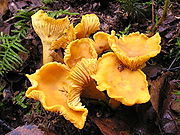
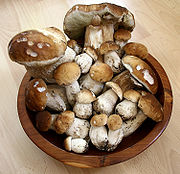
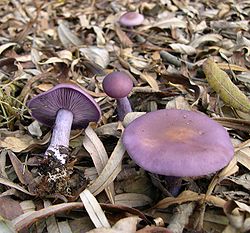
- Boletus edulisBoletus edulisBoletus edulis, commonly known as penny bun, porcino or cep, is a basidiomycete fungus, and the type species of the genus Boletus. Widely distributed in the Northern Hemisphere across Europe, Asia, and North America, it does not occur naturally in the Southern Hemisphere, although it has been...
or edible Boletus, native to Europe, known in Italian as Fungo Porcino (plural 'porcini') (Pig mushroom), in German as Steinpilz (Stone mushroom), in Russian as "white mushroom", in Albanian as (Wolf mushroom) and in French the cèpe. It also known as the king bolete, and is renowned for its delicious flavor. It is sought after worldwide, and can be found in a variety of culinary dishes. - Cantharellus cibarius (The chanterelle), The yellow chanterelle is one of the best and most easily recognizable mushrooms, and can be found in Asia, Europe, North America and Australia. There are poisonous mushrooms which resemble it, though these can be confidently distinguished if one is familiar with the chanterelle's identifying features.
- Cantharellus tubaeformisCantharellus tubaeformisCraterellus tubaeformis is an edible fungus, also known as Yellowfoot, winter mushroom, or Funnel Chanterelle. It is mycorrhizal, forming symbiotic associations with plants, making it very challenging to cultivate...
, the tube chanterelle or yellow-leg - Clitocybe nudaClitocybe nudaClitocybe nuda , is an edible mushroom, found in both coniferous and deciduous woodlands. It is a fairly distinctive mushroom which is widely eaten, though there is some caution about edibility...
- Blewit (or Blewitt) - Cortinarius caperatusCortinarius caperatusCortinarius caperatus, commonly known as the gypsy mushroom, is a highly esteemed edible mushroom of the genus Cortinarius found in northern regions of Europe and North America. It was known as Rozites caperata for many years, before genetic studies revealed it lay within the large genus Cortinarius...
the Gypsy mushroom (recently moved from genus Rozites) - Craterellus cornucopioidesCraterellus cornucopioidesCraterellus cornucopioides is an edible mushroom, also known as trumpet of death, black chanterelle, black trumpet, or horn of plenty. The Cornucopia, in Greek mythology, referred to the magnificent horn of the goat Amalthea, that filled itself with whatever meat or drink its owner requested...
- Trompette du Mort or Horn of Plenty - Grifola frondosaGrifola frondosaGrifola frondosa is a polypore mushroom that grows in clusters at the base of trees, particularly oaks. The mushroom is commonly known among English speakers as Hen-of-the-Woods, Ram's Head and Sheep's Head...
, known in Japan as maitake (also "hen of the woods" or "sheep’s head"); a large, hearty mushroom commonly found on or near stumps and bases of oak trees, and believed to have Macrolepiota procera properties. - Gyromitra esculenta this "False morelFalse morelGyromitra esculenta , one of several species of fungi known as false morels, is an ascomycete fungus from the genus Gyromitra, widely distributed across Europe and North America. It normally sprouts in sandy soils under coniferous trees in spring and early summer...
" is prized by the Finns. This mushroom is deadly poisonous if eaten raw, but highly regarded when parboilParboilParboiling is the partial boiling of food as the first step in the cooking process.The word is often used when referring to parboiled rice. Parboiling can also be used for removing poisonous or foul-tasting substances from foodstuffs...
ed (see below). - Hericium erinaceusHericium erinaceusHericium erinaceus is an edible mushroom and medicinal mushroom in the tooth fungus group...
, a tooth fungus; also called "lion's mane mushroom." - Hydnum repandum Sweet tooth fungus, hedgehog mushroom, urchin of the woods
- Lactarius deliciosusLactarius deliciosusLactarius deliciosus, commonly known as the Saffron milk cap, Red pine mushroom, is one of the best known members of the large milk-cap genus Lactarius in the order Russulales...
Saffron milk cap - Consumed around the world and prized in Russia - Morchella species, (morel family), morels belong to the ascomycete grouping of fungi. They are usually found in open scrub, woodland or open ground in late spring. When collecting this fungus, care must be taken to distinguish it from the poisonous false morelFalse morelGyromitra esculenta , one of several species of fungi known as false morels, is an ascomycete fungus from the genus Gyromitra, widely distributed across Europe and North America. It normally sprouts in sandy soils under coniferous trees in spring and early summer...
s, including Gyromitra esculenta.- Morchella conicaMorchella conicaMorchella conica is a species of fungus in the Morchellaceae family. It is one of three related species commonly known as the black morel, the others being M. angusticeps and M. elata. It was first described by mycologist Christian Hendrik Persoon in 1818....
var. deliciosa - Morchella esculentaMorchella esculentaMorchella esculenta, is a species of fungus in the Morchellaceae family of the Ascomycota. It is one of the most readily recognized of all the edible mushrooms and highly sought after...
var. rotunda
- Morchella conica
- Tricholoma matsutake the Matsutake, a mushroom highly prized in Japanese cuisine.
- Tuber species, (the truffle), Truffles have long eluded the modern techniques of domestication known as trufficulture. Although the field of trufficulture has greatly expanded since its inception in 1808, several species still remain uncultivated. Domesticated truffles include
- Tuber borchii
- Tuber brumale
- Tuber indicum - Chinese black truffle
- Tuber macrosporum - White truffle
- Tuber mesentericum - The Bagnoli truffle
- Tuber uncinatum - Black summer truffle
Other edible wild species
Many wild species are consumed around the world. The species which can be identified "in the field" (without use of special chemistry or a microscope) and therefore safely eaten vary widely from country to country, even from region to region. This list is a sampling of lesser-known species that are reportedly edible.- Amanita caesareaAmanita caesareaAmanita caesarea, commonly known in English as Caesar's Mushroom, is a highly regarded edible mushroom in the genus Amanita, native to southern Europe and North Africa. It has a distinctive orange cap, yellow gills and stem. Similar orange-capped species occur in North America and India...
(Caesar's Mushroom) - Armillaria melleaArmillaria melleaArmillaria mellea is a plant pathogen and a species of Honey fungus. It causes Armillaria root rot in many plant species. The mushrooms are edible but some people may be intolerant to them. The fungus produces mushrooms around the base of trees it has infected...
- Boletus badiusBoletus badiusBoletus badius , and commonly known as the Bay Bolete is an edible, pored mushroom from Europe and North America...
- Boletus elegans
- Chroogomphus rutilusChroogomphus rutilusChroogomphus rutilus, commonly known as the brown slimecap or the copper spike, is a species of fungus in the Gomphidiaceae family. First described scientifically as Agaricus rutilus by Jacob Christian Schaffer in 1774, it was transferred to the genus Chroogomphus in 1964 by Orson K. Miller, Jr....
(pine-spikes or spike-caps) - Calvatia gigantea (Giant Puffball)
- ClavariaceaeClavariaceaeThe Clavariaceae are a family of fungi in the Agaricales order of mushrooms. The family contains 7 genera and 120 species. Collectively, they are commonly known as coral fungi due to their resemblance to aquatic coral, although other vernacular names including antler fungi, finger fungi, worm mold,...
species (coral fungus family) - ClavulinaceaeClavulinaceaeThe Clavulinaceae are a family of fungi in the order Cantharellales. The family is not well defined, but currently comprises species of clavarioid fungi as well as some corticioid fungi...
species (coral fungus family) - Coprinus comatusCoprinus comatusCoprinus comatus, the shaggy ink cap, lawyer's wig, or shaggy mane, is a common fungus often seen growing on lawns, along gravel roads and waste areas. The young fruit bodies first appear as white cylinders emerging from the ground, then the bell-shaped caps open out. The caps are white, and...
, the Shaggy mane. Must be cookedCookingCooking is the process of preparing food by use of heat. Cooking techniques and ingredients vary widely across the world, reflecting unique environmental, economic, and cultural traditions. Cooks themselves also vary widely in skill and training...
as soon as possible after harvesting or the caps will first turn dark and unappetizing, then deliquesce and turn to ink. Not found in markets for this reason. - Cortinarius variecolor
- Fistulina hepatica (beefsteak polypore or the ox tongue)
- Hygrophorus chrysodon
.jpg)
- Lactarius salmonicolor
- Lactarius subdulcisLactarius subdulcisLactarius subdulcis, commonly known as the mild milkcap or beech milk cap, is an edible mushroom in the genus Lactarius. It is brown in colour, with a large number of gills and a particularly thin layer of flesh in the cap...
(mild milkcap) - Lactarius volemusLactarius volemusLactarius volemus is a species of fungus in the family Russulaceae. It is widely distributed in the northern hemisphere, in temperate regions of Europe, North America and Asia as well as some subtropical and tropical regions of Central America and Asia...
- Laetiporous sulphureusSulphur shelfLaetiporus is a genus of edible mushrooms found throughout much of the world. Some species are commonly known as sulphur shelf, chicken of the woods, the chicken mushroom, or the chicken fungus because many think they taste like chicken...
(Sulphur shelf). Also known by names such as the "chicken mushroom", "chicken fungus", sulphur shelf is a distinct bracket fungusBracket fungusBracket fungi, or shelf fungi, among many groups of the fungi in the phylum Basidiomycota. Characteristically, they produce shelf- or bracket-shaped fruiting bodies called conks that lie in a close planar grouping of separate or interconnected horizontal rows...
popular among mushroom hunters. - Leccinum aurantiacumLeccinum aurantiacumLeccinum aurantiacum, is a species of fungus in the genus Leccinum. It is found in forests of Europe, North America and Asia and has a large, characteristically red-capped fruiting body. In North America, it is sometimes referred to by the common name red-capped scaber stalk...
(Red-capped scaber stalk) - Leccinum scabrum (Birch bolete)
- Lepiota procera
- Macrolepiota procera Parasol Mushroom - Globally, it is widespread in temperate regions
- Polyporus squamosusPolyporus squamosusPolyporus squamosus is an basidiomycete bracket fungus, with common names including Dryad's saddle and Pheasant's back mushroom. It has a widespread distribution, being found in North America, Australia, Asia, and Europe, where it causes a white rot in the heartwood of living and dead hardwood trees...
(Dryad's saddle and Pheasant's back mushroom) - Polyporus sulphureus
- Polyporus mylittae
- Ramariaceae species (coral fungus family)
- Rhizopogon luteolus
- RussulaRussulaAround 750 worldwide species of mycorrhizal mushrooms compose the genus Russula. They are typically common, fairly large, and brightly colored - making them one of the most recognizable genera among mycologists and mushroom collectors...
, some members of this genus are edible. - Sparassis crispaSparassis crispaSparassis crispa is a species of fungus in the genus Sparassis.-Description:S. crispa grows in a globe that is up to in diameter. The lobes are flat and curly, resembling lasagna noodles and they are colored white to creamy yellow. They are found growing on wood, usually conifers....
. Also known as "cauliflower mushroom". - Suillus bovinusSuillus bovinusSuillus bovinus, also known as the Jersey cow mushroom, is a pored mushroom of the genus Suillus in the Suillaceae family. It is an edible mushroom that often grows in a symbiosis with pine.-Description:...
- Suillus luteusSuillus luteusSuillus luteus is a basidiomycete fungus, and the type species of the genus Suillus. It is a common fungus indigenous to coniferous forests of Eurasia and North America, and introduced to southern Australia and New Zealand...
- Suillus tomentosusSuillus tomentosusSuillus tomentosus is a species of mushroom. The common names of the species are Blue-staining Slippery Jack, Poor Man's Slippery Jack, and Woolly-capped Suillus.-Description:...
- Tricholoma terreumTricholoma terreumTricholoma terreum, commonly known as the grey knight or dirty tricholoma, is a grey-capped edible mushroom of the large genus Tricholoma. It is found in coniferous woodlands in Europe, and has also been encountered under introduced pine trees in Australia...
Conditionally edible species
There are a number of fungi that are considered choice by some and toxic by others. In some cases, proper preparation can remove some or all of the toxins.- Amanita muscariaAmanita muscariaAmanita muscaria, commonly known as the fly agaric or fly amanita , is a poisonous and psychoactive basidiomycete fungus, one of many in the genus Amanita...
is edible if parboilParboilParboiling is the partial boiling of food as the first step in the cooking process.The word is often used when referring to parboiled rice. Parboiling can also be used for removing poisonous or foul-tasting substances from foodstuffs...
ed to leach out toxins. Fresh mushrooms cause vomiting, twitching, drowsiness, and hallucinations due to the presence of muscimolMuscimolMuscimol is the major psychoactive alkaloid present in many mushrooms of the Amanita genus. Unlike psilocin , which is a serotonergic psychedelic and agonist for the 5-HT2A receptor set, muscimol is a potent, selective agonist for the GABAA receptor set and is a deliriant as a opposed...
. Although present in A. muscaria, ibotenic acid is not in high enough concentration to produce any physical or psychological effects unless massive amounts are ingested. - Coprinopsis atramentariaCoprinopsis atramentariaCoprinopsis atramentaria, commonly known as the common ink cap or inky cap, is an edible mushroom found in Europe and North America. Previously known as Coprinus atramentarius, it is the second best known ink cap and previous member of the genus Coprinus after C. comatus...
is edible without special preparation. However, consumption with alcohol is toxic due to the presence of coprine. Some other CoprinusCoprinusCoprinus is a small genus of mushrooms consisting of Coprinus comatus and several of its close relatives. Until 2001, Coprinus was a large genus consisting of all agaric species in which the lamellae autodigested to release their spores...
spp. share this property. - Gyromitra esculenta is eaten by some after it has been parboilParboilParboiling is the partial boiling of food as the first step in the cooking process.The word is often used when referring to parboiled rice. Parboiling can also be used for removing poisonous or foul-tasting substances from foodstuffs...
ed; however, mycologists do not recommend it. Raw GyromitraGyromitraGyromitra is a genus of ascomycete mushrooms found in the northern hemisphere. The most famous member is the controversial false morel ...
are toxic due to the presence of gyromitrinGyromitrinGyromitrin is a toxin and carcinogen present in several members of the fungal genus Gyromitra, most notably the false morel G. esculenta. It is unstable and is easily hydrolyzed to the toxic compound monomethylhydrazine, a component of some rocket fuels. Monomethylhydrazine acts on the central...
, and it is not known if all of the toxin can be removed by parboilParboilParboiling is the partial boiling of food as the first step in the cooking process.The word is often used when referring to parboiled rice. Parboiling can also be used for removing poisonous or foul-tasting substances from foodstuffs...
ing. - LactariusLactariusLactarius is a genus of mushroom-producing fungi. The genus, collectively known commonly as milk-caps, are characterized by the fact that they exude a milky fluid if cut or damaged...
spp. - Apart from Lactarius deliciosusLactarius deliciosusLactarius deliciosus, commonly known as the Saffron milk cap, Red pine mushroom, is one of the best known members of the large milk-cap genus Lactarius in the order Russulales...
which is universally considered edible, other LactariusLactariusLactarius is a genus of mushroom-producing fungi. The genus, collectively known commonly as milk-caps, are characterized by the fact that they exude a milky fluid if cut or damaged...
spp. that are considered toxic elsewhere in the world are eaten in Russia after pickling or parboilParboilParboiling is the partial boiling of food as the first step in the cooking process.The word is often used when referring to parboiled rice. Parboiling can also be used for removing poisonous or foul-tasting substances from foodstuffs...
ing. - Verpa bohemicaVerpa bohemicaVerpa bohemica is a species of fungus in the Morchellaceae family. Commonly known as the early morel or the wrinkled thimble-cap, it is one of several species known informally as a "false morel"...
- Considered choice by some, it even can be found for sale as a "morel", but cases of toxicity have been reported. Verpas contain toxins similar to gyromitrinGyromitrinGyromitrin is a toxin and carcinogen present in several members of the fungal genus Gyromitra, most notably the false morel G. esculenta. It is unstable and is easily hydrolyzed to the toxic compound monomethylhydrazine, a component of some rocket fuels. Monomethylhydrazine acts on the central...
and similar precautions apply.
Medicinal use

Medicinal mushrooms
Medicinal mushrooms are mushrooms, or mushroom extracts, that are used or studied as possible treatments for diseases. Lentinula edodes , Grifola frondosa , Ganoderma lucidum , and Cordyceps, have a history of medicinal use spanning millennia in parts of Asia...
are mushrooms or extracts from mushrooms that are used or studied as possible treatments for disease
Disease
A disease is an abnormal condition affecting the body of an organism. It is often construed to be a medical condition associated with specific symptoms and signs. It may be caused by external factors, such as infectious disease, or it may be caused by internal dysfunctions, such as autoimmune...
s. Research has shown some medicinal mushroom isolates that have promising cardiovascular, anticancer, antiviral, antibacterial, antiparasitic, anti-inflammatory, and antidiabetic properties. Currently, several extracts (polysaccharide-K
Polysaccharide-K
Polysaccharide-K is a protein-bound polysaccharide, which is used as an immune system boosting agent in the treatment of cancer in some countries in Europe as well as China and Japan. In Japan, PSK is approved as an adjuvant for cancer therapy and is covered by government health insurance...
, polysaccharide peptide
Polysaccharide Peptide
Polysaccharide peptide is a protein-bound polysaccharide extracted from the edible mushroom Coriolus versicolor. PSP is currently in the animal-testing phase of research in many countries for use as an anti-tumor drug. It appears to work as a Biological Response Modifier, enhancing the body's own...
, lentinan
Lentinan
Lentinan is a beta-glucan with a glycosidic β-1,3:β-1,6 linkage. It is an anti-tumor polysaccharide from the shiitake mushroom. Lentinan is a polysaccharide that has a molecular weight of approximately 500,000 Da...
http://www.mskcc.org/mskcc/html/69279.cfm) have widespread use in Japan, Korea and China, as adjuvants to radiation treatments and chemotherapy.
The concept of a medicinal mushroom has a history spanning millennia in parts of Asia.http://www.cancer.org/Treatment/TreatmentsandSideEffects/ComplementaryandAlternativeMedicine/DietandNutrition/shiitake-mushroom?sitearea=etohttp://www.cancer.org/Treatment/TreatmentsandSideEffects/ComplementaryandAlternativeMedicine/DietandNutrition/maitake-mushrooms Only a few mushroom extracts have been extensively tested for efficacy. The available results for most other extracts, are on isolated cell lines, animal research with rodents, or underpowered clinical human trials. Although medicinal molds
Medicinal molds
Medicinal molds are molds which were the original source of certain medicines. The most important contribution to medicine by medicinal molds include the first statins and the discovery of penicillin.-Statins:...
do not produce mushrooms, these fungi were the original source of penicillin
Penicillin
Penicillin is a group of antibiotics derived from Penicillium fungi. They include penicillin G, procaine penicillin, benzathine penicillin, and penicillin V....
, the first statins, and griseofulvin
Griseofulvin
Griseofulvin is an antifungal drug that is administered orally. It is used both in animals and in humans, to treat fungal infections of the skin and nails...
.
Preparing wild edibles
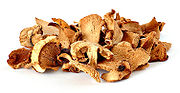
One recipe for Auricularia auricula-judae
Auricularia auricula-judae
Auricularia auricula-judae, known as the Jew's ear, jelly ear or by a number of other common names, is a species of edible Auriculariales fungus found worldwide. The fruiting body is distinguished by its noticeably ear-like shape and brown colouration; it grows upon wood, especially elder...
is to collect it while still soft, wash it thoroughly and cut it into thin slices. The prepared slices should be stewed in stock or milk for around three-quarters of an hour, and then served with plenty of pepper. The result is crispy and not unlike seaweed.
The difficult task of identifying mushrooms in the wild, for culinary or recreational purposes, can produce severe poisoning.
Production
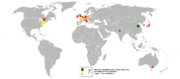
| Country | Output in ton Ton The ton is a unit of measure. It has a long history and has acquired a number of meanings and uses over the years. It is used principally as a unit of weight, and as a unit of volume. It can also be used as a measure of energy, for truck classification, or as a colloquial term.It is derived from... s | Percentage of total world output |
|---|---|---|
| China People's Republic of China China , officially the People's Republic of China , is the most populous country in the world, with over 1.3 billion citizens. Located in East Asia, the country covers approximately 9.6 million square kilometres... |
1,608,219 | 45.89 |
| United States United States The United States of America is a federal constitutional republic comprising fifty states and a federal district... |
363,560 | 10.40 |
| Netherlands Netherlands The Netherlands is a constituent country of the Kingdom of the Netherlands, located mainly in North-West Europe and with several islands in the Caribbean. Mainland Netherlands borders the North Sea to the north and west, Belgium to the south, and Germany to the east, and shares maritime borders... |
240,000 | 6.86 |
| Poland Poland Poland , officially the Republic of Poland , is a country in Central Europe bordered by Germany to the west; the Czech Republic and Slovakia to the south; Ukraine, Belarus and Lithuania to the east; and the Baltic Sea and Kaliningrad Oblast, a Russian exclave, to the north... |
180,000 | 5.15 |
| France France The French Republic , The French Republic , The French Republic , (commonly known as France , is a unitary semi-presidential republic in Western Europe with several overseas territories and islands located on other continents and in the Indian, Pacific, and Atlantic oceans. Metropolitan France... |
150,450 | 4.30 |
| Spain Spain Spain , officially the Kingdom of Spain languages]] under the European Charter for Regional or Minority Languages. In each of these, Spain's official name is as follows:;;;;;;), is a country and member state of the European Union located in southwestern Europe on the Iberian Peninsula... |
131,974 | 3.77 |
| Italy Italy Italy , officially the Italian Republic languages]] under the European Charter for Regional or Minority Languages. In each of these, Italy's official name is as follows:;;;;;;;;), is a unitary parliamentary republic in South-Central Europe. To the north it borders France, Switzerland, Austria and... |
100,000 | 2.86 |
| Canada Canada Canada is a North American country consisting of ten provinces and three territories. Located in the northern part of the continent, it extends from the Atlantic Ocean in the east to the Pacific Ocean in the west, and northward into the Arctic Ocean... |
86,946 | 2.49 |
| Ireland Republic of Ireland Ireland , described as the Republic of Ireland , is a sovereign state in Europe occupying approximately five-sixths of the island of the same name. Its capital is Dublin. Ireland, which had a population of 4.58 million in 2011, is a constitutional republic governed as a parliamentary democracy,... |
75,000 | 2.14 |
| Japan Japan Japan is an island nation in East Asia. Located in the Pacific Ocean, it lies to the east of the Sea of Japan, China, North Korea, South Korea and Russia, stretching from the Sea of Okhotsk in the north to the East China Sea and Taiwan in the south... |
67,000 | 1.92 |
| WORLD | 3,497,290 | 100.00 |
Source: FAOSTAT
Vitamin D
| Name | Chemical composition | Structure |
|---|---|---|
| Vitamin D2 | ergocalciferol Ergocalciferol Ergocalciferol is a form of vitamin D, also called vitamin D2. It is marketed under various names including Deltalin , Drisdol and Calcidol... (made from ergosterol Ergosterol Ergosterol is a sterol found in fungi, and named for ergot, a common name for the members of the fungal genus Claviceps from which ergosterol was first isolated. Ergosterol does not occur in plant or animal cells... ) |
 |
| Vitamin D3 | cholecalciferol Cholecalciferol Cholecalciferol is a form of vitamin D, also called vitamin D3 or calciol.It is structurally similar to steroids such as testosterone, cholesterol, and cortisol .-Forms:Vitamin D3 has several forms:... (made from 7-dehydrocholesterol 7-Dehydrocholesterol 7-Dehydrocholesterol is a zoosterol that functions in the serum as a cholesterol precursor, and is converted to vitamin D3 in the skin, therefore functioning as provitamin-D3. The presence of this compound in human skin enables humans to manufacture vitamin D3 from ultra-violet rays in the sun... in the skin). |
 |
Mushroom
Mushroom
A mushroom is the fleshy, spore-bearing fruiting body of a fungus, typically produced above ground on soil or on its food source. The standard for the name "mushroom" is the cultivated white button mushroom, Agaricus bisporus; hence the word "mushroom" is most often applied to those fungi that...
s that have been exposed to ultraviolet
Ultraviolet
Ultraviolet light is electromagnetic radiation with a wavelength shorter than that of visible light, but longer than X-rays, in the range 10 nm to 400 nm, and energies from 3 eV to 124 eV...
(UV) light contain large amounts of vitamin D2. Mushrooms, when exposed to UV light, convert ergosterol
Ergosterol
Ergosterol is a sterol found in fungi, and named for ergot, a common name for the members of the fungal genus Claviceps from which ergosterol was first isolated. Ergosterol does not occur in plant or animal cells...
, a chemical found in large concentrations in many mushrooms, to vitamin D2
Vitamin D
Vitamin D is a group of fat-soluble secosteroids. In humans, vitamin D is unique both because it functions as a prohormone and because the body can synthesize it when sun exposure is adequate ....
. This is similar to the reaction in humans, where Vitamin D3
Cholecalciferol
Cholecalciferol is a form of vitamin D, also called vitamin D3 or calciol.It is structurally similar to steroids such as testosterone, cholesterol, and cortisol .-Forms:Vitamin D3 has several forms:...
is synthesized after exposure to UV light.
Testing conducted by the Pennsylvania State University
Pennsylvania State University
The Pennsylvania State University, commonly referred to as Penn State or PSU, is a public research university with campuses and facilities throughout the state of Pennsylvania, United States. Founded in 1855, the university has a threefold mission of teaching, research, and public service...
showed an hour of UV light exposure made a serving of mushrooms contain twice the U.S. Food and Drug Administration's daily recommendation of vitamin D. Testing by the Monterey Mushrooms Company demonstrated 5 minutes of UV light exposure made a serving of mushrooms contain four times the FDA's daily recommendation of vitamin D. High performance liquid chromatography analysis has also demonstrated the effect sunlight
Sunlight
Sunlight, in the broad sense, is the total frequency spectrum of electromagnetic radiation given off by the Sun. On Earth, sunlight is filtered through the Earth's atmosphere, and solar radiation is obvious as daylight when the Sun is above the horizon.When the direct solar radiation is not blocked...
has on mushroom vitamin D2 content.
The ergocalciferol, vitamin D2, in UV-irradiated mushrooms is not the same form of vitamin D as is produced by UV-irradiation of human skin or animal skin, fur, or feathers (cholecalciferol, vitamin D3). Although vitamin D2 clearly has vitamin D activity in humans and formerly was widely used in milk fortification
Food fortification
Food fortification or enrichment is the process of adding micronutrients to food. It can be purely a commercial choice to provide extra nutrients in a food, or sometimes it is a public health policy which aims to reduce numbers of people with dietary deficiencies in a population.Diets that lack...
and in nutritional supplements
Dietary supplement
A dietary supplement, also known as food supplement or nutritional supplement, is a preparation intended to supplement the diet and provide nutrients, such as vitamins, minerals, fiber, fatty acids, or amino acids, that may be missing or may not be consumed in sufficient quantities in a person's diet...
, vitamin D3 is often used in dairy products. However, any difference in vitamin D bioavailability from the two forms has been adequately disproved to allow reasonable assumption that D2 and D3 are equal for maintaining 25-hydroxyvitamin D status.
| Mushroom | Sunlight exposure | Vitamin D2 content (IU/100g) |
|---|---|---|
| Shiitake Shiitake The Shiitake is an edible mushroom native to East Asia, which is cultivated and consumed in many Asian countries, as well as being dried and exported to many countries around the world. It is a feature of many Asian cuisines including Vietnamese, Chinese, Japanese, Korean and Thai... |
None | 10 — 100 |
| Shiitake Shiitake The Shiitake is an edible mushroom native to East Asia, which is cultivated and consumed in many Asian countries, as well as being dried and exported to many countries around the world. It is a feature of many Asian cuisines including Vietnamese, Chinese, Japanese, Korean and Thai... |
Gills down | 11,000 |
| Shiitake Shiitake The Shiitake is an edible mushroom native to East Asia, which is cultivated and consumed in many Asian countries, as well as being dried and exported to many countries around the world. It is a feature of many Asian cuisines including Vietnamese, Chinese, Japanese, Korean and Thai... |
Gills up | 46,000 |
| Reishi | None | 66 |
| Reishi | Gills up | 2,760 |
| Maitake | None | 460 |
| Maitake | Gills up | 31,900 |