

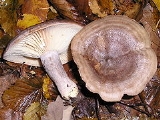
Lactarius

Encyclopedia
Lactarius is a genus
of mushroom
-producing fungi. The genus, collectively known commonly
as milk-caps, are characterized by the fact that they exude a milky fluid ('latex') if cut or damaged. Like the genus Russula
, with which they are grouped in the family Russulaceae
, their flesh has a distinctive brittle consistency.
Often the gills
are decurrent (starting to run down the stem) and the cap is depressed or even funnel-shaped when older. The stem and cap sometimes show 'strobicules' (or 'strobiculi'), which are flat-based shallow oval pits.
To identify to which of the roughly 400 Lactarius species a given specimen belongs, note whether the cap is bald/greasy or velvety or hairy/shaggy at the rim, particularly in young individuals. Also the initial colour of the milk (white, cream, orange, violet, ...) and the final colour on drying are determining characteristics.
The genus was described by Christian Hendrik Persoon
in 1797. Lactarius is derived from the Latin
lac 'milk
'.
spp., a group of about 20 woody, evergreen or semideciduous shrub species found in wide semi-arid areas from the Canary Islands throughout the Mediterranean region to the Caucasus. Cistus
species are obligate seeding, early colonizers that follow disturbance, particularly fire, in low maquis-type Mediterranean ecosystems, rendering their ectomycorrhizal ecology particularly intriguing.
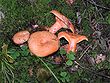 This group of mushrooms has orange or red milk and carrot-orange coloration, in many cases becoming flecked with green or blue-green with age. They are all generally considered to be edible and tasty, the appetizingly named Lactarius deliciosus reputedly being much better than the others. They grow in coniferous woods.
L. deliciosus is the only one with an English name: 'saffron milk-cap'. It is found under pine or spruce. L. deterrimus was formerly considered to be a variety of L. deliciosus and is distinguished by the milk turning wine-red on drying - but only after up to 30 minutes. L. salmonicolor is associated with spruce and remains a pure orange, unlike the other two which discolour green.
 The milk of this mushroom emerges white but immediately changes to a deep yellow colour. The top of the cap is a pinkish red with concentric zoning on a background showing yellow tints. It is common under broad-leaved trees, especially oak. There are conflicting reports as to its edibility.
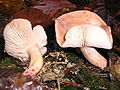 This flesh-coloured Lactarius is closely related to L. chrysorrheus, and again the milk is initially white and turns yellow, but only after several seconds. To allow the milk to contact the air this is best tested on a paper tissue (a cloth handkerchief is liable to be permanently stained).
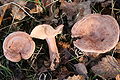 L. quietus, which is commonly found under oak trees, is often thought to be a non-descript mushroom, and in fact that is the significance of its Latin epithet quietus. It has a distinctive smell said to be of bedbugs or of wet laundry. The milk goes a little cream but does not change further.
Genus
In biology, a genus is a low-level taxonomic rank used in the biological classification of living and fossil organisms, which is an example of definition by genus and differentia...
of mushroom
Mushroom
A mushroom is the fleshy, spore-bearing fruiting body of a fungus, typically produced above ground on soil or on its food source. The standard for the name "mushroom" is the cultivated white button mushroom, Agaricus bisporus; hence the word "mushroom" is most often applied to those fungi that...
-producing fungi. The genus, collectively known commonly
Common name
A common name of a taxon or organism is a name in general use within a community; it is often contrasted with the scientific name for the same organism...
as milk-caps, are characterized by the fact that they exude a milky fluid ('latex') if cut or damaged. Like the genus Russula
Russula
Around 750 worldwide species of mycorrhizal mushrooms compose the genus Russula. They are typically common, fairly large, and brightly colored - making them one of the most recognizable genera among mycologists and mushroom collectors...
, with which they are grouped in the family Russulaceae
Russulaceae
The Russulaceae are a family of fungi in the order Russulales. According to a 2008 estimate, the family contains 1243 species. Its species typically have fruit bodies with friable, chalk-like stalks, that break with a distinct crack, somewhat like a carrot but with porous flesh...
, their flesh has a distinctive brittle consistency.
Often the gills
Gill (mushroom)
A lamella, or gill, is a papery hymenophore rib under the cap of some mushroom species, most often but not always agarics. The gills are used by the mushrooms as a means of spore dispersal, and are important for species identification...
are decurrent (starting to run down the stem) and the cap is depressed or even funnel-shaped when older. The stem and cap sometimes show 'strobicules' (or 'strobiculi'), which are flat-based shallow oval pits.
To identify to which of the roughly 400 Lactarius species a given specimen belongs, note whether the cap is bald/greasy or velvety or hairy/shaggy at the rim, particularly in young individuals. Also the initial colour of the milk (white, cream, orange, violet, ...) and the final colour on drying are determining characteristics.
The genus was described by Christian Hendrik Persoon
Christian Hendrik Persoon
Christiaan Hendrik Persoon was a mycologist who made additions to Linnaeus' mushroom taxonomy.-Early life:...
in 1797. Lactarius is derived from the Latin
Latin
Latin is an Italic language originally spoken in Latium and Ancient Rome. It, along with most European languages, is a descendant of the ancient Proto-Indo-European language. Although it is considered a dead language, a number of scholars and members of the Christian clergy speak it fluently, and...
lac 'milk
Milk
Milk is a white liquid produced by the mammary glands of mammals. It is the primary source of nutrition for young mammals before they are able to digest other types of food. Early-lactation milk contains colostrum, which carries the mother's antibodies to the baby and can reduce the risk of many...
'.
Ecology
Lactarius is one of the most prominent genera of ectomycorrhizal fungi. With more than 400 species described worldwide, Lactarius taxa play a significant role as late-stage colonizers of trees and shrubs in a vast range of ecosystems, from boreal coniferous forests to temperate Mediterranean-type maquis. An interesting case is that of the strict association of selected Lactarius species - such as L. tesquorum and L. cistophilus - with CistusCistus
Cistus is a genus of flowering plants in the rockrose family Cistaceae, containing about 20 species . They are perennial shrubs found on dry or rocky soils throughout the Mediterranean region, from Morocco and Portugal through to the Middle East, and also on the Canary Islands...
spp., a group of about 20 woody, evergreen or semideciduous shrub species found in wide semi-arid areas from the Canary Islands throughout the Mediterranean region to the Caucasus. Cistus
Cistus
Cistus is a genus of flowering plants in the rockrose family Cistaceae, containing about 20 species . They are perennial shrubs found on dry or rocky soils throughout the Mediterranean region, from Morocco and Portugal through to the Middle East, and also on the Canary Islands...
species are obligate seeding, early colonizers that follow disturbance, particularly fire, in low maquis-type Mediterranean ecosystems, rendering their ectomycorrhizal ecology particularly intriguing.
A selection of well-known European species
- Lactarius turpisLactarius turpisLactarius turpis is commonly known as the Ugly Milk-cap in English. It is found naturally in Europe and Siberia, and has been introduced to Australia and New Zealand...
- ugly milk-cap - Lactarius torminosusLactarius torminosusLactarius torminosus, commonly known as the woolly milkcap or the bearded milkcap, is a large basidiomycete fungus in the genus Lactarius. It is found in the United Kingdom, Northern Europe, and is common in North America, where it grows in mixed forests in a mycorrhizal association with various...
- woolly milk-cap - Lactarius piperatusLactarius piperatusLactarius piperatus, commonly known as the peppery milk-cap is a semi-edible basidiomycete fungus of the genus Lactarius. Despite being edible, it is not recommended due to its poor taste, though can be used as seasoning when dried. The fruiting body is a creamy-white mushroom which is...
- peppery milk-cap - Lactarius uvidusLactarius uvidusLactarius uvidus is a European and North American "milk-cap" mushroom, of which the milk turns violet when the flesh is damaged. The fungi generally identified as L. uvidus are part of a complex of closely related species and varieties which are difficult to delimit definitively, .It gives its...
Section Deliciosi
- Lactarius deliciosusLactarius deliciosusLactarius deliciosus, commonly known as the Saffron milk cap, Red pine mushroom, is one of the best known members of the large milk-cap genus Lactarius in the order Russulales...
- Lactarius deterrimusLactarius deterrimusLactarius deterrimus is a mushroom closely related to Lactarius deliciosus. The common name for this fungus is False saffron milk-cap, it's also known as Bitterer Milchling.-Taxonomy:...
- Lactarius salmonicolor
L. deliciosus is the only one with an English name: 'saffron milk-cap'. It is found under pine or spruce. L. deterrimus was formerly considered to be a variety of L. deliciosus and is distinguished by the milk turning wine-red on drying - but only after up to 30 minutes. L. salmonicolor is associated with spruce and remains a pure orange, unlike the other two which discolour green.
Lactarius chrysorrheus
Lactarius decipiens
Lactarius quietus
External links
- North American species of Lactarius by L. R. Hesler and Alexander H. Smith, 1979. (Full text of monograph.)
- Russulales News