

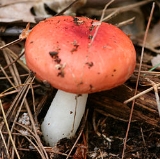
Russula

Encyclopedia
Around 750 worldwide species of mycorrhizal mushrooms compose the genus Russula. They are typically common, fairly large, and brightly colored - making them one of the most recognizable genera among mycologists and mushroom collectors. Their distinguishing characteristics include a white to dark yellow spore print
, brittle free white gills
, and an absence of partial veil
or volva
tissue on the stem. Members of the related Lactarius
genus have similar characteristics but emit a milky latex when their gills are broken. The genus was described by Christian Hendrik Persoon
in 1796.
Russula means reddish.
While it is relatively easy to identify a sample mushroom as belonging to this genus, it is a significant challenge to distinguish member species of Russula. This task often requires microscopic characteristics, and subtle subjective distinctions, such as the difference between a mild to bitter and a mild to acrid flavor. Moreover the exact phylogenetic relationships of these mushrooms have yet to be resolved in the professional mycological community, and may ultimately depend on DNA sequencing
analysis.
The following characteristics are often important in identifying individual species:
Despite the difficulty in positively identifying collected specimens, the possibility to spot the toxic species by their acrid taste makes some of the mild species, such as R. cyanoxantha
and R. vesca
, popular edible mushrooms. As far as is known, no species of Russula is deadly poisonous and mild-tasting ones are all edible. Note that this rule applies only to Russulas and not to other types of mushrooms!
see
http://www.mtsn.tn.it/russulales-news/pdf/macro_form.pdf
, R. sardonia
and R. nobilis. However, rhabdomyolysis
was seen after consumption of R. subnigricans
in Taiwan. Several active agents have been isolated; one designated russuphelin A by researchers in Japan.
Spore print
thumb|300px|right|Making a spore print of the mushroom Volvariella volvacea shown in composite: mushroom cap laid on white and dark paper; cap removed after 24 hours showing pinkish-tan spore print...
, brittle free white gills
Gill (mushroom)
A lamella, or gill, is a papery hymenophore rib under the cap of some mushroom species, most often but not always agarics. The gills are used by the mushrooms as a means of spore dispersal, and are important for species identification...
, and an absence of partial veil
Partial veil
thumb|150px|right|Developmental stages of [[Agaricus campestris]] showing the role and evolution of a partial veilPartial veil is a mycological term used to describe a temporary structure of tissue found on the fruiting bodies of some basidiomycete fungi, typically agarics...
or volva
Universal veil
In mycology, a universal veil is a temporary membranous tissue that fully envelops immature fruiting bodies of certain gilled mushrooms. The developing Caesar's mushroom , for example, which may resemble a small white sphere at this point, is protected by this structure...
tissue on the stem. Members of the related Lactarius
Lactarius
Lactarius is a genus of mushroom-producing fungi. The genus, collectively known commonly as milk-caps, are characterized by the fact that they exude a milky fluid if cut or damaged...
genus have similar characteristics but emit a milky latex when their gills are broken. The genus was described by Christian Hendrik Persoon
Christian Hendrik Persoon
Christiaan Hendrik Persoon was a mycologist who made additions to Linnaeus' mushroom taxonomy.-Early life:...
in 1796.
Russula means reddish.
Identification
Like the genus Lactarius, Russulas have a distinctive flesh consistency, which is also reflected in the appearance of the gills and stipe, and normally makes them immediately recognizable. They have no trace of a veil (no ring, or veil remnants on the cap). The gills are brittle except in a few cases, and cannot be bent parallel with the cap without breaking. The spore powder varies from white to cream, or even orange.While it is relatively easy to identify a sample mushroom as belonging to this genus, it is a significant challenge to distinguish member species of Russula. This task often requires microscopic characteristics, and subtle subjective distinctions, such as the difference between a mild to bitter and a mild to acrid flavor. Moreover the exact phylogenetic relationships of these mushrooms have yet to be resolved in the professional mycological community, and may ultimately depend on DNA sequencing
DNA sequencing
DNA sequencing includes several methods and technologies that are used for determining the order of the nucleotide bases—adenine, guanine, cytosine, and thymine—in a molecule of DNA....
analysis.
The following characteristics are often important in identifying individual species:
- the exact colour of the spore powder (white/cream/ochre),
- the taste (mild/bitter/acrid),
- colour changes in the flesh,
- the distance from the centre to which the cap skin can be pulled off: (peeling percentage).
- cap colour (but this is often very variable within one species),
- reaction of the flesh to ferrous sulphateIron(II) sulfateIron sulfate or ferrous sulfate is the chemical compound with the formula FeSO4. Known since ancient times as copperas and as green vitriol, the blue-green heptahydrate is the most common form of this material...
(FeSO4), formalin, alkalis, and other chemicals, - ornamentation of the spores, and
- other microscopic characteristics, such as the appearance of the cystidiaCystidiumA cystidium is a relatively large cell found on the hymenium of a basidiomycete , often between clusters of basidia. Since cystidia have highly varied and distinct shapes that are often unique to a particular species or genus, they are a useful micromorphological characteristic in the...
in various mounting reagents.
Despite the difficulty in positively identifying collected specimens, the possibility to spot the toxic species by their acrid taste makes some of the mild species, such as R. cyanoxantha
Russula cyanoxantha
Russula cyanoxantha, synonymous with R. xyanoxantha, commonly known as the charcoal burner, is a basidiomycete mushroom, distinguished from most other members of the Russula genus by the fact that its gills do not split, but are soft and flexible. It is one of the most common species of Russula in...
and R. vesca
Russula vesca
Russula vesca, known by the common names of bare-toothed Russula or the flirt, is a basidiomycete mushroom of the genus Russula.- Taxonomy :...
, popular edible mushrooms. As far as is known, no species of Russula is deadly poisonous and mild-tasting ones are all edible. Note that this rule applies only to Russulas and not to other types of mushrooms!
see
http://www.mtsn.tn.it/russulales-news/pdf/macro_form.pdf
Toxicity
The main pattern of toxicity seen among Russula species to date has been gastrointestinal symptoms in those with a bitter taste when eaten raw or undercooked; many of these are red-capped species such as R. emeticaRussula emetica
Russula emetica, commonly known as the sickener, is a basidiomycete mushroom of the genus Russula, one of many species with a predominantly red-coloured cap and white gills and stalk. It gets its common name from its inedibility, as it causes vomiting and diarrhea when consumed...
, R. sardonia
Russula sardonia
Russula sardonia, commonly known as the primrose brittlegill, is a mushroom of the Russula genus, which are commonly known as brittlegills. The fruiting body, or mushroom, is a reddish-purple, the colour of blackberry juice, and is found in coniferous woodland in summer and autumn...
and R. nobilis. However, rhabdomyolysis
Rhabdomyolysis
Rhabdomyolysis is a condition in which damaged skeletal muscle tissue breaks down rapidly. Breakdown products of damaged muscle cells are released into the bloodstream; some of these, such as the protein myoglobin, are harmful to the kidneys and may lead to kidney failure...
was seen after consumption of R. subnigricans
Russula subnigricans
Russula subnigricans is a basidiomycete mushroom of the genus Russula found in China and North America. It has been responsible for mushroom poisoning in Taiwan. The effect was a serious one, rhabdomyolysis. Several active agents have been isolated; one designated russuphelin A by researchers in...
in Taiwan. Several active agents have been isolated; one designated russuphelin A by researchers in Japan.
Species
- For more examples, see the List of Russula species.
 Russula cyanoxanthaRussula cyanoxanthaRussula cyanoxantha, synonymous with R. xyanoxantha, commonly known as the charcoal burner, is a basidiomycete mushroom, distinguished from most other members of the Russula genus by the fact that its gills do not split, but are soft and flexible. It is one of the most common species of Russula in...
- one of the largest species, with blue to greenish cap, mild taste and white, greasy gills. Russula emeticaRussula emeticaRussula emetica, commonly known as the sickener, is a basidiomycete mushroom of the genus Russula, one of many species with a predominantly red-coloured cap and white gills and stalk. It gets its common name from its inedibility, as it causes vomiting and diarrhea when consumed...
- so acrid it can be dried and powdered to make a chilli pepper substitute;- Russula subnigricansRussula subnigricansRussula subnigricans is a basidiomycete mushroom of the genus Russula found in China and North America. It has been responsible for mushroom poisoning in Taiwan. The effect was a serious one, rhabdomyolysis. Several active agents have been isolated; one designated russuphelin A by researchers in...
- a poisonous mushroom causing rhabdomyolysisRhabdomyolysisRhabdomyolysis is a condition in which damaged skeletal muscle tissue breaks down rapidly. Breakdown products of damaged muscle cells are released into the bloodstream; some of these, such as the protein myoglobin, are harmful to the kidneys and may lead to kidney failure...
in TaiwanTaiwanTaiwan , also known, especially in the past, as Formosa , is the largest island of the same-named island group of East Asia in the western Pacific Ocean and located off the southeastern coast of mainland China. The island forms over 99% of the current territory of the Republic of China following...
. - Russula virescensRussula virescensRussula virescens is a basidiomycete mushroom of the genus Russula, and is commonly known as the green-cracking Russula, the quilted green Russula, or the green brittlegill. It can be recognized by its distinctive pale green cap covered with darker green patches, its crowded white gills, and its...
- an excellent mushroom, easily recognizable by the green and distinctly crackled cap cuticle;  Russula xerampelinaRussula xerampelinaRussula xerampelina, also commonly known as the crab brittlegill or the shrimp mushroom, is a basidiomycete mushroom of the brittlegill genus Russula. Two subspecies are recognised. The fruiting bodies appear in coniferous woodlands in autumn in northern Europe and North America. Their caps are...
- an edible russula that smells and tastes like shrimp or seafood;
External links
- Russulales News http://www.mtsn.tn.it/russulales-news
- Genus Russula at Mushroom Expert.com http://www.mushroomexpert.com/russula.html