

Coprinus comatus

Encyclopedia
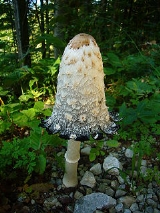
Coprinus comatus, the shaggy ink cap, lawyer's wig, or shaggy mane, is a common fungus
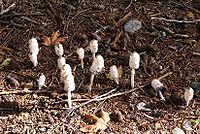
often seen growing on lawns, along gravel roads and waste areas. The young fruit bodies
first appear as white cylinders emerging from the ground, then the bell-shaped caps
open out. The caps are white, and covered with scales—this is the origin of the common name
s of the fungus. The gills beneath the cap are white, then pink, then turn black and secrete a black liquid filled with spore
s (hence the “ink cap” name). This mushroom is unusual because it will turn black and dissolve itself in a matter of hours after being picked or depositing spores.
When young it is an excellent edible mushroom
provided that it is eaten soon after being collected (it keeps very badly because of the autodigestion of its gills and cap). If long-term storage is desired, sauteing or simmering until done will allow the mushrooms to be stored in a refrigerator for several days or frozen. Processing must be done whether for eating or storage within four to six hours of harvest to prevent undesirable changes to the mushroom. The species is cultivated
in China as food.
in 1780 as Agaricus comatus, before being given its current binomial name in 1797 by Christiaan Hendrik Persoon. Its specific name derives from coma, or “hair”, hence comatus, “hairy” or “shaggy”.
Coprinus comatus is the type species for the genus Coprinus
. This genus was formerly considered to be a large one with well over 100 species. However, molecular analysis of DNA sequences showed that the former species belonged in two families, the Agaricaceae
and the Psathyrellaceae
. Coprinus comatus is the best known of the true Coprinus. Adding to its unusual features, a recent study has found the shaggy ink cap kills nematode
species Panagrellus redivivus
and Meloidogyne arenaria
. See also nematophagous fungus
.
Other common names include lawyer's wig, and shaggy mane.
is black-brown and the spores measure 10–13 × 6.5–8 µm
. The flesh is white and the taste mild.
issued by Australia Post
in 1981.
.
The agent responsible for unpleasant symptoms when consumed with alcohol, coprine, which is found in Coprinopsis atramentaria
, has not been isolated from C. comatus.
Fungus
A fungus is a member of a large group of eukaryotic organisms that includes microorganisms such as yeasts and molds , as well as the more familiar mushrooms. These organisms are classified as a kingdom, Fungi, which is separate from plants, animals, and bacteria...
often seen growing on lawns, along gravel roads and waste areas. The young fruit bodies
Basidiocarp
In fungi, a basidiocarp, basidiome or basidioma , is the sporocarp of a basidiomycete, the multicellular structure on which the spore-producing hymenium is borne. Basidiocarps are characteristic of the hymenomycetes; rusts and smuts do not produce such structures...
first appear as white cylinders emerging from the ground, then the bell-shaped caps
Pileus (mycology)
The pileus is the technical name for the cap, or cap-like part, of a basidiocarp or ascocarp that supports a spore-bearing surface, the hymenium. The hymenium may consist of lamellae, tubes, or teeth, on the underside of the pileus...
open out. The caps are white, and covered with scales—this is the origin of the common name
Common name
A common name of a taxon or organism is a name in general use within a community; it is often contrasted with the scientific name for the same organism...
s of the fungus. The gills beneath the cap are white, then pink, then turn black and secrete a black liquid filled with spore
Spore
In biology, a spore is a reproductive structure that is adapted for dispersal and surviving for extended periods of time in unfavorable conditions. Spores form part of the life cycles of many bacteria, plants, algae, fungi and some protozoa. According to scientist Dr...
s (hence the “ink cap” name). This mushroom is unusual because it will turn black and dissolve itself in a matter of hours after being picked or depositing spores.
When young it is an excellent edible mushroom
Edible mushroom
Edible mushrooms are the fleshy and edible fruiting bodies of several species of fungi. Mushrooms belong to the macrofungi, because their fruiting structures are large enough to be seen with the naked eye. They can appear either below ground or above ground where they may be picked by hand...
provided that it is eaten soon after being collected (it keeps very badly because of the autodigestion of its gills and cap). If long-term storage is desired, sauteing or simmering until done will allow the mushrooms to be stored in a refrigerator for several days or frozen. Processing must be done whether for eating or storage within four to six hours of harvest to prevent undesirable changes to the mushroom. The species is cultivated
Fungiculture
Fungiculture is the process of producing food, medicine, and other products by the cultivation of mushrooms and other fungi.The word is also commonly used to refer to the practice of cultivating fungi by leafcutter ants, termites, ambrosia beetles, and marsh periwinkles.- Introduction :Mushrooms...
in China as food.
Taxonomy
The shaggy ink cap was first described by Danish naturalist Otto Friedrich MüllerOtto Friedrich Müller
Otto Friedrich Müller, also Mueller was a Danish naturalist.-Biography:Müller was born in Copenhagen. He was educated for the church, became tutor to a young nobleman, and after several years' travel with him settled in Copenhagen in 1767, and married a lady of wealth.His first important works,...
in 1780 as Agaricus comatus, before being given its current binomial name in 1797 by Christiaan Hendrik Persoon. Its specific name derives from coma, or “hair”, hence comatus, “hairy” or “shaggy”.
Coprinus comatus is the type species for the genus Coprinus
Coprinus
Coprinus is a small genus of mushrooms consisting of Coprinus comatus and several of its close relatives. Until 2001, Coprinus was a large genus consisting of all agaric species in which the lamellae autodigested to release their spores...
. This genus was formerly considered to be a large one with well over 100 species. However, molecular analysis of DNA sequences showed that the former species belonged in two families, the Agaricaceae
Agaricaceae
The Agaricaceae are a family of basidiomycete fungi and includes the genus Agaricus, as well as basidiomycetes previously classified in the families Tulostomataceae, Lepiotaceae, and Lycoperdaceae. The genus contains 85 genera and 1340 species.-Genera:...
and the Psathyrellaceae
Psathyrellaceae
The Psathyrellaceae are a family of dark-spored agarics that generally have rather soft, fragile fruiting bodies, and are characterized by black or dark brown, rarely reddish, or even pastel colored spore prints. About 50% of the species produce fruiting bodies that dissolve into ink-like ooze...
. Coprinus comatus is the best known of the true Coprinus. Adding to its unusual features, a recent study has found the shaggy ink cap kills nematode
Nematode
The nematodes or roundworms are the most diverse phylum of pseudocoelomates, and one of the most diverse of all animals. Nematode species are very difficult to distinguish; over 28,000 have been described, of which over 16,000 are parasitic. It has been estimated that the total number of nematode...
species Panagrellus redivivus
Panagrellus redivivus
The free-living nematode Panagrellus redivivus is known to many aquarium enthusiasts and fishkeepers as the microworm. It is a tiny roundworm used as the first food for minuscule newly-hatched fish, such as the popular pet fish betta...
and Meloidogyne arenaria
Meloidogyne arenaria
Meloidogyne arenaria is a plant pathogenic nematode.- External links :*...
. See also nematophagous fungus
Nematophagous fungus
Nematophagous fungi are carnivorous fungi specialized in trapping and digesting nematodes. Around 160 species are known. There exist both species that live inside the nematodes from the beginning and others that catch them mostly with glue traps or in rings, some of which constrict on contact. Some...
.
Other common names include lawyer's wig, and shaggy mane.
Description
The shaggy ink cap is easily recognizable from its almost cylindical cap which initially covers most of its stem. The cap is mostly white with shaggy scales, which are more pale brown at the apex. The free gills change rapidly from white to pink, then to black. It is deliquescent. The stipe has a loose ring and measures 10–37 cm (3.9–14.6 in) high by 1–2.5 cm (0.393700787401575–0.984251968503937 in) diameter. Microscopically it lacks pleurocystidia. The spore printSpore print
thumb|300px|right|Making a spore print of the mushroom Volvariella volvacea shown in composite: mushroom cap laid on white and dark paper; cap removed after 24 hours showing pinkish-tan spore print...
is black-brown and the spores measure 10–13 × 6.5–8 µm
Micrometre
A micrometer , is by definition 1×10⁻⁶ of a meter .In plain English, it means one-millionth of a meter . Its unit symbol in the International System of Units is μm...
. The flesh is white and the taste mild.
Distribution and habitat
It grows in groups in places which are often unexpected, such as green areas in towns. It occurs widely in grasslands and meadows in Europe and North America. It appears to have been introduced to Australia, New Zealand and Iceland. In Australia the species is sufficiently common to have been featured on a postage stampPostage stamp
A postage stamp is a small piece of paper that is purchased and displayed on an item of mail as evidence of payment of postage. Typically, stamps are made from special paper, with a national designation and denomination on the face, and a gum adhesive on the reverse side...
issued by Australia Post
Australia Post
Australia Post is the trading name of the Australian Government-owned Australian Postal Corporation .-History:...
in 1981.
Growth
The left image below shows a young mushroom. The second image shows the same specimen 24 hours later. "Ink" can be seen dripping from the gills.Edibility
The young mushrooms, before the gills start to turn black, are edible. It can sometimes be used in mushroom soup with parasol mushroomParasol mushroom
The parasol mushroom is a basidiomycete fungus with a large, prominent fruiting body resembling a lady's parasol. It is a fairly common species on well-drained soils. It is found solitary or in groups and fairy rings in pastures and occasionally in woodland...
.
The agent responsible for unpleasant symptoms when consumed with alcohol, coprine, which is found in Coprinopsis atramentaria
Coprinopsis atramentaria
Coprinopsis atramentaria, commonly known as the common ink cap or inky cap, is an edible mushroom found in Europe and North America. Previously known as Coprinus atramentarius, it is the second best known ink cap and previous member of the genus Coprinus after C. comatus...
, has not been isolated from C. comatus.
External links
- Mushroom-Collecting.com: Coprinus comatus
- AmericanMushrooms.com: Best Edible Wild Mushrooms
- “The Genus Coprinus: The Inky Caps” by Michael Kuo, MushroomExpert.com, February, 2005.
- All about Inkcaps: Coprinus site of Kees Uljé – taxonomy and keys to coprinoid fungi.
- Fungus of the Month for May 2004: Coprinus comatus, the shaggy mane by Tom Volk, TomVolkFungi.net.
- “Coprinus comatus: The Shaggy Mane” by Michael Kuo, MushroomExpert.com, September, 2001.
- “California Fungi: Coprinus comatus”, MykoWeb.com.
- “Wild About Mushrooms: Shaggy Mane Mushroom” by Louise Freedman, MykoWeb.com.
- “Coprinus comatus” by Robert Sasata, Healing-Mushrooms.net, September, 2007.
- Medicinal Mushroom Society