

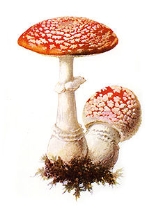
Amanita

Encyclopedia
The genus
Amanita contains about 600 species
of agarics including some of the most toxic known mushrooms found worldwide. This genus is responsible for approximately 95% of the fatalities resulting from mushroom poisoning
, with the death cap
accounting for about 50% on its own. The most potent toxin present in these mushrooms is α-amanitin.
The genus also contains many edible mushrooms, but mycologists generally discourage amateur mushroom hunters from selecting these for human consumption. Nonetheless, in some cultures, the larger local edible species of Amanita are mainstays of the markets in the local growing season. Samples of this are Amanita zambiana and other fleshy species in central Africa
, A. basii and similar species in Mexico
, A. caesarea in Europe
, and A. chepangiana in South-East Asia. Other species are used for colouring sauces, such as the red A. jacksonii with a range from eastern Canada
to eastern Mexico
.
Many species are of unknown edibility, especially in countries such as Australia
where many fungi are little-known. Understandably, this is not a genus that lends itself to safe experimentation.
.
The genus Amanita was first published with its current meaning by Christian Hendrik Persoon
in 1797. Under the International Code of Botanical Nomenclature, Persoon's concept of Amanita, with Amanita muscaria
(L.) Pers. as the type species, has been officially conserved against the older Amanita Boehm (1760) which is considered a synonym of Agaricus
L.
s which can cause liver failure and death. These include the death cap A. phalloides, species known as destroying angels including A. virosa
, A. bisporigera
and A. ocreata
and the fool's mushroom A. verna
.
More recently, a series in the subgenus Lepidella have been found to cause acute renal failure, including A. smithiana
of Northwestern North America, A. pseudoporphyria of Japan, and A. proxima of southern Europe.
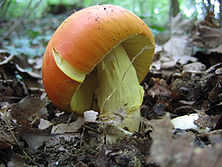 Although there are a few species of edible amanita, many fungi experts advise against eating a member of amanita unless the species is known with absolute certainty. Because so many species within this genus
are so deadly toxic, if a specimen is identified incorrectly, consumption may cause extreme sickness and possibly death.
Edible species of Amanita include Amanita fulva
(grisette), Amanita vaginata
, Amanita calyptrata
(coccoli), Amanita crocea
, and Amanita rubescens (blusher).
Inedible species of Amanita include Amanita albocreata
(Ringless Panther), Amanita atkinsoniana
, Amanita citrina, Amanita daucipes
, Amanita excelsa, Amanita flavoconia
, Amanita franchetti, Amanita jacksonii
(American Caesar's Mushroom)), Amanita longipes, Amanita magniverrucata
, Amanita onusta
, Amanita rhopalopus, Amanita silvicola, Amanita sinicoflava, Amanita spreta, and Amanita volvata.
Poisonous species include Amanita brunnescens
, Amanita cecilae, Amanita cokeri
(Coker's Amanita), Amanita crenulata, Amanita farinosa
(Eastern American Floury Amanita), Amanita flavorubescens, Amanita frostiana
, Amanita pantherina (Panther cap), and Amanita porphyria
.
Deadly poisonous species include Amanita abrupta
, Amanita arocheae
, Amanita bisporigera
(Eastern NA Destroying Angel), Amanita exitialis
(Guangzhou Destroying Angel), Amanita magnivelaris
, Amanita ocreata
(Western NA Destroying Angel), Amanita phalloides (Death Cap), Amanita smithiana
, Amanita subjunquillea
(East Asian Death Cap), Amanita verna
(Fool's Mushroom), and Amanita virosa
(European Destroying Angel)
Genus
In biology, a genus is a low-level taxonomic rank used in the biological classification of living and fossil organisms, which is an example of definition by genus and differentia...
Amanita contains about 600 species
Species
In biology, a species is one of the basic units of biological classification and a taxonomic rank. A species is often defined as a group of organisms capable of interbreeding and producing fertile offspring. While in many cases this definition is adequate, more precise or differing measures are...
of agarics including some of the most toxic known mushrooms found worldwide. This genus is responsible for approximately 95% of the fatalities resulting from mushroom poisoning
Mushroom poisoning
Mushroom poisoning refers to harmful effects from ingestion of toxic substances present in a mushroom. These symptoms can vary from slight gastrointestinal discomfort to death. The toxins present are secondary metabolites produced in specific biochemical pathways in the fungal cells...
, with the death cap
Death cap
Amanita phalloides , commonly known as the death cap, is a deadly poisonous basidiomycete fungus, one of many in the genus Amanita. Widely distributed across Europe, A. phalloides forms ectomycorrhizas with various broadleaved trees. In some cases, death cap has been introduced to new regions with...
accounting for about 50% on its own. The most potent toxin present in these mushrooms is α-amanitin.
The genus also contains many edible mushrooms, but mycologists generally discourage amateur mushroom hunters from selecting these for human consumption. Nonetheless, in some cultures, the larger local edible species of Amanita are mainstays of the markets in the local growing season. Samples of this are Amanita zambiana and other fleshy species in central Africa
Africa
Africa is the world's second largest and second most populous continent, after Asia. At about 30.2 million km² including adjacent islands, it covers 6% of the Earth's total surface area and 20.4% of the total land area...
, A. basii and similar species in Mexico
Mexico
The United Mexican States , commonly known as Mexico , is a federal constitutional republic in North America. It is bordered on the north by the United States; on the south and west by the Pacific Ocean; on the southeast by Guatemala, Belize, and the Caribbean Sea; and on the east by the Gulf of...
, A. caesarea in Europe
Europe
Europe is, by convention, one of the world's seven continents. Comprising the westernmost peninsula of Eurasia, Europe is generally 'divided' from Asia to its east by the watershed divides of the Ural and Caucasus Mountains, the Ural River, the Caspian and Black Seas, and the waterways connecting...
, and A. chepangiana in South-East Asia. Other species are used for colouring sauces, such as the red A. jacksonii with a range from eastern Canada
Canada
Canada is a North American country consisting of ten provinces and three territories. Located in the northern part of the continent, it extends from the Atlantic Ocean in the east to the Pacific Ocean in the west, and northward into the Arctic Ocean...
to eastern Mexico
Mexico
The United Mexican States , commonly known as Mexico , is a federal constitutional republic in North America. It is bordered on the north by the United States; on the south and west by the Pacific Ocean; on the southeast by Guatemala, Belize, and the Caribbean Sea; and on the east by the Gulf of...
.
Many species are of unknown edibility, especially in countries such as Australia
Australia
Australia , officially the Commonwealth of Australia, is a country in the Southern Hemisphere comprising the mainland of the Australian continent, the island of Tasmania, and numerous smaller islands in the Indian and Pacific Oceans. It is the world's sixth-largest country by total area...
where many fungi are little-known. Understandably, this is not a genus that lends itself to safe experimentation.
Taxonomy
The name is possibly derived from Amanon, a mountain in CiliciaCilicia
In antiquity, Cilicia was the south coastal region of Asia Minor, south of the central Anatolian plateau. It existed as a political entity from Hittite times into the Byzantine empire...
.
The genus Amanita was first published with its current meaning by Christian Hendrik Persoon
Christian Hendrik Persoon
Christiaan Hendrik Persoon was a mycologist who made additions to Linnaeus' mushroom taxonomy.-Early life:...
in 1797. Under the International Code of Botanical Nomenclature, Persoon's concept of Amanita, with Amanita muscaria
Amanita muscaria
Amanita muscaria, commonly known as the fly agaric or fly amanita , is a poisonous and psychoactive basidiomycete fungus, one of many in the genus Amanita...
(L.) Pers. as the type species, has been officially conserved against the older Amanita Boehm (1760) which is considered a synonym of Agaricus
Agaricus
Agaricus is a large and important genus of mushrooms containing both edible and poisonous species, with possibly over 300 members worldwide...
L.
Toxicity
Several members of the section Phalloidieae are notable for their toxicity, containing toxins known as amatoxinAmatoxin
Amatoxins are a subgroup of at least eight toxic compounds found in several genera of poisonous mushrooms, most notably Amanita phalloides and several other members of the genus Amanita, as well as some Conocybe, Galerina and Lepiota mushroom species.-Structure:The compounds have a similar...
s which can cause liver failure and death. These include the death cap A. phalloides, species known as destroying angels including A. virosa
Amanita virosa
Amanita virosa, commonly known as the European destroying angel, is a deadly poisonous basidiomycete fungus, one of many in the genus Amanita. Occurring in Europe, A. virosa associates with various deciduous and coniferous trees...
, A. bisporigera
Destroying angel
The name destroying angel applies to several similar, closely related species of deadly all-white mushrooms in the genus Amanita. They are Amanita bisporigera and A. ocreata in eastern and western North America, and A. virosa in Europe. Another very similar species, A. verna or fool's mushroom was...
and A. ocreata
Amanita ocreata
Amanita ocreata, commonly known as the death angel, destroying angel, angel of death or more precisely Western North American destroying angel, is a deadly poisonous basidiomycete fungus, one of many in the genus Amanita. Occurring in the Pacific Northwest and California floristic provinces of...
and the fool's mushroom A. verna
Amanita verna
Amanita verna, commonly known as the fool's mushroom, Destroying angel or the mushroom fool, is a deadly poisonous basidiomycete fungus, one of many in the genus Amanita. Occurring in Europe in spring, A. verna associates with various deciduous and coniferous trees...
.
More recently, a series in the subgenus Lepidella have been found to cause acute renal failure, including A. smithiana
Amanita smithiana
Amanita smithiana, also known as Smith's Amanita, is a species of agaric found on soil in coniferous and broadleaved woodland in the Pacific Northwest of North America...
of Northwestern North America, A. pseudoporphyria of Japan, and A. proxima of southern Europe.
Edibility
Genus
In biology, a genus is a low-level taxonomic rank used in the biological classification of living and fossil organisms, which is an example of definition by genus and differentia...
are so deadly toxic, if a specimen is identified incorrectly, consumption may cause extreme sickness and possibly death.
Edible species of Amanita include Amanita fulva
Amanita fulva
Amanita fulva, commonly called the tawny grisette, is a basidiomycete mushroom of the genus Amanita. It is found frequently in deciduous and coniferous forests of Europe, and possibly North America.-Taxonomy and naming:...
(grisette), Amanita vaginata
Amanita vaginata
Amanita vaginata, commonly known as the grisette, is an edible mushroom in the Amanitaceae family of fungi. Unlike many other Amanita mushrooms, A. vaginata lacks a ring on the stem. The cap is gray or brownish, in diameter, and has furrows around the edge that duplicate the gill pattern...
, Amanita calyptrata
Amanita lanei
Amanita lanei , also known as coccora or coccoli, is a white-spored mushroom that fruits naturally in the coastal forests of the western United States during the fall and winter...
(coccoli), Amanita crocea
Amanita crocea
Saffron Ringless Amanita is a species of Amanita widely distributed in Europe.-Description:* Cap: The cap is free of rings with the volva and has a diameter of 5 – 10 cm, yellow-orange in colour with an apricot tinge at the centre...
, and Amanita rubescens (blusher).
Inedible species of Amanita include Amanita albocreata
Amanita albocreata
Amanita albocreata, also called the ringless panther , is a species of fungus in the Amanitaceae family. It is commonly found in northeastern USA and southeastern Canada and elsewhere in North America. This species, that grows about 5 to 15 centimeters in length, is doubted to be fatally toxic...
(Ringless Panther), Amanita atkinsoniana
Amanita atkinsoniana
Amanita atkinsoniana is a species of fungus in the Amanitaceae family. It is found in the northeastern, southeastern, and southern United States as well as southern Canada, where it grows solitarily or in small groups on the ground in mixed woods. The fruit body is white to brownish, with caps that...
, Amanita citrina, Amanita daucipes
Amanita daucipes
Amanita daucipes is a species of fungus in the Amanitaceae family of the Agaricales order of mushrooms. Found exclusively in North America, the mushroom may be recognized in the field by the medium to large white caps with pale orange tints, and the dense covering of pale orange or reddish-brown...
, Amanita excelsa, Amanita flavoconia
Amanita flavoconia
Amanita flavoconia, commonly known as yellow patches, yellow wart, orange Amanita, or yellow-dust Amanita, is a species of mushroom in the family Amanitaceae. It has an orangish-yellow cap with yellowish-orange patches or warts, a yellowish-orange annulus, and a white to orange stem...
, Amanita franchetti, Amanita jacksonii
Amanita jacksonii
Amanita jacksonii is a species of fungus in the Amanitaceae family. It is a reddish-orange colored mushroom species extends from the Province of Quebec, Canada at least to the State of Hidalgo, Mexico. It was given its current name in 1984 by Canadian mycologist René Pomerleau...
(American Caesar's Mushroom)), Amanita longipes, Amanita magniverrucata
Amanita magniverrucata
Amanita magniverrucata is a species of agaric in the Amanitaceae family. First described scientifically by American mycologists Harry Delbert Thiers and Joseph Ammirati in 1982, it is mycorrhizal and associates with the tree Pinus radiata....
, Amanita onusta
Amanita onusta
Amanita onusta, commonly known as the loaded Lepidella or the gunpowder Lepidella, is a species of fungus in the Amanitaceae family of mushrooms. It is characterized by its small to medium-sized fruit bodies that have white to pale gray caps crowded with roughly conical, pyramidal, or irregular...
, Amanita rhopalopus, Amanita silvicola, Amanita sinicoflava, Amanita spreta, and Amanita volvata.
Poisonous species include Amanita brunnescens
Amanita brunnescens
Amanita brunnescens, also known as the brown American star-footed amanita or cleft-footed amanita is a native North American mushroom of the large genus Amanita. Originally presumed to be Amanita phalloides by renowned American mycologist Charles Horton Peck it was described and named by G. F....
, Amanita cecilae, Amanita cokeri
Amanita cokeri
Amanita cokeri, commonly known as Coker's Amanita, is a mushroom in the Amanitaceae family. The mushroom is poisonous. First described as Lepidella cokeri in 1928, it was transferred to the genus Amanita in 1940.-Description:...
(Coker's Amanita), Amanita crenulata, Amanita farinosa
Amanita farinosa
Amanita farinosa, also called Eastern American Floury Amanita, is a North American poisonous mushroom of the genus Amanita, a genus of fungi including some of the most deadly mushrooms, as well as notably psychedelic mushrooms.-Taxonomy:...
(Eastern American Floury Amanita), Amanita flavorubescens, Amanita frostiana
Amanita frostiana
Amanita frostiana, also known as Frost's Amanita, is a small fungi species of eastern U.S.A. and southeastern Canada. The mushroom varies in colours from yellow, red or reddish pink usually.-Physical description:...
, Amanita pantherina (Panther cap), and Amanita porphyria
Amanita porphyria
Amanita porphyria, also known as the Grey Veiled Amanita, is a fairly common, inedible basidiomycete mushroom of the genus Amanita found in Europe and North America.-Description:...
.
Deadly poisonous species include Amanita abrupta
Amanita abrupta
Amanita abrupta, commonly known as the abrupt-bulbed Lepidella, is a species of fungus in the Amanitaceae family of mushrooms. Named for the characteristic shape of its fruit bodies, this white Amanita has a slender stem, a cap covered with conical white warts, and an "abruptly enlarged" swollen base...
, Amanita arocheae
Amanita arocheae
Amanita arocheae, also known as the Latin American death cap is a mushroom of the large genus Amanita, which occurs in Central and South America. Deadly poisonous, it is a member of section phalloideae and related to the death cap A. phalloides. It is named after mycologist R. M. Aroche.It is...
, Amanita bisporigera
Amanita bisporigera
Amanita bisporigera is a deadly poisonous species of fungus in the Amanitaceae family. It is commonly known as the eastern North American destroying angel or the destroying angel, although it shares this latter name with three other lethal white Amanita species, A. ocreata, A. verna and...
(Eastern NA Destroying Angel), Amanita exitialis
Amanita exitialis
Amanita exitialis, also known as the Guangzhou destroying angel, is a mushroom of the large genus Amanita. It is distributed in eastern Asia, and probably also in India where it has been misidentified as A. verna. Deadly poisonous, it is a member of section Phalloideae and related to the death...
(Guangzhou Destroying Angel), Amanita magnivelaris
Amanita magnivelaris
Amanita magnivelaris, commonly known as the great felt skirt destroying angel, is a poisonous basidiomycete fungus, one of many in the genus Amanita. Originally described from Ithaca, New York, by Charles Horton Peck, it is found in New York state and southeastern Canada.-See also:*List of Amanita...
, Amanita ocreata
Amanita ocreata
Amanita ocreata, commonly known as the death angel, destroying angel, angel of death or more precisely Western North American destroying angel, is a deadly poisonous basidiomycete fungus, one of many in the genus Amanita. Occurring in the Pacific Northwest and California floristic provinces of...
(Western NA Destroying Angel), Amanita phalloides (Death Cap), Amanita smithiana
Amanita smithiana
Amanita smithiana, also known as Smith's Amanita, is a species of agaric found on soil in coniferous and broadleaved woodland in the Pacific Northwest of North America...
, Amanita subjunquillea
Amanita subjunquillea
Amanita subjunquillea, also known as the East Asian death cap is a mushroom of the large genus Amanita, which occurs in East and Southeast Asia. Deadly poisonous, it is a member of section phalloideae and related to the death cap A. phalloides.Initially little reported, the toxicity of A...
(East Asian Death Cap), Amanita verna
Amanita verna
Amanita verna, commonly known as the fool's mushroom, Destroying angel or the mushroom fool, is a deadly poisonous basidiomycete fungus, one of many in the genus Amanita. Occurring in Europe in spring, A. verna associates with various deciduous and coniferous trees...
(Fool's Mushroom), and Amanita virosa
Amanita virosa
Amanita virosa, commonly known as the European destroying angel, is a deadly poisonous basidiomycete fungus, one of many in the genus Amanita. Occurring in Europe, A. virosa associates with various deciduous and coniferous trees...
(European Destroying Angel)
External links
- Rodham E. Tuloss and Zhu-liang Yang's Amanita site – Comprehensive listing of the nearly 600 named Amanita species with photos and/or technical details on over 510 species.
- "The genus Amanita" by Michael Kuo, MushroomExpert.Com, March 2005.