
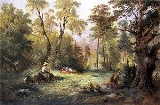
Mushroom hunting, mushrooming, mushroom picking, and similar terms describe the activity of gathering
mushroomA mushroom is the fleshy, spore-bearing fruiting body of a fungus, typically produced above ground on soil or on its food source. The standard for the name "mushroom" is the cultivated white button mushroom, Agaricus bisporus; hence the word "mushroom" is most often applied to those fungi that...
s in the wild, typically for eating. This is popular in most of
EuropeEurope is, by convention, one of the world's seven continents. Comprising the westernmost peninsula of Eurasia, Europe is generally 'divided' from Asia to its east by the watershed divides of the Ural and Caucasus Mountains, the Ural River, the Caspian and Black Seas, and the waterways connecting...
, including the
NordicThe Nordic countries make up a region in Northern Europe and the North Atlantic which consists of Denmark, Finland, Iceland, Norway and Sweden and their associated territories, the Faroe Islands, Greenland and Åland...
,
BalticThe term Baltic states refers to the Baltic territories which gained independence from the Russian Empire in the wake of World War I: primarily the contiguous trio of Estonia, Latvia, Lithuania ; Finland also fell within the scope of the term after initially gaining independence in the 1920s.The...
, and
SlavicThe Slavic people are an Indo-European panethnicity living in Eastern Europe, Southeast Europe, North Asia and Central Asia. The term Slavic represents a broad ethno-linguistic group of people, who speak languages belonging to the Slavic language family and share, to varying degrees, certain...
countries and the
Mediterranean BasinIn biogeography, the Mediterranean Basin refers to the lands around the Mediterranean Sea that have a Mediterranean climate, with mild, rainy winters and hot, dry summers, which supports characteristic Mediterranean forests, woodlands, and scrub vegetation...
, as well as in
AustraliaAustralia , officially the Commonwealth of Australia, is a country in the Southern Hemisphere comprising the mainland of the Australian continent, the island of Tasmania, and numerous smaller islands in the Indian and Pacific Oceans. It is the world's sixth-largest country by total area...
,
JapanJapan is an island nation in East Asia. Located in the Pacific Ocean, it lies to the east of the Sea of Japan, China, North Korea, South Korea and Russia, stretching from the Sea of Okhotsk in the north to the East China Sea and Taiwan in the south...
,
KoreaKorea ) is an East Asian geographic region that is currently divided into two separate sovereign states — North Korea and South Korea. Located on the Korean Peninsula, Korea is bordered by the People's Republic of China to the northwest, Russia to the northeast, and is separated from Japan to the...
,
CanadaCanada is a North American country consisting of ten provinces and three territories. Located in the northern part of the continent, it extends from the Atlantic Ocean in the east to the Pacific Ocean in the west, and northward into the Arctic Ocean...
, and the
northwesternThe Pacific Northwest is a region in northwestern North America, bounded by the Pacific Ocean to the west and, loosely, by the Rocky Mountains on the east. Definitions of the region vary and there is no commonly agreed upon boundary, even among Pacific Northwesterners. A common concept of the...
, Midwestern and Appalachian
United StatesThe United States of America is a federal constitutional republic comprising fifty states and a federal district...
.
Identifying mushrooms
A large number of mushroom species are favored for eating by mushroom hunters. The
king boleteBoletus edulis, commonly known as penny bun, porcino or cep, is a basidiomycete fungus, and the type species of the genus Boletus. Widely distributed in the Northern Hemisphere across Europe, Asia, and North America, it does not occur naturally in the Southern Hemisphere, although it has been...
is a popular delicacy.
Sulphur shelfLaetiporus is a genus of edible mushrooms found throughout much of the world. Some species are commonly known as sulphur shelf, chicken of the woods, the chicken mushroom, or the chicken fungus because many think they taste like chicken...
(also known as Chicken Mushroom or Chicken of the Woods) is often gathered because it occurs in bulk, recurs year after year, is easily identified, and has a wide variety of culinary uses.
Lactarius deliciosusLactarius deliciosus, commonly known as the Saffron milk cap, Red pine mushroom, is one of the best known members of the large milk-cap genus Lactarius in the order Russulales...
(Pine Mushrooms),
ChanterelleCantharellus cibarius, commonly known as the chanterelle, golden chanterelle or girolle, is a fungus. It is probably the best known species of the genus Cantharellus, if not the entire family of Cantharellaceae. It is orange or yellow, meaty and funnel-shaped...
s,
MorelMorchella, the true morels, is a genus of edible mushrooms closely related to anatomically simpler cup fungi. These distinctive mushrooms appear honeycomb-like in that the upper portion is composed of a network of ridges with pits between them....
s,
Oyster MushroomPleurotus ostreatus, the oyster mushroom, is a common edible mushroom. It was first cultivated in Germany as a subsistence measure during World War I and is now grown commercially around the world for food. However, the first documented cultivation was by Kaufert There is some question about the...
s, Puffballs and
PolyporePolypores are a group of tough, leathery poroid mushrooms similar to boletes, but typically lacking a distinct stalk. The technical distinction between the two types of mushrooms is that polypores do not have the spore-bearing tissue continuous along the entire underside of the mushroom. Many...
s are among the most popular types of mushrooms to gather, most of these being relatively hard to misidentify by anyone with practice. Only experts, however, collect from dangerous groups, such as
AmanitaThe genus Amanita contains about 600 species of agarics including some of the most toxic known mushrooms found worldwide. This genus is responsible for approximately 95% of the fatalities resulting from mushroom poisoning, with the death cap accounting for about 50% on its own...
, which include some of the most
toxic mushroomsalpha-Amanitin or α-amanitin is a cyclic peptide of eight amino acids. It is possibly the most deadly of all the amatoxins, toxins found in several species of the Amanita genus of mushrooms, one being the Death cap as well as the Destroying angel, a complex of similar species, principally A....
in existence.
Naturally, there are abundant mushroom guides, i.e.
field guideA field guide is a book designed to help the reader identify wildlife or other objects of natural occurrence . It is generally designed to be brought into the 'field' or local area where such objects exist to help distinguish between similar objects...
s on mushrooms available, but especially in the Slavic countries the ability to identify and prepare edible mushrooms is usually passed down through generations.
Identification is not the only element of mushroom hunting that takes practice — knowing where and when to search does as well. Most mushroom species require very specific conditions—some only grow at the base of a certain type of tree, for example. Finding a desired species that is known to grow in a certain region can be a challenge.
Safety issues
Some mushrooms are deadly or extremely hazardous when consumed; see
List of deadly fungi. Others, while not deadly, can nevertheless cause permanent organ damage. The literature strongly advises that you:
- Only eat mushrooms you have positively identified yourself.
- Identify mushrooms a second time during preparation and cook them properly, unless you know that the species can be eaten raw.
- Don't combine mushrooms types.
- Retain a sample of any mushroom you are not well-experienced with for analysis in case of poisoning.
- Inform yourself about deadly mushrooms that are look-alikes of edible ones. "Deadly twins" differ regionally, so take into account regional variation.
- Don't gather mushrooms that are difficult to identify, unless you have expert knowledge. This applies especially to the mushrooms of the genus
In biology, a genus is a low-level taxonomic rank used in the biological classification of living and fossil organisms, which is an example of definition by genus and differentia...
AmanitaThe genus Amanita contains about 600 species of agarics including some of the most toxic known mushrooms found worldwide. This genus is responsible for approximately 95% of the fatalities resulting from mushroom poisoning, with the death cap accounting for about 50% on its own...
or CortinariusCortinarius is a genus of mushrooms. It is suspected to be the largest genus of agarics, containing over 2000 different species and found worldwide. A common feature among all species in the genus Cortinarius is that young specimens have a cortina between the cap and the stem, hence the name,...
and "little brown mushrooms."
- Consume only a small amount the first time you try a certain species. People react differently to different mushrooms, and all mushroom species can cause an adverse reaction in a few individuals, even the common champignon.
"Little brown mushrooms"
"Little brown mushroom" (or LBM) refers to any of a large number of small, dull-coloured
agaricAn agaric is a type of fungal fruiting body characterized by the presence of a pileus that is clearly differentiated from the stipe , with lamellae on the underside of the pileus. "Agaric" can also refer to a basidiomycete species characterized by an agaric-type fruiting body...
species, with few macromorphological uniquely distinguishing characteristics. As a result, LBMs typically range from difficult to impossible for mushroom hunters to identify. Experienced mushroomers may discern more subtle identifying traits that help narrow the mushroom down to a particular genus or group of species, but exact identification of LBMs often requires close examination of microscopic characteristics plus a certain degree of familiarity or specialization in that particular group.
For mycologists, LBMs are the equivalent of LGBs ("
little grey birdsLittle brown jobbie or LBJ is an informal name commonly used by birders for any of the large number of species of small brown passerine birds, many of which are notoriously difficult to distinguish.-See also:...
") and DYCs ("
damned yellow compositeA damned or damn yellow composite is a jocular reference to the difficulty of distinguishing many of the numerous species of composite that have yellow flowers and can be difficult to tell apart in the field. It is sometimes reserved for those yellow composites of no particular interest...
") that are the bane of ornithologists and botanists, respectively.
"Big white mushroom" (or BWM) is also sometimes used to describe groups of difficult to identify larger and paler agarics, many of which are in the genus
ClitocybeHundreds of species of mushrooms compose the fungus genus Clitocybe. They are characterized by white, off-white, buff, cream, pink, or light-yellow spores, gills running down the stem, and pale white to brown or lilac coloration. They are primarily saprotrophic, decomposing forest ground litter...
.
Psychotropics
The
Amanita muscariaAmanita muscaria, commonly known as the fly agaric or fly amanita , is a poisonous and psychoactive basidiomycete fungus, one of many in the genus Amanita...
s psychotropic properties have been traditionally used by shamans in Siberia in their rituals. However, its use for such purposes today is very rare, despite the mushroom's abundance. Instead, the
Psilocybe semilanceataPsilocybe semilanceata, commonly known as the liberty cap, is a psychedelic mushroom that contains the psychoactive compounds psilocybin and baeocystin. Of the world's psychoactive mushrooms, it is the most common in nature, and one of the most potent...
, being the only
psilocybinPsilocybin is a naturally occurring psychedelic prodrug, with mind-altering effects similar to those of LSD and mescaline, after it is converted to psilocin. The effects can include altered thinking processes, perceptual distortions, an altered sense of time, and spiritual experiences, as well as...
-containing mushroom common in Slavic countries, is sought after for its hallucinogenic properties, the latter being more desirable with fewer side effects than those of A. muscaria. The use of P. semilanceata is however significantly hindered by its small size, requiring larger quantities and being hard to spot. Other Psilocybe species are abundant in the American south and west, as well as Mexico, where they have been used by traditional shamans for centuries. In the west, one can often find mushroom pickers in cow pastures in a stereotypical stoop looking in the grass for Psilocybes. This can be quite dangerous, as many species grow in pastures and amateurs often misidentify Psilocybes.
- Amanita muscaria
Amanita muscaria, commonly known as the fly agaric or fly amanita , is a poisonous and psychoactive basidiomycete fungus, one of many in the genus Amanita...
(Мухомор Красный [Mukhomor Krasniy] - Red Fly-Killer; Fly Agaric, Toadstool)
- Psilocybe semilanceata
Psilocybe semilanceata, commonly known as the liberty cap, is a psychedelic mushroom that contains the psychoactive compounds psilocybin and baeocystin. Of the world's psychoactive mushrooms, it is the most common in nature, and one of the most potent...
(Псилоциба Сосочковидная [Psilotsiba Sosochkovidnaya] - Nipple-Like Psylocybe; Liberty Cap)
Regional importance
- In the United States mushroom picking is particularly popular in the Appalachian areas of the United States and on the west coast from the San Francisco Bay Area northward along the Pacific Coast, in northern California
California is a state located on the West Coast of the United States. It is by far the most populous U.S. state, and the third-largest by land area...
, OregonOregon is a state in the Pacific Northwest region of the United States. It is located on the Pacific coast, with Washington to the north, California to the south, Nevada on the southeast and Idaho to the east. The Columbia and Snake rivers delineate much of Oregon's northern and eastern...
and Washington, and in many other regions.
- British enthusiasts today enjoy an extended average picking season of 75 days compared to just 33 in the 1950s.
- In Slavic countries, such as Russia
Russia or , officially known as both Russia and the Russian Federation , is a country in northern Eurasia. It is a federal semi-presidential republic, comprising 83 federal subjects...
, PolandPoland , officially the Republic of Poland , is a country in Central Europe bordered by Germany to the west; the Czech Republic and Slovakia to the south; Ukraine, Belarus and Lithuania to the east; and the Baltic Sea and Kaliningrad Oblast, a Russian exclave, to the north...
, UkraineUkraine is a country in Eastern Europe. It has an area of 603,628 km², making it the second largest contiguous country on the European continent, after Russia...
, CroatiaCroatia , officially the Republic of Croatia , is a unitary democratic parliamentary republic in Europe at the crossroads of the Mitteleuropa, the Balkans, and the Mediterranean. Its capital and largest city is Zagreb. The country is divided into 20 counties and the city of Zagreb. Croatia covers ...
, SloveniaSlovenia , officially the Republic of Slovenia , is a country in Central and Southeastern Europe touching the Alps and bordering the Mediterranean. Slovenia borders Italy to the west, Croatia to the south and east, Hungary to the northeast, and Austria to the north, and also has a small portion of...
, SlovakiaThe Slovak Republic is a landlocked state in Central Europe. It has a population of over five million and an area of about . Slovakia is bordered by the Czech Republic and Austria to the west, Poland to the north, Ukraine to the east and Hungary to the south...
and the Czech RepublicThe Czech Republic is a landlocked country in Central Europe. The country is bordered by Poland to the northeast, Slovakia to the east, Austria to the south, and Germany to the west and northwest....
also in LithuaniaLithuania , officially the Republic of Lithuania is a country in Northern Europe, the biggest of the three Baltic states. It is situated along the southeastern shore of the Baltic Sea, whereby to the west lie Sweden and Denmark...
, mushroom picking is a common family activity. After a heavy rain during mushroom season whole families often venture into the nearest forest, picking bucketfuls of mushrooms, which are cooked and eaten for dinner upon return or alternatively dried or marinatedMarination is the process of soaking foods in a seasoned, often acidic, liquid before cooking. The origins of the word allude to the use of brine in the pickling process, which led to the technique of adding flavor by immersion in liquid...
for later consumption.
- Commercial exploitation of wild mushrooms in Canada
Canada is a North American country consisting of ten provinces and three territories. Located in the northern part of the continent, it extends from the Atlantic Ocean in the east to the Pacific Ocean in the west, and northward into the Arctic Ocean...
has become a multi-million dollar industry.
Iberian Peninsula
In the
Iberian PeninsulaThe Iberian Peninsula , sometimes called Iberia, is located in the extreme southwest of Europe and includes the modern-day sovereign states of Spain, Portugal and Andorra, as well as the British Overseas Territory of Gibraltar...
mushroom hunting is a popular activity in many regions including
Castile and LeonCastile and León is an autonomous community in north-western Spain. It was so constituted in 1983 and it comprises the historical regions of León and Old Castile...
, the Basque Country, and
CataloniaCatalonia is an autonomous community in northeastern Spain, with the official status of a "nationality" of Spain. Catalonia comprises four provinces: Barcelona, Girona, Lleida, and Tarragona. Its capital and largest city is Barcelona. Catalonia covers an area of 32,114 km² and has an...
, where a mushroom hunter is called boletaire. Spanish mushroom hunters often keep picking location secret to prevent others from pillaging the area for monetary gain. Pickers can be competitive, with some listening in on unknowing subjects ("incautos") to glean information about picking areas. Such behaviour is not considered inappropriate among Spaniards, since it is part of the innate sense of competition that permeates Spanish society.
The social dynamic of mushroom picking can be particularly complex and more dedicated pickers have established unspoken rules and etiquette to the activity. Much like secret fishing spots, mushroom picking areas (which vary from season to season) may only be shared with close friends, and informed pickers are expected to remain discreet. Becoming the first successful picker of the season is a goal of any social picker and successful pickers can gain a high standing within their social group. In rural Spain, mushroom picking is a common conversation point in local bars. Families or friends choose mushroom hunting as the focus for weekend trips, which (as well as providing part of a meal) often serves as a bonding activity.
Occasionally, mushroom gatherers may devise an elaborate prank on a novice gatherer. The joke played on the unknowing subject (another "incauto") may vary from getting them lost in the woods to making them believe a wolf or other dangerous animal is stalking them. Like any other anecdote-rich story, the prank is retold countless times in the local bars, providing Spaniards with even more enjoyment. Eventually, as Winter sets in and mushrooms cease to sprout, Spaniards forget about mushroom picking until the next season.
Festivals
The popularity of mushroom picking in some parts of the world has led to mushroom festivals. The festivals are usually between September and October, depending on the mushrooms available in a particular region. Festivals in North America include:
- Aerie Resort on Vancouver Island—Great Fall Mushroom Hunt
- Bamfield, Vancouver Island—Bamfield Mushroom festival http://www.mushroomfestival.ca/index.html
- Boyne City, Michigan—Annual National Morel Mushroom Festival http://www.morelfest.com/
- Washington's Long Beach Peninsula—Wild Mushroom Celebration
- Lake Quinault Lodge in Washington's Olympic National Forest—Quinault Rain Forest Mushroom Festival
- Mendocino County (North of San Francisco)--Mushroom Festival
- Madisonville, Texas—Mushroom Festival http://www.texasmushroomfestival.com/
- Telluride, Colorado—Fungifest http://www.tellurideinstitute.org/page_62
- Kennett Square, Pennsylvania—Mushroom Festival
- Girdwood, Alaska—Fungus Fair
- Muscoda, Wisconsin-Morel Mushroom Festival
- Eugene, Oregon--Mushroom Festival
Radiation
Nuclear falloutFallout is the residual radioactive material propelled into the upper atmosphere following a nuclear blast, so called because it "falls out" of the sky after the explosion and shock wave have passed. It commonly refers to the radioactive dust and ash created when a nuclear weapon explodes...
from the
Chernobyl disasterThe Chernobyl disaster was a nuclear accident that occurred on 26 April 1986 at the Chernobyl Nuclear Power Plant in Ukraine , which was under the direct jurisdiction of the central authorities in Moscow...
is an important issue concerning mushroom picking in Europe. Due to the wide spread of their
myceliumthumb|right|Fungal myceliaMycelium is the vegetative part of a fungus, consisting of a mass of branching, thread-like hyphae. The mass of hyphae is sometimes called shiro, especially within the fairy ring fungi. Fungal colonies composed of mycelia are found in soil and on or within many other...
, mushrooms tend to accumulate more radioactive
caesium-137Caesium-137 is a radioactive isotope of caesium which is formed as a fission product by nuclear fission.It has a half-life of about 30.17 years, and decays by beta emission to a metastable nuclear isomer of barium-137: barium-137m . Caesium-137 is a radioactive isotope of caesium which is formed...
than surrounding soil and other organisms. Special state agencies (in Belarus it is
BellesradBellesrad is short name for the State Institution for Radiation Monitoring and Radiation Safety of the Republic of Belarus. It is subordinated to the State Forestry Committee of the Council of Ministers of Republic of Belarus...
) monitor and analyze the degree of
radionuclideA radionuclide is an atom with an unstable nucleus, which is a nucleus characterized by excess energy available to be imparted either to a newly created radiation particle within the nucleus or to an atomic electron. The radionuclide, in this process, undergoes radioactive decay, and emits gamma...
accumulation in various wild species of plants and animals. In particular, Bellesrad claims that свинушка (
PaxillusPaxillus is a genus of mushrooms of which most are known to be poisonous or inedible. The widespread genus contains 15 species. Species include Paxillus involutus and Paxillus vernalis...
ssp.), масленок (
SuillusSuillus is a genus of basidiomycete fungi in the family Suillaceae and order Boletales. Species in the genus are associated with coniferous trees, and are mostly distributed in northern temperate locations, although some species have been introduced to the Southern Hemisphere.-Taxonomy:The genus...
ssp.), моховик (
XerocomusXerocomus is a genus of fungi which is closely related to Boletus. Many mycologists do not recognize the distinction.Most members of Xerocomus are edible.Ladurner and Simonini published a monograph on Xerocomus in 2003....
ssp.), and горькушка (
Lactarius rufusLactarius rufus is a common, medium sized member of the Lactarius genus, whose many members are commonly known as milkcaps. Known by the common name of the Rufous Milkcap, or the Red Hot Milk Cap in North America...
) are the worst ones in this respect. The safest one is oпёнок oсенний (
Armillaria melleaArmillaria mellea is a plant pathogen and a species of Honey fungus. It causes Armillaria root rot in many plant species. The mushrooms are edible but some people may be intolerant to them. The fungus produces mushrooms around the base of trees it has infected...
). See also: Russian joke.
This is not only an issue in
PolandPoland , officially the Republic of Poland , is a country in Central Europe bordered by Germany to the west; the Czech Republic and Slovakia to the south; Ukraine, Belarus and Lithuania to the east; and the Baltic Sea and Kaliningrad Oblast, a Russian exclave, to the north...
,
BelarusBelarus , officially the Republic of Belarus, is a landlocked country in Eastern Europe, bordered clockwise by Russia to the northeast, Ukraine to the south, Poland to the west, and Lithuania and Latvia to the northwest. Its capital is Minsk; other major cities include Brest, Grodno , Gomel ,...
,
UkraineUkraine is a country in Eastern Europe. It has an area of 603,628 km², making it the second largest contiguous country on the European continent, after Russia...
and
RussiaRussia or , officially known as both Russia and the Russian Federation , is a country in northern Eurasia. It is a federal semi-presidential republic, comprising 83 federal subjects...
; the fallout also reached western Europe, and until recently the German government discouraged people gathering certain mushrooms.
Poisonous mushrooms commonly confused for edible ones
Good mushroom guidebooks call attention to similarities between species, especially if an edible species is similar to or commonly confused with one that is potentially harmful.
Examples:
- False chanterelles (Hygrophoropsis aurantiaca
Hygrophoropsis aurantiaca, commonly known as the False Chanterelle, is an orange funnel-shaped mushroom which has been confused at times with the true chanterelles, however recent work shows its affinity lies with the Boletes in the order Boletales.-Description:The False chanterelle has an orange...
) can look like real chanterelles (CantharellusCantharellus is a genus of popular edible mushrooms, commonly known as chanterelles . They are mycorrhizal fungi, meaning they form symbiotic associations with plants, making them very difficult to cultivate...
cibarius) to the inexperienced eye. The latter do not have sharp gills, but rather blunt veins on the underside. A mistake here would, however, not be very serious, since false chanterelles are considered edible, just not tasty. Mild symptoms have reported from consuming them. The Jack O'Lantern MushroomOmphalotus olearius, commonly known as the jack-o'-lantern mushroom, is an orange- to yellow-gill mushroom that to an untrained eye appears similar to some chanterelles, and is most notable for its bioluminescent properties. Unlike the chanterelle, the Jack o'Lantern mushroom is poisonous...
, on the other hand, is often mistaken for a chanterelle, and it is potently toxic.
- True morels are distinguished from false morel
Gyromitra esculenta , one of several species of fungi known as false morels, is an ascomycete fungus from the genus Gyromitra, widely distributed across Europe and North America. It normally sprouts in sandy soils under coniferous trees in spring and early summer...
s (Gyromitra spp. and Verpa spp.). The impostors have caps attached at the top of the stalk, while true morels have a honeycombed cap and a single, continuous hollow chamber within.
- Immature Chlorophyllum molybdites
Chlorophyllum molybdites, which has the common names of false parasol or green-spored parasol is a widespread mushroom. Highly poisonous and producing severe gastrointestinal symptoms of vomiting and diarrhea, it is commonly confused with the shaggy parasol, and is the most commonly consumed...
can be confused with edible AgaricusAgaricus is a large and important genus of mushrooms containing both edible and poisonous species, with possibly over 300 members worldwide...
mushrooms.
- Immature puffball
A puffball is a member of any of several groups of fungus in the division Basidiomycota. The puffballs were previously treated as a taxonomic group called the Gasteromycetes or Gasteromycetidae, but they are now known to be a polyphyletic assemblage. The distinguishing feature of all puffballs is...
s are generally edible, but care must be taken to avoid species such as Scleroderma citrinumScleroderma citrinum, commonly known as the common earthball, pigskin poison puffball, or common earth ball, is the most common species of earthball in the UK and occurs widely in woods, heathland and in short grass from Autumn to Winter.Scleroderma citrinum has two synonyms, Scleroderma aurantium ...
and immature AmanitaThe genus Amanita contains about 600 species of agarics including some of the most toxic known mushrooms found worldwide. This genus is responsible for approximately 95% of the fatalities resulting from mushroom poisoning, with the death cap accounting for about 50% on its own...
s. These can be identified by cutting a puffball in half and looking for a dark reticulated glebaGleba is the fleshy spore-bearing inner mass of fungi such as the puffball or stinkhorn.The gleba is a solid mass of spores, generated within an enclosed area within the sporocarp. The continuous maturity of the sporogenous cells leave the spores behind as a powdery mass that can be easily blown away...
or the articulated, nonhomogenous structures of a gilled mushroom, respectively.
- Conocybe filaris
Conocybe filaris is a common lawn mushroom which is widely distributed and especially common in the pacific northwest. It contains the same mycotoxins as the death cap. It is also known as Pholiotina filaris.- Description :...
, and some GalerinaGalerina is a genus of small brown-spored saprobic mushrooms, with over 300 species found throughout the world, from the far north to remote Macquarie Island in the Southern Ocean. Species are typically small and hygrophanous, with a slender and brittle stem. They are often found growing on wood,...
species can look like, and grow next to, PsilocybePsilocybe is a genus of small mushrooms growing worldwide. This genus is best known for its species with psychedelic or hallucinogenic properties, widely known as "magic mushrooms", though the majority of species do not contain hallucinogenic compounds...
. Psilocybe is not deadly but contains the alkaloids psilocybin and psilocin, hence it is often sought for use as a recreational psychedelic drug. Galerina and Conocybe Filaris on the other hand are highly poisonous.
Eating poisonous species
There are treatments to reduce or eliminate the toxicity of certain (but not all) poisonous species to the point where they may be edible.
http://www.williamrubel.com/wild-mushrooms/amanita-muscaria/ For instance,
false morelGyromitra esculenta , one of several species of fungi known as false morels, is an ascomycete fungus from the genus Gyromitra, widely distributed across Europe and North America. It normally sprouts in sandy soils under coniferous trees in spring and early summer...
s are deadly poisonous when eaten raw or incorrectly prepared, but their toxins can be reduced by a proper method of parboiling. Prepared in this way, this mushroom is widely used and considered a delicacy in the Scandinavian countries, although recent research suggests that there may still be long-term health consequences from eating it.
Commonly gathered mushrooms
The commonly gathered species, grouped by their order taxa, are as follows:
Mushroom species mentioned in each group are listed at the end of the paragraph using the following convention:
Latin name (Russian name [transliteration of Russian name] - literal translation of name; common English names, if any).
AgaricaceaeThe Agaricaceae are a family of basidiomycete fungi and includes the genus Agaricus, as well as basidiomycetes previously classified in the families Tulostomataceae, Lepiotaceae, and Lycoperdaceae. The genus contains 85 genera and 1340 species.-Genera:...
The
MacrolepiotaMacrolepiota is a genus of white spored, gilled mushrooms of the family Agaricaceae. The best known member is the parasol mushroom . The genus has a widespread distribution and contains about 30 species....
genus, usually the Macrolepiota procera, and, to a lesser extent, the M. rhacodes are highly regarded, especially in Europe, being very palatable and very large, with specimens of M. procera as high as 1 metre being reported.
- Agaricus bisporus also known as the table or button mushroom. Sales of this mushroom in 1996 reached $209 million in Canada
Canada is a North American country consisting of ten provinces and three territories. Located in the northern part of the continent, it extends from the Atlantic Ocean in the east to the Pacific Ocean in the west, and northward into the Arctic Ocean...
. Another well known mushroom known as the portobello is a large brown strain of this fungus.
- Coprinus comatus
Coprinus comatus, the shaggy ink cap, lawyer's wig, or shaggy mane, is a common fungus often seen growing on lawns, along gravel roads and waste areas. The young fruit bodies first appear as white cylinders emerging from the ground, then the bell-shaped caps open out. The caps are white, and...
(Shaggy Ink Cap) decomposes into ink, and hence must be prepared soon after picking and only young specimens should be collected. While being a general mushroom hunting guideline, the avoidance of specimens growing in areas with high pollutionPollution is the introduction of contaminants into a natural environment that causes instability, disorder, harm or discomfort to the ecosystem i.e. physical systems or living organisms. Pollution can take the form of chemical substances or energy, such as noise, heat or light...
is especially important with this family, as it is a very effective pollutant absorber.
- Macrolepiota procera (Зонтик Пёстрый [Zontik Pyostriy] - Colourful Umbrella; The Parasol Mushroom)
AmanitaceaeAmanitaceae are a family of fungi or mushrooms. The family, also commonly called the Amanita family, is in order Agaricales, gilled mushrooms...
While the family of
AmanitaThe genus Amanita contains about 600 species of agarics including some of the most toxic known mushrooms found worldwide. This genus is responsible for approximately 95% of the fatalities resulting from mushroom poisoning, with the death cap accounting for about 50% on its own...
s should be approached with extreme caution, as it contains the lethal
Amanita phalloides and
Amanita virosaAmanita virosa, commonly known as the European destroying angel, is a deadly poisonous basidiomycete fungus, one of many in the genus Amanita. Occurring in Europe, A. virosa associates with various deciduous and coniferous trees...
, those confident in their skills often pick the Amanita rubescens, which is highly prized in
EuropeEurope is, by convention, one of the world's seven continents. Comprising the westernmost peninsula of Eurasia, Europe is generally 'divided' from Asia to its east by the watershed divides of the Ural and Caucasus Mountains, the Ural River, the Caspian and Black Seas, and the waterways connecting...
and to a much lesser extent in Russia, accounted by some not to superior taste, but to its relation to the
Amanita caesareaAmanita caesarea, commonly known in English as Caesar's Mushroom, is a highly regarded edible mushroom in the genus Amanita, native to southern Europe and North Africa. It has a distinctive orange cap, yellow gills and stem. Similar orange-capped species occur in North America and India...
, which is not found in Russia, but was considered a delicacy worthy of the emperor in
Ancient RomeAncient Rome was a thriving civilization that grew on the Italian Peninsula as early as the 8th century BC. Located along the Mediterranean Sea and centered on the city of Rome, it expanded to one of the largest empires in the ancient world....
.
- Amanita rubescens (Мухомор Серо-Розовый [Mukhomor Sero-Rozoviy] - Grey-Pink Fly-Killer; European blusher)
- Amanita caesarea
Amanita caesarea, commonly known in English as Caesar's Mushroom, is a highly regarded edible mushroom in the genus Amanita, native to southern Europe and North Africa. It has a distinctive orange cap, yellow gills and stem. Similar orange-capped species occur in North America and India...
(Цезарский Гриб [Tsezarskiy Grib] - Caesar's Mushroom)
BoletaceaeBoletaceae are a family of mushrooms, primarily characterized by developing their spores in small pores on the underside of the mushroom, instead of gills, as are found in agarics. Nearly as widely distributed as agarics, they include the Cep or King Bolete , much sought after by mushroom hunters...
This order is often viewed as the order of "noble" mushrooms, containing few poisonous species, identifiable with relative ease, and having superior palatability. The most notable species is the
Boletus edulisBoletus edulis, commonly known as penny bun, porcino or cep, is a basidiomycete fungus, and the type species of the genus Boletus. Widely distributed in the Northern Hemisphere across Europe, Asia, and North America, it does not occur naturally in the Southern Hemisphere, although it has been...
, the "mushroom king", a beautiful, almost legendary, relatively rare mushroom, edible in almost any (even raw) form, and commonly considered the best-tasting mushroom. (Note: Do not confuse the Russian name, literally "white mushroom", with Champignons, often known in English as "white mushrooms".)
- Boletus edulis
Boletus edulis, commonly known as penny bun, porcino or cep, is a basidiomycete fungus, and the type species of the genus Boletus. Widely distributed in the Northern Hemisphere across Europe, Asia, and North America, it does not occur naturally in the Southern Hemisphere, although it has been...
(Белый Гриб [Beliy Grib] - White Mushroom; Borowik szlachetny, Porcino, King Bolete, Cep, Steinpilz)
The Leccinum family includes two well-known mushroom species named after the trees they can usually be found next to. The
Leccinum aurantiacumLeccinum aurantiacum, is a species of fungus in the genus Leccinum. It is found in forests of Europe, North America and Asia and has a large, characteristically red-capped fruiting body. In North America, it is sometimes referred to by the common name red-capped scaber stalk...
(as well as the L. versipelle), found under
aspenPopulus section Populus, of the Populus genus, includes the aspen trees and the white poplar Populus alba. The five typical aspens are all native to cold regions with cool summers, in the north of the Northern Hemisphere, extending south at high altitudes in the mountains. The White Poplar, by...
trees, and the Leccinum scabrum (as well as the L. holopus), found under
birchBirch is a tree or shrub of the genus Betula , in the family Betulaceae, closely related to the beech/oak family, Fagaceae. The Betula genus contains 30–60 known taxa...
trees. The secondary mentioned species, are significantly different in cap colour only. Both types are very sought after, being highly palatable and beautiful, while more common than the B. edulis.
- Leccinum aurantiacum
Leccinum aurantiacum, is a species of fungus in the genus Leccinum. It is found in forests of Europe, North America and Asia and has a large, characteristically red-capped fruiting body. In North America, it is sometimes referred to by the common name red-capped scaber stalk...
(Подосиновик Красный [Podosinovik Krasniy] - Red Under-Aspen; Red-capped scaber stalk)
- Leccinum scabrum (Подберёзовик Обыкновенный [Podberyozovik Obiknovenniy] - Common Under-Birch; Birch bolete)
The
SuillusSuillus is a genus of basidiomycete fungi in the family Suillaceae and order Boletales. Species in the genus are associated with coniferous trees, and are mostly distributed in northern temperate locations, although some species have been introduced to the Southern Hemisphere.-Taxonomy:The genus...
family, characterised by its slimy cap, is another prized mushroom, the
Suillus luteusSuillus luteus is a basidiomycete fungus, and the type species of the genus Suillus. It is a common fungus indigenous to coniferous forests of Eurasia and North America, and introduced to southern Australia and New Zealand...
and
Suillus granulatusSuillus granulatus is a pored mushroom of the genus Suillus in the Suillaceae family. It is similar to the related S. luteus, but can be distinguished by its ringless stalk. Like S. luteus, it is an edible mushroom that often grows in a symbiosis with pine...
being its most common varieties, and while abundant in some parts of Eurasia, is a rare occurrence in others. It is easy to identify and very palatable.
- Suillus
Suillus is a genus of basidiomycete fungi in the family Suillaceae and order Boletales. Species in the genus are associated with coniferous trees, and are mostly distributed in northern temperate locations, although some species have been introduced to the Southern Hemisphere.-Taxonomy:The genus...
(Маслёнок [Maslyonok] - Buttery Mushroom; The Slippery Jack, Butter Mushroom)
The
XerocomusXerocomus is a genus of fungi which is closely related to Boletus. Many mycologists do not recognize the distinction.Most members of Xerocomus are edible.Ladurner and Simonini published a monograph on Xerocomus in 2003....
genus is generally considered a less desirable (though mostly edible) mushroom group, due to common abundant mould growth on their caps, which can make them poisonous. The
Xerocomus badiusBoletus badius , and commonly known as the Bay Bolete is an edible, pored mushroom from Europe and North America...
, however is an exception, being moderately sought after, especially in Europe. Note that some scientific classifications now consider species in the Xerocomus genus as members of Boletus.
- Xerocomus
Xerocomus is a genus of fungi which is closely related to Boletus. Many mycologists do not recognize the distinction.Most members of Xerocomus are edible.Ladurner and Simonini published a monograph on Xerocomus in 2003....
(Моховик [Mokhovik] - Moss Mushroom; Mossiness Mushroom)
- Xerocomus badius
Boletus badius , and commonly known as the Bay Bolete is an edible, pored mushroom from Europe and North America...
(Польский Гриб [Polskiy Grib] - Polish Mushroom)
CantharellaceaeThe Cantharellaceae are a family of fungi in the order Cantharellales. The family contains the chanterelles and related species, a group of fungi that superficially resemble agarics but have smooth, wrinkled, or gill-like hymenophores...
The Cantharellus cibarius, a common and popular mushroom, especially in Europe, is a choice edible and unique mushroom. It is very rarely infested by
wormThe term worm refers to an obsolete taxon used by Carolus Linnaeus and Jean-Baptiste Lamarck for all non-arthropod invertebrate animals, and stems from the Old English word wyrm. Currently it is used to describe many different distantly-related animals that typically have a long cylindrical...
s or
larvaA larva is a distinct juvenile form many animals undergo before metamorphosis into adults. Animals with indirect development such as insects, amphibians, or cnidarians typically have a larval phase of their life cycle...
e, has a unique appearance, and when rotting, the decomposed parts are easily distinguishable and separable from those that are edible.
- Cantharellus cibarius (Лисичка Обыкновенная [Lisichka Obiknovennaya] - Common Little-Fox; Chanterelle, Yellow Chanterelle)
HelvellaceaeThe Helvellaceae are a family of ascomycete fungi, the best known members of which are the elfin saddles of the genus Helvella. Originally erected by Elias Magnus Fries in 1823 as Elvellacei, it contained many genera...
The Gyromitra esculenta is considered poisonous, but can be consumed if dried and stored for over a year, according to Slavic literature, and can be used to supplement or replace
morelMorchella, the true morels, is a genus of edible mushrooms closely related to anatomically simpler cup fungi. These distinctive mushrooms appear honeycomb-like in that the upper portion is composed of a network of ridges with pits between them....
(see Morchellaceae below) mushrooms, while Western literature claims that even the fumes of the mushroom are dangerous. It is similar to morels both in appearance and palatability.
- Gyromitra esculenta (Строчок Обыкновенный [Strochok Obiknovenniy] - No Translation; False Morel, Beefsteak morel, Lorchel)
MorchellaceaeThe Morchellaceae are a family of ascomycete fungi. According to a standard reference work, the family contains 49 species distributed among 4 genera...
The
MorelMorchella, the true morels, is a genus of edible mushrooms closely related to anatomically simpler cup fungi. These distinctive mushrooms appear honeycomb-like in that the upper portion is composed of a network of ridges with pits between them....
,
Morchella esculentaMorchella esculenta, is a species of fungus in the Morchellaceae family of the Ascomycota. It is one of the most readily recognized of all the edible mushrooms and highly sought after...
is highly prized in Western Europe, India and North America. It is significantly less prized in Slavic countries where, like the Gyromitra esculenta, is considered marginally edible with mediocre palatability. Boiling the mushroom and discarding the water is often recommended.
- Morchella esculenta
Morchella esculenta, is a species of fungus in the Morchellaceae family of the Ascomycota. It is one of the most readily recognized of all the edible mushrooms and highly sought after...
(Сморчок Обыкновенный [Smorchok Obiknovenniy] - Common Shrunken Mushroom; Morel, Yellow morel)
LactariusLactarius is a genus of mushroom-producing fungi. The genus, collectively known commonly as milk-caps, are characterized by the fact that they exude a milky fluid if cut or damaged...
Members of the genus
LactariusLactarius is a genus of mushroom-producing fungi. The genus, collectively known commonly as milk-caps, are characterized by the fact that they exude a milky fluid if cut or damaged...
, as the name suggests, lactate a milky liquid when wounded and are often scoffed upon by Western literature. The
Lactarius deliciosusLactarius deliciosus, commonly known as the Saffron milk cap, Red pine mushroom, is one of the best known members of the large milk-cap genus Lactarius in the order Russulales...
is however regarded as one of the most palatable mushrooms in Slavic culture, comparable to the Boletus edulis. Also considered as similarly palatable are the species Lactarius necator and particularly
Lactarius resimusLactarius resimus is a species of mushrooms in the genus Lactarius, which is considered a delicacy in Russia and some other countries of Eastern Europe when pickled in salt. There it is considered one of three tastiest edible mushrooms, along with Boletus edulis and Lactarius deliciosus, though it...
. Thermal treatment may however be necessary in some cases. Slightly less appealing due to its bitter taste is the
Lactarius pubescensLactarius pubescens, commonly known as the downy milk cap, is a species of fungus in the Russulaceae family. It is a medium to large agaric with a creamy-buff, hairy cap, whitish gills and short stout stem...
.
- Lactarius deliciosus
Lactarius deliciosus, commonly known as the Saffron milk cap, Red pine mushroom, is one of the best known members of the large milk-cap genus Lactarius in the order Russulales...
(Рыжик [Rizhik] - Redcap; Saffron Milk-Cap)
- Lactarius resimus
Lactarius resimus is a species of mushrooms in the genus Lactarius, which is considered a delicacy in Russia and some other countries of Eastern Europe when pickled in salt. There it is considered one of three tastiest edible mushrooms, along with Boletus edulis and Lactarius deliciosus, though it...
(Груздь Настоящий [Gruzd Nastoyashiy] - True Milk-Cap; Pepper Cap)
- Lactarius necator (Груздь Чёрный [Gruzd Chyorniy] - Black Milk-Cap; Black Pepper Cap)
- Lactarius pubescens
Lactarius pubescens, commonly known as the downy milk cap, is a species of fungus in the Russulaceae family. It is a medium to large agaric with a creamy-buff, hairy cap, whitish gills and short stout stem...
(Волнушка Белая [Volnushka Belaya] - White Wavy Mushroom; Wooly Milk-Cap)
There is a Russian proverb: "If you call yourself gruzd, then get into the basket," which encourages people who boast about themselves too much to actually do some work. Gruzd means a valuable mushroom.
RussulaceaeThe Russulaceae are a family of fungi in the order Russulales. According to a 2008 estimate, the family contains 1243 species. Its species typically have fruit bodies with friable, chalk-like stalks, that break with a distinct crack, somewhat like a carrot but with porous flesh...
The
RussulaAround 750 worldwide species of mycorrhizal mushrooms compose the genus Russula. They are typically common, fairly large, and brightly colored - making them one of the most recognizable genera among mycologists and mushroom collectors...
family includes over 750 species and is one of the most common and abundant mushrooms in Eurasia. Their cap colours include red, brown, yellow, blue and green and can be easily spotted. The
Russula vescaRussula vesca, known by the common names of bare-toothed Russula or the flirt, is a basidiomycete mushroom of the genus Russula.- Taxonomy :...
species, one of the many red-capped varieties, is one of the most common, is reasonably palatable and can be eaten raw. The edible Russulas have a mild taste, compared to many inedible/poisonous species that have a strong hot or bitter taste. The
Russula emeticaRussula emetica, commonly known as the sickener, is a basidiomycete mushroom of the genus Russula, one of many species with a predominantly red-coloured cap and white gills and stalk. It gets its common name from its inedibility, as it causes vomiting and diarrhea when consumed...
(The Sickener) is known to cause gastrointestinal upset and has a very hot taste when a small bit is placed on the tongue. Due to their abundance they are however often regarded as an inferior mushroom for hunting. Note that mushrooms should not be eaten raw without proper cleaning and removal of all insects and decay.
- Russula vesca
Russula vesca, known by the common names of bare-toothed Russula or the flirt, is a basidiomycete mushroom of the genus Russula.- Taxonomy :...
(Сыроежка Пищевая (Siroyezhka Pischevaya) - Raw-Edible Mushroom; Russula)
TricholomataceaeThe Tricholomataceae are a large family of mushrooms within the Agaricales. A classic "wastebasket taxon", the Tricholomataceae is inclusive of any white-, yellow-, or pink-spored genera in the Agaricales not already classified as belonging to the Amanitaceae, Lepiotaceae, Hygrophoraceae,...
- Armillaria (Опёнок Осенний [Opyonok Osenniy] - Autumn Stump-Grower; The Honey Mushroom, Shoestring Rot). The genus Armillaria, with the popular species A. gallica and A. mellea, being so similar that they are rarely differentiated, are palatable, highly abundant mushrooms. Generally found on decaying tree stump
After a tree has been cut and felled, the stump or tree stump is usually a small remaining portion of the trunk with the roots still in the ground. Stumps may show the age-defining rings of a tree. The study of these rings is known as dendrochronology....
s, they grow in very large quantities and are easy to spot and identify, arguably reducing the fun and challenge in mushroom hunting.
- Pleurotus ostreatus (Вешенка Устричная [Veshenka Ustrichnaya] - Oyster-Like Hanging Mushroom; The Oyster Mushroom). It is the most commonly picked tree-dwelling mushroom and is often also artificially cultivated for sale in grocery stores. This sturdy mushroom can be quite palatable when young. Growing these mushrooms at home can be a profitable enterprise and some Russians engage in the activity.

- Tricholoma matsutake - = syn. T. nauseosum, the rare red pine mushroom that has a very fine aroma. Its undeniable fragrance is both sweet and spicy. They grow under trees and are usually concealed under fallen leaves and/or the duff layer. It forms a symbiotic relationship with the roots of a limited number of tree species. In Japan it is most commonly associated with Japanese Red Pine. However in the Pacific Northwest it is found in coniferous forests of Douglas fir, Noble fir
Abies procera, the Noble Fir, is a western North American fir, native to the Cascade Range and Coast Range mountains of extreme northwest California and western Oregon and Washington in the United States...
, sugar pinePinus lambertiana, commonly known as the sugar pine or sugar cone pine, is the tallest and most massive pine, with the longest cones of any conifer...
, and Ponderosa pinePinus ponderosa, commonly known as the Ponderosa Pine, Bull Pine, Blackjack Pine, or Western Yellow Pine, is a widespread and variable pine native to western North America. It was first described by David Douglas in 1826, from eastern Washington near present-day Spokane...
. Further south, it is also associated with hardwoods, namely TanoakTanoak, formerly known taxonomically as Lithocarpus densiflorus, was recently moved into a new genus, Notholithocarpus, based on multiple lines of evidence....
and Madrone forests. The Pacific Northwest and other similar temperate regions along the Pacific Rim also hold great habitat producing these and other quality wild mushrooms. In 1999, N. Bergius and E. Danell reported that Swedish (Tricholoma nauseosum) and Japanese matsutake (T. matsutake) are the same species. The report aroused the import from Northern Europe to Japan because of the comparable flavor and taste. Matsutake are difficult to find and are therefore very expensive. Moreover, domestic productions of Matsutake in Japan have been sharply reduced over the last fifty years due to a pine nematodeThe nematodes or roundworms are the most diverse phylum of pseudocoelomates, and one of the most diverse of all animals. Nematode species are very difficult to distinguish; over 28,000 have been described, of which over 16,000 are parasitic. It has been estimated that the total number of nematode...
Bursaphelenchus xylophilusBursaphelenchus xylophilus, commonly known as pine wood nematode or pine wilt nematode , is a nematode that infects pine trees and causes pine wilt...
, and it has influenced the price a great deal. The annual harvest of Matsutake in Japan has since further decreased. The price for Matsutake in the Japanese market is highly dependent on quality, availability and origin. The Japanese Matsutake at the beginning of the season, which is the highest grade, can go up to $2000 per kilogram, while the average value for imported Matsutake from China, Europe, and the United States is only about $90 per kilogram.
- The Tricholoma magnivelare
Tricholoma magnivelare is a gilled mushroom found in the Pacific Northwest of North America growing in coniferous woodland. These ectomycorrhizal fungi are typically edible species which exist in a symbiotic relationship with various species of pine. They belong to the genus Tricholoma, which...
is a prized mushroom in North America. British Columbia exports large quantities of this mushroom overseas to Asia where it is in high demand.
See also
- Edible mushroom
Edible mushrooms are the fleshy and edible fruiting bodies of several species of fungi. Mushrooms belong to the macrofungi, because their fruiting structures are large enough to be seen with the naked eye. They can appear either below ground or above ground where they may be picked by hand...
- Medicinal mushrooms
Medicinal mushrooms are mushrooms, or mushroom extracts, that are used or studied as possible treatments for diseases. Lentinula edodes , Grifola frondosa , Ganoderma lucidum , and Cordyceps, have a history of medicinal use spanning millennia in parts of Asia...
- Mushroom poisoning
Mushroom poisoning refers to harmful effects from ingestion of toxic substances present in a mushroom. These symptoms can vary from slight gastrointestinal discomfort to death. The toxins present are secondary metabolites produced in specific biochemical pathways in the fungal cells...
Further reading
- Edible and Medicinal Mushrooms of New England and Eastern Canada (2009) ISBN 978-1-55643-795-3 (1-55643-795-1)
- Edible Wild Mushrooms of North America: A Field-to-kitchen Guide (1992) ISBN 0-292-72080-0
- Mushrooms of Northeastern North America (1997) ISBN 0-8156-0388-6
- All That the Rain Promises, and More (1991) ISBN 0-89815-388-3
- Mushrooms Demystified: A Comprehensive Guide to the Fleshy Fungi (1986) ISBN 0-89815-169-4
- 100 Edible Mushrooms: With Tested Recipes(2007) ISBN 0-4720-3126-0
- North American Mushrooms: A Field Guide to Edible and Inedible Fungi (2006) ISBN 0-7627-3109-5
- How to Identify Edible Mushrooms (2007) ISBN 0-0072-5961-1
- Mushrooming Without Fear (2007) ISBN 1-6023-9160-2
- The Mushroom Rainbow: Only the most delicious or deadly mushrooms sorted by color (2011) ISBN 978-0-98694-090-3 (0986940909)
External links