

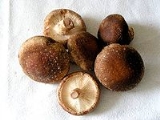
Shiitake

Encyclopedia
The Shiitake (from Japanese
) is an edible mushroom
native to East Asia
, which is cultivated and consumed in many Asian countries, as well as being dried and exported to many countries around the world. It is a feature of many Asian cuisines including Vietnamese, Chinese
, Japanese
, Korean and Thai. In the East, the shiitake mushroom has long been considered a delicacy
as well as a medicinal mushroom.
name, shiitake. (kanji: 椎茸; literally "shii
mushroom", from "shii" the Japanese name of the tree Castanopsis cuspidata
that provides the dead logs on which it is typically cultivated).
In Chinese
, it is called xiānggū (香菇, literally "fragrant mushroom"). Two Chinese variant names for high grades of shiitake are dōnggū and huāgū (花菇, "flower mushroom", which has a flower-like cracking pattern on the mushroom's upper surface); both are produced at lower temperatures.
Other names by which the mushroom is known in English include Chinese black mushroom and black forest mushroom.
In Korean
it is called pyogo (hangul: 표고), in Thai
they are called hed hom (เห็ดหอม, "fragrant mushroom"), and in Vietnamese
they are called nấm hương ("fragrant mushroom").
The species was formerly known as Lentinus edodes and Agaricus edodes. The latter name was first applied by the English botanist Miles Joseph Berkeley
in 1878.
in all three countries since prehistoric times. They have been cultivated for over 1,000 years. The oldest record regarding the shiitake mushroom dates back to AD 199 at the time of Emperor Chūai
in Japan. However, the first written record of shiitake cultivation can be traced to Wu Sang Kwuang in China, born during the Sung Dynasty
(AD 960–1127).
During the Ming Dynasty
(AD 1368–1644), physician Wu Juei wrote that the mushroom could be used not only as a food but as a medicinal mushroom, taken as a remedy for upper respiratory diseases, poor blood circulation, liver trouble, exhaustion and weakness, and to boost qi
, or life energy. It was also believed to prevent premature aging.
The Japanese cultivated the mushroom by cutting shii trees with axes and placing the logs by trees that were already growing shiitake or contained shiitake spore
s. Before 1982, the Japanese variety of these mushrooms could only be grown in traditional locations using ancient methods. In 1982, Gary F. Leatham published an academic paper based on his research on the budding and growth of the Japan Islands variety; the work helped make commercial cultivation possible in United States. Dr. Leatham is known in the industry as the "father of shiitake farming in the USA."
In the United States, shiitake cultivation got off to a slow start, due to the USDA confusing the mushroom with an invasive species known as Lentinus lepideus
. The USDA realized their mistake in 1972 and allowed importation and cultivation.
. In Japan, they are served in miso soup
, used as the basis for a kind of vegetarian
dashi
, and also as an ingredient in many steamed and simmered dishes. In Thailand, they may be served either fried or steamed.
Shiitake are often dried and sold as preserved food in packages. These must be rehydrated by soaking in water before using. Many people prefer dried shiitake to fresh, considering that the sun-drying process draws out the umami
flavour from the dried mushrooms by breaking down proteins into amino acid
s and transforms ergosterol
to vitamin D
. The stems of shiitake are rarely used in Japanese and other cuisine
s, primarily because the stems are harder and take longer to cook than the soft fleshy caps. The highest grade of shiitake are called donko in Japanese.
Today, shiitake mushrooms have become popular in many other countries as well. Russia produces and also consumes large amounts of them, mostly sold pickled; and the shiitake is slowly making its way into western cuisine as well. There is a global industry in shiitake production, with local farms in most western countries in addition to large scale importation from China, Japan, Korea and elsewhere.
Because they can now be grown world wide, their availability is widespread and their price has decreased.
aggregation, and possess antiviral
properties, possibly through antiviral agents known as proteinase inhibitor
s.
" that occurs all over the body including face and scalp, which appears about 48 hours after consumption and disappears after 10 days. This effect, caused by the (potentially therapeutic) toxin lentinan
, is well-known in Asia, but can be unfamiliar to European physicians. It occurs in roughly 1 in 50 people, and thorough cooking eliminates the effect.
In addition, animal research has shown that AHCC may increase the body's resistance to pathogen
s as shown in experiments with the influenza virus, West Nile encephalitis virus, and bacterial infection. Animal research has shown AHCC may enhance immune function. A double-blind, placebo-controlled trial of 21 people supported the idea that AHCC may enhance immune function. Clinical research has shown AHCC may benefit patients with hepatocellular carcinoma. A published case study reported AHCC benefited a patient with prostate cancer.
, a compound isolated from shiitake, is used as an intravenous anticancer agent in some countries. Studies have demonstrated lentinan
possesses antitumor properties, and human clinical studies have associated lentinan with a higher survival rate, higher quality of life, and lower recurrence of cancer. Clinical research with lentinan includes studies with 78 hepatocellular carcinoma patients, 32 gastric cancer patients, a multi-institutional study of lentinan and gastric cancer, a meta-analysis of lentinan and gastric cancer, 80 colorectal cancer patients, 20 gastric cancer patients, 36 hepatocellular carcinoma patients, and 29 pancreatic cancer patients. The City of Hope National Medical Center
is currently conducting clinical trials to determine if a select portion of the shiitake mushroom, which includes lentinan, can inhibit lung cancer.
Lentinan is currently used in Australia as part of a commercially available pharmacological blend (MC-S) to suppress cancer cell proliferation and to promote proliferation of peripheral blood lymphocytes
.
The Korea Food & Drug Administration
approved on January 2000 that the extracts of the mycelium
of shiitake mushrooms can protect and help the liver recover from substances such as alcohol. The main chemical for this effect is the beta-glucan
. The research showed injecting the extracts of the mycelium in vitro
raised the survival rates of liver cells and increased protein synthesis.
after brief exposure to sunlight or UV light. One cup of Shiitake mushrooms 145 g(5.1 oz) provides 29 IU (28.4 IU/g) of vitamin D
.
In the summer of 2004, mycologist Paul Stamets discovered that the level of vitamin D in freshly picked, indoor- grown shiitake mushrooms rose from 110 IU (international units) to an astonishing 46,000 IU per 100 grams when the mushrooms were placed outdoors in the sun for just six hours with the gills facing up (when the gills were facing down, the level rose to 10,900 IU).
This means that eating just one gram of sun-treated shiitake - about one tenth of one mushroom - would give you 460 IU, close to the FDA's recommended daily dose of 400 IU, and about a quarter of Dr. Weil's recommended 2,000 IU. In his book, Mycelium Running: How Mushrooms Can Help Save the World, Stamets concluded, "(In) populations where vitamin D is seriously deficient, sun-exposed dried mushrooms can help address a serious health issue."
tournament (Nihon Sumo
Kyokai honbasho
) a ceremonial large glass filled with shiitake mushrooms, as well as a cash prize.
The Shiitake is also eaten by caterpillar
s of the fungus moth Triaxomera parasitella
.
Journal articles
Japanese language
is a language spoken by over 130 million people in Japan and in Japanese emigrant communities. It is a member of the Japonic language family, which has a number of proposed relationships with other languages, none of which has gained wide acceptance among historical linguists .Japanese is an...
) is an edible mushroom
Edible mushroom
Edible mushrooms are the fleshy and edible fruiting bodies of several species of fungi. Mushrooms belong to the macrofungi, because their fruiting structures are large enough to be seen with the naked eye. They can appear either below ground or above ground where they may be picked by hand...
native to East Asia
East Asia
East Asia or Eastern Asia is a subregion of Asia that can be defined in either geographical or cultural terms...
, which is cultivated and consumed in many Asian countries, as well as being dried and exported to many countries around the world. It is a feature of many Asian cuisines including Vietnamese, Chinese
Chinese cuisine
Chinese cuisine is any of several styles originating in the regions of China, some of which have become highly popular in other parts of the world – from Asia to the Americas, Australia, Western Europe and Southern Africa...
, Japanese
Japanese cuisine
Japanese cuisine has developed over the centuries as a result of many political and social changes throughout Japan. The cuisine eventually changed with the advent of the Medieval age which ushered in a shedding of elitism with the age of shogun rule...
, Korean and Thai. In the East, the shiitake mushroom has long been considered a delicacy
Delicacy
A delicacy is a food item that is considered highly desirable in certain cultures. Often this is because of unusual flavors or characteristics or because it is rare....
as well as a medicinal mushroom.
Taxonomy and naming
Shiitake comes from its JapaneseJapanese language
is a language spoken by over 130 million people in Japan and in Japanese emigrant communities. It is a member of the Japonic language family, which has a number of proposed relationships with other languages, none of which has gained wide acceptance among historical linguists .Japanese is an...
name, shiitake. (kanji: 椎茸; literally "shii
Castanopsis cuspidata
Castanopsis cuspidata is a species of Castanopsis native to southern Japan and southern Korea....
mushroom", from "shii" the Japanese name of the tree Castanopsis cuspidata
Castanopsis cuspidata
Castanopsis cuspidata is a species of Castanopsis native to southern Japan and southern Korea....
that provides the dead logs on which it is typically cultivated).
In Chinese
Chinese language
The Chinese language is a language or language family consisting of varieties which are mutually intelligible to varying degrees. Originally the indigenous languages spoken by the Han Chinese in China, it forms one of the branches of Sino-Tibetan family of languages...
, it is called xiānggū (香菇, literally "fragrant mushroom"). Two Chinese variant names for high grades of shiitake are dōnggū and huāgū (花菇, "flower mushroom", which has a flower-like cracking pattern on the mushroom's upper surface); both are produced at lower temperatures.
Other names by which the mushroom is known in English include Chinese black mushroom and black forest mushroom.
In Korean
Korean language
Korean is the official language of the country Korea, in both South and North. It is also one of the two official languages in the Yanbian Korean Autonomous Prefecture in People's Republic of China. There are about 78 million Korean speakers worldwide. In the 15th century, a national writing...
it is called pyogo (hangul: 표고), in Thai
Thai language
Thai , also known as Central Thai and Siamese, is the national and official language of Thailand and the native language of the Thai people, Thailand's dominant ethnic group. Thai is a member of the Tai group of the Tai–Kadai language family. Historical linguists have been unable to definitively...
they are called hed hom (เห็ดหอม, "fragrant mushroom"), and in Vietnamese
Vietnamese language
Vietnamese is the national and official language of Vietnam. It is the mother tongue of 86% of Vietnam's population, and of about three million overseas Vietnamese. It is also spoken as a second language by many ethnic minorities of Vietnam...
they are called nấm hương ("fragrant mushroom").
The species was formerly known as Lentinus edodes and Agaricus edodes. The latter name was first applied by the English botanist Miles Joseph Berkeley
Miles Joseph Berkeley
Miles Joseph Berkeley was an English cryptogamist and clergyman, and one of the founders of the science of plant pathology....
in 1878.
Cultivation history
Shiitake are native to Korea, China and Japan and have been grownFungiculture
Fungiculture is the process of producing food, medicine, and other products by the cultivation of mushrooms and other fungi.The word is also commonly used to refer to the practice of cultivating fungi by leafcutter ants, termites, ambrosia beetles, and marsh periwinkles.- Introduction :Mushrooms...
in all three countries since prehistoric times. They have been cultivated for over 1,000 years. The oldest record regarding the shiitake mushroom dates back to AD 199 at the time of Emperor Chūai
Emperor Chuai
; also known as Tarashinakatsuhiko no Sumeramikoto; was the 14th emperor of Japan, according to the traditional order of succession.No firm dates can be assigned to this emperor's life or reign, but he is conventionally considered to have reigned from 192–200....
in Japan. However, the first written record of shiitake cultivation can be traced to Wu Sang Kwuang in China, born during the Sung Dynasty
Song Dynasty
The Song Dynasty was a ruling dynasty in China between 960 and 1279; it succeeded the Five Dynasties and Ten Kingdoms Period, and was followed by the Yuan Dynasty. It was the first government in world history to issue banknotes or paper money, and the first Chinese government to establish a...
(AD 960–1127).
During the Ming Dynasty
Ming Dynasty
The Ming Dynasty, also Empire of the Great Ming, was the ruling dynasty of China from 1368 to 1644, following the collapse of the Mongol-led Yuan Dynasty. The Ming, "one of the greatest eras of orderly government and social stability in human history", was the last dynasty in China ruled by ethnic...
(AD 1368–1644), physician Wu Juei wrote that the mushroom could be used not only as a food but as a medicinal mushroom, taken as a remedy for upper respiratory diseases, poor blood circulation, liver trouble, exhaustion and weakness, and to boost qi
Qi
In traditional Chinese culture, qì is an active principle forming part of any living thing. Qi is frequently translated as life energy, lifeforce, or energy flow. Qi is the central underlying principle in traditional Chinese medicine and martial arts...
, or life energy. It was also believed to prevent premature aging.
The Japanese cultivated the mushroom by cutting shii trees with axes and placing the logs by trees that were already growing shiitake or contained shiitake spore
Spore
In biology, a spore is a reproductive structure that is adapted for dispersal and surviving for extended periods of time in unfavorable conditions. Spores form part of the life cycles of many bacteria, plants, algae, fungi and some protozoa. According to scientist Dr...
s. Before 1982, the Japanese variety of these mushrooms could only be grown in traditional locations using ancient methods. In 1982, Gary F. Leatham published an academic paper based on his research on the budding and growth of the Japan Islands variety; the work helped make commercial cultivation possible in United States. Dr. Leatham is known in the industry as the "father of shiitake farming in the USA."
In the United States, shiitake cultivation got off to a slow start, due to the USDA confusing the mushroom with an invasive species known as Lentinus lepideus
Neolentinus lepideus
Neolentinus lepideus is a basidiomycete mushroom of the genus Neolentinus, until recently also widely known as Lentinus lepideus. Common names for it include scaly lentinus and train wrecker.-Appearance:...
. The USDA realized their mistake in 1972 and allowed importation and cultivation.
Culinary use
Fresh and dried shiitake have many uses in the cuisines of East Asia. In Chinese cuisine, they are often sauteed in vegetarian dishes such as Buddha's delightBuddha's delight
Buddha's delight, often transliterated as Luóhàn zhāi, lo han jai, or lo hon jai, is a vegetarian dish well known in Chinese and Buddhist cuisine...
. In Japan, they are served in miso soup
Miso soup
is a traditional Japanese soup consisting of a stock called "dashi" into which is mixed softened miso paste. Many ingredients are added depending on regional and seasonal recipes, and personal preference.-Miso paste:...
, used as the basis for a kind of vegetarian
Vegetarianism
Vegetarianism encompasses the practice of following plant-based diets , with or without the inclusion of dairy products or eggs, and with the exclusion of meat...
dashi
Dashi
Dashi is a class of soup and cooking stock, considered fundamental to Japanese cooking. In 1980, Shizuo Tsuji wrote: "Many substitutes for dashi are possible, but without dashi, dishes are merely à la japonaise and lack the authentic flavor." Dashi forms the base for miso soup, clear broth, noodle...
, and also as an ingredient in many steamed and simmered dishes. In Thailand, they may be served either fried or steamed.
Shiitake are often dried and sold as preserved food in packages. These must be rehydrated by soaking in water before using. Many people prefer dried shiitake to fresh, considering that the sun-drying process draws out the umami
Umami
Umami , popularly referred to as savoriness, is one of the five basic tastes together with sweet, sour, bitter, and salty.-Etymology:Umami is a loanword from the Japanese meaning "pleasant savory taste". This particular writing was chosen by Professor Kikunae Ikeda from umai "delicious" and mi ...
flavour from the dried mushrooms by breaking down proteins into amino acid
Amino acid
Amino acids are molecules containing an amine group, a carboxylic acid group and a side-chain that varies between different amino acids. The key elements of an amino acid are carbon, hydrogen, oxygen, and nitrogen...
s and transforms ergosterol
Ergosterol
Ergosterol is a sterol found in fungi, and named for ergot, a common name for the members of the fungal genus Claviceps from which ergosterol was first isolated. Ergosterol does not occur in plant or animal cells...
to vitamin D
Vitamin D
Vitamin D is a group of fat-soluble secosteroids. In humans, vitamin D is unique both because it functions as a prohormone and because the body can synthesize it when sun exposure is adequate ....
. The stems of shiitake are rarely used in Japanese and other cuisine
Cuisine
Cuisine is a characteristic style of cooking practices and traditions, often associated with a specific culture. Cuisines are often named after the geographic areas or regions that they originate from...
s, primarily because the stems are harder and take longer to cook than the soft fleshy caps. The highest grade of shiitake are called donko in Japanese.
Today, shiitake mushrooms have become popular in many other countries as well. Russia produces and also consumes large amounts of them, mostly sold pickled; and the shiitake is slowly making its way into western cuisine as well. There is a global industry in shiitake production, with local farms in most western countries in addition to large scale importation from China, Japan, Korea and elsewhere.
Because they can now be grown world wide, their availability is widespread and their price has decreased.
Shiitake research
Modern research has indicated shiitake mushroom may stimulate the immune system, possess antibacterial properties, reduce plateletPlatelet
Platelets, or thrombocytes , are small,irregularly shaped clear cell fragments , 2–3 µm in diameter, which are derived from fragmentation of precursor megakaryocytes. The average lifespan of a platelet is normally just 5 to 9 days...
aggregation, and possess antiviral
Virus
A virus is a small infectious agent that can replicate only inside the living cells of organisms. Viruses infect all types of organisms, from animals and plants to bacteria and archaea...
properties, possibly through antiviral agents known as proteinase inhibitor
Protease inhibitor (pharmacology)
Protease inhibitors are a class of drugs used to treat or prevent infection by viruses, including HIV and Hepatitis C. PIs prevent viral replication by inhibiting the activity of proteases, e.g.HIV-1 protease, enzymes used by the viruses to cleave nascent proteins for final assembly of new...
s.
Shiitake dermatitis
Consumption of raw or slightly cooked shiitake mushrooms can cause "an erythematous, micro-papular, streaky, extremely pruriginous rashRash
A rash is a change of the skin which affects its color, appearance or texture. A rash may be localized in one part of the body, or affect all the skin. Rashes may cause the skin to change color, itch, become warm, bumpy, chapped, dry, cracked or blistered, swell and may be painful. The causes, and...
" that occurs all over the body including face and scalp, which appears about 48 hours after consumption and disappears after 10 days. This effect, caused by the (potentially therapeutic) toxin lentinan
Lentinan
Lentinan is a beta-glucan with a glycosidic β-1,3:β-1,6 linkage. It is an anti-tumor polysaccharide from the shiitake mushroom. Lentinan is a polysaccharide that has a molecular weight of approximately 500,000 Da...
, is well-known in Asia, but can be unfamiliar to European physicians. It occurs in roughly 1 in 50 people, and thorough cooking eliminates the effect.
Shiitake isolate AHCC
Active hexose correlated compound (AHCC) is an α-glucan-rich compound isolated from shiitake. In Japan, AHCC is the second most popular complementary and alternative medicine used by cancer patients. AHCC is a well tolerated compound and is metabolized via the CYP450 2D6 pathway.In addition, animal research has shown that AHCC may increase the body's resistance to pathogen
Pathogen
A pathogen gignomai "I give birth to") or infectious agent — colloquially, a germ — is a microbe or microorganism such as a virus, bacterium, prion, or fungus that causes disease in its animal or plant host...
s as shown in experiments with the influenza virus, West Nile encephalitis virus, and bacterial infection. Animal research has shown AHCC may enhance immune function. A double-blind, placebo-controlled trial of 21 people supported the idea that AHCC may enhance immune function. Clinical research has shown AHCC may benefit patients with hepatocellular carcinoma. A published case study reported AHCC benefited a patient with prostate cancer.
Shiitake lentinan
LentinanLentinan
Lentinan is a beta-glucan with a glycosidic β-1,3:β-1,6 linkage. It is an anti-tumor polysaccharide from the shiitake mushroom. Lentinan is a polysaccharide that has a molecular weight of approximately 500,000 Da...
, a compound isolated from shiitake, is used as an intravenous anticancer agent in some countries. Studies have demonstrated lentinan
Lentinan
Lentinan is a beta-glucan with a glycosidic β-1,3:β-1,6 linkage. It is an anti-tumor polysaccharide from the shiitake mushroom. Lentinan is a polysaccharide that has a molecular weight of approximately 500,000 Da...
possesses antitumor properties, and human clinical studies have associated lentinan with a higher survival rate, higher quality of life, and lower recurrence of cancer. Clinical research with lentinan includes studies with 78 hepatocellular carcinoma patients, 32 gastric cancer patients, a multi-institutional study of lentinan and gastric cancer, a meta-analysis of lentinan and gastric cancer, 80 colorectal cancer patients, 20 gastric cancer patients, 36 hepatocellular carcinoma patients, and 29 pancreatic cancer patients. The City of Hope National Medical Center
City of Hope National Medical Center
City of Hope National Medical Center, is a private, not-for-profit clinical research center, hospital and graduate medical school located in Duarte, California, United States...
is currently conducting clinical trials to determine if a select portion of the shiitake mushroom, which includes lentinan, can inhibit lung cancer.
Lentinan is currently used in Australia as part of a commercially available pharmacological blend (MC-S) to suppress cancer cell proliferation and to promote proliferation of peripheral blood lymphocytes
Peripheral Blood Lymphocytes
Peripheral blood lymphocytes are mature lymphocytes that circulate in the blood, rather than localising to organs . They comprise T cells, NK cells and B cells....
.
The Korea Food & Drug Administration
Korea Food & Drug Administration
The Korea Food & Drug Administration is a South Korea government agency responsible for promoting the public health by ensuring the safety and efficiency of foods, pharmaceuticals, medical devices and cosmetics as well as supporting the development of the food and pharmaceutical industries...
approved on January 2000 that the extracts of the mycelium
Mycelium
thumb|right|Fungal myceliaMycelium is the vegetative part of a fungus, consisting of a mass of branching, thread-like hyphae. The mass of hyphae is sometimes called shiro, especially within the fairy ring fungi. Fungal colonies composed of mycelia are found in soil and on or within many other...
of shiitake mushrooms can protect and help the liver recover from substances such as alcohol. The main chemical for this effect is the beta-glucan
Beta-glucan
β-Glucans are polysaccharides of D-glucose monomers linked by β-glycosidic bonds. β-glucans are a diverse group of molecules that can vary with respect to molecular mass, solubility, viscosity, and three-dimensional configuration...
. The research showed injecting the extracts of the mycelium in vitro
In vitro
In vitro refers to studies in experimental biology that are conducted using components of an organism that have been isolated from their usual biological context in order to permit a more detailed or more convenient analysis than can be done with whole organisms. Colloquially, these experiments...
raised the survival rates of liver cells and increased protein synthesis.
Vitamin D
Recently it was noticed that shiitake mushrooms contain high amounts of vitamin DVitamin D
Vitamin D is a group of fat-soluble secosteroids. In humans, vitamin D is unique both because it functions as a prohormone and because the body can synthesize it when sun exposure is adequate ....
after brief exposure to sunlight or UV light. One cup of Shiitake mushrooms 145 g(5.1 oz) provides 29 IU (28.4 IU/g) of vitamin D
Vitamin D
Vitamin D is a group of fat-soluble secosteroids. In humans, vitamin D is unique both because it functions as a prohormone and because the body can synthesize it when sun exposure is adequate ....
.
In the summer of 2004, mycologist Paul Stamets discovered that the level of vitamin D in freshly picked, indoor- grown shiitake mushrooms rose from 110 IU (international units) to an astonishing 46,000 IU per 100 grams when the mushrooms were placed outdoors in the sun for just six hours with the gills facing up (when the gills were facing down, the level rose to 10,900 IU).
This means that eating just one gram of sun-treated shiitake - about one tenth of one mushroom - would give you 460 IU, close to the FDA's recommended daily dose of 400 IU, and about a quarter of Dr. Weil's recommended 2,000 IU. In his book, Mycelium Running: How Mushrooms Can Help Save the World, Stamets concluded, "(In) populations where vitamin D is seriously deficient, sun-exposed dried mushrooms can help address a serious health issue."
Other
The Shiitake Growers Cooperative, in Japan's Oita Prefecture, awards the winner of each bimonthly Japan Sumo AssociationJapan Sumo Association
The is the body that operates and controls professional sumo wrestling in Japan under the jurisdiction of the Japanese Ministry of Education, Culture, Sports, Science and Technology. Rikishi , gyōji , tokoyama , and yobidashi , are all on the Association's payroll, but the organisation is run...
tournament (Nihon Sumo
Sumo
is a competitive full-contact sport where a wrestler attempts to force another wrestler out of a circular ring or to touch the ground with anything other than the soles of the feet. The sport originated in Japan, the only country where it is practiced professionally...
Kyokai honbasho
Honbasho
A is an official professional sumo tournament. There are six held each year, a system established in 1958. Only honbasho results matter in determining promotion and relegation for rikishi ....
) a ceremonial large glass filled with shiitake mushrooms, as well as a cash prize.
The Shiitake is also eaten by caterpillar
Caterpillar
Caterpillars are the larval form of members of the order Lepidoptera . They are mostly herbivorous in food habit, although some species are insectivorous. Caterpillars are voracious feeders and many of them are considered to be pests in agriculture...
s of the fungus moth Triaxomera parasitella
Triaxomera parasitella
Triaxomera parasitella is a species of tineoid moth. It belongs to the fungus moth family , and therein to the subfamily Nemapogoninae. It is widespread and common in much of western Eurasia, but seems to be absent from some more outlying regions, such as Portugal and the eastern Baltic, Ireland...
.
Further reading
Books- Shen, J. et al. “An Evidence-based Perspective of Lentinus Edodes (Shiitake Mushroom) for Cancer Patients” (pp. 303-317), in: Evidence-based Anticancer Materia Medica (editor: William C. S. Cho). 2011. Springer. ISBN 9789400705258
- Smith JE, Rowan NJ, Sullivan R Medicinal Mushrooms: Their Therapeutic Properties and Current Medical Usage with Special Emphasis on Cancer Treatments Cancer Research UKCancer Research UKCancer Research UK is a cancer research and awareness charity in the United Kingdom, formed on 4 February 2002 by the merger of The Cancer Research Campaign and the Imperial Cancer Research Fund. Its aim is to reduce the number of deaths from cancer. As the world's largest independent cancer...
, 2001 - Tsuji, Shizuo (1980). Japanese Cooking: A Simple Art. New York: Kodansha International/USA.
Journal articles
- Ikekawa, T. et al. “Antitumor Activity of Aqueous Extracts of Edible Mushrooms”, Cancer Research (1969),29(3):734-735.
External links
- http://www.micotec.cl/videos.html
- Lentinan effects (antitumor and others)
- http://www.food.actapol.net/tom6/zeszyt4/13_4_2007.pdf Dried shiitake (Lentinulla edodes) and oyster (Pleurotus ostreatus) mushrooms as a good source of nutrient.
- About Shiitake (by Solomon P. Wasser, 2005)