


Taxiway

Encyclopedia
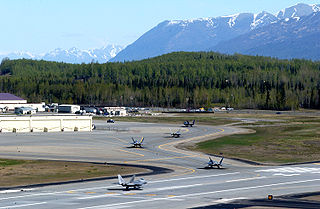
Airport
An airport is a location where aircraft such as fixed-wing aircraft, helicopters, and blimps take off and land. Aircraft may be stored or maintained at an airport...
connecting runway
Runway
According to ICAO a runway is a "defined rectangular area on a land aerodrome prepared for the landing and take-off of aircraft." Runways may be a man-made surface or a natural surface .- Orientation and dimensions :Runways are named by a number between 01 and 36, which is generally one tenth...
s with ramp
Airport ramp
The airport ramp or apron is part of an airport. It is usually the area where aircraft are parked, unloaded or loaded, refueled or boarded. Although the use of the apron is covered by regulations, such as lighting on vehicles, it is typically more accessible to users than the runway or taxiway...
s, hangar
Hangar
A hangar is a closed structure to hold aircraft or spacecraft in protective storage. Most hangars are built of metal, but other materials such as wood and concrete are also sometimes used...
s, terminal
Airport terminal
An airport terminal is a building at an airport where passengers transfer between ground transportation and the facilities that allow them to board and disembark from aircraft....
s and other facilities. They mostly have hard surface such as asphalt
Asphalt
Asphalt or , also known as bitumen, is a sticky, black and highly viscous liquid or semi-solid that is present in most crude petroleums and in some natural deposits, it is a substance classed as a pitch...
or concrete
Concrete
Concrete is a composite construction material, composed of cement and other cementitious materials such as fly ash and slag cement, aggregate , water and chemical admixtures.The word concrete comes from the Latin word...
, although smaller airports sometimes use gravel
Gravel
Gravel is composed of unconsolidated rock fragments that have a general particle size range and include size classes from granule- to boulder-sized fragments. Gravel can be sub-categorized into granule and cobble...
or grass
Grass
Grasses, or more technically graminoids, are monocotyledonous, usually herbaceous plants with narrow leaves growing from the base. They include the "true grasses", of the Poaceae family, as well as the sedges and the rushes . The true grasses include cereals, bamboo and the grasses of lawns ...
.
Busy airports typically construct high-speed or rapid-exit taxiways in order to allow aircraft
Aircraft
An aircraft is a vehicle that is able to fly by gaining support from the air, or, in general, the atmosphere of a planet. An aircraft counters the force of gravity by using either static lift or by using the dynamic lift of an airfoil, or in a few cases the downward thrust from jet engines.Although...
to leave the runway at higher speeds. This allows the aircraft to vacate the runway quicker, permitting another to land or depart in a shorter space of time.
Taxiway markings
- Normal Centerline. A single continuous yellow line, 15 centimetres (6 in) to 30 centimetres (12 in) in width.
- Enhanced Centerline. The enhanced taxiway centerline marking consists of a parallel line of yellow dashes on either side of the taxiway centerline. Taxiway centerlines are enhanced for 150 feet (45.7 m) prior to a runway holding position marking. The enhanced taxiway centerline is standard at all FARFederal Aviation RegulationsThe Federal Aviation Regulations, or FARs, are rules prescribed by the Federal Aviation Administration governing all aviation activities in the United States. The FARs are part of Title 14 of the Code of Federal Regulations...
Part 139 certified airports. - Taxiway Edge Markings. Used to define the edge of the taxiway when the taxiway edge does not correspond with the edge of the pavement. Continuous Markings consist of a continuous double yellow line, with each line being at least 15 centimetres (6 in) in width spaced 15 centimetres (6 in) apart and define the taxiway edge from the shoulder or some other abutting paved surface not intended for use by aircraft. Dashed Markings. define the edge of a taxiway on a paved surface where the adjoining pavement to the taxiway edge is intended for use by aircraft, e.g., an apron. Dashed taxiway edge markings consist of a broken double yellow line, with each line being at least 15 centimetres (6 in) in width, spaced 15 centimetres (6 in) apart (edge to edge). These lines are 15 feet (4.5 m) in length with 25 foot (7.5 m) gaps.
- Taxi Shoulder Markings. Taxiways, holding bays, and aprons are sometimes provided with paved shoulders to prevent blast and water erosion. Shoulders are not intended for use by aircraft, and may be unable to carry the aircraft load. Taxiway shoulder markings are yellow lines perpendicular to taxiway edge, from taxiway edge to pavement edge, about 3 metres.
- Surface Painted Taxiway Direction Signs. Yellow background with a black inscription, and are provided when it is not possible to provide taxiway direction signs at intersections, or when necessary to supplement such signs. These markings are located on either side of the taxiway
- Surface Painted Location Signs. Black background with a yellow inscription. When necessary, these markings supplement location signs located alongside the taxiway and assist the pilot in confirming the designation of the taxiway on which the aircraft is located. These markings are located on the right side of the centerline.
- Geographic Position Markings. These markings are located at points along low visibility taxi routes (when RVRRunway visual rangeRunway Visual Range is a term used in aviation meteorology to define the distance over which a pilot of an aircraft on the centreline of the runway can see the runway surface markings delineating the runway or identifying its centre line...
is below 1200 feet(360m)). They are positioned to the left of the taxiway centerline in the direction of taxiing. Black inscription centered on pink circle with black inner and white outer ring.
- Runway Holding Position Markings. For runways, these markings indicate where an aircraft is supposed to stop when approaching a runway. They consist of four yellow lines, two solid and two dashed, spaced six or twelve inches apart, and extending across the width of the taxiway or runway. The solid lines are always on the side where the aircraft is to hold. There are three locations where runway holding position markings are encountered: Runway holding position markings on taxiways, runway holding position markings on runways, taxiways located in runway approach areas.
- Holding Position Markings for Instrument Landing System (ILSInstrument Landing SystemAn instrument landing system is a ground-based instrument approach system that provides precision guidance to an aircraft approaching and landing on a runway, using a combination of radio signals and, in many cases, high-intensity lighting arrays to enable a safe landing during instrument...
). These consist of two yellow solid lines spaced two feet apart connected by pairs of solid lines spaced ten feet apart extending across the width of the taxiway. - Holding Position Markings for Taxiway/Taxiway Intersections. These consist of a single dashed line extending across the width of the taxiway.
- Surface Painted Holding Position Signs. Red background signs with a white inscription and supplement the signs located at the holding position.
The taxiways are given alphanumeric identification. These taxiway IDs are shown on black and yellow signboards along the taxiways.
Taxiway lights
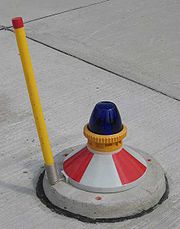
- Taxiway Edge Lights: used to outline the edges of taxiways during periods of darkness or restricted visibility conditions. These fixtures are elevated and emit blueBlueBlue is a colour, the perception of which is evoked by light having a spectrum dominated by energy with a wavelength of roughly 440–490 nm. It is considered one of the additive primary colours. On the HSV Colour Wheel, the complement of blue is yellow; that is, a colour corresponding to an equal...
light. - Taxiway Centerline Lights: They are steady burning and emit green light located along the taxiway centerline
- Clearance Bar Lights: Three in-pavement steady-burning yellow lights installed at holding positions on taxiways
- Runway Guard Lights: Either a pair of elevated flashing yellow lights installed on either side of the taxiway, or a row of in-pavement yellow lights installed across the entire taxiway, at the runway holding position marking at taxiway/runway intersections.
- Stop Bar Lights: A row of red, unidirectional, steady-burning in-pavement lights installed across the entire taxiway at the runway holding position, and elevated steady-burning red lights on each side used in low visibility conditions (below 1,200 ft RVR). A controlled stop bar is operated in conjunction with the taxiway centerline lead-on lights which extend from the stop bar toward the runway. Following the ATC clearance to proceed, the stop bar is turned off and the lead-on lights are turned on.
Taxiway edge lights are spaced 75 feet apart. These lights can be closer together at taxiway intersections. On straight segments, Taxiway Centerline Lights are spaced at either 50 or 100 foot intervals depending on the minimum authorized visibility. On curved taxiway segments, Taxiway Centerline Lights may be required to be closer together.