
| |
The Killing Fields were a number of sites in Cambodia where large numbers of people were killed and buried by the totalitarian communist Khmer Rouge regime, during its rule of the country from 1975 to 1979 (see Cambodian genocide).
At least 200,000 people were executed by the Khmer Rouge (while estimates of the total number of deaths resulting from Khmer Rouge policies, including disease and starvation, range from 1.4 to 2.2 million out of a population of around 7 million).

Discussion
Ask a question about 'The Killing Fields'
Start a new discussion about 'The Killing Fields'
Answer questions from other users
|
Quotations
Killing Fields, The
Killing Fields, The
I can't eat eggs, someone told me they shrink with fright when you cook them.
They brought in the whole fucking press corps. They want to sanitize the story. Bastards!
in his journal while imprisoned The wind whispers of fear and hate. The war has killed love. And those that confess to the Angka are punished, and no one dare ask where they go. Here, only the silent survive.
We must be like the ox, and have no thought, except for the Party. And have no love, but for the Angka. People starve, but we must not grow food. We must honor the comrade children, whose minds are not corrupted by the past.

Encyclopedia
The Killing Fields were a number of sites in Cambodia where large numbers of people were killed and buried by the totalitarian communist Khmer Rouge regime, during its rule of the country from 1975 to 1979 (see Cambodian genocide).
At least 200,000 people were executed by the Khmer Rouge (while estimates of the total number of deaths resulting from Khmer Rouge policies, including disease and starvation, range from 1.4 to 2.2 million out of a population of around 7 million). In 1979 Vietnam invaded and toppled the Khmer Rouge regime, which was officially called Democratic Kampuchea.
Process
The Khmer Rouge judicial process, for minor or political crimes, began with a warning from the Angkar, the government of Cambodia under the regime. People receiving more than two warnings were sent for "re-education", which meant near-certain death. People were often encouraged to confess to Angkar their "pre-revolutionary lifestyles and crimes" (which usually included some kind of free-market activity, or having had contact with a foreign source, such as a US missionary, or international relief or government agency, or contact with any foreigner or with the outside world at all), being told that Angkar would forgive them and "wipe the slate clean". This meant being taken away to a place such as Tuol Sleng or Choeung Ek for torture and/or execution.
The executed were buried in mass graves. In order to save ammunition, the executions were often carried out using hammers, axe handles, spades or sharpened bamboo sticks. Some victims were required to dig their own graves; their weakness often meant that they were unable to dig very deep. The soldiers who carried out the executions were mostly young men or women from peasant families.
The Khmer Rouge regime arrested and eventually executed almost everyone suspected of connections with the former government or with foreign governments, as well as professionals and intellectuals. Ethnic Vietnamese, ethnic Thai, ethnic Chinese, ethnic Chams (Muslim Cambodians), Cambodian Christians, and the Buddhist monkhood were the demographic targets of persecution.
Today
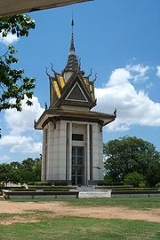
The best known monument of the Killing Fields is Choeung Ek. Today, it is the site of a Buddhist memorial to the terror, and Tuol Sleng has a museum commemorating the genocide.
Cambodian journalist Dith Pran coined the term 'Killing Fields' during his escape from the regime. A 1984 motion picture, The Killing Fields, tells the story of Dith Pran, played by Cambodian survivor Haing S. Ngor, and his journey to escape the death camps.
A survivor of the genocide, Dara Duong, founded The Killing Fields Museum in Seattle.
Related topics
See also
- - A Seattle-based museum dedicated to preserving the history of the Killing Fields.
- - Photographs from Tuol Sleng (S-21)
- Denise Affonço: To The End Of Hell: One Woman's Struggle to Survive Cambodia's Khmer Rouge. (With Introduction by Jon Swain.) ISBN 978-0955572951.
External Links
- BBC News commemorating the 30th anniversary of the Khmer Rouge's demise
|