

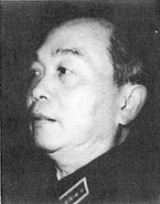
Vo Nguyen Giap

Encyclopedia
Võ Nguyên Giáp is a retired Vietnam
ese officer
in the Vietnam People’s Army
and a politician
. He was a principal commander in two wars: the First Indochina War
(1946–1954) and the Vietnam War
(1960–1975). He participated in the following historically significant battles: Lạng Sơn
(1950); Hòa Bình
(1951–1952); Điện Biên Phủ
(1954); the Tết Offensive (1968); the Easter Offensive (1972); and the final Hồ Chí Minh Campaign
(1975). He was also a journalist, an interior minister in President Hồ Chí Minh
’s Việt Minh
government, the military commander of the Việt Minh, the commander of the Vietnam People’s Army (PAVN), and defense minister. He also served as Politburo
member of the Lao Động Party.
He was the most prominent military commander, beside Hồ Chí Minh
, during the war and was responsible for major operations and leadership until the war ended.
. His father and mother, Võ Quang Nghiêm and Nguyen Thi Kien, worked the land, rented some to neighbors, and lived a relatively comfortable lifestyle. At 14, Giáp became a messenger for the Haiphong
Power Company and shortly thereafter joined the Tân Việt Cách Mạng Đảng, a romantically styled revolutionary youth group. Two years later, he entered Quốc Học (also known in English as the “National Academy”), a French-run lycée in Huế, from which two years later, according to his own account, he was expelled for having organized a student strike. Although he has denied it, Giáp is said to have also spent a few years in the prestigious Hanoian Lycée Albert Sarraut
, where the local elite was educated to serve the colonial regime. He was apparently in the same class as Phạm Văn Đồng, future Prime Minister, who has also denied having studied at Albert Sarraut, and Bảo Đại
, the last emperor of Annam. In 1933, at the age of 22, Giáp enrolled in the University of Hanoi.
Giáp was educated at the University of Hanoi where he gained a bachelor’s degree in politics, economics and law. After graduation, he taught history for one year at the Thăng Long School in Hanoi. Throughout most of the 1930s, Giáp remained a schoolteacher and a journalist, writing articles for Tien Dang, while actively participating in various revolutionary movements. He joined the Communist Party of Vietnam
in 1931 and took part in several demonstrations against French rule in Indochina
as well as having assisted in founding the Democratic Front in 1933. All the while, Giáp was a dedicated reader of military history and philosophy, revering Napoleon I
and Sun Tzu
(Vietnamese: Tôn Vũ).
Võ Nguyên Giáp was arrested in 1930 and served 13 months of a two-year sentence at Lao Bảo Prison
. During the Popular Front
years in France, he founded Hon Tre Tap Moi, an underground socialist newspaper. He also founded the French-language paper Le Travail
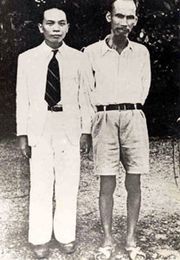
(on which Phạm Văn Đồng also worked). In 1939 he married Nguyễn Thị Quang Thái, another socialist. She bore him a daughter, Hong Anh. When France outlawed communism during the same year, Giáp fled to China together with Phạm Văn Đồng where he joined up with Hồ Chí Minh
, the leader of the Vietnam Independence League (Việt Minh
). While he was in exile, his wife, sister, father and sister-in-law were arrested, tortured and later executed by the French colonial authorities. His daughter is also believed to have perished in prison due to neglect.
He returned to Vietnam in 1944, and between then and 1945 he helped organize resistance to the Japanese occupation forces
. When the Japanese surrendered to the Allies
in August 1945, the Japanese decided to allow nationalist groups to take over public buildings while keeping the French in prison as a way of causing additional trouble to the Allies in the postwar period. The Việt Minh and other groups took over various towns and formed a provisional government in which Giáp was named Minister of the Interior.
In September 1945, Hồ Chí Minh announced the formation of the Democratic Republic of Vietnam. Unknown to the Việt Minh, President Harry S. Truman
, Prime Minister Winston Churchill
and Premier Joseph Stalin
had already decided the future of postwar Vietnam at a summit meeting at Potsdam
. They agreed that the country would be occupied temporarily to get the Japanese out; the northern half would be under the control of the Nationalist Chinese and the southern half under the British
.
After the Second World War (WWII), France attempted to reestablish control over Vietnam. In January 1946, Great Britain agreed to remove her troops, and, later that year, the Chinese left Vietnam in exchange for a promise from France that she would give up her rights to territory in China.
. Sporadic fighting quickly became a general war between the Democratic Republic of Vietnam (Việt Minh) and the French on December 19, 1946. The first few years of the war involved mostly a low-level, semi-conventional resistance fight against the French occupying forces. However, after the Chinese communists reached the northern border of Vietnam in 1949 and the Vietnamese destruction of French posts there, the conflict turned into a conventional war between two armies equipped with modern weapons supplied by the United States and the Soviet Union.
French Union
forces included colonial troops from many parts of the French former empire (Moroccan, Algerian, Tunisian, Laotian, Cambodian, Vietnamese and Vietnamese ethnic minorities), French professional troops and units of the French Foreign Legion
. The use of metropolitan
(i.e. from France itself) recruits was forbidden by the governments to prevent the war from becoming even more unpopular at home. It was called the "dirty war" (la sale guerre) by supporters of the Left
in France and intellectuals (including Sartre
) during the Henri Martin Affair
in 1950.
When it became clear that France was becoming involved in a long drawn-out and so far not very successful war, the French government tried to negotiate an agreement with the Việt Minh. They offered to help set up a national government and promised that they would eventually grant Vietnam its independence. Hồ Chí Minh and the other leaders of the Việt Minh did not trust the word of the French and continued the war.
 French public opinion continued to move against the war. There were five main reasons for this:
While growing stronger in Vietnam, the Việt Minh also expanded the war and lured the French to spread their force to remote areas such as Laos. In December 1953, Navarre
set up a defensive complex at Ðiện Biên Phủ
, which attempted to block the aids transportation route passing through Laos. He surmised that in an attempt to reestablish the route to Laos, Giáp would be forced to organize a mass attack on the French forces at Ðiện Biên Phủ, where he hoped to have advantage in a conventional battle.
Giáp took up the French challenge. While the French dug in at their outpost, the Việt Minh were also preparing the battlefield. Divergent attacks in other areas, diverted French air logistics elsewhere. Giáp ordered his men to secretly pull their artillery by hand, 24 105mm howitzers to hollows on the inner hill sides of Ðiện Biên Phủ for providing them cover from French aircraft and counter-attacks from French artillery.
With antiaircraft guns supplied by the Soviet Union, Giáp was able to severely restrict the ability of the French to supply their forces, and forced them to inaccurately drop supplies from high altitude to the besieged areas. Giáp chose to surround the outpost and ordered his men to dig a trench system that encircled the French. From the outer trench, other trenches and tunnels were dug inward towards the center. The Việt Minh were now able to move in close to the French troops defending Ðiện Biên Phủ.
When Navarre realized that he was trapped, he appealed for help. The United States was approached and some advisers suggested the use of tactical nuclear weapons against the Việt Minh, but this was never seriously considered. Another suggestion was that conventional air raids would be enough to scatter Giáp’s troops. U.S. President Dwight D. Eisenhower
, however, refused to intervene unless the British and other Western allies agreed. Churchill declined, claiming that he wanted to wait for the outcome of the peace negotiations taking place in Geneva
, Switzerland, before becoming involved in escalating the war.
On 13 March 1954, Giáp launched his offensive. For 54 days, the Việt Minh seized position after position, pushing the French until they occupied only a small area of Ðiện Biên Phủ. Colonel Piroth
, the artillery commander, blamed himself for the destruction of French artillery superiority. He told his fellow officers that he had been "completely dishonoured" and committed suicide with a hand grenade. General De Castries
, French Commander in Ðiện Biên Phủ, was captured alive in his bunker. The French surrendered on May 7. Their casualties totaled over 2,200 men, 5,600 wounded and 11,721 taken prisoner. The following day the French government announced that it intended to withdraw from Vietnam.
Giap's victory over the French crushed the legend of Western invincibility and thus opened a new era in the struggles for national independence against colonialism. With this victory, the name of Vo Nguyen Giap has become identified throughout Africa and Latin America with the defeat of colonialism.
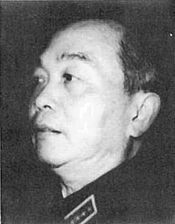 Giáp remained commander in chief of the People’s Army of Vietnam throughout the war against the United States. During the conflict, he oversaw the expansion of the PAVN from a small self-defense force into a large conventional army, equipped by its communist allies with considerable amounts of relatively sophisticated weaponry, although this did not in general match the weaponry of the Americans. Giáp has often been assumed to have been the planner of the Tết Offensive of 1968, but this appears not to have been the case. The best evidence indicates that he disliked the plan, and when it became apparent that Lê Duẩn and Văn Tiến Dũng were going to push it through despite his doubts, he left Vietnam for medical treatment in Hungary
, and did not return until after the offensive had begun. Although this attempt to spark a general uprising against the southern government failed militarily, it turned into a significant political victory by convincing the American politicians and public that their commitment to South Vietnam
could no longer be open-ended. Giáp later argued that the Tết Offensive was not a "purely military strategy" but rather part of a "general strategy, an integrated one, at once military, political and diplomatic."
Peace talks between representatives from the United States, the Republic of Vietnam, the Democratic Republic of Vietnam, and the NLF began in Paris in January 1969. President Richard M. Nixon, like President Lyndon B. Johnson
before him, was convinced that a U.S. withdrawal was necessary, but five years would pass before the last American troops left South Vietnam.
In October 1972, the negotiators came close to agreeing to a formula to end the conflict. The plan was that the last U.S. troops would withdraw from Vietnam in exchange for a cease-fire and the return of American prisoners held by Hà Nội. It was also agreed that the governments in North and South Vietnam would remain in power until new elections could be arranged to unite the whole country. Although the casualties in the Nguyễn Huệ Offensive during the spring of 1972 was high, PAVN was able to gain a foothold in territorial Southern Vietnam from which to launch future offensives.
Although U.S. troops would leave the country, PAVN troops could remain in their positions in the south. In an effort to put pressure on both North and South Vietnam during the negotiations, President Nixon ordered a new series of air raids on Hà Nội and Hải Phòng
, codenamed Operation Linebacker II
. Following the failure of the operation, on 27 January 1973, Nixon agreed to sign the Paris Peace Accords
that had been proposed in October.
to prohibit further U.S. military involvement, so the PAVN Hochiminh trail were able to operate normally without fear of U.S. bombing.
South Vietnamese President Nguyễn Văn Thiệu
appealed to Nixon for continued financial aid. Nixon was sympathetic but the U.S. Congress was not, and the move was blocked. At its peak, U.S. aid to South Vietnam
had reached $30 billion a year. By 1974, it had fallen to US$1 billion. Starved of funds, Thiệu’s government had difficulty paying even the wages of its army, and desertions became a problem. On the other side, the PAVN was also having to bring up obsolette equipment such as the SU-100
tank destroyers to prepare for their final offensive.
In the spring of 1975, Giáp sent four star General Văn Tiến Dũng to launch the deadliest attack on Buôn Ma Thuột. This town sat at the intersection of the important routes of Central Highland and it was a weak point for the enemy forces. The sudden strike frightened the southern leaders and generals, worsened the Army of the Republic of Vietnam
(ARVN) morale, and shook the ARVN defence system.
Giáp sent General Lê Trọng Tấn
to launch series of attacks against Đà Nẵng, where nearly 100,000 well-equipped troops of the best southern divisions were camped. In three days, Đà Nẵng was seized. Giáp appointed General Văn Tiến Dũng as 1st Commander and General Lê Trọng Tấn as 2nd Commander of the "Hồ Chí Minh Campaign", a massive conventional operation that utilized armor and heavy artillery. The goal of the operation was to take over Saigon from two directions, Central Highland and coastal no.1 highway. These attacks were done in coordination with General Lê Đức Anh and Snr. Lt. General Trần Văn Trà
. After important areas such as Buôn Ma Thuột, Đà Nẵng
and Huế
were lost in March, panic swept through the ARVN and its high command. President Thiệu attempted to abandon the northern half of the nation while pulling his troops back to defensive positions in the south.
Under guidelines from Giáp, General Lê Trọng Tấn’s force was first to enter Saigon and Tấn captured Dương Văn Minh alive. Minh was the last president of the Vietnamese Republic in the capital of Saigon on 30 April 1975. Soon afterward, the Socialist Republic of Vietnam
was established. In the new government, Giáp maintained his position as Minister of National Defense and he was made Deputy Prime Minister in July 1976. He was removed from this post at the Defense Ministry in 1980 and was also removed from his position in the Politburo in 1982. He remained on the Central Committee and Deputy Prime Minister until 1991.
Giáp has also written extensively on military theory and strategy. His works include Big Victory, Great Task; People's Army, People's War; "Ðiện Biên Phủ; and We Will Win. Historian Stanley Karnow
described him as ranking with "Wellington
, Grant
, Lee
, Rommel
, and MacArthur
in the pantheon of great military leaders".
In 1995, former U.S. Secretary of Defense Robert McNamara
met Giáp to ask what happened on 4 August 1964 in the second Gulf of Tonkin Incident. "Absolutely nothing", Giáp replied. The incident
, that served President Johnson as a pretext to step up U.S. involvement in the conflict, had been imaginary, although it had not started as a deliberate fabrication.
In 2010, Giáp became a prominent critic of bauxite mining in Vietnam
following government plans to open large areas of the Central Highlands
to the practice. Giáp indicated that a 1980s study led experts to advise against mining due to severe ecological damage.
Vietnam
Vietnam – sometimes spelled Viet Nam , officially the Socialist Republic of Vietnam – is the easternmost country on the Indochina Peninsula in Southeast Asia. It is bordered by China to the north, Laos to the northwest, Cambodia to the southwest, and the South China Sea –...
ese officer
Officer (armed forces)
An officer is a member of an armed force or uniformed service who holds a position of authority. Commissioned officers derive authority directly from a sovereign power and, as such, hold a commission charging them with the duties and responsibilities of a specific office or position...
in the Vietnam People’s Army
Vietnam People's Army
The Vietnam People's Army is the armed forces of Vietnam. The VPA includes: the Vietnamese People's Ground Forces , the Vietnam People's Navy , the Vietnam People's Air Force, and the Vietnam Marine Police.During the French Indochina War , the VPA was often referred to as the Việt...
and a politician
Politician
A politician, political leader, or political figure is an individual who is involved in influencing public policy and decision making...
. He was a principal commander in two wars: the First Indochina War
First Indochina War
The First Indochina War was fought in French Indochina from December 19, 1946, until August 1, 1954, between the French Union's French Far East...
(1946–1954) and the Vietnam War
Vietnam War
The Vietnam War was a Cold War-era military conflict that occurred in Vietnam, Laos, and Cambodia from 1 November 1955 to the fall of Saigon on 30 April 1975. This war followed the First Indochina War and was fought between North Vietnam, supported by its communist allies, and the government of...
(1960–1975). He participated in the following historically significant battles: Lạng Sơn
Lang Son
Lạng Sơn , sometimes Langson, is a city in far northern Vietnam, is the capital of Lang Son province. It is accessible by road and rail from Hanoi, the Vietnamese capital, and it is the northernmost point on National Road 1A.-History:...
(1950); Hòa Bình
Battle of Hoa Binh
The Battle of Hòa Bình was fought during the First Indochina War. It occurred from 10 November 1951 to 25 February 1952, when French Union forces attempted to lure the Việt Minh out in the open and to fight on French terms.-Prelude:...
(1951–1952); Điện Biên Phủ
Battle of Dien Bien Phu
The Battle of Dien Bien Phu was the climactic confrontation of the First Indochina War between the French Union's French Far East Expeditionary Corps and Viet Minh communist revolutionaries. The battle occurred between March and May 1954 and culminated in a comprehensive French defeat that...
(1954); the Tết Offensive (1968); the Easter Offensive (1972); and the final Hồ Chí Minh Campaign
Ho Chi Minh Campaign
The Hồ Chí Minh Campaign was the final title applied to a series of increasingly large-scale and ambitious offensive operations by the Democratic Republic of Vietnam and the National Front for the Liberation of South Vietnam which began on 13 December 1974...
(1975). He was also a journalist, an interior minister in President Hồ Chí Minh
Ho Chi Minh
Hồ Chí Minh , born Nguyễn Sinh Cung and also known as Nguyễn Ái Quốc, was a Vietnamese Marxist-Leninist revolutionary leader who was prime minister and president of the Democratic Republic of Vietnam...
’s Việt Minh
Viet Minh
Việt Minh was a national independence coalition formed at Pac Bo on May 19, 1941. The Việt Minh initially formed to seek independence for Vietnam from the French Empire. When the Japanese occupation began, the Việt Minh opposed Japan with support from the United States and the Republic of China...
government, the military commander of the Việt Minh, the commander of the Vietnam People’s Army (PAVN), and defense minister. He also served as Politburo
Politburo of the Communist Party of Vietnam
The Politburo of the Central Committee Communist Party of Vietnam , formerly the Standing Committee of the Central Committee, includes the top leadership of the Communist Party of Vietnam...
member of the Lao Động Party.
He was the most prominent military commander, beside Hồ Chí Minh
Ho Chi Minh
Hồ Chí Minh , born Nguyễn Sinh Cung and also known as Nguyễn Ái Quốc, was a Vietnamese Marxist-Leninist revolutionary leader who was prime minister and president of the Democratic Republic of Vietnam...
, during the war and was responsible for major operations and leadership until the war ended.
Early life
Giáp was born in the village of An Xá, Quảng Bình ProvinceQuang Binh Province
Quảng Bình , formerly Tiên Bình under the reign of Le Trung Hung of the Lê Dynasty, this province was renamed Quảng Bình in 1604) is a province in the North Central Coast of Vietnam....
. His father and mother, Võ Quang Nghiêm and Nguyen Thi Kien, worked the land, rented some to neighbors, and lived a relatively comfortable lifestyle. At 14, Giáp became a messenger for the Haiphong
Haiphong
, also Haiphong, is the third most populous city in Vietnam. The name means, "coastal defence".-History:Hai Phong was originally founded by Lê Chân, the female general of a Vietnamese revolution against the Chinese led by the Trưng Sisters in the year 43 C.E.The area which is now known as Duong...
Power Company and shortly thereafter joined the Tân Việt Cách Mạng Đảng, a romantically styled revolutionary youth group. Two years later, he entered Quốc Học (also known in English as the “National Academy”), a French-run lycée in Huế, from which two years later, according to his own account, he was expelled for having organized a student strike. Although he has denied it, Giáp is said to have also spent a few years in the prestigious Hanoian Lycée Albert Sarraut
Lycée Albert Sarraut
The Lycée Albert Sarraut was a French lyceum in Hanoi, Vietnam, during the French colonial period. It was one of 69 high schools founded by the French in their colonies worldwide, named for French Albert Sarraut. The school offered high standard academic programs for students between the ages of 11...
, where the local elite was educated to serve the colonial regime. He was apparently in the same class as Phạm Văn Đồng, future Prime Minister, who has also denied having studied at Albert Sarraut, and Bảo Đại
Bảo Đài
Bảo Đài is a commune and village in Lục Nam District, Bac Giang Province, in northeastern Vietnam.-References:...
, the last emperor of Annam. In 1933, at the age of 22, Giáp enrolled in the University of Hanoi.
Giáp was educated at the University of Hanoi where he gained a bachelor’s degree in politics, economics and law. After graduation, he taught history for one year at the Thăng Long School in Hanoi. Throughout most of the 1930s, Giáp remained a schoolteacher and a journalist, writing articles for Tien Dang, while actively participating in various revolutionary movements. He joined the Communist Party of Vietnam
Communist Party of Vietnam
The Communist Party of Vietnam , formally established in 1930, is the governing party of the nation of Vietnam. It is today the only legal political party in that country. Describing itself as Marxist-Leninist, the CPV is the directing component of a broader group of organizations known as the...
in 1931 and took part in several demonstrations against French rule in Indochina
Indochina
The Indochinese peninsula, is a region in Southeast Asia. It lies roughly southwest of China, and east of India. The name has its origins in the French, Indochine, as a combination of the names of "China" and "India", and was adopted when French colonizers in Vietnam began expanding their territory...
as well as having assisted in founding the Democratic Front in 1933. All the while, Giáp was a dedicated reader of military history and philosophy, revering Napoleon I
Napoleon I
Napoleon Bonaparte was a French military and political leader during the latter stages of the French Revolution.As Napoleon I, he was Emperor of the French from 1804 to 1815...
and Sun Tzu
Sun Tzu
Sun Wu , style name Changqing , better known as Sun Tzu or Sunzi , was an ancient Chinese military general, strategist and philosopher who is traditionally believed, and who is most likely, to have authored The Art of War, an influential ancient Chinese book on military strategy...
(Vietnamese: Tôn Vũ).
Võ Nguyên Giáp was arrested in 1930 and served 13 months of a two-year sentence at Lao Bảo Prison
Lao Bao Prison
Lao Bao Prison is a prison situated in Lao Bảo, Quảng Trị, 22 km from Khe Sanh, in the village of Duy Tan, commune of TanThanh, district of Hướng Hóa, to the west is the Sepon river, to the east is the high mountain...
. During the Popular Front
Popular Front (France)
The Popular Front was an alliance of left-wing movements, including the French Communist Party , the French Section of the Workers' International and the Radical and Socialist Party, during the interwar period...
years in France, he founded Hon Tre Tap Moi, an underground socialist newspaper. He also founded the French-language paper Le Travail
Le Travail Movement
The Le Travail Movement was an anti-French-colonialism movement led by the intellectuals of Vietnam in 1936 by means of "Le Travail" newspaper. The movement lasted only 7 months, from Sept 1936 to April 1937...
(on which Phạm Văn Đồng also worked). In 1939 he married Nguyễn Thị Quang Thái, another socialist. She bore him a daughter, Hong Anh. When France outlawed communism during the same year, Giáp fled to China together with Phạm Văn Đồng where he joined up with Hồ Chí Minh
Ho Chi Minh
Hồ Chí Minh , born Nguyễn Sinh Cung and also known as Nguyễn Ái Quốc, was a Vietnamese Marxist-Leninist revolutionary leader who was prime minister and president of the Democratic Republic of Vietnam...
, the leader of the Vietnam Independence League (Việt Minh
Viet Minh
Việt Minh was a national independence coalition formed at Pac Bo on May 19, 1941. The Việt Minh initially formed to seek independence for Vietnam from the French Empire. When the Japanese occupation began, the Việt Minh opposed Japan with support from the United States and the Republic of China...
). While he was in exile, his wife, sister, father and sister-in-law were arrested, tortured and later executed by the French colonial authorities. His daughter is also believed to have perished in prison due to neglect.
He returned to Vietnam in 1944, and between then and 1945 he helped organize resistance to the Japanese occupation forces
Vietnam during World War II
World War II was an event as decisive to Vietnam as the French taking of Đà Nẵng in 1858. Nationalist sentiments intensified in Vietnam, especially during and after the First World War, but all the uprisings and tentative efforts failed to obtain any concessions from the French overseers...
. When the Japanese surrendered to the Allies
Allies of World War II
The Allies of World War II were the countries that opposed the Axis powers during the Second World War . Former Axis states contributing to the Allied victory are not considered Allied states...
in August 1945, the Japanese decided to allow nationalist groups to take over public buildings while keeping the French in prison as a way of causing additional trouble to the Allies in the postwar period. The Việt Minh and other groups took over various towns and formed a provisional government in which Giáp was named Minister of the Interior.
In September 1945, Hồ Chí Minh announced the formation of the Democratic Republic of Vietnam. Unknown to the Việt Minh, President Harry S. Truman
Harry S. Truman
Harry S. Truman was the 33rd President of the United States . As President Franklin D. Roosevelt's third vice president and the 34th Vice President of the United States , he succeeded to the presidency on April 12, 1945, when President Roosevelt died less than three months after beginning his...
, Prime Minister Winston Churchill
Winston Churchill
Sir Winston Leonard Spencer-Churchill, was a predominantly Conservative British politician and statesman known for his leadership of the United Kingdom during the Second World War. He is widely regarded as one of the greatest wartime leaders of the century and served as Prime Minister twice...
and Premier Joseph Stalin
Joseph Stalin
Joseph Vissarionovich Stalin was the Premier of the Soviet Union from 6 May 1941 to 5 March 1953. He was among the Bolshevik revolutionaries who brought about the October Revolution and had held the position of first General Secretary of the Communist Party of the Soviet Union's Central Committee...
had already decided the future of postwar Vietnam at a summit meeting at Potsdam
Potsdam Conference
The Potsdam Conference was held at Cecilienhof, the home of Crown Prince Wilhelm Hohenzollern, in Potsdam, occupied Germany, from 16 July to 2 August 1945. Participants were the Soviet Union, the United Kingdom, and the United States...
. They agreed that the country would be occupied temporarily to get the Japanese out; the northern half would be under the control of the Nationalist Chinese and the southern half under the British
England
England is a country that is part of the United Kingdom. It shares land borders with Scotland to the north and Wales to the west; the Irish Sea is to the north west, the Celtic Sea to the south west, with the North Sea to the east and the English Channel to the south separating it from continental...
.
After the Second World War (WWII), France attempted to reestablish control over Vietnam. In January 1946, Great Britain agreed to remove her troops, and, later that year, the Chinese left Vietnam in exchange for a promise from France that she would give up her rights to territory in China.
The First Indochina War
In late 1945, after the defeat of Japan in WWII, the French returned to reclaim IndochinaIndochina
The Indochinese peninsula, is a region in Southeast Asia. It lies roughly southwest of China, and east of India. The name has its origins in the French, Indochine, as a combination of the names of "China" and "India", and was adopted when French colonizers in Vietnam began expanding their territory...
. Sporadic fighting quickly became a general war between the Democratic Republic of Vietnam (Việt Minh) and the French on December 19, 1946. The first few years of the war involved mostly a low-level, semi-conventional resistance fight against the French occupying forces. However, after the Chinese communists reached the northern border of Vietnam in 1949 and the Vietnamese destruction of French posts there, the conflict turned into a conventional war between two armies equipped with modern weapons supplied by the United States and the Soviet Union.
French Union
French Union
The French Union was a political entity created by the French Fourth Republic to replace the old French colonial system, the "French Empire" and to abolish its "indigenous" status.-History:...
forces included colonial troops from many parts of the French former empire (Moroccan, Algerian, Tunisian, Laotian, Cambodian, Vietnamese and Vietnamese ethnic minorities), French professional troops and units of the French Foreign Legion
French Foreign Legion
The French Foreign Legion is a unique military service wing of the French Army established in 1831. The foreign legion was exclusively created for foreign nationals willing to serve in the French Armed Forces...
. The use of metropolitan
Metropolitan France
Metropolitan France is the part of France located in Europe. It can also be described as mainland France or as the French mainland and the island of Corsica...
(i.e. from France itself) recruits was forbidden by the governments to prevent the war from becoming even more unpopular at home. It was called the "dirty war" (la sale guerre) by supporters of the Left
Left-wing politics
In politics, Left, left-wing and leftist generally refer to support for social change to create a more egalitarian society...
in France and intellectuals (including Sartre
Jean-Paul Sartre
Jean-Paul Charles Aymard Sartre was a French existentialist philosopher, playwright, novelist, screenwriter, political activist, biographer, and literary critic. He was one of the leading figures in 20th century French philosophy, particularly Marxism, and was one of the key figures in literary...
) during the Henri Martin Affair
Henri Martin Affair
The Henri Martin Affair was a political-military scandal that happened under the French Fourth Republic during the First Indochina War. It lasted from March 1950 to September 1953....
in 1950.
When it became clear that France was becoming involved in a long drawn-out and so far not very successful war, the French government tried to negotiate an agreement with the Việt Minh. They offered to help set up a national government and promised that they would eventually grant Vietnam its independence. Hồ Chí Minh and the other leaders of the Việt Minh did not trust the word of the French and continued the war.
- Between 1946 and 1952 many French troops had been killed, wounded, or captured.
- France was attempting to build up her economy after the devastation of the Second World War. The cost of the war had so far been twice what they had received from the United States under the Marshall PlanMarshall PlanThe Marshall Plan was the large-scale American program to aid Europe where the United States gave monetary support to help rebuild European economies after the end of World War II in order to combat the spread of Soviet communism. The plan was in operation for four years beginning in April 1948...
. - The war had lasted for seven years and there was still no sign of an outright French victory
- A growing number of people in France had reached the conclusion that their country did not have any moral justification for being in Vietnam.
- Parts of the French left supported the goals of the Việt Minh to form a socialist state.
While growing stronger in Vietnam, the Việt Minh also expanded the war and lured the French to spread their force to remote areas such as Laos. In December 1953, Navarre
Henri Navarre
Henri Eugène Navarre was a French Army general. He fought during World War I, World War II and was the seventh commander of French Far East Expeditionary Corps during the First Indochina War...
set up a defensive complex at Ðiện Biên Phủ
Dien Bien Phu
Điện Biên Phủ is a city in northwestern Vietnam. It is the capital of Dien Bien province, and is known for the events there during the First Indochina War, the Battle of Dien Bien Phu, during which the region was a breadbasket for the Việt Minh.-Population:...
, which attempted to block the aids transportation route passing through Laos. He surmised that in an attempt to reestablish the route to Laos, Giáp would be forced to organize a mass attack on the French forces at Ðiện Biên Phủ, where he hoped to have advantage in a conventional battle.
Giáp took up the French challenge. While the French dug in at their outpost, the Việt Minh were also preparing the battlefield. Divergent attacks in other areas, diverted French air logistics elsewhere. Giáp ordered his men to secretly pull their artillery by hand, 24 105mm howitzers to hollows on the inner hill sides of Ðiện Biên Phủ for providing them cover from French aircraft and counter-attacks from French artillery.
With antiaircraft guns supplied by the Soviet Union, Giáp was able to severely restrict the ability of the French to supply their forces, and forced them to inaccurately drop supplies from high altitude to the besieged areas. Giáp chose to surround the outpost and ordered his men to dig a trench system that encircled the French. From the outer trench, other trenches and tunnels were dug inward towards the center. The Việt Minh were now able to move in close to the French troops defending Ðiện Biên Phủ.
When Navarre realized that he was trapped, he appealed for help. The United States was approached and some advisers suggested the use of tactical nuclear weapons against the Việt Minh, but this was never seriously considered. Another suggestion was that conventional air raids would be enough to scatter Giáp’s troops. U.S. President Dwight D. Eisenhower
Dwight D. Eisenhower
Dwight David "Ike" Eisenhower was the 34th President of the United States, from 1953 until 1961. He was a five-star general in the United States Army...
, however, refused to intervene unless the British and other Western allies agreed. Churchill declined, claiming that he wanted to wait for the outcome of the peace negotiations taking place in Geneva
Geneva
Geneva In the national languages of Switzerland the city is known as Genf , Ginevra and Genevra is the second-most-populous city in Switzerland and is the most populous city of Romandie, the French-speaking part of Switzerland...
, Switzerland, before becoming involved in escalating the war.
On 13 March 1954, Giáp launched his offensive. For 54 days, the Việt Minh seized position after position, pushing the French until they occupied only a small area of Ðiện Biên Phủ. Colonel Piroth
Charles Piroth
Charles Piroth was a French Lieutenant Colonel and veteran of the Italian Campaign during the Second World War and more notably serving three tours in Vietnam during the First Indochina War. Piroth commanded the artillery of the French Dien Bien Phu garrison during the siege of the valley by the...
, the artillery commander, blamed himself for the destruction of French artillery superiority. He told his fellow officers that he had been "completely dishonoured" and committed suicide with a hand grenade. General De Castries
Christian de Castries
Christian Marie Ferdinand de la Croix de Castries was the French commander at the Battle of Dien Bien Phu in 1954. Castries was born into a distinguished military family and enlisted in the army at the age of 19. He was sent to the Saumur Cavalry School and in 1926 was commissioned an officer but...
, French Commander in Ðiện Biên Phủ, was captured alive in his bunker. The French surrendered on May 7. Their casualties totaled over 2,200 men, 5,600 wounded and 11,721 taken prisoner. The following day the French government announced that it intended to withdraw from Vietnam.
Giap's victory over the French crushed the legend of Western invincibility and thus opened a new era in the struggles for national independence against colonialism. With this victory, the name of Vo Nguyen Giap has become identified throughout Africa and Latin America with the defeat of colonialism.
Vietnam War
Hungary
Hungary , officially the Republic of Hungary , is a landlocked country in Central Europe. It is situated in the Carpathian Basin and is bordered by Slovakia to the north, Ukraine and Romania to the east, Serbia and Croatia to the south, Slovenia to the southwest and Austria to the west. The...
, and did not return until after the offensive had begun. Although this attempt to spark a general uprising against the southern government failed militarily, it turned into a significant political victory by convincing the American politicians and public that their commitment to South Vietnam
South Vietnam
South Vietnam was a state which governed southern Vietnam until 1975. It received international recognition in 1950 as the "State of Vietnam" and later as the "Republic of Vietnam" . Its capital was Saigon...
could no longer be open-ended. Giáp later argued that the Tết Offensive was not a "purely military strategy" but rather part of a "general strategy, an integrated one, at once military, political and diplomatic."
Peace talks between representatives from the United States, the Republic of Vietnam, the Democratic Republic of Vietnam, and the NLF began in Paris in January 1969. President Richard M. Nixon, like President Lyndon B. Johnson
Lyndon B. Johnson
Lyndon Baines Johnson , often referred to as LBJ, was the 36th President of the United States after his service as the 37th Vice President of the United States...
before him, was convinced that a U.S. withdrawal was necessary, but five years would pass before the last American troops left South Vietnam.
In October 1972, the negotiators came close to agreeing to a formula to end the conflict. The plan was that the last U.S. troops would withdraw from Vietnam in exchange for a cease-fire and the return of American prisoners held by Hà Nội. It was also agreed that the governments in North and South Vietnam would remain in power until new elections could be arranged to unite the whole country. Although the casualties in the Nguyễn Huệ Offensive during the spring of 1972 was high, PAVN was able to gain a foothold in territorial Southern Vietnam from which to launch future offensives.
Although U.S. troops would leave the country, PAVN troops could remain in their positions in the south. In an effort to put pressure on both North and South Vietnam during the negotiations, President Nixon ordered a new series of air raids on Hà Nội and Hải Phòng
Haiphong
, also Haiphong, is the third most populous city in Vietnam. The name means, "coastal defence".-History:Hai Phong was originally founded by Lê Chân, the female general of a Vietnamese revolution against the Chinese led by the Trưng Sisters in the year 43 C.E.The area which is now known as Duong...
, codenamed Operation Linebacker II
Operation Linebacker II
Operation Linebacker II was a US Seventh Air Force and US Navy Task Force 77 aerial bombing campaign, conducted against targets in the Democratic Republic of Vietnam during the final period of US involvement in the Vietnam War...
. Following the failure of the operation, on 27 January 1973, Nixon agreed to sign the Paris Peace Accords
Paris Peace Accords
The Paris Peace Accords of 1973 intended to establish peace in Vietnam and an end to the Vietnam War, ended direct U.S. military involvement, and temporarily stopped the fighting between North and South Vietnam...
that had been proposed in October.
End of the Vietnam War
The last U.S. combat troops left in March 1973. Despite the treaty, there was no letup in fighting. South Vietnamese massive advances against the NLF controlled teritorry inspired their opponents to change their strategy. In March, communist leaders met in Hanoi for a series of meetings to hammer out plans for a massive offensive against the South. In June 1973, the U.S. Congress passed the Case-Church AmendmentCase-Church Amendment
The Case-Church Amendment was legislation approved by the U.S. Congress in 1973 that prohibited further U.S. military activity in Vietnam, Laos and Cambodia. This ended direct U.S. military involvement in the Vietnam War, although the U.S. continued to provide military equipment and economic...
to prohibit further U.S. military involvement, so the PAVN Hochiminh trail were able to operate normally without fear of U.S. bombing.
South Vietnamese President Nguyễn Văn Thiệu
Nguyen Van Thieu
Nguyễn Văn Thiệu was president of South Vietnam from 1965 to 1975. He was a general in the Army of the Republic of Vietnam , became head of a military junta, and then president after winning a fraudulent election...
appealed to Nixon for continued financial aid. Nixon was sympathetic but the U.S. Congress was not, and the move was blocked. At its peak, U.S. aid to South Vietnam
South Vietnam
South Vietnam was a state which governed southern Vietnam until 1975. It received international recognition in 1950 as the "State of Vietnam" and later as the "Republic of Vietnam" . Its capital was Saigon...
had reached $30 billion a year. By 1974, it had fallen to US$1 billion. Starved of funds, Thiệu’s government had difficulty paying even the wages of its army, and desertions became a problem. On the other side, the PAVN was also having to bring up obsolette equipment such as the SU-100
SU-100
The SU-100 was a Soviet tank destroyer. It was used extensively during the last year of World War II and saw service for many years afterwards with the armies of Soviet allies around the world.- Development :...
tank destroyers to prepare for their final offensive.
In the spring of 1975, Giáp sent four star General Văn Tiến Dũng to launch the deadliest attack on Buôn Ma Thuột. This town sat at the intersection of the important routes of Central Highland and it was a weak point for the enemy forces. The sudden strike frightened the southern leaders and generals, worsened the Army of the Republic of Vietnam
Army of the Republic of Vietnam
The Army of the Republic of Viet Nam , sometimes parsimoniously referred to as the South Vietnamese Army , was the land-based military forces of the Republic of Vietnam , which existed from October 26, 1955 until the fall of Saigon on April 30, 1975...
(ARVN) morale, and shook the ARVN defence system.
Giáp sent General Lê Trọng Tấn
Lê Trọng Tấn
General Lê Trọng Tấn was an officer of the Vietnam People's Army who held several senior positions of the Army during his military career from 1945 to 1986...
to launch series of attacks against Đà Nẵng, where nearly 100,000 well-equipped troops of the best southern divisions were camped. In three days, Đà Nẵng was seized. Giáp appointed General Văn Tiến Dũng as 1st Commander and General Lê Trọng Tấn as 2nd Commander of the "Hồ Chí Minh Campaign", a massive conventional operation that utilized armor and heavy artillery. The goal of the operation was to take over Saigon from two directions, Central Highland and coastal no.1 highway. These attacks were done in coordination with General Lê Đức Anh and Snr. Lt. General Trần Văn Trà
Tran Van Tra
Trần Văn Trà was a commander in the Vietcong; a member of the Central Committee of the Lao Dong Party from 1960 to 1982; a lieutenant general in the army of the North Vietnam; chairman of Military Affairs Committee of the Central Office of South Vietnam .The son of a bricklayer, Tra was born in...
. After important areas such as Buôn Ma Thuột, Đà Nẵng
Da Nang
Đà Nẵng , occasionally Danang, is a major port city in the South Central Coast of Vietnam, on the coast of the South China Sea at the mouth of the Han River. It is the commercial and educational center of Central Vietnam; its well-sheltered, easily accessible port and its location on the path of...
and Huế
Hue
Hue is one of the main properties of a color, defined technically , as "the degree to which a stimulus can be describedas similar to or different from stimuli that are described as red, green, blue, and yellow,"...
were lost in March, panic swept through the ARVN and its high command. President Thiệu attempted to abandon the northern half of the nation while pulling his troops back to defensive positions in the south.
Under guidelines from Giáp, General Lê Trọng Tấn’s force was first to enter Saigon and Tấn captured Dương Văn Minh alive. Minh was the last president of the Vietnamese Republic in the capital of Saigon on 30 April 1975. Soon afterward, the Socialist Republic of Vietnam
Vietnam
Vietnam – sometimes spelled Viet Nam , officially the Socialist Republic of Vietnam – is the easternmost country on the Indochina Peninsula in Southeast Asia. It is bordered by China to the north, Laos to the northwest, Cambodia to the southwest, and the South China Sea –...
was established. In the new government, Giáp maintained his position as Minister of National Defense and he was made Deputy Prime Minister in July 1976. He was removed from this post at the Defense Ministry in 1980 and was also removed from his position in the Politburo in 1982. He remained on the Central Committee and Deputy Prime Minister until 1991.
Giáp has also written extensively on military theory and strategy. His works include Big Victory, Great Task; People's Army, People's War; "Ðiện Biên Phủ; and We Will Win. Historian Stanley Karnow
Stanley Karnow
Stanley Karnow is an American journalist and historian.After serving with the United States Army Air Forces in Asia during World War II, he graduated from Harvard with a bachelor's degree in 1947; in 1947 and 1948 he attended the Sorbonne, and from 1948 to 1949 the Institut d'Études Politiques de...
described him as ranking with "Wellington
Arthur Wellesley, 1st Duke of Wellington
Field Marshal Arthur Wellesley, 1st Duke of Wellington, KG, GCB, GCH, PC, FRS , was an Irish-born British soldier and statesman, and one of the leading military and political figures of the 19th century...
, Grant
Ulysses S. Grant
Ulysses S. Grant was the 18th President of the United States as well as military commander during the Civil War and post-war Reconstruction periods. Under Grant's command, the Union Army defeated the Confederate military and ended the Confederate States of America...
, Lee
Robert E. Lee
Robert Edward Lee was a career military officer who is best known for having commanded the Confederate Army of Northern Virginia in the American Civil War....
, Rommel
Erwin Rommel
Erwin Johannes Eugen Rommel , popularly known as the Desert Fox , was a German Field Marshal of World War II. He won the respect of both his own troops and the enemies he fought....
, and MacArthur
Douglas MacArthur
General of the Army Douglas MacArthur was an American general and field marshal of the Philippine Army. He was a Chief of Staff of the United States Army during the 1930s and played a prominent role in the Pacific theater during World War II. He received the Medal of Honor for his service in the...
in the pantheon of great military leaders".
In 1995, former U.S. Secretary of Defense Robert McNamara
Robert McNamara
Robert Strange McNamara was an American business executive and the eighth Secretary of Defense, serving under Presidents John F. Kennedy and Lyndon B. Johnson from 1961 to 1968, during which time he played a large role in escalating the United States involvement in the Vietnam War...
met Giáp to ask what happened on 4 August 1964 in the second Gulf of Tonkin Incident. "Absolutely nothing", Giáp replied. The incident
Gulf of Tonkin Incident
The Gulf of Tonkin Incident, or the USS Maddox Incident, are the names given to two incidents, one fabricated, involving North Vietnam and the United States in the waters of the Gulf of Tonkin...
, that served President Johnson as a pretext to step up U.S. involvement in the conflict, had been imaginary, although it had not started as a deliberate fabrication.
In 2010, Giáp became a prominent critic of bauxite mining in Vietnam
Bauxite mining in Vietnam
According to the United States Geological Survey, Vietnam is estimated to hold the world's third-largest bauxite ore reserves, after Guinea and Australia. The majority of Vietnam's reserves are located in the Central Highlands and have only been minimally mined. Bauxite is typically strip mined...
following government plans to open large areas of the Central Highlands
Tây Nguyên
Tây Nguyên, translated as Western Highlands and sometimes also called Central Highlands, is one of the regions of Vietnam. It contains the provinces of Đắk Lắk, Đắk Nông, Gia Lai, Kon Tum, Lâm Đồng....
to the practice. Giáp indicated that a 1980s study led experts to advise against mining due to severe ecological damage.