

Democracy in Ancient Rome

Encyclopedia
Early years
The traditional founding of RomeRome
Rome is the capital of Italy and the country's largest and most populated city and comune, with over 2.7 million residents in . The city is located in the central-western portion of the Italian Peninsula, on the Tiber River within the Lazio region of Italy.Rome's history spans two and a half...
was in 753 BC. The Etruscans, early Italian
Italian people
The Italian people are an ethnic group that share a common Italian culture, ancestry and speak the Italian language as a mother tongue. Within Italy, Italians are defined by citizenship, regardless of ancestry or country of residence , and are distinguished from people...
settlers of city-states throughout central Italy
Italy
Italy , officially the Italian Republic languages]] under the European Charter for Regional or Minority Languages. In each of these, Italy's official name is as follows:;;;;;;;;), is a unitary parliamentary republic in South-Central Europe. To the north it borders France, Switzerland, Austria and...
, ruled Rome for over a century; the traditional dates are 616 BC for the accession of the first Etruscan King, Tarquinius Priscus, and 510 BC for the expulsion of the last king, Tarquinius Superbus.
Roman kings were elected from each of Rome's major tribes in turn. The exact nature of the king's power is uncertain. He may have held near-absolute power, or may also have merely been the chief executive of the Senate and the people
SPQR
SPQR is an initialism from a Latin phrase, Senatus Populusque Romanus , referring to the government of the ancient Roman Republic, and used as an official emblem of the modern day comune of Rome...
. At least in military matters, the king's authority (Imperium
Imperium
Imperium is a Latin word which, in a broad sense, translates roughly as 'power to command'. In ancient Rome, different kinds of power or authority were distinguished by different terms. Imperium, referred to the sovereignty of the state over the individual...
) was likely absolute. He was also the head of the state religion
Religion in ancient Rome
Religion in ancient Rome encompassed the religious beliefs and cult practices regarded by the Romans as indigenous and central to their identity as a people, as well as the various and many cults imported from other peoples brought under Roman rule. Romans thus offered cult to innumerable deities...
. In addition to the authority of the king, there were three administrative assemblies: the Senate
Roman Senate
The Senate of the Roman Republic was a political institution in the ancient Roman Republic, however, it was not an elected body, but one whose members were appointed by the consuls, and later by the censors. After a magistrate served his term in office, it usually was followed with automatic...
, which acted as an advisory body for the King the Comitia Curiata
Curiate Assembly
The Curiate Assembly was the principal assembly during the first two decades of the Roman Republic. During these first decades, the People of Rome were organized into thirty units called "Curia"...
, which could endorse and ratify laws suggested by the King; and the Comitia Calata, which was an assembly of the priestly college which could assemble the people in order to bear witness to certain acts, hear proclamations, and declare the feast
Festival
A festival or gala is an event, usually and ordinarily staged by a local community, which centers on and celebrates some unique aspect of that community and the Festival....
and holiday schedule for the next month.
The last king was expelled by a group of aristocrats led by Lucius Junius Brutus. The Tarquins expelled from Rome, and a constitution devised, whereby power rested in the hands of the Roman senate
Roman Senate
The Senate of the Roman Republic was a political institution in the ancient Roman Republic, however, it was not an elected body, but one whose members were appointed by the consuls, and later by the censors. After a magistrate served his term in office, it usually was followed with automatic...
(the assembly of leading citizens), who delegated executive power in a pair of consuls who were elected from among their number to serve for one year.
The founding of the Republic did not mark the end for Roman troubles, since the new constitution was not flawless and there remained powerful external enemies. Internally, one serious threat was internecine feuding of the leading families. Another was the struggle between the leading families (patricians) as a whole and the rest of the population, especially the plebeians. After years of conflicts, the plebs forced the senate to pass a written series of laws (the Twelve Tables) which recognized certain rights and gave the plebs their own representatives, the tribunes. By the 4th Century BC, the plebs were given the right to stand for consulship and other major offices of the state.
The class struggle
Class struggle
Class struggle is the active expression of a class conflict looked at from any kind of socialist perspective. Karl Marx and Friedrich Engels wrote "The [written] history of all hitherto existing society is the history of class struggle"....
s of the Roman Republic
Roman Republic
The Roman Republic was the period of the ancient Roman civilization where the government operated as a republic. It began with the overthrow of the Roman monarchy, traditionally dated around 508 BC, and its replacement by a government headed by two consuls, elected annually by the citizens and...
resulted in an unusual mixture of democracy
Democracy
Democracy is generally defined as a form of government in which all adult citizens have an equal say in the decisions that affect their lives. Ideally, this includes equal participation in the proposal, development and passage of legislation into law...
and oligarchy
Oligarchy
Oligarchy is a form of power structure in which power effectively rests with an elite class distinguished by royalty, wealth, family ties, commercial, and/or military legitimacy...
. The word republic comes from the Latin res publica which literally translates to public business. Roman laws traditionally could only be passed by a vote of the Popular assembly (Comitia Tributa). Likewise, candidates for public positions had to run for election by the people. However, the Roman Senate
Roman Senate
The Senate of the Roman Republic was a political institution in the ancient Roman Republic, however, it was not an elected body, but one whose members were appointed by the consuls, and later by the censors. After a magistrate served his term in office, it usually was followed with automatic...
represented an oligarchic institution, which acted as an advisory body. In the Republic, the Senate held great authority (auctoritas), but no actual legislative power; it was technically only an advisory council. However, as the Senators were individually very influential, it was difficult to accomplish anything against the collective will of the Senate. New Senators were chosen from among the most accomplished patricians by Censor
Censor (ancient Rome)
The censor was an officer in ancient Rome who was responsible for maintaining the census, supervising public morality, and overseeing certain aspects of the government's finances....
s (Censura), who could also remove a Senator from his office if he was found "morally corrupt"; a charge that could include bribery
Bribery
Bribery, a form of corruption, is an act implying money or gift giving that alters the behavior of the recipient. Bribery constitutes a crime and is defined by Black's Law Dictionary as the offering, giving, receiving, or soliciting of any item of value to influence the actions of an official or...
or, as under Cato the Elder
Cato the Elder
Marcus Porcius Cato was a Roman statesman, commonly referred to as Censorius , Sapiens , Priscus , or Major, Cato the Elder, or Cato the Censor, to distinguish him from his great-grandson, Cato the Younger.He came of an ancient Plebeian family who all were noted for some...
, embracing one's wife in public. Later, under the reforms of the dictator Sulla, Quaestor
Quaestor
A Quaestor was a type of public official in the "Cursus honorum" system who supervised financial affairs. In the Roman Republic a quaestor was an elected official whereas, with the autocratic government of the Roman Empire, quaestors were simply appointed....
s were made automatic members of the Senate, though most of his reforms did not survive.
The Republic had no fixed bureaucracy
Bureaucracy
A bureaucracy is an organization of non-elected officials of a governmental or organization who implement the rules, laws, and functions of their institution, and are occasionally characterized by officialism and red tape.-Weberian bureaucracy:...
, and collected taxes through the practice of tax farming
Tax farming
Farming is a technique of financial management, namely the process of commuting , by its assignment by legal contract to a third party, a future uncertain revenue stream into fixed and certain periodic rents, in consideration for which commutation a discount in value received is suffered...
. Government positions such as quaestor
Quaestor
A Quaestor was a type of public official in the "Cursus honorum" system who supervised financial affairs. In the Roman Republic a quaestor was an elected official whereas, with the autocratic government of the Roman Empire, quaestors were simply appointed....
, aedile
Aedile
Aedile was an office of the Roman Republic. Based in Rome, the aediles were responsible for maintenance of public buildings and regulation of public festivals. They also had powers to enforce public order. There were two pairs of aediles. Two aediles were from the ranks of plebeians and the other...
, or praefect were funded from the office-holder's private finances. In order to prevent any citizen from gaining too much power, new magistrate
Magistrate
A magistrate is an officer of the state; in modern usage the term usually refers to a judge or prosecutor. This was not always the case; in ancient Rome, a magistratus was one of the highest government officers and possessed both judicial and executive powers. Today, in common law systems, a...
s were elected annually and had to share power with a colleague. For example, under normal conditions, the highest authority was held by two consul
Consul
Consul was the highest elected office of the Roman Republic and an appointive office under the Empire. The title was also used in other city states and also revived in modern states, notably in the First French Republic...
s. In an emergency, a temporary dictator
Roman dictator
In the Roman Republic, the dictator , was an extraordinary magistrate with the absolute authority to perform tasks beyond the authority of the ordinary magistrate . The office of dictator was a legal innovation originally named Magister Populi , i.e...
could be appointed. Throughout the Republic, the administrative system was revised several times to comply with new demands. In the end, it proved inefficient for controlling the ever-expanding dominion of Rome, contributing to the establishment of the Roman Empire
Roman Empire
The Roman Empire was the post-Republican period of the ancient Roman civilization, characterised by an autocratic form of government and large territorial holdings in Europe and around the Mediterranean....
.
Rome became the ruler of a great Mediterranean empire. In the early days, the pretense of a republican form of government was maintained. The Roman Emperor
Roman Emperor
The Roman emperor was the ruler of the Roman State during the imperial period . The Romans had no single term for the office although at any given time, a given title was associated with the emperor...
was portrayed as only a princeps
Princeps
Princeps is a Latin word meaning "first in time or order; the first, chief, the most eminent, distinguished, or noble; the first man, first person."...
, or "first citizen", and the Senate gained legislative power and all legal authority previously held by the popular assemblies. However, the rule of the emperors became increasingly autocratic over time, and the Senate was reduced to an advisory body appointed by the emperor. The Empire did not inherit a set bureaucracy from the Republic, since the Republic did not have any permanent governmental structures apart from the Senate. The Emperor appointed assistants and advisers, but the state lacked many institutions, such as a centrally planned budget
Budget
A budget is a financial plan and a list of all planned expenses and revenues. It is a plan for saving, borrowing and spending. A budget is an important concept in microeconomics, which uses a budget line to illustrate the trade-offs between two or more goods...
. Some historians have cited this as a significant reason for the decline of the Roman Empire
Decline of the Roman Empire
The decline of the Roman Empire refers to the gradual societal collapse of the Western Roman Empire. Many theories of causality prevail, but most concern the disintegration of political, economic, military, and other social institutions, in tandem with foreign invasions and usurpers from within the...
.
New provinces brought wealth to Italy, and fortunes were made through mineral concessions and enormous slave run estates. Slaves were imported to Italy and wealthy landowners soon began to buy up and displace the original peasant farmers. By the late 2nd Century this led to renewed conflict between the rich and poor and demands from the latter for reform of constitution. The background of social unease and the inability of the traditional republican constitutions to adapt to the needs of the growing empire led to the rise of a series of over-mighty generals, championing the cause of either the rich or the poor, in the last century BC.
Fall of the Republic
The beginning of the end of the Republic came when the brothers Gracchis challenged the traditional constitutional order in the 130s and 120s BC. Though members of the aristocracy themselves, they sought to parcel out public land to the dispossessed Italian peasant farmers. Other measures followed, but many senators feared the Gracchises' policy and both brothers met violent deaths. The next champion of the people was the great general Gaius MariusGaius Marius
Gaius Marius was a Roman general and statesman. He was elected consul an unprecedented seven times during his career. He was also noted for his dramatic reforms of Roman armies, authorizing recruitment of landless citizens, eliminating the manipular military formations, and reorganizing the...
; he departed from established practice by recruiting his soldiers not only from landed citizens but from landless citizens, including the growing urban proletariat
Proletariat
The proletariat is a term used to identify a lower social class, usually the working class; a member of such a class is proletarian...
. These were people who when the wars were over looked to their commander for a more permanent reward in the shape of land of their own. Thus the situation developed where commanders and their armies banded together in pursuit of political objectives, the commanders seeking power and the soldiers rewards.
The temporary ascendancy achieved by Marius was eclipsed by that of Sulla in the 80s BC. Sulla marched on Rome after his command of the Roman invasion force that was to invade Pontus
Pontus
Pontus or Pontos is a historical Greek designation for a region on the southern coast of the Black Sea, located in modern-day northeastern Turkey. The name was applied to the coastal region in antiquity by the Greeks who colonized the area, and derived from the Greek name of the Black Sea: Πόντος...
was transferred to Sulla's rival Marius. Leaving Rome damaged and terrorized, Sulla retook command of the Eastern army and after placing loyal puppets to the consul he marched for the conquest of Pontus. When Sulla returned to Rome, there was opposition to his rule by those loyal to Marius and his followers. Sulla, with the aid of a young Gnaeus Pompeius Magnus (Pompey the Great) and Marcus Licinius Crassus
Marcus Licinius Crassus
Marcus Licinius Crassus was a Roman general and politician who commanded the right wing of Sulla's army at the Battle of the Colline Gate, suppressed the slave revolt led by Spartacus, provided political and financial support to Julius Caesar and entered into the political alliance known as the...
, quelled the political opposition and had himself made dictator of Rome. Sulla was a staunch proponent of aristocratic privilege, and his short-lived monarchy saw the repeal of pro-popular legislation and condemnation, usually without trial, of thousands of his enemies to violent deaths and exile.
After Sulla's death, republican rule was more or less restored under Pompey the Great. Despite his popularity, he was faced with two astute political opponents: the immensely wealthy Crassus and Julius Caesar
Julius Caesar
Gaius Julius Caesar was a Roman general and statesman and a distinguished writer of Latin prose. He played a critical role in the gradual transformation of the Roman Republic into the Roman Empire....
. Rather than coming to blows, the three men reached a political accommodation now known as the First Triumvirate
First Triumvirate
The First Triumvirate was the political alliance of Gaius Julius Caesar, Marcus Licinius Crassus, and Gnaeus Pompeius Magnus. Unlike the Second Triumvirate, the First Triumvirate had no official status whatsoever; its overwhelming power in the Roman Republic was strictly unofficial influence, and...
. Caesar was awarded governor of two Gallic provinces (what is now modern day France). He embarked on a campaign of conquest, the Gallic War, which resulted in a huge accession of new territory and vast wealth not to mention an extremely battle hardened army after eight years of fighting the Gauls. Crassus, jealous of Caesar's successes, embarked on a campaign in Parthia, where he was defeated and killed in the Battle of Carrhae
Battle of Carrhae
The Battle of Carrhae, fought in 53 BC near the town of Carrhae, was a major battle between the Parthian Empire and the Roman Republic. The Parthian Spahbod Surena decisively defeated a Roman invasion force led by Marcus Licinius Crassus...
. In 50 BC Caesar was recalled to Rome to disband his legions and was put on trial for his war crimes. Caesar, not able to accept this insult after his fantastic conquest, crossed the Rubicon with his loyal Roman legions in 49 BC. Caesar was considered an enemy and traitor of Rome, and he was now matched against the Senate, led by Pompey the Great. This led to a violent Civil War between Caesar and the Republic. The senators and Pompey were no match for Caesar and his veteran legions and this culminated in the Battle of Pharsalus
Battle of Pharsalus
The Battle of Pharsalus was a decisive battle of Caesar's Civil War. On 9 August 48 BC at Pharsalus in central Greece, Gaius Julius Caesar and his allies formed up opposite the army of the republic under the command of Gnaeus Pompeius Magnus...
, where Caesar, although outnumbered, destroyed Pompey's legions. Pompey, who had fled to Egypt, was murdered and beheaded.
Finally, Caesar took supreme power and was appointed Dictator for life over the Roman Republic. Caesar's career was cut short by his assassination at Rome in 44 BC by a group of Senators including Marcus Junius Brutus
Marcus Junius Brutus
Marcus Junius Brutus , often referred to as Brutus, was a politician of the late Roman Republic. After being adopted by his uncle he used the name Quintus Servilius Caepio Brutus, but eventually returned to using his original name...
, the descendant of the Brutus who expelled the Etruscan King four and half centuries before.
After Caesar's assassination, his friend and chief lieutenant, Marcus Antonius, seized the last will of Caesar and using it in an inflammatory speech against the murderers, incited the mob against them. The murderers panicked and fled to Greece. In Caesar's will, his grandnephew Octavianus, who also was the adopted son of Caesar, was named as his political heir. Octavian returned from Apollonia
Apollonia, Illyria
Apollonia was an ancient Greek city in Illyria, located on the right bank of the Aous river . Its ruins are situated in the Fier region, near the village of Pojani, in modern-day Albania...
(where he and his friends Marcus Vipsanius Agrippa
Marcus Vipsanius Agrippa
Marcus Vipsanius Agrippa was a Roman statesman and general. He was a close friend, son-in-law, lieutenant and defense minister to Octavian, the future Emperor Caesar Augustus...
and Gaius Maecenas
Gaius Maecenas
Gaius Cilnius Maecenas was a confidant and political advisor to Octavian as well as an important patron for the new generation of Augustan poets...
had been studying and helping in the gathering of the Macedonian legions for the planned invasion of Parthia) and raised a small army from among Caesar's veterans. After some initial disagreements, Antony, Octavian, and Antony's ally Marcus Aemilius Lepidus
Marcus Aemilius Lepidus (triumvir)
Marcus Aemilius Lepidus , was a Roman patrician who rose to become a member of the Second Triumvirate and Pontifex Maximus. His father, Marcus Aemilius Lepidus, had been involved in a rebellion against the Roman Republic.Lepidus was among Julius Caesar's greatest supporters...
, formed the Second Triumvirate
Second Triumvirate
The Second Triumvirate is the name historians give to the official political alliance of Octavius , Marcus Aemilius Lepidus, and Mark Antony, formed on 26 November 43 BC with the enactment of the Lex Titia, the adoption of which marked the end of the Roman Republic...
. Their combined strength gave the triumvirs absolute power. In 42 BC
42 BC
Year 42 BC was either a common year starting on Monday, Tuesday or Wednesday or a leap year starting on Tuesday of the Julian calendar and a common year starting on Tuesday of the Proleptic Julian calendar...
, they followed the assassins into Greece, and mostly because of the generalship of Antony, defeated them at the Battle of Philippi
Battle of Philippi
The Battle of Philippi was the final battle in the Wars of the Second Triumvirate between the forces of Mark Antony and Octavian and the forces of Julius Caesar's assassins Marcus Junius Brutus and Gaius Cassius Longinus in 42 BC, at Philippi in Macedonia...
on 23 October. To pay for about forty legions that were engaged by the triumvirate for this purpose, proscription
Proscription
Proscription is a term used for the public identification and official condemnation of enemies of the state. It is defined by the Oxford English Dictionary as a "decree of condemnation to death or banishment" and is a heavily politically charged word, frequently used to refer to state-approved...
s were declared against about 300 senators and 2000 equites, including Cicero
Cicero
Marcus Tullius Cicero , was a Roman philosopher, statesman, lawyer, political theorist, and Roman constitutionalist. He came from a wealthy municipal family of the equestrian order, and is widely considered one of Rome's greatest orators and prose stylists.He introduced the Romans to the chief...
, who was killed at his villa. After the victory, about 22 of the largest Italian cities suffered confiscations to provide land for the veterans.
In 40 BC
40 BC
Year 40 BC was either a common year starting on Thursday, Friday or Saturday or a leap year starting on Thursday or Friday of the Julian calendar and a common year starting on Friday of the Proleptic Julian calendar...
, Antony, Octavian, and Lepidus negotiated the Pact of Brundisium. Antony received all the richer provinces in the east, namely Achaea, Macedonia and Epirus
Epirus
The name Epirus, from the Greek "Ήπειρος" meaning continent may refer to:-Geographical:* Epirus - a historical and geographical region of the southwestern Balkans, straddling modern Greece and Albania...
(roughly modern Greece
Greece
Greece , officially the Hellenic Republic , and historically Hellas or the Republic of Greece in English, is a country in southeastern Europe....
), Bithynia
Bithynia
Bithynia was an ancient region, kingdom and Roman province in the northwest of Asia Minor, adjoining the Propontis, the Thracian Bosporus and the Euxine .-Description:...
, Pontus
Pontus
Pontus or Pontos is a historical Greek designation for a region on the southern coast of the Black Sea, located in modern-day northeastern Turkey. The name was applied to the coastal region in antiquity by the Greeks who colonized the area, and derived from the Greek name of the Black Sea: Πόντος...
and Asia (roughly modern Turkey
Turkey
Turkey , known officially as the Republic of Turkey , is a Eurasian country located in Western Asia and in East Thrace in Southeastern Europe...
), Syria
Syria
Syria , officially the Syrian Arab Republic , is a country in Western Asia, bordering Lebanon and the Mediterranean Sea to the West, Turkey to the north, Iraq to the east, Jordan to the south, and Israel to the southwest....
, Cyprus
Cyprus
Cyprus , officially the Republic of Cyprus , is a Eurasian island country, member of the European Union, in the Eastern Mediterranean, east of Greece, south of Turkey, west of Syria and north of Egypt. It is the third largest island in the Mediterranean Sea.The earliest known human activity on the...
and Cyrenaica
Cyrenaica
Cyrenaica is the eastern coastal region of Libya.Also known as Pentapolis in antiquity, it was part of the Creta et Cyrenaica province during the Roman period, later divided in Libia Pentapolis and Libia Sicca...
and he was very close to Ptolemaic Egypt
Ptolemaic Egypt
Ptolemaic Egypt began when Ptolemy I Soter invaded Egypt and declared himself Pharaoh of Egypt in 305 BC and ended with the death of queen Cleopatra VII of Egypt and the Roman conquest in 30 BC. The Ptolemaic Kingdom was a powerful Hellenistic state, extending from southern Syria in the east, to...
, then the richest state of all. Octavian on the other hand received the Roman provinces of the west: Italia
Italia (Roman province)
Italia was the name of the Italian peninsula of the Roman Empire.-Under the Republic and Augustan organization:During the Republic and the first centuries of the empire, Italia was not a province, but rather the territory of the city of Rome, thus having a special status: for example, military...
(modern Italy
Italy
Italy , officially the Italian Republic languages]] under the European Charter for Regional or Minority Languages. In each of these, Italy's official name is as follows:;;;;;;;;), is a unitary parliamentary republic in South-Central Europe. To the north it borders France, Switzerland, Austria and...
), Gaul
Gaul
Gaul was a region of Western Europe during the Iron Age and Roman era, encompassing present day France, Luxembourg and Belgium, most of Switzerland, the western part of Northern Italy, as well as the parts of the Netherlands and Germany on the left bank of the Rhine. The Gauls were the speakers of...
(modern France
France
The French Republic , The French Republic , The French Republic , (commonly known as France , is a unitary semi-presidential republic in Western Europe with several overseas territories and islands located on other continents and in the Indian, Pacific, and Atlantic oceans. Metropolitan France...
), Gallia Belgica
Gallia Belgica
Gallia Belgica was a Roman province located in what is now the southern part of the Netherlands, Belgium, Luxembourg, northeastern France, and western Germany. The indigenous population of Gallia Belgica, the Belgae, consisted of a mixture of Celtic and Germanic tribes...
(parts of modern Belgium
Belgium
Belgium , officially the Kingdom of Belgium, is a federal state in Western Europe. It is a founding member of the European Union and hosts the EU's headquarters, and those of several other major international organisations such as NATO.Belgium is also a member of, or affiliated to, many...
, the Netherlands
Netherlands
The Netherlands is a constituent country of the Kingdom of the Netherlands, located mainly in North-West Europe and with several islands in the Caribbean. Mainland Netherlands borders the North Sea to the north and west, Belgium to the south, and Germany to the east, and shares maritime borders...
and Luxembourg
Luxembourg
Luxembourg , officially the Grand Duchy of Luxembourg , is a landlocked country in western Europe, bordered by Belgium, France, and Germany. It has two principal regions: the Oesling in the North as part of the Ardennes massif, and the Gutland in the south...
), and Hispania
Hispania
Another theory holds that the name derives from Ezpanna, the Basque word for "border" or "edge", thus meaning the farthest area or place. Isidore of Sevilla considered Hispania derived from Hispalis....
(modern Spain
Spain
Spain , officially the Kingdom of Spain languages]] under the European Charter for Regional or Minority Languages. In each of these, Spain's official name is as follows:;;;;;;), is a country and member state of the European Union located in southwestern Europe on the Iberian Peninsula...
and Portugal
Portugal
Portugal , officially the Portuguese Republic is a country situated in southwestern Europe on the Iberian Peninsula. Portugal is the westernmost country of Europe, and is bordered by the Atlantic Ocean to the West and South and by Spain to the North and East. The Atlantic archipelagos of the...
), these territories were poorer but traditionally the better recruiting grounds; and Lepidus was given the minor province of Africa
Africa Province
The Roman province of Africa was established after the Romans defeated Carthage in the Third Punic War. It roughly comprised the territory of present-day northern Tunisia, and the small Mediterranean coast of modern-day western Libya along the Syrtis Minor...
(modern Tunisia
Tunisia
Tunisia , officially the Tunisian RepublicThe long name of Tunisia in other languages used in the country is: , is the northernmost country in Africa. It is a Maghreb country and is bordered by Algeria to the west, Libya to the southeast, and the Mediterranean Sea to the north and east. Its area...
) to govern. Henceforth, the contest for supreme power would be between Antony and Octavian.
In the west, Octavian and Lepidus had first to deal with Sextus Pompeius
Sextus Pompeius
Sextus Pompeius Magnus Pius, in English Sextus Pompey , was a Roman general from the late Republic . He was the last focus of opposition to the Second Triumvirate...
, the surviving son of Pompey, who had taken control of Sicily and was running pirate operations in the whole of the Mediterranean, endangering the flow of the crucial Egyptian grain to Rome. In 36 BC
36 BC
Year 36 BC was either a common year starting on Tuesday, Wednesday or Thursday or a leap year starting on Wednesday of the Julian calendar and a common year starting on Wednesday of the Proleptic Julian calendar...
, Lepidus, while besieging Sextus's forces in Sicily, ignored Octavian's orders that no surrender would be allowed. Octavian then bribed the legions of Lepidus, and they deserted to him. This stripped Lepidus of all his remaining military and political power.
Antony, in the east, was waging war against the Parthians. His campaign was not as successful as he would have hoped, though far more successful than Crassus. He took up an amorous relationship with Cleopatra, who gave birth to three children by him. In 34 BC
34 BC
Year 34 BC was either a common year starting on Friday, Saturday or Sunday or a leap year starting on Friday or Saturday of the Julian calendar and a common year starting on Friday of the Proleptic Julian calendar...
, at the Donations of Alexandria
Donations of Alexandria
The Donations of Alexandria were a religio-political statement by Cleopatra VII and Mark Antony in which they distributed lands held by Rome and Parthia amongst Cleopatra's children, and granted them many titles, especially for Caesarion, son of Julius Caesar...
, Antony "gave away" much of the eastern half of the empire to his children by Cleopatra. In Rome, this donation, the divorce of Octavia Minor
Octavia Minor
Octavia the Younger , also known as Octavia Minor or simply Octavia, was the sister of the first Roman Emperor, Augustus , half-sister of Octavia the Elder, and fourth wife of Mark Antony...
and the affair with Cleopatra, and the seized testament of Antony (in which he famously asked to be buried in his beloved Alexandria) was used by Octavian in a vicious propaganda
Propaganda
Propaganda is a form of communication that is aimed at influencing the attitude of a community toward some cause or position so as to benefit oneself or one's group....
war accusing Antony of "going native", of being completely in the thrall of Cleopatra and of deserting the cause of Rome. He was careful not to attack Antony directly, for Antony was still quite popular in Rome; instead, the entire blame was placed on Cleopatra.
In 31 BC
31 BC
Year 31 BC was either a common year starting on Tuesday, Wednesday or Thursday or a leap year starting on Tuesday or Wednesday of the Julian calendar and a common year starting on Tuesday of the Proleptic Julian calendar...
war finally broke out. Approximately 200 senators, one-third of the Senate, abandoned Octavian to support Antony and Cleopatra. The final confrontation of the Roman Republic occurred on 2 September 31 BC, at the naval Battle of Actium
Battle of Actium
The Battle of Actium was the decisive confrontation of the Final War of the Roman Republic. It was fought between the forces of Octavian and the combined forces of Mark Antony and Cleopatra VII. The battle took place on 2 September 31 BC, on the Ionian Sea near the city of Actium, at the Roman...
, where the fleet of Octavian under the command of Agrippa
Marcus Vipsanius Agrippa
Marcus Vipsanius Agrippa was a Roman statesman and general. He was a close friend, son-in-law, lieutenant and defense minister to Octavian, the future Emperor Caesar Augustus...
routed the combined fleet of Antony and Cleopatra; the two lovers fled to Egypt. After his victory, Octavian skillfully used propaganda, negotiation, and bribery to bring Antony's legions in Greece, Asia Minor, and Cyrenaica to his side.
30 BC
Year 30 BC was either a common year starting on Wednesday, Thursday or Friday or a leap year starting on Thursday of the Julian calendar and a common year starting on Wednesday of the Proleptic Julian calendar...
, but before Octavian could capture him, Antony committed suicide. Cleopatra did the same within a few days.
The period of civil wars was finally over. Thereafter, there was no one left in the Roman Republic who wanted, or could stand against Octavian, as the adopted son of Caesar moved to take absolute control. He designated governors loyal to him to the half dozen "frontier" provinces, where the majority of the legions were situated, thus, at a stroke, giving him command of enough legions to ensure that no single governor could try to overthrow him. He also reorganized the Senate, purging it of unreliable or dangerous members, and "refilled it" with his supporters from the provinces and outside the Roman aristocracy, men who could be counted on to follow his lead. However, he left the majority of Republican institutions apparently intact, albeit feeble. Consuls continued to be elected, tribunes of the plebeians continued to offer legislation, and debate still resounded through the Roman Curia
Curia
A curia in early Roman times was a subdivision of the people, i.e. more or less a tribe, and with a metonymy it came to mean also the meeting place where the tribe discussed its affairs...
. However it was Octavian who influenced everything and ultimately controlled the final decisions, and had the legions to back it up, if necessary.
The Roman Senate and the Roman citizens, tired of the never-ending civil wars and unrest, were willing to toss aside the incompetent and unstable rule of the Senate and the popular assemblies in exchange for the iron will of one man who might set Rome back in order. By 27 BC
27 BC
Year 27 BC was either a common year starting on Sunday, Monday or Tuesday or a leap year starting on Monday of the Julian calendar and a common year starting on Sunday of the Proleptic Julian calendar...
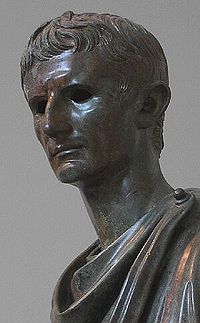
the transition, though subtle and disguised, was made complete. In that year, Octavian offered back all his extraordinary powers to the Senate, and in a carefully staged way, the Senate refused and in fact titled Octavian Augustus — "the revered one". He was always careful to avoid the title of rex – "king", and instead took on the titles of princeps – "first citizen" and imperator
Imperator
The Latin word Imperator was originally a title roughly equivalent to commander under the Roman Republic. Later it became a part of the titulature of the Roman Emperors as part of their cognomen. The English word emperor derives from imperator via Old French Empreur...
, a title given by Roman troops to their victorious commanders. All these titles, alongside the name of "Caesar", were used by all Roman Emperors and still survive slightly changed to this date. Prince
Prince
Prince is a general term for a ruler, monarch or member of a monarch's or former monarch's family, and is a hereditary title in the nobility of some European states. The feminine equivalent is a princess...
derives from "Princeps" and Emperor
Emperor
An emperor is a monarch, usually the sovereign ruler of an empire or another type of imperial realm. Empress, the female equivalent, may indicate an emperor's wife or a woman who rules in her own right...
from "Imperator", Caesar became "Kaiser
Kaiser
Kaiser is the German title meaning "Emperor", with Kaiserin being the female equivalent, "Empress". Like the Russian Czar it is directly derived from the Latin Emperors' title of Caesar, which in turn is derived from the personal name of a branch of the gens Julia, to which Gaius Julius Caesar,...
" (German
German language
German is a West Germanic language, related to and classified alongside English and Dutch. With an estimated 90 – 98 million native speakers, German is one of the world's major languages and is the most widely-spoken first language in the European Union....
) and "Czar" (Russian
Russian language
Russian is a Slavic language used primarily in Russia, Belarus, Uzbekistan, Kazakhstan, Tajikistan and Kyrgyzstan. It is an unofficial but widely spoken language in Ukraine, Moldova, Latvia, Turkmenistan and Estonia and, to a lesser extent, the other countries that were once constituent republics...
). The Roman Empire
Roman Empire
The Roman Empire was the post-Republican period of the ancient Roman civilization, characterised by an autocratic form of government and large territorial holdings in Europe and around the Mediterranean....
had been born.
Once Octavian named Tiberius
Tiberius
Tiberius , was Roman Emperor from 14 AD to 37 AD. Tiberius was by birth a Claudian, son of Tiberius Claudius Nero and Livia Drusilla. His mother divorced Nero and married Augustus in 39 BC, making him a step-son of Octavian...
as his heir, it was clear to everyone that even the hope of a restored Republic was dead. Most likely, by the time Augustus died, no one was old enough to know a time before a dictator ruled Rome. The Roman Republic had been changed into a despot
Despotism
Despotism is a form of government in which a single entity rules with absolute power. That entity may be an individual, as in an autocracy, or it may be a group, as in an oligarchy...
ic régime, which, underneath a competent and strong Emperor, could achieve military supremacy, economic prosperity, and a genuine peace, but under a weak or incompetent one saw its glory tarnished by cruelty, military defeats, revolts, and civil war.
A final assessment must necessarily be ambivalent. On the one hand, for the Roman state, the restoration of the monarchy led to apogee followed by a series of stabilizations resulting in a slow decline in the Greek East where it survived until the fall of Constantinople
Fall of Constantinople
The Fall of Constantinople was the capture of the capital of the Byzantine Empire, which occurred after a siege by the Ottoman Empire, under the command of Ottoman Sultan Mehmed II, against the defending army commanded by Byzantine Emperor Constantine XI...
in 1453 AD, nearly 1500 years later. On the other, the preservation of Roman republican culture and "virtues" was a paramount goal for Octavian, so it is ironic that his restoration of monarchy led to their complete corruption and decay and ultimately that of Latin culture in the West
Western Roman Empire
The Western Roman Empire was the western half of the Roman Empire after its division by Diocletian in 285; the other half of the Roman Empire was the Eastern Roman Empire, commonly referred to today as the Byzantine Empire....
(Sack of Rome
Sack of Rome
The city of Rome has been sacked on several occasions. Among the most famous:*Battle of the Allia – Rome is sacked by the Gauls after the Battle of the Allia*Sack of Rome – Rome is sacked by Alaric, King of the Visigoths...
). Again, had this death process of classical European civilization and the Roman republican form of "democracy" had the same stability as similar imperial institutions established in China at roughly the same time, today's preeminence of Western culture might not exist.