
All Topics  
Booker T. Washington

 
Booker T. Washington

   Email Print
   Bookmark   Link


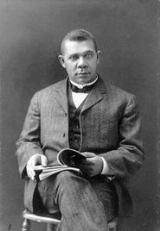
Booker T. Washington


Booker Taliaferro Washington (April 5, 1856 – November 14, 1915) was an American educator, orator, author and the dominant leader of the African-American community nationwide from the 1890s to his death. Born to slavery and freed by the war in 1865, as a young man, he became head of the new Tuskegee Institute, then a teachers' college
Normal school

A normal school was a school created to train high school graduates to be teachers. Its purpose was to establish teaching standards or norms, hence its name....
 for blacks. It became his base of operations. His "Atlanta Compromise" of 1895 appealed to middle class whites across the South, asking them to give blacks a chance to work and develop separately, while implicitly promising not to demand the vote.


Discussion
Ask a question about 'Booker T. Washington'
Start a new discussion about 'Booker T. Washington'
Answer questions from other users
Full Discussion Forum


Recent Posts


Quotations


Nothing ever comes to me, that is worth having, except as the result of hard work.

Chapter XII: Raising Money

From some things that I have said one may get the idea that some of the slaves did not want freedom. This is not true. I have never seen one who did not want to be free, or one who would return to slavery.

Chapter I: A Slave Among Slaves

Few things can help an individual more than to place responsibility on him, and to let him know that you trust him.

Chapter XI: Making Their Beds Before They Could Lie On Them

Cast down your bucket where you are.

Chapter XIV: The Atlanta Exposition Address, This address was a speech at the Cotton States and International Exposition, Atlanta (1895-09-18)

In all things that are purely social we can be as separate as the fingers, yet one as the hand in all things essential to mutual progress.

Chapter XIV: The Atlanta Exposition Address

No race can prosper till it learns that there is as much dignity in tilling a field as in writing a poem. It is at the bottom of life we must begin, and not at the top.

Chapter XIV: The Atlanta Exposition Address


Encyclopedia


Booker Taliaferro Washington (April 5, 1856 – November 14, 1915) was an American educator, orator, author and the dominant leader of the African-American community nationwide from the 1890s to his death. Born to slavery and freed by the war in 1865, as a young man, he became head of the new Tuskegee Institute, then a teachers' college
Normal school

A normal school was a school created to train high school graduates to be teachers. Its purpose was to establish teaching standards or norms, hence its name....
 for blacks. It became his base of operations. His "Atlanta Compromise" of 1895 appealed to middle class whites across the South, asking them to give blacks a chance to work and develop separately, while implicitly promising not to demand the vote. White leaders across the North, from politicians to industrialists, from philanthropists to Churchman, enthusiastically endorsed Washington's program, as did most middle class blacks across the country. A more militant northern group, led by W.E.B. DuBois rejected Washington's self-help and demanded recourse to politics. The critics were marginalized until the Civil Rights Movement of the 1960s, at which point more radical black leaders rejected Washington's philosophy and demanded federal civil rights laws.

Career overview


Washington was born into slavery
Slavery

Slavery is a form of forced labor where a person is compelled to Labor for another . Slaves are held against their will from the time of their capture, purchase, or birth, and are deprived of the right to leave, to refuse to work, or to receive Remuneration in return for their labor....
 to Jane, an enslaved African American woman on the Burroughs Plantation in southwest Virginia. He knew little about his white father. His family gained freedom in 1865 as the Civil War
American Civil War

The American Civil War , also known as the War Between the States and several Naming the American Civil War, was a civil war in the United States....
 ended. After working in salt furnaces and coal mines in West Virginia
West Virginia

West Virginia is a U.S. state in the Appalachian, Upland South, and Mid-Atlantic States regions of the United States, bordered by Virginia on the southeast, Kentucky on the southwest, Ohio on the northwest, and Pennsylvania and Maryland on the northeast....
 for several years, Washington made his way east to Hampton Institute, established to educate freedmen. There, he worked his way through his studies and later attended Wayland Seminary
Wayland Seminary

Wayland Seminary was the Washington, D.C. branch of the National Theological Institute. The Institute was established beginning in 1865 by several Baptist groups designed primarily at providing education and training for African-American freedmen to enter into the ministry....
 to complete preparation as an instructor. In 1881, Hampton president Samuel C. Armstrong
Samuel C. Armstrong

Samuel Chapman Armstrong was an United States educator and a commissioned officer in the Union Army during the American Civil War. He is best remembered for his work after the war as the founder and first principal of the normal school which is now Hampton University....
 recommended Washington to become the first leader of Tuskegee Institute, the new normal school
Normal school

A normal school was a school created to train high school graduates to be teachers. Its purpose was to establish teaching standards or norms, hence its name....
 (teachers' college) in Alabama
Alabama

Alabama is a state located in the Southern United States of the United States of America. It is bordered by Tennessee to the north, Georgia to the east, Florida and the Gulf of Mexico to the south, and Mississippi to the west....
. He headed what became Tuskegee University for the rest of his life.

Washington was the dominant figure in the African-American community in the United States from 1890 to 1915, especially after he achieved prominence for his "Atlanta Address of 1895
Atlanta Compromise

The Atlanta Cotton States and International Exposition Speech was an Speech on the topic of race relations given by black leader Booker T. Washington on September 11, 1895....
". To many politicians and the public in general, he was seen as a popular spokesman for African-American citizens. Representing the last generation of black
Black people

Black people is a term usually referring to a Race of humans with a dark skin color, but the term has also been used to categorise a number of diverse populations into one common group....
 leaders born into slavery, Washington was generally perceived as a credible proponent of education for freedmen in the post-Reconstruction, Jim Crow
Jim Crow laws

The Jim Crow laws were state and local laws in the United States enacted between 1876 and 1965. They mandated de jure Racial segregation in the United States in all public facilities, with a "separate but equal" status for black Americans and members of other non-white racial groups....
 South. Throughout the final 20 years of his life, he maintained his standing through a nationwide network of core supporters in many communities, including black educators, ministers, editors and businessmen, especially those who were liberal-thinking on social and educational issues. He gained access to top national leaders in politics, philanthropy and education, and was awarded honorary degrees. Critics called his network of supporters the "Tuskegee Machine."

Late in his career, Washington was criticized by leaders of the NAACP, which was formed in 1909. W.E.B. Du Bois
W.E.B. Du Bois

'William Edward Burghardt Du Bois' was an American civil rights activist, Pan-Africanism, sociologist, historian, author, and editor. At the age of 95, in 1963, he became a naturalized citizen of Ghana....
 especially looked for a harder line on activism to achieve civil rights
Civil rights

Civil and political rights are a class of rights ensuring things such as the protection of peoples' physical integrity; procedural fairness in law; protection from discrimination based on sexism, religious intolerance, Racism, Homophobia, etc; individual freedom of freedom of belief, freedom of speech, freedom of association, and freedom...
. He labeled Washington "the Great Accommodator". Washington's response was that confrontation could lead to disaster for the outnumbered blacks. He believed that cooperation with supportive whites was the only way in the long run to overcome pervasive racism. Washington secretly contributed substantially to legal challenges of segregation and disfranchisement of blacks. In his public role, he believed he could achieve more by skillful accommodation to the social realities of the age of segregation
Racial segregation

File:Segregated cinema entrance3.jpgRacial segregation is the separation of different Race s in daily life, such as eating in a restaurant, drinking from a drinking fountain, using a rest room, attending school, going to the movies, or in the rental or purchase of a home....
. Washington clearly had his eyes on a better future for blacks. Through his own personal experience, Washington knew that good education was a powerful tool for individuals to collectively accomplish that better future.

Washington's philosophy and tireless work on education issues helped him enlist both the moral and substantial financial support of many major white philanthropist
Philanthropist

A philanthropist is someone who engages in philanthropy; that is, someone who donates his or her time, money, and/or reputation to charitable organization....
s. He became friends with such self-made men as Standard Oil
Standard Oil

Standard Oil was a predominant United States integrated petroleum producing, transporting, refining, and marketing company. Established in 1870 as an Ohio Corporation, it was the largest oil refiner in the world and operated as a major company trust and was one of the world's first and largest multinational corporations until it was broken up...
 magnate Henry Huttleston Rogers
Henry H. Rogers

Henry Huttleston Rogers was a United States capitalism, businessman, industrialist, financier, and philanthropist. ...
; Sears, Roebuck and Company
Sears, Roebuck and Company

Sears, Roebuck and Co., commonly known as Sears, is an united States mid-range chain of international department stores, founded by Richard Warren Sears and Alvah Roebuck in the late 19th century....
 President Julius Rosenwald
Julius Rosenwald

File:Julius Rosenwald 02.jpgJulius Rosenwald was a United States of America tailor, manufacturer, business executive, and philanthropist. He is best known as a part-owner and leader of Sears, Roebuck and Company, and for the Rosenwald Fund which donated millions to support the education of African Americans and other philanthropic causes in...
; and George Eastman
George Eastman

George Eastman founded the Eastman Kodak Company and invented roll film, helping to bring photography to the mainstream. Roll film was also the basis for the invention of the film stock in 1888 by world's first filmmaker, Louis Le Prince, and a decade later by his followers L?on Bouly, Thomas Edison, the Lumi?re Brothers and Georges M?li?s....
, inventor and founder of Kodak. These individuals and many other wealthy men and women funded his causes, such as supporting Hampton
Hampton University

Hampton University is a Historically clever colleges and universities located in Hampton, Virginia, United States....
 and Tuskegee
Tuskegee University

Tuskegee University is a private university, Historically black colleges and universities university located in Tuskegee, Alabama, Alabama, United States....
 institutes. Each school was originally founded to produce teachers. However, graduates had often gone back to their local communities only to find precious few schools and educational resources to work with in the largely impoverished South.

To address those needs, Washington enlisted his philanthropic network in matching funds
Matching funds

Matching funds is a term used to describe the requirement or condition that a generally minimal amount of money or services-in-kind originate from the beneficiaries of financial amounts, usually for a purpose of charitable or public good....
 programs to stimulate construction of numerous rural public schools for black children in the South. Together, these efforts eventually established and operated over 5,000 schools and supporting resources for the betterment of blacks throughout the South
Southern United States

The Southern United States—commonly referred to as the American South, Dixie, or simply the South—constitutes a large distinctive region in the southeastern and south-central United States....
 in the late 19th and early 20th centuries. The local schools were a source of much community pride and were of priceless value to African-American families when poverty and segregation limited their children's chances. A major part of Washington's legacy, the number of model rural schools increased with matching funds from the Rosenwald Fund
Rosenwald Fund

The Rosenwald Fund was established in 1917 by Julius Rosenwald and his family for "the well-being of mankind."Julius Rosenwald, an American tailor, became part-owner of Sears, Roebuck and Company in 1895, and eventually served as its president from 1908 to 1922, and chairman of its Board of Directors until his death in 1932....
 into the 1930s.

Washington did much to improve the overall friendship and working relationship between the races in the United States. His autobiography, Up From Slavery
Up From Slavery

Up from Slavery is the 1901 autobiography of Booker T. Washington detailing his slow and steady rise from a slave child during the American Civil War, to the difficulties and obstacles he overcame to get an education at the new Hampton University, to his work establishing vocational schools?most notably the Tuskegee Institute in Alabama...
, first published in 1901, is still widely read today.

Youth, freedom and education

Booker T. Washington was born on April 5, 1856, on the Burroughs farm at the community of Hale's Ford, Virginia
Hale's Ford, Virginia

Hale's Ford was a small unincorporated community located in the northeastern corner of Franklin County, Virginia, Virginia about from Roanoke, Virginia....
 about 25 miles from Roanoke
Roanoke, Virginia

For the metropolitan area, see Roanoke, VA MSA.Roanoke is an independent city located in the Roanoke Metropolitan Area in the U.S. state of Virginia....
. His mother Jane was an enslaved black woman who worked as a cook and his father was an unknown white plantation owner. Under the laws of the time, his mother's status meant that Booker was born a slave. His given name was "Booker Taliaferro," but during his childhood he was known as only Booker; "Taliaferro" was temporarily forgotten.

Washington recalled Emancipation in early 1865: [Up from Slavery 19-21]
As the great day drew nearer, there was more singing in the slave quarters than usual. It was bolder, had more ring, and lasted later into the night. Most of the verses of the plantation songs had some reference to freedom.... Some man who seemed to be a stranger (a United States officer, I presume) made a little speech and then read a rather long paper -- the Emancipation Proclamation
Emancipation Proclamation

The Emancipation Proclamation consists of two Executive order s issued by United States President Abraham Lincoln during the American Civil War....
, I think. After the reading we were told that we were all free, and could go when and where we pleased. My mother, who was standing by my side, leaned over and kissed her children, while tears of joy ran down her cheeks. She explained to us what it all meant, that this was the day for which she had been so long praying, but fearing that she would never live to see.


In the summer of 1865, when he was nine, he migrated with his brother John and his sister Amanda to Malden
Malden, West Virginia

Malden is an unincorporated area in Kanawha County, West Virginia, West Virginia, United States, within the Charleston, West Virginia. The ZIP code for Malden is 25306 and the area code is 304....
 in Kanawha County, West Virginia
Kanawha County, West Virginia

Kanawha County is a county located in the U.S. state of West Virginia taking its name from the Native term, Kanawha: "place of white stone". As of 2000, the population was 200,073....
 to join his stepfather, Washington Ferguson. Washington's mother was a major influence on his schooling. Even though she couldn't read herself, she bought her son spelling books which encouraged him to read. She then enrolled him in an elementary school, where Booker took the last name of Washington because he found out that other children had more than one name. When the teacher called on him and asked for his name he answered, "Booker Washington," as if I had been called by that name all my life;..." He worked with his mother and other free blacks as a salt-packer and in a coal
Coal

Coal is a readily combustion black or brownish-black sedimentary rock. The harder forms, such as anthracite, can be regarded as metamorphic rock because of later exposure to elevated temperature and pressure....
 mine. He even signed up briefly as a hired hand on a steamboat. About the only other jobs available for blacks at the time were in agriculture. He was hired as a houseboy for Viola Ruffner (née Knapp)
Viola Ruffner

Viola Knapp Ruffner was a teacher and became the second wife of General Lewis Ruffner, a salt and coal mine owner and community leader in Kanawha County, West Virginia....
, the wife of General Lewis Ruffner
Lewis Ruffner

Lewis Ruffner was a salt manufacturer from Malden, West Virginia in Kanawha County, West Virginia in the area near what is now Charleston, West Virginia....
, who owned the salt-furnace and coal mine. Many other houseboys had failed to satisfy the demanding Mrs. Ruffner, but Booker's diligence met her standards. Encouraged by Mrs. Ruffner, young Booker attended school and learned to read and to write. Soon he sought more education than was available in his community.

Leaving Malden at sixteen, Washington enrolled at the Hampton Normal and Agricultural Institute
Hampton University

Hampton University is a Historically clever colleges and universities located in Hampton, Virginia, United States....
, in Hampton, Virginia
Hampton, Virginia

Hampton is an independent city in Virginia, and therefore not part of any Virginia county. One of the Seven Cities of Hampton Roads, it is on the southeast end of the Virginia Peninsula, bordering on Hampton Roads and Chesapeake Bay....
. Students with little income such as Washington could work at the school to pay their way. The normal school
Normal school

A normal school was a school created to train high school graduates to be teachers. Its purpose was to establish teaching standards or norms, hence its name....
 (teachers college) at Hampton was founded to train teachers, as education was seen as a critical need by the black community. Funding came from the federal government and white Protestant groups. From 1878 to 1879 Washington attended Wayland Seminary
Wayland Seminary

Wayland Seminary was the Washington, D.C. branch of the National Theological Institute. The Institute was established beginning in 1865 by several Baptist groups designed primarily at providing education and training for African-American freedmen to enter into the ministry....
 in Washington, D.C., and returned to teach at Hampton. The president of Hampton, Samuel C. Armstrong
Samuel C. Armstrong

Samuel Chapman Armstrong was an United States educator and a commissioned officer in the Union Army during the American Civil War. He is best remembered for his work after the war as the founder and first principal of the normal school which is now Hampton University....
 recommended Washington to become the first principal at Tuskegee Institute, a similar school being founded in Alabama
Alabama

Alabama is a state located in the Southern United States of the United States of America. It is bordered by Tennessee to the north, Georgia to the east, Florida and the Gulf of Mexico to the south, and Mississippi to the west....
.

Tuskegee Normal and Industrial Institute

Booker T
The organizers of the new all-black Tuskegee Normal and Industrial Institute
Tuskegee University

Tuskegee University is a private university, Historically black colleges and universities university located in Tuskegee, Alabama, Alabama, United States....
 found the energetic leader they sought in 25 year-old Booker T. Washington. Washington believed with a little self help, people may go from poverty to success. The new school opened on July 4, 1881, initially using space in a local church. The next year, Washington purchased a former plantation
Plantation

A plantation is usually a large farm or Estate , especially in a tropical or semitropical country, like Brazil or Nicaragua on which cotton, tobacco, lice coffee, sugar cane and the like are cultivated, usually by resident laborers....
, which became the permanent site of the campus. Under his direction, his students literally built their own school: constructing classrooms, barns and outbuildings; growing their own crops and raising livestock, and providing for most of their own basic necessities. Both men and women had to learn trades as well as academics. The Tuskegee faculty utilized each of these activities to teach the students basic skills to take back to the mostly rural black communities throughout the South. The main goal was not to produce farmers and tradesmen, but teachers of farming and trades who taught in the new high schools and colleges for blacks across the South. The school later grew to become the present-day Tuskegee University
Tuskegee University

Tuskegee University is a private university, Historically black colleges and universities university located in Tuskegee, Alabama, Alabama, United States....
.

The institute illustrated Washington's aspirations for his race. His theory was that by providing needed skills to society, African Americans would play their part, leading to acceptance by white Americans. He believed that blacks would eventually gain full participation in society by showing themselves to be responsible, reliable American citizens. Shortly after the Spanish-American War
Spanish-American War

The Spanish?American War was an armed military conflict between Spain and the United States that took place between April and August 1898, over the issues of the liberation of Cuba....
, President William McKinley
William McKinley

William McKinley, Jr. was the List of Presidents of the United States President of the United States, and the last veteran of the American Civil War to be elected....
 and most of his cabinet visited the College President at the University. Washington was head of the school until his death in 1915. By then Tuskegee's endowment had grown to over $1.5 million, compared to the initial $2,000 annual appropriation.

Marriages and children


Washington was married three times. In his autobiography Up From Slavery
Up From Slavery

Up from Slavery is the 1901 autobiography of Booker T. Washington detailing his slow and steady rise from a slave child during the American Civil War, to the difficulties and obstacles he overcame to get an education at the new Hampton University, to his work establishing vocational schools?most notably the Tuskegee Institute in Alabama...
, he gave all three of his wives credit for their contributions at Tuskegee. He emphatically said that he would not have been successful without them.

Fannie N. Smith was from Malden, West Virginia
Malden, West Virginia

Malden is an unincorporated area in Kanawha County, West Virginia, West Virginia, United States, within the Charleston, West Virginia. The ZIP code for Malden is 25306 and the area code is 304....
, the same Kanawha River Valley
Kanawha River

The Kanawha River is a tributary of the Ohio River, approximately 97 mi long, in the U.S. state of West Virginia. The largest inland waterway in West Virginia, it has formed a significant industrial region of the state since the middle of the 19th century....
 town where Washington had lived from age nine to sixteen. He maintained ties there all his life. Washington and Smith were married in the summer of 1882. They had one child, Portia M. Washington. Fannie died in May 1884..

Washington next wed Olivia A. Davidson
Olivia A. Davidson

Olivia America Davidson Washington, was a co-founder of the Tuskegee Institute and the wife of Booker T. Washington. She was born on June 11, 1854 in Mercer County, Virginia, now Mercer County, West Virginia....
 in 1885. Davidson was born in Ohio
Ohio

Ohio is a Midwestern United States U.S. state of the United States. As part of the Great Lakes region , Ohio has long been a cultural and geographical crossroads in North America....
 and studied at Hampton Institute and the Massachusetts State Normal School
Framingham State College

Framingham State College is located in Framingham, Massachusetts, Massachusetts, USA, 20 miles from Boston. It offers undergraduate programs in a range of subjects from Art to Biology to Communication Arts, and Graduate school programs including MBA, MEd, and Master's degree....
 at Framingham
Framingham, Massachusetts

Framingham is a town in Middlesex County, Massachusetts, Massachusetts, United States. As of the 2000 census, the population was 66,910, making it the most populous New England town in New England....
. She taught in Mississippi
Mississippi

Mississippi is a U.S. state located in the Deep South of the United States. Jackson, Mississippi is the state capital and largest city. The state's name comes from the Mississippi River, which flows along its western boundary, and takes its name from the Anishinaabe language word misi-ziibi ....
 and Tennessee
Tennessee

Tennessee is a U.S. state located in the Southern United States United States. In 1796, it became the sixteenth state to join the United States....
 before going to Tuskegee to work. Washington met Davidson when she was a teacher at Tuskegee. She became the assistant principal there. They had two sons, Booker T. Washington Jr. and Ernest Davidson Washington, before she died in 1889.

Washington's third marriage was in 1893 to Margaret James Murray. She was from Mississippi and was a graduate of Fisk University
Fisk University

Fisk University is a Historically black colleges and universities founded in 1866 in Nashville, Tennessee, Tennessee, United States The world-famous Fisk Jubilee Singers started as a group of students who performed to earn enough money to save the school at a critical time of financial shortages....
, also a historically black college. They had no children together, but she helped rear Washington's children. Murray outlived Washington and died in 1925.

Politics and the Atlanta Compromise

Washington’s 1895 Atlanta Exhibition address was viewed as an “revolutionary moment” by both African-Americans and whites across the country. He was supported by W.E.B. Du Bois
W.E.B. Du Bois

'William Edward Burghardt Du Bois' was an American civil rights activist, Pan-Africanism, sociologist, historian, author, and editor. At the age of 95, in 1963, he became a naturalized citizen of Ghana....
 at the time but years later the two had a falling out due to difference in direction over the remedy required to reversing disenfranchisement. After the falling out, Du Bois and his supporters took to erroneously referring to the Atlanta Exposition speech as the "Atlanta Compromise" speech to illustrate their belief that Washington was too accommodating to white interests.

Washington advocated “go slow” accommodationism. This required African-Americans to accept the sacrifice of political power, civil rights and higher education for the youth that existed in the current system. His belief was that African-Americans should “concentrate all their energies on industrial education, and accumulation of wealth, and the conciliation of the South.” Washington valued the "industrial" education, as it provided critical skills for the jobs then available to the majority of African-Americans at the time. It would be these skills that would lay the foundation for the creation of stability that the African-American community required in order to move forward. He believed that in the long term “blacks would eventually gain full participation in society by showing themselves to be responsible, reliable American citizens” His approach advocated for an initial step towards equal rights, rather than full equality under the law. It would be this step that would provide the economic power to back up their demands for equality in the future This action, over time, would provide the proof to a deeply prejudiced white America that they where not in fact “ ’naturally’ stupid and incompetent”

This stance was contrary to what many blacks form the North envisioned. Du Bois wanted blacks to have the same "classical" liberal arts
Liberal arts

The term liberal arts refers to the education derived from the Classical education curriculum....
 education as whites did, along with voting rights and civic equality. He believed that an elite he called the Talented Tenth would advance to lead the race to a wider variety of occupations. The source of division between Du Bois and Washington was generated by the differences in how African-Americans where treated in the North versus the South. Many in the North felt that they were being “ 'led', and authoritatively spoken for, by a Southern accommodationist imposed on them primarily by Southern whites”. Both men sought to define the best means to improve the conditions of the post-Civil War African-American community through education.

Blacks were solidly Republican in this period. Southern states disfranchised most blacks and many poor whites from 1890-1908 through constitutional amendments and statutes that created barriers to voter registration and voting such as pole taxes and literacy tests. More blacks continued to vote in border and northern states.

Washington worked and socialized with many white politicians and industry leaders. Much of his expertise was his ability to persuade wealthy whites to donate money to black causes. He argued that the surest way for blacks eventually to gain equal social rights was to demonstrate “patience, industry, thrift, and usefulness” This was the key to improved conditions for African Americans in the United States. Because they had only recently been granted emancipation, he believed they could not expect too much at once. Washington said, "I have learned that success is to be measured not so much by the position that one has reached in life as by the obstacles which he has had to overcome while trying to succeed.

Along with W.E.B. Du Bois
W.E.B. Du Bois

'William Edward Burghardt Du Bois' was an American civil rights activist, Pan-Africanism, sociologist, historian, author, and editor. At the age of 95, in 1963, he became a naturalized citizen of Ghana....
, he partly organized the "Negro exhibition" at the 1900 Exposition Universelle
Exposition Universelle (1900)

The Exposition Universelle of 1900 was a world's fair held in Paris, France, to celebrate the achievements of the past century and to accelerate development into the next....
 in Paris, where photos, taken by his friend Frances Benjamin Johnston
Frances Benjamin Johnston

Frances "Fannie" Benjamin Johnston was one of the earliest United States female photographers and photojournalists....
, of Hampton Institute's black students were displayed. The exhibition aimed at showing Afro-Americans' positive contributions to American society .

While not publicly confrontational, Washington privately contributed substantial funds for legal challenges to segregation
Racial segregation

File:Segregated cinema entrance3.jpgRacial segregation is the separation of different Race s in daily life, such as eating in a restaurant, drinking from a drinking fountain, using a rest room, attending school, going to the movies, or in the rental or purchase of a home....
 and disfranchisement
Disfranchisement

Disfranchisement is the revocation of the right of suffrage to a person or group of people, or rendering a person's vote less effective, or ineffective....
, such as the case of Giles v. Harris
Giles v. Harris

Giles v. Harris, Case citation , was a turn-of-the-century Supreme Court of the United States case in which the Court upheld a state constitution's requirements for voter registration and qualifications....
, which went before the United States Supreme Court in 1903.

Wealthy friends and benefactors

and Robert C. Ogden, seen here in 1906 while visiting Tuskegee Institute]] Washington associated with the richest and most powerful businessmen and politicians of the era. He was seen as a spokesperson for African Americans and became a conduit for funding educational programs. His contacts included such diverse and well-known personages as Andrew Carnegie
Andrew Carnegie

Andrew Carnegie was a Scotland-born United States industrialist, List of business people, and a major philanthropist. He was an immigrant as a child with his parents....
, William Howard Taft
William Howard Taft

William Howard Taft was the List of Presidents of the United States President of the United States, the tenth Chief Justice of the United States, a leader of the progressive conservative wing of the History of the United States Republican Party in the early 20th century, a pioneer in international arbitration and staunch advocate of world pe...
, John D. Rockefeller
John D. Rockefeller

John Davison Rockefeller was an United States industrialist and philanthropist. Rockefeller revolutionized the petroleum industry and defined the structure of modern philanthropy....
, Henry Huttleston Rogers
Henry H. Rogers

Henry Huttleston Rogers was a United States capitalism, businessman, industrialist, financier, and philanthropist. ...
, Julius Rosenwald
Julius Rosenwald

File:Julius Rosenwald 02.jpgJulius Rosenwald was a United States of America tailor, manufacturer, business executive, and philanthropist. He is best known as a part-owner and leader of Sears, Roebuck and Company, and for the Rosenwald Fund which donated millions to support the education of African Americans and other philanthropic causes in...
, Robert Ogden, Collis P. Huntington, and William Baldwin, who donated large sums of money to agencies such as the Jeanes and Slater Funds. As a result, countless small schools were established through his efforts, in programs that continued many years after his death. Along with rich people, black communities also helped their communities by donating time, money and labor to schools. Churches such as the Baptist and Methodist also supported black schools in both the elementary and secondary levels.

Henry Rogers


A representative case of an exceptional relationship was Washington's friendship with millionaire industrialist and financier Henry H. Rogers
Henry H. Rogers

Henry Huttleston Rogers was a United States capitalism, businessman, industrialist, financier, and philanthropist. ...
 (1840-1909). Henry Rogers was a self-made man, who had risen from a modest working-class family to become a principal of Standard Oil
Standard Oil

Standard Oil was a predominant United States integrated petroleum producing, transporting, refining, and marketing company. Established in 1870 as an Ohio Corporation, it was the largest oil refiner in the world and operated as a major company trust and was one of the world's first and largest multinational corporations until it was broken up...
, and had become one of the richest men in the United States. Around 1894, Rogers heard Washington speak at Madison Square Garden
Madison Square Garden

Madison Square Garden, often abbreviated as MSG and known colloquially as The Garden, has been the name of four arenas in New York City....
. The next day, he contacted Washington and requested a meeting, during which Washington later recounted that he was told that Rogers "was surprised that no one had 'passed the hat' after the speech." The meeting began a close relationship that was to extend over a period of 15 years. Although he and the very-private Rogers openly became visible to the public as friends, and Washington was a frequent guest at Rogers' New York office, his Fairhaven, Massachusetts
Fairhaven, Massachusetts

Fairhaven is a New England town in Bristol County, Massachusetts, Massachusetts, United States. The population was 16,159 at the 2000 census....
 summer home, and aboard his steam yacht Kanawha
Kanawha (1899)

Kanawha was a 471-ton steamboat luxury yacht initially built in 1899 for millionaire industrialist and financier Henry H. Rogers . One of the key men in the Standard Oil Trust, Rogers was one of the last of the robber baron of the Gilded Age in the United States....
, the true depth and scope of their relationship was not publicly revealed until after Rogers' sudden death of an apoplectic stroke
Stroke

A stroke is the rapidly developing loss of brain function due to a disturbance in the blood supply to the brain. According to the National Stroke Association, a "stroke" occurs when a blood clot blocks and artery or a blood vessel breaks, interrupting blood flow to an area of the brain....
 in May 1909.

Bookertwashington1909vavwtour
A few weeks later, Washington went on a previously planned speaking tour along the newly completed Virginian Railway
Virginian Railway

The Virginian Railway was a Class I railroad located in Virginia and West Virginia in the United States. The VGN was created to transport high quality "smokeless" bituminous coal from southern West Virginia to port at Hampton Roads....
, a $40 million dollar enterprise which had been built almost entirely from a substantial portion of Rogers' personal fortune. As Washington rode in the late financier's private railroad car, "Dixie", he stopped and made speeches at many locations, where his companions later recounted that he had been warmly welcomed by both black and white citizens at each stop.

Washington revealed that Rogers had been quietly funding operations of 65 small country schools for African Americans, and had given substantial sums of money to support Tuskegee Institute and Hampton Institute. He also disclosed that Rogers had encouraged programs with matching funds
Matching funds

Matching funds is a term used to describe the requirement or condition that a generally minimal amount of money or services-in-kind originate from the beneficiaries of financial amounts, usually for a purpose of charitable or public good....
 requirements so the recipients would have a stake in knowing that they were helping themselves through their own hard work and sacrifice, and thereby enhance their self-esteem.

Anna T. Jeanes


$1,000,000 was entrusted to Washington by Anna T. Jeanes
Anna T. Jeanes

Anna T. Jeanes was an United States Philanthropy. She was born in Philadelphia, the city where she gave Spring Garden Institute, a technical school, $200,000; $100,000 to the Hicksite Friends; $200,000 to the Religious Society of Friends schools of Philadelphia; and $200,000 to the Home for Aged Friends, an institution where she spent the...
 (1822-1907) of Philadelphia in 1907. She hoped to construct some elementary schools for Negro
Negro

Negro is a term referring to people of Black people ancestry. Prior to the shift in the lexicon of American and worldwide classification of race and ethnicity in the late 1960s, the appellation was accepted as a normal neutral formal term both by those of Black African descent as well as non-African blacks....
 children in the South. Her contributions and those of Henry Rogers and others funded schools in many communities where the white people were also very poor, and few funds were available for Negro schools.

Julius Rosenwald


Julius Rosenwald (1862-1932) was another self-made wealthy man with whom Washington found common ground. By 1908, Rosenwald, son of an immigrant clothier, had become part-owner and president of Sears, Roebuck and Company
Sears, Roebuck and Company

Sears, Roebuck and Co., commonly known as Sears, is an united States mid-range chain of international department stores, founded by Richard Warren Sears and Alvah Roebuck in the late 19th century....
 in Chicago. Rosenwald was a philanthropist who was deeply concerned about the poor state of African American education, especially in the Southern states.

In 1912 Rosenwald was asked to serve on the Board of Directors of Tuskegee Institute, a position he held for the remainder of his life. Rosenwald endowed Tuskegee so that Washington could spend less time traveling to seek funding and devote more time towards management of the school. Later in 1912, Rosenwald provided funds for a pilot program involving six new small schools in rural Alabama, which were designed, constructed and opened in 1913 and 1914 and overseen by Tuskegee; the model proved successful. Rosenwald established the The Rosenwald Fund
Rosenwald Fund

The Rosenwald Fund was established in 1917 by Julius Rosenwald and his family for "the well-being of mankind."Julius Rosenwald, an American tailor, became part-owner of Sears, Roebuck and Company in 1895, and eventually served as its president from 1908 to 1922, and chairman of its Board of Directors until his death in 1932....
. The school building program was one of its largest programs. Using state-of-the-art architectural plans initially drawn by professors at Tuskegee Institute, the Rosenwald Fund spent over four million dollars to help build 4,977 schools, 217 teachers' homes, and 163 shop buildings in 883 counties in 15 states, from Maryland to Texas. The Rosenwald Fund used a system of matching grants
Matching funds

Matching funds is a term used to describe the requirement or condition that a generally minimal amount of money or services-in-kind originate from the beneficiaries of financial amounts, usually for a purpose of charitable or public good....
, and black communities raised more than $4.7 million to aid the construction. These schools became known as Rosenwald Schools. By 1932, the facilities could accommodate one third of all African American children in Southern U.S. schools.

Up from Slavery an invitation to the White House


In an effort to inspire the "commercial, agricultural, educational, and industrial advancement" of African Americans, Washington founded the National Negro Business League
National Negro Business League

The National Negro Business League was an United States organization founded in Boston, Massachusetts in 1900 by Booker T. Washington. The mission and main goal of the National Negro Business League was "to promote the commercial and financial development of the Negro." The organization was formally incorporated in 1901 in New York City, and...
 (NNBL) in 1900.

When Washington's autobiography
Autobiography

An autobiography is a biography written by its subject . The term was first used by the poet Robert Southey in 1809 in the English language Periodical publication Quarterly Review, but the form goes back to antiquity....
, Up From Slavery
Up From Slavery

Up from Slavery is the 1901 autobiography of Booker T. Washington detailing his slow and steady rise from a slave child during the American Civil War, to the difficulties and obstacles he overcame to get an education at the new Hampton University, to his work establishing vocational schools?most notably the Tuskegee Institute in Alabama...
, was published in 1901, it became a bestseller and had a major impact on the African American community, and its friends and allies. Washington in 1901 was the first African-American ever invited to the White House as the guest of President Theodore Roosevelt
Theodore Roosevelt

Theodore Roosevelt , also known as T.R., and to the public as Teddy, was the List of Presidents of the United States President of the United States....
.

Lifetime of overwork, death at age 59


3c11868r
Despite his travels and widespread work, Washington remained as principal of Tuskegee. Washington's health was deteriorating rapidly; he collapsed in New York City and was brought home to Tuskegee, where he died on November 14, 1915 at the age of 59. The cause of death was unclear, probably from nervous exhaustion and arteriosclerosis
Arteriosclerosis

Arteriosclerosis refers to a stiffening of arteries.Arteriosclerosis is a general term describing any hardening of medium or large arteries ...
. He was buried on the campus of Tuskegee University near the University Chapel.

His death was thought at the time to have been a result of congestive heart failure, aggravated by overwork. In March 2006, with the permission of his descendants, examination of medical records indicated that he died of hypertension
Hypertension

Hypertension, also referred to as high blood pressure, HTN or HPN, is a medical condition in which the blood pressure is chronically elevated....
, with a blood pressure
Blood pressure

Blood pressure is the pressure exerted by circulating blood on the walls of blood vessels, and constitutes one of the principal vital signs. The pressure of the circulating blood decreases as it moves away from the heart through artery and capillary, and toward the heart through veins....
 more than twice normal, confirming what had long been suspected.

At his death Tuskegee's endowment exceeded US$1.5 million. His greatest life's work, the work of education of blacks in the South, was well underway and expanding.

Honors and Memorials


For his contributions to American society, Washington was granted an honorary master's degree
Master's degree

A master's degree provides a mastery or high-order overview of a specific field of study or area of profession. Within the area studied, graduates possess advanced knowledge of a specialized body of theory and applied topics; high order skills in analysis, Critical thinking and/or professional application; and the ability to problem solving a...
 from Harvard University
Harvard University

Harvard University is a private university in Cambridge, Massachusetts, Massachusetts, United States, and a member of the Ivy League. Founded in 1636 by the colonial Massachusetts legislature, Harvard is the Colonial Colleges institution of higher learning in the United States....
 in 1896 and an honorary doctorate from Dartmouth College
Dartmouth College

Dartmouth College is a private university, coeducational university located in Hanover, New Hampshire, New Hampshire. Incorporated as "Trustees of Dartmouth College,"...
 in 1901.

Washington, as the guest of President Theodore Roosevelt
Theodore Roosevelt

Theodore Roosevelt , also known as T.R., and to the public as Teddy, was the List of Presidents of the United States President of the United States....
 in 1901, was the first African-American ever invited to the White House. At the end of the 2008 presidential election, the defeated Republican candidate, Senator John McCain
John McCain

John Sidney McCain III is the senior senator United States United States Senator from Arizona. He was the Republican Party presidential nominee in the 2008 United States presidential election....
, referred to Washington’s visit to the White House a century before as the seed that blossomed into the first African American becoming the President of the United States, Barack Obama
Barack Obama

Barack Hussein Obama II is the List of Presidents of the United States and current President of the United States. He is the first African American to hold the office....
.

In 1934, Robert Russa Moton
Robert Russa Moton

Robert Russa Moton was an African American educator and author. He served as an administrator at Hampton Institute and was named principal of Tuskegee Institute in 1915 after the death of Dr....
, Washington's successor as president of Tuskegee University, arranged an air tour for two African Americans aviators, and afterward the plane was christened the Booker T. Washington.

In 1942, the Liberty Ship
Liberty ship

Liberty ships were cargo ships built in the United States during World War II. Though British in conception, they were adapted by the U.S. as they were cheap and quick to build, and came to symbolize U.S....
 Booker T. Washington was named in his honor, the first major oceangoing vessel to be named after an African American. The ship was christened by Marian Anderson
Marian Anderson

Marian Anderson was an United States Contralto and one of the most celebrated singers of the twentieth century. She possessed a rich and vibrant voice with an intrinsic quality of beauty....
.

On April 7, 1940, Washington became the first African American to be depicted on a United States postage stamp. The first coin to feature an African American was the Booker T. Washington Memorial Half Dollar that was minted by the United States from 1946 to 1951. He was also depicted on a U.S. Half Dollar from 1951-1954.

On April 5, 1956, the hundredth anniversary of Washington's birth, the house where he was born in Franklin County, Virginia
Franklin County, Virginia

Franklin County is a county located in the U.S. state of Virginia. As of the United States Census, 2000, the population was 47,286. Its county seat is Rocky Mount, Virginia....
, was designated as the Booker T. Washington National Monument
Booker T. Washington National Monument

Booker T. Washington National Monument is a unit of the National Park Service located in Franklin County, Virginia, USA near the community of Hardy, Virginia about 25 miles southeast of Roanoke, Virginia....
. A state park in Chattanooga, Tennessee
Chattanooga, Tennessee

Chattanooga, "the Scenic City", is the fourth-largest city in Tennessee , and the county seat of Hamilton County, Tennessee, in the United States....
 was named in his honor, as was a bridge spanning the Hampton River
Hampton River

The Hampton River is a short tidal estuary which empties into Hampton Roads near its mouth. Hampton Roads in turn empties into the southern end of Chesapeake Bay in southeast Virginia in the United States....
 adjacent to his alma mater, Hampton University.

In 1984, Hampton University dedicated a Booker T. Washington Memorial on campus near the historic Emancipation Oak
Emancipation Oak

Emancipation Oak is a historic tree located on the campus of Hampton University in what is now the Hampton, Virginia. . The large sprawling oak is 98 feet in diameter, with branches which extend upward as well as laterally, as if offering refuge....
, establishing, in the words of the University, "a relationship between one of America's great educators and social activists, and the symbol of Black achievement in education."

Numerous high schools
Booker T. Washington High School

Booker T. Washington High School refers to several schools in the United States named after the African-American education pioneer Booker T. Washington:...
 and middle schools
Booker T. Washington Middle School

Booker T. Washington Middle School refers to several schools named after the African-American education pioneer Booker T. Washington:* Booker T....
 across the United States have been named after Booker T. Washington.

At the center of the campus at Tuskegee University, the Booker T. Washington Monument, called "Lifting the Veil," was dedicated in 1922. The inscription at its base reads:
"He lifted the veil of ignorance from his people and pointed the way to progress through education and industry."


In 2002, scholar Molefi Kete Asante
Molefi Kete Asante

Molefi Kete Asante is a contemporary American Academia in the field of African studies and African American Studies. He is currently Professor in the Department of African American Studies at Temple University, where he founded the first PhD program in African American Studies....
 listed Booker T. Washington on his list of 100 Greatest African Americans
100 Greatest African Americans

100 Greatest African Americans is a biographical dictionary of the one hundred greatness African Americans, as assessed by Molefi Kete Asante in 2002....
.

Primary sources

  • Washington, Booker T. The Awakening of the Negro, The Atlantic Monthly, 78 (September, 1896).
  • (1901).
  • Washington,Booker T. , Louis R Harlan, John W. Blassingame , University of Illinois Press (1972) ISBN 0252002423 Google Book Search. Retrieved on February 4th, 2009.
  • DuBois, W. E. B. The Souls of Black Folk A. C. McClurg and Co. (1903)
  • Washington, Booker T. The Atlanta Cotton States Exposition Address (Sep, 1895).
  • University of Illinois Press
    University of Illinois Press

    The University of Illinois Press , is a major United States university press and part of the University of Illinois at Urbana-Champaign....
     online version of complete fourteen volume set of all letters to and from Booker T. Washington.


Secondary sources

  • .
  • W. Fitzhugh Brundage, ed Booker T. Washington and Black Progress: Up from Slavery 100 Years Later (2003).
  • Louis R. Harlan, Booker T. Washington: The Making of a Black Leader, 1856-1901 (1972) the standard biography, vol 1.
  • , the standard scholarly biography vol 2.
  • .
  • Louis R. Harlan. "The Secret Life of Booker T. Washington." Journal of Southern History 37:2 (1971). in JSTOR
    JSTOR

    JSTOR is a United States-based Internet system for archiving academic journals, founded in 1995. It provides full-text searches of Digitizing back issues of several hundred well-known journals, dating back to 1665 in the case of the Philosophical Transactions of the Royal Society....
     Documents Booker T. Washington's secret financing and directing of litigation against segregation and disfranchisement.
  • August Meier. "Toward a Reinterpretation of Booker T. Washington." The Journal of Southern History, 23#2 (May, 1957), pp. 220-227. . Documents Booker T. Washington's secret financing and directing of litigation against segregation and disfranchisement.
  • Norrell, Robert J. Up from History: The Life of Booker T. Washington (2009). Belknap Press/Harvard University Press. ISBN-10: 067403211X; ISBN-13: 978-0674032118, favorable scholarly biography
  • .
  • Pole, J. R. Review: Of mr booker T. washington and others; the children of pride. vol. II: The Historical Journal 17, (4) (Dec,1974) in
  • Bauerlein, Mark. Booker T. washington and W.E.B. du bois: The origins of a bitter intellectual battle. The Journal of Blacks in Higher Education (46) (Winter,2004) in
  • Crouch,Stanley The Artificial White Man: Essays on Authenticity Basic Civitas Books,ISBN 0465015166 (2005)


See also

  • African American literature
    African American literature

    African American literature is the body of literature produced in the United States by writers of African descent. The genre traces its origins to the works of such late 18th century writers as Phillis Wheatley and Olaudah Equiano, reaching early high points with slave narratives and the Harlem Renaissance, and continuing today with author...
  • List of African American firsts
  • Booker T. Washington High School
    Booker T. Washington High School

    Booker T. Washington High School refers to several schools in the United States named after the African-American education pioneer Booker T. Washington:...


External links

  • Toronto, Ont.; Naperville, Ill.: J. L. Nichols & Co., c1901.
  • London: Hodder and Stoughton, 1906.
  • Garden City, New York: Doubleday, Page & Company, 1911.
  • Garden City, N.Y.: Doubleday & Co., c1901.
  • searchable index to complete annotated text of all important letters to and from Washington and all his writings.
  • from the American Social History Project / Center for Media and Learning (Graduate Center, CUNY) and the Center for History and New Media (George Mason University)