

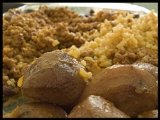
Cholent

Encyclopedia
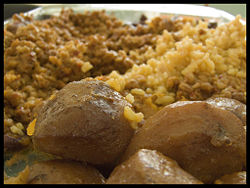
Stew
A stew is a combination of solid food ingredients that have been cooked in liquid and served in the resultant gravy. Ingredients in a stew can include any combination of vegetables , meat, especially tougher meats suitable for slow-cooking, such as beef. Poultry, sausages, and seafood are also used...
. It is usually simmered
Simmering
Simmering is a food preparation technique in which foods are cooked in hot liquids kept at or just below the boiling point of water , but higher than poaching temperature...
overnight for 12 hours or more, and eaten for lunch on Shabbat
Shabbat
Shabbat is the seventh day of the Jewish week and a day of rest in Judaism. Shabbat is observed from a few minutes before sunset on Friday evening until a few minutes after when one would expect to be able to see three stars in the sky on Saturday night. The exact times, therefore, differ from...
(the Sabbath). Cholent was developed over the centuries to conform with Jewish religious law
Halakha
Halakha — also transliterated Halocho , or Halacha — is the collective body of Jewish law, including biblical law and later talmudic and rabbinic law, as well as customs and traditions.Judaism classically draws no distinction in its laws between religious and ostensibly non-religious life; Jewish...
s that prohibit cooking on the Sabbath. The pot is brought to boil on Friday before the Sabbath begins, and kept on a blech
Blech
A blech is a metal sheet used by many observant Jews to cover stovetop burners on Shabbat , as part of the precautions taken to avoid violating the halachic prohibition against cooking on the Sabbath.- Common use : A blech (from the German by way of Yiddish word for tin or sheet metal) is a metal...
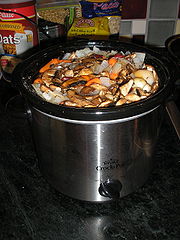
or hotplate, or placed in a slow oven or electric slow cooker
Slow cooker
A slow cooker, also known as a Crock-Pot or Slo-Cooker , is a countertop electrical cooking appliance that is used for simmering, which requires maintaining a relatively low temperature compared to other cooking methods for many hours, allowing unattended cooking...
until the following day.
There are many variations of the dish, which is standard in both the Ashkenazi and Sephardi kitchens. The basic ingredients of cholent are meat, potato
Potato
The potato is a starchy, tuberous crop from the perennial Solanum tuberosum of the Solanaceae family . The word potato may refer to the plant itself as well as the edible tuber. In the region of the Andes, there are some other closely related cultivated potato species...
es, beans and barley. Sephardi-style hamin uses rice instead of beans and barley, and chicken instead of beef. A traditional Sephardi addition is whole eggs in the shell (haminados), which turn brown overnight. Ashkenazi cholent often contains kishke
Kishke (Jewish food)
Kishke or kishka , also known as stuffed derma, is a Jewish dish traditionally made from beef intestine stuffed with flour or matzo meal, schmaltz and spices. In modern cooking, edible synthetic casings often replace the beef intestine...
or helzel
Helzel
Helzel is an Ashkenazi Jewish dish. It is a sort of sausage made from chicken neck skin stuffed with flour, schmaltz, internal meats , and fried onions and sewn up with a thread. Sometimes the stuffing is flavored with garlic and black pepper. Helzel may be cooked in chicken soup or used as an...
– a sausage casing or a chicken neck skin stuffed with a flour-based mixture. Slow overnight cooking allows the flavors of the various ingredients to permeate and produces the characteristic taste of cholent.
Other names
Hamin (חמין) , the Sephardi version of cholent popular also in IsraelIsrael
The State of Israel is a parliamentary republic located in the Middle East, along the eastern shore of the Mediterranean Sea...
, derives from the Hebrew word חם – "hot", as it is always served fresh off the stove, oven, or slow cooker. The origin of this name is the Mishnaic phrase tomnim et ha’chamim (Hebrew for "bury the hot"), which essentially provides the Rabbinical
Oral Torah
The Oral Torah comprises the legal and interpretative traditions that, according to tradition, were transmitted orally from Mount Sinai, and were not written in the Torah...
prescription for keeping food hot for the Sabbath without lighting a fire.
In Germany
Germany
Germany , officially the Federal Republic of Germany , is a federal parliamentary republic in Europe. The country consists of 16 states while the capital and largest city is Berlin. Germany covers an area of 357,021 km2 and has a largely temperate seasonal climate...
, Holland, and European countries the special hot dish for the Sabbath lunch is known as schalet, shalent, or shalet. These western Yiddish words are straight synonyms of the eastern Yiddish cholent.d
In Morocco
Morocco
Morocco , officially the Kingdom of Morocco , is a country located in North Africa. It has a population of more than 32 million and an area of 710,850 km², and also primarily administers the disputed region of the Western Sahara...
, the hot dish eaten by Jews on the Sabbath is traditionally called s’hina or skhina (Arabic for "the warm dish"; Hebrew
Hebrew language
Hebrew is a Semitic language of the Afroasiatic language family. Culturally, is it considered by Jews and other religious groups as the language of the Jewish people, though other Jewish languages had originated among diaspora Jews, and the Hebrew language is also used by non-Jewish groups, such...
spelling סכינא). S'hina is made with chickpeas, rice or hulled wheat, potatoes, meat, and whole eggs simmering in the pot.
In Spain
Spain
Spain , officially the Kingdom of Spain languages]] under the European Charter for Regional or Minority Languages. In each of these, Spain's official name is as follows:;;;;;;), is a country and member state of the European Union located in southwestern Europe on the Iberian Peninsula...
and the Maghreb
Maghreb
The Maghreb is the region of Northwest Africa, west of Egypt. It includes five countries: Morocco, Algeria, Tunisia, Libya, and Mauritania and the disputed territory of Western Sahara...
a similar dish is called adafina or dafina, from the Arabic d’fina or t’fina for "buried" (which echoes the Mishnaic phrase "bury the hot food"). Adafina was popular in Medieval Judeo-Iberian cuisine, but today it is mainly found as dafina in Jewish communities in North Africa
North Africa
North Africa or Northern Africa is the northernmost region of the African continent, linked by the Sahara to Sub-Saharan Africa. Geopolitically, the United Nations definition of Northern Africa includes eight countries or territories; Algeria, Egypt, Libya, Morocco, South Sudan, Sudan, Tunisia, and...
.
In Bukharan Jewish cuisine, a hot Shabbat dish with meat, rice, and fruit added for a unique sweet and sour taste is called oshi sabo (or osh savo). The name of the dish in Persian
Persian language
Persian is an Iranian language within the Indo-Iranian branch of the Indo-European languages. It is primarily spoken in Iran, Afghanistan, Tajikistan and countries which historically came under Persian influence...
or Bukharian Jewish dialect means "hot food [oshi or osh] for Shabbat [sabo or savo]", reminiscent of both hamin and s'hina.
Among Iraqi Jews, the hot Shabbat meal is called tebit and it consists of whole chicken skin filled with a mixture of rice, chopped chicken meats, and herbs. The stuffed chicken skin in tebit recalls to mind the Ashkenazi helzel, chicken neck skin stuffed with a flour and onion mixture that often replaces (or supplements) the kishke in East European cholent recipes.
Etymology
Max WeinreichMax Weinreich
Max Weinreich was a linguist, specializing in the Yiddish language, and the father of the linguist Uriel Weinreich, who edited the Modern Yiddish-English English-Yiddish Dictionary.- Biography :Max Weinreich began his studies in a German school in Kuldiga,...
traces the etymology of cholent to the Latin present participle calentem, meaning "that which is hot" (as in calorie), via Old French
Old French
Old French was the Romance dialect continuum spoken in territories that span roughly the northern half of modern France and parts of modern Belgium and Switzerland from the 9th century to the 14th century...
chalant (present participle of chalt, from the verb chaloir, "to warm"). One widely quoted folk etymology, relying on the French
French language
French is a Romance language spoken as a first language in France, the Romandy region in Switzerland, Wallonia and Brussels in Belgium, Monaco, the regions of Quebec and Acadia in Canada, and by various communities elsewhere. Second-language speakers of French are distributed throughout many parts...
pronunciation of cholent or the Central and Western European variants shalent or shalet, derives the word from French
French language
French is a Romance language spoken as a first language in France, the Romandy region in Switzerland, Wallonia and Brussels in Belgium, Monaco, the regions of Quebec and Acadia in Canada, and by various communities elsewhere. Second-language speakers of French are distributed throughout many parts...
chaud ("hot") and lent ("slow"). Another folk etymology derives cholent (or sholen) from the Hebrew she’lan, which means "that rested [overnight]". This refers to the old time cooking process of Jewish families placing their individual pots of cholent into the town baker's ovens that always stayed hot and slow-cooked the food overnight.
Traditional Shabbat food
Main course
A main dish is the featured or primary dish in a meal consisting of several courses. It usually follows the entrée course, and the salad course. In North American usage it may in fact be called the "entree"....
of the midday Shabbat meal
Meal
A meal is an instance of eating, specifically one that takes place at a specific time and includes specific, prepared food.Meals occur primarily at homes, restaurants, and cafeterias, but may occur anywhere. Regular meals occur on a daily basis, typically several times a day...
served on Saturdays after the morning synagogue services. Secular Jewish families in Israel
Israel
The State of Israel is a parliamentary republic located in the Middle East, along the eastern shore of the Mediterranean Sea...
also serve cholent. The dish is more popular in the winter. Cholent may be served on Shabbat in synagogues at a kiddush
Kiddush
Kiddush , literally, "sanctification," is a blessing recited over wine or grape juice to sanctify the Shabbat and Jewish holidays.-Significance:...
celebration after the conclusion of the Shabbat services, at the celebratory reception following an aufruf
Aufruf
Aufruf , which in Yiddish, means "calling up", is the Jewish custom of a groom being called up in the synagogue for an aliyah, i.e., recitation of a blessing over the Torah...
when a Jewish groom is called up to the Torah reading
Torah reading
Torah reading is a Jewish religious ritual that involves the public reading of a set of passages from a Torah scroll. The term often refers to the entire ceremony of removing the Torah scroll from the ark, chanting the appropriate excerpt with special cantillation, and returning the scroll to...
on the Shabbat prior to the wedding, or at bar and bat mitzvah receptions held on Shabbat morning.
Lighting a fire and cooking food are among the activities prohibited on Shabbat by the written Torah
Torah
Torah- A scroll containing the first five books of the BibleThe Torah , is name given by Jews to the first five books of the bible—Genesis , Exodus , Leviticus , Numbers and Deuteronomy Torah- A scroll containing the first five books of the BibleThe Torah , is name given by Jews to the first five...
. Therefore, cooked Shabbat food, such as cholent or hamin, must be prepared before the onset of the Jewish Shabbat – by some as early as Thursdays and certainly not later than Friday afternoon. The pre-cooked food may then be kept hot for the Shabbat meal by the provision in the Rabbinical oral law
Oral law
An oral law is a code of conduct in use in a given culture, religion or community application, by which a body of rules of human behaviour is transmitted by oral tradition and effectively respected, or the single rule that is orally transmitted....
, which explains that one may use a fire that was lit before Shabbat to keep warm food that was already cooked before Shabbat.
History
Ashkenazi-style cholent was first mentioned in 1180, in the writings of Rabbi Yitzhak of Vienna.In the shtetl
Shtetl
A shtetl was typically a small town with a large Jewish population in Central and Eastern Europe until The Holocaust. Shtetls were mainly found in the areas which constituted the 19th century Pale of Settlement in the Russian Empire, the Congress Kingdom of Poland, Galicia and Romania...
s of Eastern Europe
Eastern Europe
Eastern Europe is the eastern part of Europe. The term has widely disparate geopolitical, geographical, cultural and socioeconomic readings, which makes it highly context-dependent and even volatile, and there are "almost as many definitions of Eastern Europe as there are scholars of the region"...
, religious neighborhoods in Jerusalem and other cities in Israel before the advent of electricity and cooking gas, a pot with the assembled but uncooked ingredients was brought to the local baker before sunset on Fridays. The baker would put the pot with the cholent mixture in his oven, which was always kept fired, and families would come by to pick up their cooked cholent on Saturday mornings. The same practice was observed in Morocco
Morocco
Morocco , officially the Kingdom of Morocco , is a country located in North Africa. It has a population of more than 32 million and an area of 710,850 km², and also primarily administers the disputed region of the Western Sahara...
, where black pots of s’hina placed overnight in bakers’ ovens and then delivered by bakers’ assistants to households on Shabbat morning.
Ashkenazi cholent recipes
There are many recipes for cholent. Ingredients vary according to the geographic areas of Europe where the Jews lived and especially the personal preferences of the cook. The core ingredients of a traditional cholent include beefBeef
Beef is the culinary name for meat from bovines, especially domestic cattle. Beef can be harvested from cows, bulls, heifers or steers. It is one of the principal meats used in the cuisine of the Middle East , Australia, Argentina, Brazil, Europe and the United States, and is also important in...
(shoulder
Chuck steak
Chuck steak is a cut of beef and is part of the subprimal cut known as the chuck. The typical chuck steak is a rectangular cut, about 1" thick and containing parts of the shoulder bones, and is often known as a "7-bone steak"...
, brisket
Brisket
Brisket is a cut of meat from the breast or lower chest of beef or veal. The beef brisket is one of the eight beef primal cuts. The brisket muscles include the superficial and deep pectorals. As cattle do not have collar bones, these muscles support about 60% of the body weight of standing/moving...
, flanken
Short ribs
Short ribs are a popular cut of beef. Beef short ribs are larger and usually more tender and meatier than their pork counterpart, pork spare ribs...
, or any other cut that becomes tender and flavorful in long slow cooking). The meat is placed in a pot with peeled potato
Potato
The potato is a starchy, tuberous crop from the perennial Solanum tuberosum of the Solanaceae family . The word potato may refer to the plant itself as well as the edible tuber. In the region of the Andes, there are some other closely related cultivated potato species...
es, any type or size of bean
Bean
Bean is a common name for large plant seeds of several genera of the family Fabaceae used for human food or animal feed....
s, and grain
GRAIN
GRAIN is a small international non-profit organisation that works to support small farmers and social movements in their struggles for community-controlled and biodiversity-based food systems. Our support takes the form of independent research and analysis, networking at local, regional and...
s (barley
Barley
Barley is a major cereal grain, a member of the grass family. It serves as a major animal fodder, as a base malt for beer and certain distilled beverages, and as a component of various health foods...
, hulled wheat
Wheat
Wheat is a cereal grain, originally from the Levant region of the Near East, but now cultivated worldwide. In 2007 world production of wheat was 607 million tons, making it the third most-produced cereal after maize and rice...
, rice
Rice
Rice is the seed of the monocot plants Oryza sativa or Oryza glaberrima . As a cereal grain, it is the most important staple food for a large part of the world's human population, especially in East Asia, Southeast Asia, South Asia, the Middle East, and the West Indies...
). The mixture is lightly seasoned
Seasoning
Seasoning is the process of imparting flavor to, or improving the flavor of, food.- General meaning :Seasonings include herbs and spices, which are themselves frequently referred to as "seasonings"...
, mainly salt
Salt
In chemistry, salts are ionic compounds that result from the neutralization reaction of an acid and a base. They are composed of cations and anions so that the product is electrically neutral...
and pepper
Black pepper
Black pepper is a flowering vine in the family Piperaceae, cultivated for its fruit, which is usually dried and used as a spice and seasoning. The fruit, known as a peppercorn when dried, is approximately in diameter, dark red when fully mature, and, like all drupes, contains a single seed...
, and water is added to the pot to create a stew-like consistency during slow cooking.
While beef is the traditional meat ingredient, alternative meats may include chicken
Chicken
The chicken is a domesticated fowl, a subspecies of the Red Junglefowl. As one of the most common and widespread domestic animals, and with a population of more than 24 billion in 2003, there are more chickens in the world than any other species of bird...
, turkey
Turkey (bird)
A turkey is a large bird in the genus Meleagris. One species, Meleagris gallopavo, commonly known as the Wild Turkey, is native to the forests of North America. The domestic turkey is a descendant of this species...
, veal
Veal
Veal is the meat of young cattle , as opposed to meat from older cattle. Though veal can be produced from a calf of either sex and any breed, most veal comes from male calves of dairy cattle breeds...
, frankfurters
Hot dog
A hot dog is a sausage served in a sliced bun. It is very often garnished with mustard, ketchup, onions, mayonnaise, relish and/or sauerkraut.-History:...
, or even goose
Goose
The word goose is the English name for a group of waterfowl, belonging to the family Anatidae. This family also includes swans, most of which are larger than true geese, and ducks, which are smaller....
(echoing the French
French cuisine
French cuisine is a style of food preparation originating from France that has developed from centuries of social change. In the Middle Ages, Guillaume Tirel , a court chef, authored Le Viandier, one of the earliest recipe collections of Medieval France...
cassoulet
Cassoulet
Cassoulet is a rich, slow-cooked bean stew or casserole originating in the south of France, containing meat , pork skin and white haricot beans....
). Other vegetables such as carrot
Carrot
The carrot is a root vegetable, usually orange in colour, though purple, red, white, and yellow varieties exist. It has a crisp texture when fresh...
s, sweet potato
Sweet potato
The sweet potato is a dicotyledonous plant that belongs to the family Convolvulaceae. Its large, starchy, sweet-tasting, tuberous roots are an important root vegetable. The young leaves and shoots are sometimes eaten as greens. Of the approximately 50 genera and more than 1,000 species of...
, tomatoes, and zucchini
Zucchini
The zucchini is a summer squash which often grows to nearly a meter in length, but which is usually harvested at half that size or less. It is a hybrid of the cucumber. Along with certain other squashes, it belongs to the species Cucurbita pepo. Zucchini can be dark or light green...
may be added. Spicing may be enhanced to include paprika
Paprika
Paprika is a spice made from the grinding of dried fruits of Capsicum annuum . In many European languages, the word paprika refers to bell peppers themselves. The seasoning is used in many cuisines to add color and flavor to dishes. Paprika can range from mild to hot...
, peppercorn
Black pepper
Black pepper is a flowering vine in the family Piperaceae, cultivated for its fruit, which is usually dried and used as a spice and seasoning. The fruit, known as a peppercorn when dried, is approximately in diameter, dark red when fully mature, and, like all drupes, contains a single seed...
s, and even tomato sauce
Tomato sauce
A tomato sauce is any of a very large number of sauces made primarily from tomatoes, usually to be served as part of a dish...
. For additional flavor and browning, some cooks add unpeeled onions or a small amount of sugar caramelized in oil. Some are known to add also beer or whiskey for extra flavor.
A common addition to cholent is kishke
Kishke (Jewish food)
Kishke or kishka , also known as stuffed derma, is a Jewish dish traditionally made from beef intestine stuffed with flour or matzo meal, schmaltz and spices. In modern cooking, edible synthetic casings often replace the beef intestine...
or helzel
Helzel
Helzel is an Ashkenazi Jewish dish. It is a sort of sausage made from chicken neck skin stuffed with flour, schmaltz, internal meats , and fried onions and sewn up with a thread. Sometimes the stuffing is flavored with garlic and black pepper. Helzel may be cooked in chicken soup or used as an...
. Kishke is a type of kosher sausage stuffed with a flour mixture, chicken or goose fat, fried onions and spices. Traditionally, kishke was made with intestinal lining from a cow. Today, the casing is often an edible synthetic casing such as that used for salami or hot dogs. Helzel is chicken neck skin stuffed with a flour-based mixture similar to kishke and sewed with a thread and needle to ensure that it remains intact in long cooking.
Sephardi hamin recipes
SephardiSephardi Jews
Sephardi Jews is a general term referring to the descendants of the Jews who lived in the Iberian Peninsula before their expulsion in the Spanish Inquisition. It can also refer to those who use a Sephardic style of liturgy or would otherwise define themselves in terms of the Jewish customs and...
-style hamin calls for whole, stuffed vegetables in addition to meat or chicken. Whole vegetables such as tomatoes, green peppers
Bell pepper
Bell pepper, also known as sweet pepper or a pepper and capsicum , is a cultivar group of the species Capsicum annuum . Cultivars of the plant produce fruits in different colors, including red, yellow, orange and green. Bell peppers are sometimes grouped with less pungent pepper varieties as...
, eggplant halves and zucchini
Zucchini
The zucchini is a summer squash which often grows to nearly a meter in length, but which is usually harvested at half that size or less. It is a hybrid of the cucumber. Along with certain other squashes, it belongs to the species Cucurbita pepo. Zucchini can be dark or light green...
are stuffed with a mixture of beef and rice
Rice
Rice is the seed of the monocot plants Oryza sativa or Oryza glaberrima . As a cereal grain, it is the most important staple food for a large part of the world's human population, especially in East Asia, Southeast Asia, South Asia, the Middle East, and the West Indies...
, and are then placed into the pot with meat or chicken and chickpeas. Sephardim also add spices such as cumin
Cumin
Cumin is a flowering plant in the family Apiaceae, native from the east Mediterranean to India. Its seeds are used in the cuisines of many different cultures, in both whole and ground form.-Etymology:...
and hot peppers.
The ingredients and spiciness of hamin varies from area to area. Iraqi Jews prepare their version of cholent, known as tebit, with a whole chicken stuffed with rice. Jews from Morocco
Morocco
Morocco , officially the Kingdom of Morocco , is a country located in North Africa. It has a population of more than 32 million and an area of 710,850 km², and also primarily administers the disputed region of the Western Sahara...
or Iberia
Iberian Peninsula
The Iberian Peninsula , sometimes called Iberia, is located in the extreme southwest of Europe and includes the modern-day sovereign states of Spain, Portugal and Andorra, as well as the British Overseas Territory of Gibraltar...
make a version called dafina, which calls for spices like garlic
Garlic
Allium sativum, commonly known as garlic, is a species in the onion genus, Allium. Its close relatives include the onion, shallot, leek, chive, and rakkyo. Dating back over 6,000 years, garlic is native to central Asia, and has long been a staple in the Mediterranean region, as well as a frequent...
, cinnamon
Cinnamon
Cinnamon is a spice obtained from the inner bark of several trees from the genus Cinnamomum that is used in both sweet and savoury foods...
, allspice
Allspice
Allspice, also called Jamaica pepper, pepper, myrtle pepper, pimenta, or newspice, is a spice that is the dried unripe fruit of Pimenta dioica , a mid-canopy tree native to the Greater Antilles, southern Mexico, and Central America, now cultivated in many warm parts of the world...
, ginger
Ginger
Ginger is the rhizome of the plant Zingiber officinale, consumed as a delicacy, medicine, or spice. It lends its name to its genus and family . Other notable members of this plant family are turmeric, cardamom, and galangal....
, and pepper, as well as whole eggs that turn brown and creamy during the long cooking process. The Spanish cocido ('stew') containing chicken and chickpeas is a likely offshoot of the traditional hamin of the Spanish Jews. Yemenite Jews
Yemenite Jews
Yemenite Jews are those Jews who live, or whose recent ancestors lived, in Yemen . Between June 1949 and September 1950, the overwhelming majority of Yemen's Jewish population was transported to Israel in Operation Magic Carpet...
have developed various kinds of puff pastry
Puff pastry
In baking, a puff pastry is a light, flaky, leavened pastry containing several layers of fat which is in solid state at 20 °C . In raw form, puff pastry is a dough which is spread with solid fat and repeatedly folded and rolled out and used to produce the aforementioned pastries...
cooked for ten hours, including jahnoun and kuban (eaten in the morning of the Sabbath rather than at mid-day, with dairy meals).
Haminados
Sephardi-style hamin typically includes whole eggs in the shell, which are placed on top of the mixture in the stewing pot and turn brown in the course of all-night cooking. The brown eggs, called haminados (güevos haminadavos in Ladino, huevos haminados in SpanishSpanish language
Spanish , also known as Castilian , is a Romance language in the Ibero-Romance group that evolved from several languages and dialects in central-northern Iberia around the 9th century and gradually spread with the expansion of the Kingdom of Castile into central and southern Iberia during the...
), are shelled before serving and placed on top of the other cooked ingredients. In a Tunisia
Tunisia
Tunisia , officially the Tunisian RepublicThe long name of Tunisia in other languages used in the country is: , is the northernmost country in Africa. It is a Maghreb country and is bordered by Algeria to the west, Libya to the southeast, and the Mediterranean Sea to the north and east. Its area...
n version, the brown eggs are cooked separately in a metal pot on the all-night stove with water and tea leaves (similar to tea egg
Tea egg
Tea egg is a typical Chinese savory snack commonly sold by street vendors or in night markets in most Chinese communities throughout the world.-Regular/traditional method:...
s). Haminados can be cooked in this way even if no hamin is prepared. The addition of tea leaves, coffee grinds, or onion skins to the water dyes the shell purple and the white a light brown, giving the egg a smooth creamy texture. Brown eggs are a popular accompaniment to ful medames
Ful Medames
Fūl medammis , or simply fūl, is an Egyptian dish of cooked and mashed fava beans served with olive oil, chopped parsley, onion, garlic, and lemon juice. A staple meal in Egypt, it is popular in the cuisines of the Levant, Somalia, Eritrea, Ethiopia, Sudan and Saudi Arabia.-History:The roots of fūl...
(an Egyptian
Egyptian cuisine
Egyptian cuisine consists of the local culinary traditions of Egypt. Egyptian cuisine makes heavy use of legumes and vegetables, as Egypt's rich Nile Valley and Delta produce large quantities of high-quality crops.- History and characteristics :...
dish of mashed broad beans) and in Israel
Israel
The State of Israel is a parliamentary republic located in the Middle East, along the eastern shore of the Mediterranean Sea...
they may also be served with hummus
Hummus
Hummus is high in iron and vitamin C and also has significant amounts of folate and vitamin B6. The chickpeas make it a good source of protein and dietary fiber; the tahini consists mostly of sesame seeds, which are an excellent source of the amino acid methionine, complementing the proteins in the...
(a spread of mashed chickpea
Chickpea
The chickpea is a legume of the family Fabaceae, subfamily Faboideae...
s).
Literary references
Cholent is the subject of poem by Heinrich HeineHeinrich Heine
Christian Johann Heinrich Heine was one of the most significant German poets of the 19th century. He was also a journalist, essayist, and literary critic. He is best known outside Germany for his early lyric poetry, which was set to music in the form of Lieder by composers such as Robert Schumann...
. He writes (using the German word schalet for cholent), "Schalet, ray of light immortal! / Schalet, daughter of Elysium!" / So had Schiller's song resounded, / Had he ever tasted schalet. / For this schalet is the very- / Food of heaven, which, on Sinai, / God Himself instructed Moses in the secret of preparing... (trans. Leland)
In the play "La Gran Sultana", first act (Jornada Primera), Cervantes
Miguel de Cervantes
Miguel de Cervantes Saavedra was a Spanish novelist, poet, and playwright. His magnum opus, Don Quixote, considered the first modern novel, is a classic of Western literature, and is regarded amongst the best works of fiction ever written...
mentions the North-African Hamin, which he calls "boronía", in the voice of anti-semitic character Madrigal, who had surreptitiously inserted ham into a Jew's Cholent: "y en una gran cazuela que tenían de un guisado que llaman boronía, les eché de tocino un gran pedazo" ("and in a great pot they had of a stew they call boronía (a vegetable stew), I threw in a large piece of pork fat"). It's been said that Cervantes was a man of many cultures, but this and other details about the customs around Hamin in that same play, imply the author had great familiarity with North-African Jewish culinary customs.
See also
- Israeli cuisineIsraeli cuisineIsraeli cuisine comprises local dishes by Jews native to Israel and dishes brought to Israel by Jews from the Diaspora. Since before the establishment of the State of Israel in 1948, and particularly since the late 1970s, an Israeli Jewish fusion cuisine has developed.Israeli cuisine has adopted,...
- FeijoadaFeijoadaFeijoada is a stew of beans with beef and pork, which is a typical from Brazilian Cuisine, is also typical in Angola, Mozambique, Goa, India and other former Portuguese colonies. In Brazil, feijoada is considered by many as the national dish...
- Food and cooking hygiene
- LecsóLecsóLecsó is an originally Hungarian thick vegetable stew which features peppers and tomato, onion, lard, salt, sugar and ground paprika as a base recipe. In northern Hungary, the onions and peppers are usually sauteed in lard or bacon fat, while in the south sunflower oil is more commonly used...
- GoulashGoulashGoulash is a soup or stew of meat, noodles and vegetables , seasoned with paprika and other spices. Originating in Hungary, goulash is also a popular meal in Austria, Croatia, Czech Republic, Romania, Scandinavia, Serbia, Slovakia, Slovenia and the north-eastern Italian region of Friuli Venezia...
- Jewish cuisineJewish cuisineJewish Cuisine is a collection of the different cooking traditions of the Jewish people worldwide. It is a diverse cuisine that has evolved over many centuries, shaped by Jewish dietary laws and Jewish Festival and Sabbath traditions...
- KashrutKashrutKashrut is the set of Jewish dietary laws. Food in accord with halakha is termed kosher in English, from the Ashkenazi pronunciation of the Hebrew term kashér , meaning "fit" Kashrut (also kashruth or kashrus) is the set of Jewish dietary laws. Food in accord with halakha (Jewish law) is termed...
- Kosher foodsKosher foodsKosher foods are those that conform to the regulations of the Jewish Halakhic law framework, kosher meaning fit or allowed to be eaten. A list of some kosher foods are found in the book of Leviticus 11:1-47. There are also certain kosher rules found there...
- KugelKugelKugel is a baked Ashkenazi Jewish pudding or casserole, similar to a pie, most commonly made from egg noodles or potatoes, though at times made of zucchini, apples, spinach, broccoli, cranberry, or sweet potato...
- JachnunJachnunJachnun is a traditional Yemenite Jewish dish prepared from rolled dough which is baked on very low heat for about ten hours. The dough is rolled out thinly, brushed with shortening , and rolled up, similar to puff pastry. It turns a dark amber color and has a slightly sweet taste...
- Cocido madrileñoCocido madrileñoCocido madrileño is a traditional chickpea-based stew from Madrid, Spain. A substantial dish prepared with meat and vegetables, it is most popular during the winter but is served throughout the year in some restaurants.-History:...
- List of recipes