
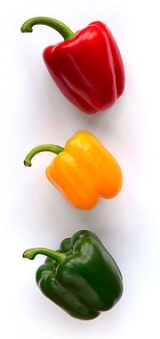
Bell pepper, also known as
sweet pepper or a
pepper (in the UK) and
capsicum (in Australia and New Zealand), is a
cultivar groupIn naming cultivated plants, a Group is a formal classification category, under the International Code of Nomenclature for Cultivated Plants :The term "Group" was introduced in the 2004 ICNCP, replacing the "Cultivar-group" of the 1995 ICNCP.A Group is united by some common trait; for example...
of the species
Capsicum annuumCapsicum annuum is a domesticated species of the plant genus Capsicum native to southern North America and northern South America. The three species C. annuum, C. frutescens and C. chinense all evolved from a single common ancestor located somewhere in the northwest Brazil - Colombia area...
(
chili pepperChili pepper is the fruit of plants from the genus Capsicum, members of the nightshade family, Solanaceae. The term in British English and in Australia, New Zealand, India, Malaysia and other Asian countries is just chilli without pepper.Chili peppers originated in the Americas...
). Cultivars of the
plantPlants are living organisms belonging to the kingdom Plantae. Precise definitions of the kingdom vary, but as the term is used here, plants include familiar organisms such as trees, flowers, herbs, bushes, grasses, vines, ferns, mosses, and green algae. The group is also called green plants or...
produce fruits in different colors, including red, yellow, orange and green. Bell peppers are sometimes grouped with less pungent pepper varieties as "sweet peppers". Peppers are native to
MexicoThe United Mexican States , commonly known as Mexico , is a federal constitutional republic in North America. It is bordered on the north by the United States; on the south and west by the Pacific Ocean; on the southeast by Guatemala, Belize, and the Caribbean Sea; and on the east by the Gulf of...
,
Central AmericaCentral America is the central geographic region of the Americas. It is the southernmost, isthmian portion of the North American continent, which connects with South America on the southeast. When considered part of the unified continental model, it is considered a subcontinent...
and northern
South AmericaSouth America is a continent situated in the Western Hemisphere, mostly in the Southern Hemisphere, with a relatively small portion in the Northern Hemisphere. The continent is also considered a subcontinent of the Americas. It is bordered on the west by the Pacific Ocean and on the north and east...
. Pepper seeds were later carried to
SpainSpain , officially the Kingdom of Spain languages]] under the European Charter for Regional or Minority Languages. In each of these, Spain's official name is as follows:;;;;;;), is a country and member state of the European Union located in southwestern Europe on the Iberian Peninsula...
in 1493 and from there spread to other
EuropeEurope is, by convention, one of the world's seven continents. Comprising the westernmost peninsula of Eurasia, Europe is generally 'divided' from Asia to its east by the watershed divides of the Ural and Caucasus Mountains, the Ural River, the Caspian and Black Seas, and the waterways connecting...
an,
AfricaAfrica is the world's second largest and second most populous continent, after Asia. At about 30.2 million km² including adjacent islands, it covers 6% of the Earth's total surface area and 20.4% of the total land area...
n and
AsiaAsia is the world's largest and most populous continent, located primarily in the eastern and northern hemispheres. It covers 8.7% of the Earth's total surface area and with approximately 3.879 billion people, it hosts 60% of the world's current human population...
n countries. Today,
ChinaChinese civilization may refer to:* China for more general discussion of the country.* Chinese culture* Greater China, the transnational community of ethnic Chinese.* History of China* Sinosphere, the area historically affected by Chinese culture...
is the world's largest pepper producer in the world, followed by
MexicoThe United Mexican States , commonly known as Mexico , is a federal constitutional republic in North America. It is bordered on the north by the United States; on the south and west by the Pacific Ocean; on the southeast by Guatemala, Belize, and the Caribbean Sea; and on the east by the Gulf of...
.
Nomenclature
The misleading name "pepper" (
pimiento in Spanish) was given by
Christopher ColumbusChristopher Columbus was an explorer, colonizer, and navigator, born in the Republic of Genoa, in northwestern Italy. Under the auspices of the Catholic Monarchs of Spain, he completed four voyages across the Atlantic Ocean that led to general European awareness of the American continents in the...
upon bringing the plant back to Europe. At that time
peppercornsBlack pepper is a flowering vine in the family Piperaceae, cultivated for its fruit, which is usually dried and used as a spice and seasoning. The fruit, known as a peppercorn when dried, is approximately in diameter, dark red when fully mature, and, like all drupes, contains a single seed...
, the fruit of
Piper nigrumBlack pepper is a flowering vine in the family Piperaceae, cultivated for its fruit, which is usually dried and used as a spice and seasoning. The fruit, known as a peppercorn when dried, is approximately in diameter, dark red when fully mature, and, like all drupes, contains a single seed...
, an unrelated plant originating from India, were a highly prized condiment; the name "pepper" was at that time applied in Europe to all known spices with a hot and pungent taste and so naturally extended to the newly discovered
CapsicumCapsicum is a genus of flowering plants in the nightshade family, Solanaceae. Its species are native to the Americas where they have been cultivated for thousands of years, but they are now also cultivated worldwide, used as spices, vegetables, and medicines - and have become are a key element in...
genus. The most commonly used alternative name of the plant family, "
chiliChili pepper is the fruit of plants from the genus Capsicum, members of the nightshade family, Solanaceae. The term in British English and in Australia, New Zealand, India, Malaysia and other Asian countries is just chilli without pepper.Chili peppers originated in the Americas...
", is of Central American origin. Bell peppers are botanically fruits, but are generally considered in culinary contexts to be vegetables.
While the bell pepper is a member of the
Capsicum genus, it is the only
Capsicum apart from Capsicum rhomboideum that does not produce
capsaicinCapsaicin 2CHCH=CH4CONHCH2C6H3-4--3- ) is the active component of chili peppers, which are plants belonging to the genus Capsicum. It is an irritant for mammals, including humans, and produces a sensation of burning in any tissue with which it comes into contact...
, a
lipophilicLipophilicity, , refers to the ability of a chemical compound to dissolve in fats, oils, lipids, and non-polar solvents such as hexane or toluene. These non-polar solvents are themselves lipophilic — the axiom that like dissolves like generally holds true...
chemical that can cause a strong burning sensation when it comes in contact with
mucous membraneThe mucous membranes are linings of mostly endodermal origin, covered in epithelium, which are involved in absorption and secretion. They line cavities that are exposed to the external environment and internal organs...
s. The lack of capsaicin in bell peppers is due to a recessive form of a gene that eliminates capsaicin and, consequently, the "hot" taste usually associated with the rest of the
Capsicum genus.
The terms "bell pepper", "pepper" or in Australia and New Zealand "capsicum", are often used for any of the large bell shaped fruits, regardless of their color. In
British EnglishBritish English, or English , is the broad term used to distinguish the forms of the English language used in the United Kingdom from forms used elsewhere...
, the fruit is simply referred to as a "pepper", or additionally by colour (as in the term "green pepper", for example), whereas in many
Commonwealth of NationsThe Commonwealth of Nations, normally referred to as the Commonwealth and formerly known as the British Commonwealth, is an intergovernmental organisation of fifty-four independent member states...
countries, such as
IndiaIndia , officially the Republic of India , is a country in South Asia. It is the seventh-largest country by geographical area, the second-most populous country with over 1.2 billion people, and the most populous democracy in the world...
and
Malaysia, they are called "bell peppers". Across Europe, the term "paprika", which has its roots in the word for pepper, is used—sometimes referred to by their color (e.g., "groene paprika", "gele paprika", in Dutch, which are green and yellow, respectively).
PaprikaPaprika is a spice made from the grinding of dried fruits of Capsicum annuum . In many European languages, the word paprika refers to bell peppers themselves. The seasoning is used in many cuisines to add color and flavor to dishes. Paprika can range from mild to hot...
also refers to the powdered spice made from the fruits in the
Capsicum genus. In
FranceThe French Republic , The French Republic , The French Republic , (commonly known as France , is a unitary semi-presidential republic in Western Europe with several overseas territories and islands located on other continents and in the Indian, Pacific, and Atlantic oceans. Metropolitan France...
, it is called "poivron", with the same root as "poivre" (meaning "
pepperPiper, the pepper plants or pepper vines , are an economically and ecologically important genus in the family Piperaceae...
"), or "piment". In Korea, the word 피망 ("piman" from the French) refers to green bell peppers, whereas 파프리카 ("papurika" from paprika) refers to bell peppers of other colors.
Varieties
The color can be green, red, yellow, orange and more rarely, white, rainbow (between stages of ripening) and purple, depending on when they are harvested and the specific
cultivarA cultivar'Cultivar has two meanings as explained under Formal definition. When used in reference to a taxon, the word does not apply to an individual plant but to all those plants sharing the unique characteristics that define the cultivar. is a plant or group of plants selected for desirable...
. Green peppers are less sweet and slightly more bitter than yellow or orange peppers, with red bell peppers being the sweetest. The taste of ripe peppers can also vary with growing conditions and post-harvest storage treatment; the sweetest are fruit allowed to ripen fully on the plant in full sunshine, while fruit harvested green and after-ripened in storage are less sweet.
Nutritional value
Compared to green peppers, red peppers have more vitamins and nutrients and contain the
antioxidantAn antioxidant is a molecule capable of inhibiting the oxidation of other molecules. Oxidation is a chemical reaction that transfers electrons or hydrogen from a substance to an oxidizing agent. Oxidation reactions can produce free radicals. In turn, these radicals can start chain reactions. When...
lycopeneLycopene is a bright red carotene and carotenoid pigment and phytochemical found in tomatoes and other red fruits and vegetables, such as red carrots, watermelons and papayas...
. The level of
caroteneThe term carotene is used for several related unsaturated hydrocarbon substances having the formula C40Hx, which are synthesized by plants but cannot be made by animals. Carotene is an orange photosynthetic pigment important for photosynthesis. Carotenes are all coloured to the human eye...
, like lycopene, is nine times higher in red peppers. Red peppers have twice the vitamin C content of green peppers. Also, one large red bell pepper contains 209 mg of vitamin C, which is almost three times the 70 mg of an average orange.
Production
colspan=5|Bell and Chile pepper production (tonneThe tonne, known as the metric ton in the US , often put pleonastically as "metric tonne" to avoid confusion with ton, is a metric system unit of mass equal to 1000 kilograms. The tonne is not an International System of Units unit, but is accepted for use with the SI...
s)
| Country |
2004 |
2005 |
2006 |
2007 |
Mainland China |
12,031,031 |
12,530,180 |
13,031,000 |
14,033,000 |
Mexico |
1,431,258 |
1,617,264 |
1,681,277 |
1,690,000 |
Indonesia |
1,100,514 |
1,058,023 |
1,100,000 |
1,100,000 |
Turkey |
1,700,000 |
1,829,000 |
1,842,175 |
1,090,921 |
Spain |
1,077,025 |
1,063,501 |
1,074,100 |
1,065,000 |
United States |
978,890 |
959,070 |
998,210 |
855,870 |
Nigeria |
720,000 |
721,000 |
721,500 |
723,000 |
Egypt |
467,433 |
460,000 |
470,000 |
475,000 |
South Korea |
410,281 |
395,293 |
352,966 |
345,000 |
Netherlands |
318,000 |
345,000 |
318,000 |
340,000 |
Kingdom of Romania |
237,240 |
203,751 |
279,126 |
280,000 |
Ghana |
270,000 |
270,000 |
277,000 |
279,000 |
Italy |
362,430 |
362,994 |
345,152 |
252,194 |
Tunisia |
255,000 |
256,000 |
256,000 |
250,000 |
Algeria |
265,307 |
248,614 |
275,888 |
233,000 |
Hungary |
126,133 |
113,371 |
206,419 |
207,000 |
Morocco |
182,340 |
190,480 |
235,570 |
192,000 |
Serbia* |
159,741 |
167,477 |
177,255 |
150,257 |
Japan |
153,400 |
154,000 |
146,900 |
150,000 |
Israel |
129,100 |
134,700 |
150,677 |
136,000 |
| |
24,587,124 |
25,261,259 |
26,252,907 |
26,056,900 |
- Note: Serbia before 2006 incl. Montenegro
See also
- List of capsicum cultivars
- Scoville scale
The Scoville scale is a measurement of the spicy heat of a chili pepper. The number of Scoville heat units indicates the amount of capsaicin present. Capsaicin is a chemical compound that stimulates chemoreceptor nerve endings in the skin, especially the mucous membranes.The scale is named after...
- Paprika
Paprika is a spice made from the grinding of dried fruits of Capsicum annuum . In many European languages, the word paprika refers to bell peppers themselves. The seasoning is used in many cuisines to add color and flavor to dishes. Paprika can range from mild to hot...
- Stuffed peppers
Stuffed peppers is a dish which exists in different names and forms around the world.- India :Stuffed Peppers is one of several stuffed vegetable dishes in Indian cuisine...