


Slow cooker

Encyclopedia
A slow cooker, also known as a Crock-Pot or Slo-Cooker (trademark
s that are often used generically
in the US and UK, respectively), is a countertop
electrical cooking appliance that is used for simmering
, which requires maintaining a relatively low temperature compared to other cooking methods (such as baking, boiling, and frying) for many hours, allowing unattended cooking of pot roast, stew
, and other suitable dishes.
bought Naxon in 1970 and reintroduced it under the Crock-Pot name in 1971. In 1974, Rival introduced removable stoneware inserts. The brand now belongs to Sunbeam Products
, a subsidiary of Jarden Corporation. Other brands of this appliance include Hamilton Beach
, West Bend Housewares
, GE
, Magic Chef
, and former American Electric Corporation
.
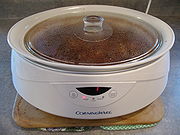 A basic slow cooker consists of a lidded round or oval cooking pot made of glazed
ceramic
or porcelain
, surrounded by a housing, usually metal, containing an electric heating element. The lid is often of glass
seated in a groove in the pot edge; condensed vapour collects in the groove and provides a low-pressure seal to the atmosphere. The contents of a crock pot are effectively at atmospheric pressure, despite the water vapor generated inside the pot. A crock pot is quite different from a pressure cooker and presents no danger of an abrupt pressure release.
The ceramic pot, or 'crock
', acts as both a cooking container and a heat reservoir
. Slow cookers come in capacities from 500 ml (16 oz) to 7 liters (7.4 US quarts). Due to the placement of heating elements (generally at the bottom and often also partway up the sides), there is usually a minimum recommended liquid level to avoid uncontrolled local heating.
Many slow cookers have two or more heat settings (e.g., low, medium, high, and sometimes a "keep warm" setting); some have continuously variable temperature. A typical slow cooker is designed to heat food to 77 °C (170 °F) on low, to perhaps 88-93 °C (190-200 °F) on high. Many recipes that include sauce or liquid will reach the boiling point around the edges, while food in the center remains gently cooked. This may be because slow cooker settings are based on wattage, not temperature.
The heating element heats the contents to a steady temperature in the 79–93 °C (175–200 °F) range. The contents are enclosed by the crock and the lid, and attain an essentially constant temperature. The vapor that is produced at this temperature condenses on the lid and returns as liquid. Some water-soluble vitamins are leached into the liquid.
The liquid transfers heat from the pot walls to its contents, and also distributes flavours. A lid is essential to prevent warm vapour from escaping, taking heat with it and cooling the contents.
Basic cookers, which have only high, medium, low, or keep warm settings, have to be manually turned on and off. Others have settings for high and low (e.g., four hours high, eight hours low) which allow the cook to choose a cooking time after which the cooker switches to "keep warm" mode. The most advanced cookers have computerised timing devices that allow the cooker to be programmed to perform multiple operations (e.g., two hours high, followed by two hours low, followed by warm), and to delay the start of cooking.
Because food stays warm for a long time after switching off, slow cookers can be used to cook food to be taken to be eaten elsewhere without reheating. Some cookers have ways of sealing the lid to prevent the contents from spilling during transport.
and lean muscle
fibre are suitable for stew
ing, and tastier than stews using expensive cuts, as long slow cooking will soften the connective tissue without toughening the muscle. Slow cooking leaves the gelatinised tissue in the meat, so that it may be advantageous to start with a richer liquid.
The low temperature of slow-cooking makes it impossible to burn food even if cooked too long; however, meat and vegetables will become nearly tasteless or "raggy" if overcooked.
Food can be set to slow-cook before leaving for the day, and will be ready on return. Some models include timers or thermostats which bring food to a given temperature, and then lower it. With a timerless cooker it is possible to use an external timer to stop cooking after a set time, or both to start and stop.
Cooking the meal in a single pot reduces washing up, and the low cooking temperature and glazed pot make cleaning easy.
s and other trace nutrients are lost, particularly from vegetables, partially by enzyme
action during cooking and partially due to heat degradation/evaporation. When vegetables are cooked at higher temperatures these enzymes are rapidly denatured
and have less time in which to act during cooking. Since slow cookers work at temperatures well below boiling point and do not rapidly denature enzymes, vegetables tend to lose trace nutrients. Blanched vegetables, having been exposed to very hot water, have already had these enzymes rendered largely ineffective, so a blanching or sauteing pre-cook stage will leave more vitamins intact. This is often a smaller nutrient loss than over-boiling and can be lessened to an extent by not removing the lid until the food is done.
Raw kidney beans, and to a lesser extent some other beans (such as broad/fava beans), contain the toxin
phytohaemagglutinin
, which is destroyed by boiling for at least ten minutes, but not by the lower temperatures of a slow cooker, so dry beans must be boiled prior to slow cooking to avoid poisoning. Even a few beans can be toxic, and beans can be as much as five times more toxic if cooked at 80 °C (175 °F) than if eaten raw, so adequate pre-boiling is vital. Cases of poisoning by slow-cooked beans have been published in the UK; poisoning has occurred in the USA but has not been formally reported. This risk can be avoided entirely by using canned cooked beans, adding them towards the end of the recipe's cooking time.
Slow cookers do not provide sufficient heat to compensate for loss of moisture and heat due to frequent removal of the lid, e.g., to add and remove food in perpetual stew
s, (pot au feu, olla podrida
). Added ingredients must be given time to cook before the food can be eaten. If food is allowed to cool below about 70 °C (158 °F) and not reheated, harmful bacterial growth is possible; some bacteria produce toxin
s or spores which are not destroyed even by reheating.
Trademark
A trademark, trade mark, or trade-mark is a distinctive sign or indicator used by an individual, business organization, or other legal entity to identify that the products or services to consumers with which the trademark appears originate from a unique source, and to distinguish its products or...
s that are often used generically
Genericized trademark
A genericized trademark is a trademark or brand name that has become the colloquial or generic description for, or synonymous with, a general class of product or service, rather than as an indicator of source or affiliation as intended by the trademark's holder...
in the US and UK, respectively), is a countertop
Countertop
Countertop usually refers to a horizontal worksurface in kitchens or other food preparation areas, bathrooms or lavatories, and workrooms in general. It is frequently installed upon and supported by cabinets...
electrical cooking appliance that is used for simmering
Simmering
Simmering is a food preparation technique in which foods are cooked in hot liquids kept at or just below the boiling point of water , but higher than poaching temperature...
, which requires maintaining a relatively low temperature compared to other cooking methods (such as baking, boiling, and frying) for many hours, allowing unattended cooking of pot roast, stew
Stew
A stew is a combination of solid food ingredients that have been cooked in liquid and served in the resultant gravy. Ingredients in a stew can include any combination of vegetables , meat, especially tougher meats suitable for slow-cooking, such as beef. Poultry, sausages, and seafood are also used...
, and other suitable dishes.
History
The Naxon Utilities Corporation of Chicago developed the Naxon Beanery All-Purpose Cooker. The Rival CompanyThe Rival Company
The Rival Company was an American manufacturer of small appliances that produced products under the Bionaire, Crock-Pot, Fasco, Patton, Pollenex, Rival, Simer, and White Mountain brands. They became a wholly owned subsidiary of Holmes Products Corp...
bought Naxon in 1970 and reintroduced it under the Crock-Pot name in 1971. In 1974, Rival introduced removable stoneware inserts. The brand now belongs to Sunbeam Products
Sunbeam Products
Sunbeam Products is an American brand that has produced electric home appliances since 1910. Their products have included the Mixmaster mixer, the Sunbeam CG waffle iron, Coffeemaster and the fully automatic T20 toaster. Sunbeam is owned by Jarden Consumer Solutions after Jarden's acquisition in...
, a subsidiary of Jarden Corporation. Other brands of this appliance include Hamilton Beach
Hamilton Beach Company
Hamilton Beach Brands, Inc. is a manufacturer of home appliances, air purifiers, and commercial restaurant equipment marketed primarily in the United States, Canada, and Mexico, including:* Blenders* Mixers* Toasters* Slow cookers* Irons* Air purifiers...
, West Bend Housewares
West Bend Housewares
West Bend Housewares, LLC, based in West Bend, Wisconsin, produces household appliances such as breadmakers, mixers, coffee urns, slow cookers and woks. The West Bend Company, founded in 1911, was owned by Regal Ware Inc. but the part sold to Vernon Hills, Illinois based Focus Products Group took...
, GE
General Electric
General Electric Company , or GE, is an American multinational conglomerate corporation incorporated in Schenectady, New York and headquartered in Fairfield, Connecticut, United States...
, Magic Chef
Magic Chef
Magic Chef, Inc. is an appliance brand owned by Whirlpool Corporation.In the 1850s, a immigrant to the United States John Ringen began a tinshop in St. Louis, Missouri. His business prospered and in 1870, he took in a partner, George August Kahle, who had immigrated to America in 1867...
, and former American Electric Corporation
American Electric Corporation
The American Electric Corporation was a company that manufactured various electronic appliances and devices such as food processors, hair dryers, mini deep fryers, and fluorescent light bulbs. The company was located at 9937 W. Jefferson Blvd in Culver City, California...
.
Design
Ceramic glaze
Glaze is a layer or coating of a vitreous substance which has been fired to fuse to a ceramic object to color, decorate, strengthen or waterproof it.-Use:...
ceramic
Ceramic
A ceramic is an inorganic, nonmetallic solid prepared by the action of heat and subsequent cooling. Ceramic materials may have a crystalline or partly crystalline structure, or may be amorphous...
or porcelain
Porcelain
Porcelain is a ceramic material made by heating raw materials, generally including clay in the form of kaolin, in a kiln to temperatures between and...
, surrounded by a housing, usually metal, containing an electric heating element. The lid is often of glass
Glass
Glass is an amorphous solid material. Glasses are typically brittle and optically transparent.The most familiar type of glass, used for centuries in windows and drinking vessels, is soda-lime glass, composed of about 75% silica plus Na2O, CaO, and several minor additives...
seated in a groove in the pot edge; condensed vapour collects in the groove and provides a low-pressure seal to the atmosphere. The contents of a crock pot are effectively at atmospheric pressure, despite the water vapor generated inside the pot. A crock pot is quite different from a pressure cooker and presents no danger of an abrupt pressure release.
The ceramic pot, or 'crock
Crock (dishware)
A crock is a pottery container sometimes used for food and water, synonymous with the word pot, and sometimes used for chemicals. Derivative terms include crockery and crock-pot.A gypsy's crock is a cooking pot.-External links:...
', acts as both a cooking container and a heat reservoir
Heat reservoir
In thermodynamics, a heat reservoir, thermal reservoir, or heat bath is a system whose heat capacity is so large that when it is in thermal contact with some other system of interest its temperature remains effectively constant. The heat bath is effectively an infinite reservoir of energy and...
. Slow cookers come in capacities from 500 ml (16 oz) to 7 liters (7.4 US quarts). Due to the placement of heating elements (generally at the bottom and often also partway up the sides), there is usually a minimum recommended liquid level to avoid uncontrolled local heating.
Many slow cookers have two or more heat settings (e.g., low, medium, high, and sometimes a "keep warm" setting); some have continuously variable temperature. A typical slow cooker is designed to heat food to 77 °C (170 °F) on low, to perhaps 88-93 °C (190-200 °F) on high. Many recipes that include sauce or liquid will reach the boiling point around the edges, while food in the center remains gently cooked. This may be because slow cooker settings are based on wattage, not temperature.
Operation
Raw food and a liquid (such as water, wine, or stock) are placed in the slow cooker. Some recipes call for pre-heated liquid. The cooker lid is put on and the cooker is switched on. Some cookers automatically switch from cooking to warming (maintaining the temperature at 71–74 °C [160–165 °F]) after a fixed time or after the internal temperature of the food, as determined by a probe, reaches a specified value.The heating element heats the contents to a steady temperature in the 79–93 °C (175–200 °F) range. The contents are enclosed by the crock and the lid, and attain an essentially constant temperature. The vapor that is produced at this temperature condenses on the lid and returns as liquid. Some water-soluble vitamins are leached into the liquid.
The liquid transfers heat from the pot walls to its contents, and also distributes flavours. A lid is essential to prevent warm vapour from escaping, taking heat with it and cooling the contents.
Basic cookers, which have only high, medium, low, or keep warm settings, have to be manually turned on and off. Others have settings for high and low (e.g., four hours high, eight hours low) which allow the cook to choose a cooking time after which the cooker switches to "keep warm" mode. The most advanced cookers have computerised timing devices that allow the cooker to be programmed to perform multiple operations (e.g., two hours high, followed by two hours low, followed by warm), and to delay the start of cooking.
Because food stays warm for a long time after switching off, slow cookers can be used to cook food to be taken to be eaten elsewhere without reheating. Some cookers have ways of sealing the lid to prevent the contents from spilling during transport.
Recipes
Recipes intended for other cooking methods must be modified for slow cookers. Quantities of liquids may have to be adjusted as there is little evaporation, but there should be enough liquid to cover the food. Many published recipes for slow cookers (aka crock-pots) are designed primarily for convenience and use few ingredients, often prepared sauces. The long, moist cooking is particularly suitable for tough and cheap cuts of meat—for many slow-cooked dishes these cuts give better results than more expensive ones.Advantages
Cheaper cuts of meat with connective tissueConnective tissue
"Connective tissue" is a fibrous tissue. It is one of the four traditional classes of tissues . Connective Tissue is found throughout the body.In fact the whole framework of the skeleton and the different specialized connective tissues from the crown of the head to the toes determine the form of...
and lean muscle
Muscle
Muscle is a contractile tissue of animals and is derived from the mesodermal layer of embryonic germ cells. Muscle cells contain contractile filaments that move past each other and change the size of the cell. They are classified as skeletal, cardiac, or smooth muscles. Their function is to...
fibre are suitable for stew
Stew
A stew is a combination of solid food ingredients that have been cooked in liquid and served in the resultant gravy. Ingredients in a stew can include any combination of vegetables , meat, especially tougher meats suitable for slow-cooking, such as beef. Poultry, sausages, and seafood are also used...
ing, and tastier than stews using expensive cuts, as long slow cooking will soften the connective tissue without toughening the muscle. Slow cooking leaves the gelatinised tissue in the meat, so that it may be advantageous to start with a richer liquid.
The low temperature of slow-cooking makes it impossible to burn food even if cooked too long; however, meat and vegetables will become nearly tasteless or "raggy" if overcooked.
Food can be set to slow-cook before leaving for the day, and will be ready on return. Some models include timers or thermostats which bring food to a given temperature, and then lower it. With a timerless cooker it is possible to use an external timer to stop cooking after a set time, or both to start and stop.
Cooking the meal in a single pot reduces washing up, and the low cooking temperature and glazed pot make cleaning easy.
Disadvantages
Some vitaminVitamin
A vitamin is an organic compound required as a nutrient in tiny amounts by an organism. In other words, an organic chemical compound is called a vitamin when it cannot be synthesized in sufficient quantities by an organism, and must be obtained from the diet. Thus, the term is conditional both on...
s and other trace nutrients are lost, particularly from vegetables, partially by enzyme
Enzyme
Enzymes are proteins that catalyze chemical reactions. In enzymatic reactions, the molecules at the beginning of the process, called substrates, are converted into different molecules, called products. Almost all chemical reactions in a biological cell need enzymes in order to occur at rates...
action during cooking and partially due to heat degradation/evaporation. When vegetables are cooked at higher temperatures these enzymes are rapidly denatured
Denaturation (biochemistry)
Denaturation is a process in which proteins or nucleic acids lose their tertiary structure and secondary structure by application of some external stress or compound, such as a strong acid or base, a concentrated inorganic salt, an organic solvent , or heat...
and have less time in which to act during cooking. Since slow cookers work at temperatures well below boiling point and do not rapidly denature enzymes, vegetables tend to lose trace nutrients. Blanched vegetables, having been exposed to very hot water, have already had these enzymes rendered largely ineffective, so a blanching or sauteing pre-cook stage will leave more vitamins intact. This is often a smaller nutrient loss than over-boiling and can be lessened to an extent by not removing the lid until the food is done.
Raw kidney beans, and to a lesser extent some other beans (such as broad/fava beans), contain the toxin
Toxin
A toxin is a poisonous substance produced within living cells or organisms; man-made substances created by artificial processes are thus excluded...
phytohaemagglutinin
Phytohaemagglutinin
Phytohaemagglutinin is a lectin found in plants, especially legumes. PHA actually consists of two closely related proteins, called leucoagglutinin and PHA-E. The letters E and L indicate these proteins agglutinate Erythrocytes and Leukocytes...
, which is destroyed by boiling for at least ten minutes, but not by the lower temperatures of a slow cooker, so dry beans must be boiled prior to slow cooking to avoid poisoning. Even a few beans can be toxic, and beans can be as much as five times more toxic if cooked at 80 °C (175 °F) than if eaten raw, so adequate pre-boiling is vital. Cases of poisoning by slow-cooked beans have been published in the UK; poisoning has occurred in the USA but has not been formally reported. This risk can be avoided entirely by using canned cooked beans, adding them towards the end of the recipe's cooking time.
Slow cookers do not provide sufficient heat to compensate for loss of moisture and heat due to frequent removal of the lid, e.g., to add and remove food in perpetual stew
Perpetual stew
A perpetual stew is a pot into which whatever one can find is placed and cooked. The pot is never emptied all the way, as ingredients are replenished as necessary. The concept is often a common element in descriptions of medieval inns. Perpetual stew can also be called a “hunter’s stew”.- Examples...
s, (pot au feu, olla podrida
Olla podrida
Olla podrida is a Spanish stew made from pork and beans and an inconsistent, wide variety of other meats and vegetables, often including chickpeas, depending on the recipe used. The meal is traditionally prepared in a clay pot over several hours...
). Added ingredients must be given time to cook before the food can be eaten. If food is allowed to cool below about 70 °C (158 °F) and not reheated, harmful bacterial growth is possible; some bacteria produce toxin
Toxin
A toxin is a poisonous substance produced within living cells or organisms; man-made substances created by artificial processes are thus excluded...
s or spores which are not destroyed even by reheating.
Hazards
Slow cookers are less dangerous than ovens or stove tops due to the lower temperatures and closed lids. However, they still contain a large amount of near boiling temperature food and liquid and can cause serious burns if spilled. Children may be at risk due to the high temperatures.See also
- Carry over cookingCarry over cookingCarry over cooking refers to the phenomenon that food retains heat and continues to cook even after being removed from the source of heat. The larger and denser the object being heated the greater the amount of carry over cooking. After being removed from the heat source the internal temperature...
- CholentCholentCholent or Hamin is a traditional Jewish stew. It is usually simmered overnight for 12 hours or more, and eaten for lunch on Shabbat . Cholent was developed over the centuries to conform with Jewish religious laws that prohibit cooking on the Sabbath...
- HayboxHayboxA hay box, straw box or fireless cooker is a cooker that utilizes the heat of the food being cooked to complete the cooking process. Food items to be cooked are heated to boiling point, and then insulated. Over a period of time, the food items cook by the heat captured in the insulated container...
- Low temperature cookingLow temperature cookingLow-temperature cooking is a cooking technique, a variant of roasting, which is claimed to produce more tender and tasty results than traditional high-temperature roasting. In low-temperature cooking, the food to be cooked is cooked for a long period of time at a low temperature...
- Sous-videSous-videSous-vide is a method of cooking food sealed in airtight plastic bags in a water bath for a long time—72 hours is not unusual—at an accurately determined temperature much lower than normally used for cooking, typically around...
- Vacuum flask cookingVacuum flask cookingVacuum flask cooking was introduced to the Asian market in the mid-1990s. The vacuum cooker , often called a thermal cooker in English, is a stainless steel vacuum flask. The flasks come in various sizes ranging from in diameter and tall. A removable pot, with handle and lid, fits inside the...